
Chapter 5 Bone Formation and Remodeling Pages 141
Chapter 5 Bone Formation and Remodeling Pages 141 -145
Ossification Animation This animation shows the development of the skeleton from conception through adulthood � http: //www. pennmedicine. org/encyclopedia/ em_Display. Animation. aspx? gcid=000112&pti d=17
Ossification (Bone Formation) and Growth There are two major phases of ossification in long bones 1. Osteoblasts (builder cells) �osteoblasts multiply (through mitosis) �cartilage calcifies- it is replaced with bone by the osteoblasts 2. Cartilage inside the diaphysis is digested away � This opens up the medullary cavity © 2015 Pearson Education, Inc.

Bone Formation and Growth � By birth, most cartilage is converted to bone except: 1. Articular cartilages (the epiphyseal surfaces) 2. Epiphyseal plates � New cartilage is continuously formed by chondrocytes © 2015 Pearson Education, Inc.

Bone Formation and Growth � Bones grow in two ways: ◦ length (longitudinal) ◦ width (appositional) �Growth in diameter � Controlled by growth hormones � Epiphyseal plates are converted from cartilage to bone during adolescence ◦ Fused by the age of 18 (W), 21 (M) © 2015 Pearson Education, Inc.
Bone Remodeling � Bones are lengthened until growth stops � Bones are remodeled throughout life (every 7 -10 years) in response to two factors: 1. Blood calcium levels 2. Pull of gravity and muscles on the skeleton © 2015 Pearson Education, Inc.
Bone Remodeling � Parathyroid hormone (PTH) ◦ Released when blood calcium levels are low ◦ Activates osteoclasts (bone-destroying cells) �Osteoclasts break down bone and release calcium ions into the blood � Hypercalcemia (high blood calcium levels) prompts calcium storage to bones ◦ Regulated by calcitonin (secreted by thyroid) © 2015 Pearson Education, Inc.
Bone Growth Animation Showing appositional growth � http: //highered. mheducation. com/sites/007 2495855/student_view 0/chapter 6/animation __bone_growth_in_width. html
Bone Fractures � Fracture: break in a bone � Types of fractures © 2015 Pearson Education, Inc.
Bone Fractures- a break in a bone � Bone fractures are treated by reduction and immobilization ◦ Closed reduction: bones are manually coaxed into position by physician’s hands ◦ Open reduction: bones are secured with pins, screws, or wires during surgery © 2015 Pearson Education, Inc.
Steps of Fracture Repair 1. 2. 3. Hematoma (blood-filled swelling) is formed Fibrocartilage callus forms 1. A soft mixture of cartilage matrix, bony matrix, and collagen fibers splint the broken bone Bony callus (hard) replaces the fibrocartilage callus 1. Osteoblasts and osteoclasts migrate in 4. Bone remodeling- compact bone replaces cartilage © 2015 Pearson Education, Inc.
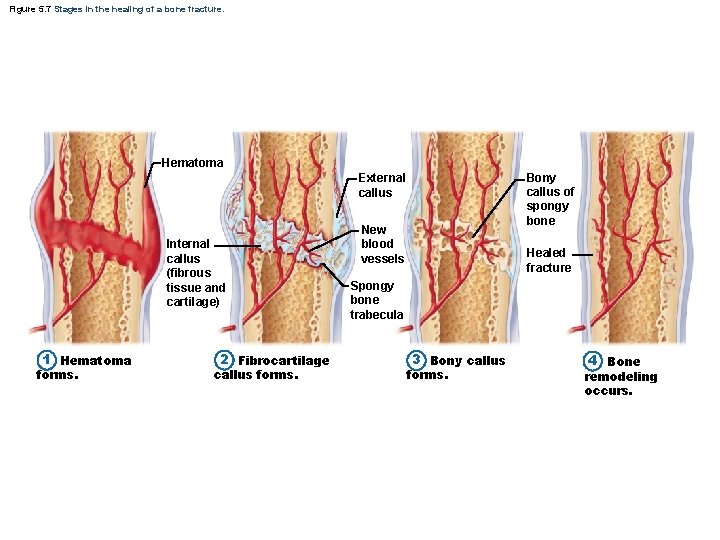
Figure 5. 7 Stages in the healing of a bone fracture. Hematoma Bony callus of spongy bone External callus Internal callus (fibrous tissue and cartilage) 1 Hematoma forms. 2 Fibrocartilage callus forms. New blood vessels Healed fracture Spongy bone trabecula 3 Bony callus forms. 4 Bone remodeling occurs.
Common Types of Fractures • Closed (simple) fracture: break that does not penetrate the skin • Open (compound) fracture: broken bone penetrates through the skin • Comminuted: bone breaks into many fragments • Compression: bone is crushed • Depressed: broken bone portion is pressed inward • Impacted: broken bone ends are forced into each other • Spiral: ragged break occurs when excessive twisting forces are applied to a bone • Greenstick: bone breaks incompletely (common in children) © 2015 Pearson Education, Inc.
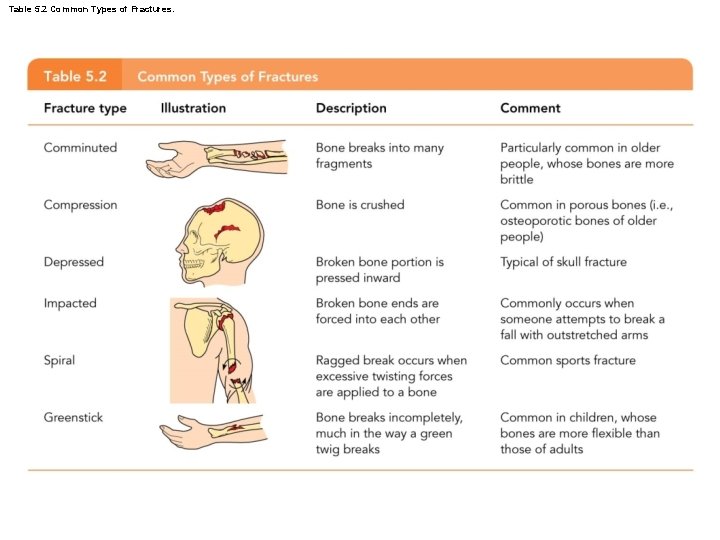
Table 5. 2 Common Types of Fractures.
- Slides: 14