
CHAPTER 5 BIPOLAR TRANSISTORS RELATED DEVICES Assignment 10
CHAPTER 5: BIPOLAR TRANSISTORS & RELATED DEVICES

Assignment (10 marks) ¡ Mobility is an important feature for determining drift current. Explain how the mean free path and mean free time play their parts in mobility. And, explain the scattering mechanisms occurred in S/C, so that you understand the differences between those mechanisms. (2 -3 pages A 4 size, single spacing, 2 weeks)

INTRODUCTION ¡ ¡ ¡ The bipolar junction transistor (BJT) is a semiconductor device constructed with three doped regions The most common use of the BJT is in linear amplifier circuits (linear means that the output is proportional to input). It can also be used as a switch (in, for example, logic circuits). What’s meaning by BJT? What’s the difference between PNP & NPN transistor? Transistor Mode Operation and Characteristic I-V curves l The current gain l The cutoff frequency and switching time of a bipolar transistor l The advantages of heterojunction bipolar transistor l The power handling capability of thyristor and related bipolar devices

The Bipolar Junction Transistor The term Bipolar is because two type of charges (electrons and holes) are involved in the flow of electricity ¡ The term Junction is because there are two p-n junctions ¡ There are two configurations for this device ¡
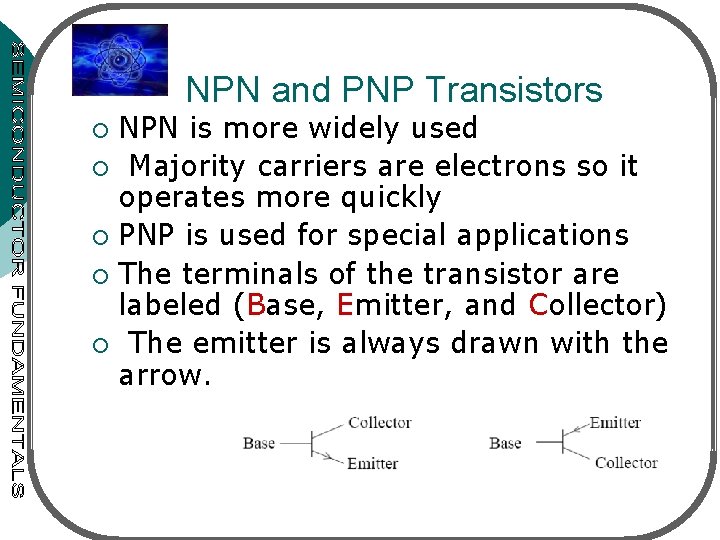
NPN and PNP Transistors NPN is more widely used ¡ Majority carriers are electrons so it operates more quickly ¡ PNP is used for special applications ¡ The terminals of the transistor are labeled (Base, Emitter, and Collector) ¡ The emitter is always drawn with the arrow. ¡

Figure 5 -1. Perspective view of a silicon p-n-p bipolar transistor.
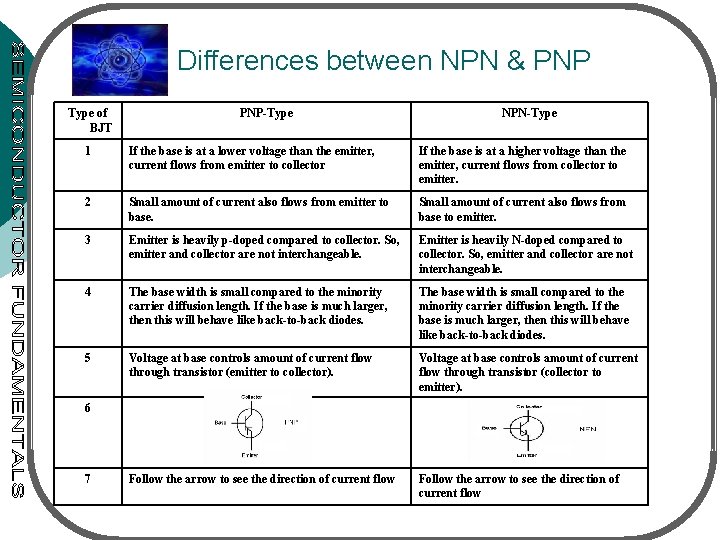
Differences between NPN & PNP Type of BJT PNP-Type NPN-Type 1 If the base is at a lower voltage than the emitter, current flows from emitter to collector If the base is at a higher voltage than the emitter, current flows from collector to emitter. 2 Small amount of current also flows from emitter to base. Small amount of current also flows from base to emitter. 3 Emitter is heavily p-doped compared to collector. So, emitter and collector are not interchangeable. Emitter is heavily N-doped compared to collector. So, emitter and collector are not interchangeable. 4 The base width is small compared to the minority carrier diffusion length. If the base is much larger, then this will behave like back-to-back diodes. 5 Voltage at base controls amount of current flow through transistor (emitter to collector). Voltage at base controls amount of current flow through transistor (collector to emitter). Follow the arrow to see the direction of current flow 6 7

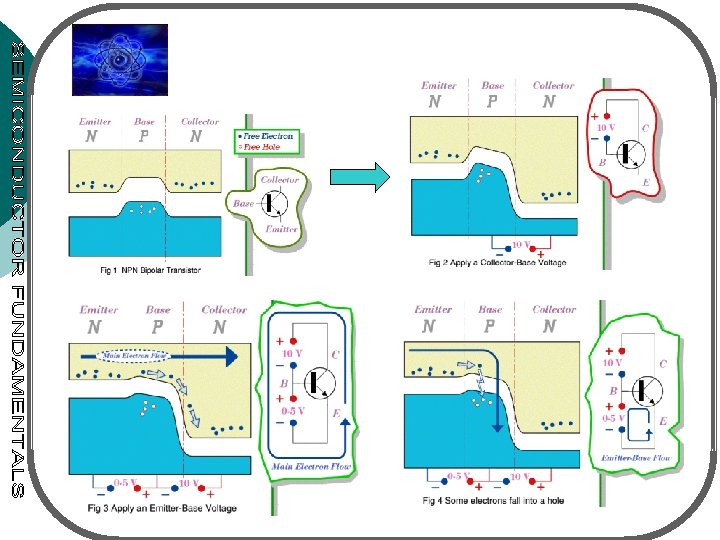
Operation of NPN Transistor • In normal operation, the EB junction is forward biased and the BC junction is reverse biased • The base region is very thin so the ratio L 1: L 2 is typically about 150: 1 Figure 5 -2. (a) Idealized one-dimensional schematic of a p-n-p bipolar transistor and (b) its circuit symbol. (c) Idealized onedimensional schematic of an n-p-n bipolar transistor and (d) its circuit symbol.
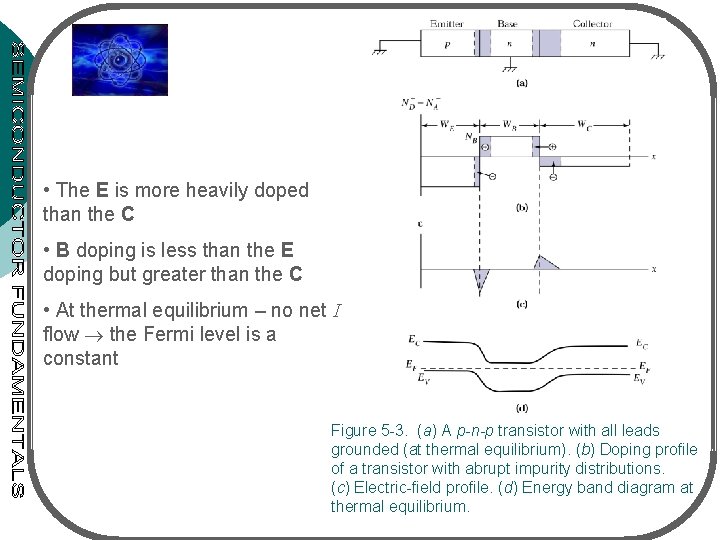
• The E is more heavily doped than the C • B doping is less than the E doping but greater than the C • At thermal equilibrium – no net I flow the Fermi level is a constant Figure 5 -3. (a) A p-n-p transistor with all leads grounded (at thermal equilibrium). (b) Doping profile of a transistor with abrupt impurity distributions. (c) Electric-field profile. (d) Energy band diagram at thermal equilibrium.
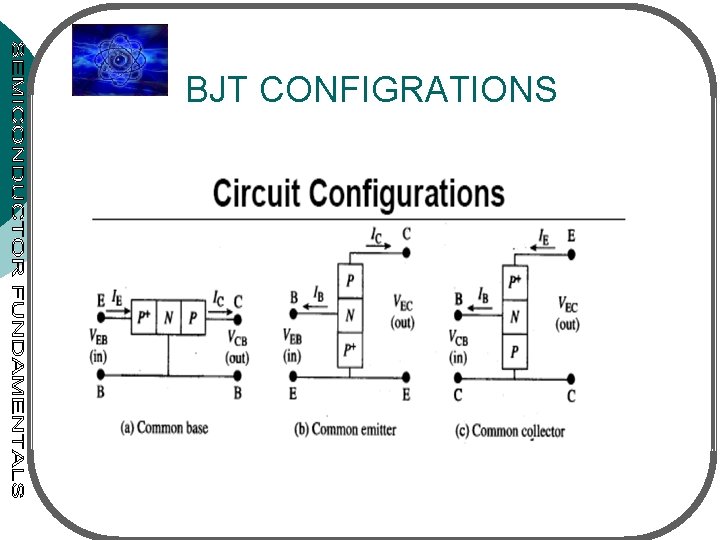
BJT CONFIGRATIONS
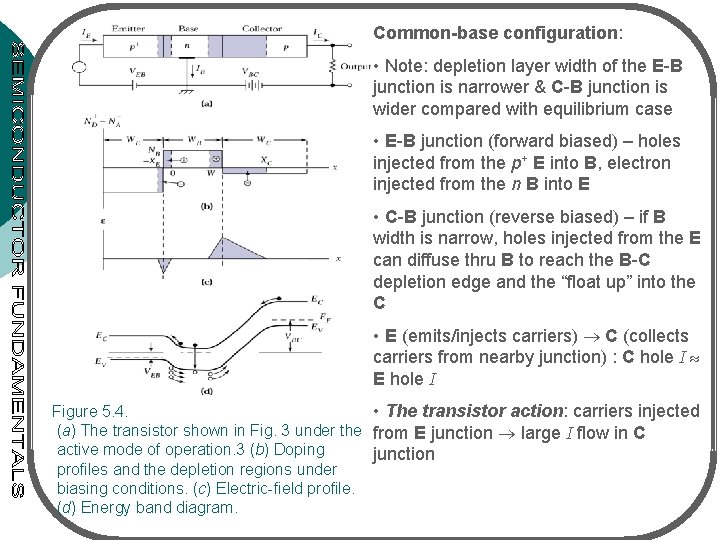
Common-base configuration: • Note: depletion layer width of the E-B junction is narrower & C-B junction is wider compared with equilibrium case • E-B junction (forward biased) – holes injected from the p+ E into B, electron injected from the n B into E • C-B junction (reverse biased) – if B width is narrow, holes injected from the E can diffuse thru B to reach the B-C depletion edge and the “float up” into the C • E (emits/injects carriers) C (collects carriers from nearby junction) : C hole I E hole I Figure 5. 4. • The transistor action: carriers injected (a) The transistor shown in Fig. 3 under the from E junction large I flow in C active mode of operation. 3 (b) Doping junction profiles and the depletion regions under biasing conditions. (c) Electric-field profile. (d) Energy band diagram.
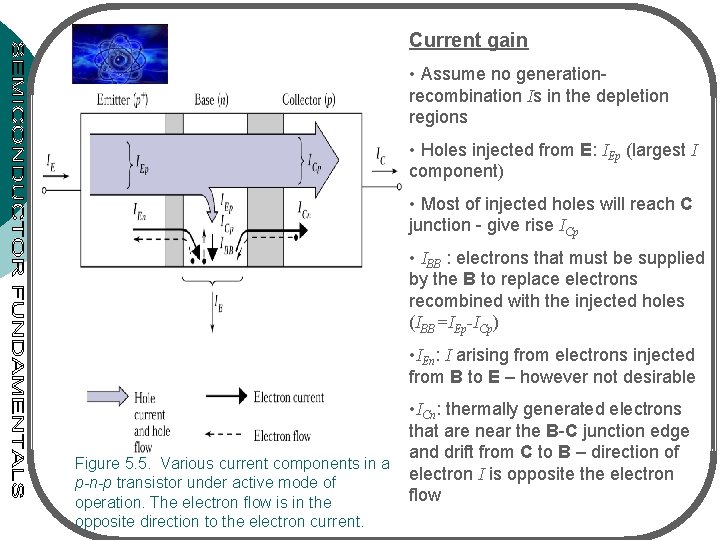
Current gain • Assume no generationrecombination Is in the depletion regions • Holes injected from E: IEp (largest I component) • Most of injected holes will reach C junction - give rise ICp • IBB : electrons that must be supplied by the B to replace electrons recombined with the injected holes (IBB=IEp-ICp) • IEn: I arising from electrons injected from B to E – however not desirable • ICn: thermally generated electrons that are near the B-C junction edge and drift from C to B – direction of Figure 5. 5. Various current components in a electron I is opposite the electron p-n-p transistor under active mode of flow operation. The electron flow is in the opposite direction to the electron current.
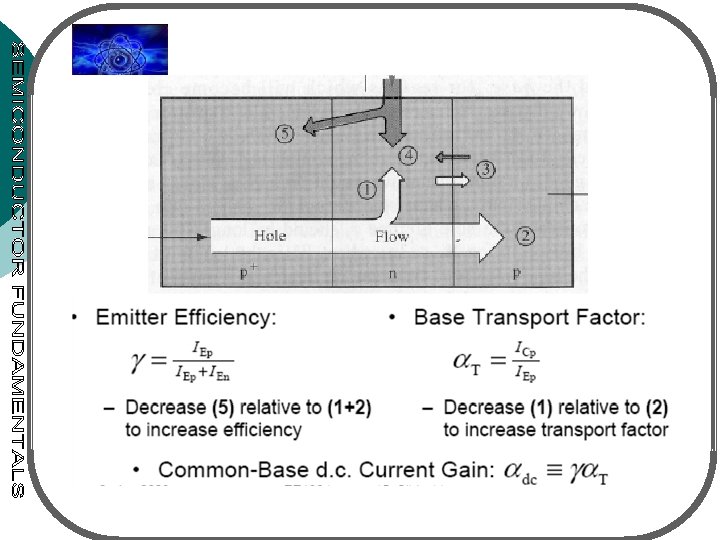
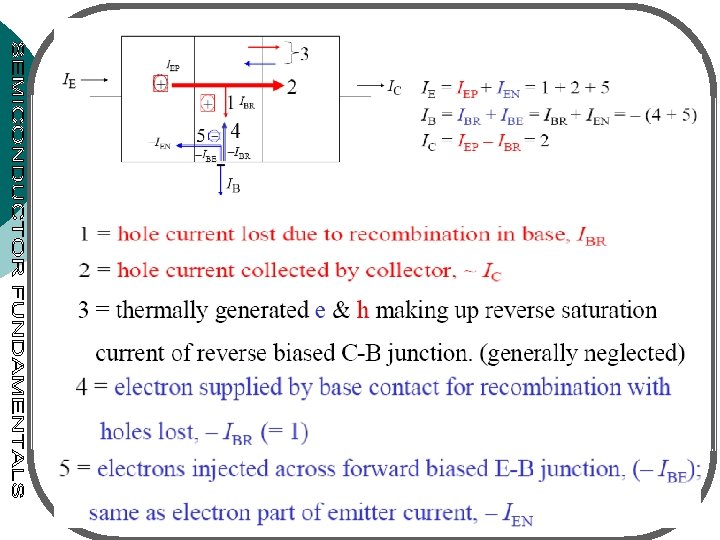

Common-base current gain Emitter efficiency Base transport factor Collector current ICBO : the leakage current between the C and B with the E-B junction open

Carrier Distribution ¡ To derive the I-V for an ideal transistor, assume: l l l ¡ The device has uniform doping in each region The hole drift current in the base region as well as the C saturation current is negligible There is low-level injection There are no generation-recombination currents in the depletion regions There are no series resistance Holes from E to B to C : Once the minoritycarrier distribution is determined (holes in the n -type B) can obtain I from the minoritycarrier gradient
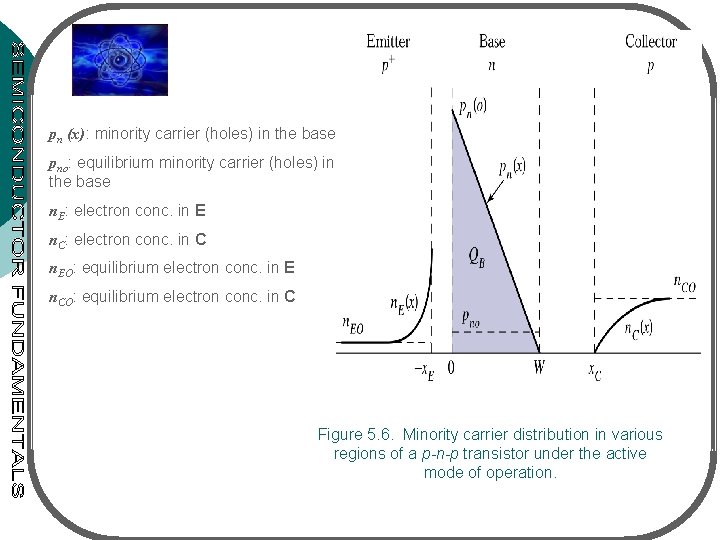
pn (x): minority carrier (holes) in the base pno: equilibrium minority carrier (holes) in the base n. E: electron conc. in E n. C: electron conc. in C n. EO: equilibrium electron conc. in E n. CO: equilibrium electron conc. in C Figure 5. 6. Minority carrier distribution in various regions of a p-n-p transistor under the active mode of operation.
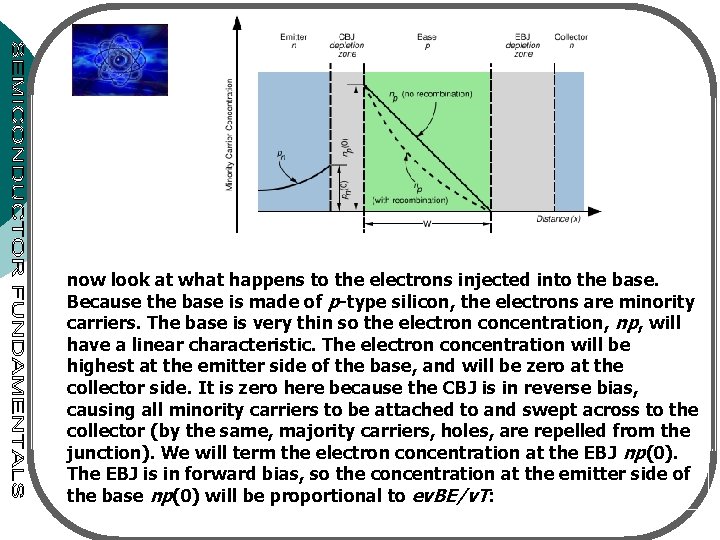
now look at what happens to the electrons injected into the base. Because the base is made of p-type silicon, the electrons are minority carriers. The base is very thin so the electron concentration, np, will have a linear characteristic. The electron concentration will be highest at the emitter side of the base, and will be zero at the collector side. It is zero here because the CBJ is in reverse bias, causing all minority carriers to be attached to and swept across to the collector (by the same, majority carriers, holes, are repelled from the junction). We will term the electron concentration at the EBJ np(0). The EBJ is in forward bias, so the concentration at the emitter side of the base np(0) will be proportional to ev. BE/v. T:
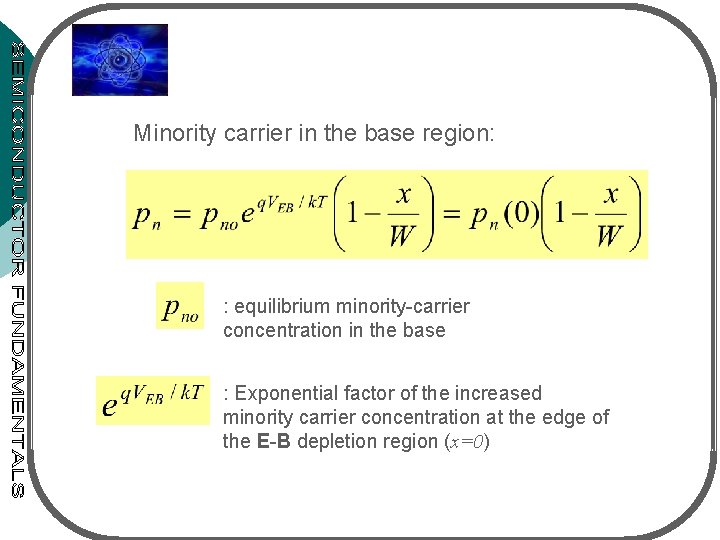
Minority carrier in the base region: : equilibrium minority-carrier concentration in the base : Exponential factor of the increased minority carrier concentration at the edge of the E-B depletion region (x=0)
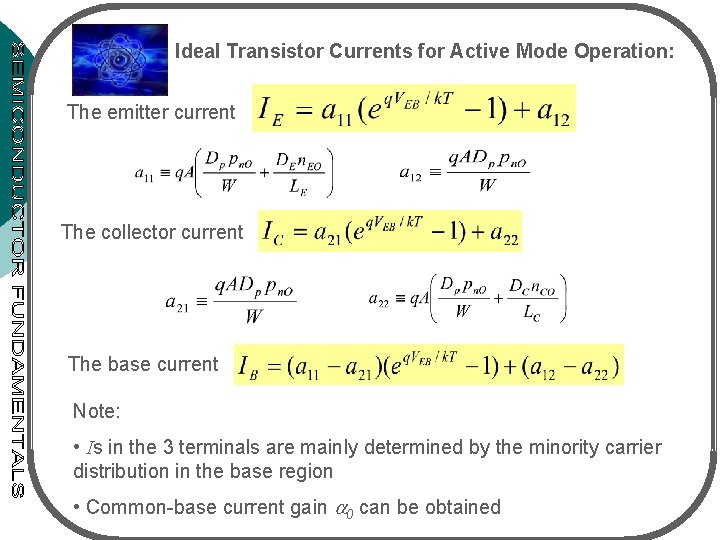
Ideal Transistor Currents for Active Mode Operation: The emitter current The collector current The base current Note: • Is in the 3 terminals are mainly determined by the minority carrier distribution in the base region • Common-base current gain 0 can be obtained
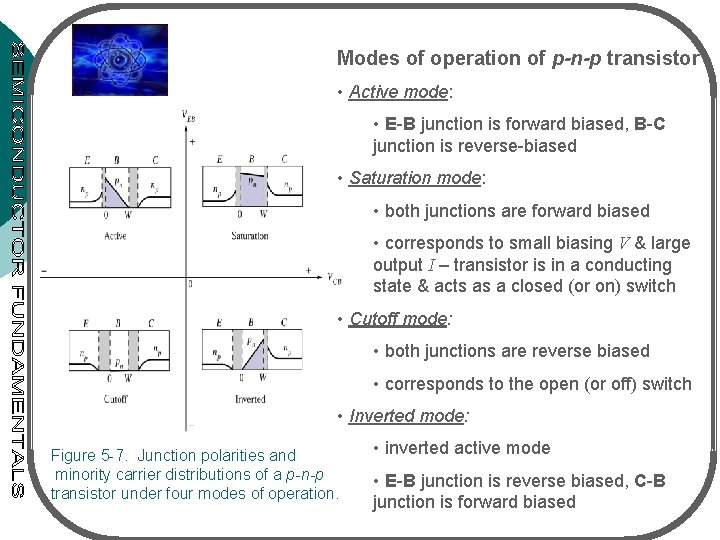
Modes of operation of p-n-p transistor • Active mode: • E-B junction is forward biased, B-C junction is reverse-biased • Saturation mode: • both junctions are forward biased • corresponds to small biasing V & large output I – transistor is in a conducting state & acts as a closed (or on) switch • Cutoff mode: • both junctions are reverse biased • corresponds to the open (or off) switch • Inverted mode: Figure 5 -7. Junction polarities and minority carrier distributions of a p-n-p transistor under four modes of operation. • inverted active mode • E-B junction is reverse biased, C-B junction is forward biased
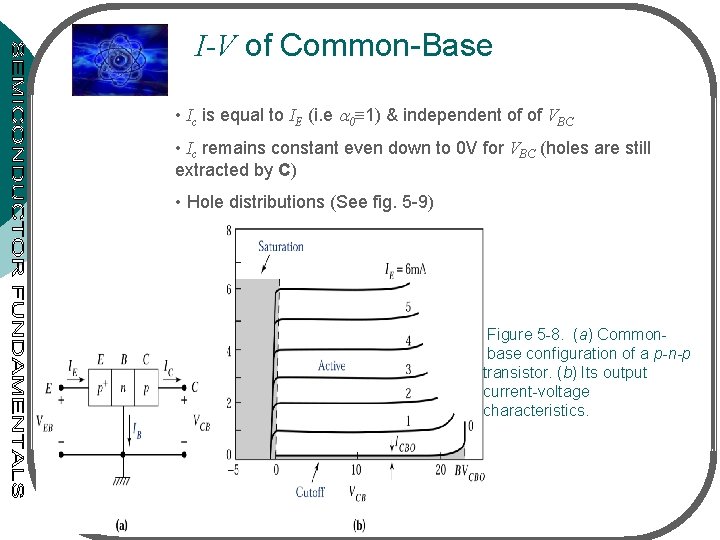
I-V of Common-Base • Ic is equal to IE (i. e 0 1) & independent of of VBC • Ic remains constant even down to 0 V for VBC (holes are still extracted by C) • Hole distributions (See fig. 5 -9) Figure 5 -8. (a) Commonbase configuration of a p-n-p transistor. (b) Its output current-voltage characteristics.
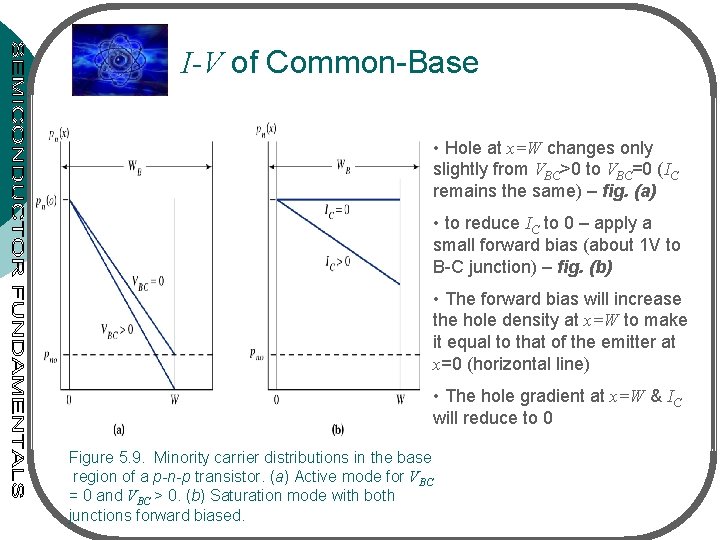
I-V of Common-Base • Hole at x=W changes only slightly from VBC>0 to VBC=0 (IC remains the same) – fig. (a) • to reduce IC to 0 – apply a small forward bias (about 1 V to B-C junction) – fig. (b) • The forward bias will increase the hole density at x=W to make it equal to that of the emitter at x=0 (horizontal line) • The hole gradient at x=W & IC will reduce to 0 Figure 5. 9. Minority carrier distributions in the base region of a p-n-p transistor. (a) Active mode for VBC = 0 and VBC > 0. (b) Saturation mode with both junctions forward biased.

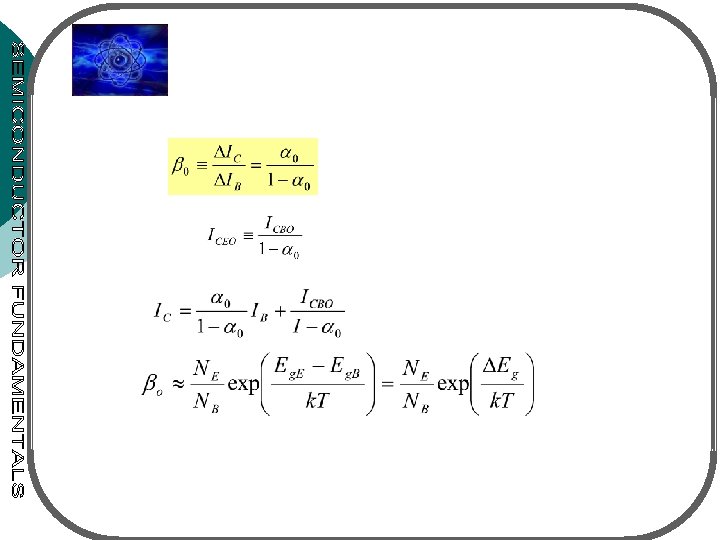
I-V of Common-emitter current gain: C-E leakage current: Figure 5. 10. (a) Common-emitter config. of a p-n-p transistor. (b) Its output I-V characteristics. Common-base current gain

Heterojunction bipolar transistor ¡ ¡ ¡ The heterojunction bipolar transistor (HBT) is an improvement of the BJT that can handle signals of very high frequencies up to several hundred GHz. It is using mostly RF systems. Heterojunction transistors have different semiconductors for the elements of the transistor. Usually the emitter is composed of a larger bandgap material than the base. This helps reduce minority carrier injection from the base when the emitter-base junction is under forward bias and increases emitter injection efficiency. The improved injection of carriers into the base allows the base to have a higher doping level, resulting in lower resistance to access the base electrode. Two commonly used HBTs are silicon–germanium and aluminum gallium arsenide, though a wide variety of semiconductors may be used for the HBT structures are usually grown by epitaxy techniques like MOCVD and MBE.

The Heterojunction Bipolar Transistor • Emitter – wide band gap (Al. Ga. As) • Base – lower band gap (Ga. As) • Large band gap difference (between E-B) common-emitter current gain can be extremely large • Homojunction: no band gap difference – doping concentration in the E & B must be very high • EV increases the valence-band barrier height reduce injection of holes from B to E Figure 5 -17. (a) Schematic cross section of an n-p-n heterojunction bipolar transistor (HBT) structure. (b) Energy band diagram of a HBT operated under active mode. • can use heavily doped base, maintain a high E efficiency & current gain
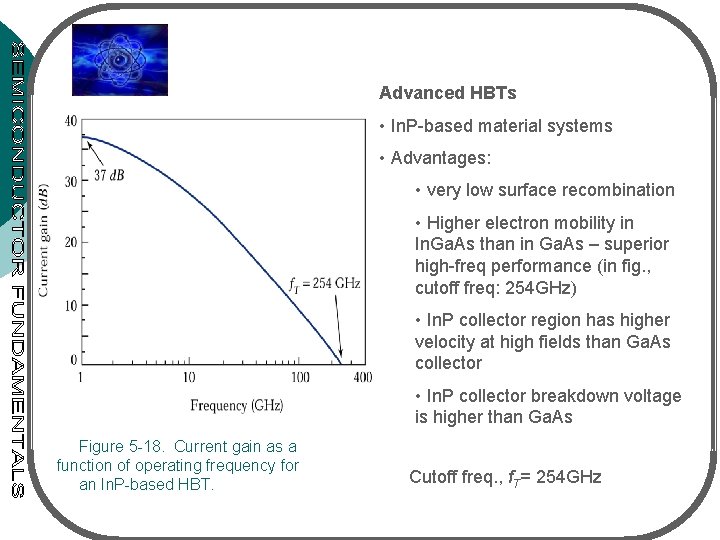
Advanced HBTs • In. P-based material systems • Advantages: • very low surface recombination • Higher electron mobility in In. Ga. As than in Ga. As – superior high-freq performance (in fig. , cutoff freq: 254 GHz) • In. P collector region has higher velocity at high fields than Ga. As collector • In. P collector breakdown voltage is higher than Ga. As Figure 5 -18. Current gain as a function of operating frequency for an In. P-based HBT. Cutoff freq. , f. T= 254 GHz
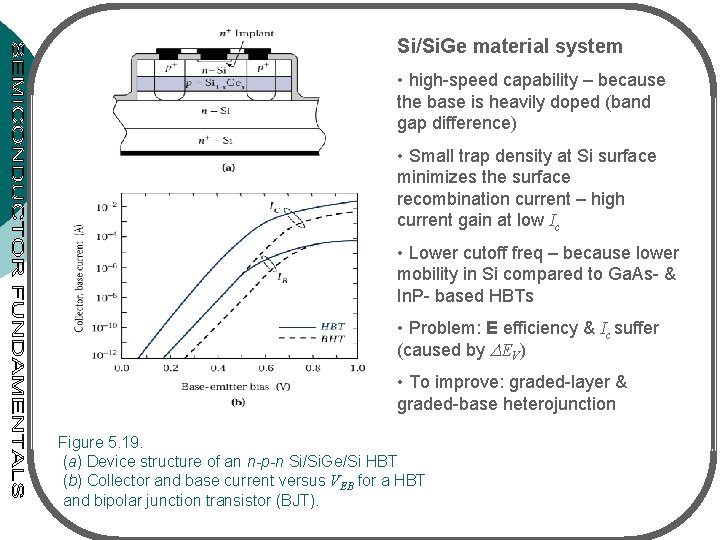
Si/Si. Ge material system • high-speed capability – because the base is heavily doped (band gap difference) • Small trap density at Si surface minimizes the surface recombination current – high current gain at low Ic • Lower cutoff freq – because lower mobility in Si compared to Ga. As- & In. P- based HBTs • Problem: E efficiency & Ic suffer (caused by EV) • To improve: graded-layer & graded-base heterojunction Figure 5. 19. (a) Device structure of an n-p-n Si/Si. Ge/Si HBT (b) Collector and base current versus VEB for a HBT and bipolar junction transistor (BJT).
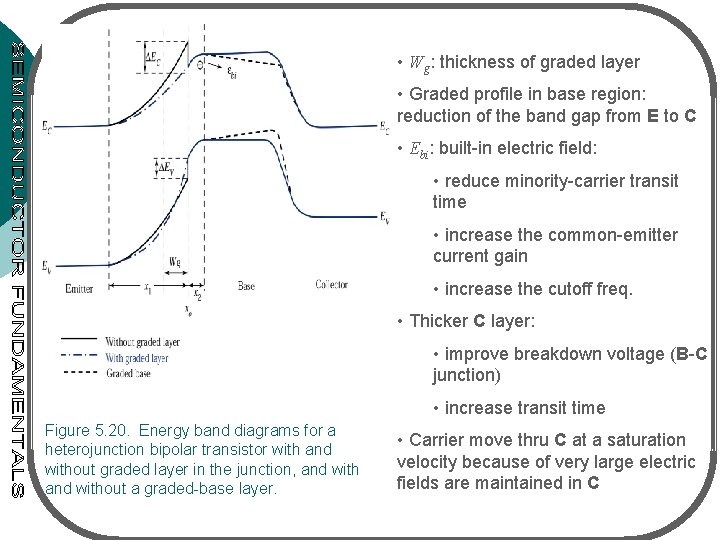
• Wg: thickness of graded layer • Graded profile in base region: reduction of the band gap from E to C • Ebi: built-in electric field: • reduce minority-carrier transit time • increase the common-emitter current gain • increase the cutoff freq. • Thicker C layer: • improve breakdown voltage (B-C junction) • increase transit time Figure 5. 20. Energy band diagrams for a heterojunction bipolar transistor with and without graded layer in the junction, and without a graded-base layer. • Carrier move thru C at a saturation velocity because of very large electric fields are maintained in C
THYRISTOR & RELATED DEVICES ¡ ¡ Thyristor: designed for handling high V & large I Used for switching applications that require the device to change from an off or blocking state to an on conducting state Thyristors have much wider range of I- & Vhandling capabilities Available with I ratings from a few miliamperes to over 5000 A, V ratings extending above 10, 000 V

• Called p-n-p-n diode • Add gate electrode at the inner player (p 2) 3 -terminal device called semiconductor-controlled rectifier (SCR) or thyristor Figure 5 -22. (a) Four-layer p-n-p-n diode. (b) Typical doping profile of a thyristor. (c) Energy band diagram of a thyristor in thermal equilibrium.
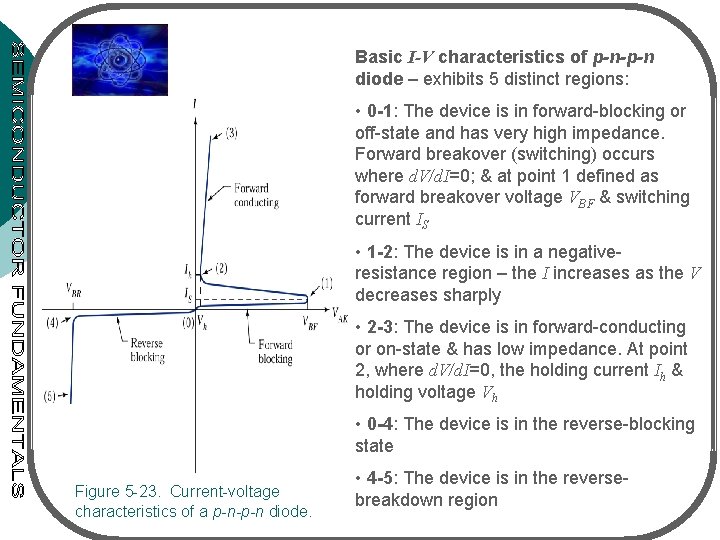
Basic I-V characteristics of p-n-p-n diode – exhibits 5 distinct regions: • 0 -1: The device is in forward-blocking or off-state and has very high impedance. Forward breakover (switching) occurs where d. V/d. I=0; & at point 1 defined as forward breakover voltage VBF & switching current IS • 1 -2: The device is in a negativeresistance region – the I increases as the V decreases sharply • 2 -3: The device is in forward-conducting or on-state & has low impedance. At point 2, where d. V/d. I=0, the holding current Ih & holding voltage Vh • 0 -4: The device is in the reverse-blocking state Figure 5 -23. Current-voltage characteristics of a p-n-p-n diode. • 4 -5: The device is in the reversebreakdown region
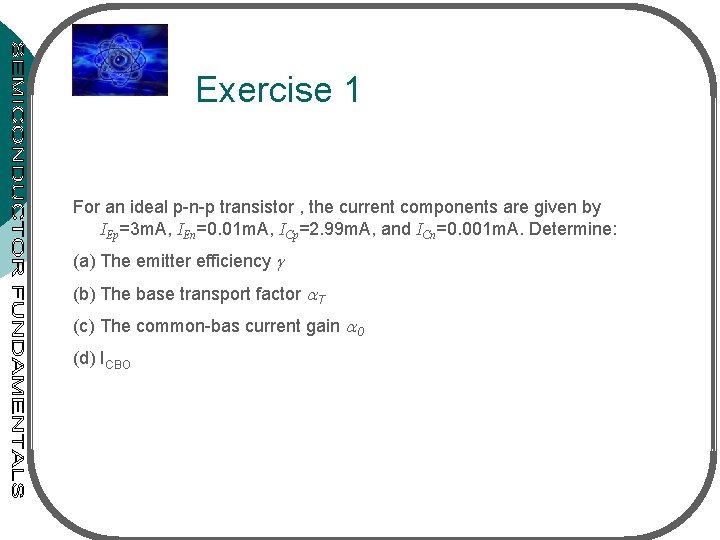
Exercise 1 For an ideal p-n-p transistor , the current components are given by IEp=3 m. A, IEn=0. 01 m. A, ICp=2. 99 m. A, and ICn=0. 001 m. A. Determine: (a) The emitter efficiency (b) The base transport factor T (c) The common-bas current gain 0 (d) ICBO

Solution (a) Emitter efficiency is: (b) The base transport factor : (c) The common-base current gain (d)

Exercise 2 Referring to Exer. 1, find the common-emitter current gain 0. Express ICEO in terms of 0 and ICBO and find the value of ICEO
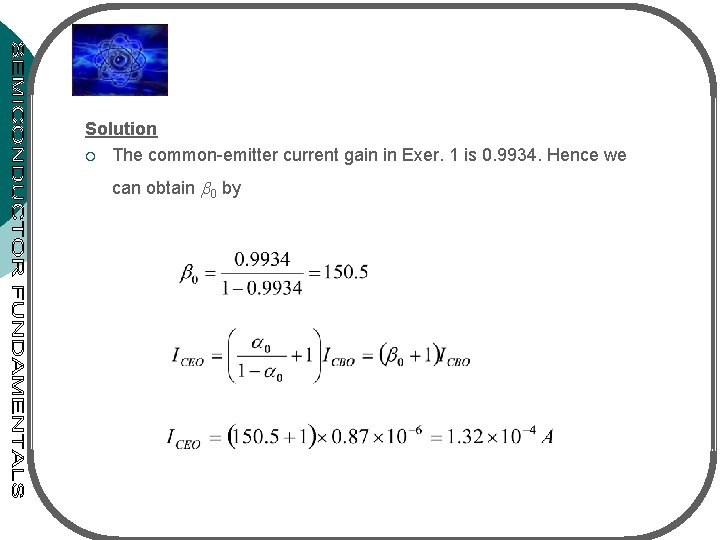
Solution ¡ The common-emitter current gain in Exer. 1 is 0. 9934. Hence we can obtain 0 by
- Slides: 39