
Chapter 5 Binary Mixtures Simple 5 1 Partial
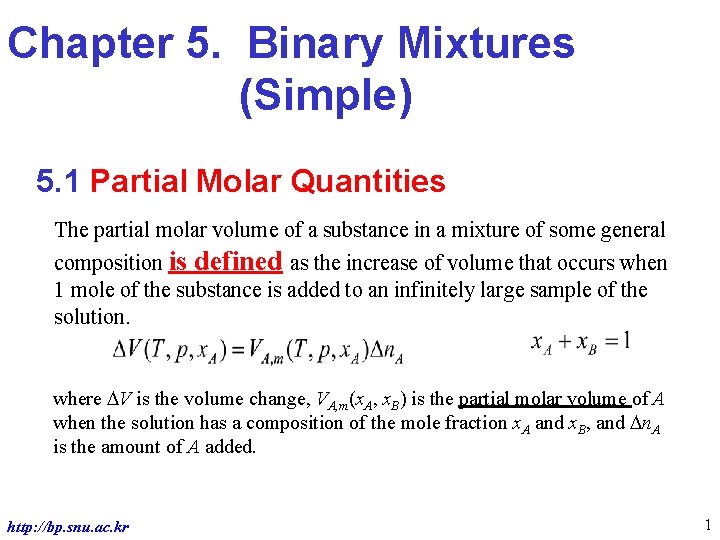
Chapter 5. Binary Mixtures (Simple) 5. 1 Partial Molar Quantities The partial molar volume of a substance in a mixture of some general composition is defined as the increase of volume that occurs when 1 mole of the substance is added to an infinitely large sample of the solution. where DV is the volume change, VA, m(x. A, x. B) is the partial molar volume of A when the solution has a composition of the mole fraction x. A and x. B, and Dn. A is the amount of A added. Physical Chemistry of Materials http: //bp. snu. ac. kr Nano-Bio Molecular Engineering Lab. 1
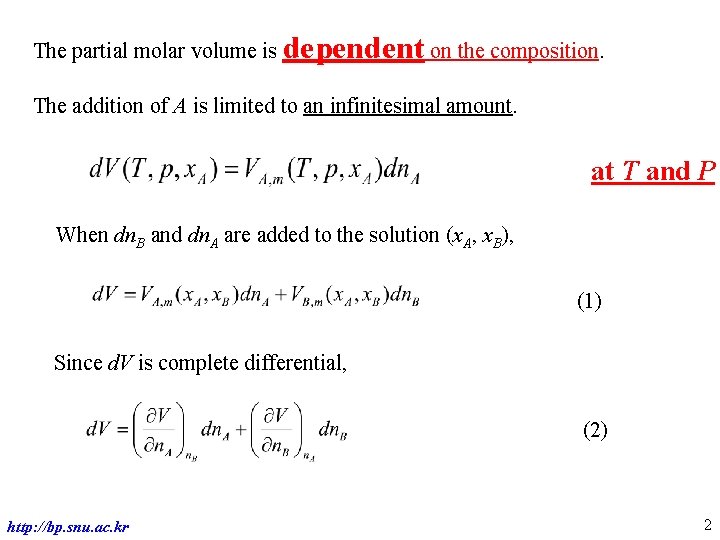
The partial molar volume is dependent on the composition. The addition of A is limited to an infinitesimal amount. at T and P When dn. B and dn. A are added to the solution (x. A, x. B), (1) Since d. V is complete differential, (2) Physical Chemistry of Materials http: //bp. snu. ac. kr Nano-Bio Molecular Engineering Lab. 2
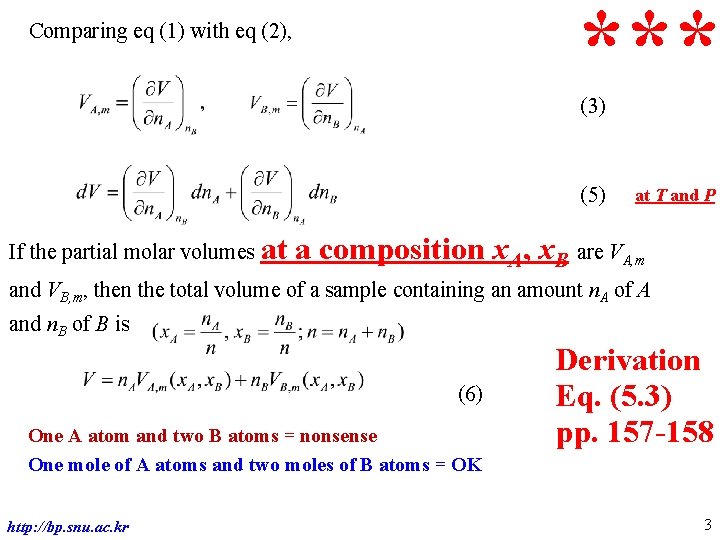
*** Comparing eq (1) with eq (2), (3) (5) If the partial molar volumes at at T and P a composition x. A, x. B are VA, m and VB, m, then the total volume of a sample containing an amount n. A of A and n. B of B is (6) One A atom and two B atoms = nonsense One mole of A atoms and two moles of B atoms = OK Physical Chemistry of Materials http: //bp. snu. ac. kr Derivation Eq. (5. 3) pp. 157 -158 Nano-Bio Molecular Engineering Lab. 3
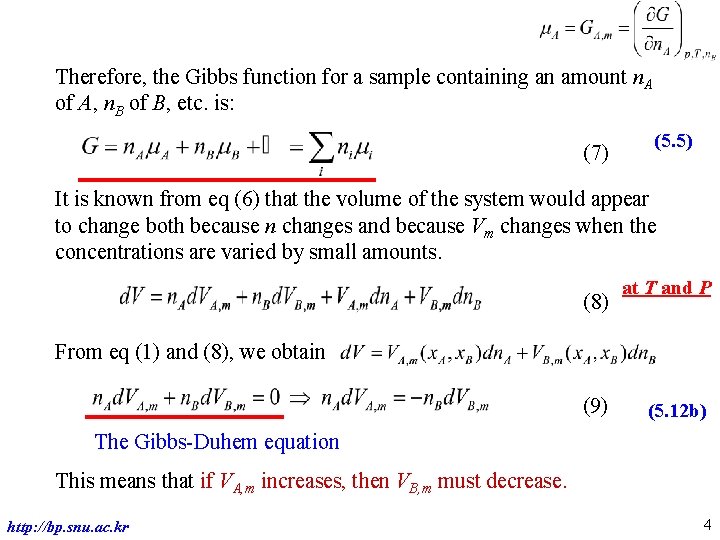
Therefore, the Gibbs function for a sample containing an amount n. A of A, n. B of B, etc. is: _____ (7) (5. 5) It is known from eq (6) that the volume of the system would appear to change both because n changes and because Vm changes when the concentrations are varied by small amounts. (8) at T and P From eq (1) and (8), we obtain ______ (9) (5. 12 b) The Gibbs-Duhem equation This means that if VA, m increases, then VB, m must decrease. Physical Chemistry of Materials http: //bp. snu. ac. kr Nano-Bio Molecular Engineering Lab. 4
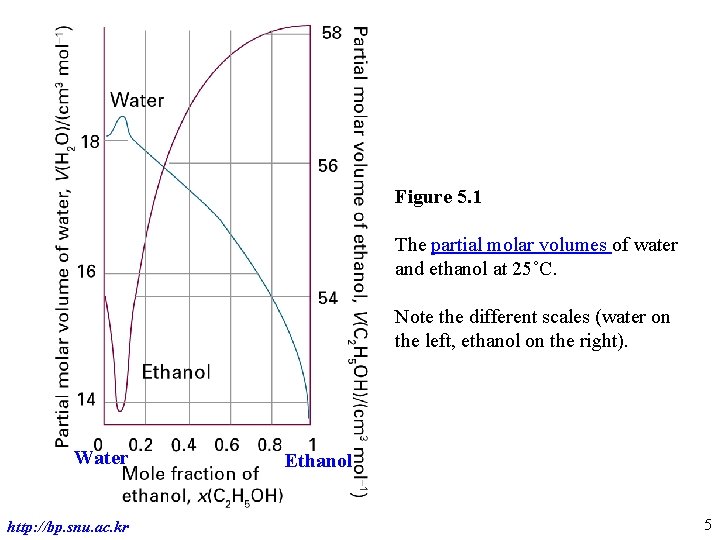
Figure 5. 1 The partial molar volumes of water and ethanol at 25˚C. Note the different scales (water on the left, ethanol on the right). Water Physical Chemistry of Materials http: //bp. snu. ac. kr Ethanol Nano-Bio Molecular Engineering Lab. 5

Figure 5. 2 V´ The partial molar volume of a substance is the slope of the variation of the total volume of the sample plotted against the amount of each atom. In general, partial molar quantities vary with the composition, as shown by the different slopes at the amounts a or b. Note that the partial molar volume at b negative n. A (not x. A) is : the overall volume of the sample decreases as A is added. Fix n. B n. C n. D n. E. . . Physical Chemistry of Materials http: //bp. snu. ac. kr Nano-Bio Molecular Engineering Lab. 6
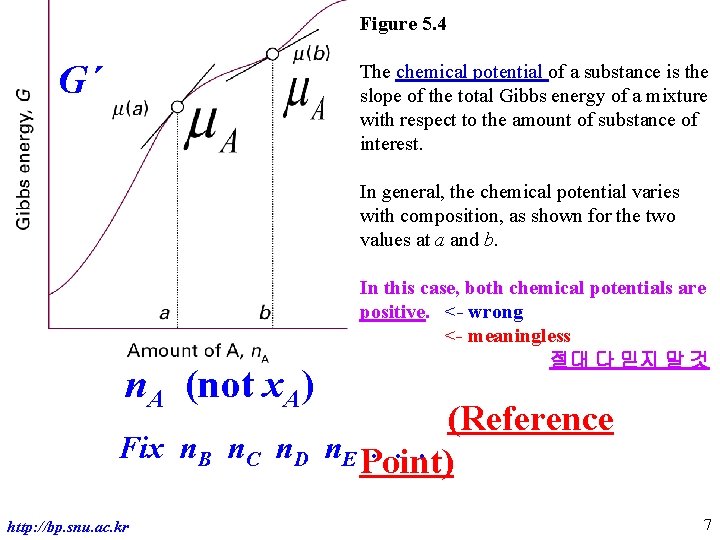
Figure 5. 4 G´ The chemical potential of a substance is the slope of the total Gibbs energy of a mixture with respect to the amount of substance of interest. In general, the chemical potential varies with composition, as shown for the two values at a and b. n. A (not x. A) In this case, both chemical potentials are positive. <- wrong <- meaningless 절대 다 믿지 말 것 (Reference Fix n. B n. C n. D n. E Point). . . Physical Chemistry of Materials http: //bp. snu. ac. kr Nano-Bio Molecular Engineering Lab. 7
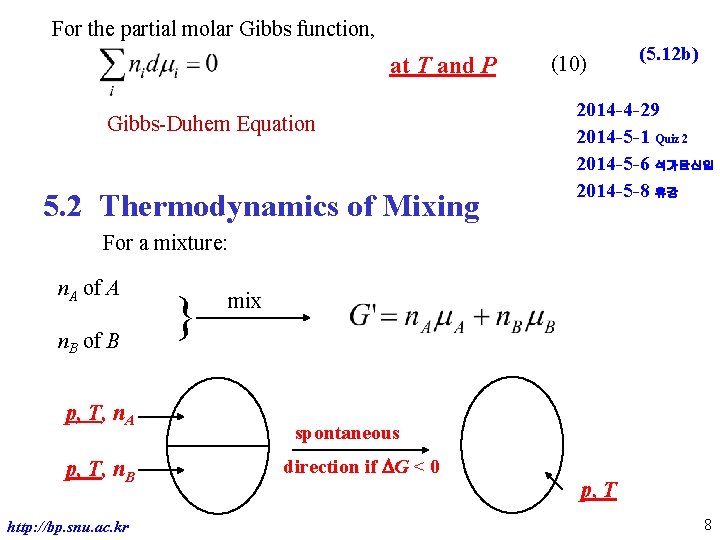
For the partial molar Gibbs function, at T and P Gibbs-Duhem Equation 5. 2 Thermodynamics of Mixing (10) (5. 12 b) 2014 -4 -29 2014 -5 -1 Quiz 2 2014 -5 -6 석가탄신일 2014 -5 -8 휴강 For a mixture: n. A of A n. B of B } p, T, n. A p, T, n. B Physical Chemistry of Materials http: //bp. snu. ac. kr mix spontaneous direction if DG < 0 p, T Nano-Bio Molecular Engineering Lab. 8
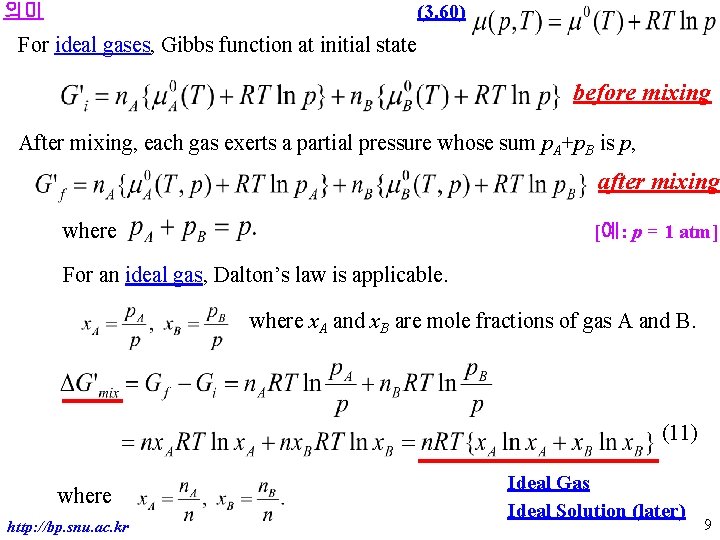
(3. 60) 의미 For ideal gases, Gibbs function at initial state before mixing After mixing, each gas exerts a partial pressure whose sum p. A+p. B is p, after mixing where [예: p = 1 atm] For an ideal gas, Dalton’s law is applicable. where x. A and x. B are mole fractions of gas A and B. __ where Physical Chemistry of Materials http: //bp. snu. ac. kr ____ (11) Ideal Gas Ideal Solution (later) Nano-Bio Molecular Engineering Lab. 9
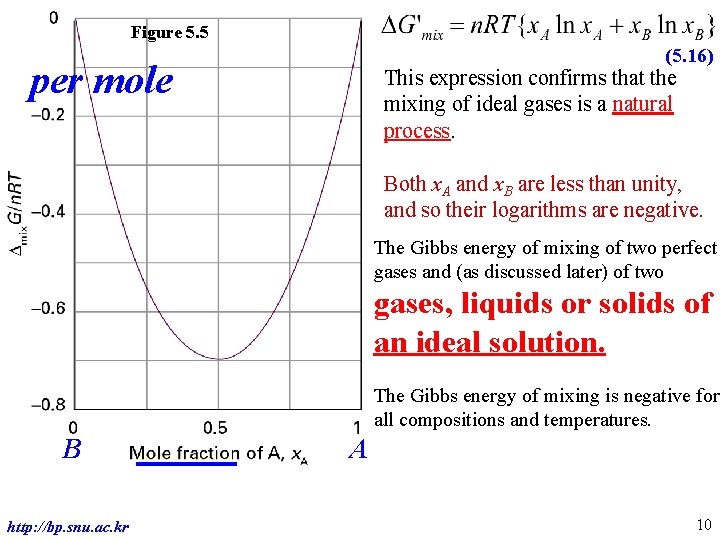
Figure 5. 5 (5. 16) per mole This expression confirms that the mixing of ideal gases is a natural process. Both x. A and x. B are less than unity, and so their logarithms are negative. The Gibbs energy of mixing of two perfect gases and (as discussed later) of two gases, liquids or solids of an ideal solution. B ___ Physical Chemistry of Materials http: //bp. snu. ac. kr The Gibbs energy of mixing is negative for all compositions and temperatures. A Nano-Bio Molecular Engineering Lab. 10
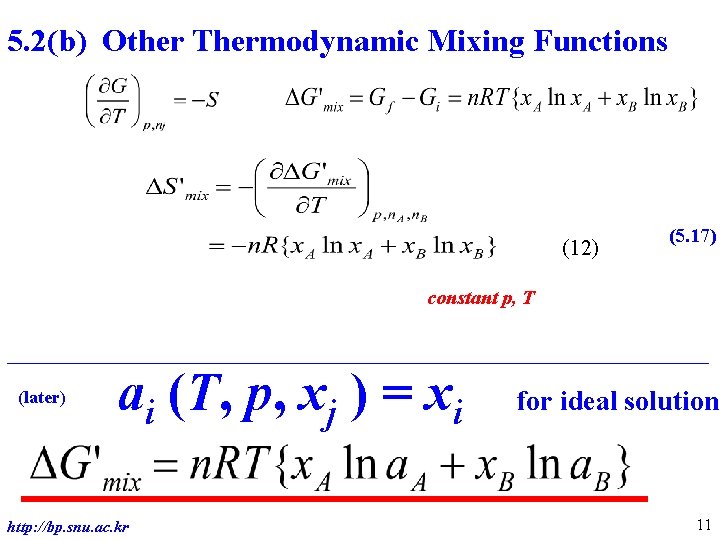
5. 2(b) Other Thermodynamic Mixing Functions (12) (5. 17) constant p, T _______________________________________ (later) ai (T, p, xj ) = xi for ideal solution _______ Physical Chemistry of Materials http: //bp. snu. ac. kr Nano-Bio Molecular Engineering Lab. 11
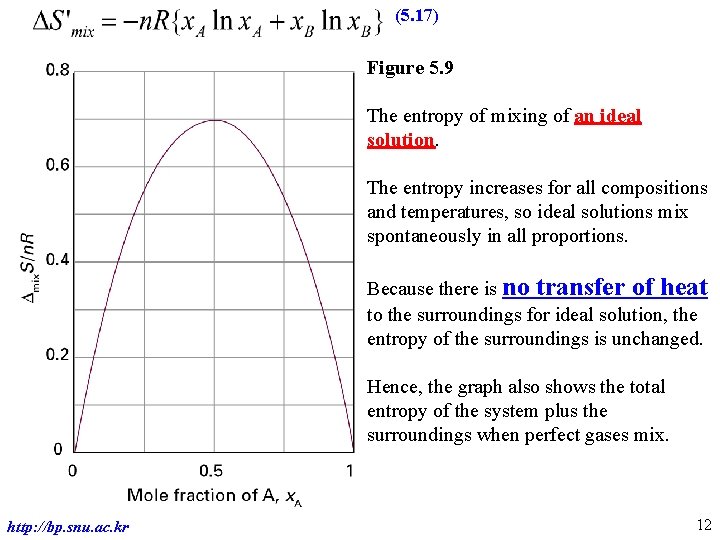
(5. 17) Figure 5. 9 The entropy of mixing of an ideal solution. The entropy increases for all compositions and temperatures, so ideal solutions mix spontaneously in all proportions. Because there is no transfer of heat to the surroundings for ideal solution, the entropy of the surroundings is unchanged. Hence, the graph also shows the total entropy of the system plus the surroundings when perfect gases mix. Physical Chemistry of Materials http: //bp. snu. ac. kr Nano-Bio Molecular Engineering Lab. 12
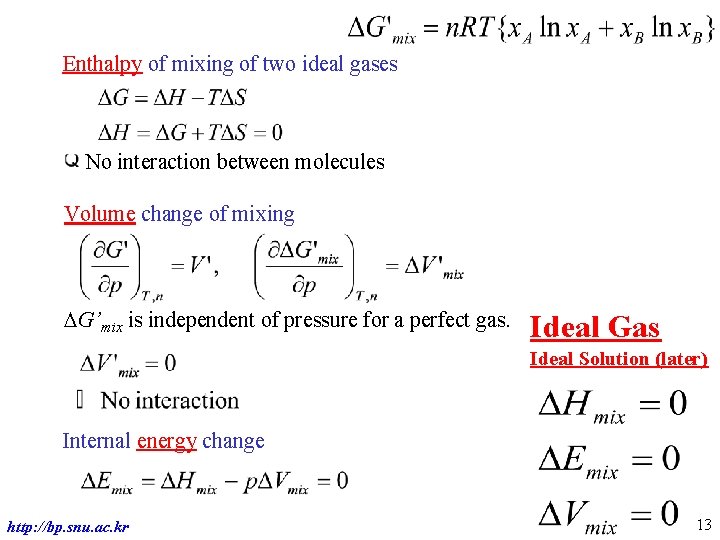
Enthalpy of mixing of two ideal gases No interaction between molecules Volume change of mixing DG’mix is independent of pressure for a perfect gas. Ideal Gas Ideal Solution (later) Internal energy change Physical Chemistry of Materials http: //bp. snu. ac. kr Nano-Bio Molecular Engineering Lab. 13
![Ideal Vapor 5. 3 Chemical Potential of Liquids (a) [예: p = 1 atm]](http://slidetodoc.com/presentation_image_h2/7f8f7d8c8883b7ff09c4d66bfdda73de/image-14.jpg "Ideal Vapor 5. 3 Chemical Potential of Liquids (a) [예: p = 1 atm]")
Ideal Vapor 5. 3 Chemical Potential of Liquids (a) [예: p = 1 atm] vapor A equal liquid A Chemical potential of a pure liquid in equilibrium with its vapor. * = pure Figure 5. 10 (b) vapor A+B liquid A+B Physical Chemistry of Materials http: //bp. snu. ac. kr ________ equal The chemical potential of a liquid mixture in equilibrium with its vapor. Nano-Bio Molecular Engineering Lab. 14
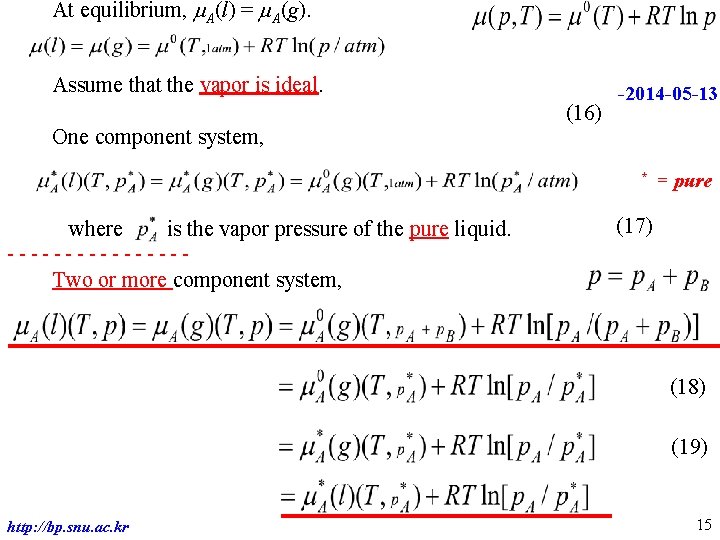
At equilibrium, m. A(l) = m. A(g). Assume that the vapor is ideal. (16) -2014 -05 -13 One component system, * where is the vapor pressure of the pure liquid. = pure (17) -------- Two or more component system, ____________ (18) Physical Chemistry of Materials http: //bp. snu. ac. kr ______ (19) Nano-Bio Molecular Engineering Lab. 15
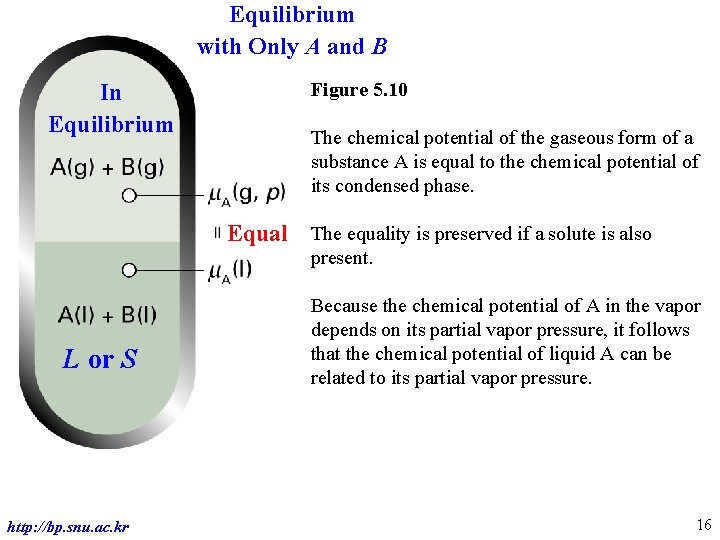
Equilibrium with Only A and B In Equilibrium Figure 5. 10 The chemical potential of the gaseous form of a substance A is equal to the chemical potential of its condensed phase. Equal The equality is preserved if a solute is also present. L or S Physical Chemistry of Materials http: //bp. snu. ac. kr Because the chemical potential of A in the vapor depends on its partial vapor pressure, it follows that the chemical potential of liquid A can be related to its partial vapor pressure. Nano-Bio Molecular Engineering Lab. 16
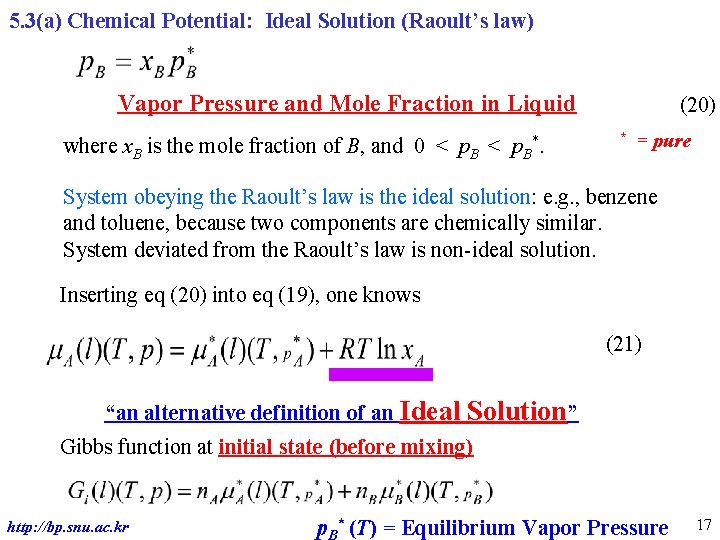
5. 3(a) Chemical Potential: Ideal Solution (Raoult’s law) Vapor Pressure and Mole Fraction in Liquid where x. B is the mole fraction of B, and 0 < p. B*. _ (20) * = pure System obeying the Raoult’s law is the ideal solution: e. g. , benzene and toluene, because two components are chemically similar. System deviated from the Raoult’s law is non-ideal solution. Inserting eq (20) into eq (19), one knows “an alternative definition of an Ideal (21) Solution” Gibbs function at initial state (before mixing) Physical Chemistry of Materials http: //bp. snu. ac. kr Nano-Bio Molecular Engineering Lab. p * (T) = Equilibrium Vapor Pressure 17
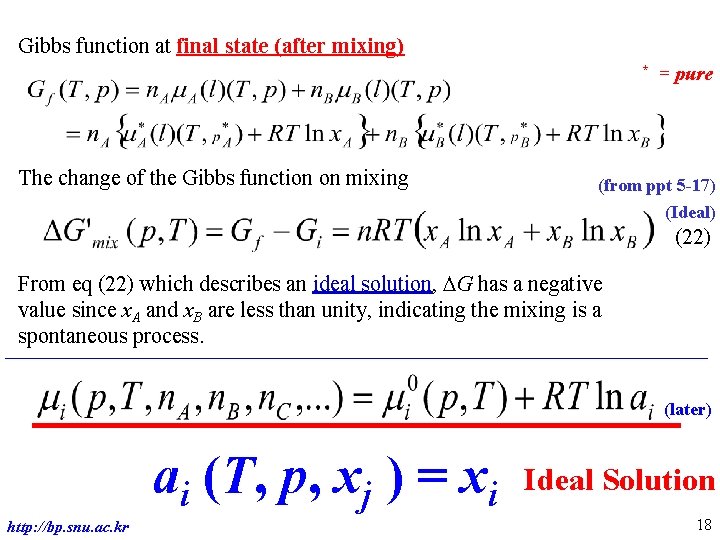
Gibbs function at final state (after mixing) * The change of the Gibbs function on mixing = pure (from ppt 5 -17) (Ideal) (22) From eq (22) which describes an ideal solution, DG has a negative value since x. A and x. B are less than unity, indicating the mixing is a spontaneous process. _______________________________________ (later) ai (T, p, xj ) = xi Physical Chemistry of Materials http: //bp. snu. ac. kr Ideal Solution Nano-Bio Molecular Engineering Lab. 18
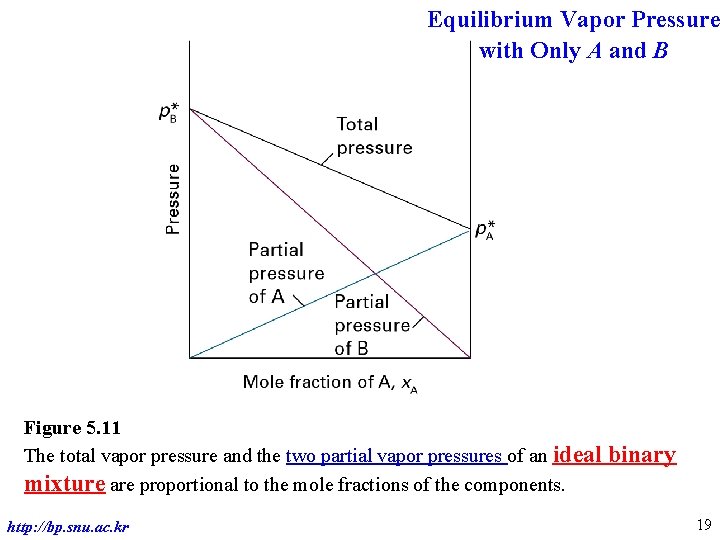
Equilibrium Vapor Pressure with Only A and B Figure 5. 11 The total vapor pressure and the two partial vapor pressures of an ideal mixture are proportional to the mole fractions of the components. Physical Chemistry of Materials http: //bp. snu. ac. kr binary Nano-Bio Molecular Engineering Lab. 19
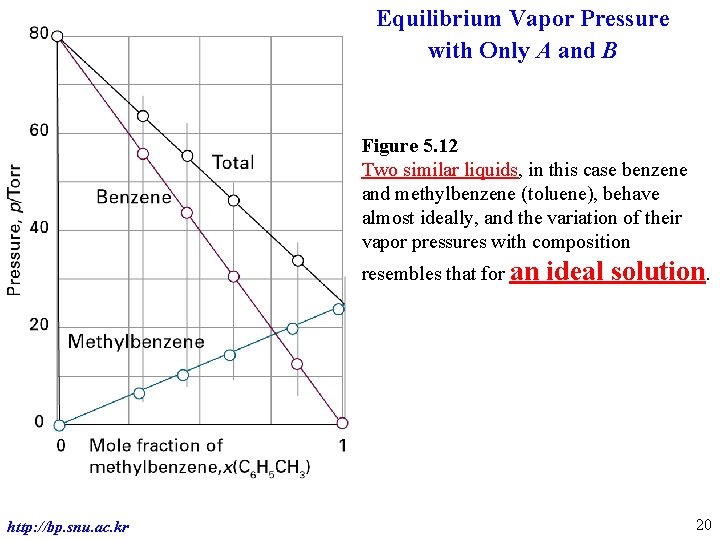
Equilibrium Vapor Pressure with Only A and B Figure 5. 12 Two similar liquids, in this case benzene and methylbenzene (toluene), behave almost ideally, and the variation of their vapor pressures with composition resembles that for an Physical Chemistry of Materials http: //bp. snu. ac. kr ideal solution. Nano-Bio Molecular Engineering Lab. 20
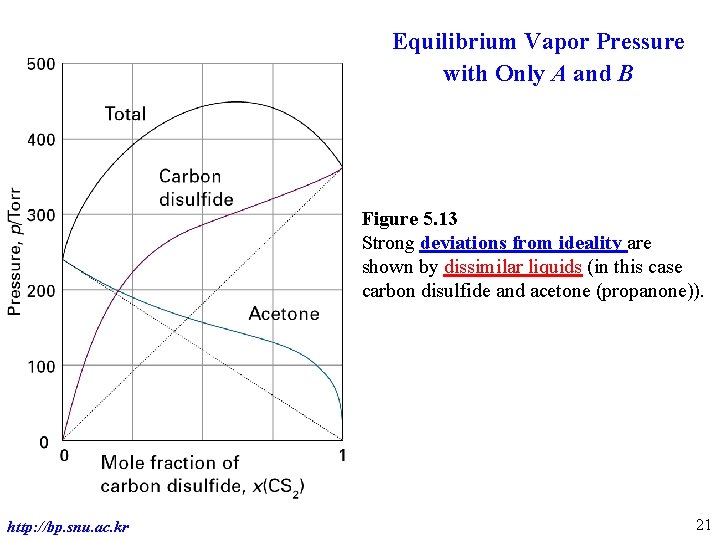
Equilibrium Vapor Pressure with Only A and B Figure 5. 13 Strong deviations from ideality are shown by dissimilar liquids (in this case carbon disulfide and acetone (propanone)). Physical Chemistry of Materials http: //bp. snu. ac. kr Nano-Bio Molecular Engineering Lab. 21
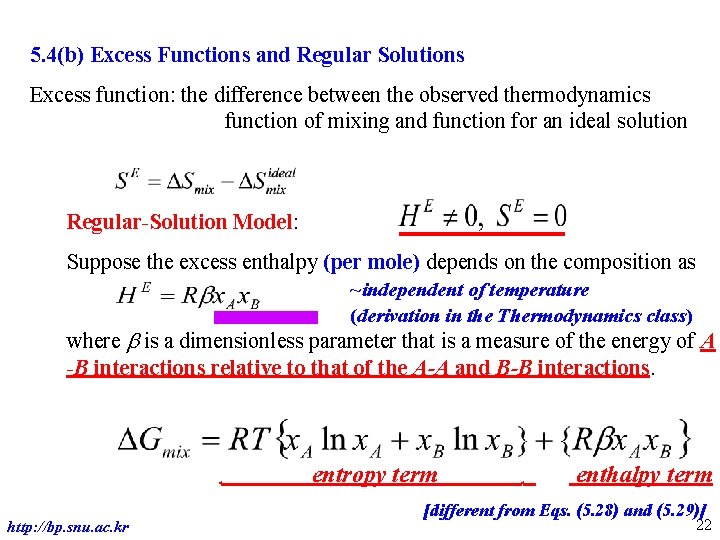
5. 4(b) Excess Functions and Regular Solutions Excess function: the difference between the observed thermodynamics function of mixing and function for an ideal solution _ Regular-Solution Model: _____ Suppose the excess enthalpy (per mole) depends on the composition as ~independent of temperature (derivation in the Thermodynamics class) where b is a dimensionless parameter that is a measure of the energy of A -B interactions relative to that of the A-A and B-B interactions. . Physical Chemistry of Materials http: //bp. snu. ac. kr entropy term . enthalpy term [different from Eqs. (5. 28) and (5. 29)] Nano-Bio Molecular Engineering Lab. 22
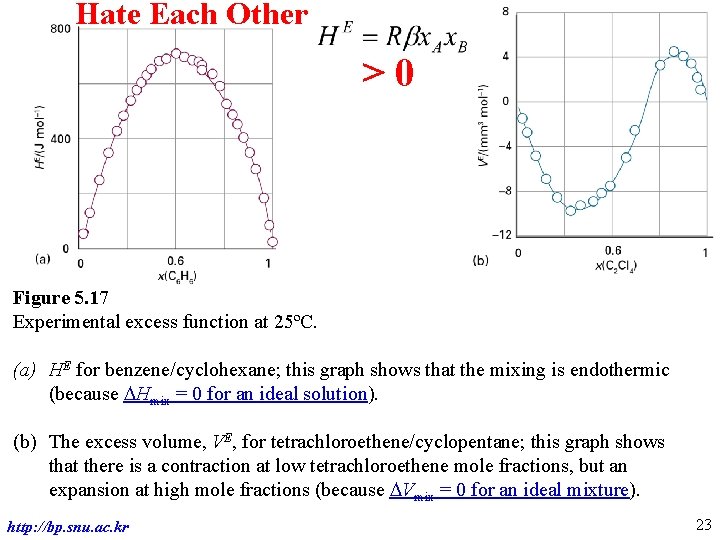
Hate Each Other >0 Figure 5. 17 Experimental excess function at 25ºC. (a) HE for benzene/cyclohexane; this graph shows that the mixing is endothermic (because DHmix = 0 for an ideal solution). (b) The excess volume, VE, for tetrachloroethene/cyclopentane; this graph shows that there is a contraction at low tetrachloroethene mole fractions, but an expansion at high mole fractions (because DVmix = 0 for an ideal mixture). Physical Chemistry of Materials http: //bp. snu. ac. kr Nano-Bio Molecular Engineering Lab. 23
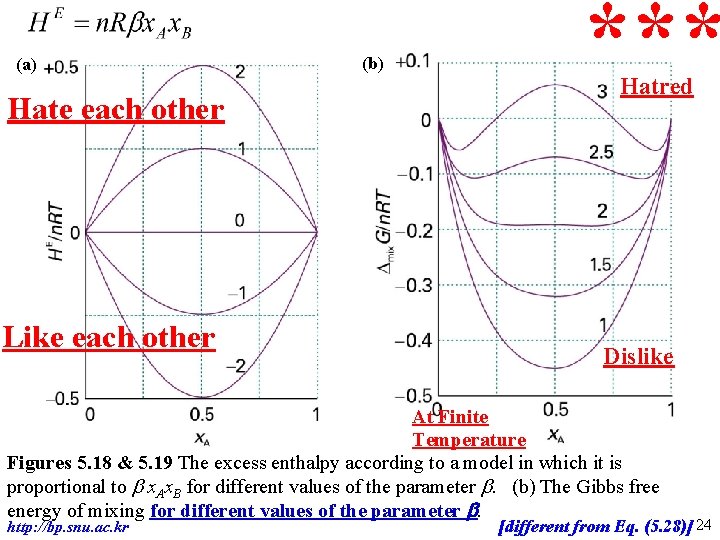
(a) Hate each other Like each other (b) *** Hatred Dislike At Finite Temperature Figures 5. 18 & 5. 19 The excess enthalpy according to a model in which it is proportional to b x. Ax. B for different values of the parameter b. (b) The Gibbs free energy of mixing for different values of the parameter b. Nano-Bio Molecular Engineering Lab. Physical Chemistry of Materials http: //bp. snu. ac. kr [different from Eq. (5. 28)] 24
5. 5 Solutions of Nonvolatile Solutes: Colligative Properties (총괄성) The elevation of boiling point The depression of freezing point Two assumptions: 1. The solute is involatile: the solvent vapor is only the gas present. 2. The involatile solute does not dissolve much in solid solvent. Principle The Gibbs free energy of the liquid solution is lowered by the presence of the solute, causing that the boiling point is raised and the freezing point lowered. (See Fig. 5. 15) Physical Chemistry of Materials http: //bp. snu. ac. kr Nano-Bio Molecular Engineering Lab. 25
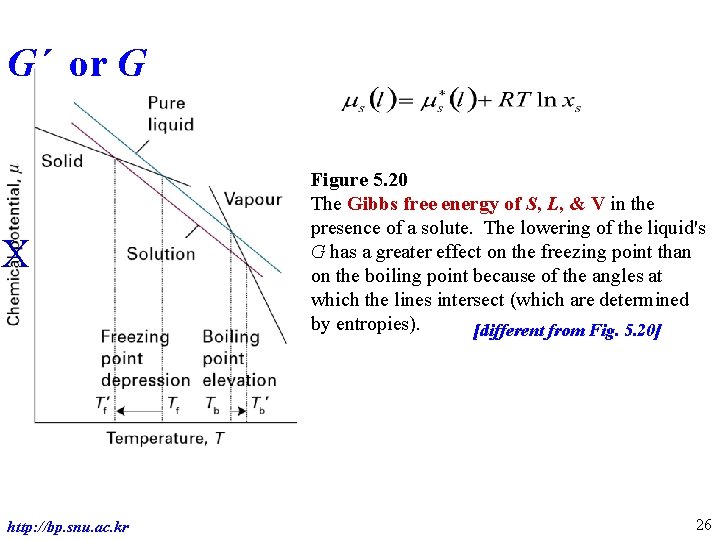
G´ or G X Physical Chemistry of Materials http: //bp. snu. ac. kr Figure 5. 20 The Gibbs free energy of S, L, & V in the presence of a solute. The lowering of the liquid's G has a greater effect on the freezing point than on the boiling point because of the angles at which the lines intersect (which are determined by entropies). [different from Fig. 5. 20] Nano-Bio Molecular Engineering Lab. 26
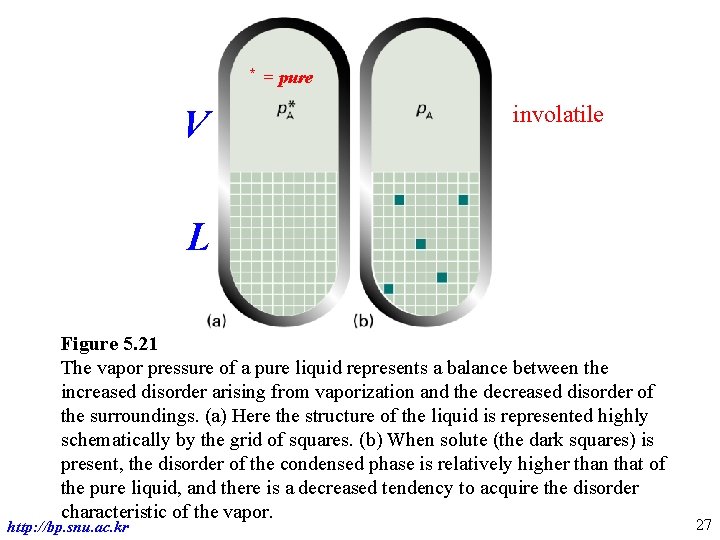
* V = pure involatile L Figure 5. 21 The vapor pressure of a pure liquid represents a balance between the increased disorder arising from vaporization and the decreased disorder of the surroundings. (a) Here the structure of the liquid is represented highly schematically by the grid of squares. (b) When solute (the dark squares) is present, the disorder of the condensed phase is relatively higher than that of the pure liquid, and there is a decreased tendency to acquire the disorder characteristic of the vapor. Physical Chemistry of Materials Nano-Bio Molecular Engineering Lab. http: //bp. snu. ac. kr 27
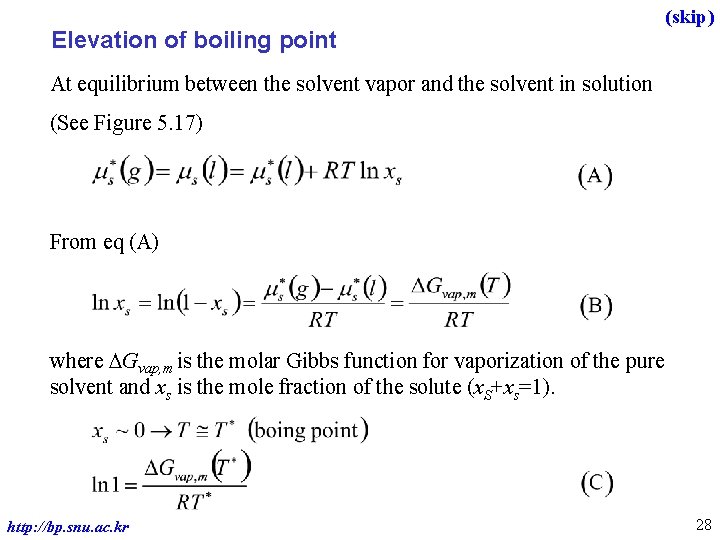
(skip) Elevation of boiling point At equilibrium between the solvent vapor and the solvent in solution (See Figure 5. 17) From eq (A) where DGvap, m is the molar Gibbs function for vaporization of the pure solvent and xs is the mole fraction of the solute (x. S+xs=1). Physical Chemistry of Materials http: //bp. snu. ac. kr Nano-Bio Molecular Engineering Lab. 28
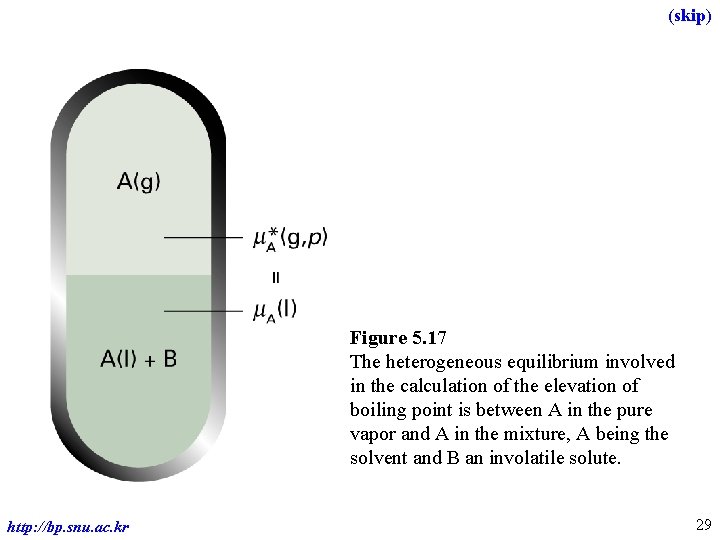
(skip) Figure 5. 17 The heterogeneous equilibrium involved in the calculation of the elevation of boiling point is between A in the pure vapor and A in the mixture, A being the solvent and B an involatile solute. Physical Chemistry of Materials http: //bp. snu. ac. kr Nano-Bio Molecular Engineering Lab. 29
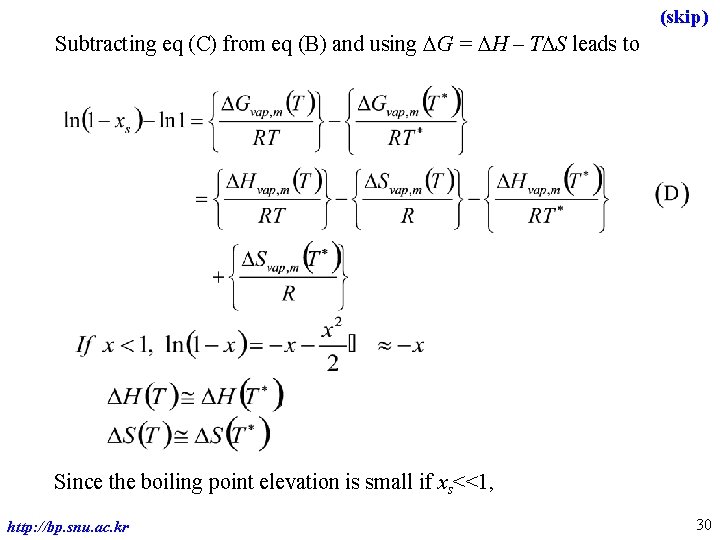
(skip) Subtracting eq (C) from eq (B) and using DG = DH – TDS leads to Since the boiling point elevation is small if xs<<1, Physical Chemistry of Materials http: //bp. snu. ac. kr Nano-Bio Molecular Engineering Lab. 30
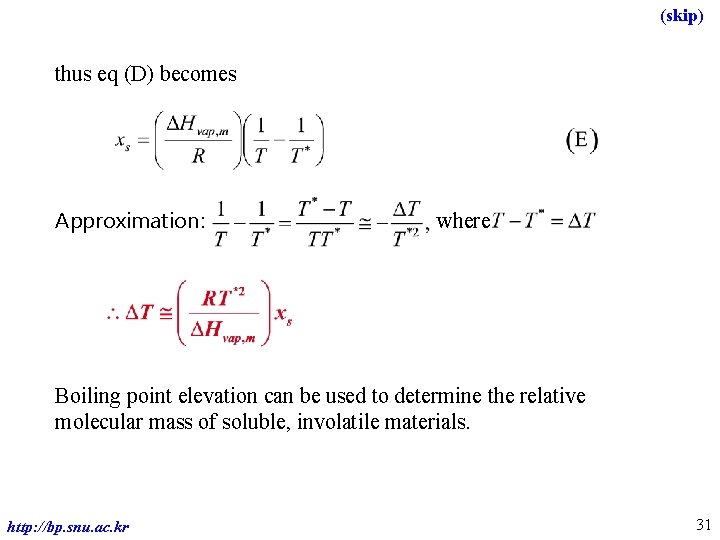
(skip) thus eq (D) becomes Approximation: where Boiling point elevation can be used to determine the relative molecular mass of soluble, involatile materials. Physical Chemistry of Materials http: //bp. snu. ac. kr Nano-Bio Molecular Engineering Lab. 31
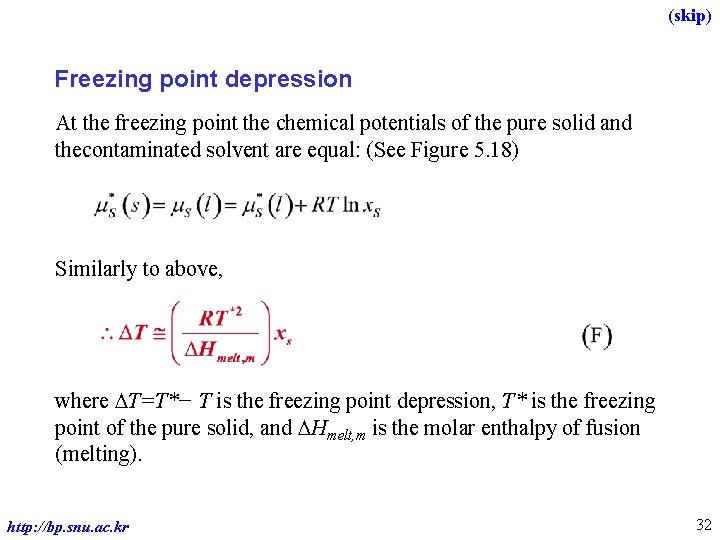
(skip) Freezing point depression At the freezing point the chemical potentials of the pure solid and thecontaminated solvent are equal: (See Figure 5. 18) Similarly to above, where DT=T*− T is the freezing point depression, T* is the freezing point of the pure solid, and DHmelt, m is the molar enthalpy of fusion (melting). Physical Chemistry of Materials http: //bp. snu. ac. kr Nano-Bio Molecular Engineering Lab. 32
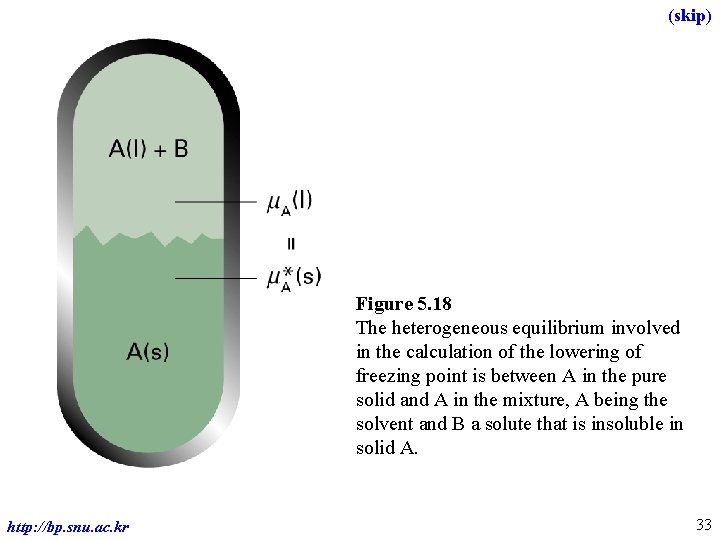
(skip) Figure 5. 18 The heterogeneous equilibrium involved in the calculation of the lowering of freezing point is between A in the pure solid and A in the mixture, A being the solvent and B a solute that is insoluble in solid A. Physical Chemistry of Materials http: //bp. snu. ac. kr Nano-Bio Molecular Engineering Lab. 33
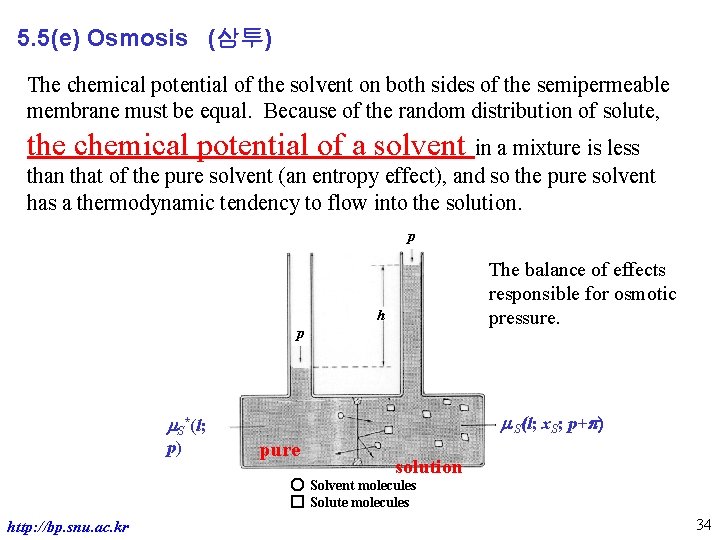
5. 5(e) Osmosis (삼투) The chemical potential of the solvent on both sides of the semipermeable membrane must be equal. Because of the random distribution of solute, the chemical potential of a solvent in a mixture is less than that of the pure solvent (an entropy effect), and so the pure solvent has a thermodynamic tendency to flow into the solution. p The balance of effects responsible for osmotic pressure. h p m S(l; x. S; p+p) m. S*(l; p) pure solution Solvent molecules Solute molecules Physical Chemistry of Materials http: //bp. snu. ac. kr Nano-Bio Molecular Engineering Lab. 34
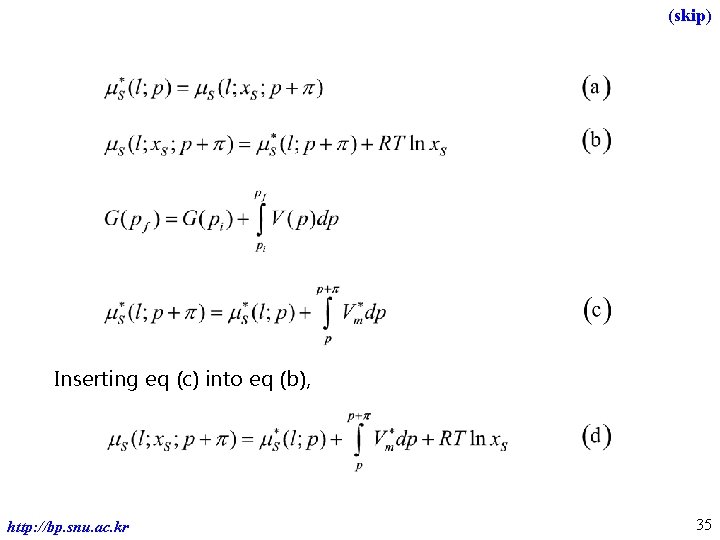
(skip) Inserting eq (c) into eq (b), Physical Chemistry of Materials http: //bp. snu. ac. kr Nano-Bio Molecular Engineering Lab. 35
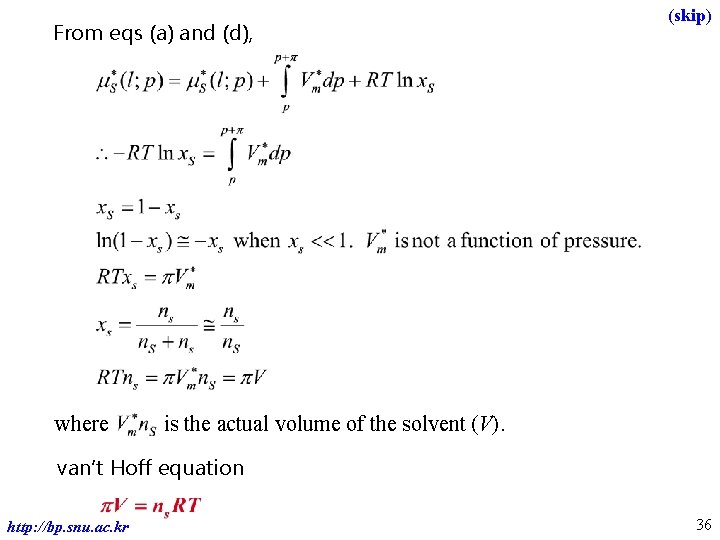
(skip) From eqs (a) and (d), where is the actual volume of the solvent (V). van’t Hoff equation Physical Chemistry of Materials http: //bp. snu. ac. kr Nano-Bio Molecular Engineering Lab. 36
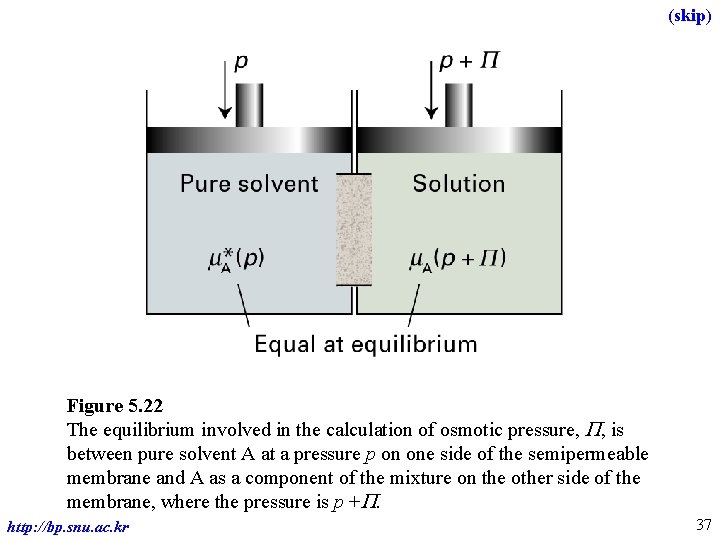
(skip) Figure 5. 22 The equilibrium involved in the calculation of osmotic pressure, P, is between pure solvent A at a pressure p on one side of the semipermeable membrane and A as a component of the mixture on the other side of the membrane, where the pressure is p +P. Physical Chemistry of Materials http: //bp. snu. ac. kr Nano-Bio Molecular Engineering Lab. 37
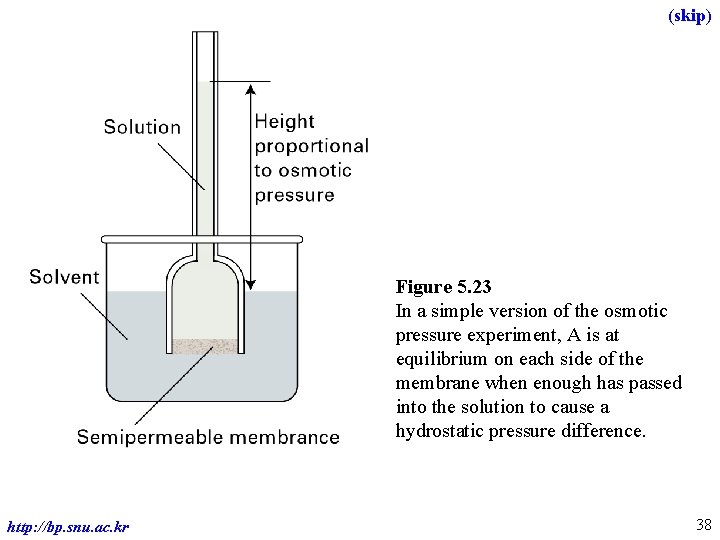
(skip) Figure 5. 23 In a simple version of the osmotic pressure experiment, A is at equilibrium on each side of the membrane when enough has passed into the solution to cause a hydrostatic pressure difference. Physical Chemistry of Materials http: //bp. snu. ac. kr Nano-Bio Molecular Engineering Lab. 38
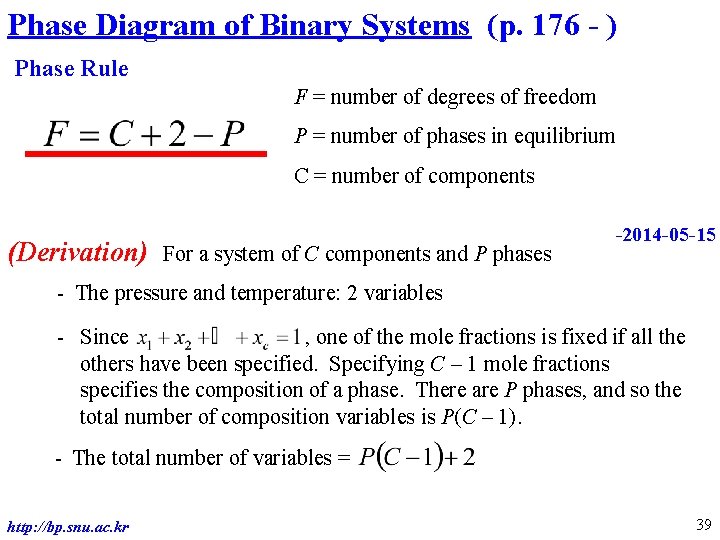
Phase Diagram of Binary Systems (p. 176 - ) _____ Phase Rule F = number of degrees of freedom P = number of phases in equilibrium C = number of components (Derivation) For a system of C components and P phases -2014 -05 -15 - The pressure and temperature: 2 variables - Since , one of the mole fractions is fixed if all the others have been specified. Specifying C – 1 mole fractions specifies the composition of a phase. There are P phases, and so the total number of composition variables is P(C – 1). - The total number of variables = Physical Chemistry of Materials http: //bp. snu. ac. kr Nano-Bio Molecular Engineering Lab. 39
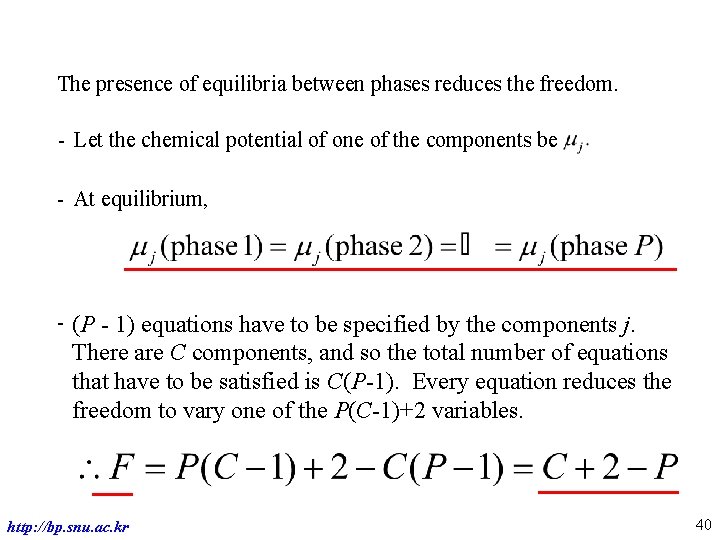
The presence of equilibria between phases reduces the freedom. - Let the chemical potential of one of the components be - At equilibrium, ____________ - (P - 1) equations have to be specified by the components j. There are C components, and so the total number of equations that have to be satisfied is C(P-1). Every equation reduces the freedom to vary one of the P(C-1)+2 variables. __ Physical Chemistry of Materials http: //bp. snu. ac. kr _______ Nano-Bio Molecular Engineering Lab. 40
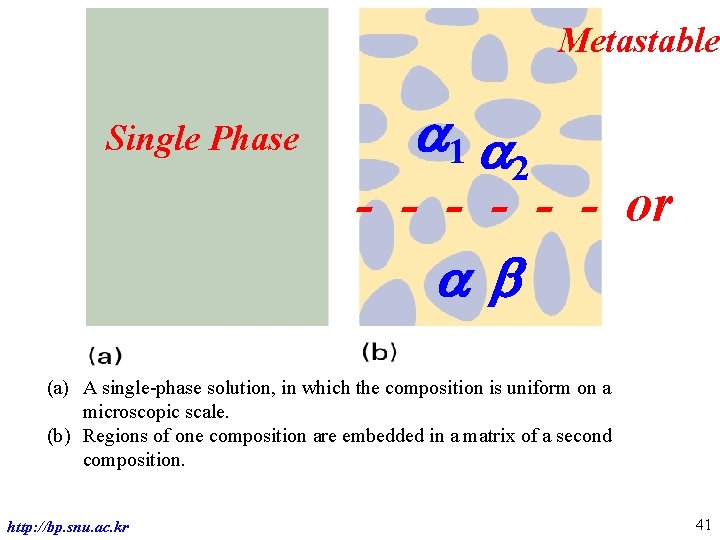
Metastable Single Phase a 1 a 2 - - - or ab (a) A single-phase solution, in which the composition is uniform on a microscopic scale. (b) Regions of one composition are embedded in a matrix of a second composition. Physical Chemistry of Materials http: //bp. snu. ac. kr Nano-Bio Molecular Engineering Lab. 41
Physical Chemistry of Materials http: //bp. snu. ac. kr Nano-Bio Molecular Engineering Lab. 42
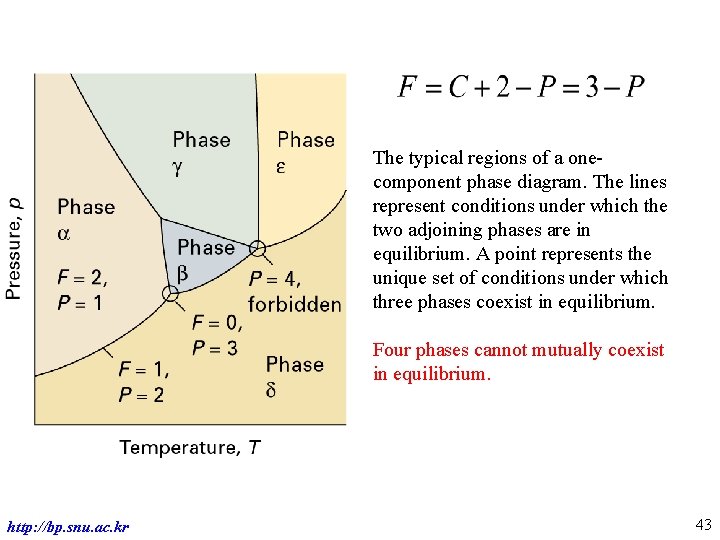
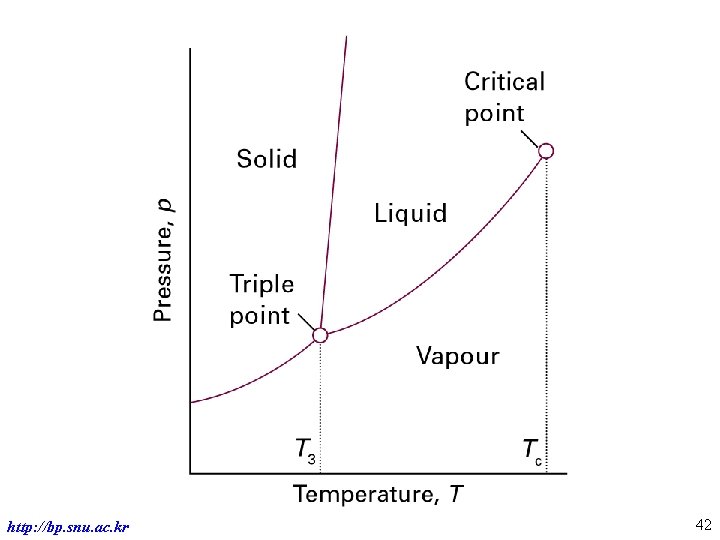
The typical regions of a onecomponent phase diagram. The lines represent conditions under which the two adjoining phases are in equilibrium. A point represents the unique set of conditions under which three phases coexist in equilibrium. Four phases cannot mutually coexist in equilibrium. Physical Chemistry of Materials http: //bp. snu. ac. kr Nano-Bio Molecular Engineering Lab. 43
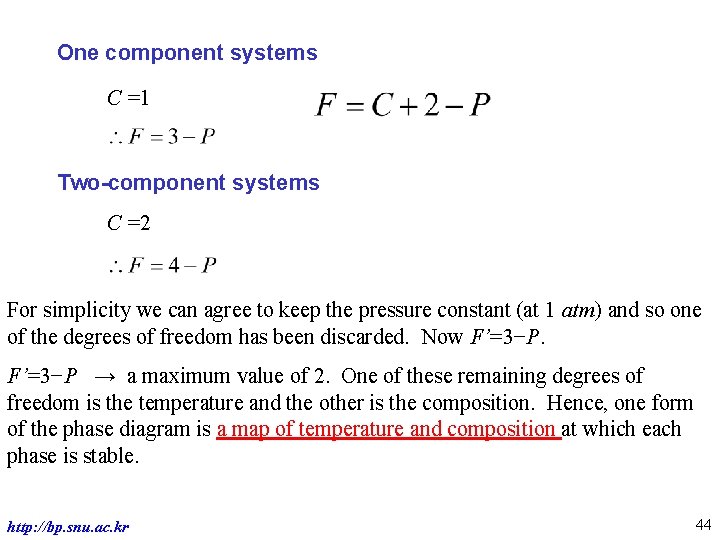
One component systems C =1 Two-component systems C =2 For simplicity we can agree to keep the pressure constant (at 1 atm) and so one of the degrees of freedom has been discarded. Now F’=3−P → a maximum value of 2. One of these remaining degrees of freedom is the temperature and the other is the composition. Hence, one form of the phase diagram is a map of temperature and composition at which each phase is stable. Physical Chemistry of Materials http: //bp. snu. ac. kr Nano-Bio Molecular Engineering Lab. 44
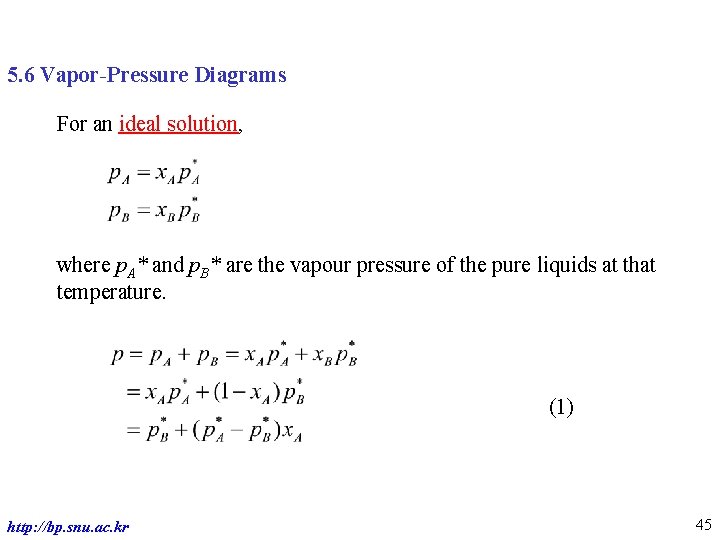
5. 6 Vapor-Pressure Diagrams For an ideal solution, where p. A* and p. B* are the vapour pressure of the pure liquids at that temperature. (1) Physical Chemistry of Materials http: //bp. snu. ac. kr Nano-Bio Molecular Engineering Lab. 45
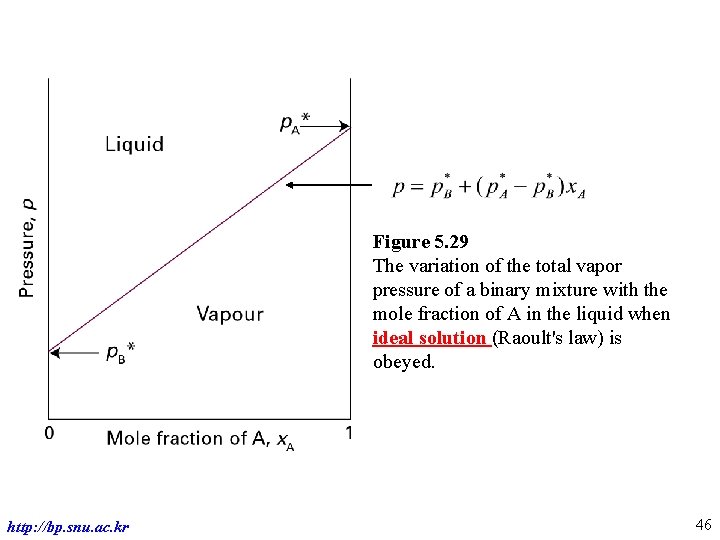
Figure 5. 29 The variation of the total vapor pressure of a binary mixture with the mole fraction of A in the liquid when ideal solution (Raoult's law) is obeyed. Physical Chemistry of Materials http: //bp. snu. ac. kr Nano-Bio Molecular Engineering Lab. 46
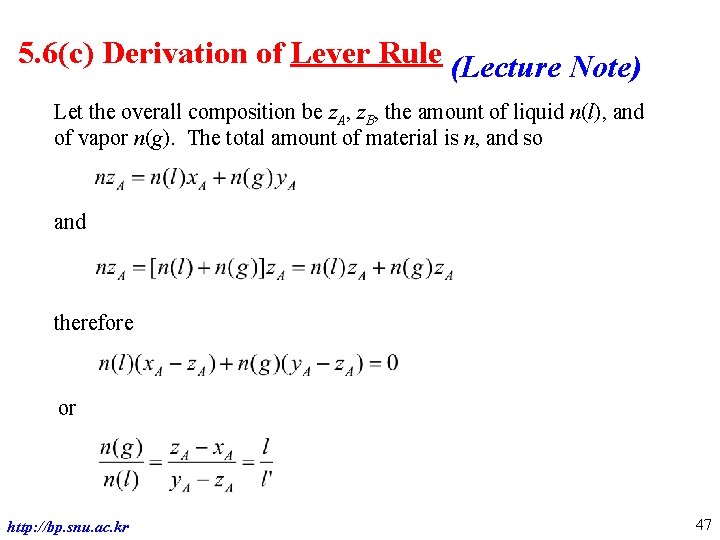
5. 6(c) Derivation of Lever Rule (Lecture Note) Let the overall composition be z. A, z. B, the amount of liquid n(l), and of vapor n(g). The total amount of material is n, and so and therefore or Physical Chemistry of Materials http: //bp. snu. ac. kr Nano-Bio Molecular Engineering Lab. 47
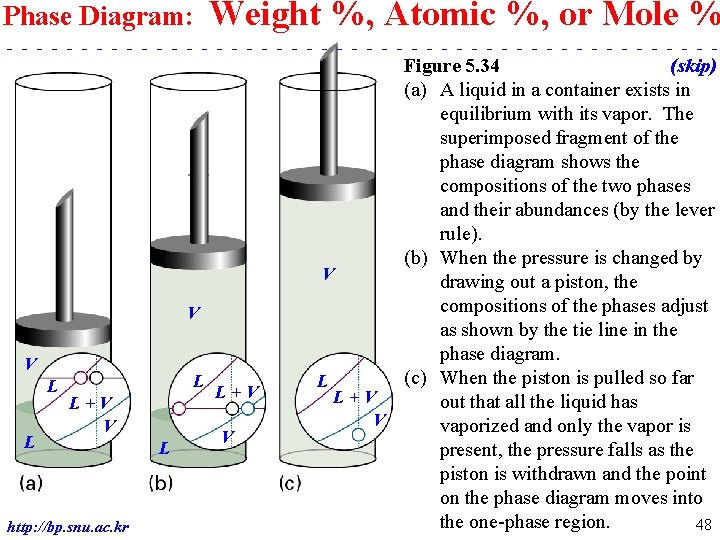
Phase Diagram: Weight %, Atomic %, or Mole % - - - - - - - - - - - - V V L L+V V L+V L Physical Chemistry of Materials http: //bp. snu. ac. kr V Figure 5. 34 (skip) (a) A liquid in a container exists in equilibrium with its vapor. The superimposed fragment of the phase diagram shows the compositions of the two phases and their abundances (by the lever rule). (b) When the pressure is changed by V drawing out a piston, the compositions of the phases adjust as shown by the tie line in the phase diagram. (c) When the piston is pulled so far L L+V out that all the liquid has V vaporized and only the vapor is present, the pressure falls as the piston is withdrawn and the point on the phase diagram moves into Nano-Bio Molecular the one-phase region. Engineering Lab. 48
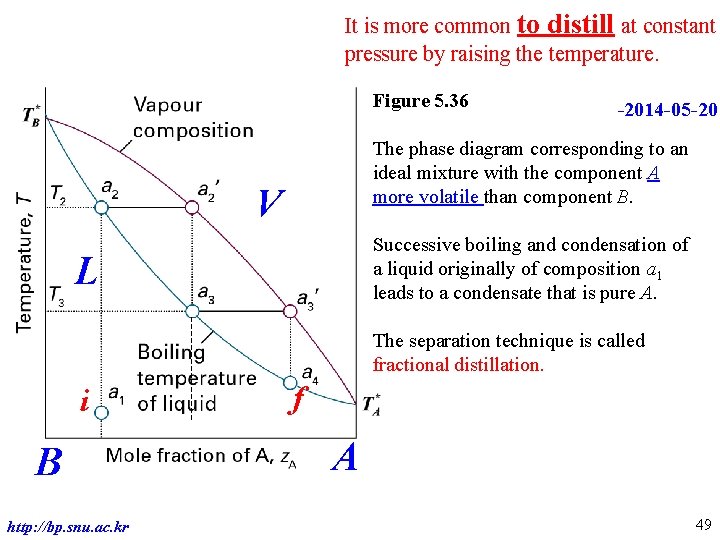
It is more common to distill at constant pressure by raising the temperature. Figure 5. 36 -2014 -05 -20 The phase diagram corresponding to an ideal mixture with the component A more volatile than component B. V Successive boiling and condensation of a liquid originally of composition a 1 leads to a condensate that is pure A. L The separation technique is called fractional distillation. i B Physical Chemistry of Materials http: //bp. snu. ac. kr f A Nano-Bio Molecular Engineering Lab. 49
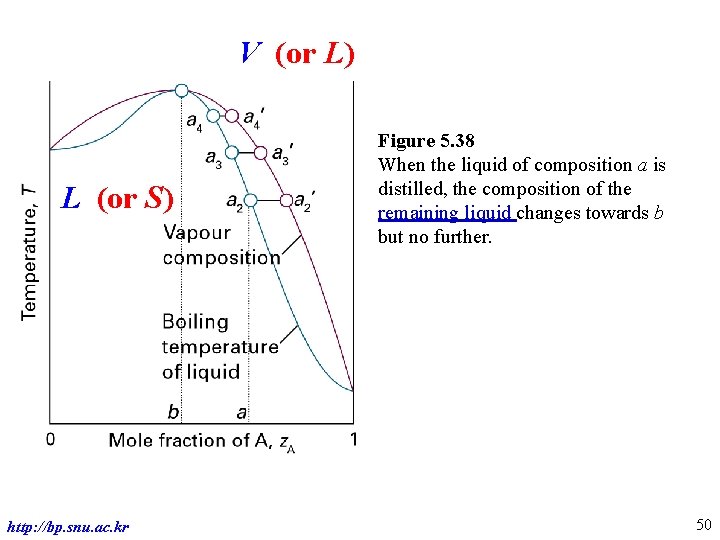
V (or L) L (or S) Physical Chemistry of Materials http: //bp. snu. ac. kr Figure 5. 38 When the liquid of composition a is distilled, the composition of the remaining liquid changes towards b but no further. Nano-Bio Molecular Engineering Lab. 50
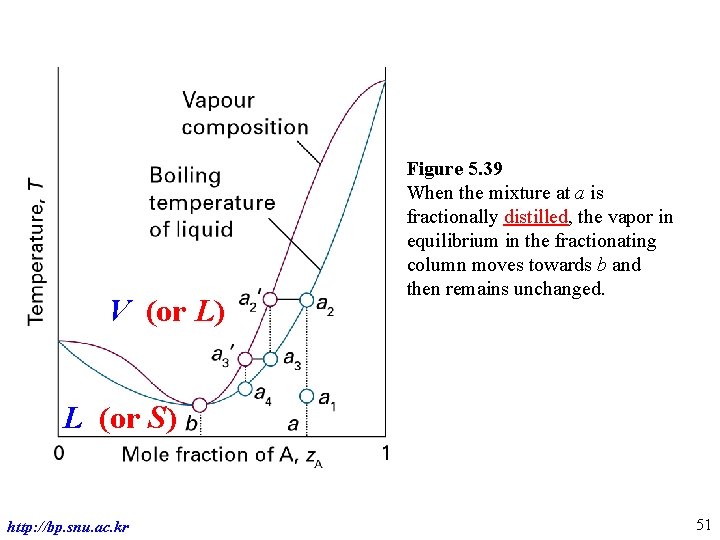
V (or L) Figure 5. 39 When the mixture at a is fractionally distilled, the vapor in equilibrium in the fractionating column moves towards b and then remains unchanged. L (or S) Physical Chemistry of Materials http: //bp. snu. ac. kr Nano-Bio Molecular Engineering Lab. 51
5. 8 Liquid-Liquid (or Solid-Solid) Phase Diagrams C=2, Under conditions where the two liquids mix completely, only one phase is present and so F’=2, which indicates that both the temperature and composition may be varied independently. When the two liquids do not mix, like oil and water, P=2 and so F=2. Consider two partially miscible liquids A and B. The upper critical solution temperature is the temperature above which phase separation does not occur at any composition. It may seem quite natural that there should be upper critical solution temperatures, where the more violent molecular motion overcomes the tendency of molecules of the same species to stick together in swarms and therefore to form two phases. However, some systems show a lower critical solution temperature beneath which they mix in all proportions and above which they form two layers (see Figure 5. 46): e. g. water/ triethylamine. Some systems show both UCST and LCST: e. g. water/nicotine (see Figure 5. 47). Physical Chemistry of Materials http: //bp. snu. ac. kr Nano-Bio Molecular Engineering Lab. 52
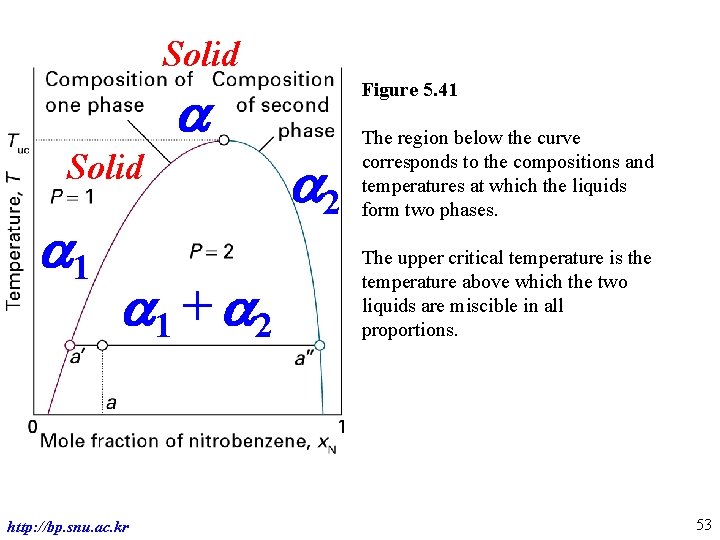
Solid a 1 a 1 + a 2 Physical Chemistry of Materials http: //bp. snu. ac. kr Figure 5. 41 a 2 The region below the curve corresponds to the compositions and temperatures at which the liquids form two phases. The upper critical temperature is the temperature above which the two liquids are miscible in all proportions. Nano-Bio Molecular Engineering Lab. 53
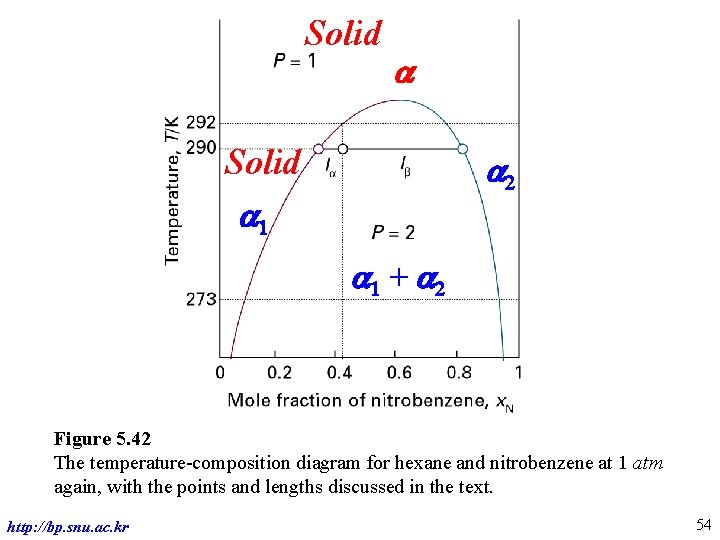
Solid a 2 a 1 + a 2 Figure 5. 42 The temperature-composition diagram for hexane and nitrobenzene at 1 atm again, with the points and lengths discussed in the text. Physical Chemistry of Materials http: //bp. snu. ac. kr Nano-Bio Molecular Engineering Lab. 54
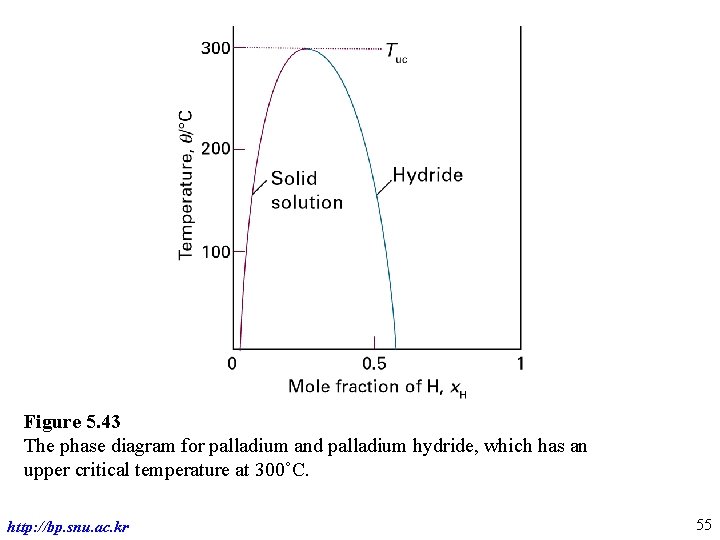
Figure 5. 43 The phase diagram for palladium and palladium hydride, which has an upper critical temperature at 300˚C. Physical Chemistry of Materials http: //bp. snu. ac. kr Nano-Bio Molecular Engineering Lab. 55
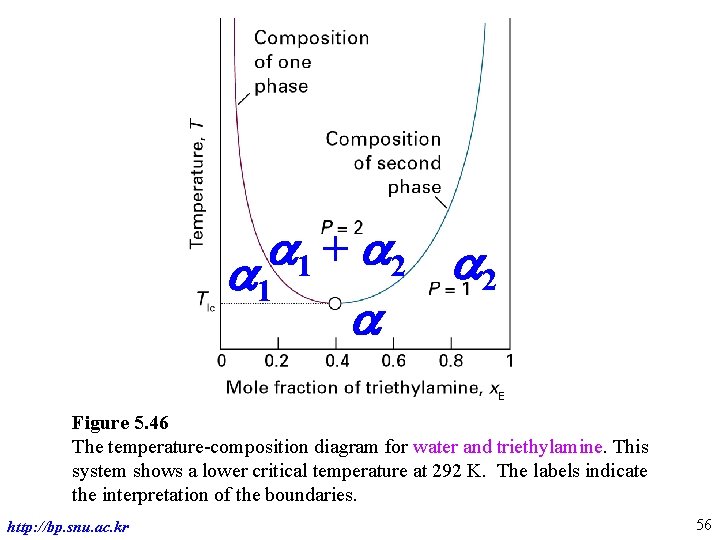
a + a 2 a 1 2 a Figure 5. 46 The temperature-composition diagram for water and triethylamine. This system shows a lower critical temperature at 292 K. The labels indicate the interpretation of the boundaries. Physical Chemistry of Materials http: //bp. snu. ac. kr Nano-Bio Molecular Engineering Lab. 56
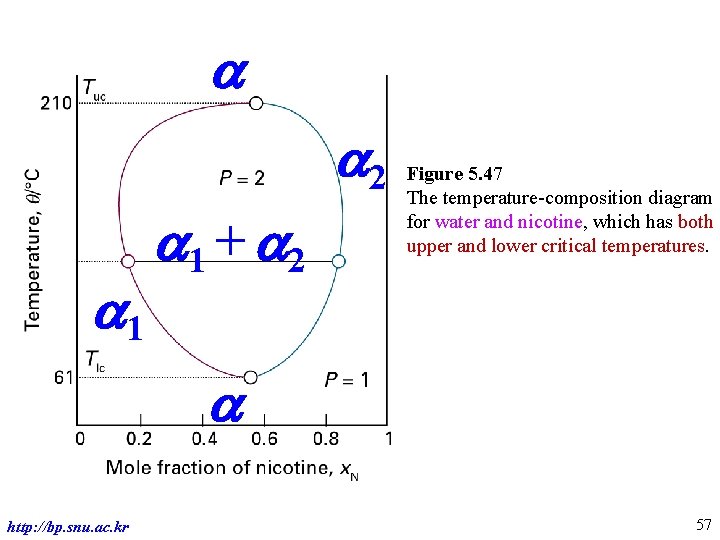
a a 2 a 1 + a 2 Figure 5. 47 The temperature-composition diagram for water and nicotine, which has both upper and lower critical temperatures. a Physical Chemistry of Materials http: //bp. snu. ac. kr Nano-Bio Molecular Engineering Lab. 57
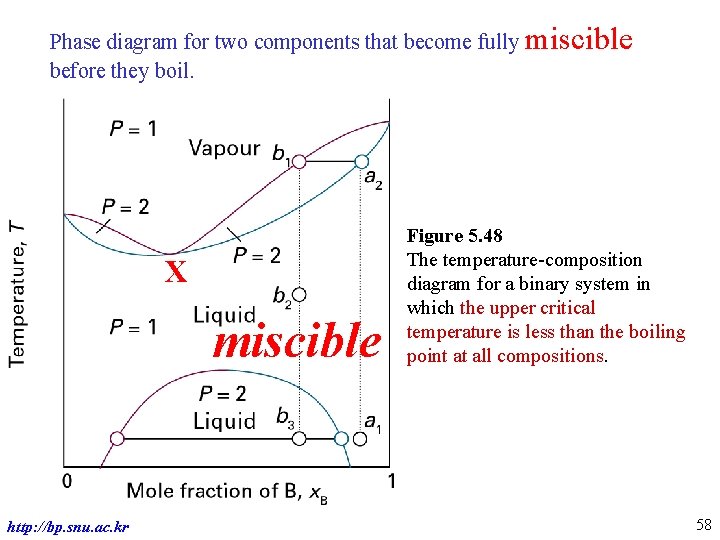
Phase diagram for two components that become fully miscible before they boil. X miscible Physical Chemistry of Materials http: //bp. snu. ac. kr Figure 5. 48 The temperature-composition diagram for a binary system in which the upper critical temperature is less than the boiling point at all compositions. Nano-Bio Molecular Engineering Lab. 58
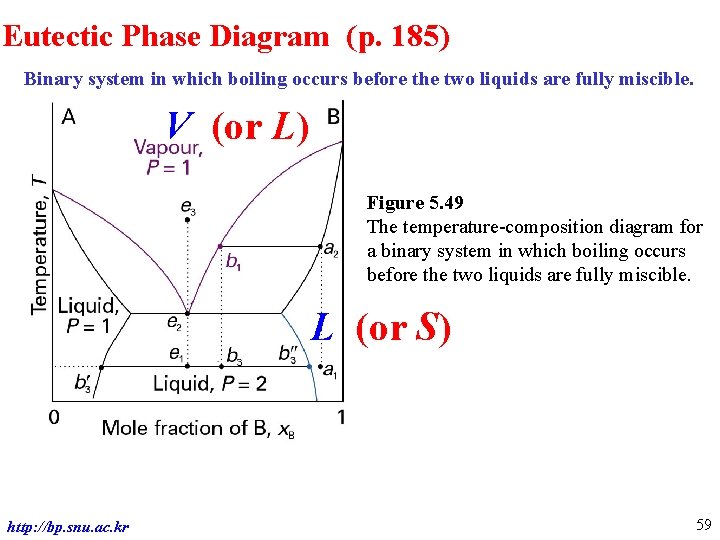
Eutectic Phase Diagram (p. 185) Binary system in which boiling occurs before the two liquids are fully miscible. V (or L) Figure 5. 49 The temperature-composition diagram for a binary system in which boiling occurs before the two liquids are fully miscible. L (or S) Physical Chemistry of Materials http: //bp. snu. ac. kr Nano-Bio Molecular Engineering Lab. 59
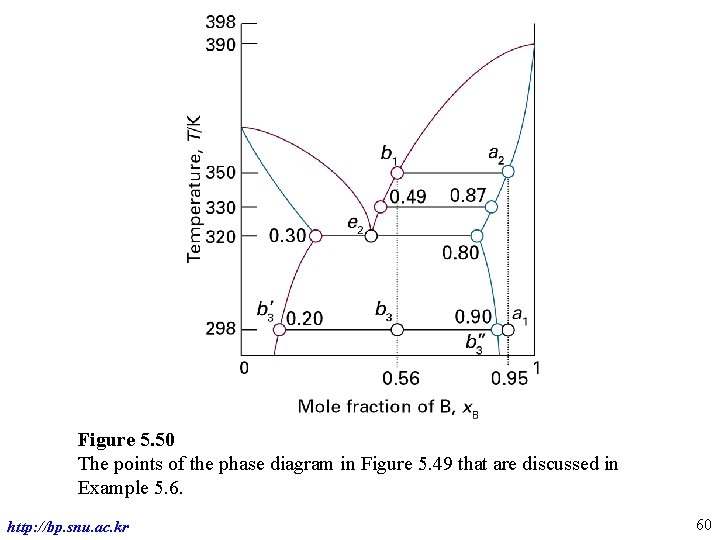
Figure 5. 50 The points of the phase diagram in Figure 5. 49 that are discussed in Example 5. 6. Physical Chemistry of Materials http: //bp. snu. ac. kr Nano-Bio Molecular Engineering Lab. 60
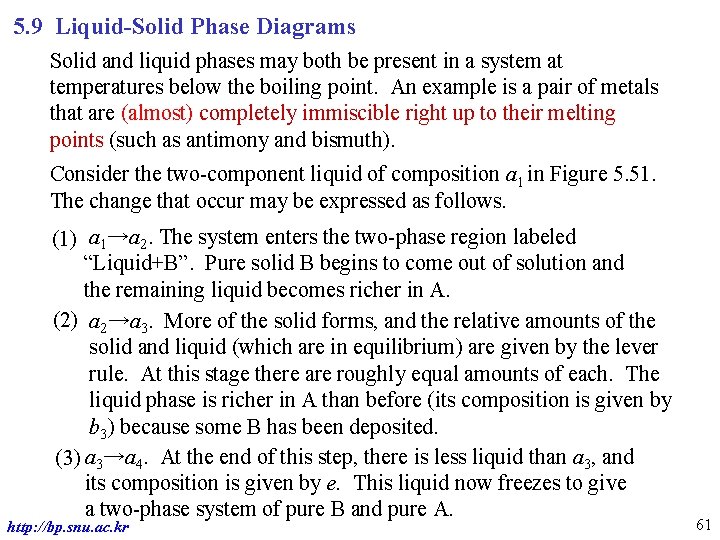
5. 9 Liquid-Solid Phase Diagrams Solid and liquid phases may both be present in a system at temperatures below the boiling point. An example is a pair of metals that are (almost) completely immiscible right up to their melting points (such as antimony and bismuth). Consider the two-component liquid of composition a 1 in Figure 5. 51. The change that occur may be expressed as follows. (1) a 1→a 2. The system enters the two-phase region labeled “Liquid+B”. Pure solid B begins to come out of solution and the remaining liquid becomes richer in A. (2) a 2→a 3. More of the solid forms, and the relative amounts of the solid and liquid (which are in equilibrium) are given by the lever rule. At this stage there are roughly equal amounts of each. The liquid phase is richer in A than before (its composition is given by b 3) because some B has been deposited. (3) a 3→a 4. At the end of this step, there is less liquid than a 3, and its composition is given by e. This liquid now freezes to give a two-phase system of pure B and pure A. Physical Chemistry of Materials Nano-Bio Molecular Engineering Lab. http: //bp. snu. ac. kr 61
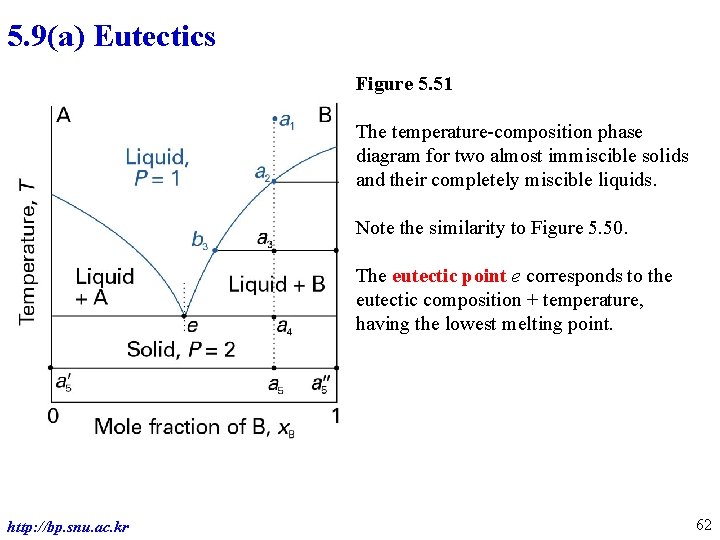
5. 9(a) Eutectics Figure 5. 51 The temperature-composition phase diagram for two almost immiscible solids and their completely miscible liquids. Note the similarity to Figure 5. 50. The eutectic point e corresponds to the eutectic composition + temperature, having the lowest melting point. Physical Chemistry of Materials http: //bp. snu. ac. kr Nano-Bio Molecular Engineering Lab. 62
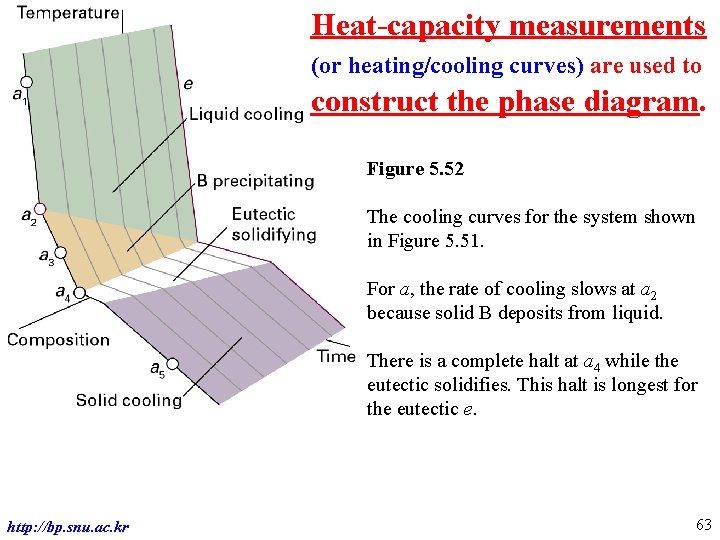
Heat-capacity measurements (or heating/cooling curves) are used to construct the phase diagram. Figure 5. 52 The cooling curves for the system shown in Figure 5. 51. For a, the rate of cooling slows at a 2 because solid B deposits from liquid. There is a complete halt at a 4 while the eutectic solidifies. This halt is longest for the eutectic e. Physical Chemistry of Materials http: //bp. snu. ac. kr Nano-Bio Molecular Engineering Lab. 63
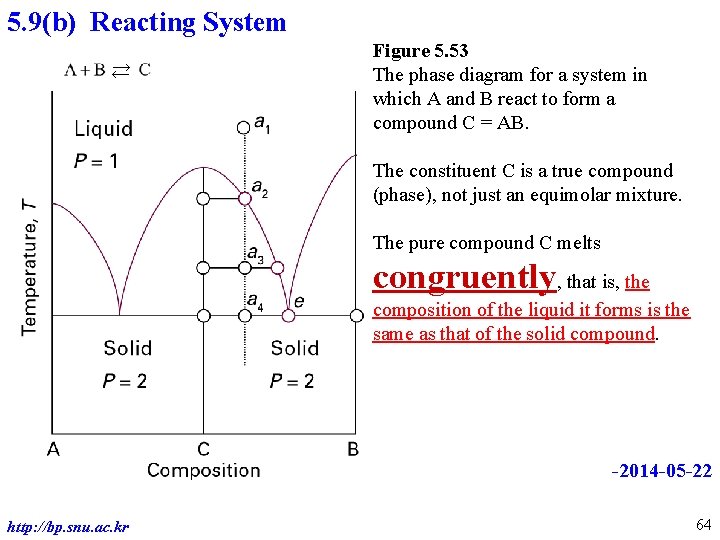
5. 9(b) Reacting System → ← Figure 5. 53 The phase diagram for a system in which A and B react to form a compound C = AB. The constituent C is a true compound (phase), not just an equimolar mixture. The pure compound C melts congruently, that is, the composition of the liquid it forms is the same as that of the solid compound. -2014 -05 -22 Physical Chemistry of Materials http: //bp. snu. ac. kr Nano-Bio Molecular Engineering Lab. 64
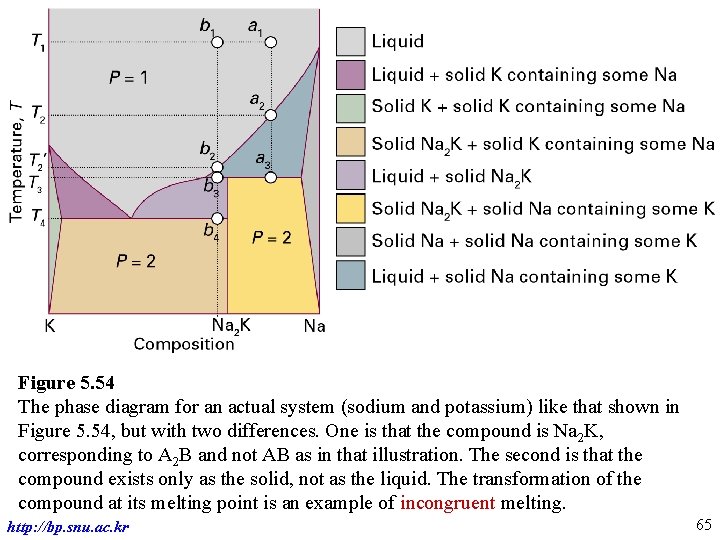
Figure 5. 54 The phase diagram for an actual system (sodium and potassium) like that shown in Figure 5. 54, but with two differences. One is that the compound is Na 2 K, corresponding to A 2 B and not AB as in that illustration. The second is that the compound exists only as the solid, not as the liquid. The transformation of the compound at its melting point is an example of incongruent melting. Physical Chemistry of Materials http: //bp. snu. ac. kr Nano-Bio Molecular Engineering Lab. 65
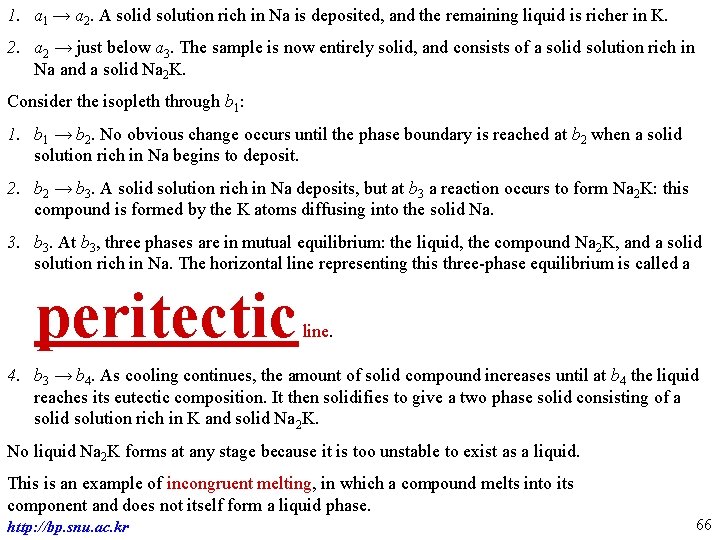
1. a 1 → a 2. A solid solution rich in Na is deposited, and the remaining liquid is richer in K. 2. a 2 → just below a 3. The sample is now entirely solid, and consists of a solid solution rich in Na and a solid Na 2 K. Consider the isopleth through b 1: 1. b 1 → b 2. No obvious change occurs until the phase boundary is reached at b 2 when a solid solution rich in Na begins to deposit. 2. b 2 → b 3. A solid solution rich in Na deposits, but at b 3 a reaction occurs to form Na 2 K: this compound is formed by the K atoms diffusing into the solid Na. 3. b 3. At b 3, three phases are in mutual equilibrium: the liquid, the compound Na 2 K, and a solid solution rich in Na. The horizontal line representing this three-phase equilibrium is called a peritectic line. 4. b 3 → b 4. As cooling continues, the amount of solid compound increases until at b 4 the liquid reaches its eutectic composition. It then solidifies to give a two phase solid consisting of a solid solution rich in K and solid Na 2 K. No liquid Na 2 K forms at any stage because it is too unstable to exist as a liquid. This is an example of incongruent melting, in which a compound melts into its component and does not itself form a liquid phase. Physical Chemistry of Materials http: //bp. snu. ac. kr Nano-Bio Molecular Engineering Lab. 66
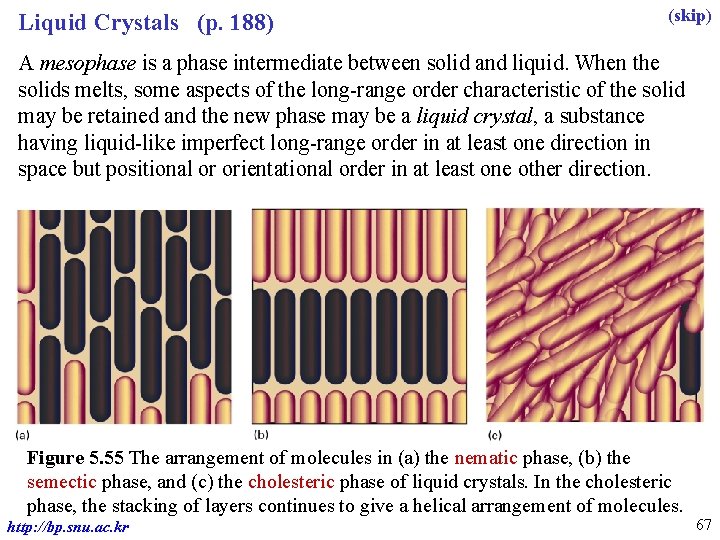
Liquid Crystals (p. 188) (skip) A mesophase is a phase intermediate between solid and liquid. When the solids melts, some aspects of the long-range order characteristic of the solid may be retained and the new phase may be a liquid crystal, a substance having liquid-like imperfect long-range order in at least one direction in space but positional or orientational order in at least one other direction. Figure 5. 55 The arrangement of molecules in (a) the nematic phase, (b) the semectic phase, and (c) the cholesteric phase of liquid crystals. In the cholesteric phase, the stacking of layers continues to give a helical arrangement of molecules. Physical Chemistry of Materials http: //bp. snu. ac. kr Nano-Bio Molecular Engineering Lab. 67
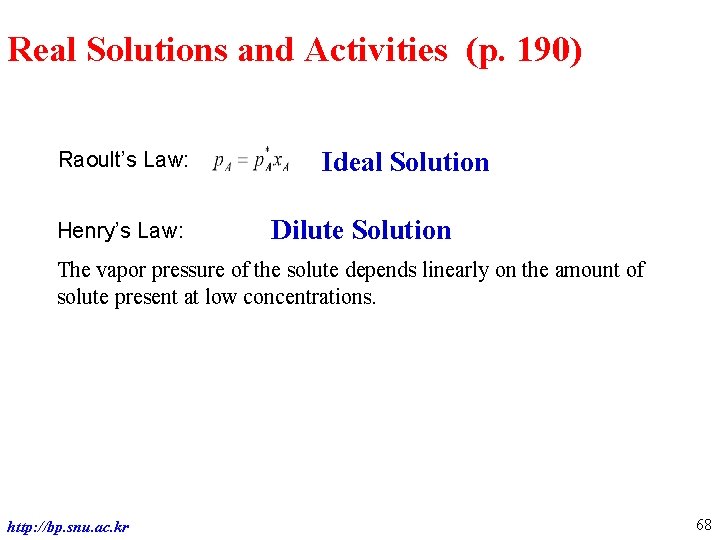
Real Solutions and Activities (p. 190) Raoult’s Law: Henry’s Law: Ideal Solution Dilute Solution The vapor pressure of the solute depends linearly on the amount of solute present at low concentrations. Physical Chemistry of Materials http: //bp. snu. ac. kr Nano-Bio Molecular Engineering Lab. 68
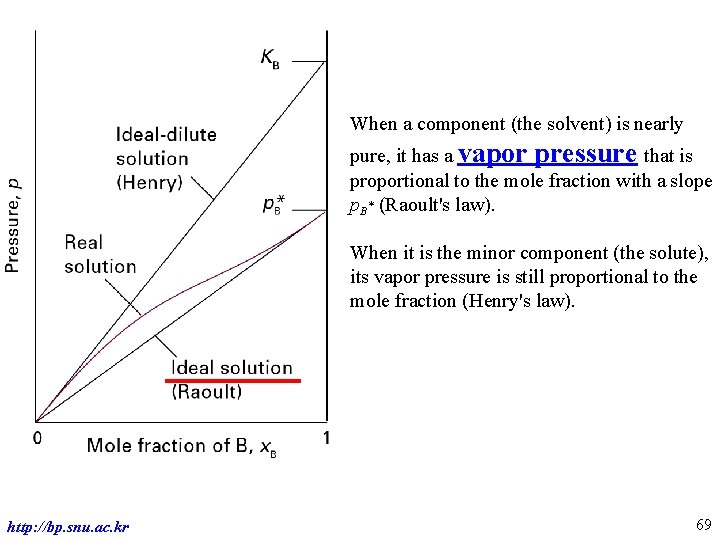
When a component (the solvent) is nearly pure, it has a vapor pressure that is proportional to the mole fraction with a slope p. B* (Raoult's law). When it is the minor component (the solute), its vapor pressure is still proportional to the mole fraction (Henry's law). _____ Physical Chemistry of Materials http: //bp. snu. ac. kr Nano-Bio Molecular Engineering Lab. 69
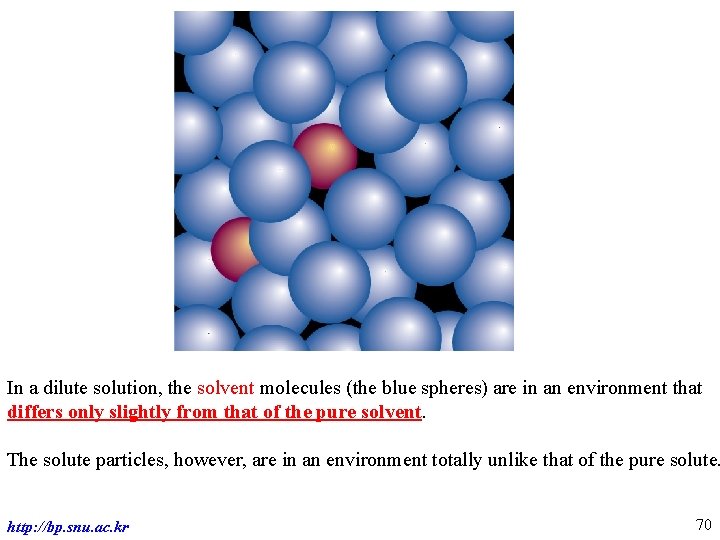
In a dilute solution, the solvent molecules (the blue spheres) are in an environment that differs only slightly from that of the pure solvent. The solute particles, however, are in an environment totally unlike that of the pure solute. Physical Chemistry of Materials http: //bp. snu. ac. kr Nano-Bio Molecular Engineering Lab. 70
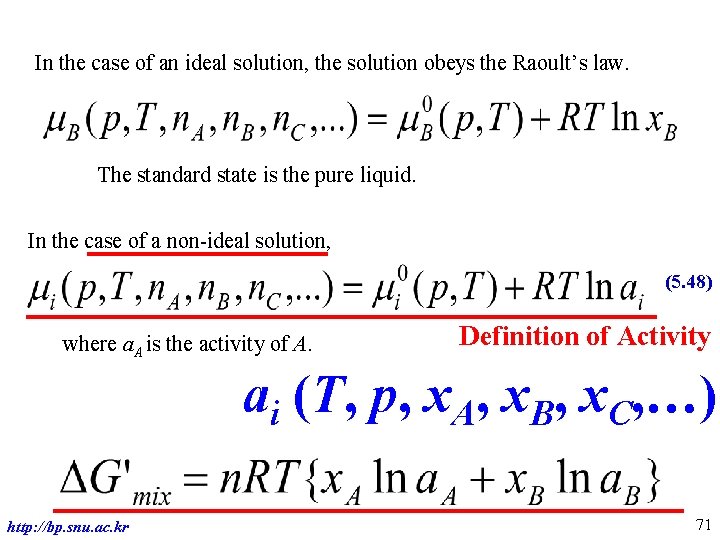
In the case of an ideal solution, the solution obeys the Raoult’s law. The standard state is the pure liquid. _______________ In the case of a non-ideal solution, where a. A is the activity of A. (5. 48) Definition of Activity ai (T, p, x. A, x. B, x. C, …) ___________ Physical Chemistry of Materials http: //bp. snu. ac. kr Nano-Bio Molecular Engineering Lab. 71
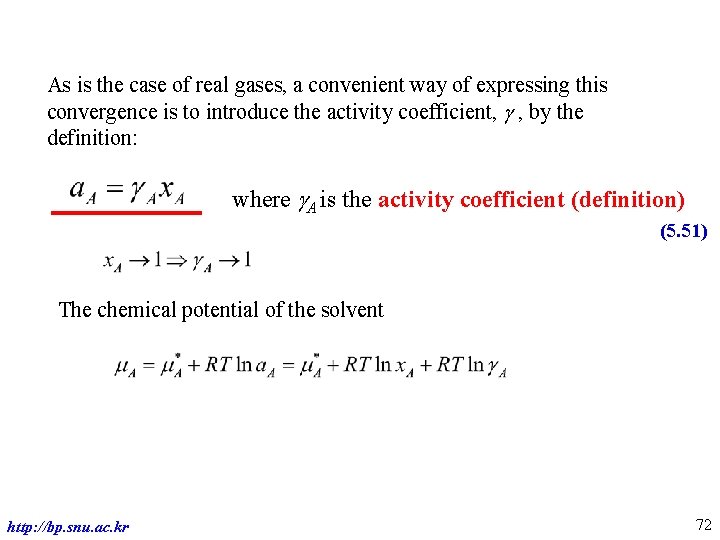
As is the case of real gases, a convenient way of expressing this convergence is to introduce the activity coefficient, g , by the definition: _____ where g. A is the activity coefficient (definition) (5. 51) The chemical potential of the solvent Physical Chemistry of Materials http: //bp. snu. ac. kr Nano-Bio Molecular Engineering Lab. 72
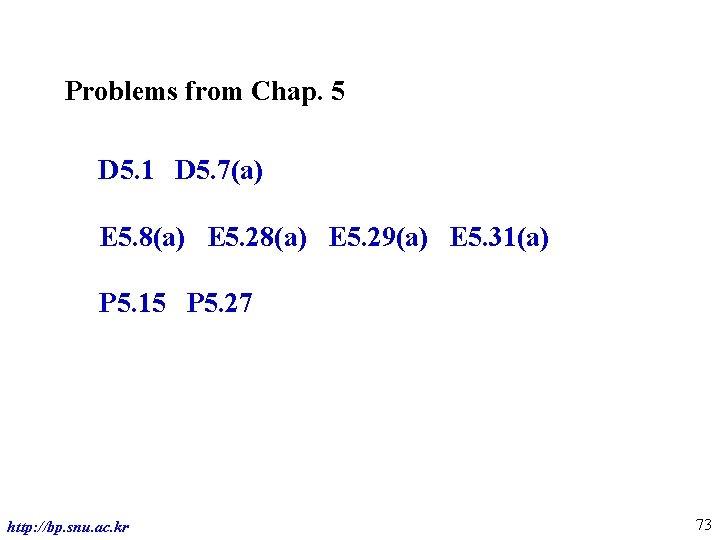
Problems from Chap. 5 D 5. 1 D 5. 7(a) E 5. 8(a) E 5. 29(a) E 5. 31(a) P 5. 15 P 5. 27 Physical Chemistry of Materials http: //bp. snu. ac. kr Nano-Bio Molecular Engineering Lab. 73
- Slides: 73