
Chapter 5 Baseline Vital Signs and SAMPLE History

Chapter 5 Baseline Vital Signs and SAMPLE History
5: Baseline Vital Signs and SAMPLE History Objectives (1 of 4) • Identify the components of vital signs. • Describe methods for obtaining breathing rate. • Differentiate among abnormal breathing qualities. • Describe how to obtain a pulse rate and determine quality. Emergency Care and Transportation of the Sick and 2
5: Baseline Vital Signs and SAMPLE History Objectives (2 of 4) • Differentiate among abnormal pulse qualities. • Describe how to obtain skin temperature, color, and condition. • Identify how to measure capillary refill in children and infants. • Describe how to evaluate pupils. Emergency Care and Transportation of the Sick and 3

5: Baseline Vital Signs and SAMPLE History Objectives (3 of 4) • Describe how to obtain a blood pressure reading. • Define systolic and diastolic blood pressure. • Differentiate between auscultation and palpation when measuring blood pressure. Emergency Care and Transportation of the Sick and 4
5: Baseline Vital Signs and SAMPLE History Objectives (4 of 4) • Identify components of a SAMPLE history. • Differentiate between a sign and a symptom. • State importance of accurately reporting and recording baseline vital signs. • Discuss the need to search for additional medical information. Emergency Care and Transportation of the Sick and 5
5: Baseline Vital Signs and SAMPLE History • Assessment is the most complex skill EMT-Bs learn. • During assessment you will: • Gather key information. • Evaluate the patient. • Learn the history. • Learn about the patient’s overall health. Emergency Care and Transportation of the Sick and 6

5: Baseline Vital Signs and SAMPLE History Gathering Key Patient Information • Obtain the patient’s name. • Note the age, gender, and race. • Look for identification if the patient is unconscious. Emergency Care and Transportation of the Sick and 7
5: Baseline Vital Signs and SAMPLE History Chief Complaint • The major sign and/or symptom reported by the patient • Symptoms • Problems or feelings a patient reports • Signs • Conditions that can be seen, heard, felt, smelled, or measured Emergency Care and Transportation of the Sick and 8
5: Baseline Vital Signs and SAMPLE History Baseline Vital Signs (1 of 3) • Key signs used to evaluate a patient’s condition • First set is known as baseline vitals. • Repeated vital signs compared to the baseline Emergency Care and Transportation of the Sick and 9
5: Baseline Vital Signs and SAMPLE History Baseline Vital Signs (2 of 3) • Vital signs always include: • Respirations • Pulse • Blood pressure Emergency Care and Transportation of the Sick and 10
5: Baseline Vital Signs and SAMPLE History Baseline Vital Signs (3 of 3) • Other key indicators include: • Skin temperature and condition in adults • Capillary refill time in children • Pupils • Level of consciousness Emergency Care and Transportation of the Sick and 11
5: Baseline Vital Signs and SAMPLE History Respirations • Rate • Number of breaths in 30 seconds x 2 • Quality • Character of breathing • Rhythm • Regular or irregular • Effort • Normal or labored • Noisy respiration • Normal, stridor, wheezing, snoring, gurgling • Depth • Shallow or deep Emergency Care and Transportation of the Sick and 12
5: Baseline Vital Signs and SAMPLE History Respiratory Rates Adults Children Infants 12 to 20 breaths/min 15 to 30 breaths/min 25 to 50 breaths/min Emergency Care and Transportation of the Sick and 13
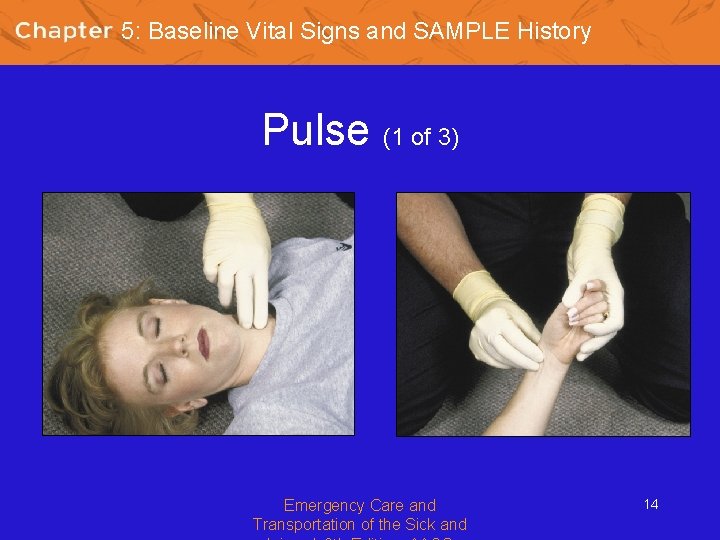
5: Baseline Vital Signs and SAMPLE History Pulse (1 of 3) Emergency Care and Transportation of the Sick and 14
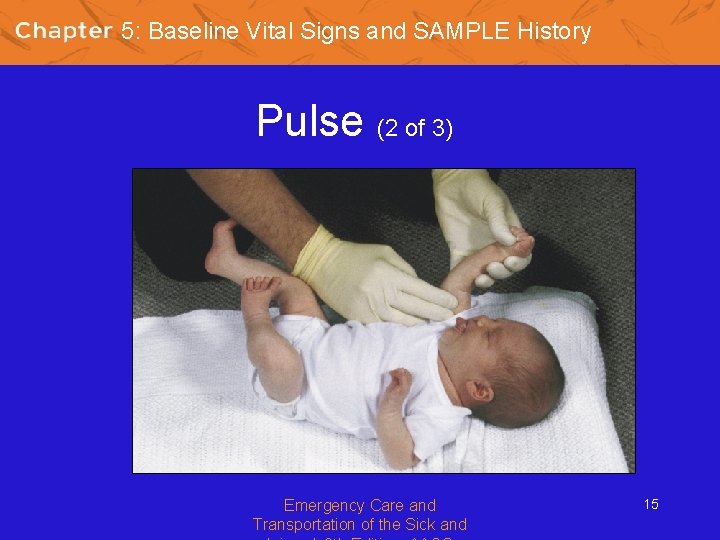
5: Baseline Vital Signs and SAMPLE History Pulse (2 of 3) Emergency Care and Transportation of the Sick and 15
5: Baseline Vital Signs and SAMPLE History Pulse (3 of 3) • Rate • Number of beats in 30 seconds x 2 • Strength • Bounding, strong, or weak (thready) • Regularity • Regular or irregular Emergency Care and Transportation of the Sick and 16

5: Baseline Vital Signs and SAMPLE History Normal Ranges for Pulse Rate Adults Children Toddlers Newborns 60 to 100 beats/min 80 to 100 beats/min 100 to 120 beats/min 120 to 140 beats/min Emergency Care and Transportation of the Sick and 17
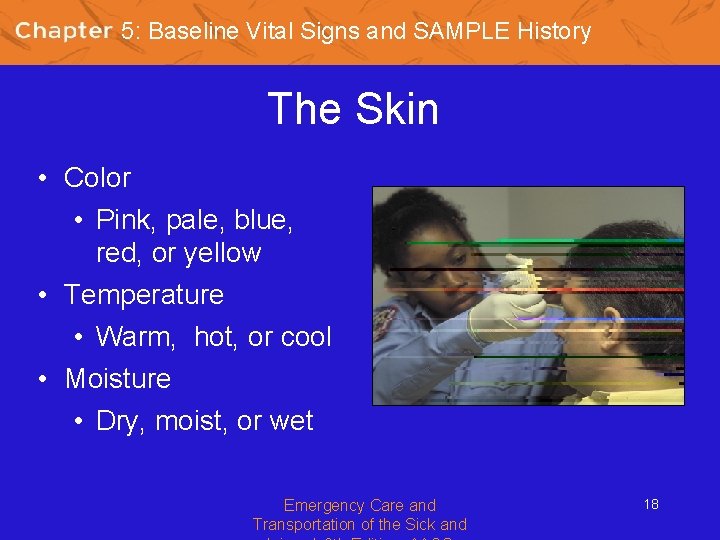
5: Baseline Vital Signs and SAMPLE History The Skin • Color • Pink, pale, blue, red, or yellow • Temperature • Warm, hot, or cool • Moisture • Dry, moist, or wet Emergency Care and Transportation of the Sick and 18
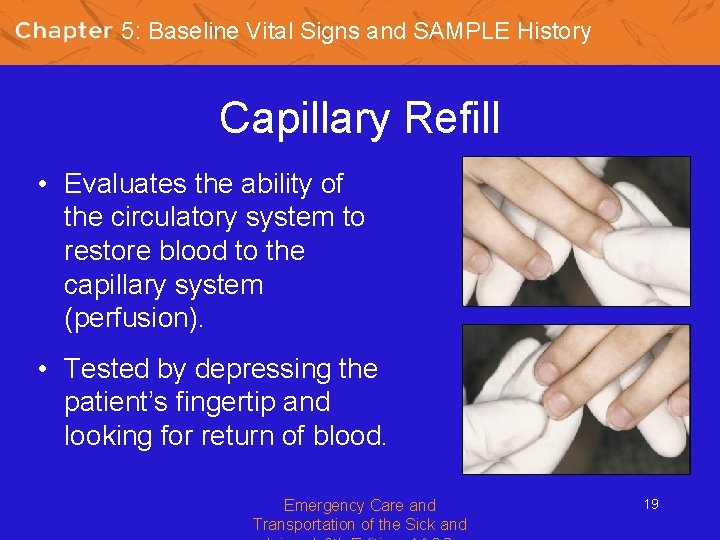
5: Baseline Vital Signs and SAMPLE History Capillary Refill • Evaluates the ability of the circulatory system to restore blood to the capillary system (perfusion). • Tested by depressing the patient’s fingertip and looking for return of blood. Emergency Care and Transportation of the Sick and 19
5: Baseline Vital Signs and SAMPLE History Blood Pressure • Blood pressure is a vital sign. • A drop in blood pressure may indicate: • Loss of blood • Loss of vascular tone • Cardiac pumping problem • Blood pressure should be measured in all patients older than 3 years. Emergency Care and Transportation of the Sick and 20
5: Baseline Vital Signs and SAMPLE History Measuring Blood Pressure • Diastolic • Pressure during relaxing phase of the heart’s cycle • Systolic • Pressure during contraction • Measured as millimeters of mercury (mm Hg) • Recorded as systolic/diastolic Emergency Care and Transportation of the Sick and 21
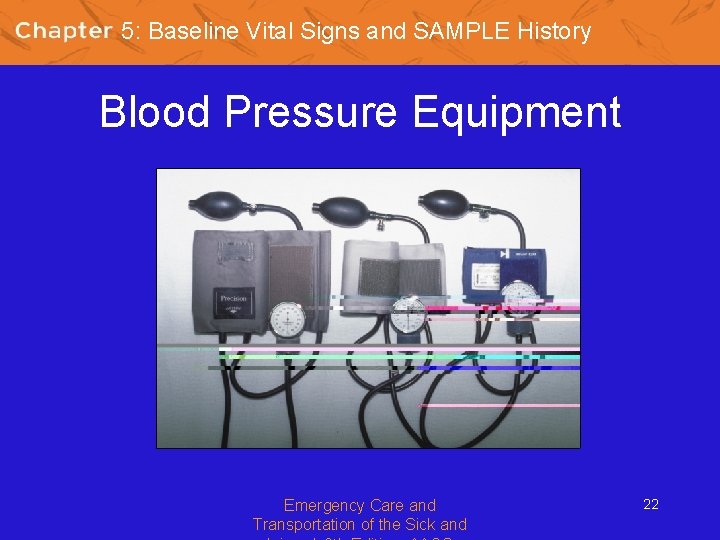
5: Baseline Vital Signs and SAMPLE History Blood Pressure Equipment Emergency Care and Transportation of the Sick and 22
5: Baseline Vital Signs and SAMPLE History Auscultation of Blood Pressure (1 of 2) • Place cuff on patient's arm. • Palpate brachial artery and place stethoscope. • Inflate cuff until you no longer hear pulse sounds. • Continue pumping to increase pressure by an additional 20 mm Hg. Emergency Care and Transportation of the Sick and 23
5: Baseline Vital Signs and SAMPLE History Auscultation of Blood Pressure (2 of 2) • Note the systolic and diastolic pressures as you let air escape slowly. • As soon as pulse sounds stop, open the valve and release the air quickly. Emergency Care and Transportation of the Sick and 24
5: Baseline Vital Signs and SAMPLE History Palpation of Blood Pressure • • • Secure cuff. Locate radial pulse. Inflate to 200 mm Hg. Release air until pulse is felt. Method only obtains systolic pressure. Emergency Care and Transportation of the Sick and 25
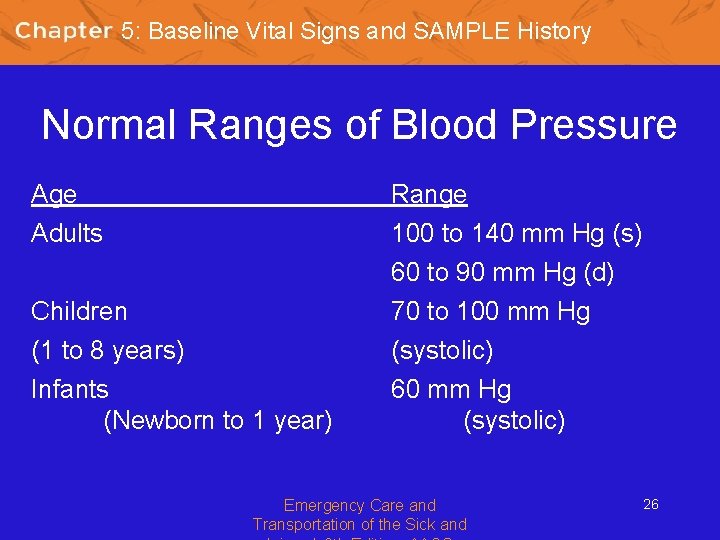
5: Baseline Vital Signs and SAMPLE History Normal Ranges of Blood Pressure Age Range Adults 100 to 140 mm Hg (s) Children (1 to 8 years) Infants (Newborn to 1 year) 60 to 90 mm Hg (d) 70 to 100 mm Hg (systolic) 60 mm Hg (systolic) Emergency Care and Transportation of the Sick and 26
5: Baseline Vital Signs and SAMPLE History Level of Consciousness A - Alert V - Responsive to Verbal stimulus P - Responsive to Pain U - Unresponsive Emergency Care and Transportation of the Sick and 27
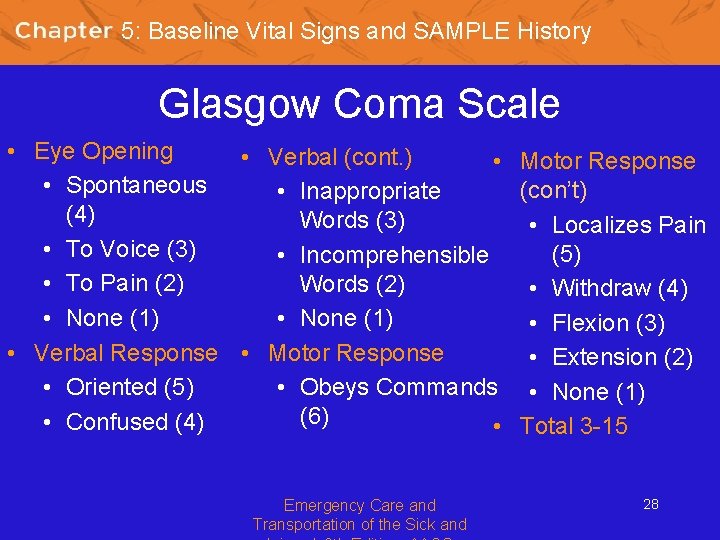
5: Baseline Vital Signs and SAMPLE History Glasgow Coma Scale • Eye Opening • Verbal (cont. ) • Motor Response • Spontaneous (con’t) • Inappropriate (4) Words (3) • Localizes Pain • To Voice (3) (5) • Incomprehensible • To Pain (2) Words (2) • Withdraw (4) • None (1) • Flexion (3) • Verbal Response • Motor Response • Extension (2) • Oriented (5) • Obeys Commands • None (1) (6) • Confused (4) • Total 3 -15 Emergency Care and Transportation of the Sick and 28
5: Baseline Vital Signs and SAMPLE History Abnormal Pupil Reactions • Fixed with no reaction to light • Dilate with light and constrict without light • React sluggishly • Unequal in size • Unequal with light or when light is removed Emergency Care and Transportation of the Sick and 29
5: Baseline Vital Signs and SAMPLE History Pupil Assessment • P - Pupils • E - Equal • A - And • R - Round • R - Regular in size • L - React to Light Emergency Care and Transportation of the Sick and 30
5: Baseline Vital Signs and SAMPLE History Reassessment of Vital Signs • Reassess stable patients every 15 minutes. • Reassess unstable patients every 5 minutes. Emergency Care and Transportation of the Sick and 31
5: Baseline Vital Signs and SAMPLE History Obtaining a SAMPLE History (1 of 2) • S—Signs and Symptoms • What signs and symptoms occurred at onset? • A —Allergies • Is the patient allergic to medications, foods, or other? • M— Medications • What medications is the patient taking? Emergency Care and Transportation of the Sick and 32
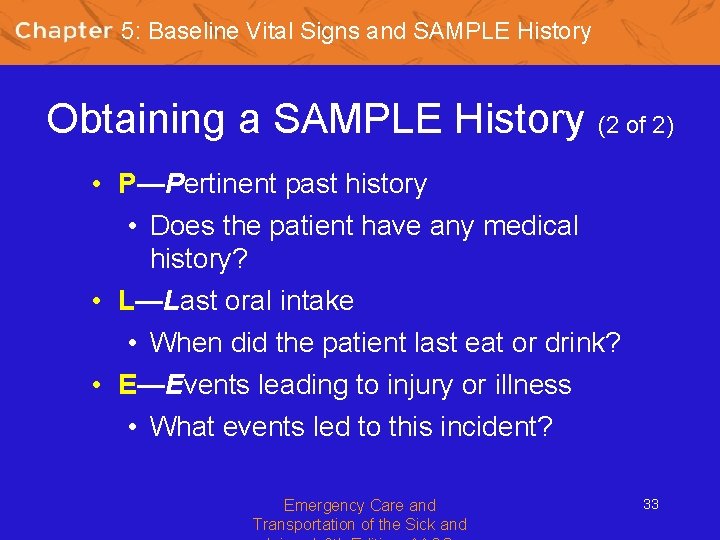
5: Baseline Vital Signs and SAMPLE History Obtaining a SAMPLE History (2 of 2) • P—Pertinent past history • Does the patient have any medical history? • L—Last oral intake • When did the patient last eat or drink? • E—Events leading to injury or illness • What events led to this incident? Emergency Care and Transportation of the Sick and 33
- Slides: 33