
Chapter 5 B Work and Energy A Power
Chapter 5 B - Work and Energy A Power. Point Presentation by Paul E. Tippens, Professor of Physics Southern Polytechnic State University © 2007
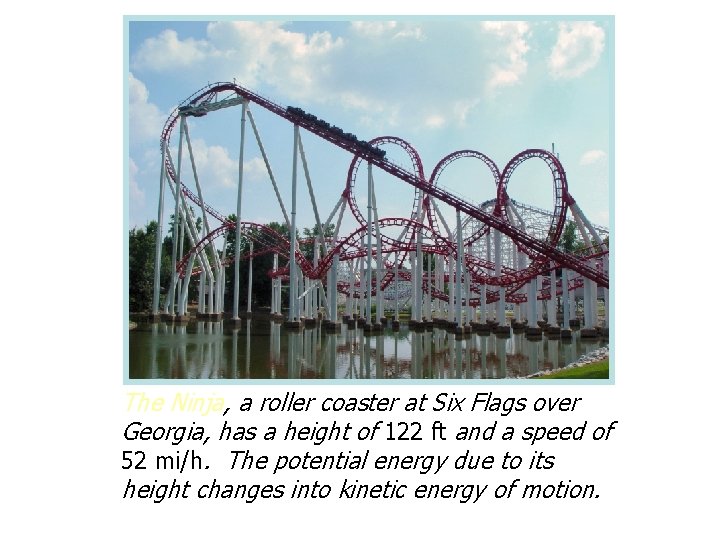
The Ninja, a roller coaster at Six Flags over Georgia, has a height of 122 ft and a speed of 52 mi/h. The potential energy due to its height changes into kinetic energy of motion.
Objectives: After completing this module, you should be able to: • Define kinetic energy and potential energy, along with the appropriate units in each system. • Describe the relationship between work and kinetic energy, and apply the WORKENERGY THEOREM. • Define and apply the concept of POWER, along with the appropriate units.
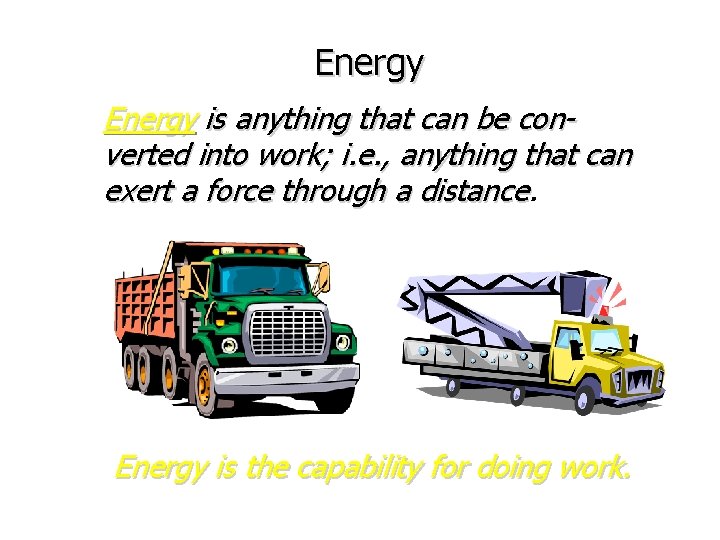
Energy is anything that can be converted into work; i. e. , anything that can exert a force through a distance Energy is the capability for doing work.

Potential Energy: Ability to do work by virtue of position or condition A suspended weight A stretched bow

Example Problem: What is the potential energy of a 50 -kg person in a skyscraper if he is 480 m above the street below? Gravitational Potential Energy What is the P. E. of a 50 -kg person at a height of 480 m? U = mgh = (50 kg)(9. 8 m/s 2)(480 m) U = 235 k. J
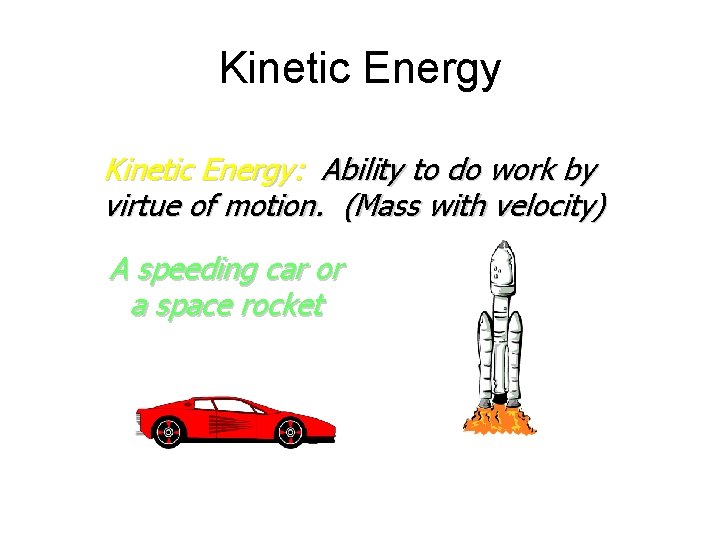
Kinetic Energy: Ability to do work by virtue of motion. (Mass with velocity) A speeding car or a space rocket
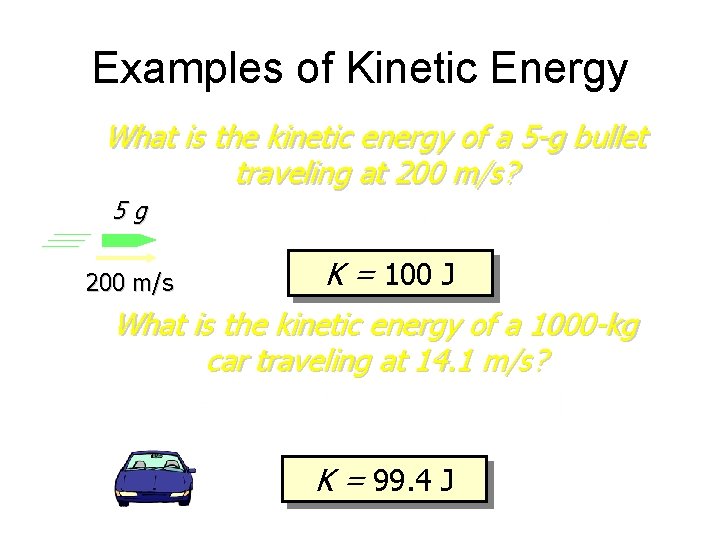
Examples of Kinetic Energy What is the kinetic energy of a 5 -g bullet traveling at 200 m/s? 5 g 200 m/s K = 100 J What is the kinetic energy of a 1000 -kg car traveling at 14. 1 m/s? K = 99. 4 J
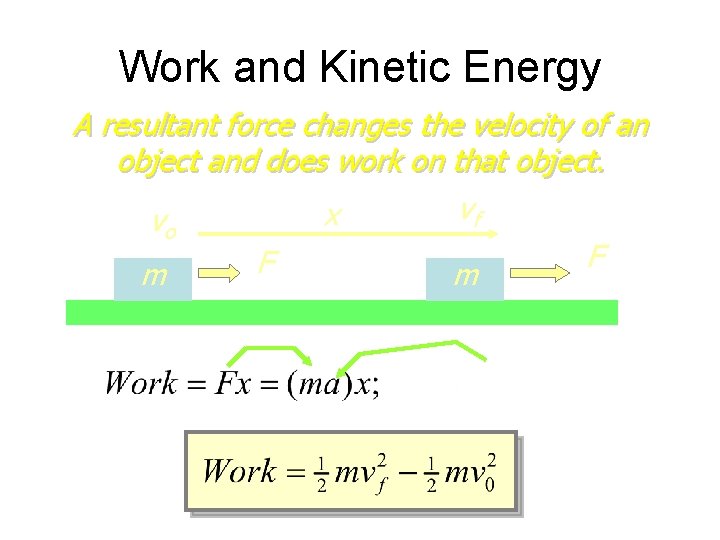
Work and Kinetic Energy A resultant force changes the velocity of an object and does work on that object. vf x v o m F
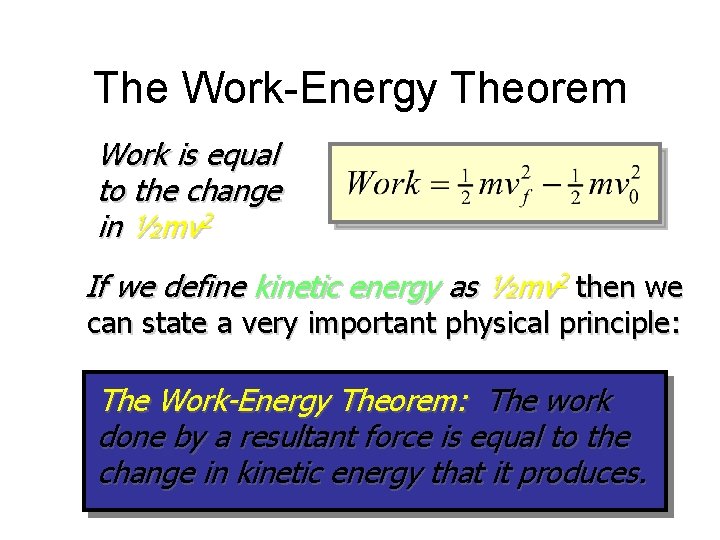
The Work-Energy Theorem Work is equal to the change in ½mv 2 If we define kinetic energy as ½mv 2 then we can state a very important physical principle: The Work-Energy Theorem: The work done by a resultant force is equal to the change in kinetic energy that it produces.
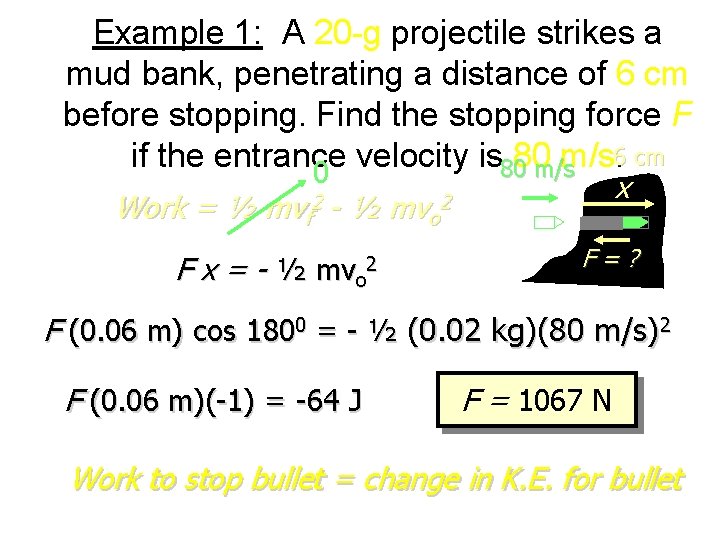
Example 1: A 20 -g projectile strikes a mud bank, penetrating a distance of 6 cm before stopping. Find the stopping force F 6 cm if the entrance velocity is 80 m/s 0 Work = ½ mvf 2 - ½ F x = - ½ mvo 2 x mvo 2 F=? F (0. 06 m) cos 1800 = - ½ (0. 02 kg)(80 m/s)2 F (0. 06 m)(-1) = -64 J F = 1067 N Work to stop bullet = change in K. E. for bullet
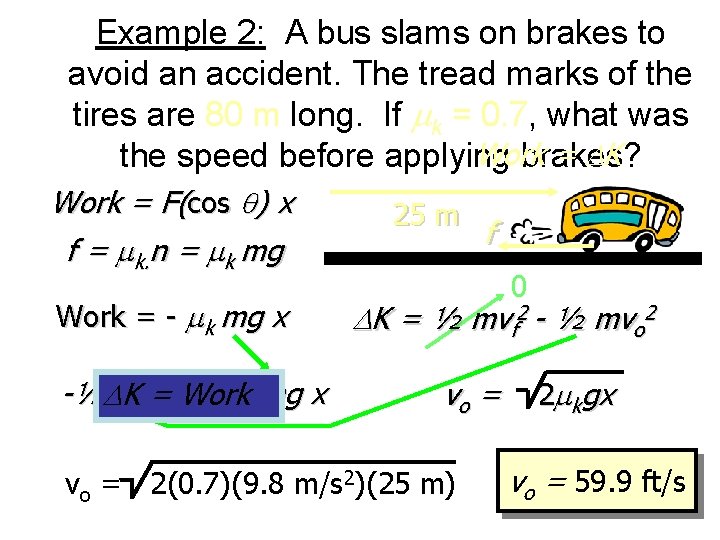
Example 2: A bus slams on brakes to avoid an accident. The tread marks of the tires are 80 m long. If mk = 0. 7, what was Work = DK the speed before applying brakes? Work = F(cos q) x f = mk. n = mk mg Work = - mk mg x 2 Work -½ DK mv= o = -mk mg x 25 m f 0 DK = ½ mvf 2 - ½ mvo 2 vo = 2(0. 7)(9. 8 m/s 2)(25 m) 2 mkgx vo = 59. 9 ft/s
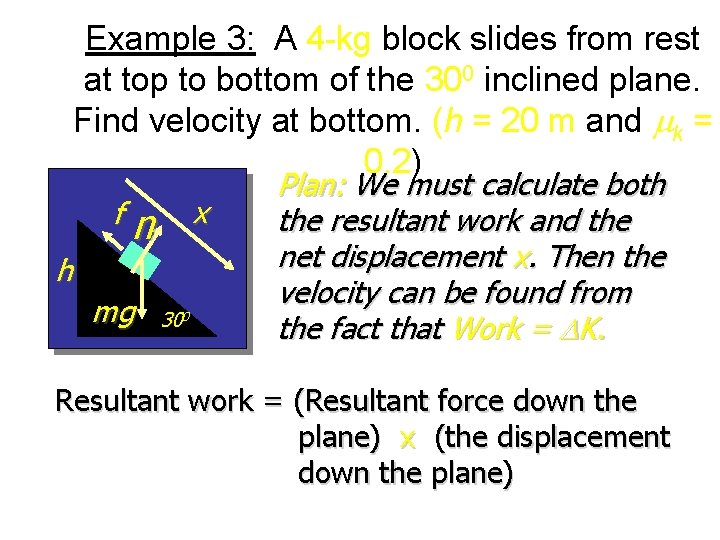
Example 3: A 4 -kg block slides from rest at top to bottom of the 300 inclined plane. Find velocity at bottom. (h = 20 m and mk = 0. 2) x fn h n mg 300 Plan: We must calculate both the resultant work and the net displacement x. Then the velocity can be found from the fact that Work = DK. Resultant work = (Resultant force down the plane) x (the displacement down the plane)
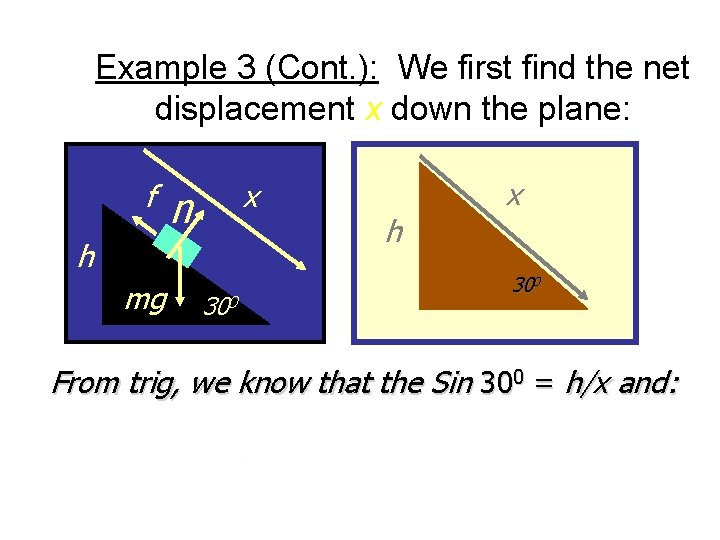
Example 3 (Cont. ): We first find the net displacement x down the plane: f x n h mg 300 h x 300 From trig, we know that the Sin 300 = h/x and:
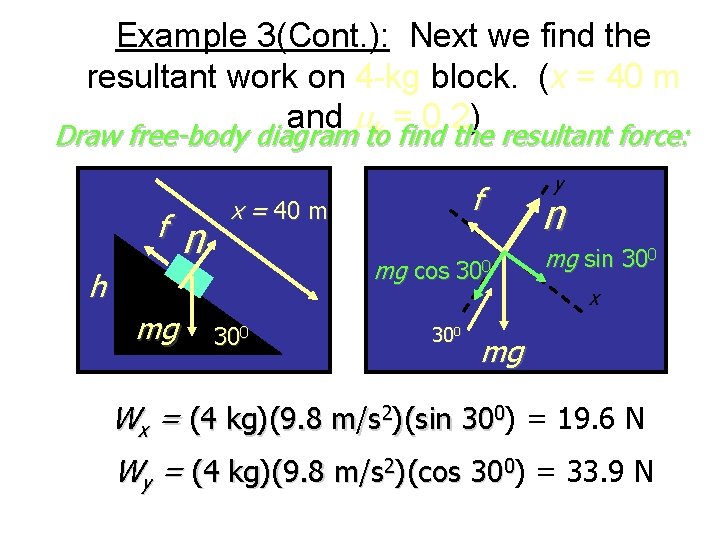
Example 3(Cont. ): Next we find the resultant work on 4 -kg block. (x = 40 m and mk = 0. 2) Draw free-body diagram to find the resultant force: f n mg cos h mg f x = 40 m 300 300 y n mg sin 300 x mg Wx = (4 kg)(9. 8 m/s 2)(sin 300) = 19. 6 N Wy = (4 kg)(9. 8 m/s 2)(cos 300) = 33. 9 N
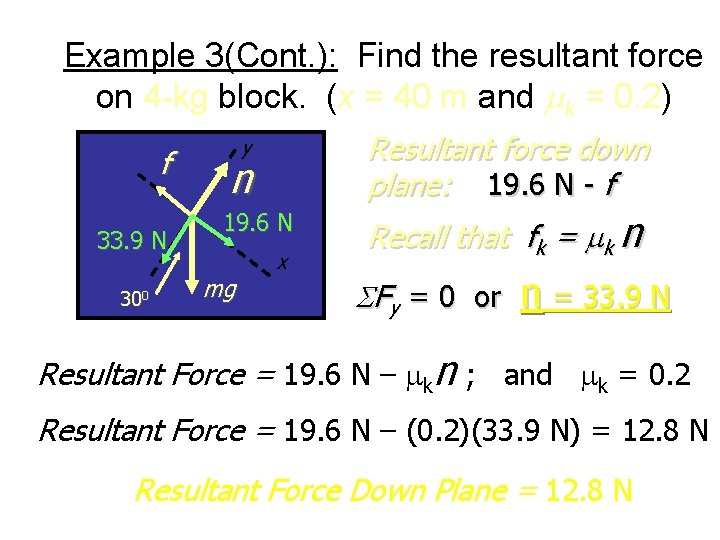
Example 3(Cont. ): Find the resultant force on 4 -kg block. (x = 40 m and mk = 0. 2) f 33. 9 N 300 n Resultant force down plane: 19. 6 N - f 19. 6 N Recall that fk = mk n y mg x SFy = 0 or n = 33. 9 N Resultant Force = 19. 6 N – mkn ; and mk = 0. 2 Resultant Force = 19. 6 N – (0. 2)(33. 9 N) = 12. 8 N Resultant Force Down Plane = 12. 8 N
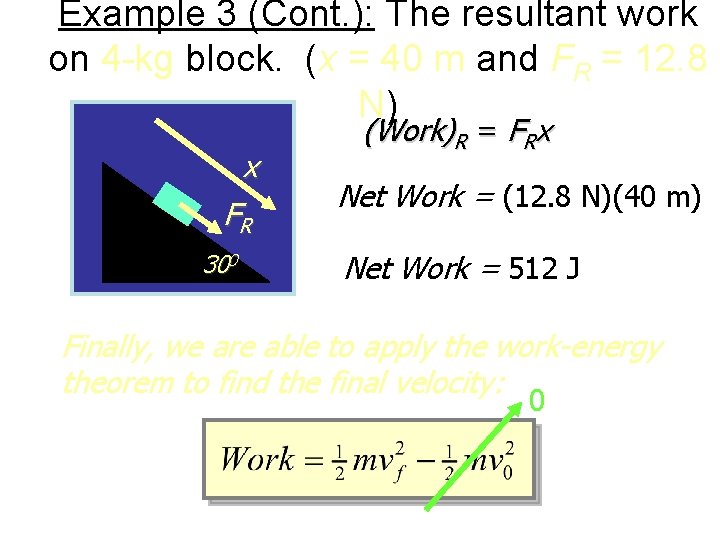
Example 3 (Cont. ): The resultant work on 4 -kg block. (x = 40 m and FR = 12. 8 N) x FR 300 (Work)R = FRx Net Work = (12. 8 N)(40 m) Net Work = 512 J Finally, we are able to apply the work-energy theorem to find the final velocity: 0
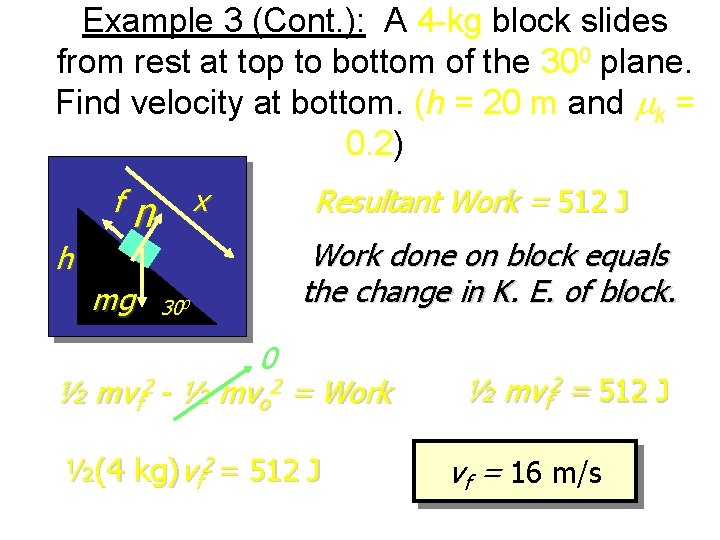
Example 3 (Cont. ): A 4 -kg block slides from rest at top to bottom of the 300 plane. Find velocity at bottom. (h = 20 m and mk = 0. 2) x fn h n mg 300 Resultant Work = 512 J Work done on block equals the change in K. E. of block. 0 ½ mvf 2 - ½ mvo 2 = Work ½(4 kg)vf 2 = 512 J ½ mvf 2 = 512 J vf = 16 m/s
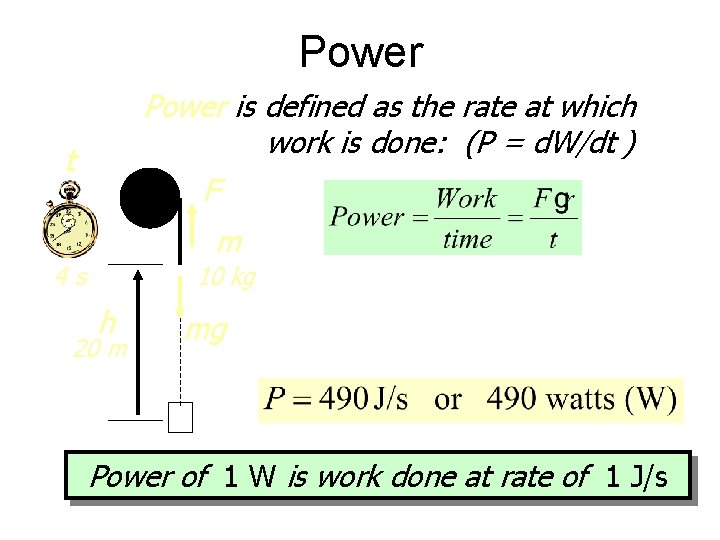
Power is defined as the rate at which work is done: (P = d. W/dt ) F t m 4 s 10 kg h 20 m mg Power of 1 W is work done at rate of 1 J/s
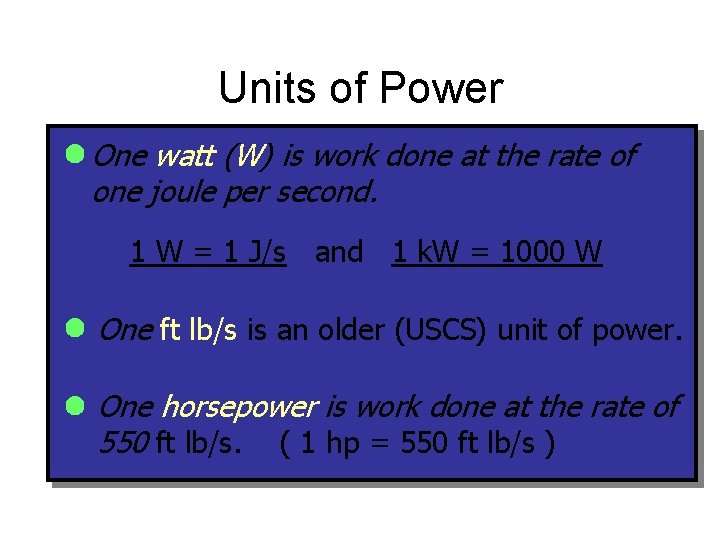
Units of Power One watt (W) is work done at the rate of one joule per second. 1 W = 1 J/s and 1 k. W = 1000 W One ft lb/s is an older (USCS) unit of power. One horsepower is work done at the rate of 550 ft lb/s. ( 1 hp = 550 ft lb/s )
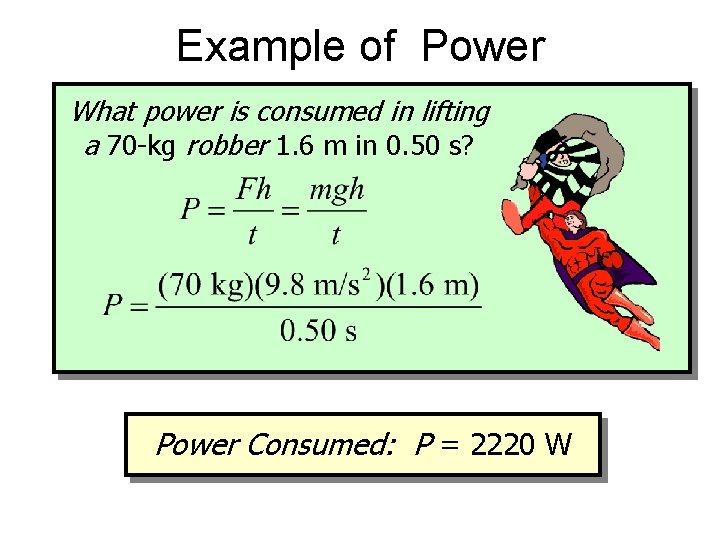
Example of Power What power is consumed in lifting a 70 -kg robber 1. 6 m in 0. 50 s? Power Consumed: P = 2220 W
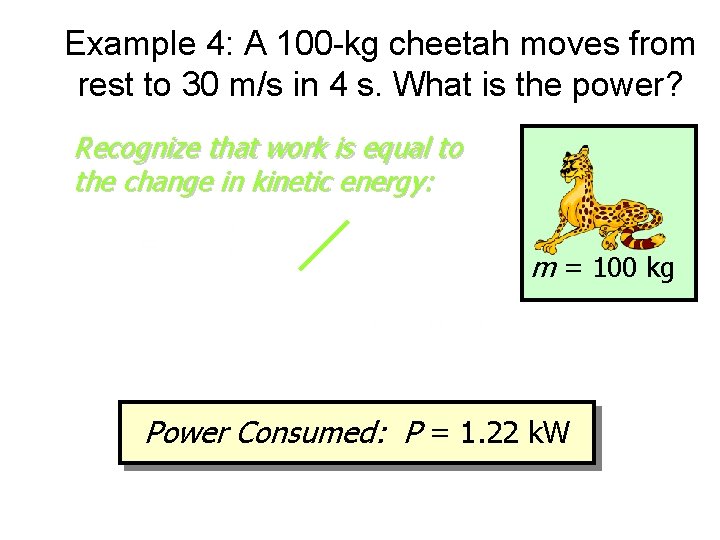
Example 4: A 100 -kg cheetah moves from rest to 30 m/s in 4 s. What is the power? Recognize that work is equal to the change in kinetic energy: m = 100 kg Power Consumed: P = 1. 22 k. W
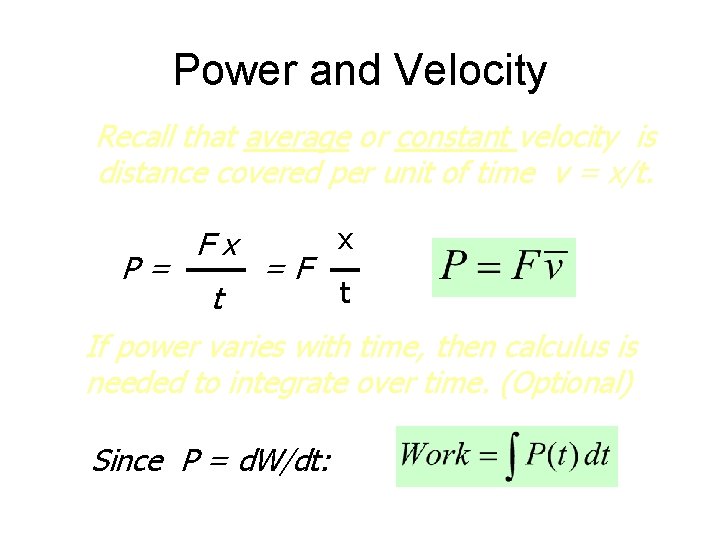
Power and Velocity Recall that average or constant velocity is distance covered per unit of time v = x/t. P= Fx t =F x t If power varies with time, then calculus is needed to integrate over time. (Optional) Since P = d. W/dt:
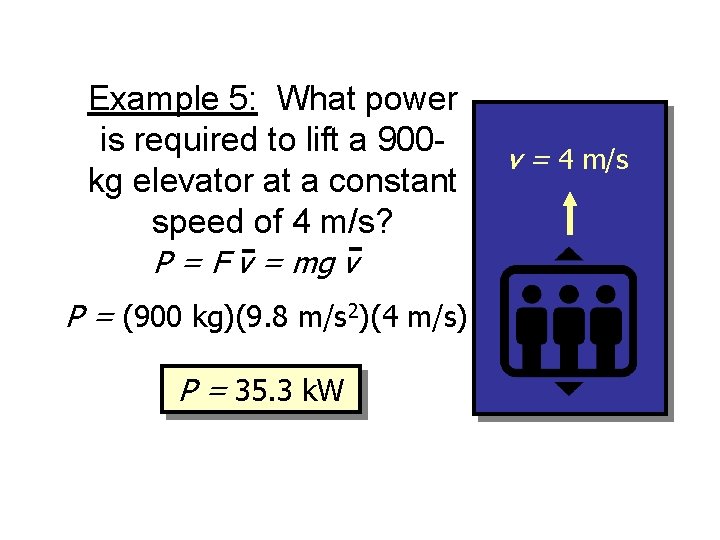
Example 5: What power is required to lift a 900 kg elevator at a constant speed of 4 m/s? P = F v = mg v P = (900 kg)(9. 8 m/s 2)(4 m/s) P = 35. 3 k. W v = 4 m/s
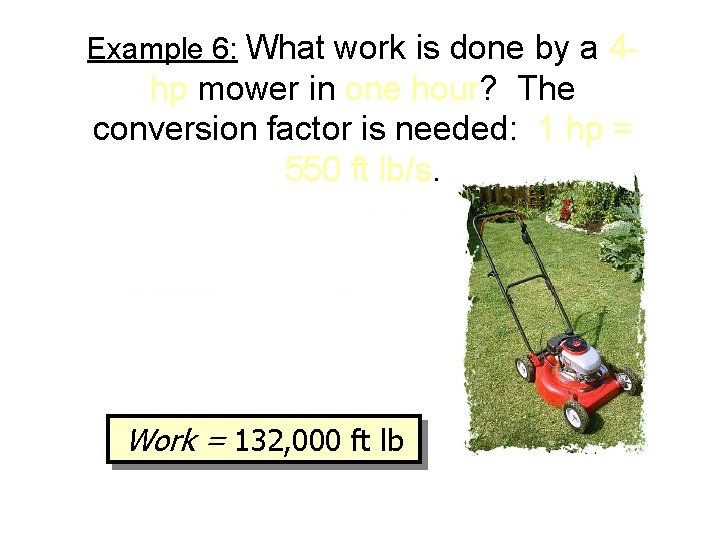
Example 6: What work is done by a 4 - hp mower in one hour? The conversion factor is needed: 1 hp = 550 ft lb/s. Work = 132, 000 ft lb
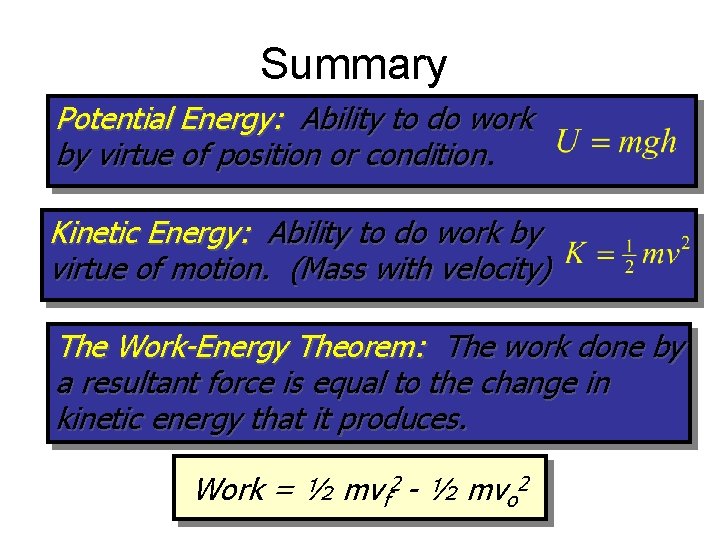
Summary Potential Energy: Ability to do work by virtue of position or condition Kinetic Energy: Ability to do work by virtue of motion. (Mass with velocity) The Work-Energy Theorem: The work done by a resultant force is equal to the change in kinetic energy that it produces. Work = ½ mvf 2 - ½ mvo 2
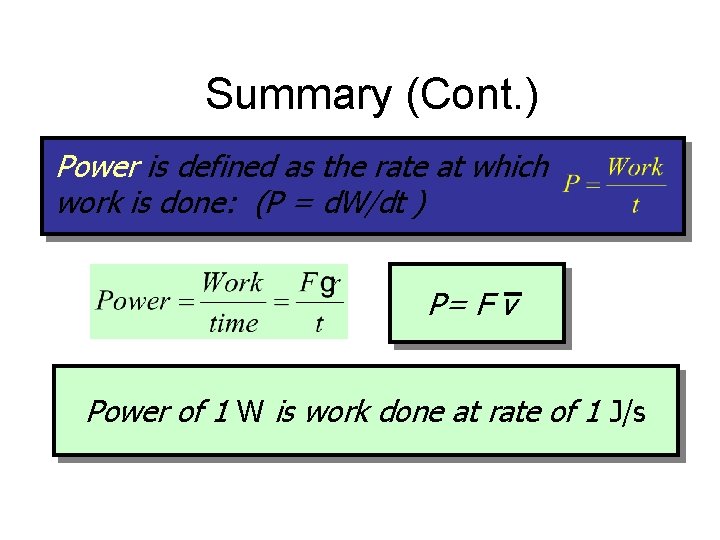
Summary (Cont. ) Power is defined as the rate at which work is done: (P = d. W/dt ) P= F v Power of 1 W is work done at rate of 1 J/s
- Slides: 27