
Chapter 5 Atomic Structure and the Periodic Table
Chapter 5 Atomic Structure and the Periodic Table
Warm up (1 -4 -16) • Get a warm-up off the front table please! • What do you know about atomic structure? • Think about specific molecules you may know of. How would you describe their atomic structure?
Outline • • • Objectives Review Semester Test Goal Setting Natural Remedies Reading Model Medicine discussion Read ch. 5. 1
Objectives • IWBAT explain atomic structure and have a general understanding of how atomic structure relates to the periodic table of elements
Warm up (1 -5 -16) • What is the periodic table of elements? • Is there a specific way that the elements are arranged?
Outline • • • Objectives Read Chapter 5. 1 -5. 2 Notes Chapter 5. 1 and 5. 2 Model Medicine Project Intro Model Medicine Project Planning
Objectives • IWBAT explain atomic structure and have a general understanding of how atomic structure relates to the periodic table of elements • IWBAT explain the organization of the periodic table of elements and the locations of those elements on the table
Explore the size of atoms How small can you tear a piece of paper? 1. Rip the strip of paper in half. Rip one of these halves in half. 2. Continue ripping one piece of paper in half as many times as you can. What do you think? • How many rips were you able to make? • Do you think you could keep ripping the paper forever? Why or why not?
5. 1 Notes • Atoms are the smallest form of elements – All matter is made of atoms – Greek philosophers proposed everything on Earth was made of 4 basic substances – air, water, fire, and earth – Now we know there about 100 basic substances or elements
5. 1 Notes • Each element is made of a different atom – Atoms are composed of three types of particles • Proton – positively charged in nucleus • Neutron – neutral charge in nucleus • Electron – negatively charged, orbits nucleus – Atomic number: the identity of an atom is determined by the number of protons in its nucleus – Atomic mass number: total number of protons and neutrons in an atom’s nucleus – Isotopes: atoms of the same element that have a different number of neutrons.
5. 1 Notes • Atoms form ions – Ion: formed when an atom loses or gains one or more electrons – Positive ions: lose an electron (-) so the overall charge of the atom is positive – Negative ions: gain an electron (-) so the overall charge of the atom is negative
Warm up (1 -6 -16) • Why do you think knowing about atomic structure is beneficial to doctors? • What are some potential risks associated with not knowing atomic structure when doctors are producing new medicine?
Outline • Objectives • Model Medicine
Objectives • IWBAT explain atomic structure and have a general understanding of how atomic structure relates to the periodic table of elements • IWBAT explain the organization of the periodic table of elements and the locations of those elements on the table
How can different objects be organized? • P. 145 • Procedure – With several classmates, organize the buttons into three or more groups – Compare your team’s organization of the buttons with another team’s organization • What do you think? – What characteristics did you use to organize the buttons? – In what other ways could you have organized the buttons?
5. 2 Notes • Elements make up the periodic table – Elements can be organized by similarities • Atomic mass: average mass of all the element’s isotopes • Periodic table: shows a periodic, or repeating pattern of properties of the elements – The periodic table organizes the atoms of the elements by properties and atomic number
5. 2 Notes • Reading the Periodic Table – Number at the top of the square is the atomic number, which is the number of protons in the nucleus of an atom of that element – The chemical symbol is an abbreviation for the element’s name. It contains one or two letters. Some elements have not yet been named are designated by temporary three-letter symbols – The name of the element is written below the symbol – The number below the name indicates the average atomic mass of all the isotopes of the element
5. 2 Notes – Group: elements in a column are labeled by a number at the top of the column – Period: horizontal row • Trends in the Periodic Table – Sizes of atoms – Densities of atoms
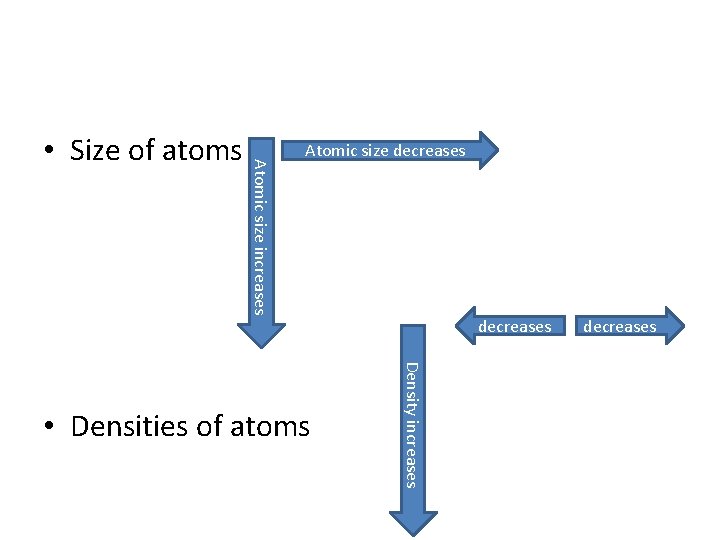
Atomic size increases • Size of atoms Atomic size decreases Density increases • Densities of atoms decreases
Warm up (1 -7 -16) • How does structure of atoms help determine specific properties of those elements or substances?
Outline • Objectives • 5. 3 Reading and Notes • Model Medicine
Objectives • IWBAT explain atomic structure and have a general understanding of how atomic structure relates to the periodic table of elements • IWBAT explain the organization of the periodic table of elements and the locations of those elements on the table
5. 3 Notes • The periodic table is a map of the elements – The periodic table has distinct regions • Reactive: indicates how likely an element is to undergo a chemical change
5. 3 Notes – Most elements are metals • Metals: elements that conduct electricity and heat well and have a shiny appearance. Can be easily shaped, solid at room temperature besides Mercury • Reactive Metals: group 1 and group 2 • Transition Metals: groups 3 -12 • Rare Earth Elements: top row of the two rows of metals that are usually shown outside the main body of the periodic table
5. 3 Notes – Nonmetals and metalloids have a wide range of properties • Nonmetals: elements to the right side of the periodic table • Halogens: Group 17, form salts • Noble Gases: Group 18 elements, almost never react with other elements • Metalloids: elements that have properties of both metals and nonmetals
5. 3 Notes – Some atoms can change their identity • Identity of an element is determined by the number of protons in its nucleus • Radioactivity: the process by which atoms produce energy and particles – An isotope is radioactive if the nucleus has too many or too few neutrons • Radioactive decay: radioactive atoms produce energy and particles from their nuclei, occurs at a steady rate that is characteristic of the particular isotope – Half-life: the amount of time that it takes for one-half of the atoms in a particular sample to decay
Plan for Medicine Project 1. Names of Group Members 2. Which medicine you are going to use 3. What type of presentation you are going to do 4. What materials you are going to use 5. Who will bring what materials
Isotope activity • Isotopes and atomic mass simulation • http: //phet. colorado. edu/en/simulation/isoto pes-and-atomic-mass
How to cite in MLA • Contributors' names. "Title of Resource. " The Purdue OWL. Purdue U Writing Lab, Last edited date. Web. Date of access. • Russell, Tony, Allen Brizee, and Elizabeth Angeli. "MLA Formatting and Style Guide. " The Purdue OWL. Purdue U Writing Lab, 4 Apr. 2010. Web. 20 July 2010.
Warm up (1 -8 -16) • What is one explanation that can be given for the chemical and physical properties that are used to describe substances?
Outline • Objectives • Model Medicine • Introduce and Discuss Elements Quiz!!
Objectives • IWBAT explain atomic structure and have a general understanding of how atomic structure relates to the periodic table of elements • IWBAT explain the organization of the periodic table of elements and the locations of those elements on the table
How to cite in MLA • Contributors' names. "Title of Resource. " The Purdue OWL. Purdue U Writing Lab, Last edited date. Web. Date of access. • Russell, Tony, Allen Brizee, and Elizabeth Angeli. "MLA Formatting and Style Guide. " The Purdue OWL. Purdue U Writing Lab, 4 Apr. 2010. Web. 20 July 2010.
Warm up (1 -11 -16) • If all matter is made of atoms, what can we conclude about the atomic and molecular structure of different types of matter?
Outline • Objectives • Model Medicine
Objectives • IWBAT explain atomic structure and have a general understanding of how atomic structure relates to the periodic table of elements • IWBAT explain the organization of the periodic table of elements and the locations of those elements on the table
How to cite in MLA • Contributors' names. "Title of Resource. " The Purdue OWL. Purdue U Writing Lab, Last edited date. Web. Date of access. • Russell, Tony, Allen Brizee, and Elizabeth Angeli. "MLA Formatting and Style Guide. " The Purdue OWL. Purdue U Writing Lab, 4 Apr. 2010. Web. 20 July 2010.
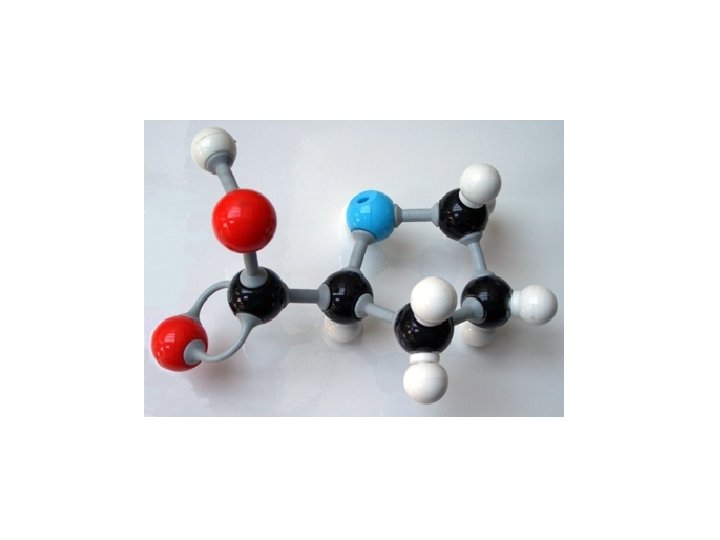
Warm up (1 -12 -16) • Think about your medicine that you are creating a model of… What is one thing that is helpful about having a visual model of the medicine? What is something that a visual model allows scientists to do?
Outline • Objectives • Model Medicine Project
Objectives • IWBAT explain atomic structure and have a general understanding of how atomic structure relates to the periodic table of elements • IWBAT explain the organization of the periodic table of elements and the locations of those elements on the table
Warm up (1 -13 -16) • When creating models, why do you think it is important to do research before you create the model? • What suggestions can you give scientists who are going to create a model of a specific type of medicine?
Outline • Objectives • Model Medicine Project work
Objectives • Develop a model of medicine and be able to explain how structure relates to function of the medicine
Warm up (1 -14 -16) • What is the difference between atomic structure and molecular structure? • Explain the benefits of knowing each of these types of structures.
Outline • Objectives • Model Medicine Project work • Turn In Assignments
Objectives • IWBAT explain atomic structure and have a general understanding of how atomic structure relates to the periodic table of elements • IWBAT explain the organization of the periodic table of elements and the locations of those elements on the table
Turning in your project • If you have a powerpoint or a prezi, I need the powerpoint or the link to your prezi emailed to me. • If you have a poster I need to see your poster at the beginning of class to check off that you have finished.
Grading Your Group Get out a half sheet of paper Write your name at the top of it What was your medicine? Who was your partner(s)? Did your partner participate in class? ____/5 Did your partner bring supplies like they said? _____/5 Overall, was your partner helpful to the success of this project? _____/5 6. Write any comments that you feel are important for me to know in order to grade your partner. (be respectful) 7. Write their total out of 15 and circle it at the bottom 8. Fold your paper in half and bring it to me when you finish • • 1. 2. 3. 4. 5.
Warm up (1 -15 -16) • Explain what helped you the most while completing this project. – This project may have been challenging or difficult, but did that challenging or difficult thing help you learn and get through this project?
Outline • Objectives • Model Medicine Presentations
Objectives • IWBAT explain atomic structure and have a general understanding of how atomic structure relates to the periodic table of elements • IWBAT explain the organization of the periodic table of elements and the locations of those elements on the table
Warm up (1 -19 -16) • Grab a warm up off the front table • What is an ion and how is it formed? • What is an isotope and how is it formed? • What happens if the number of protons for a certain atom is changed?
Outline • • • Objectives Finish project presentations? Chapter 5 review Study guide and vocabulary day Electron Configurations
Objectives • IWBAT explain atomic structure and have a general understanding of how atomic structure relates to the periodic table of elements • IWBAT explain the organization of the periodic table of elements and the locations of those elements on the table
Building an Atom Simulation • http: //www. classzone. com/books/ml_sci_phy sical/? state=CO • Phet Simulation • http: //phet. colorado. edu/en/simulation/build -an-atom
Electron Configuration Information ***Reading and Notes*** • http: //kaffee. 50 webs. com/Science/activities/ Chem/Activity. Electron. Configuration. html
Warm up (1 -20 -16) • Explain what an electron is and where it is located within an atom.
Outline • Objectives • Electron configuration discussion and information • Interactive periodic table of elements worksheet
Objectives • IWBAT explain atomic structure and have a general understanding of how atomic structure relates to the periodic table of elements • IWBAT explain the organization of the periodic table of elements and the locations of those elements on the table
Electron Configuration Information ***Reading and Notes*** • http: //kaffee. 50 webs. com/Science/activities/ Chem/Activity. Electron. Configuration. html
Warm up (1 -21 -16) • What are some questions that you still have about chapter 5? • If you don’t have any questions, try to define some of the following terms: • (atoms, isotopes, ions, protons, neutrons, electrons, atomic number, atomic mass, etc. )
Outline • Objectives • Elements Quiz 1 • Interactive periodic table of elements worksheet
Objectives • IWBAT explain atomic structure and have a general understanding of how atomic structure relates to the periodic table of elements • IWBAT explain the organization of the periodic table of elements and the locations of those elements on the table
Orbital and Ion formation activity • http: //www. learner. org/interactives/periodic/ elementary_interactive. html • Electron Orbital Demonstration • http: //demonstrations. wolfram. com/Visualizi ng. Atomic. Orbitals/
Electron Orbital Configuration Information • https: //dashboard. dublinschools. net/lessons/ ? id=fe 4368151 f 953 fa 93 fb 839172 a 66352 e&v= 1
Electron Orbital Practice • http: //www. cstephenmurray. com/onlinequize s/chemistry/readingperiodictable/whichorbita lsarefilled. htm
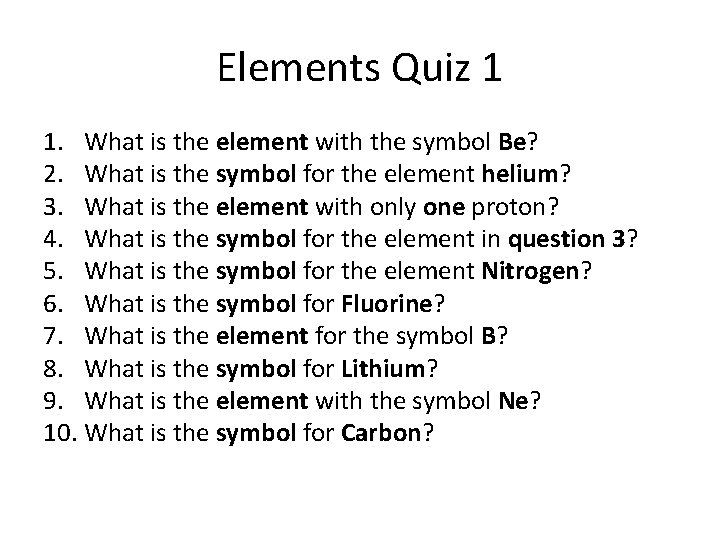
Elements Quiz 1 1. What is the element with the symbol Be? 2. What is the symbol for the element helium? 3. What is the element with only one proton? 4. What is the symbol for the element in question 3? 5. What is the symbol for the element Nitrogen? 6. What is the symbol for Fluorine? 7. What is the element for the symbol B? 8. What is the symbol for Lithium? 9. What is the element with the symbol Ne? 10. What is the symbol for Carbon?
Warm up (1 -22 -16) • Explain how the periodic table of elements is organized. • Include an explanation of groups and periods in your answer, please.
Outline • Objectives • Interactive Periodic Table of elements
Objectives • IWBAT explain atomic structure and have a general understanding of how atomic structure relates to the periodic table of elements • IWBAT explain the organization of the periodic table of elements and the locations of those elements on the table
Warm up (1 -25 -16) • Explain where electrons are located in an atom and why they are located there.
Outline • Objectives • Interactive Periodic Table of elements • Chapter 5 review
Objectives • IWBAT explain atomic structure and have a general understanding of how atomic structure relates to the periodic table of elements • IWBAT explain the organization of the periodic table of elements and the locations of those elements on the table
Warm up (1 -26 -16) • Write down everything you remember from chapter 5. • Include things like (atoms, isotopes, ions, protons, neutrons, electrons, atomic number, atomic mass, etc. )
Outline • Objectives • Chapter 5 Test
Objectives • IWBAT explain atomic structure and have a general understanding of how atomic structure relates to the periodic table of elements • IWBAT explain the organization of the periodic table of elements and the locations of those elements on the table
- Slides: 77