
Chapter 5 Asynchronous Transfer Mode ATM Chapter 2




- Slides: 36
Chapter 5 Asynchronous Transfer Mode (ATM) Chapter 2 Protocols and the TCP/IP Suite 1
Introduction ATM Protocol Architecture l Logical connections l ATM Cells l Service categories l ATM Adaptation Layer (AAL) l Chapter 2 Protocols and the TCP/IP Suite 2
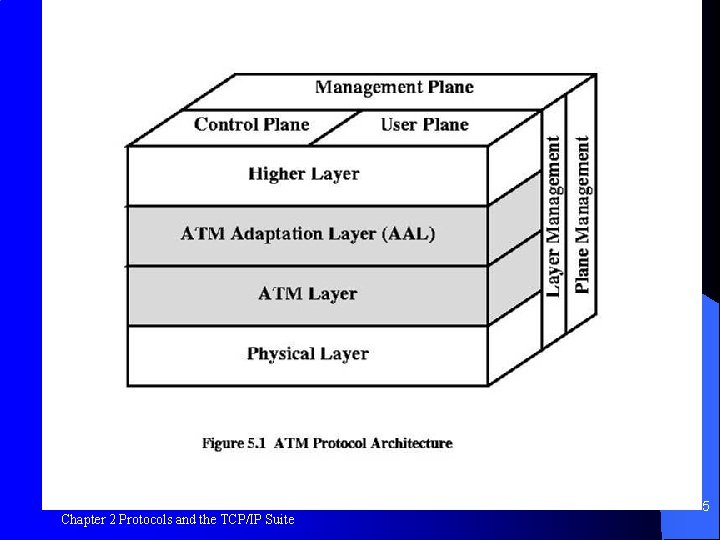
ATM Protocol Architecture Fixed-size packets called cells l Streamlined: minimal error and flow control l 2 protocol layers relate to ATM functions: l – Common layer providing packet transfers – Service dependent ATM adaptation layer (AAL) l AAL maps other protocols to ATM Chapter 2 Protocols and the TCP/IP Suite 3
Protocol Model has 3 planes User l Control l management l Chapter 2 Protocols and the TCP/IP Suite 4
Figure 5. 1 Chapter 2 Protocols and the TCP/IP Suite 5
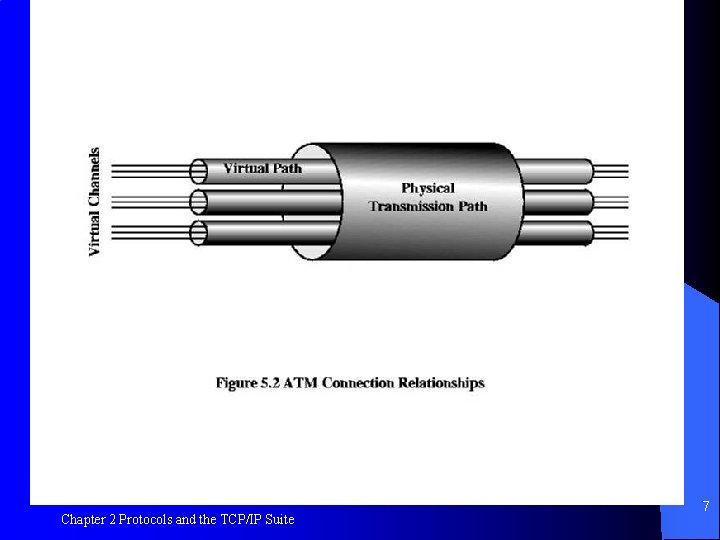
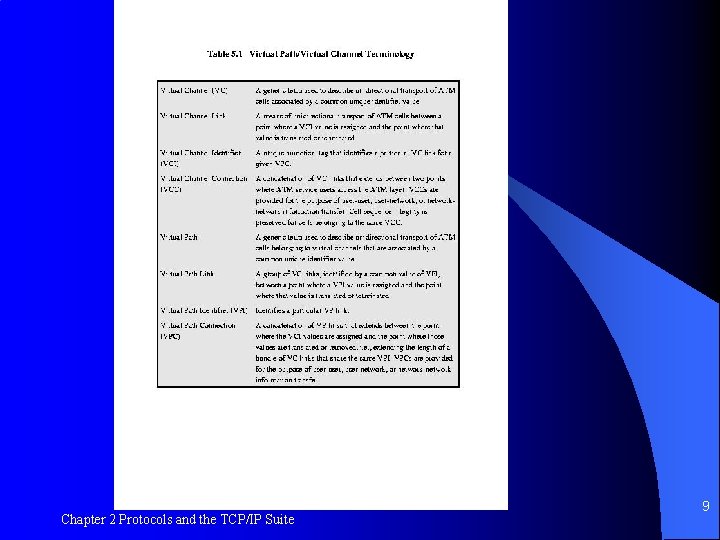
Logical Connections VCC (Virtual Channel Connection): a logical connection analogous to virtual circuit in X. 25 l VPC (Virtual Path Connection): a bundle of VCCs with same endpoints l Chapter 2 Protocols and the TCP/IP Suite 6
Figure 5. 2 Chapter 2 Protocols and the TCP/IP Suite 7
Advantages of Virtual Paths Simplified network architecture l Increased network performance and reliability l Reduced processing and short connection setup time l Enhanced network services l Chapter 2 Protocols and the TCP/IP Suite 8
Table 5. 1 Chapter 2 Protocols and the TCP/IP Suite 9
VCC Uses Between end users l Between an end user and a network entity l Between 2 network entities l Chapter 2 Protocols and the TCP/IP Suite 10
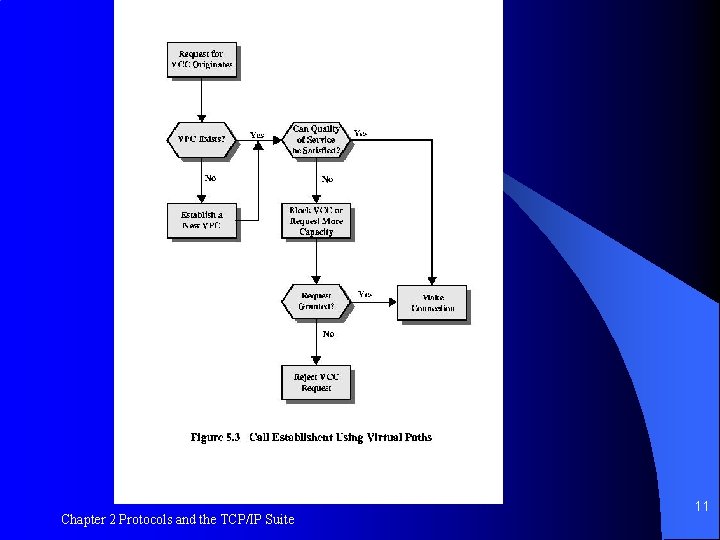
Figure 5. 3 Chapter 2 Protocols and the TCP/IP Suite 11
VPC/VCC Characteristics Quality of Service (Qo. S) l Switched and semi-permanent virtual channel connections l Cell sequence integrity l Traffic parameter negotiation and usage monitoring l (VPC only) virtual channel identifier restriction within a VPC l Chapter 2 Protocols and the TCP/IP Suite 12
Control Signaling A mechanism to establish and release VPCs and VCCs l 4 methods for VCCs: l – Semi-permanent VCCs – Meta-signaling channel – User-to-network signaling virtual channel – User-to-user signaling virtual channel Chapter 2 Protocols and the TCP/IP Suite 13
Control Signaling l 3 methods for VPCs – Semi-permanent – Customer controlled – Network controlled Chapter 2 Protocols and the TCP/IP Suite 14
ATM Cells Fixed size l 5 -octet header l 48 -octet information field l Small cells reduce delay for high-priority cells l Fixed size facilitate switching in hardware l Chapter 2 Protocols and the TCP/IP Suite 15
Header Format Generic flow control l Virtual path identifier (VPI) l Virtual channel identifier (VCI) l Payload type l Cell loss priority l Header error control l Chapter 2 Protocols and the TCP/IP Suite 16
Figure 5. 4 Chapter 2 Protocols and the TCP/IP Suite 17
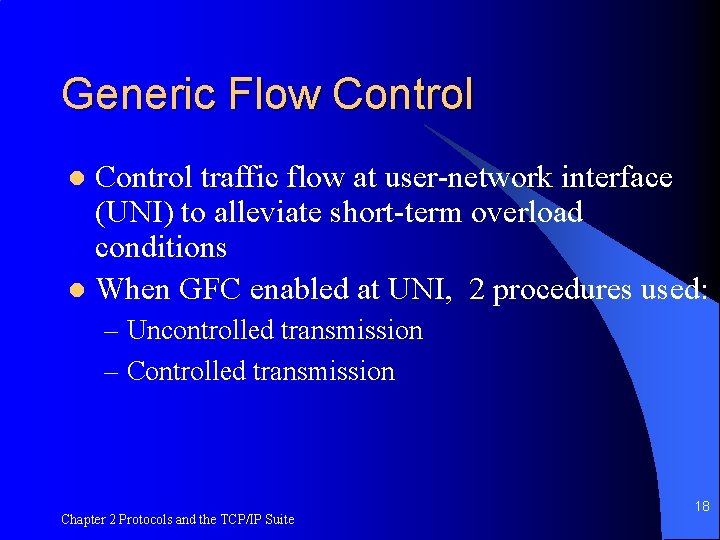
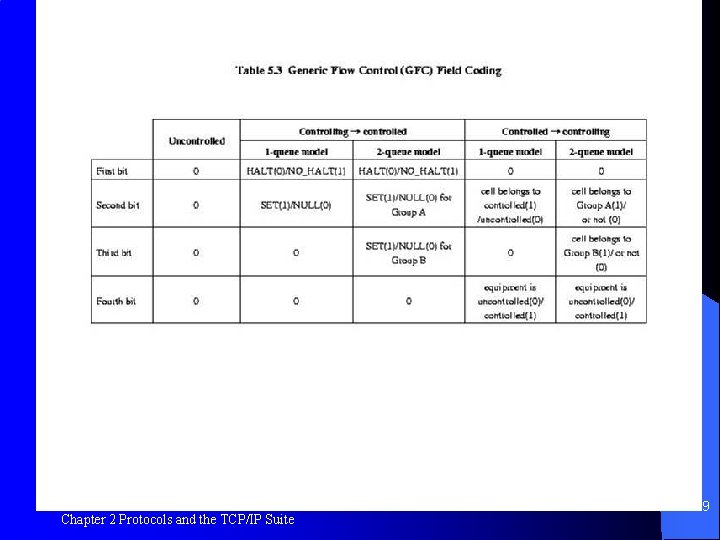
Generic Flow Control traffic flow at user-network interface (UNI) to alleviate short-term overload conditions l When GFC enabled at UNI, 2 procedures used: l – Uncontrolled transmission – Controlled transmission Chapter 2 Protocols and the TCP/IP Suite 18
Table 5. 3 Chapter 2 Protocols and the TCP/IP Suite 19
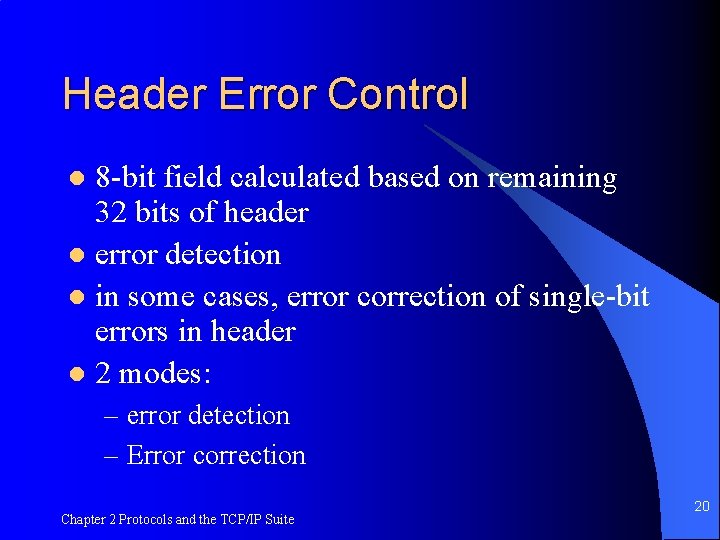
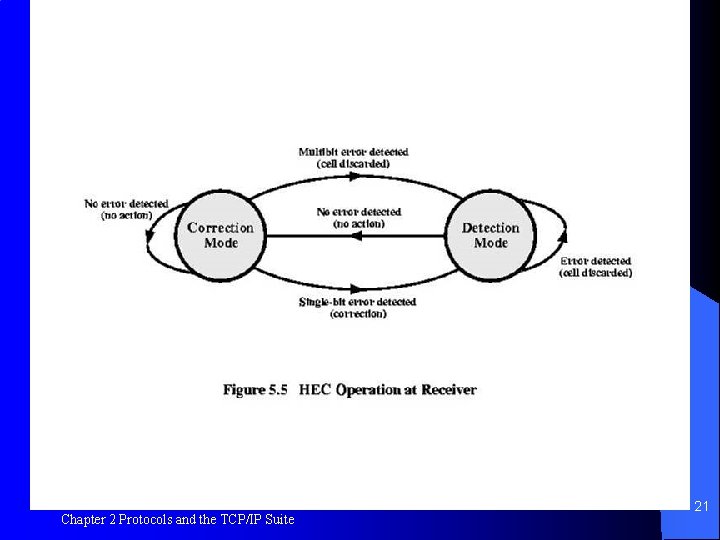
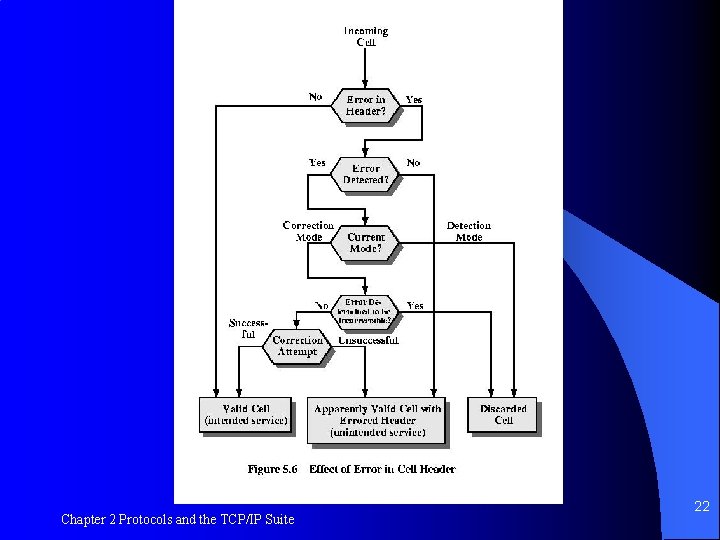
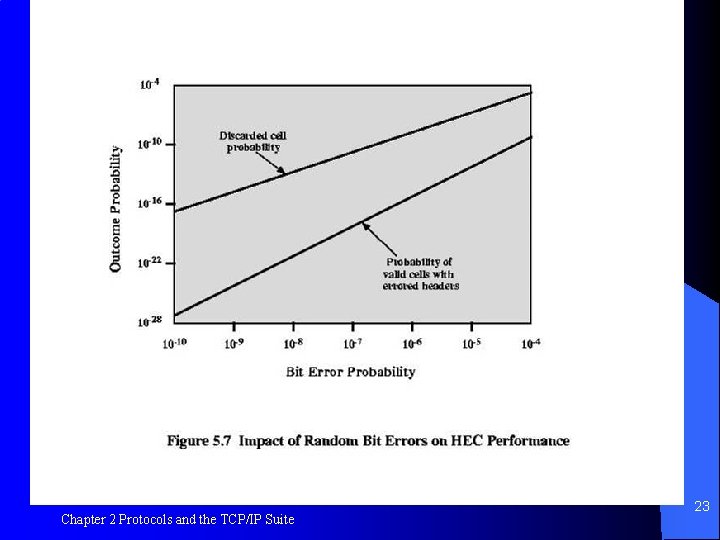
Header Error Control 8 -bit field calculated based on remaining 32 bits of header l error detection l in some cases, error correction of single-bit errors in header l 2 modes: l – error detection – Error correction Chapter 2 Protocols and the TCP/IP Suite 20
Figure 5. 5 Chapter 2 Protocols and the TCP/IP Suite 21
Figure 5. 6 Chapter 2 Protocols and the TCP/IP Suite 22
Figure 5. 7 Chapter 2 Protocols and the TCP/IP Suite 23
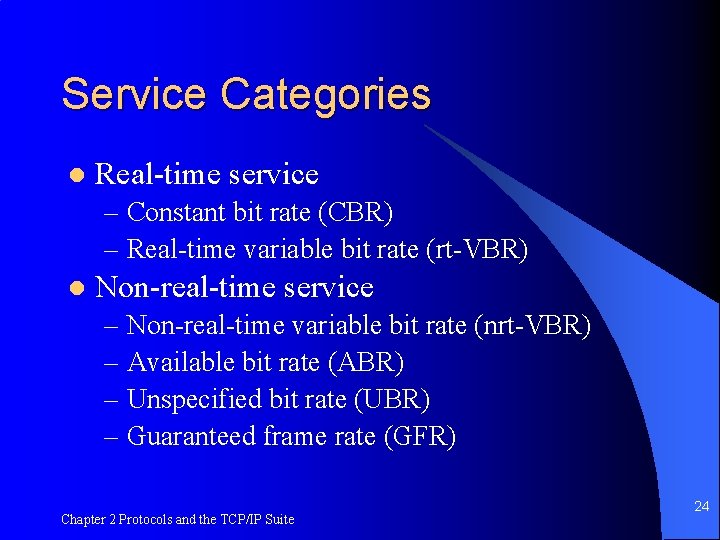
Service Categories l Real-time service – Constant bit rate (CBR) – Real-time variable bit rate (rt-VBR) l Non-real-time service – Non-real-time variable bit rate (nrt-VBR) – Available bit rate (ABR) – Unspecified bit rate (UBR) – Guaranteed frame rate (GFR) Chapter 2 Protocols and the TCP/IP Suite 24
Figure 5. 8 Chapter 2 Protocols and the TCP/IP Suite 25
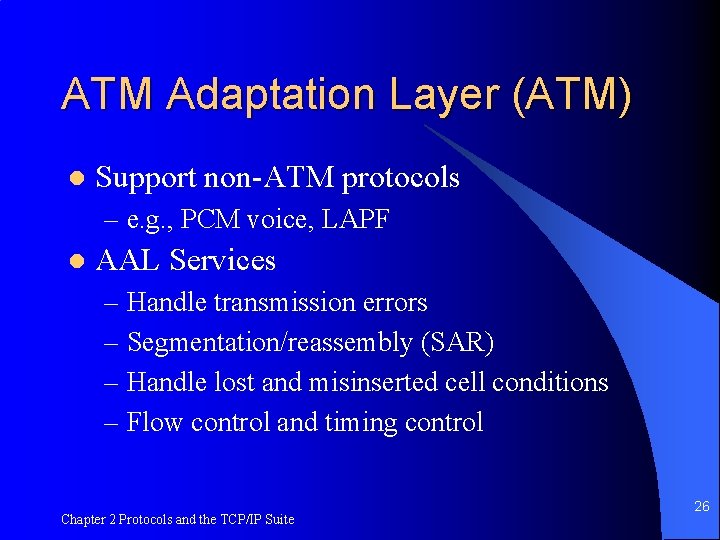
ATM Adaptation Layer (ATM) l Support non-ATM protocols – e. g. , PCM voice, LAPF l AAL Services – Handle transmission errors – Segmentation/reassembly (SAR) – Handle lost and misinserted cell conditions – Flow control and timing control Chapter 2 Protocols and the TCP/IP Suite 26
Applications of AAL and ATM Circuit emulation (e. g. , T-1 synchronous TDM circuits) l VBR voice and video l General data services l IP over ATM l Multiprotocol encapsulation over ATM (MPOA) l LAN emulation (LANE) l Chapter 2 Protocols and the TCP/IP Suite 27
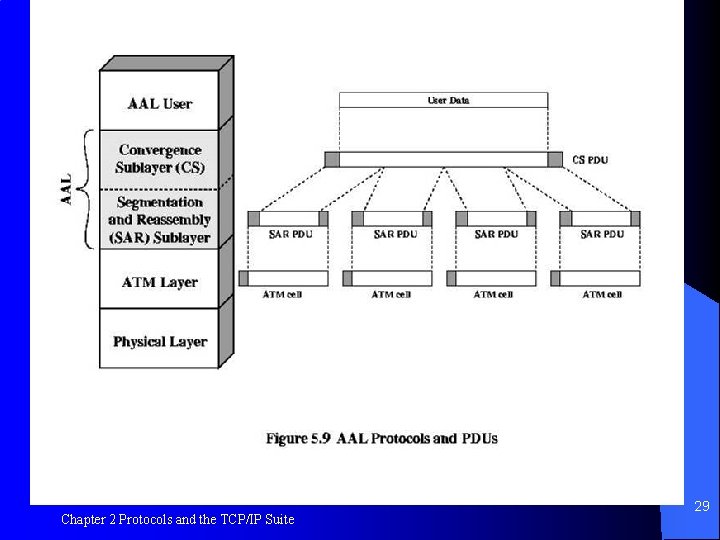
AAL Protocols l AAL layer has 2 sublayers: – Convergence Sublayer (CS) l Supports specific applications using AAL – Segmentation and Reassembly Layer (SAR) l Packages data from CS into cells and unpacks at other end Chapter 2 Protocols and the TCP/IP Suite 28
Figure 5. 9 Chapter 2 Protocols and the TCP/IP Suite 29
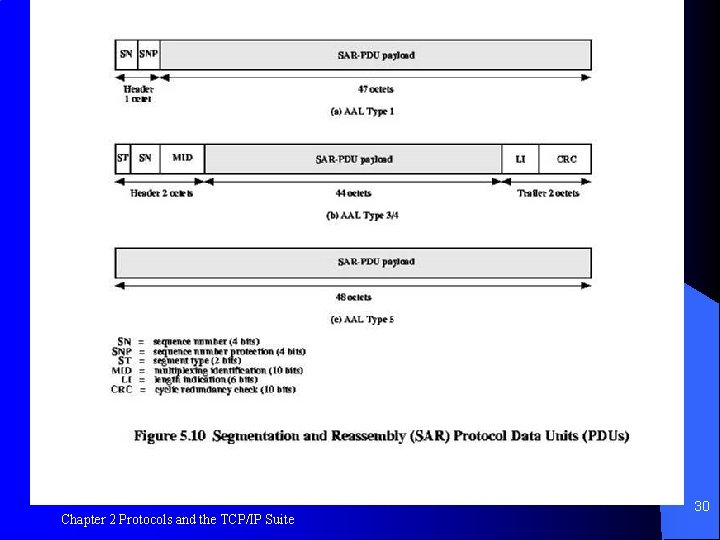
Figure 5. 10 Chapter 2 Protocols and the TCP/IP Suite 30
AAL Type 1 Constant-bit-rate source l SAR simply packs bits into cells and unpacks them at destination l One-octet header contains 3 -bit SC field to provide an 8 -cell frame structure l No CS PDU since CS sublayer primarily for clocking and synchronization l Chapter 2 Protocols and the TCP/IP Suite 31
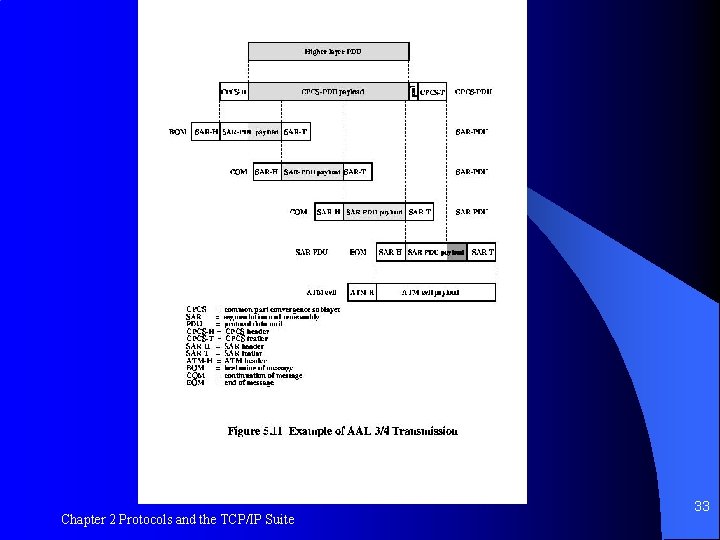
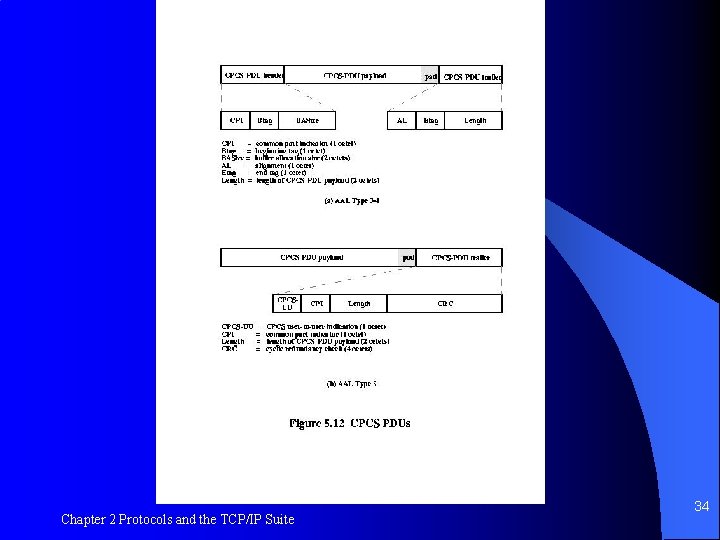
AAL Type 3/4 May be connectionless or connection oriented l May be message mode or streaming mode l Chapter 2 Protocols and the TCP/IP Suite 32
Figure 5. 11 Chapter 2 Protocols and the TCP/IP Suite 33
Figure 5. 12 Chapter 2 Protocols and the TCP/IP Suite 34
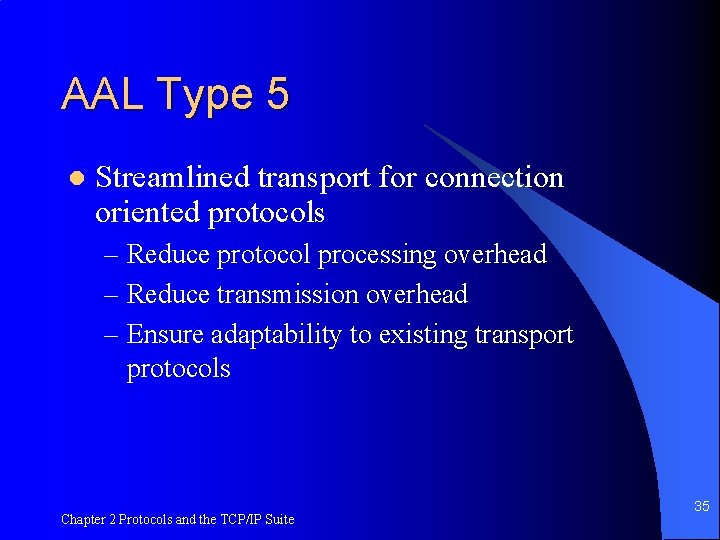
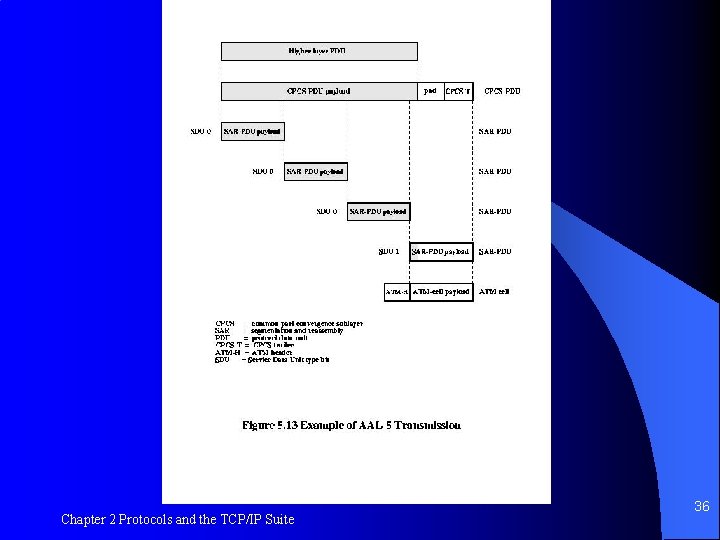
AAL Type 5 l Streamlined transport for connection oriented protocols – Reduce protocol processing overhead – Reduce transmission overhead – Ensure adaptability to existing transport protocols Chapter 2 Protocols and the TCP/IP Suite 35
Figure 5. 13 Chapter 2 Protocols and the TCP/IP Suite 36