
Chapter 5 Ancient Rome and the Rise of

- Slides: 58
Chapter 5 Ancient Rome and the Rise of Christianity 509 B. C. – 476 B. C.
Chapter 5, Section 1 The Roman World Takes Shape
Geography of Ancient Rome
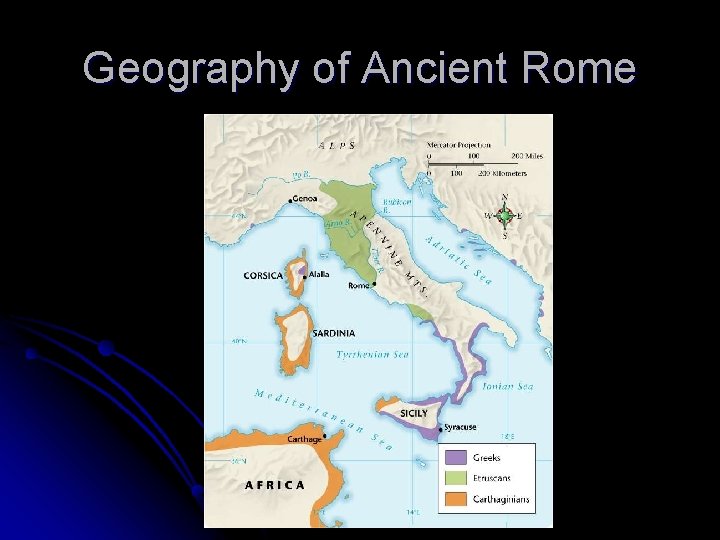
Geography of Ancient Rome l l Rome began as a small city-state on the Italian Peninsula The Italian Peninsula (the boot) juts into the Mediterranean Sea Rome is located about half way up the western coast of this peninsula This location helped Rome to expand throughout the Med and eventually create its empire
Geography of Ancient Rome l l The Roman Peninsula is not broken into small valleys like Greece This made it easier to unify the people and create an empire The Apennine Mountains run north and south and are not as rugged as the mountains of Greece The peninsula also contains a broad fertile plain to the north that can support a larger population
Early People Settle Italy l Around 800 B. C. the Latins migrated into Italy and settled along the Tiber River in small villages l These villages eventually became Rome The Latins competed on the peninsula with the Greeks to the south and the Etruscans to the north l About 750 B. C. the Etruscans controlled the Latins l
Influence of the Etruscans l Under Etruscan rule, the Romans learned how to: l To build roads l Construct buildings l Build city walls l Adapt the Greek alphabet l Make metal weapons l Use military tactics
Romans Establish a Republic Around 509 B. C. the Romans rose up and drove out the Etruscans l In attempts to govern, the people of Rome set up a republic called res republica which means “that which belongs to the people” l The first republic was ruled by the wealthy landowners. . . the patricians l
Roman Republic l First ruled by the Patricians who made up the senate (300 members) l Senate made laws, approved appointments, controlled foreign affairs l The Senate elected two consuls l Supervise the business of government and command armies l Checked by the government (checks and balances) l Limited term, answer to the Senate
Plebeians Fight for their Rights l l The common people of Rome, the plebeians, looked to remove the aristocracy and gain more say in the government Over time the plebeians gained power in the government: l Elected tribunes to protect their interests l Tribunes l could veto (turn down) Required the Twelve Tables l Codified law
Roman Influence l The Roman Republic developed various political elements that greatly influenced later government systems: l Veto l Senate l Checks and Balances
Rome Conquers Italian Peninsula l Through a series of wars, the Romans gained control of the Italian Peninsula l l Pushed back the Gauls Defeated the Etruscans Captured Greek colonies Success was due to: l l l Powerful armies. . . soldiers were citizens and took pride in gaining and protecting their land Troops could be moved easily Treated conquered people well and gained allegiance (gave some citizenship)
Roman Society Family was the basic unit and very important to the Romans l Males - head of the household, had absolute power, and demanded total respect and authority l Women. . . larger role than in Greek society l l Most worked at home raising the family l Others took an active role in business l Some female patricians had political influence
Roman Society l Education. . . both boys and girls learned to read and write l Many l of the wealthy hired Greek tutors Religion. . . early Rome was polytheistic l Worshipped many of the same gods the Greeks did l Gave them different names. . . Zeus became Jupiter, Poseidon became Neptune, Hera became Juno
Chapter 5, Section 2 From Republic to Empire
Rome Grows Through Conquest After gaining control of the Italian peninsula, the Romans began to conquer and expand around the Med. l This expansion put eventual strains on the republic, and internal conflicts led to the republic’s decline l
Punic Wars Carthage. . . city state in northern Africa that controlled a vast empire throughout Africa and the western Mediterranean l Rome fought a series of wars against Carthage l These wars are known as the Punic Wars l l 1 st Punic War. . . Rome gains Sicily, Corsica, Sardinia l Hannibal seeks revenge
Punic Wars l 2 nd Punic War. . . Hannibal marches his army through the Alps l l Conquers much of the Peninsula but not Rome Roman army attacks Carthage and Hannibal returns home to defend Carthage surrendered all land except those in Africa 3 rd Punic War. . . Rome destroys Carthage itself and kills survivors or takes them into slavery l Cato (senator). . . ends every speech with “Carthage must be destroyed. ”
Continued Expansion l Rome continued to fight for world domination l l After defeating Carthage, they went after the lands that were formerly Alexander’s empire l l l Policy of imperialism Gained Macedonia, Greece, Asia Minor and Egypt. All of these became Roman provinces Led Rome to call the Mediterranean “our sea”
Why was Rome so Successful? l The Roman army was incredibly powerful for many reasons l Roman pride l Very disciplined (no retreat) l Well fed and rested l Adopted elements of war and looked to change them for the better l Javelins from the Gauls l Tactics from the Etruscans l Armor from the Greeks
Greco-Roman Culture l The Romans admired Greek advancements and Hellenistic Culture l Shipped Greek treasures, books, statues, and vases to Rome l Enslaved educated Greeks to serve as tutors, actors, writers, and scientists l Imitated Greek culture extensively l This cultural diffusion produced what we refer to as Greco-Roman Culture
The Impact at Home As Rome expanded and conquered more areas, the flow of wealth and riches into Rome increased. l This led to a new class of wealthy who bought huge estates called latifundia l An increased number of slaves worked on the latifundia and lessened the role of the small farmer l
The Impact at Home The increased production by the slaves on the latifundia lowered the price of grain l Many farmers acquired large debts and were forced to sell their land l l They moved to the city to join other unemployed l Large mobs formed and rioting broke out
Attempts at Reform l Tiberius and Gaius Gracchus l Two patrician brothers who attempted reform l Looked for government support to help the poor The Senate saw them as a threat to power and killed them along with their followers during street violence l The great political process of the Roman Republic was dying l
Civil Wars l Uncertainty and protest led to a civil war in Rome l The senate fought political leaders l Slaves and the poor revolted and led riots l Military generals led their armies against each other in a struggle for power l Sulla. . . military leader who temporarily restored power and control to the Senate
The Rise of Caesar l During this period of warring generals, Caesar, Pompey, and Crassus dominated Roman politics and formed the first Triumvirate l Caesar left Rome to conquer Gaul and gained much popularity l Pompey feared his popularity and convinced the Senate to order him back to Rome
Julius Caesar the Dictator Caesar defies the order to return and instead leads his troops to seize Rome l Caesar crushes Pompey and continues around the eastern Mediterranean l Forces the Senate to name him dictator l l Keeps some political features of the Republic but ultimately has all the control
Caesar Makes Reforms l Caesar pushed many reforms l l l Public works to employ the jobless Gave public land to the poor Reorganized provinces and granted more citizenship Opponents of Caesar feared that he was gaining too much power and would dissolve all features of the republic Upon arrival to the Senate, he was assassinated
After Caesar With the death of Caesar, civil wars began again l Caesar named his nephew Octavian as heir to the throne l Mark Antony was Caesar’s chief general l The two joined forces to hunt down the conspirators l l Brutus and Cassius
Octavian vs. Antony l l l After the defeat of Brutus and Cassius, Octavian and Antony would struggle for power Octavian eventually defeats Antony and ends another period of civil war Octavian is willing to restore the republic but the senate asks him to stay as their ruler l l He is given the name Augustus and becomes the first Roman Emperor This marks the beginning of the Roman Empire
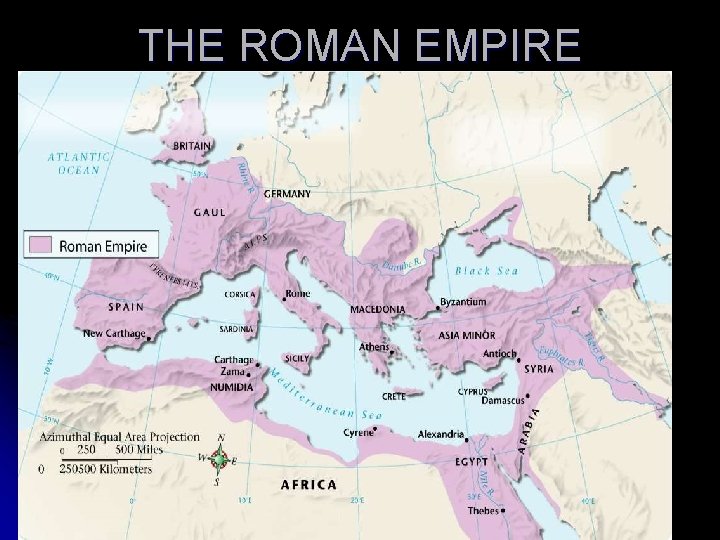
Pax Romana Brings Prosperity l l 200 year period that began with Augustus and ended with Marcus Aurelius is called “Pax Romana” (Roman Peace) During this time Roman rule brought peace, order, unity, prosperity from the Euphrates River to Great Britain Trade flowed freely during this time (spices, cotton, ivory, gold, grain, etc. ) Very peaceful and prosperous time period
THE ROMAN EMPIRE
Review 1) Which of the following contributed to the decline of the Roman republic? a) widespread unemployment b) food shortages c) conquest of Italian peninsula d) Pax Romana 2) Who was given the title of Augustus? a) Julius Caesar b) Mark Antony c) Octavian d) Pompey
Chapter 5, Section 3 The Roman Achievement
Literature Wrote history. . . the rise and fall of Rome l Poetry was used to try and create a past as storied as Greece l l Roman poet Virgil wrote much like Homer l Wrote famous poem Aeneid, shortly after Augustus came to power l Other poets used satire in their works (making fun)
Philosophy Roman philosophy was much like that of Greece l Stoicism was a popular theme l l Impressed emperor Marcus Aurelius l Stressed the importance of duty and acceptance to one’s faith l Tried to show concern for the well – being of all people
Art Adapted Greek style of Art l Decorated homes with Mosaics picture made from colored stone or glass l Sculptors stressed realism l l Would make sculptures with every detail of a person (scars, veins, etc. ) l Some would change the way people looked (Ex: Augustus was made to look powerful)
Architecture l Romans emphasized grandeur while the Greeks emphasized simple structures l Immense l palaces, temples and stadiums Utilized concrete in their buildings l Eventually led to the first dome being built (Pantheon is the most famous dome) l Built aqueducts – bridge like stone structure l Carried water from streams to city of Rome
Laws l Principles of Roman Laws would later become the basis for many legal systems l United States included Civil Law applied to all Roman Citizens l Law of Nations emerged as Rome conquered several places l l Eventually applied to all citizens and non – citizens of Rome
New Laws Protect Empire l Other Principles that were used later: 1. An accused person was presumed to be innocent until proven guilty 2. The accused was permitted to face the accuser and offer a defense 3. Guilt had to be established through evidence 4. Judges were expected to interpret the laws and make fair decisions
Review 1) What structures carried water from streams to the city of Rome? a) Domes b) Aqueducts c) Palaces d) Temples 2) Roman principles of law a) led to civil war within the empire. b) were primitive and harsh. c) were based on the idea that the accused was presumed guilty. d) would later become the basis for legal systems in Europe and the Americas.
Chapter 5, Section 4 The Rise of Christianity
Roman Religions In the Roman Empire, there were many religious beliefs: Judaism, Polytheism, etc. l Generally, Rome tolerated many religions as long as they honored Roman gods and acknowledged the divine spirit of the emperor l When Rome conquered Judea, they allowed the Jews to continue their practice l
Jesus Proclaims His Teachings Some Jews were not happy with Roman rule and believed that they would be sent a leader from god l A boy was born in Bethlehem and his mother was told by an angel that he would be great. . . he was the son of God l Jesus grew up in the Jewish faith and began to preach when he was 30 yrs old l
Followers l Large crowds would gather to hear Jesus l l l He recruited 12 apostles to help spread his word His teachings were rooted deeply in Jewish belief However, he preached some new teachings as well l l He taught that he was the Son of God He would bring eternal life to those who followed him
Appeal of Christianity People were dissatisfied with their polytheistic faiths l Attracted by the idea of one god, eternal salvation, and equality l Easy to spread the word throughout Rome l Equality for all. . . poor, women, rich etc. . . l People were impressed by devotion l l Martyrs. . . died for their beliefs
Opposition and Persecution l For 300 years, Roman leaders opposed and persecuted Christians l l Leaders feared Jesus may lead Jews in rebellion Accused of treason l They would not worship the Roman Emperor or gods l Would not serve in the armies l Opposed such events as gladiator fights l l Many Jews also opposed Jesus. . . regarding him as a troublemaker He was arrested by the Romans and crucified
Message of Christianity Spreads Christianity spread throughout the empire by the work of Jesus' disciples l Christian documents were written in Greek and Latin so they could be read by many l Eventually, Roman Emperors converted to Christianity l l Constantine issued the Edict of Milan l Granted religious freedom to all Romans
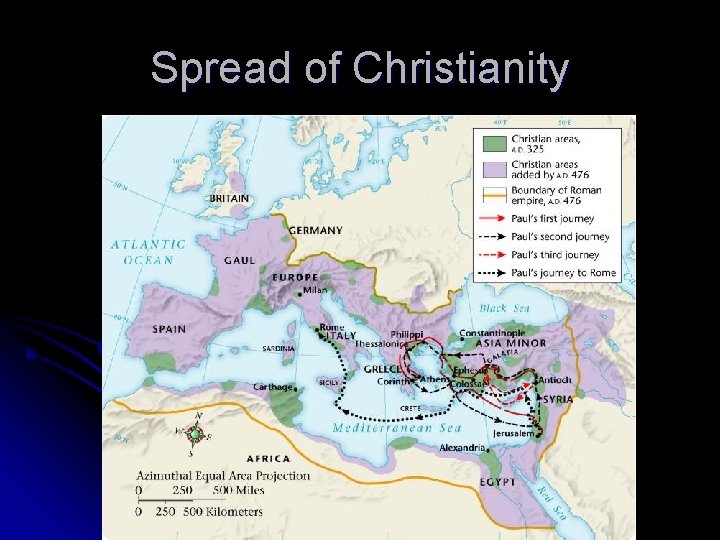
Paul Spreads Christianity Paul was a missionary who is noted for spreading much of Christianity beyond the Jewish community l Traveled throughout the empire and set up churches l Promised that those who believed in Jesus would receive eternal salvation l
Spread of Christianity
Early Christian Church Develops Each Christian had to be baptized it was believed that from baptism sins were forgiven l Clergy group of people who conduct Christian services (Ex: Sunday Mass) l Christians were grouped as a diocese l l Each diocese had a priest l Bishop presided over the priest
Review 1) Roman leaders mistrusted Christians because Christians a) b) c) d) refused to pay taxes. refused to worship Roman gods. supported the Jews. rebelled against the emperor. 2) Who first spread Christianity beyond the Jewish community? a) Peter b) The Romans c) Jesus d) Paul
Chapter 5, Section 5 The Long Decline
The Roman Empire Divides l Political Violence l Several emperors were assassinated l In one 50 year period 26 emperors reigned and were killed l Social and Economic Problems l High Taxes placed burdens on business people and small farmers l Many small farmers gave up their land worked for wealthy land owners
Diocletian and Constantine l Diocletian. . . emperor who looked to restore Rome’s greatness l l Divided the empire in two in hopes it would be easier to govern The west declined while the east flourished Constantine. . . emperor who moved the capitol of the empire to Byzantium. . . Constantinople Granted toleration of Christians l Converted to Christianity himself
Invaders Threaten Roman Empire Rome became too large to control l The eastward movement of the Huns pushed many nomadic groups into the Roman Empire l l These groups defeated many outlying areas of the empire l There were not enough people to defend all parts of the Roman Empire
Causes of the Fall of Rome Military. . . hiring of mercenaries weakened the army l Political. . . many corrupt leaders and the division of the empire l Economic. . . high taxes and slave labor l Social. . . Romans became materialistic and complacent l
Did Rome Fall? Although we refer to the “fall of Rome, ” it was only the western half that fell. l The eastern half thrived for another 1000 years and became to be known as the Byzantine Empire l