
Chapter 5 Analog Transmission Converting binary data or
Chapter 5 Analog Transmission » Converting binary data or a low-pass analog signal to band pass analog signal is traditionally called modulation. Mc. Graw-Hill ©The Mc. Graw-Hill Companies, Inc. , 2004
5. 1 Modulation of Digital Data Digital-to-Analog Conversion Amplitude Shift Keying (ASK) Frequency Shift Keying (FSK) Phase Shift Keying (PSK) Quadrature Amplitude Modulation Bit/Baud Comparison Mc. Graw-Hill ©The Mc. Graw-Hill Companies, Inc. , 2004
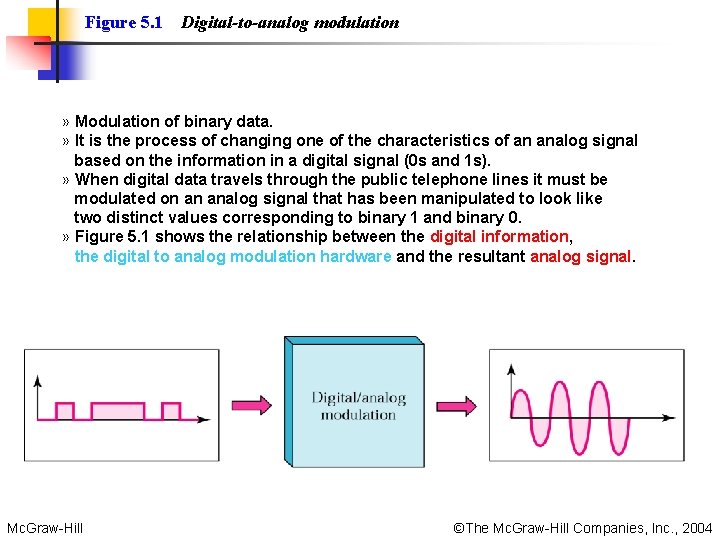
Figure 5. 1 Digital-to-analog modulation » Modulation of binary data. » It is the process of changing one of the characteristics of an analog signal based on the information in a digital signal (0 s and 1 s). » When digital data travels through the public telephone lines it must be modulated on an analog signal that has been manipulated to look like two distinct values corresponding to binary 1 and binary 0. » Figure 5. 1 shows the relationship between the digital information, the digital to analog modulation hardware and the resultant analog signal. Mc. Graw-Hill ©The Mc. Graw-Hill Companies, Inc. , 2004
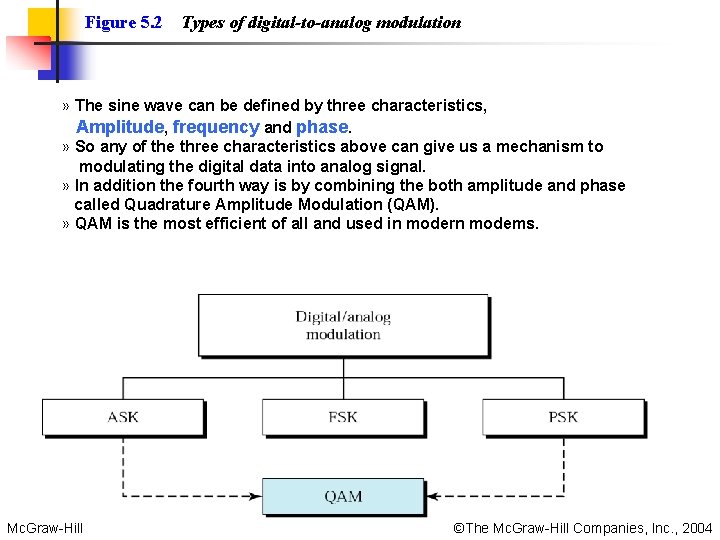
Figure 5. 2 Types of digital-to-analog modulation » The sine wave can be defined by three characteristics, Amplitude, frequency and phase. » So any of the three characteristics above can give us a mechanism to modulating the digital data into analog signal. » In addition the fourth way is by combining the both amplitude and phase called Quadrature Amplitude Modulation (QAM). » QAM is the most efficient of all and used in modern modems. Mc. Graw-Hill ©The Mc. Graw-Hill Companies, Inc. , 2004
Note: Bit rate is the number of bits per second. Baud rate is the number of signal units per second. Baud rate is less than or equal to the bit rate. Mc. Graw-Hill ©The Mc. Graw-Hill Companies, Inc. , 2004
Example 1 An analog signal carries 4 bits in each signal unit. If 1000 signal units are sent per second, find the baud rate and the bit rate Solution Baud rate = 1000 bauds per second (baud/s) Bit rate = 1000 x 4 = 4000 bps Mc. Graw-Hill ©The Mc. Graw-Hill Companies, Inc. , 2004
Example 2 The bit rate of a signal is 3000. If each signal unit carries 6 bits, what is the baud rate? Solution Baud rate = 3000 / 6 = 500 baud/s Mc. Graw-Hill ©The Mc. Graw-Hill Companies, Inc. , 2004
Figure 5. 2 Career Signal » In analog transmission the sending device produces a high-frequency signal that acts as a basis for the information signal. » This base signal is called career signal or career frequency. » The receiving device is tuned to the frequency of the career signal that it expects from the sender. Mc. Graw-Hill ©The Mc. Graw-Hill Companies, Inc. , 2004
Figure 5. 3 ASK » Amplitude Shift Keying » The strength of the career signal is varied to represent binary 1 or 0. » Both frequency and phase remains constant. » Which voltage represents binary 1 or 0 , depends on the system designers. » A bit duration is the period of time that defines 1 bit. » Peak amplitude of the signal during each bit duration is constant. » ASK is highly susceptible to noise, because noise usually effects the amplitude. » A poplar ASK is on/off keying (OOK). » OOK » In OOK one of the bit values is represented by no voltage. The advantage is to reduce the amount of energy required to transmit information. Mc. Graw-Hill ©The Mc. Graw-Hill Companies, Inc. , 2004
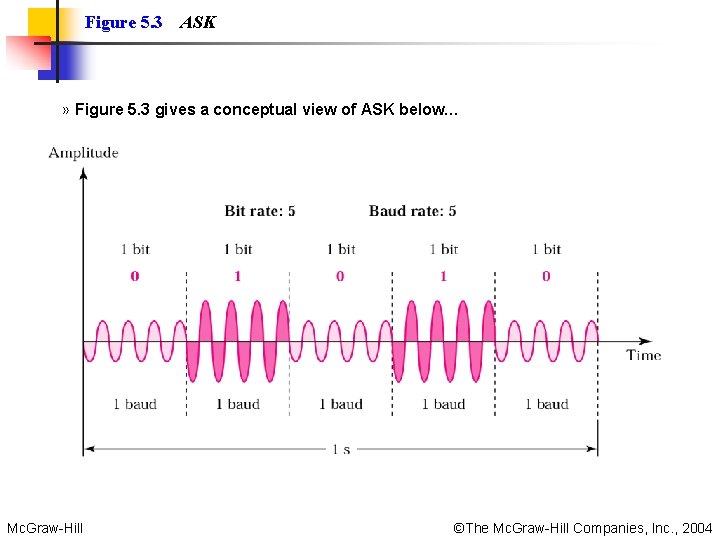
Figure 5. 3 ASK » Figure 5. 3 gives a conceptual view of ASK below… Mc. Graw-Hill ©The Mc. Graw-Hill Companies, Inc. , 2004
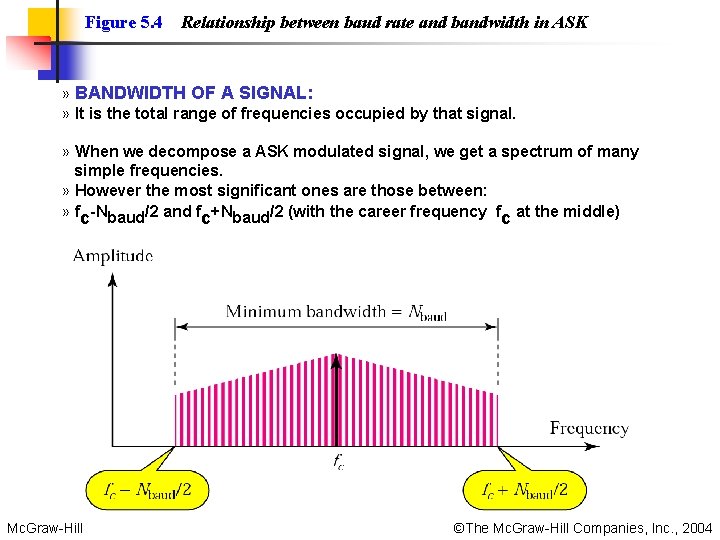
Figure 5. 4 Relationship between baud rate and bandwidth in ASK » BANDWIDTH OF A SIGNAL: » It is the total range of frequencies occupied by that signal. » When we decompose a ASK modulated signal, we get a spectrum of many simple frequencies. » However the most significant ones are those between: » fc-Nbaud/2 and fc+Nbaud/2 (with the career frequency fc at the middle) Mc. Graw-Hill ©The Mc. Graw-Hill Companies, Inc. , 2004
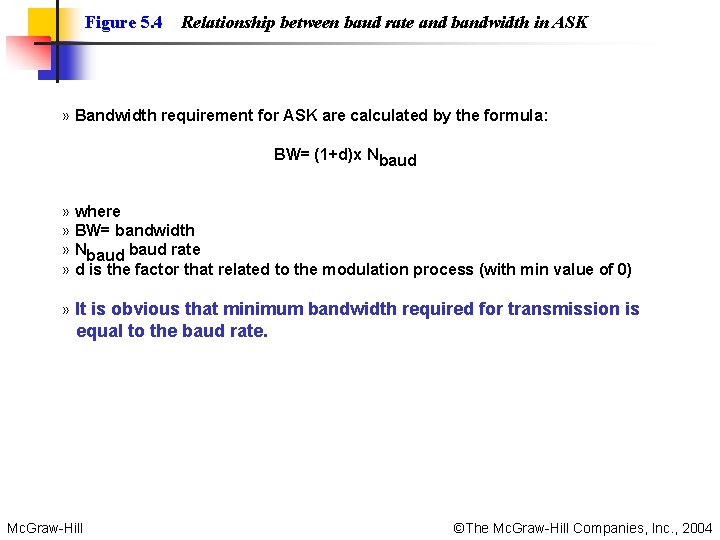
Figure 5. 4 Relationship between baud rate and bandwidth in ASK » Bandwidth requirement for ASK are calculated by the formula: BW= (1+d)x Nbaud » where » BW= bandwidth » Nbaud rate » d is the factor that related to the modulation process (with min value of 0) » It is obvious that minimum bandwidth required for transmission is equal to the baud rate. Mc. Graw-Hill ©The Mc. Graw-Hill Companies, Inc. , 2004
Example 3 Find the minimum bandwidth for an ASK signal transmitting at 2000 bps. The transmission mode is halfduplex. Solution In ASK the baud rate and bit rate are the same. The baud rate is therefore 2000. An ASK signal requires a minimum bandwidth equal to its baud rate. Therefore, the minimum bandwidth is 2000 Hz. Mc. Graw-Hill ©The Mc. Graw-Hill Companies, Inc. , 2004
Example 4 Given a bandwidth of 5000 Hz for an ASK signal, what are the baud rate and bit rate? Solution In ASK the baud rate is the same as the bandwidth, which means the baud rate is 5000. But because the baud rate and the bit rate are also the same for ASK, the bit rate is 5000 bps. Mc. Graw-Hill ©The Mc. Graw-Hill Companies, Inc. , 2004
Example 5 Given a bandwidth of 10, 000 Hz (1000 to 11, 000 Hz), draw the full-duplex ASK diagram of the system. Find the carriers and the bandwidths in each direction. Assume there is no gap between the bands in the two directions. Solution For full-duplex ASK, the bandwidth for each direction is BW = 10000 / 2 = 5000 Hz The carrier frequencies can be chosen at the middle of each band (see Fig. 5. 5). fc (forward) = 1000 + 5000/2 = 3500 Hz fc (backward) = 11000 – 5000/2 = 8500 Hz Mc. Graw-Hill ©The Mc. Graw-Hill Companies, Inc. , 2004
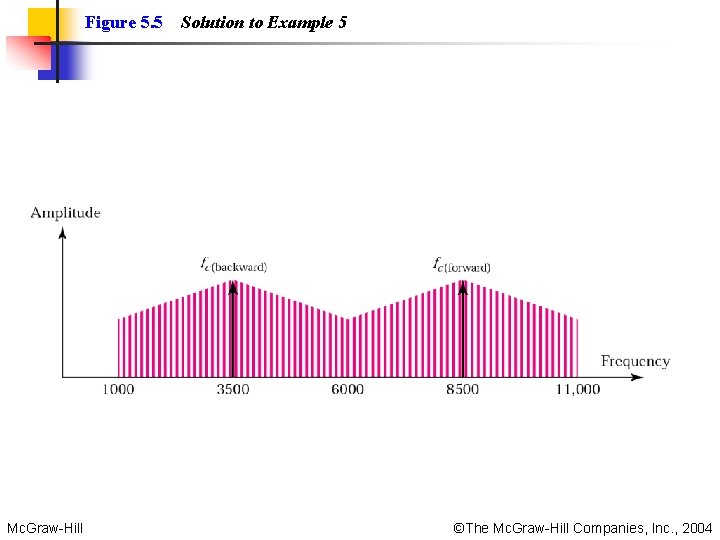
Figure 5. 5 Mc. Graw-Hill Solution to Example 5 ©The Mc. Graw-Hill Companies, Inc. , 2004
FSK » FREQUENCY SHIFT KEYING: » The frequency of the career signal is varied to represents binary 1 or 0. » The frequency of the signal during each bit duration is constant. » Both peak amplitude and phase remains constant. » FSK avoid most of the problems of the noise. » Because the receiving device is looking for specific frequency changes over a given number of periods. » It can ignore voltage spikes. Mc. Graw-Hill ©The Mc. Graw-Hill Companies, Inc. , 2004
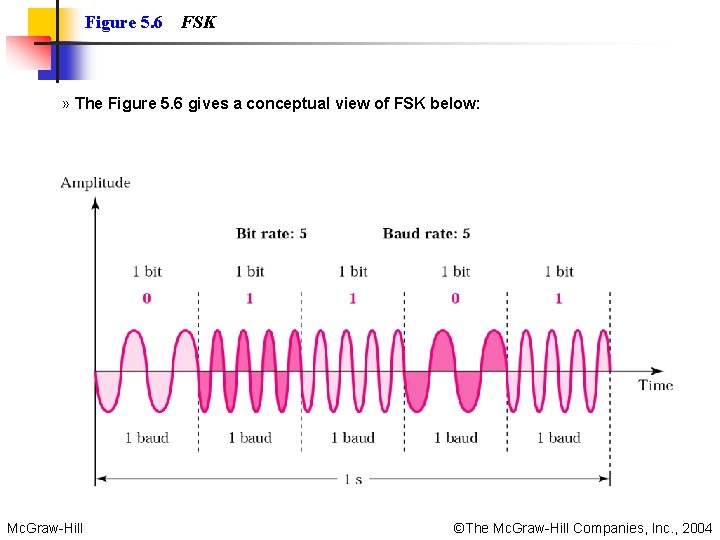
Figure 5. 6 FSK » The Figure 5. 6 gives a conceptual view of FSK below: Mc. Graw-Hill ©The Mc. Graw-Hill Companies, Inc. , 2004
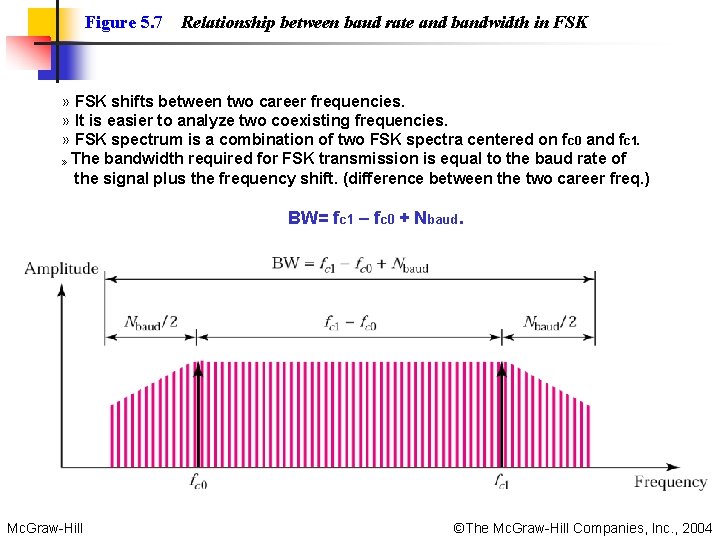
Figure 5. 7 Relationship between baud rate and bandwidth in FSK » FSK shifts between two career frequencies. » It is easier to analyze two coexisting frequencies. » FSK spectrum is a combination of two FSK spectra centered on f c 0 and fc 1. » The bandwidth required for FSK transmission is equal to the baud rate of the signal plus the frequency shift. (difference between the two career freq. ) BW= fc 1 – fc 0 + Nbaud. Mc. Graw-Hill ©The Mc. Graw-Hill Companies, Inc. , 2004
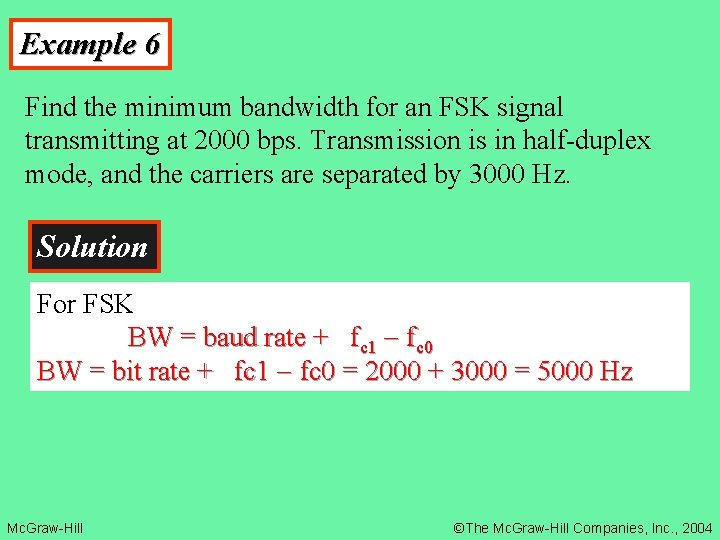
Example 6 Find the minimum bandwidth for an FSK signal transmitting at 2000 bps. Transmission is in half-duplex mode, and the carriers are separated by 3000 Hz. Solution For FSK BW = baud rate + fc 1 - fc 0 BW = bit rate + fc 1 - fc 0 = 2000 + 3000 = 5000 Hz Mc. Graw-Hill ©The Mc. Graw-Hill Companies, Inc. , 2004
PSK » PHASE SHIFT KEYING: » The phase of the career is varied to represents binary 1 or 0. » Both peak amplitude and frequency remains constant. » e. g. if we starts with a phase of 00 to represents binary 0, then we can change the phase to 1800 to send binary 1. » The phase of the signal during each bit duration remains constant. » The above method is called 2 -PSK or binary PSK, because two different phases are used. Mc. Graw-Hill ©The Mc. Graw-Hill Companies, Inc. , 2004
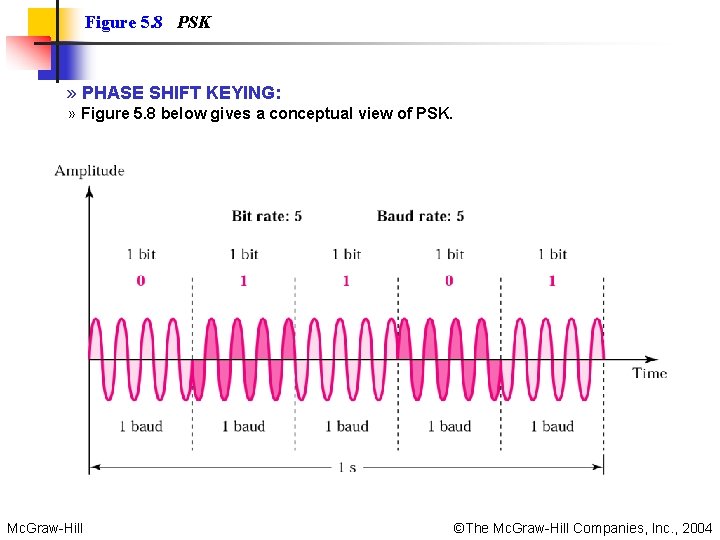
Figure 5. 8 PSK » PHASE SHIFT KEYING: » Figure 5. 8 below gives a conceptual view of PSK. Mc. Graw-Hill ©The Mc. Graw-Hill Companies, Inc. , 2004
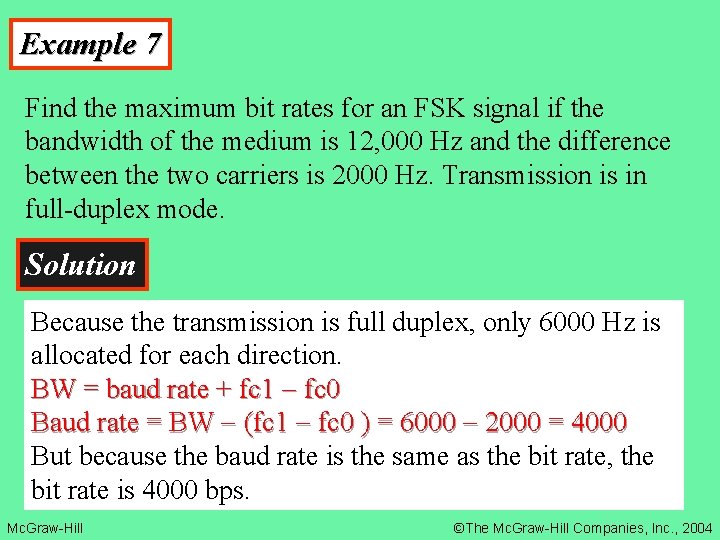
Example 7 Find the maximum bit rates for an FSK signal if the bandwidth of the medium is 12, 000 Hz and the difference between the two carriers is 2000 Hz. Transmission is in full-duplex mode. Solution Because the transmission is full duplex, only 6000 Hz is allocated for each direction. BW = baud rate + fc 1 - fc 0 Baud rate = BW - (fc 1 - fc 0 ) = 6000 - 2000 = 4000 But because the baud rate is the same as the bit rate, the bit rate is 4000 bps. Mc. Graw-Hill ©The Mc. Graw-Hill Companies, Inc. , 2004
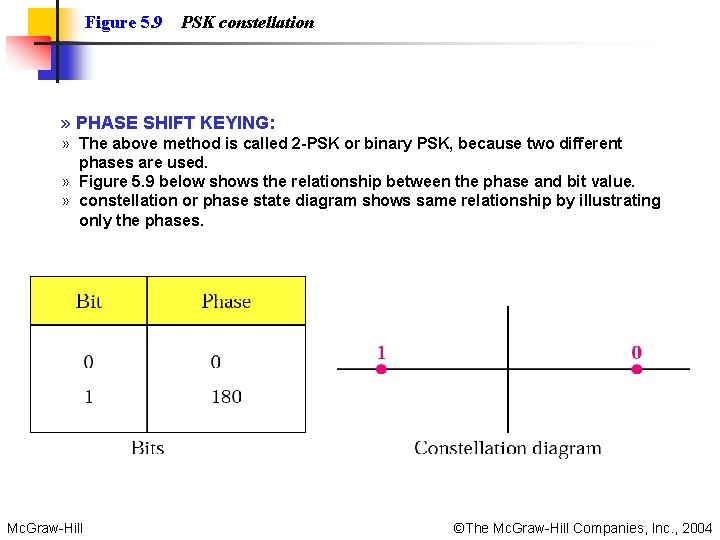
Figure 5. 9 PSK constellation » PHASE SHIFT KEYING: » The above method is called 2 -PSK or binary PSK, because two different phases are used. » Figure 5. 9 below shows the relationship between the phase and bit value. » constellation or phase state diagram shows same relationship by illustrating only the phases. Mc. Graw-Hill ©The Mc. Graw-Hill Companies, Inc. , 2004
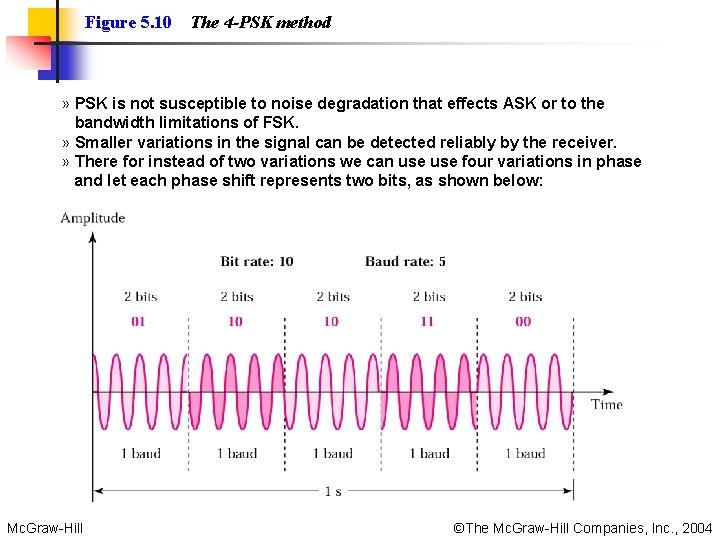
Figure 5. 10 The 4 -PSK method » PSK is not susceptible to noise degradation that effects ASK or to the bandwidth limitations of FSK. » Smaller variations in the signal can be detected reliably by the receiver. » There for instead of two variations we can use four variations in phase and let each phase shift represents two bits, as shown below: Mc. Graw-Hill ©The Mc. Graw-Hill Companies, Inc. , 2004
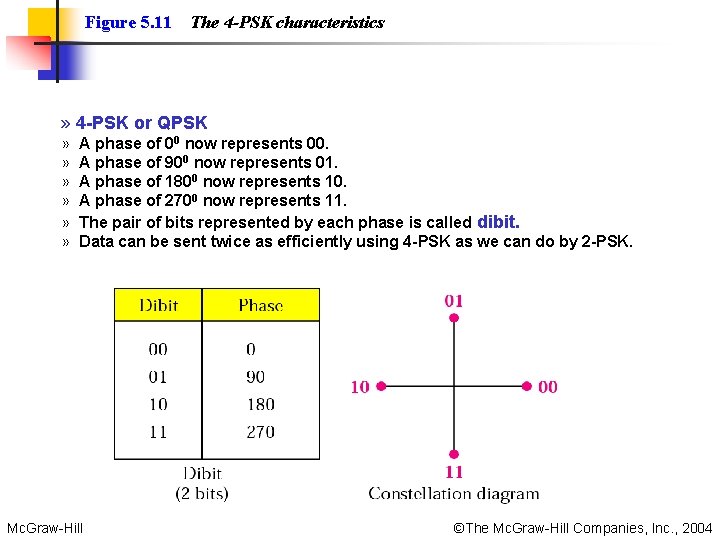
Figure 5. 11 The 4 -PSK characteristics » 4 -PSK or QPSK » » » A phase of 00 now represents 00. A phase of 900 now represents 01. A phase of 1800 now represents 10. A phase of 2700 now represents 11. The pair of bits represented by each phase is called dibit. Data can be sent twice as efficiently using 4 -PSK as we can do by 2 -PSK. Mc. Graw-Hill ©The Mc. Graw-Hill Companies, Inc. , 2004
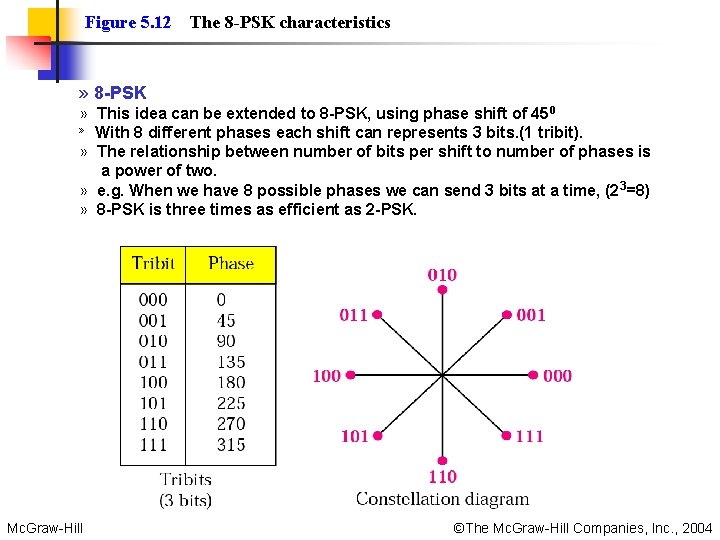
Figure 5. 12 The 8 -PSK characteristics » 8 -PSK » This idea can be extended to 8 -PSK, using phase shift of 45 0 » With 8 different phases each shift can represents 3 bits. (1 tribit). » The relationship between number of bits per shift to number of phases is a power of two. » e. g. When we have 8 possible phases we can send 3 bits at a time, (2 3=8) » 8 -PSK is three times as efficient as 2 -PSK. Mc. Graw-Hill ©The Mc. Graw-Hill Companies, Inc. , 2004
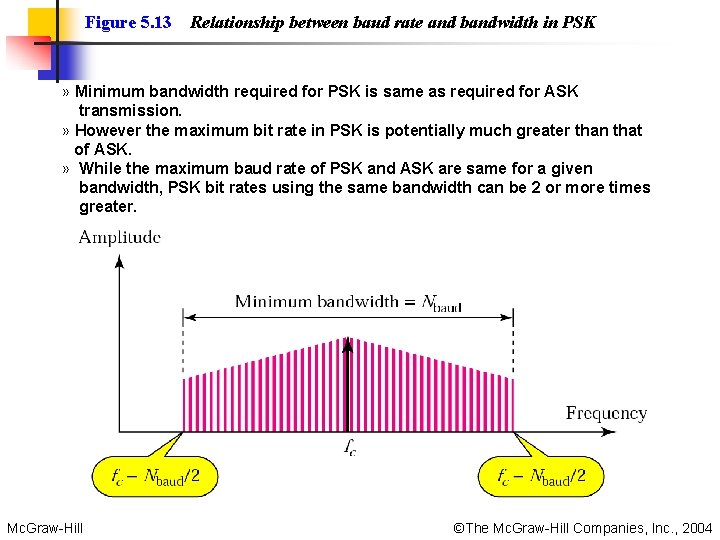
Figure 5. 13 Relationship between baud rate and bandwidth in PSK » Minimum bandwidth required for PSK is same as required for ASK transmission. » However the maximum bit rate in PSK is potentially much greater than that of ASK. » While the maximum baud rate of PSK and ASK are same for a given bandwidth, PSK bit rates using the same bandwidth can be 2 or more times greater. Mc. Graw-Hill ©The Mc. Graw-Hill Companies, Inc. , 2004
Example 8 Find the bandwidth for a 4 -PSK signal transmitting at 2000 bps. Transmission is in half-duplex mode. Solution For PSK the baud rate is the same as the bandwidth, which means the baud rate is 5000. But in 8 -PSK the bit rate is 3 times the baud rate, so the bit rate is 15, 000 bps. Mc. Graw-Hill ©The Mc. Graw-Hill Companies, Inc. , 2004
Example 9 Given a bandwidth of 5000 Hz for an 8 -PSK signal, what are the baud rate and bit rate? Solution For PSK the baud rate is the same as the bandwidth, which means the baud rate is 5000. But in 8 -PSK the bit rate is 3 times the baud rate, so the bit rate is 15, 000 bps. Mc. Graw-Hill ©The Mc. Graw-Hill Companies, Inc. , 2004
Note: Quadrature amplitude modulation is a combination of ASK and PSK so that a maximum contrast between each signal unit (bit, dibit, tribit, and so on) is achieved. Mc. Graw-Hill ©The Mc. Graw-Hill Companies, Inc. , 2004
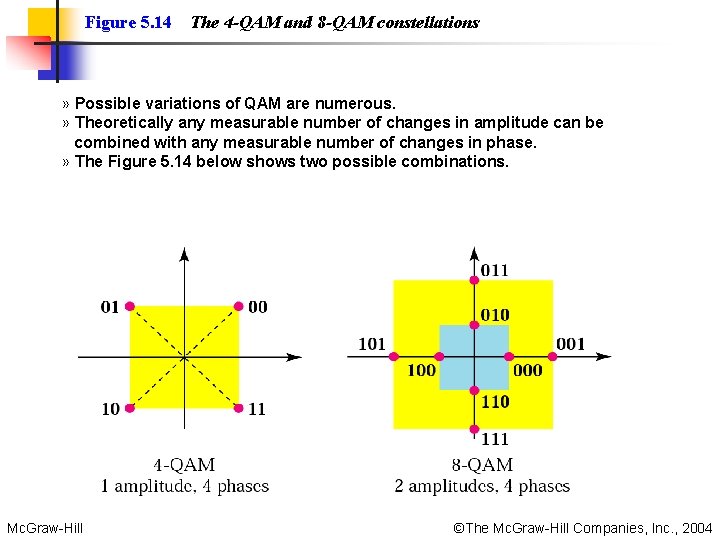
Figure 5. 14 The 4 -QAM and 8 -QAM constellations » Possible variations of QAM are numerous. » Theoretically any measurable number of changes in amplitude can be combined with any measurable number of changes in phase. » The Figure 5. 14 below shows two possible combinations. Mc. Graw-Hill ©The Mc. Graw-Hill Companies, Inc. , 2004
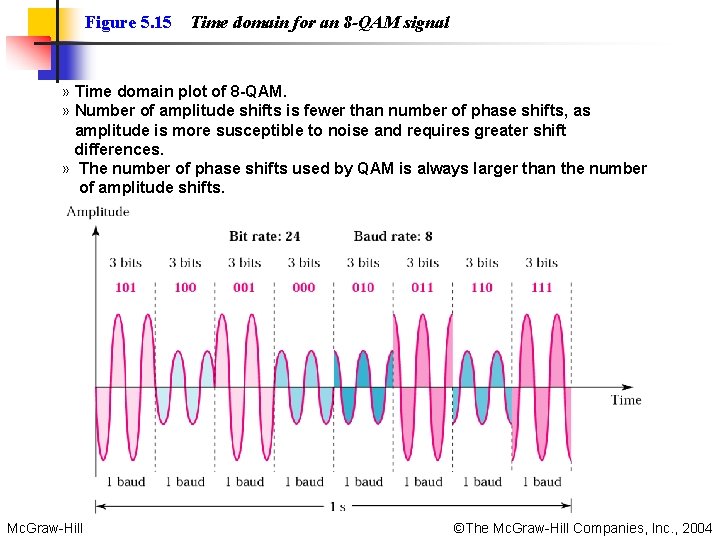
Figure 5. 15 Time domain for an 8 -QAM signal » Time domain plot of 8 -QAM. » Number of amplitude shifts is fewer than number of phase shifts, as amplitude is more susceptible to noise and requires greater shift differences. » The number of phase shifts used by QAM is always larger than the number of amplitude shifts. Mc. Graw-Hill ©The Mc. Graw-Hill Companies, Inc. , 2004
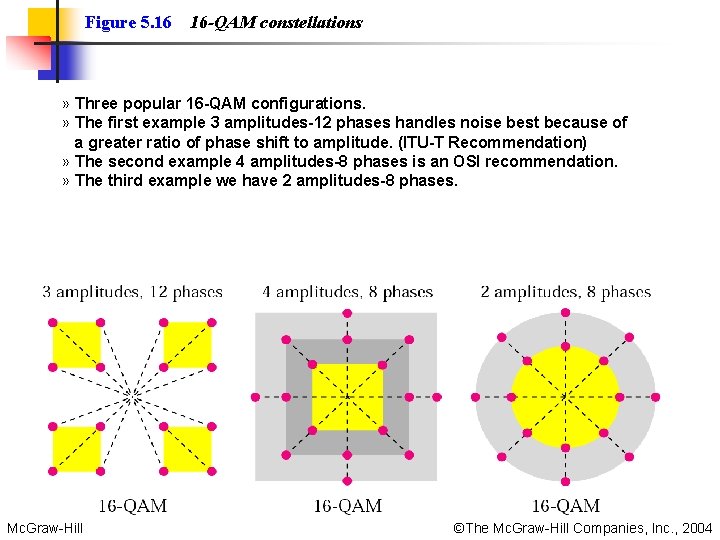
Figure 5. 16 16 -QAM constellations » Three popular 16 -QAM configurations. » The first example 3 amplitudes-12 phases handles noise best because of a greater ratio of phase shift to amplitude. (ITU-T Recommendation) » The second example 4 amplitudes-8 phases is an OSI recommendation. » The third example we have 2 amplitudes-8 phases. Mc. Graw-Hill ©The Mc. Graw-Hill Companies, Inc. , 2004
Bandwidth of QAM » The minimum bandwidth required for QAM is same as required for ASK and PSK transmission. QAM has some advantages as PSK over ASK. Mc. Graw-Hill ©The Mc. Graw-Hill Companies, Inc. , 2004
Figure 5. 17 Bit and baud » Assuming that an FSK signal over voice –grade phone lines can send 1200 bps. » Each frequency shift requires a single bit; so it requires 1200 signals. » Its baud rate is therefore also 1200 bps. » Each single variation in an 8 -QAM however represents 3 bits. » So a bit rate of 1200 bps, using 8 -QAM has a baud rate of 400 bps. Mc. Graw-Hill ©The Mc. Graw-Hill Companies, Inc. , 2004
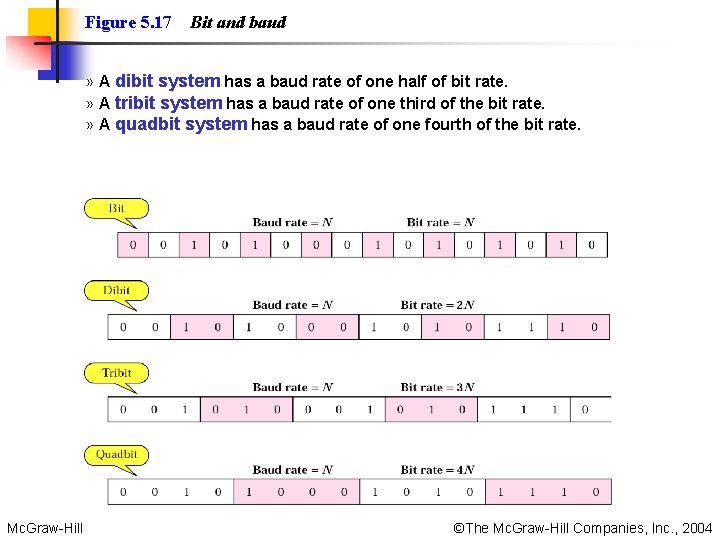
Figure 5. 17 Bit and baud » A dibit system has a baud rate of one half of bit rate. » A tribit system has a baud rate of one third of the bit rate. » A quadbit system has a baud rate of one fourth of the bit rate. Mc. Graw-Hill ©The Mc. Graw-Hill Companies, Inc. , 2004
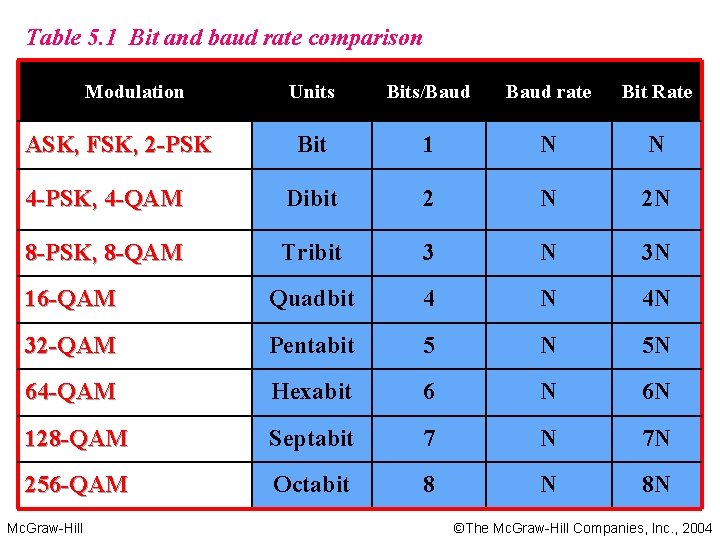
Table 5. 1 Bit and baud rate comparison Modulation Units Bits/Baud rate Bit Rate Bit 1 N N 4 -PSK, 4 -QAM Dibit 2 N 2 N 8 -PSK, 8 -QAM Tribit 3 N 3 N 16 -QAM Quadbit 4 N 4 N 32 -QAM Pentabit 5 N 5 N 64 -QAM Hexabit 6 N 6 N 128 -QAM Septabit 7 N 7 N 256 -QAM Octabit 8 N 8 N ASK, FSK, 2 -PSK Mc. Graw-Hill ©The Mc. Graw-Hill Companies, Inc. , 2004
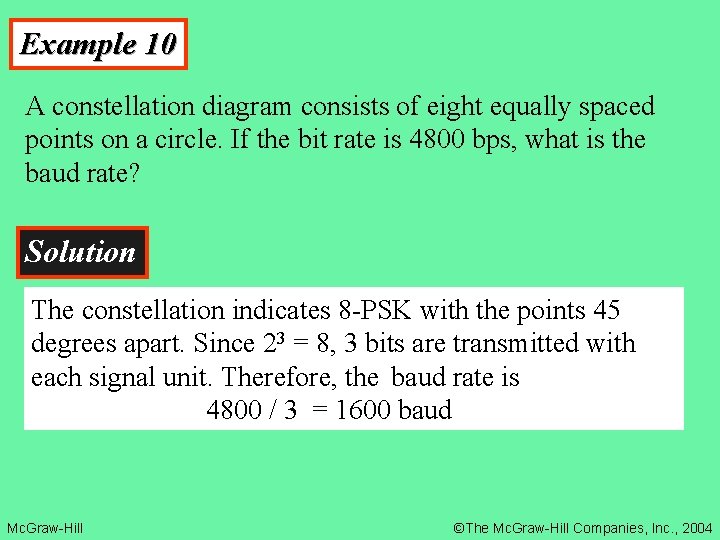
Example 10 A constellation diagram consists of eight equally spaced points on a circle. If the bit rate is 4800 bps, what is the baud rate? Solution The constellation indicates 8 -PSK with the points 45 degrees apart. Since 23 = 8, 3 bits are transmitted with each signal unit. Therefore, the baud rate is 4800 / 3 = 1600 baud Mc. Graw-Hill ©The Mc. Graw-Hill Companies, Inc. , 2004
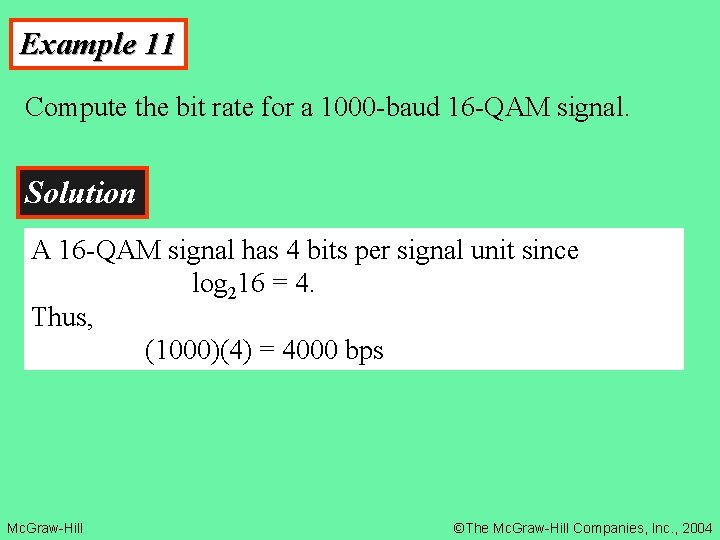
Example 11 Compute the bit rate for a 1000 -baud 16 -QAM signal. Solution A 16 -QAM signal has 4 bits per signal unit since log 216 = 4. Thus, (1000)(4) = 4000 bps Mc. Graw-Hill ©The Mc. Graw-Hill Companies, Inc. , 2004
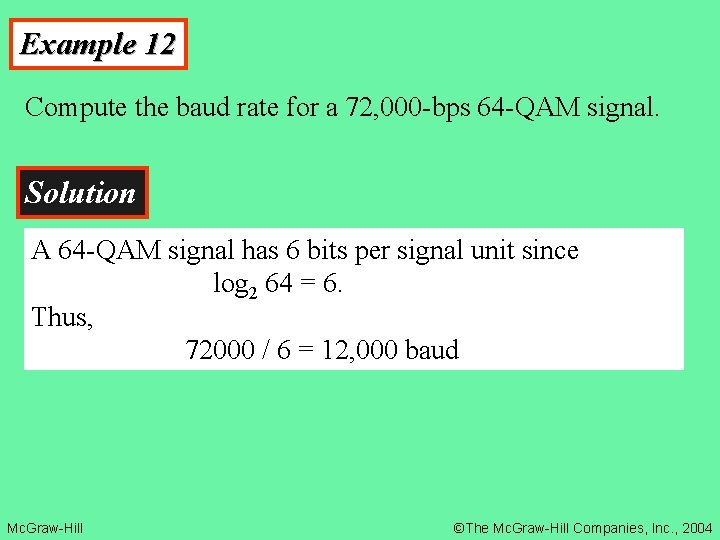
Example 12 Compute the baud rate for a 72, 000 -bps 64 -QAM signal. Solution A 64 -QAM signal has 6 bits per signal unit since log 2 64 = 6. Thus, 72000 / 6 = 12, 000 baud Mc. Graw-Hill ©The Mc. Graw-Hill Companies, Inc. , 2004
5. 2 Telephone Modems Modem Standards » The word MODEM is a composite word that refers to two functional entities. » A signal MOdulater and a signal DEModulater. » MODULATER creates band pass analog signal for binary data. » DEMODULATER recovers the binary data from the modulated signal. Mc. Graw-Hill ©The Mc. Graw-Hill Companies, Inc. , 2004
Note: Modem stands for modulator/demodulator. Mc. Graw-Hill ©The Mc. Graw-Hill Companies, Inc. , 2004
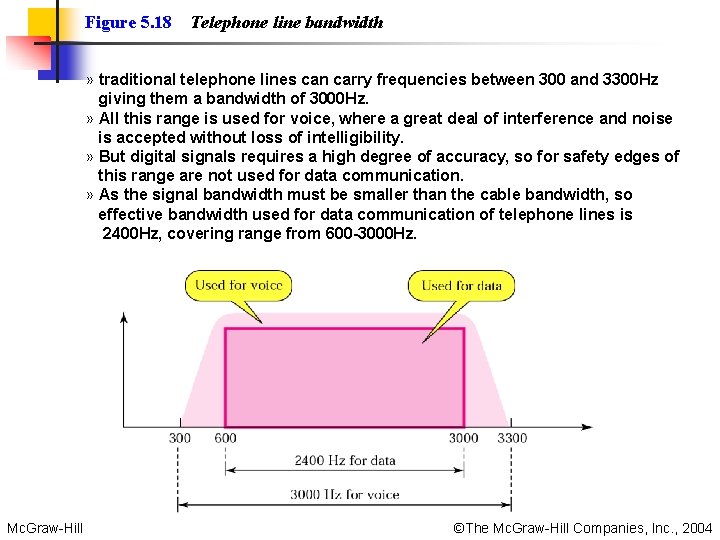
Figure 5. 18 Telephone line bandwidth » traditional telephone lines can carry frequencies between 300 and 3300 Hz giving them a bandwidth of 3000 Hz. » All this range is used for voice, where a great deal of interference and noise is accepted without loss of intelligibility. » But digital signals requires a high degree of accuracy, so for safety edges of this range are not used for data communication. » As the signal bandwidth must be smaller than the cable bandwidth, so effective bandwidth used for data communication of telephone lines is 2400 Hz, covering range from 600 -3000 Hz. Mc. Graw-Hill ©The Mc. Graw-Hill Companies, Inc. , 2004
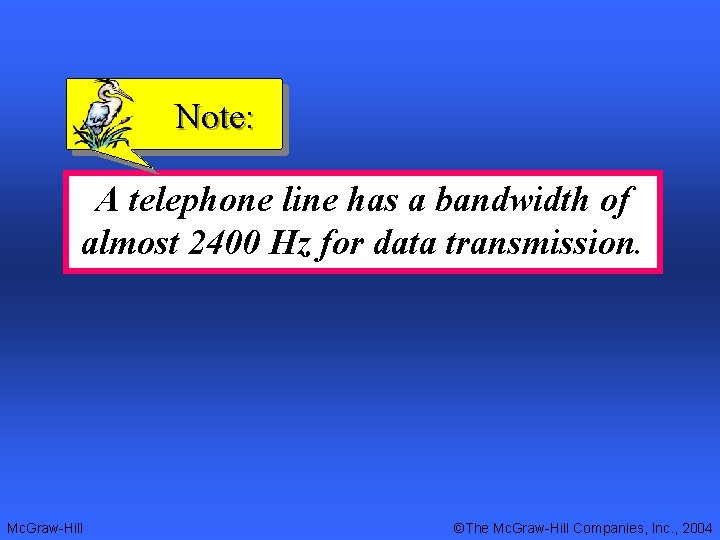
Note: A telephone line has a bandwidth of almost 2400 Hz for data transmission. Mc. Graw-Hill ©The Mc. Graw-Hill Companies, Inc. , 2004
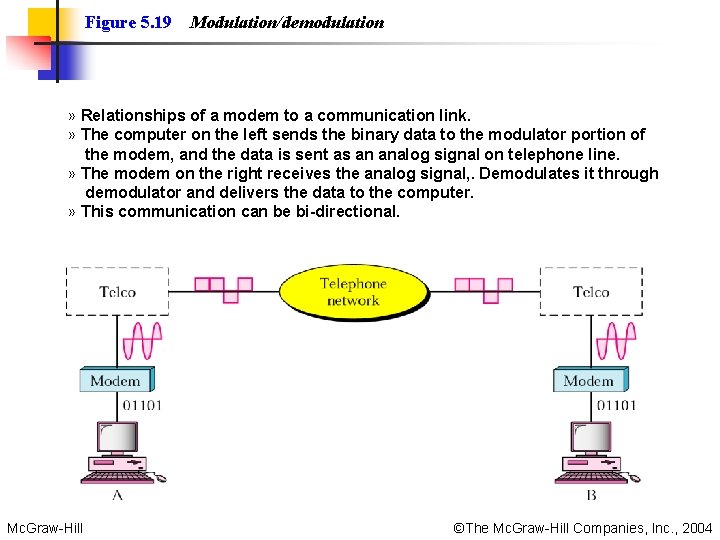
Figure 5. 19 Modulation/demodulation » Relationships of a modem to a communication link. » The computer on the left sends the binary data to the modulator portion of the modem, and the data is sent as an analog signal on telephone line. » The modem on the right receives the analog signal, . Demodulates it through demodulator and delivers the data to the computer. » This communication can be bi-directional. Mc. Graw-Hill ©The Mc. Graw-Hill Companies, Inc. , 2004
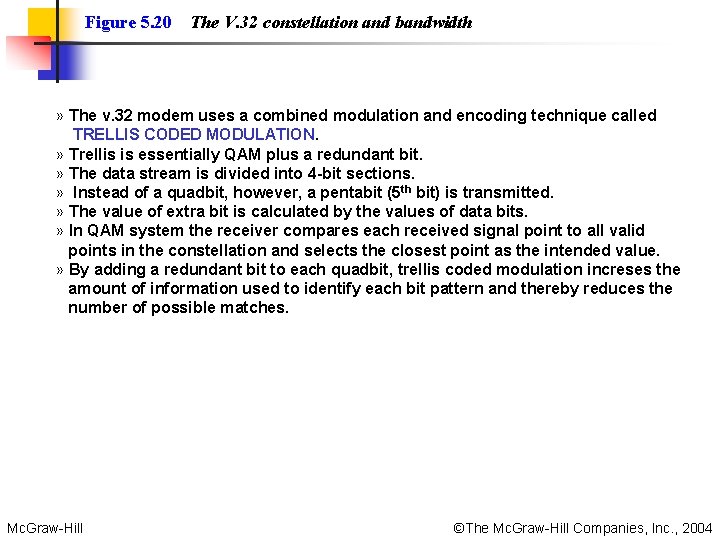
Figure 5. 20 The V. 32 constellation and bandwidth » The v. 32 modem uses a combined modulation and encoding technique called TRELLIS CODED MODULATION. » Trellis is essentially QAM plus a redundant bit. » The data stream is divided into 4 -bit sections. » Instead of a quadbit, however, a pentabit (5 th bit) is transmitted. » The value of extra bit is calculated by the values of data bits. » In QAM system the receiver compares each received signal point to all valid points in the constellation and selects the closest point as the intended value. » By adding a redundant bit to each quadbit, trellis coded modulation increses the amount of information used to identify each bit pattern and thereby reduces the number of possible matches. Mc. Graw-Hill ©The Mc. Graw-Hill Companies, Inc. , 2004
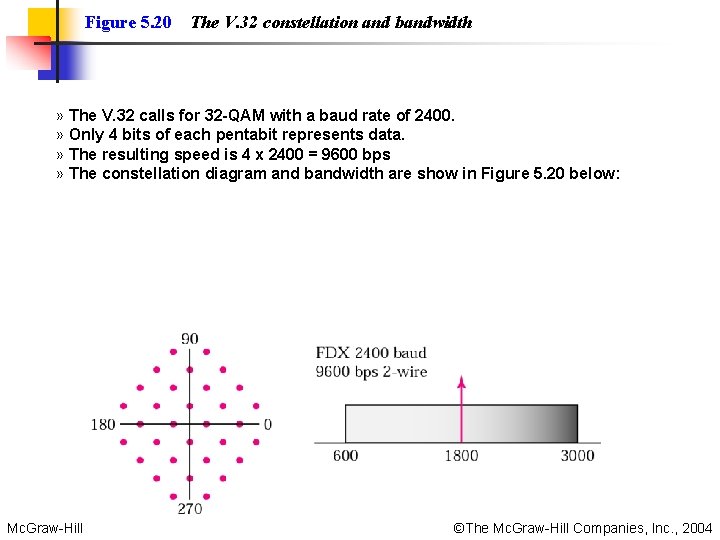
Figure 5. 20 The V. 32 constellation and bandwidth » The V. 32 calls for 32 -QAM with a baud rate of 2400. » Only 4 bits of each pentabit represents data. » The resulting speed is 4 x 2400 = 9600 bps » The constellation diagram and bandwidth are show in Figure 5. 20 below: Mc. Graw-Hill ©The Mc. Graw-Hill Companies, Inc. , 2004
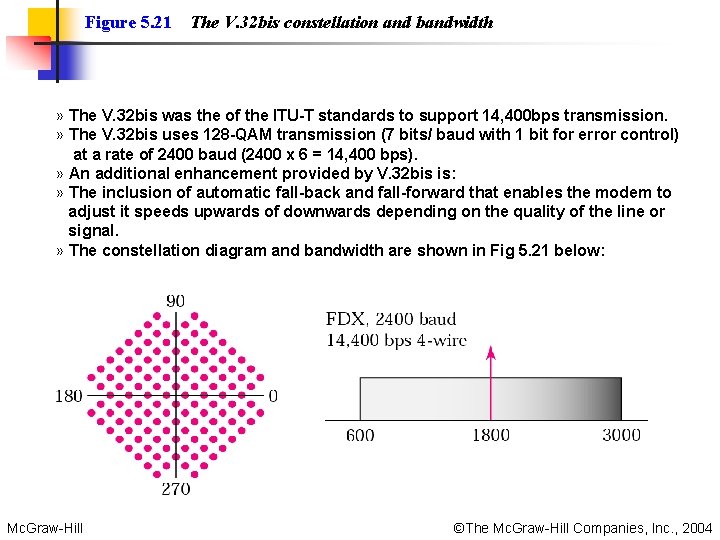
Figure 5. 21 The V. 32 bis constellation and bandwidth » The V. 32 bis was the of the ITU-T standards to support 14, 400 bps transmission. » The V. 32 bis uses 128 -QAM transmission (7 bits/ baud with 1 bit for error control) at a rate of 2400 baud (2400 x 6 = 14, 400 bps). » An additional enhancement provided by V. 32 bis is: » The inclusion of automatic fall-back and fall-forward that enables the modem to adjust it speeds upwards of downwards depending on the quality of the line or signal. » The constellation diagram and bandwidth are shown in Fig 5. 21 below: Mc. Graw-Hill ©The Mc. Graw-Hill Companies, Inc. , 2004
The V. 34 bis » The V. 34 bis modem provides a bit rate of 28, 800 with a 960 -point constellation to a bit rate of 33, 600 with 1664 -point constellation. Mc. Graw-Hill ©The Mc. Graw-Hill Companies, Inc. , 2004
The V. 90 » Traditionally modems has data rate limitation up to 33. 6 Kbps (by Shannon Formula). » V. 90 modems has a data rate of 56, 000 bps, called 56 K modems. Mc. Graw-Hill ©The Mc. Graw-Hill Companies, Inc. , 2004
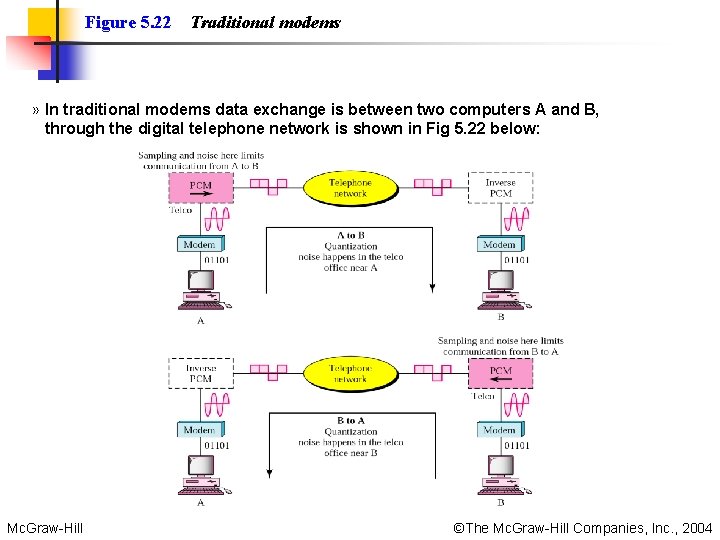
Figure 5. 22 Traditional modems » In traditional modems data exchange is between two computers A and B, through the digital telephone network is shown in Fig 5. 22 below: Mc. Graw-Hill ©The Mc. Graw-Hill Companies, Inc. , 2004
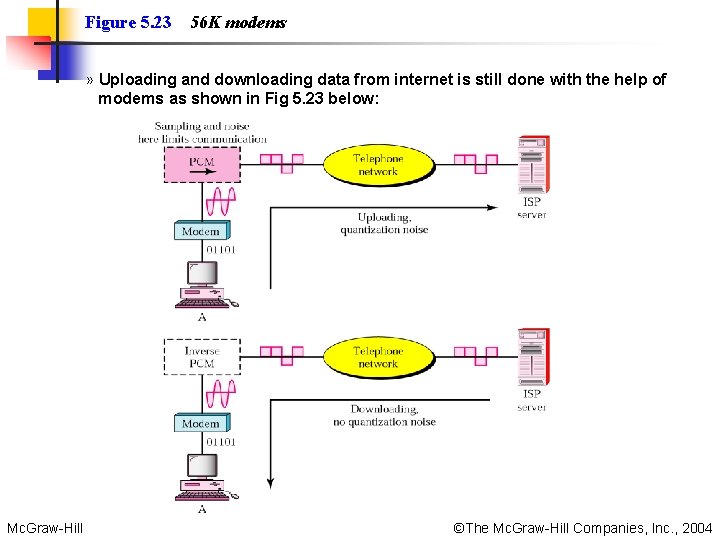
Figure 5. 23 56 K modems » Uploading and downloading data from internet is still done with the help of modems as shown in Fig 5. 23 below: Mc. Graw-Hill ©The Mc. Graw-Hill Companies, Inc. , 2004
5. 3 Modulation of Analog Signals Amplitude Modulation (AM) Frequency Modulation (FM) Phase Modulation (PM) Mc. Graw-Hill ©The Mc. Graw-Hill Companies, Inc. , 2004
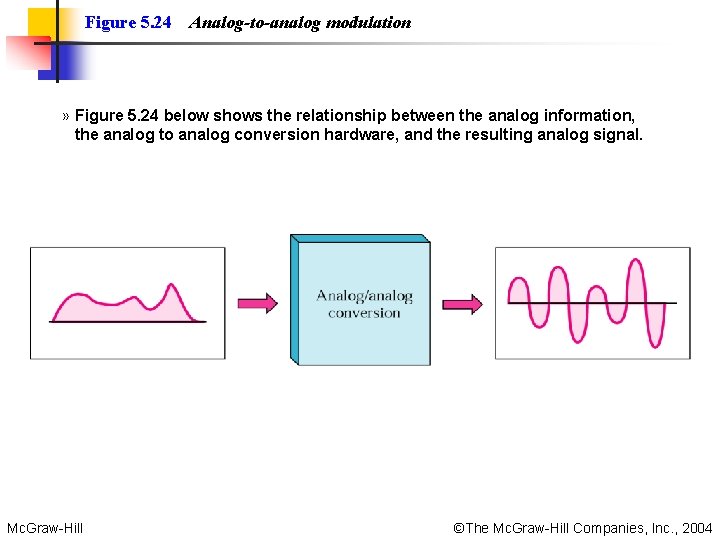
Figure 5. 24 Analog-to-analog modulation » Figure 5. 24 below shows the relationship between the analog information, the analog to analog conversion hardware, and the resulting analog signal. Mc. Graw-Hill ©The Mc. Graw-Hill Companies, Inc. , 2004
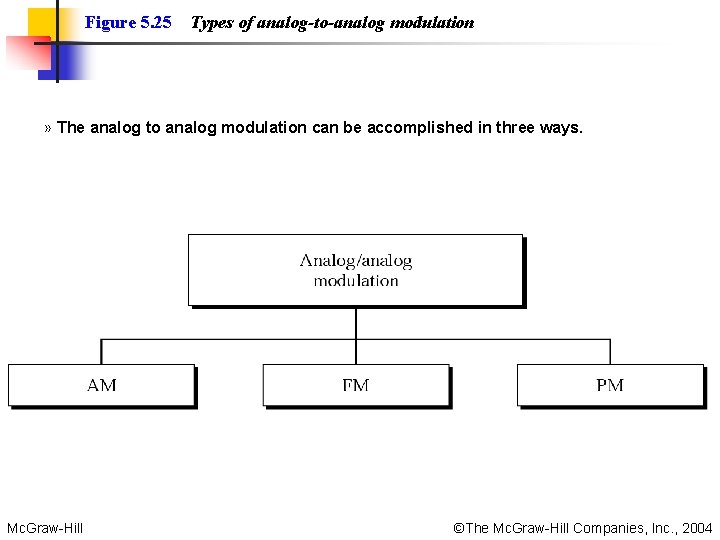
Figure 5. 25 Types of analog-to-analog modulation » The analog to analog modulation can be accomplished in three ways. Mc. Graw-Hill ©The Mc. Graw-Hill Companies, Inc. , 2004
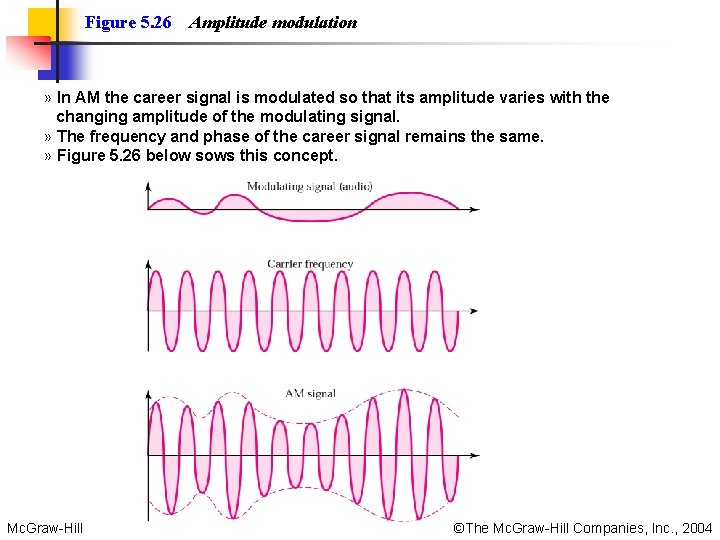
Figure 5. 26 Amplitude modulation » In AM the career signal is modulated so that its amplitude varies with the changing amplitude of the modulating signal. » The frequency and phase of the career signal remains the same. » Figure 5. 26 below sows this concept. Mc. Graw-Hill ©The Mc. Graw-Hill Companies, Inc. , 2004
Note: The total bandwidth required for AM can be determined from the bandwidth of the audio signal: BWt = 2 x BWm. Mc. Graw-Hill ©The Mc. Graw-Hill Companies, Inc. , 2004
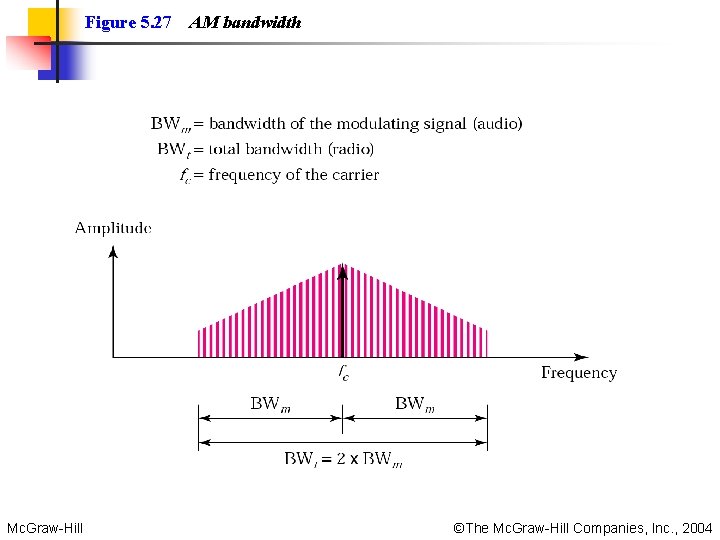
Figure 5. 27 Mc. Graw-Hill AM bandwidth ©The Mc. Graw-Hill Companies, Inc. , 2004
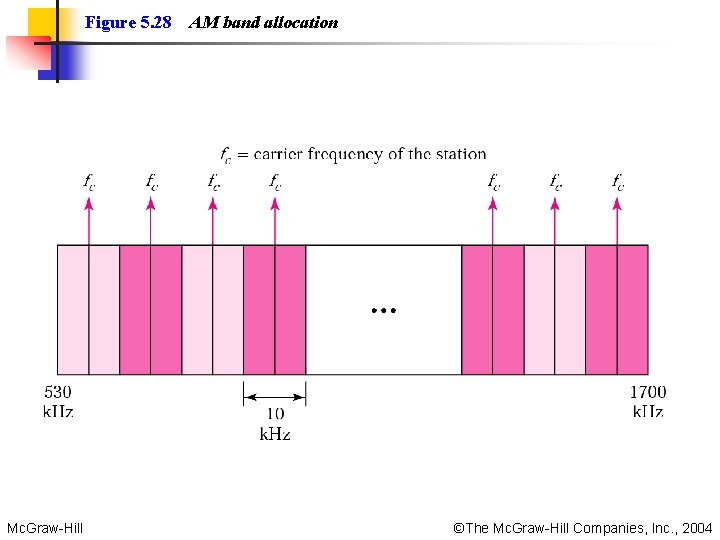
Figure 5. 28 Mc. Graw-Hill AM band allocation ©The Mc. Graw-Hill Companies, Inc. , 2004
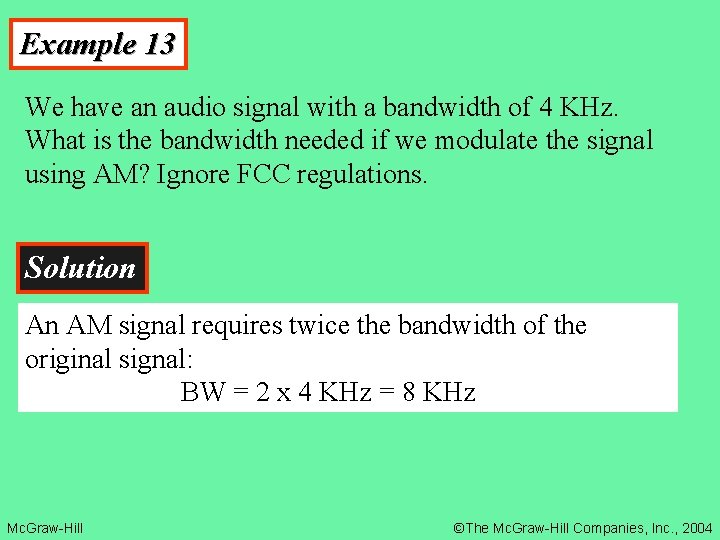
Example 13 We have an audio signal with a bandwidth of 4 KHz. What is the bandwidth needed if we modulate the signal using AM? Ignore FCC regulations. Solution An AM signal requires twice the bandwidth of the original signal: BW = 2 x 4 KHz = 8 KHz Mc. Graw-Hill ©The Mc. Graw-Hill Companies, Inc. , 2004
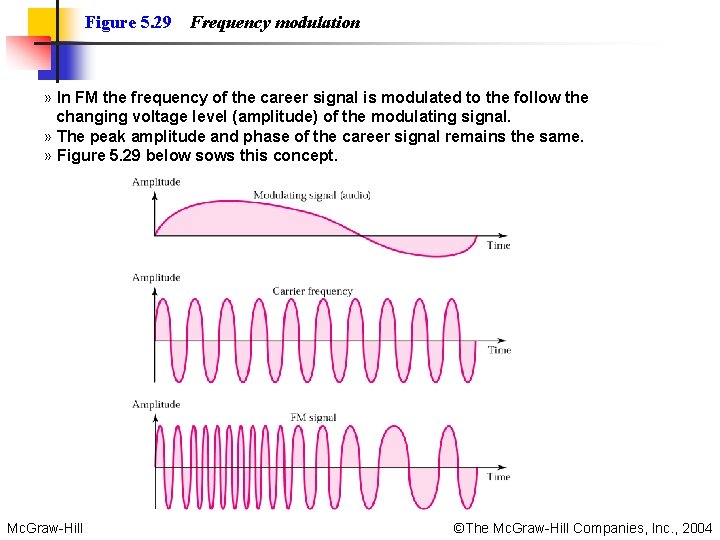
Figure 5. 29 Frequency modulation » In FM the frequency of the career signal is modulated to the follow the changing voltage level (amplitude) of the modulating signal. » The peak amplitude and phase of the career signal remains the same. » Figure 5. 29 below sows this concept. Mc. Graw-Hill ©The Mc. Graw-Hill Companies, Inc. , 2004
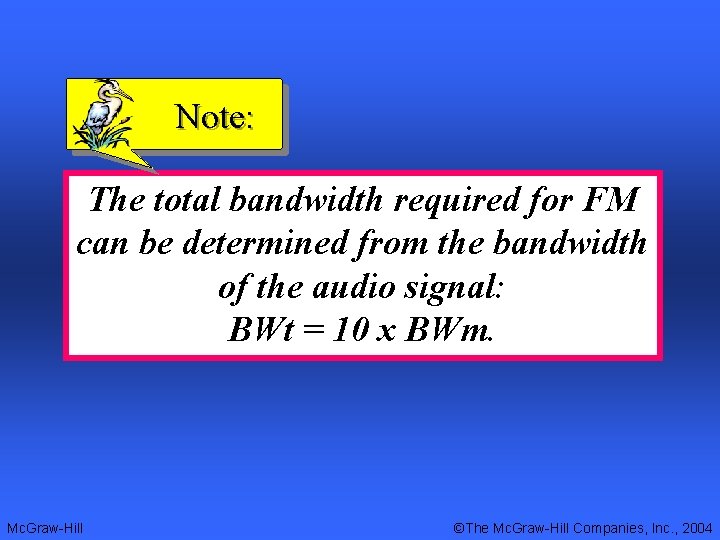
Note: The total bandwidth required for FM can be determined from the bandwidth of the audio signal: BWt = 10 x BWm. Mc. Graw-Hill ©The Mc. Graw-Hill Companies, Inc. , 2004
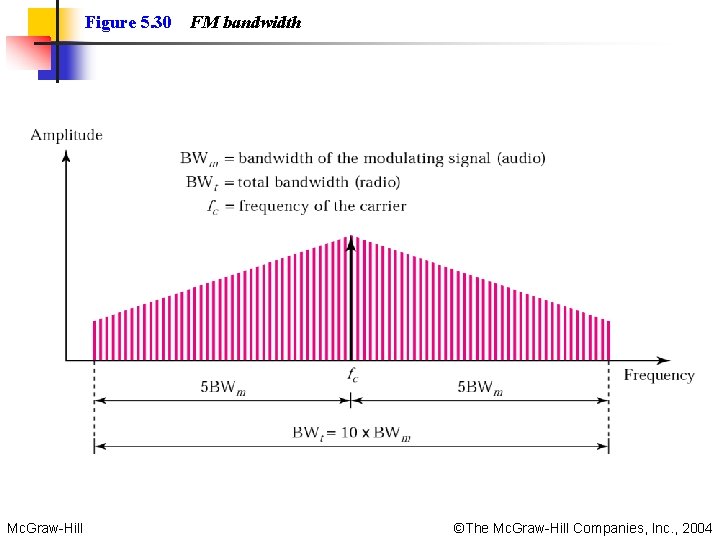
Figure 5. 30 Mc. Graw-Hill FM bandwidth ©The Mc. Graw-Hill Companies, Inc. , 2004
Note: The bandwidth of a stereo audio signal is usually 15 KHz. Therefore, an FM station needs at least a bandwidth of 150 KHz. The FCC requires the minimum bandwidth to be at least 200 KHz (0. 2 MHz). Mc. Graw-Hill ©The Mc. Graw-Hill Companies, Inc. , 2004
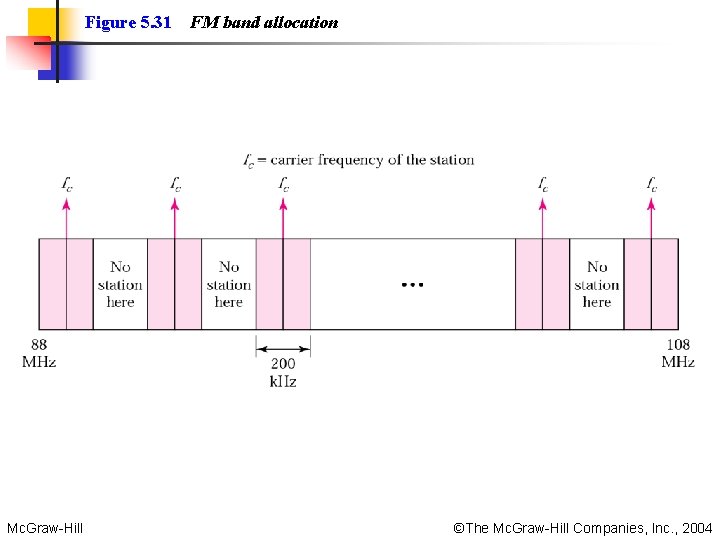
Figure 5. 31 Mc. Graw-Hill FM band allocation ©The Mc. Graw-Hill Companies, Inc. , 2004
Example 14 We have an audio signal with a bandwidth of 4 MHz. What is the bandwidth needed if we modulate the signal using FM? Ignore FCC regulations. Solution An FM signal requires 10 times the bandwidth of the original signal: BW = 10 x 4 MHz = 40 MHz Mc. Graw-Hill ©The Mc. Graw-Hill Companies, Inc. , 2004
Phase Modulation » In PM the phase of the career signal is modulated to follow the changing in the changing voltage level (amplitude) of the modulating signal. » The peak amplitude and frequency of the career signal remain constant. » The analysis and the phase modulation is same as Mc. Graw-Hill ©The Mc. Graw-Hill Companies, Inc. , 2004
- Slides: 68