
Chapter 5 Algorithms 2 Introduction to CS 1
- Slides: 18
Chapter 5 Algorithms (2) Introduction to CS 1 st Semester, 2015 Sanghyun Park
Outline ± ± ± ± ± Informal Definition of an Algorithm Find. Largest Three Basic Constructs Sorting Algorithms Searching Algorithms Recursion Algorithm Performance Time Complexity Asymptotic Notation Growth Rate (previous file) (previous file)
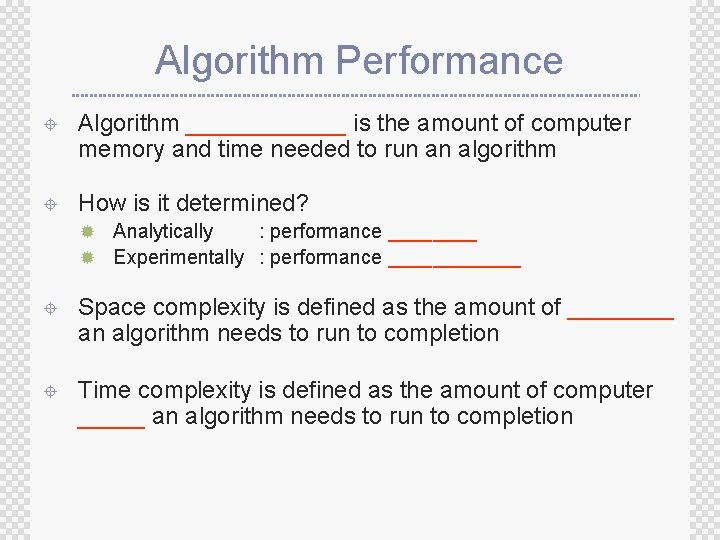
Algorithm Performance ± Algorithm ______ is the amount of computer memory and time needed to run an algorithm ± How is it determined? ® Analytically : performance ____ ® Experimentally : performance ______ ± Space complexity is defined as the amount of ____ an algorithm needs to run to completion ± Time complexity is defined as the amount of computer _____ an algorithm needs to run to completion
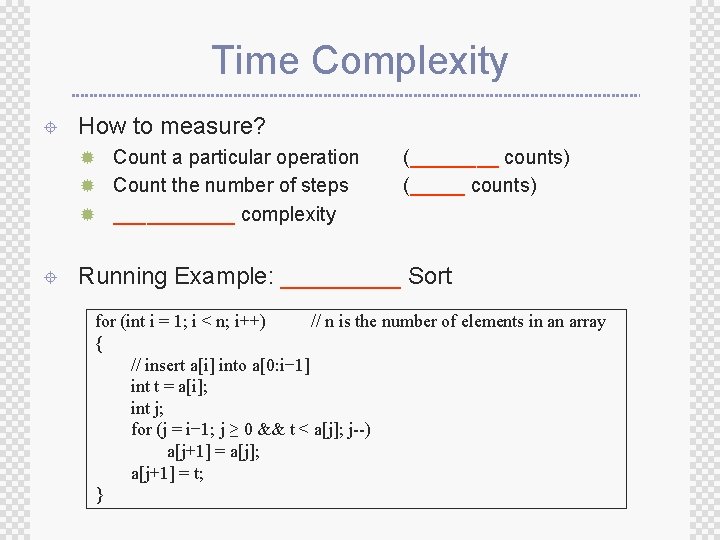
Time Complexity ± How to measure? ® Count a particular operation ® Count the number of steps (____ counts) (_____ counts) ® ______ complexity ± Running Example: _____ Sort for (int i = 1; i < n; i++) // n is the number of elements in an array { // insert a[i] into a[0: i− 1] int t = a[i]; int j; for (j = i− 1; j ≥ 0 && t < a[j]; j--) a[j+1] = a[j]; a[j+1] = t; }
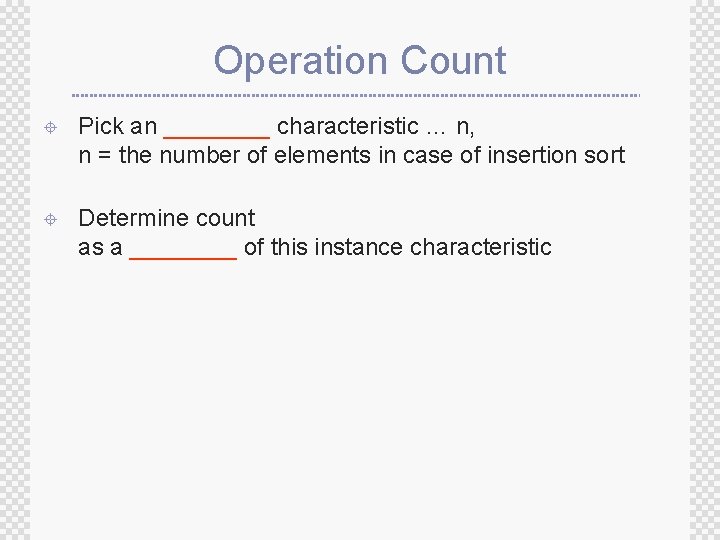
Operation Count ± Pick an ____ characteristic … n, n = the number of elements in case of insertion sort ± Determine count as a ____ of this instance characteristic
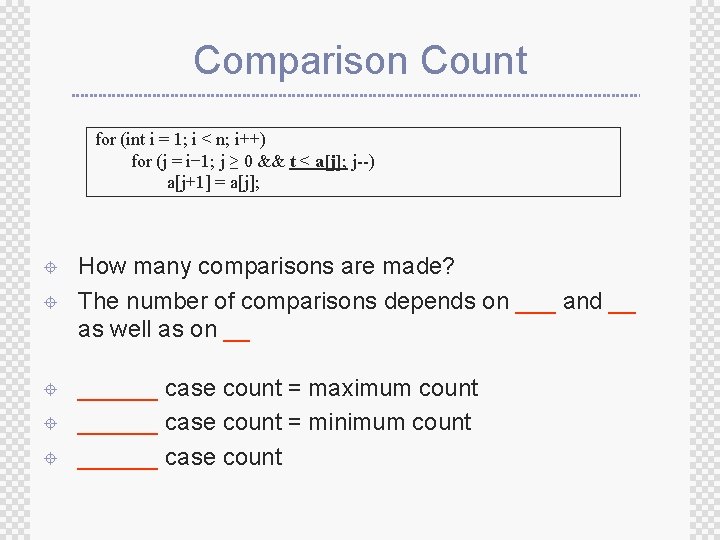
Comparison Count for (int i = 1; i < n; i++) for (j = i− 1; j ≥ 0 && t < a[j]; j--) a[j+1] = a[j]; ± ± ± How many comparisons are made? The number of comparisons depends on ___ and __ as well as on __ ______ case count = maximum count ______ case count = minimum count ______ case count
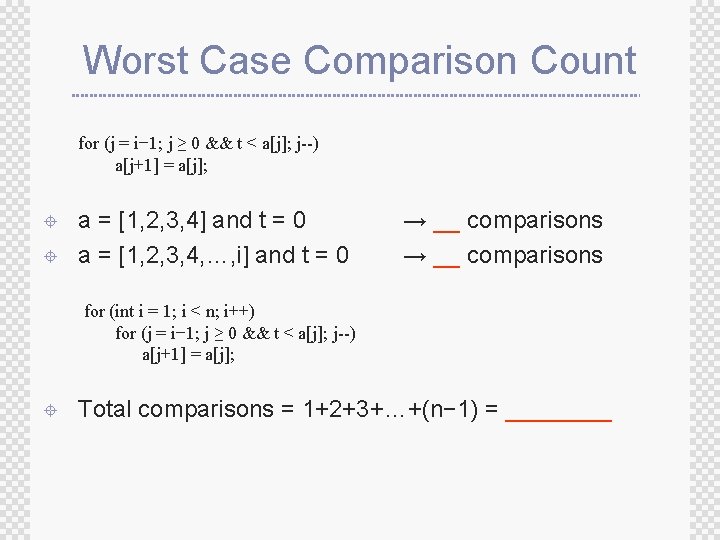
Worst Case Comparison Count for (j = i− 1; j ≥ 0 && t < a[j]; j--) a[j+1] = a[j]; ± ± a = [1, 2, 3, 4] and t = 0 a = [1, 2, 3, 4, …, i] and t = 0 → __ comparisons for (int i = 1; i < n; i++) for (j = i− 1; j ≥ 0 && t < a[j]; j--) a[j+1] = a[j]; ± Total comparisons = 1+2+3+…+(n− 1) = ____
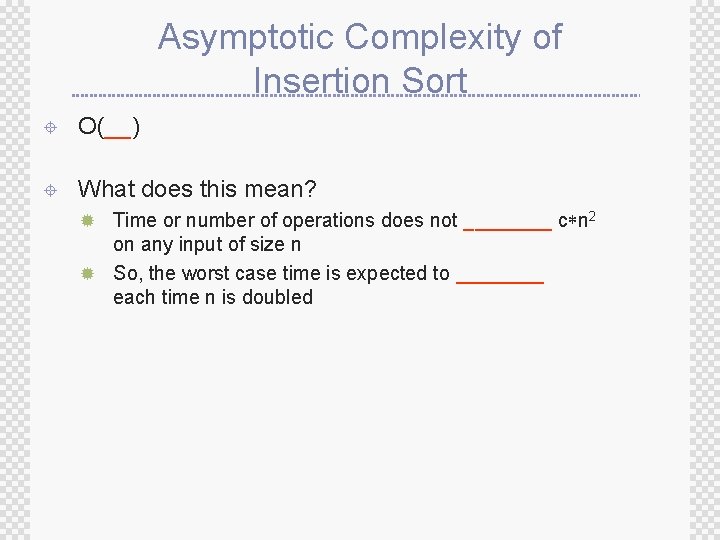
Asymptotic Complexity of Insertion Sort ± O(__) ± What does this mean? ® Time or number of operations does not ____ c n 2 on any input of size n ® So, the worst case time is expected to ____ each time n is doubled
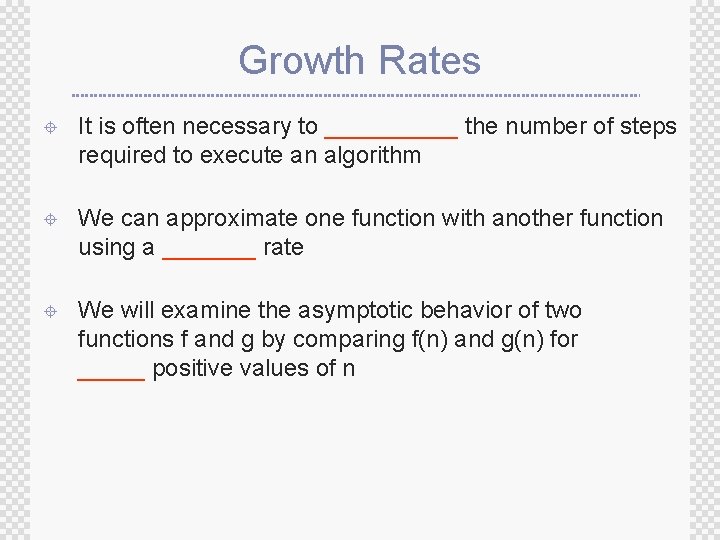
Growth Rates ± It is often necessary to _____ the number of steps required to execute an algorithm ± We can approximate one function with another function using a _______ rate ± We will examine the asymptotic behavior of two functions f and g by comparing f(n) and g(n) for _____ positive values of n
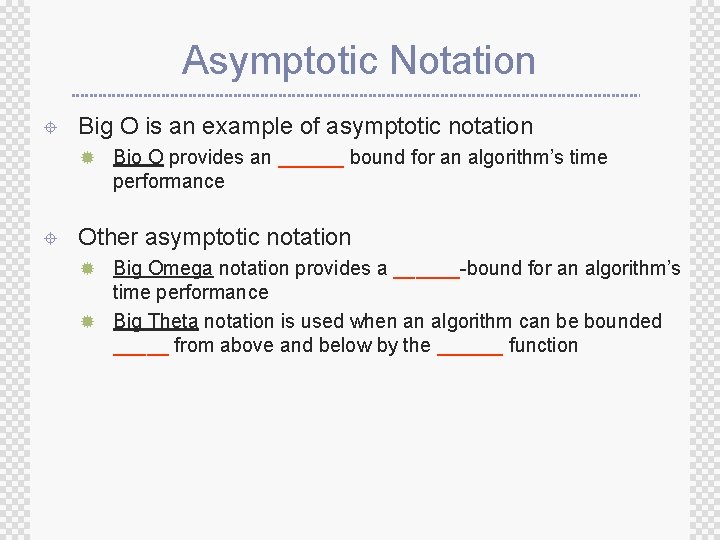
Asymptotic Notation ± Big O is an example of asymptotic notation ® Bio O provides an ______ bound for an algorithm’s time performance ± Other asymptotic notation ® Big Omega notation provides a ______-bound for an algorithm’s time performance ® Big Theta notation is used when an algorithm can be bounded _____ from above and below by the ______ function
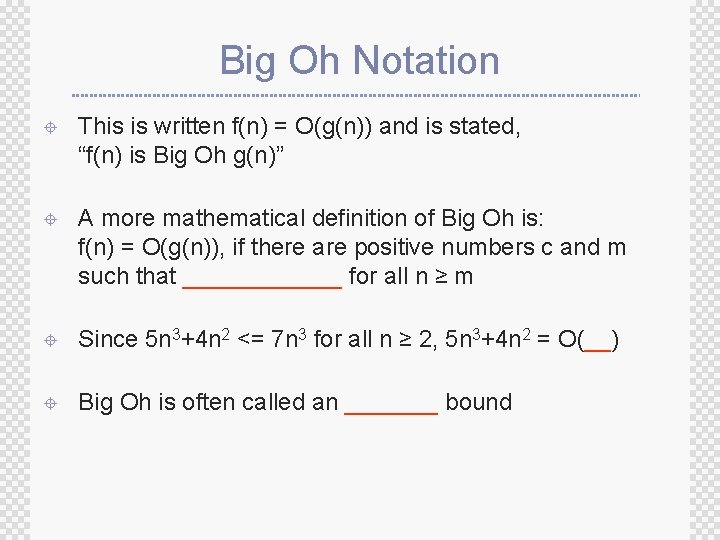
Big Oh Notation ± This is written f(n) = O(g(n)) and is stated, “f(n) is Big Oh g(n)” ± A more mathematical definition of Big Oh is: f(n) = O(g(n)), if there are positive numbers c and m such that ______ for all n ≥ m ± Since 5 n 3+4 n 2 <= 7 n 3 for all n ≥ 2, 5 n 3+4 n 2 = O(__) ± Big Oh is often called an _______ bound
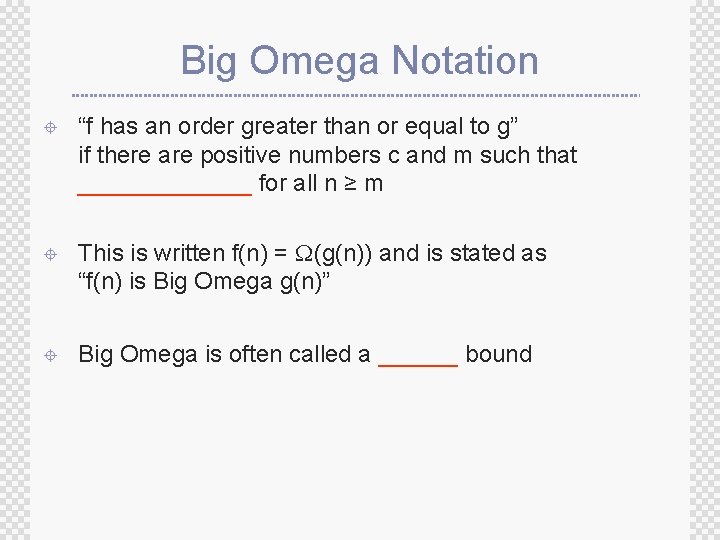
Big Omega Notation ± “f has an order greater than or equal to g” if there are positive numbers c and m such that _______ for all n ≥ m ± This is written f(n) = (g(n)) and is stated as “f(n) is Big Omega g(n)” ± Big Omega is often called a ______ bound
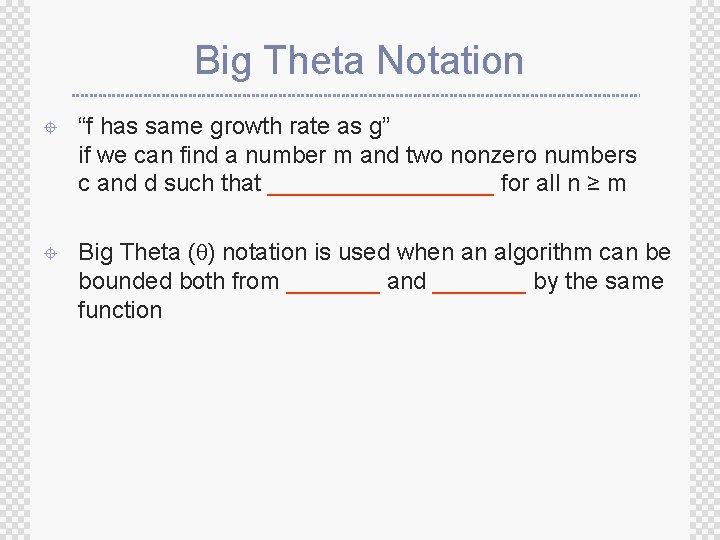
Big Theta Notation ± “f has same growth rate as g” if we can find a number m and two nonzero numbers c and d such that _________ for all n ≥ m ± Big Theta (θ) notation is used when an algorithm can be bounded both from _______ and _______ by the same function
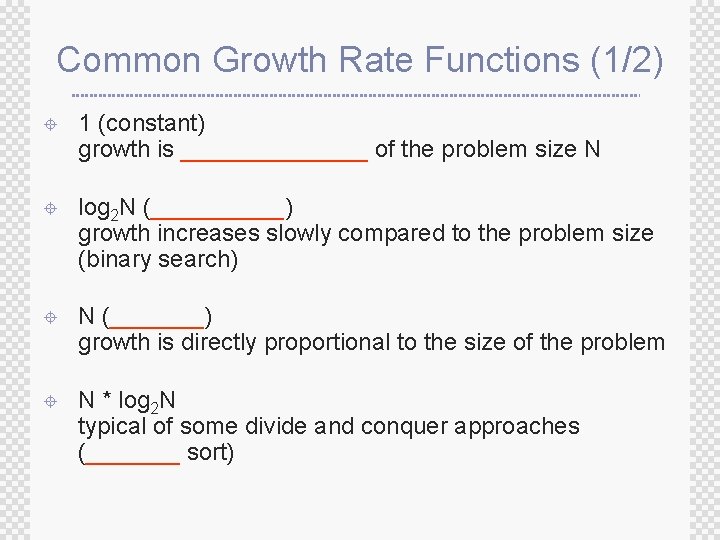
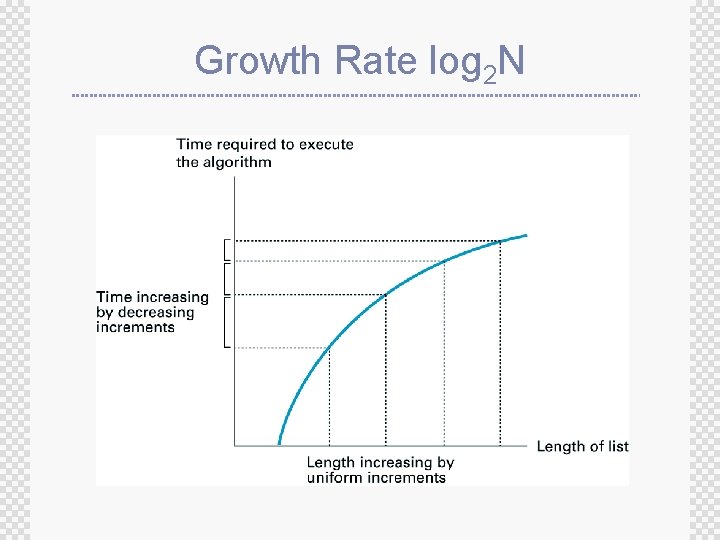
Common Growth Rate Functions (1/2) ± 1 (constant) growth is _______ of the problem size N ± log 2 N (_____) growth increases slowly compared to the problem size (binary search) ± N (_______) growth is directly proportional to the size of the problem ± N * log 2 N typical of some divide and conquer approaches (_______ sort)
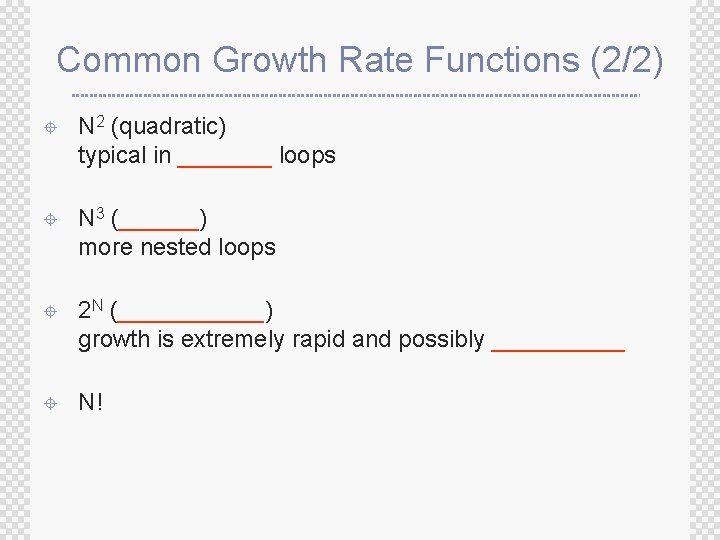
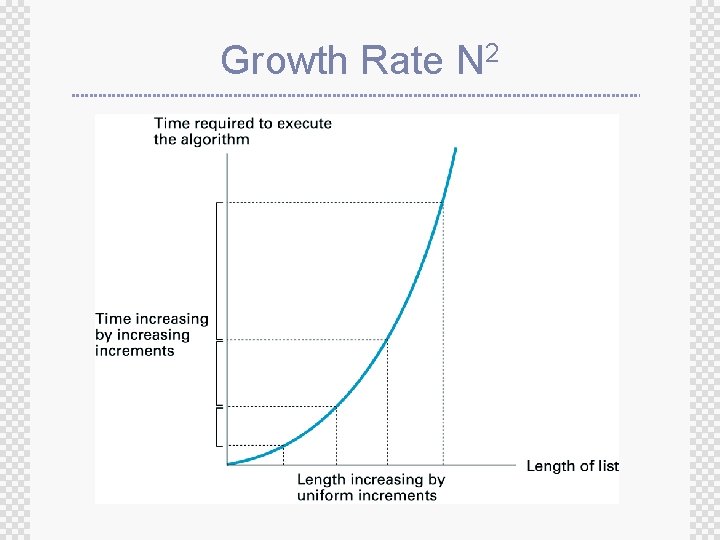
Common Growth Rate Functions (2/2) ± N 2 (quadratic) typical in _______ loops ± N 3 (______) more nested loops ± 2 N (______) growth is extremely rapid and possibly _____ ± N!
Growth Rate log 2 N
Growth Rate N 2
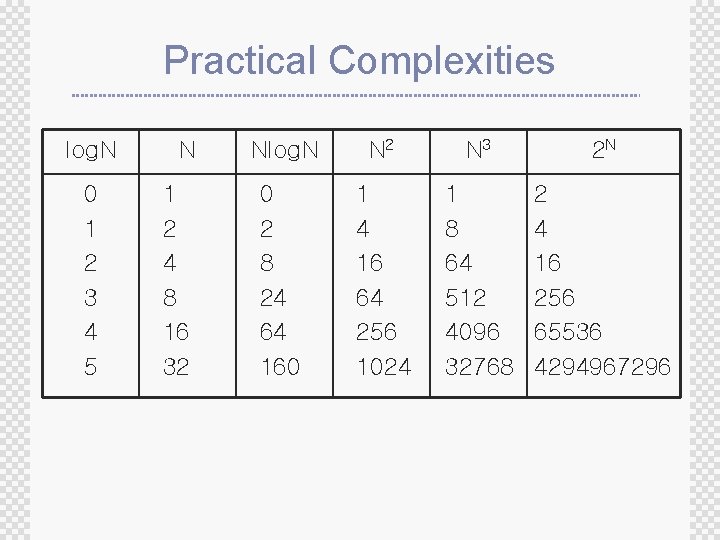
Practical Complexities log. N 0 1 2 3 4 5 N 1 2 4 8 16 32 Nlog. N N 2 N 3 2 N 0 2 8 24 64 160 1 4 16 64 256 1024 1 8 64 512 4096 32768 2 4 16 256 65536 4294967296