
Chapter 5 Aggregate Supply and Demand Copyright 2002

- Slides: 27
Chapter 5 Aggregate Supply and Demand Copyright 2002 Mc. Graw-Hill Australia Pty Ltd PPTs t/a Macroeconomics by Dornbusch, Bodman, Crosby, Fischer and Startz 1
Aggregate Supply and Aggregate Demand t The aggregate supply–aggregate demand (AS–AD) model is the basic tool for studying output fluctuations and the determination of price levels t The model describes the relationship between overall prices (GDP deflator) and output (real GDP) Copyright 2002 Mc. Graw-Hill Australia Pty Ltd PPTs t/a Macroeconomics by Dornbusch, Bodman, Crosby, Fischer and Startz 2
Chapter Organisation 5. 1 The Aggregate Supply Curve 5. 2 The Aggregate Demand Curve 5. 3 Aggregate Demand Under Alternative Supply Assumptions 5. 4 Supply-side Economics Copyright 2002 Mc. Graw-Hill Australia Pty Ltd PPTs t/a Macroeconomics by Dornbusch, Bodman, Crosby, Fischer and Startz 3
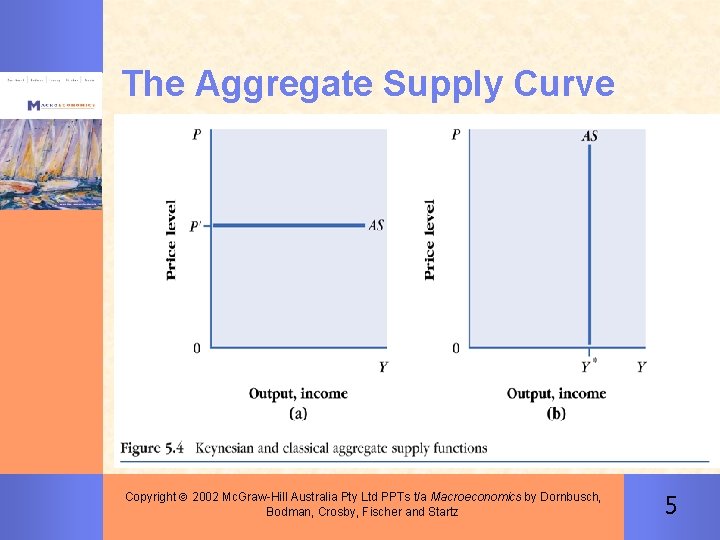
5. 1 The Aggregate Supply Curve t The AS curve describes, for each given price level, the quantity of output firms are willing to supply t The AS curve is upward sloping since firms are willing to supply more at higher prices t In the short run the AS curve is horizontal (the Keynesian AS curve) t In the long run the AS curve is vertical (the classical AS curve) Copyright 2002 Mc. Graw-Hill Australia Pty Ltd PPTs t/a Macroeconomics by Dornbusch, Bodman, Crosby, Fischer and Startz 4
The Aggregate Supply Curve Copyright 2002 Mc. Graw-Hill Australia Pty Ltd PPTs t/a Macroeconomics by Dornbusch, Bodman, Crosby, Fischer and Startz 5
The Classical AS Curve t The classical AS curve Ø Is vertical, indicating that the same amount of goods will be supplied whatever the price level t Assumption Ø The labour market is in equilibrium at full employment and all factors of production are fully utilised t Implication Ø Increases in AD do not increase output but merely raises prices Copyright 2002 Mc. Graw-Hill Australia Pty Ltd PPTs t/a Macroeconomics by Dornbusch, Bodman, Crosby, Fischer and Startz 6
The Classical AS Curve t The level of output corresponding to full employment is called potential GDP t Potential GDP grows over time as the economy accumulates resources and new technologies t This shifts the AS curve to the right over time Copyright 2002 Mc. Graw-Hill Australia Pty Ltd PPTs t/a Macroeconomics by Dornbusch, Bodman, Crosby, Fischer and Startz 7
The Keynesian AS Curve t The Keynesian AS curve Ø Is horizontal, indicating firms will supply whatever amount of goods is demanded at the existing price t Assumption Ø There is unemployment, so firms may obtain as much labour as they want at the current wage t Implication Ø AD determines the level of output, with prices ‘sticky’ in the short run Copyright 2002 Mc. Graw-Hill Australia Pty Ltd PPTs t/a Macroeconomics by Dornbusch, Bodman, Crosby, Fischer and Startz 8
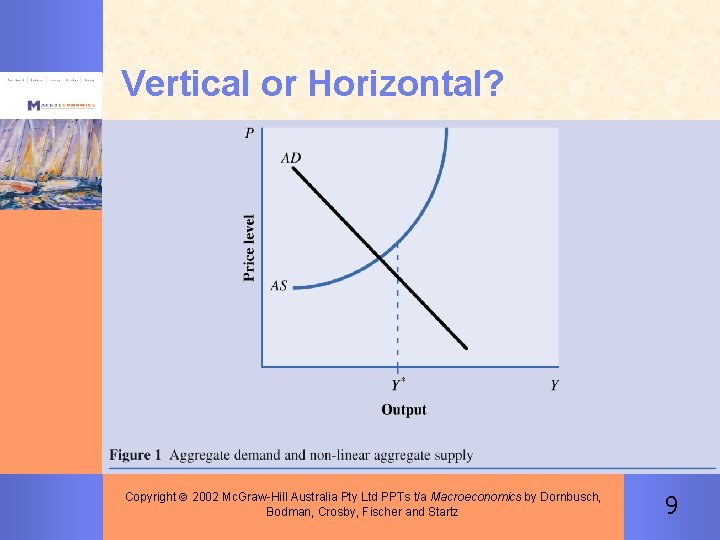
Vertical or Horizontal? Copyright 2002 Mc. Graw-Hill Australia Pty Ltd PPTs t/a Macroeconomics by Dornbusch, Bodman, Crosby, Fischer and Startz 9
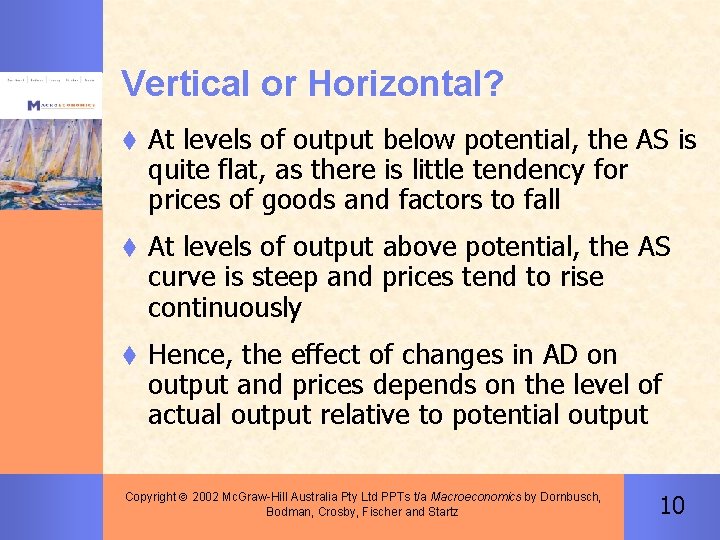
Vertical or Horizontal? t At levels of output below potential, the AS is quite flat, as there is little tendency for prices of goods and factors to fall t At levels of output above potential, the AS curve is steep and prices tend to rise continuously t Hence, the effect of changes in AD on output and prices depends on the level of actual output relative to potential output Copyright 2002 Mc. Graw-Hill Australia Pty Ltd PPTs t/a Macroeconomics by Dornbusch, Bodman, Crosby, Fischer and Startz 10
Types of Unemployment t Frictional unemployment Ø Unemployment due to individuals shifting between jobs and looking for new jobs t Structural unemployment Ø Unemployment due to a mismatch between the skills of the labour force and the skills demanded by firms Ø Unemployment is a consequence of technological improvements Copyright 2002 Mc. Graw-Hill Australia Pty Ltd PPTs t/a Macroeconomics by Dornbusch, Bodman, Crosby, Fischer and Startz 11
Types of Unemployment t The natural rate of unemployment (NRU) Ø The frictional and structural unemployment associated with the full employment level of output Ø Current estimates of the NRU in Australia are about 6. 5% Copyright 2002 Mc. Graw-Hill Australia Pty Ltd PPTs t/a Macroeconomics by Dornbusch, Bodman, Crosby, Fischer and Startz 12
Chapter Organisation 5. 1 The Aggregate Supply Curve 5. 2 The Aggregate Demand Curve 5. 3 Aggregate Demand Under Alternative Supply Assumptions 5. 4 Supply-side Economics Copyright 2002 Mc. Graw-Hill Australia Pty Ltd PPTs t/a Macroeconomics by Dornbusch, Bodman, Crosby, Fischer and Startz 13
5. 2 The Aggregate Demand Curve t The AD curve Ø Shows the combinations of the price and output level at which the goods and money markets are in equilibrium Ø Is downward sloping because for a given level of nominal money, higher prices reduce the value of the real money supply, which reduces the demand for output Ø Increases in autonomous AD shifts the AD curve to the right Copyright 2002 Mc. Graw-Hill Australia Pty Ltd PPTs t/a Macroeconomics by Dornbusch, Bodman, Crosby, Fischer and Startz 14
The Aggregate Demand Curve t The AD relationship between price and output Ø Is dependent upon the real money supply Ø Real money supply is nominal money supply ( ) deflated by the price level (P) Ø That is: /P Ø When P falls, the real money supply rises, interest rates fall and investment rises, causing AD to increase Copyright 2002 Mc. Graw-Hill Australia Pty Ltd PPTs t/a Macroeconomics by Dornbusch, Bodman, Crosby, Fischer and Startz 15
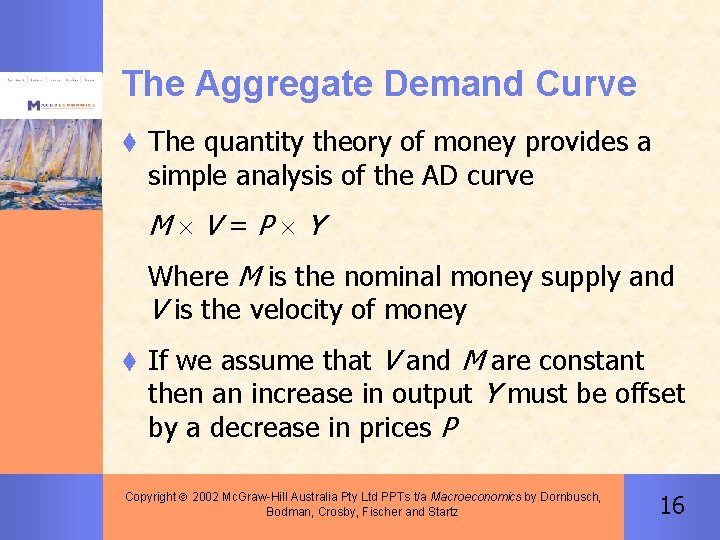
The Aggregate Demand Curve t The quantity theory of money provides a simple analysis of the AD curve M V=P Y Where M is the nominal money supply and V is the velocity of money t If we assume that V and M are constant then an increase in output Y must be offset by a decrease in prices P Copyright 2002 Mc. Graw-Hill Australia Pty Ltd PPTs t/a Macroeconomics by Dornbusch, Bodman, Crosby, Fischer and Startz 16
Chapter Organisation 5. 1 The Aggregate Supply Curve 5. 2 The Aggregate Demand Curve 5. 3 Aggregate Demand Under Supply Assumptions Alternative 5. 4 Supply-side Economics Copyright 2002 Mc. Graw-Hill Australia Pty Ltd PPTs t/a Macroeconomics by Dornbusch, Bodman, Crosby, Fischer and Startz 17
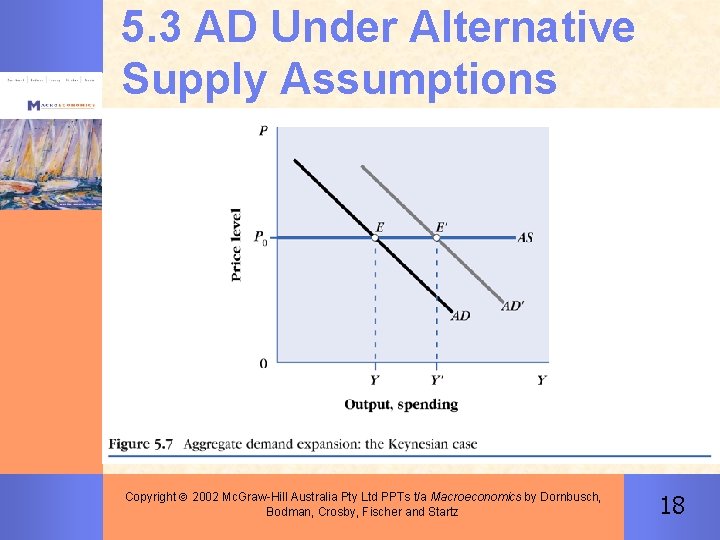
5. 3 AD Under Alternative Supply Assumptions Copyright 2002 Mc. Graw-Hill Australia Pty Ltd PPTs t/a Macroeconomics by Dornbusch, Bodman, Crosby, Fischer and Startz 18
The Keynesian Case Ø Initial equilibrium is at E where AD and AS intersect (goods and money market equilibrium) Ø Assume an increase in AD, which shifts AD to AD’ Ø The new equilibrium point is E’ where output has increased Ø Firms are willing to supply any amount of output at that level of price Copyright 2002 Mc. Graw-Hill Australia Pty Ltd PPTs t/a Macroeconomics by Dornbusch, Bodman, Crosby, Fischer and Startz 19
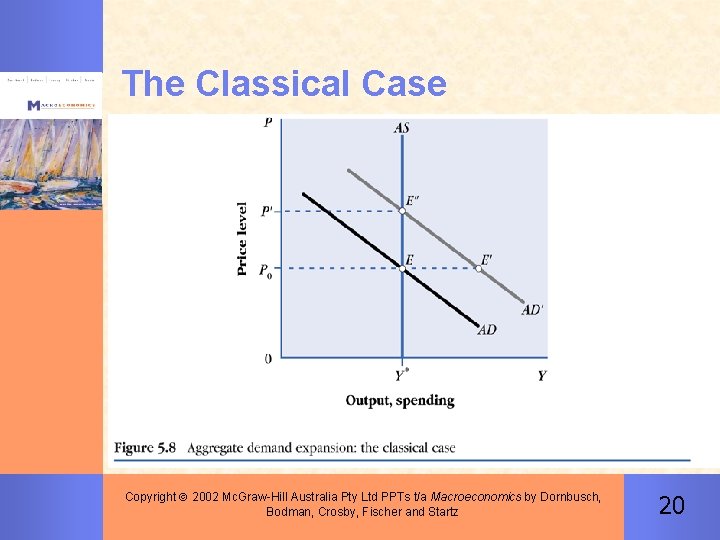
The Classical Case Copyright 2002 Mc. Graw-Hill Australia Pty Ltd PPTs t/a Macroeconomics by Dornbusch, Bodman, Crosby, Fischer and Startz 20
The Classical Case Ø Assume an increase in AD Ø At the initial level of prices, spending has increased and the economy would tend to move towards point E’ Ø However, firms cannot obtain more labour as the economy is at full employment Ø Wages are bid up which increases the costs of production Ø The increase in costs is passed on as higher prices Copyright 2002 Mc. Graw-Hill Australia Pty Ltd PPTs t/a Macroeconomics by Dornbusch, Bodman, Crosby, Fischer and Startz 21
The Classical Case Ø The increase in prices reduces real money stock and decreases spending Ø The economy moves up along AD’ until spending has decreased to the level consistent with full employment output at E” Ø Increases in AD only lead to higher prices, not increases in output Copyright 2002 Mc. Graw-Hill Australia Pty Ltd PPTs t/a Macroeconomics by Dornbusch, Bodman, Crosby, Fischer and Startz 22
Chapter Organisation 5. 1 The Aggregate Supply Curve 5. 2 The Aggregate Demand Curve 5. 3 The Aggregate Demand Under Alternative Supply Assumptions 5. 4 Supply-side Economics Copyright 2002 Mc. Graw-Hill Australia Pty Ltd PPTs t/a Macroeconomics by Dornbusch, Bodman, Crosby, Fischer and Startz 23
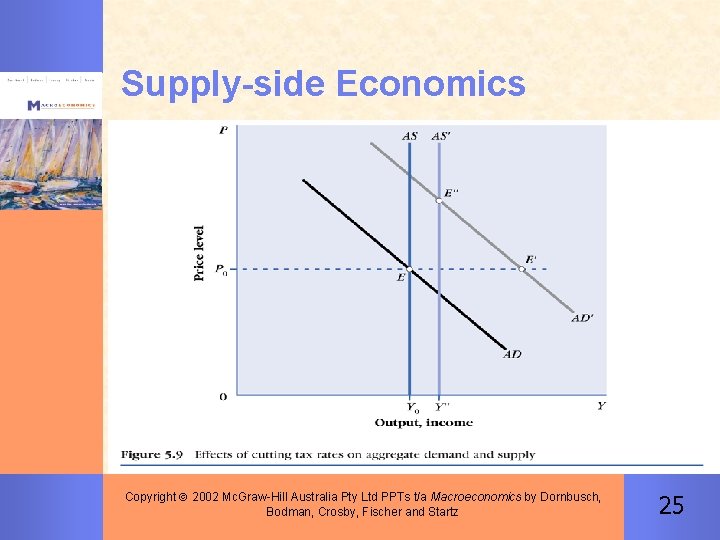
5. 4 Supply-side Economics t Shifting the AS to the right is preferred as it increases potential GDP t There is debate about how best to achieve this increase in AS t Supply-side economics (advocated by George Bush Senior) argue Ø Cutting taxes will significantly increase AS Ø This increase will be so large that total tax revenue will rise Copyright 2002 Mc. Graw-Hill Australia Pty Ltd PPTs t/a Macroeconomics by Dornbusch, Bodman, Crosby, Fischer and Startz 24
Supply-side Economics Copyright 2002 Mc. Graw-Hill Australia Pty Ltd PPTs t/a Macroeconomics by Dornbusch, Bodman, Crosby, Fischer and Startz 25
Supply-side Economics t The initial tax cut shifts AD to the right t The AS also shifts to the right over time because lower tax rates increase the incentive to work t However, the AD curve shifts by more than the AS curve, since consumer spending increases by more than the increase in potential GDP Copyright 2002 Mc. Graw-Hill Australia Pty Ltd PPTs t/a Macroeconomics by Dornbusch, Bodman, Crosby, Fischer and Startz 26
Supply-side Economics t In the short run Ø GDP has increased substantially (from E to E’) Ø This is primarily due to the AD effect t In the long run Ø The economy moves to E” Ø GDP has only increased by a small amount, total tax collection falls, the government’s budget deficit rises, and prices are permanently higher Copyright 2002 Mc. Graw-Hill Australia Pty Ltd PPTs t/a Macroeconomics by Dornbusch, Bodman, Crosby, Fischer and Startz 27