
Chapter 5 Addressing Cultural and Socioeconomic Diversity Overview

- Slides: 24
Chapter 5 Addressing Cultural and Socioeconomic Diversity
Overview • • The Rise of Multiculturalism Ethnicity and Social Class Multicultural Education Programs Bilingual Education Copyright © Houghton Mifflin Company. All rights reserved. 5|2
The Meaning of Culture • The term culture typically refers to. . . the way in which a group of people perceives the world; formulates beliefs; evaluates objects, ideas, and experiences, and behaves Copyright © Houghton Mifflin Company. All rights reserved. 5|3
From Melting Pot to Cultural Pluralism • Melting pot Diverse ethnic groups assimilating into one mainstream culture • Cultural Pluralism A society should strive to maintain the different cultures that reside within it Each culture within a society should be respected by others Individuals within a society have the right to participate in all aspects of that society without having to give up their cultural identity Copyright © Houghton Mifflin Company. All rights reserved. 5|4
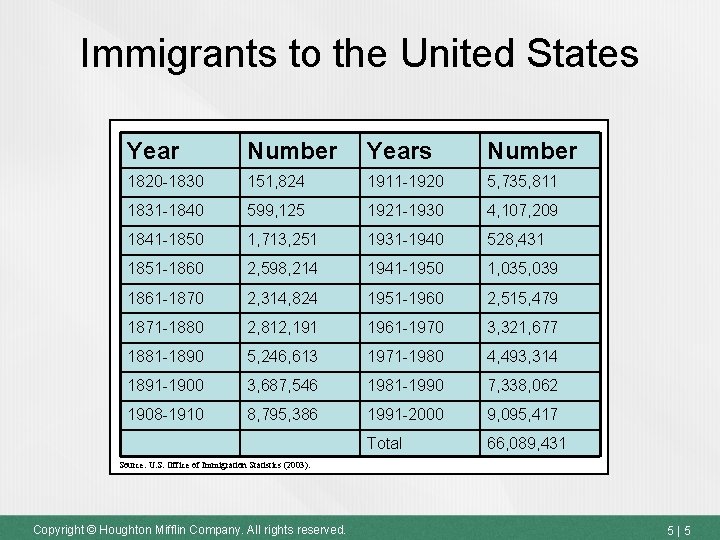
Immigrants to the United States Year Number Years Number 1820 -1830 151, 824 1911 -1920 5, 735, 811 1831 -1840 599, 125 1921 -1930 4, 107, 209 1841 -1850 1, 713, 251 1931 -1940 528, 431 1851 -1860 2, 598, 214 1941 -1950 1, 035, 039 1861 -1870 2, 314, 824 1951 -1960 2, 515, 479 1871 -1880 2, 812, 191 1961 -1970 3, 321, 677 1881 -1890 5, 246, 613 1971 -1980 4, 493, 314 1891 -1900 3, 687, 546 1981 -1990 7, 338, 062 1908 -1910 8, 795, 386 1991 -2000 9, 095, 417 Total 66, 089, 431 Source: U. S. Office of Immigration Statistics (2003). Copyright © Houghton Mifflin Company. All rights reserved. 5|5
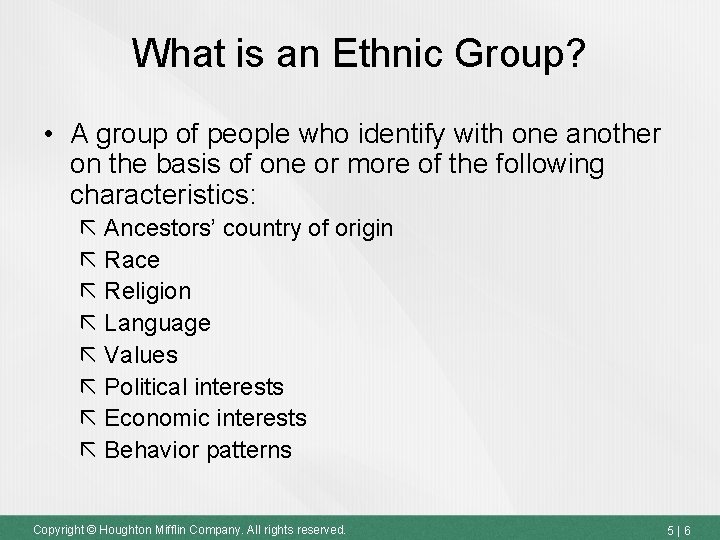
What is an Ethnic Group? • A group of people who identify with one another on the basis of one or more of the following characteristics: Ancestors’ country of origin Race Religion Language Values Political interests Economic interests Behavior patterns Copyright © Houghton Mifflin Company. All rights reserved. 5|6
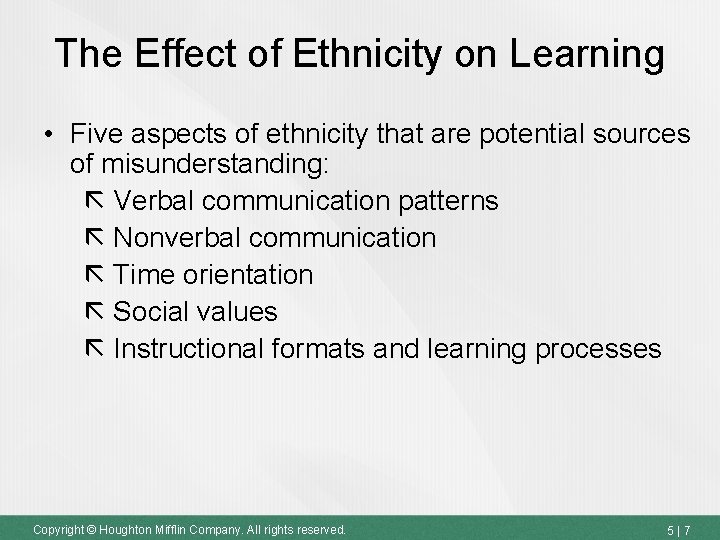
The Effect of Ethnicity on Learning • Five aspects of ethnicity that are potential sources of misunderstanding: Verbal communication patterns Nonverbal communication Time orientation Social values Instructional formats and learning processes Copyright © Houghton Mifflin Company. All rights reserved. 5|7
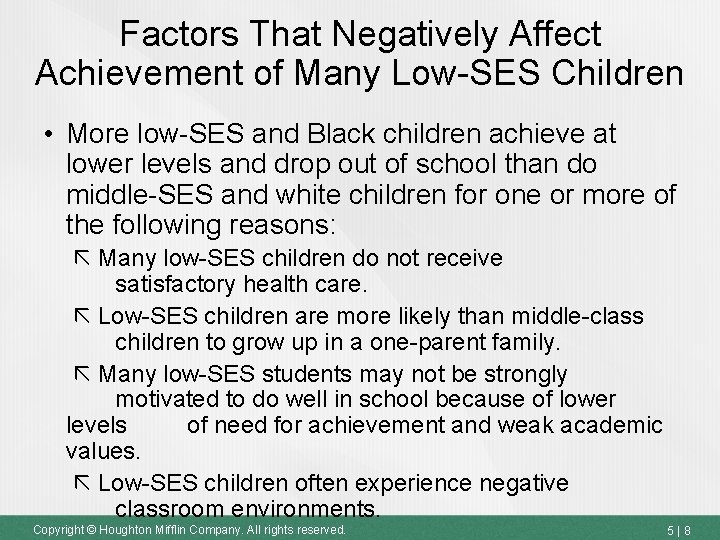
Factors That Negatively Affect Achievement of Many Low-SES Children • More low-SES and Black children achieve at lower levels and drop out of school than do middle-SES and white children for one or more of the following reasons: Many low-SES children do not receive satisfactory health care. Low-SES children are more likely than middle-class children to grow up in a one-parent family. Many low-SES students may not be strongly motivated to do well in school because of lower levels of need for achievement and weak academic values. Low-SES children often experience negative classroom environments. Copyright © Houghton Mifflin Company. All rights reserved. 5|8
Teacher Expectancy Effect • On the basis of such characteristics as race, SES, ethnic background, dress, speech pattern, and test scores, teachers form expectancies about how various students will perform in class. • Those expectancies are subtly communicated to the students in a variety of ways. • Students come to behave in a way that is consistent with what the teacher expects. Copyright © Houghton Mifflin Company. All rights reserved. 5|9
Factors That Help Create Expectancies • Middle-class students are expected to receive higher grades than low-SES students, even when their IQ scores and achievement scores are similar. • Black students are given less attention and are expected to learn less than white students, even when both groups have the same ability. • Teachers tend to perceive children from poor homes as less mature, less capable of following directions, and less capable of working independently than children from more advantaged homes. • Teachers who think of intelligence as a fixed and stable capacity are more likely to formulate negative and positive expectations of students than are teachers who think of intelligence as a collection of skills that can be shaped. Copyright © Houghton Mifflin Company. All rights reserved. 5 | 10
Factors That Help Create Expectancies • Teachers are more influenced by negative information about students than they are by neutral or positive information. • High-achieving students receive more praise than low-achieving students. • Attractive children are often perceived by teachers to be brighter, more capable, and more social than unattractive children. • Teachers tend to approve of girls’ behavior more frequently than they approve of boys’ behavior. Copyright © Houghton Mifflin Company. All rights reserved. 5 | 11
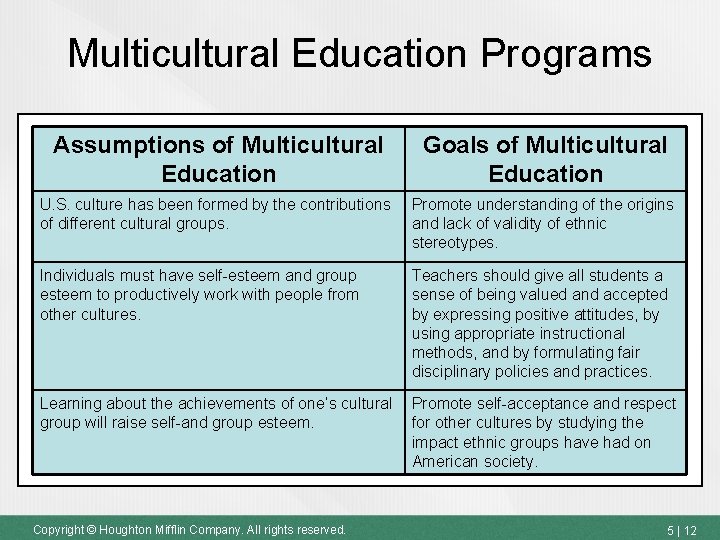
Multicultural Education Programs Assumptions of Multicultural Education Goals of Multicultural Education U. S. culture has been formed by the contributions of different cultural groups. Promote understanding of the origins and lack of validity of ethnic stereotypes. Individuals must have self-esteem and group esteem to productively work with people from other cultures. Teachers should give all students a sense of being valued and accepted by expressing positive attitudes, by using appropriate instructional methods, and by formulating fair disciplinary policies and practices. Learning about the achievements of one’s cultural group will raise self-and group esteem. Promote self-acceptance and respect for other cultures by studying the impact ethnic groups have had on American society. Copyright © Houghton Mifflin Company. All rights reserved. 5 | 12
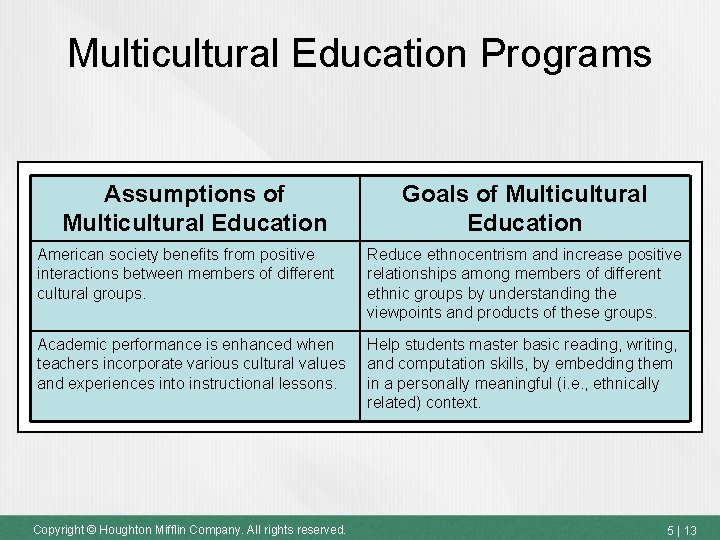
Multicultural Education Programs Assumptions of Multicultural Education Goals of Multicultural Education American society benefits from positive interactions between members of different cultural groups. Reduce ethnocentrism and increase positive relationships among members of different ethnic groups by understanding the viewpoints and products of these groups. Academic performance is enhanced when teachers incorporate various cultural values and experiences into instructional lessons. Help students master basic reading, writing, and computation skills, by embedding them in a personally meaningful (i. e. , ethnically related) context. Copyright © Houghton Mifflin Company. All rights reserved. 5 | 13
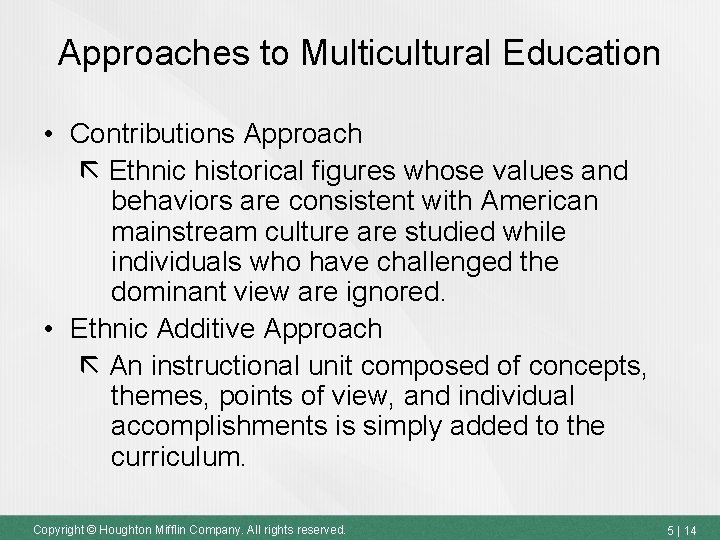
Approaches to Multicultural Education • Contributions Approach Ethnic historical figures whose values and behaviors are consistent with American mainstream culture are studied while individuals who have challenged the dominant view are ignored. • Ethnic Additive Approach An instructional unit composed of concepts, themes, points of view, and individual accomplishments is simply added to the curriculum. Copyright © Houghton Mifflin Company. All rights reserved. 5 | 14
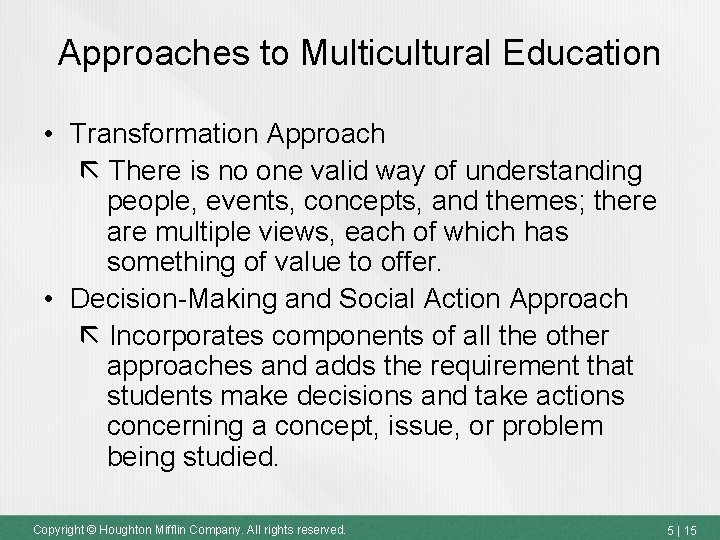
Approaches to Multicultural Education • Transformation Approach There is no one valid way of understanding people, events, concepts, and themes; there are multiple views, each of which has something of value to offer. • Decision-Making and Social Action Approach Incorporates components of all the other approaches and adds the requirement that students make decisions and take actions concerning a concept, issue, or problem being studied. Copyright © Houghton Mifflin Company. All rights reserved. 5 | 15
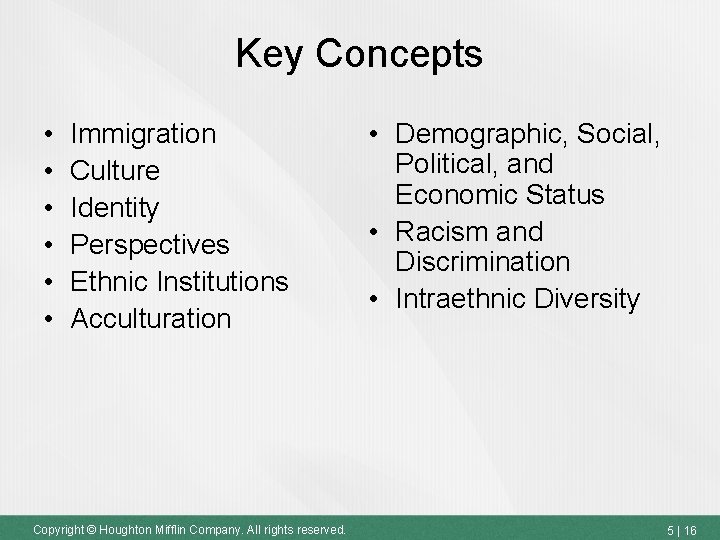
Key Concepts • • • Immigration Culture Identity Perspectives Ethnic Institutions Acculturation Copyright © Houghton Mifflin Company. All rights reserved. • Demographic, Social, Political, and Economic Status • Racism and Discrimination • Intraethnic Diversity 5 | 16
Characteristics of Effective Multicultural Teachers • Provides students with clear objectives. • Continuously communicates high expectations to the students. • Monitors student progress and provides immediate feedback. • Has several years experience in teaching culturally diverse students. • Can clearly explain why she uses specific instructional techniques. Copyright © Houghton Mifflin Company. All rights reserved. 5 | 17
Characteristics of Effective Multicultural Teachers • Strives to embed instruction in a meaningful context. • Provides opportunities for active learning through small-group work and hands-on activities. • Exhibits a high level of dedication. • Enhances students’ self-esteem by having classroom materials and practices reflect students’ cultural and linguistic backgrounds. • Has a strong affinity for the students. See Online Video Case “Culturally Responsive Teaching: A Multicultural Lesson for Elementary Students” Copyright © Houghton Mifflin Company. All rights reserved. 5 | 18
Recommended Instructional Methods • Peer tutoring Teaching of one student by another • Cooperative learning Working in small, heterogeneous groups to help one another master a task • Mastery learning Approach that assumes most children can master the curriculum if certain conditions are established Copyright © Houghton Mifflin Company. All rights reserved. 5 | 19
Rationale for Multicultural Education • Multicultural programs foster teaching practices that are effective in general as well as for members of a particular group. • All students may profit from understanding different cultural values. • The U. S. is becoming an increasingly multicultural society and students need to understand know how to work with people of cultures different from their own. Copyright © Houghton Mifflin Company. All rights reserved. 5 | 20
Rationale for Multicultural Education • Multicultural education programs expose students to the idea that “truth” is very much in the eye of the beholder. • Multicultural programs can encourage student motivation and learning. • The rationale for multicultural education that we have provided has been reinforced by numerous studies that document the disappointing academic performance of a significant number of minority-group students. Copyright © Houghton Mifflin Company. All rights reserved. 5 | 21
Bilingual Education • Goal Help students with limited English proficiency (LEP) acquire the English skills they will need to succeed in school Copyright © Houghton Mifflin Company. All rights reserved. 5 | 22
Bilingual Education • Approaches Transition programs teach students wholly or partly in their native language until they can function effectively in a regular class. Maintenance programs provide instruction in native language for a longer period of time before moving to all-English instruction. Two-way bilingual programs provide instruction in the language of both the majority culture and the minority culture. Copyright © Houghton Mifflin Company. All rights reserved. 5 | 23
Bilingual Education • Research Findings Bilingual education produces moderate learning gains for students with limited English proficiency. See Online Video Case “Bilingual Education: An Elementary Two-Way Immersion Program” Copyright © Houghton Mifflin Company. All rights reserved. 5 | 24