
Chapter 5 A Dual Court System Business Law
Chapter 5 “A Dual Court System” Business Law
A Dual Court System
A Dual Court System Federal Court System • Jurisdiction - the power and authority given to a court to hear a case and to make a judgment.
A Dual Court System • • Federal courts have jurisdiction over: 1. Actions in which the U. S. or a state is a party, except those actions between a state and its own citizens 2. Cases that raise a federal question (interpretation of the U. S. constitution or the violation or interpretation of a federal law) 3. Diversity of citizenship cases – actions between citizens of different state where the amount of money involved exceeds $50, 000 4. Admiralty (pertaining to the sea), patent-right, copyright, and bankruptcy cases

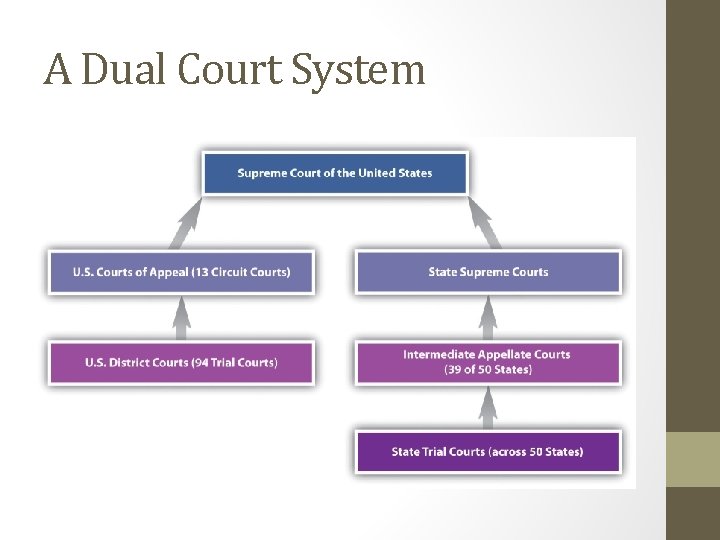
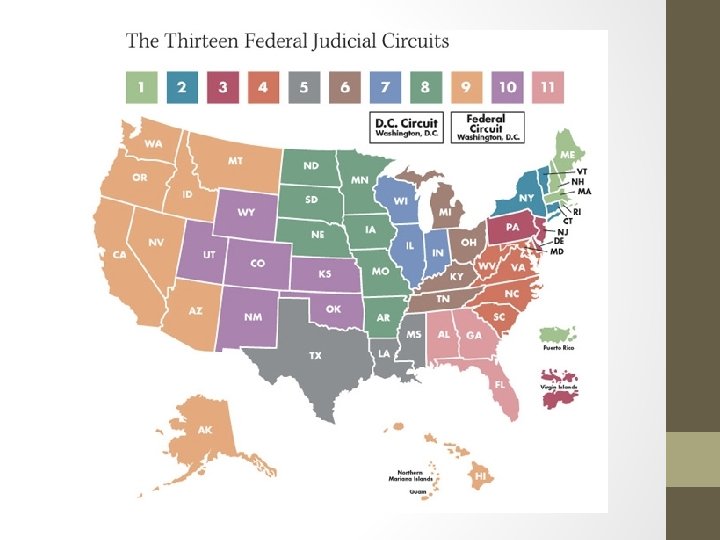
A Dual Court System • District Courts - have original jurisdiction - (the authority to try a case the first time it is heard) over most federal court cases • Courts of Appeals (Appellate Courts)- are intermediate courts between the lower courts and the highest court • They have the authority to hear appeals and review cases from lower courts • Appellate jurisdiction - any party to a suit decided in a federal district court may appeal the decision to the federal court of appeals in the circuit where the case was tried
A Dual Court System • Special U. S. Courts - include suits by citizens against the federal government, disagreement over taxes on imported goods, and disputes between taxpayers and the Internal Revenue Service • U. S. Supreme Court - highest court in the land. Appellate jurisdiction is the main function. Has original jurisdiction in all cases involving ambassadors, consuls, other public ministers, and cases in which a state is a party.
A Dual Court System • State Court System • Local Trial Courts - have limited jurisdiction (jurisdiction only in minor matters such as misdemeanors and civil actions involving small amounts of money) • Minor legal matters - traffic courts, police courts, or municipal courts

A Dual Court System • General Trial Courts - (county courts, superior court, court of common pleas, or circuit court) have general jurisdiction • All cases involving major crimes and large amounts of money • Sometimes hear appeals from lower courts
A Dual Court System • Special Courts - handle specialized cases such as: land courts, housing courts, family or domestic relations court, probate court, juvenile courts
A Dual Court System • Persons appearing in juvenile courts have no right to a trial by jury or to be released on bail • Hearings are often more informal than other courts • Have special jurisdiction over delinquent, unruly, abused, and neglected children • Most matters are private and open to the general public
A Dual Court System • Intermediate Appellate Courts - hear appeals from the courts of general jurisdiction • Hear cases only on questions of the law, not questions of fact • Only hear arguments from attorneys • Judges study the legal documents and records in the case

A Dual Court System • Supreme Courts - these high courts make final decisions on matters of law that are appealed from the lower courts • Do not retry a case and redetermine the facts • Only decide whether an error was made in the lower courts in determining the law
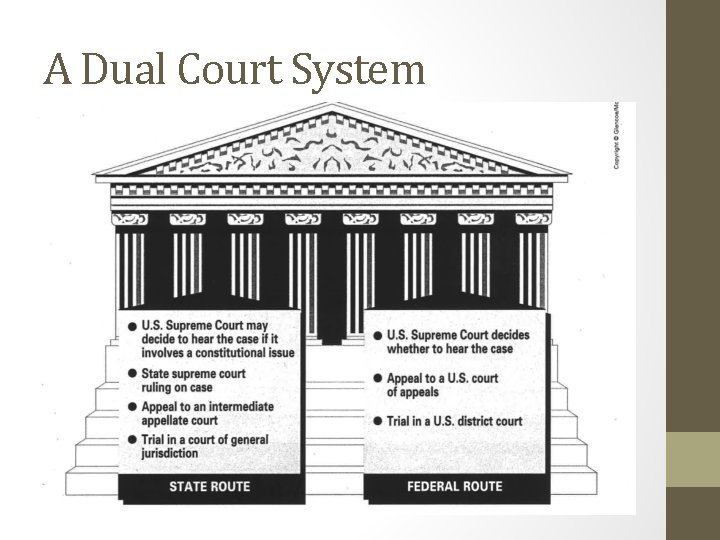
A Dual Court System

A Dual Court System US SUPREME COURT ___________________ STATE SUPREME COURT ___________________ US COURT OF APPEALS (Intermediate) ___________________ INTERMEDIATE APPELLATE COURT ___________________ US DISTRICT COURT ___________________ GENERAL TRIAL COURT ___________________ LOCAL TRIAL COURT ___________________

A Dual Court System US SUPREME COURT APPELLATE JURISDICTION STATE SUPREME COURT APPELLATE JURISDICTION US COURT OF APPEALS (Intermediate) APPELLATE JURISDICTION INTERMEDIATE APPELLATE COURT APPELLATE JURISDICTION US DISTRICT COURT GENERAL TRIAL COURT GENERAL JURISDICTION LOCAL TRIAL COURT LIMITED JURISDICTION ORIGINAL JURISDCTION
- Slides: 17