
Chapter 5 A Closer Look at Cell Membranes
Chapter 5: A Closer Look at Cell Membranes
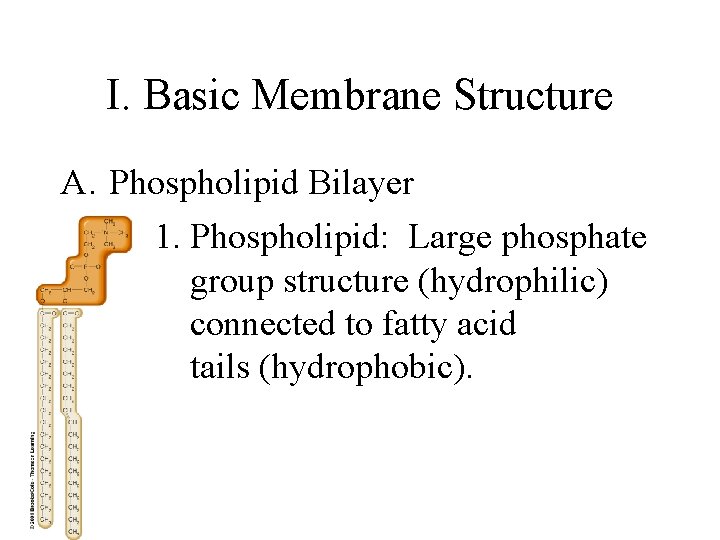
I. Basic Membrane Structure A. Phospholipid Bilayer 1. Phospholipid: Large phosphate group structure (hydrophilic) connected to fatty acid tails (hydrophobic).
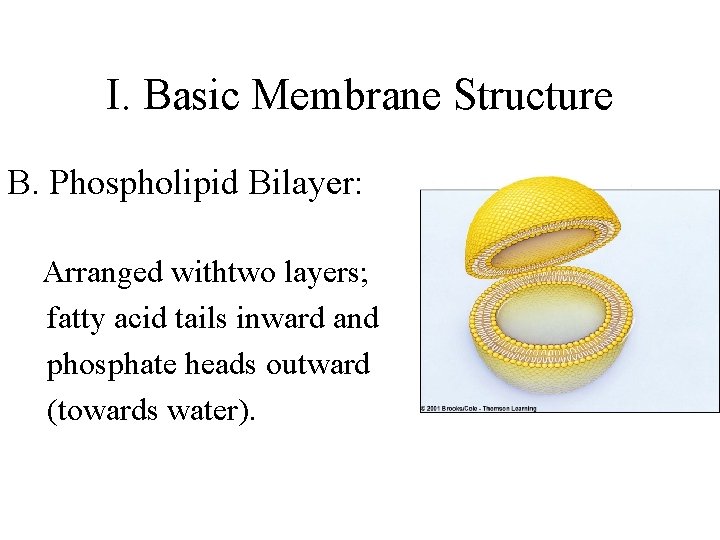
I. Basic Membrane Structure B. Phospholipid Bilayer: Arranged withtwo layers; fatty acid tails inward and phosphate heads outward (towards water).
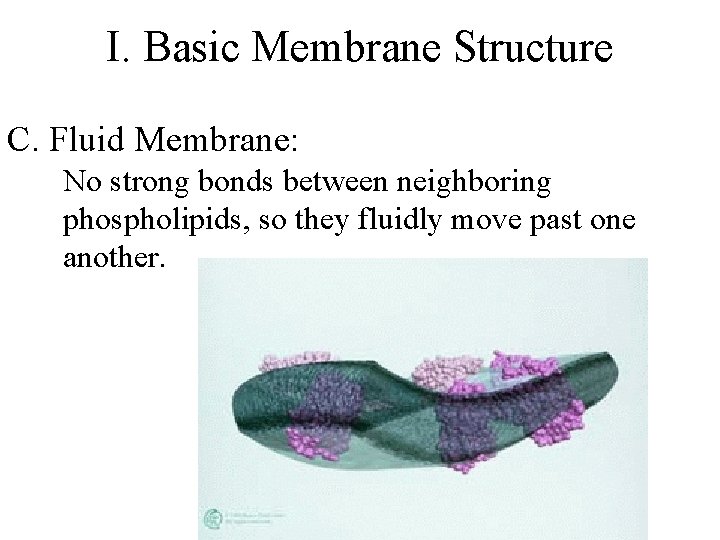
I. Basic Membrane Structure C. Fluid Membrane: No strong bonds between neighboring phospholipids, so they fluidly move past one another.

I. Basic Membrane Structure D. Selectively Permeable: Allows small, uncharged particles through membrane. So we have a rule that if a particle is LARGE (larger than glucose) and/or CHARGED (ionic, not simply polar like water) it will not pass through a membrane.
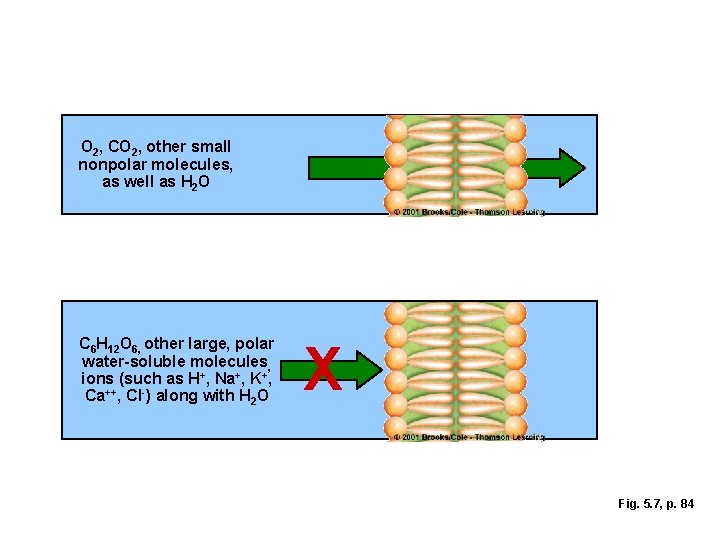
O 2, CO 2, other small nonpolar molecules, as well as H 2 O C 6 H 12 O 6, other large, polar water-soluble molecules, ions (such as H+, Na+, K+, Ca++, CI-) along with H 2 O X Fig. 5. 7, p. 84
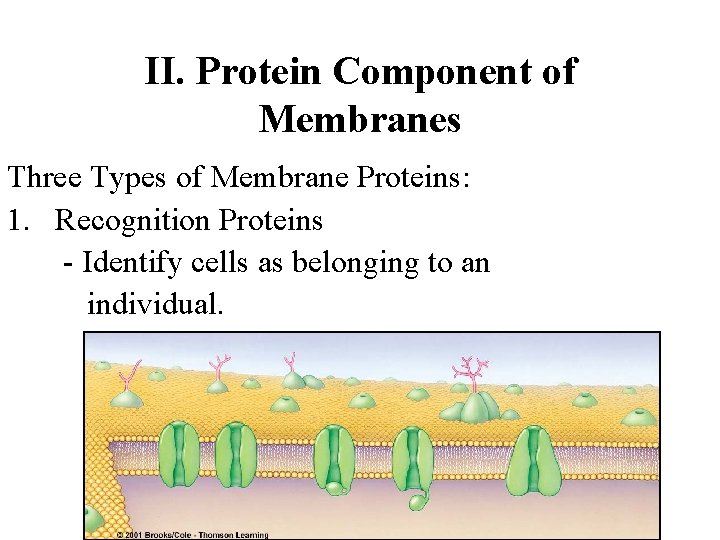
II. Protein Component of Membranes Three Types of Membrane Proteins: 1. Recognition Proteins - Identify cells as belonging to an individual.
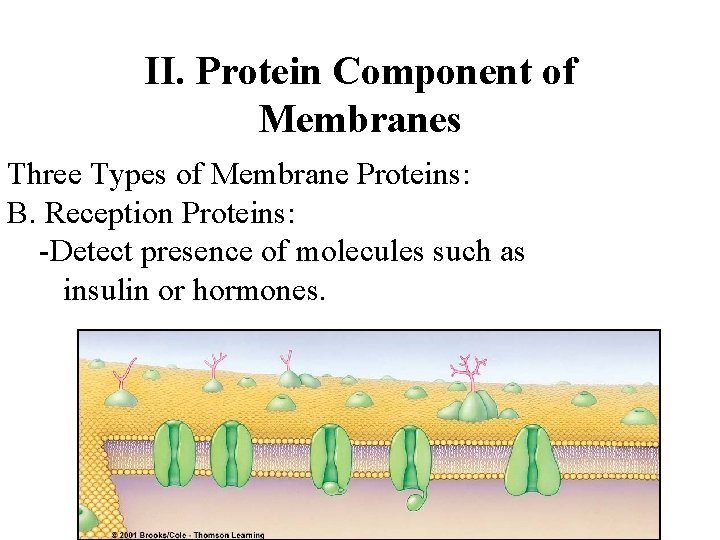
II. Protein Component of Membranes Three Types of Membrane Proteins: B. Reception Proteins: -Detect presence of molecules such as insulin or hormones.
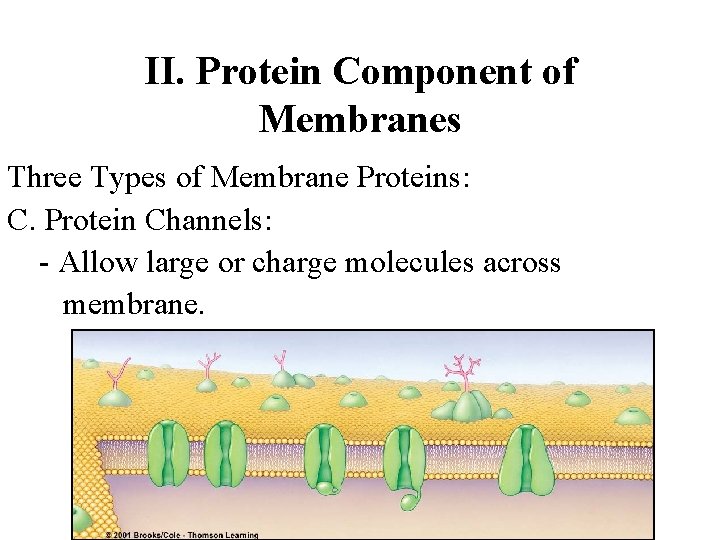
II. Protein Component of Membranes Three Types of Membrane Proteins: C. Protein Channels: - Allow large or charge molecules across membrane.
III. Crossing A Semipermeable Membrane A. Diffusion: Movement of particles from areas of high concentration to low concentration. • No additional energy required • Always from high concentration to low concentration!
III. Crossing A Semipermeable Membrane B. Osmosis: Special case of diffusion in which molecules of water move across a semipermeable membrane.
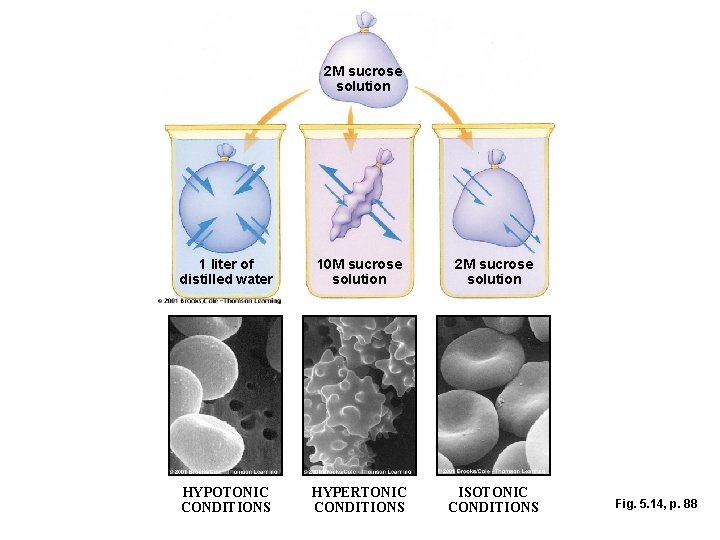
2 M sucrose solution 1 liter of distilled water 10 M sucrose solution 2 M sucrose solution HYPOTONIC CONDITIONS HYPERTONIC CONDITIONS ISOTONIC CONDITIONS Fig. 5. 14, p. 88
III. Crossing A Semipermeable Membrane B. Osmosis Terms: Hypertonic: More Solute, More Water Hypotonic: Less Solute, More Water Isotonic: Equal Concentration on each side of membrane.
III. Crossing A Semipermeable Membrane Avoiding Osmosis Misconceptions: • Based on random movement of water. • Water still moves from both sides. • Dependent upon water temperature. • Water still moves from hypertonic to hyptonic (but rate is less than the reverse)
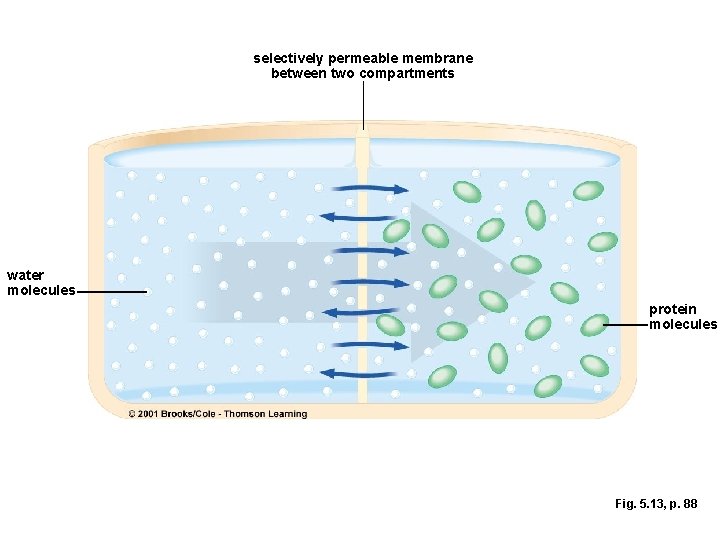
selectively permeable membrane between two compartments water molecules protein molecules Fig. 5. 13, p. 88
IV. Protein Mediated Transport A. Passive/Facilitated Transport – Some large/charged particles move across membranes by means of specially shaped transport protein channels. 1. Specially shaped for specific molecules, 2. Don’t require extra energy (passive) but 3. Can’t move against a gradient (high to low concentration).
IV. Protein Mediated Transport B. Active Transport – Some large/charged particles move across membrane but the cell must dedicate ATP to the process as it requires energy. • Can move against gradient. • Can move charged/large particles.

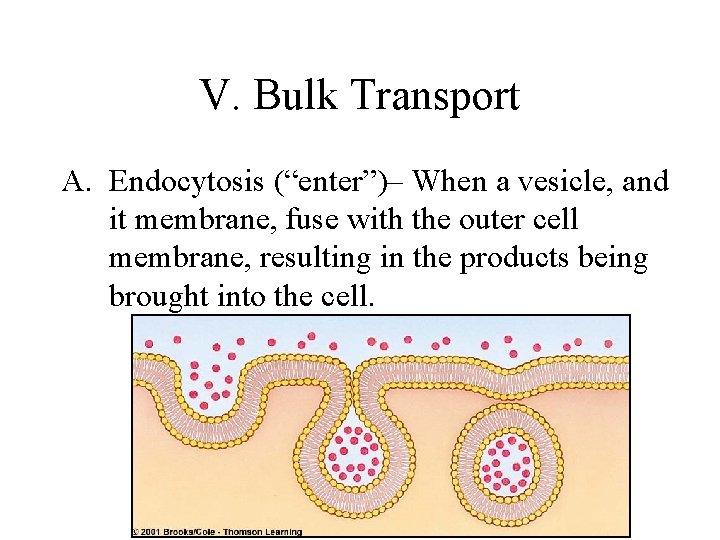
V. Bulk Transport A. Endocytosis (“enter”)– When a vesicle, and it membrane, fuse with the outer cell membrane, resulting in the products being brought into the cell.
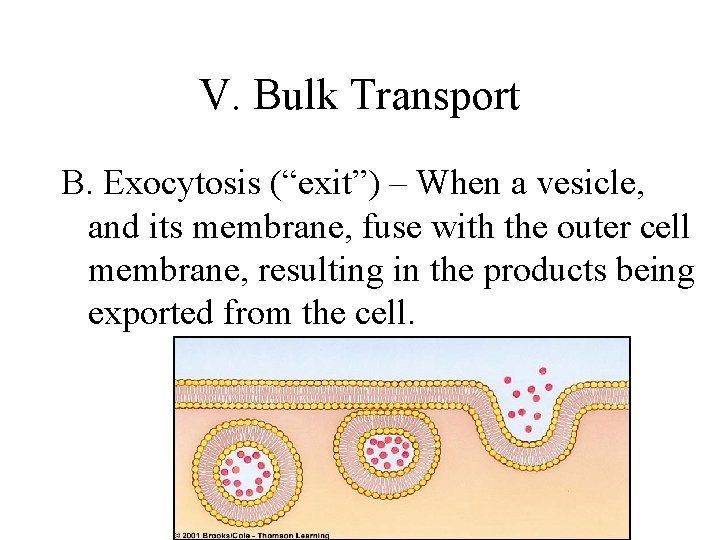
V. Bulk Transport B. Exocytosis (“exit”) – When a vesicle, and its membrane, fuse with the outer cell membrane, resulting in the products being exported from the cell.
V. Bulk Transport C. Phagocytosis – A special form of endocytosis in which a cell engulfs a large amount of material, usually another microoganism. This is seen in amoebas and white blood cells.
- Slides: 21