
Chapter 5 5 Database Design 1 Some Normalization
Chapter 5 5 Database Design 1: Some Normalization Examples Spring 2008 1

Dependencies: Definitions u 5 Multivalued Attributes (or repeating groups): nonkey attributes or groups of non-key attributes the values of which are not uniquely identified by (directly or indirectly) (not functionally dependent on) the value of the Primary Key (or its part). 2
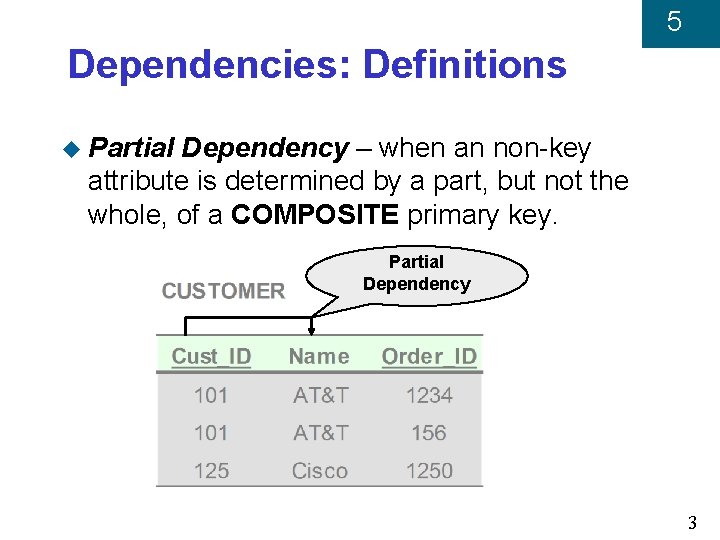
5 Dependencies: Definitions u Partial Dependency – when an non-key attribute is determined by a part, but not the whole, of a COMPOSITE primary key. Partial Dependency 3
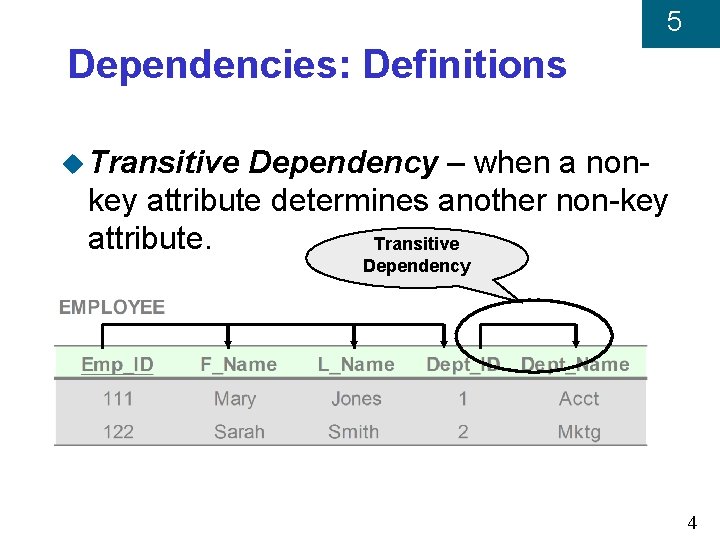
5 Dependencies: Definitions u Transitive Dependency – when a nonkey attribute determines another non-key attribute. Transitive Dependency 4

5 Normal Forms: Review u u Unnormalized – There are multivalued attributes or repeating groups 1 NF – No multivalued attributes or repeating groups. 2 NF – 1 NF plus no partial dependencies 3 NF – 2 NF plus no transitive dependencies 5
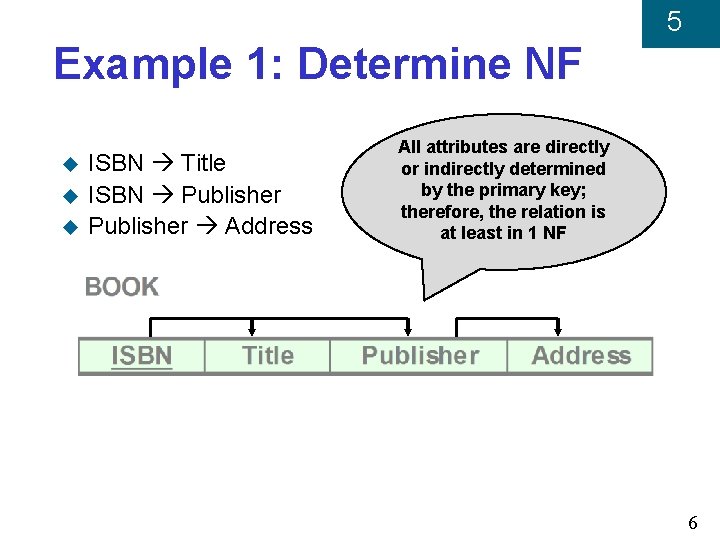
5 Example 1: Determine NF u u u ISBN Title ISBN Publisher Address All attributes are directly or indirectly determined by the primary key; therefore, the relation is at least in 1 NF 6
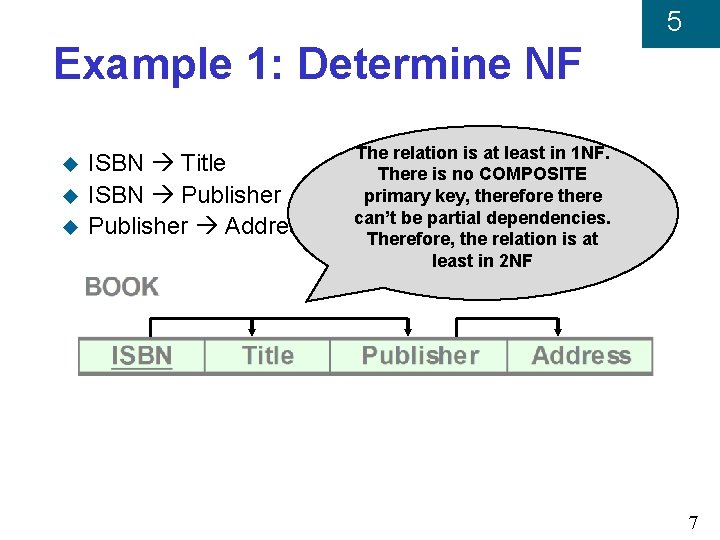
5 Example 1: Determine NF u u u ISBN Title ISBN Publisher Address The relation is at least in 1 NF. There is no COMPOSITE primary key, therefore there can’t be partial dependencies. Therefore, the relation is at least in 2 NF 7
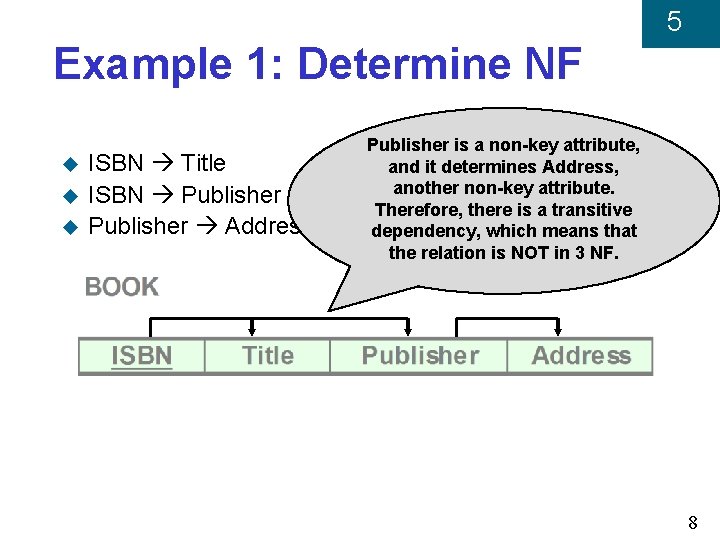
5 Example 1: Determine NF u u u ISBN Title ISBN Publisher Address Publisher is a non-key attribute, and it determines Address, another non-key attribute. Therefore, there is a transitive dependency, which means that the relation is NOT in 3 NF. 8
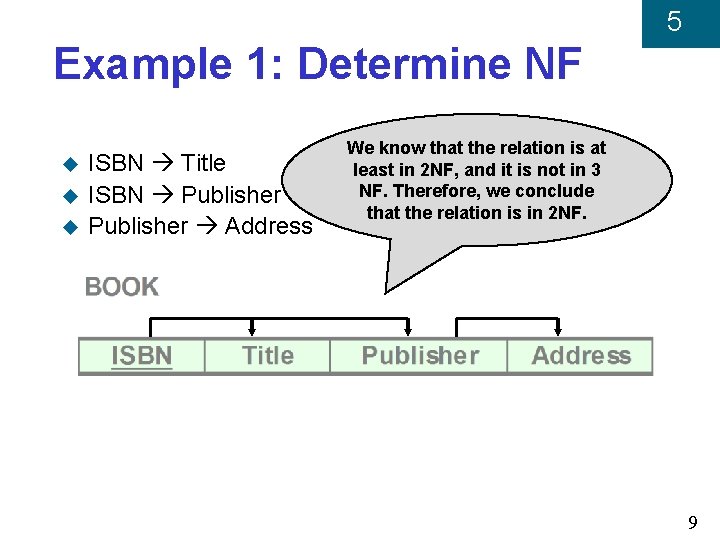
5 Example 1: Determine NF u u u ISBN Title ISBN Publisher Address We know that the relation is at least in 2 NF, and it is not in 3 NF. Therefore, we conclude that the relation is in 2 NF. 9
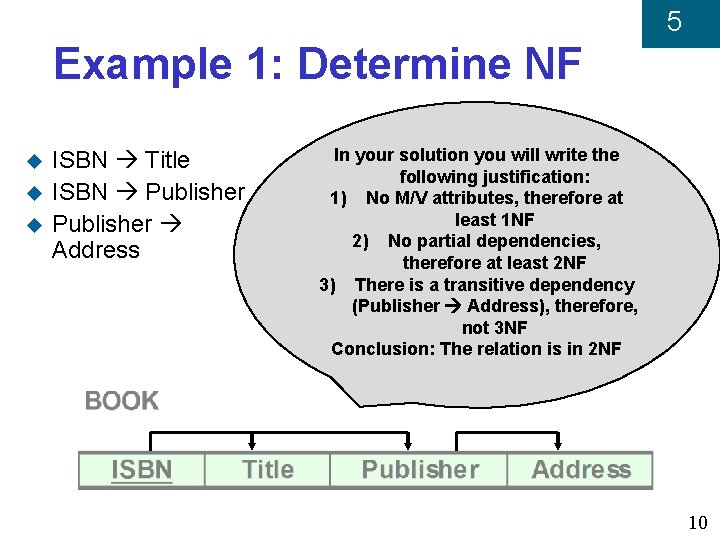
5 Example 1: Determine NF u u u ISBN Title ISBN Publisher Address In your solution you will write the following justification: 1) No M/V attributes, therefore at least 1 NF 2) No partial dependencies, therefore at least 2 NF 3) There is a transitive dependency (Publisher Address), therefore, not 3 NF Conclusion: The relation is in 2 NF 10
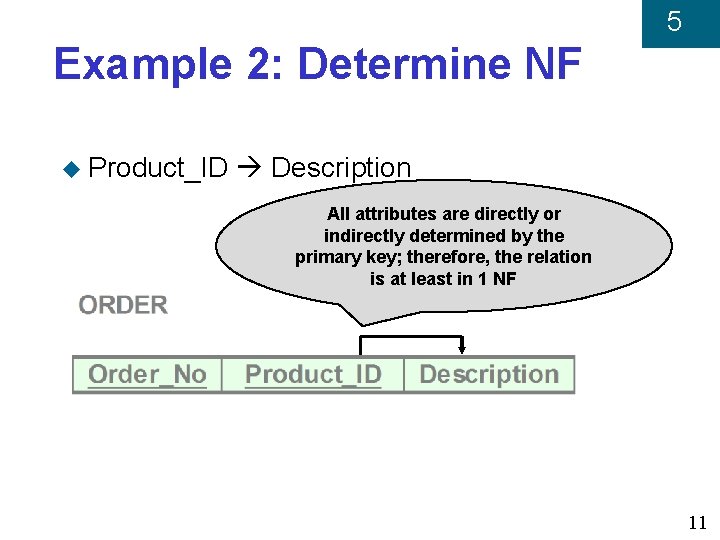
5 Example 2: Determine NF u Product_ID Description All attributes are directly or indirectly determined by the primary key; therefore, the relation is at least in 1 NF 11
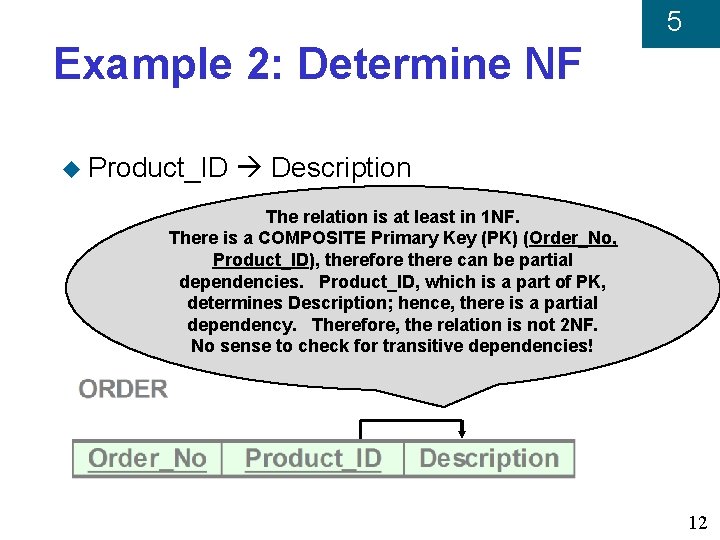
5 Example 2: Determine NF u Product_ID Description The relation is at least in 1 NF. There is a COMPOSITE Primary Key (PK) (Order_No, Product_ID), therefore there can be partial dependencies. Product_ID, which is a part of PK, determines Description; hence, there is a partial dependency. Therefore, the relation is not 2 NF. No sense to check for transitive dependencies! 12
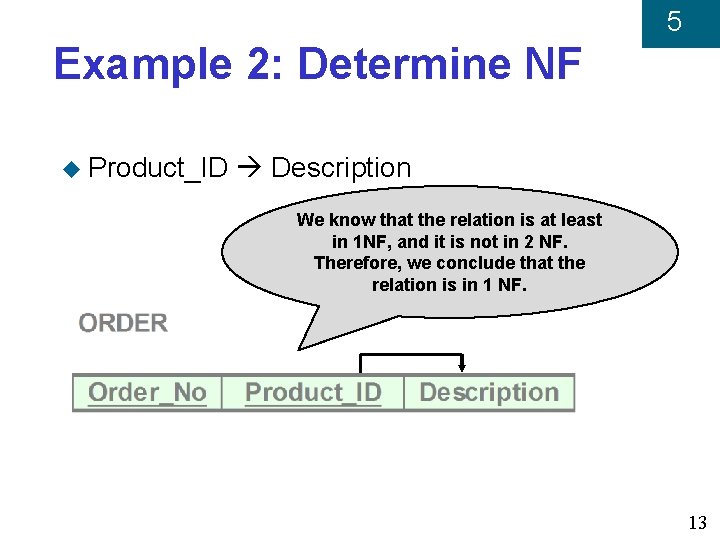
5 Example 2: Determine NF u Product_ID Description We know that the relation is at least in 1 NF, and it is not in 2 NF. Therefore, we conclude that the relation is in 1 NF. 13
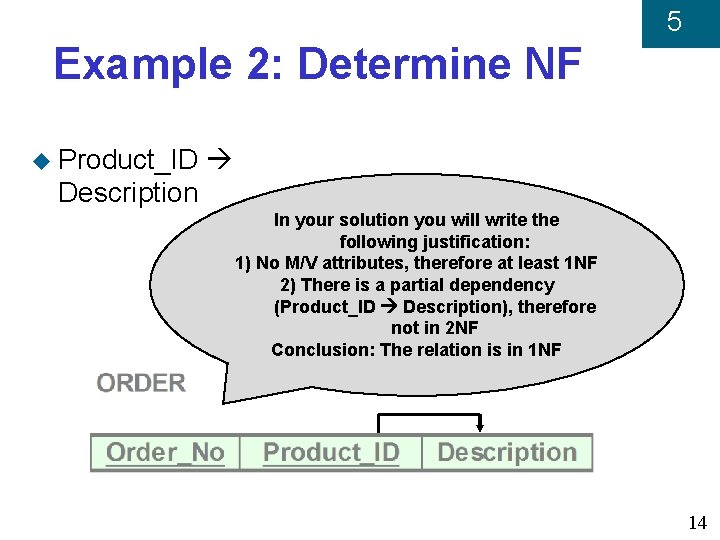
5 Example 2: Determine NF u Product_ID Description In your solution you will write the following justification: 1) No M/V attributes, therefore at least 1 NF 2) There is a partial dependency (Product_ID Description), therefore not in 2 NF Conclusion: The relation is in 1 NF 14
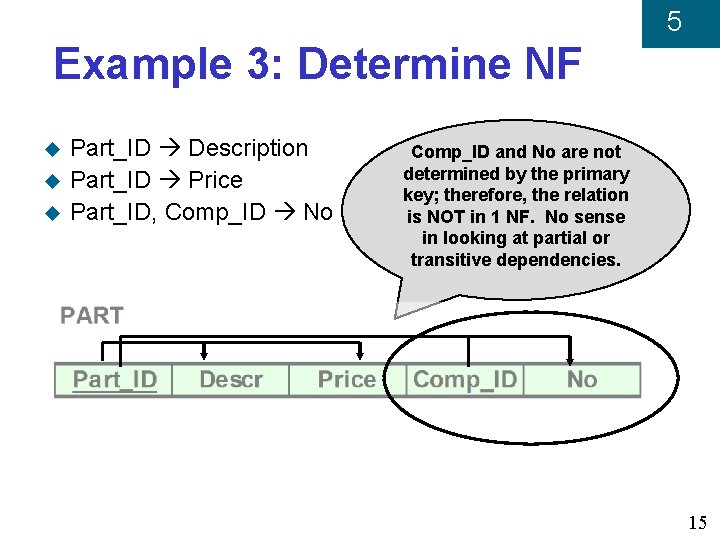
5 Example 3: Determine NF u u u Part_ID Description Part_ID Price Part_ID, Comp_ID No Comp_ID and No are not determined by the primary key; therefore, the relation is NOT in 1 NF. No sense in looking at partial or transitive dependencies. 15
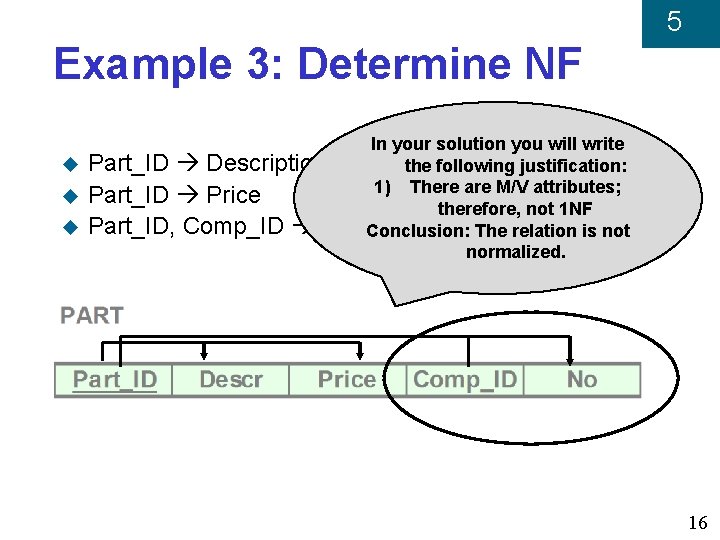
5 Example 3: Determine NF u u u Part_ID Description Part_ID Price Part_ID, Comp_ID No In your solution you will write the following justification: 1) There are M/V attributes; therefore, not 1 NF Conclusion: The relation is not normalized. 16
5 Bringing a Relation to 1 NF 17

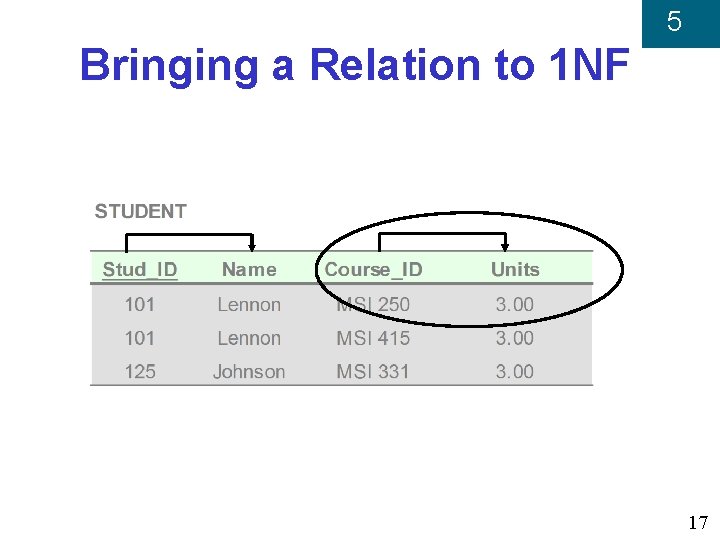
5 Bringing a Relation to 1 NF u Option 1: Make a determinant of the repeating group (or the multivalued attribute) a part of the primary key. Composite Primary Key 18
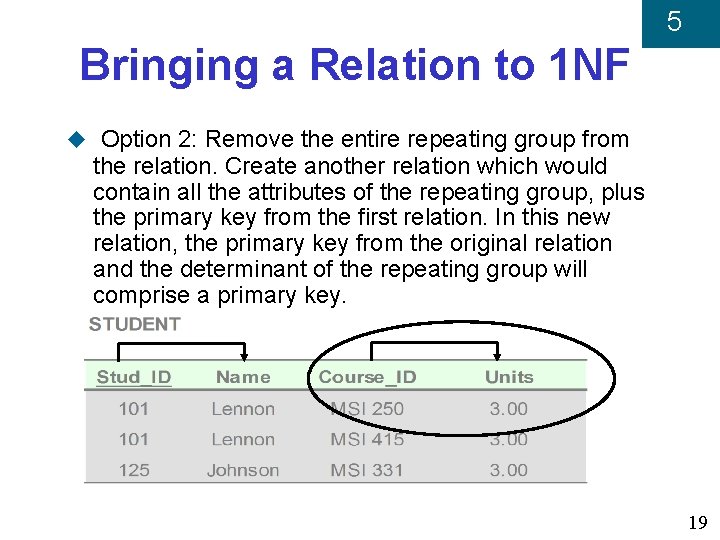
5 Bringing a Relation to 1 NF u Option 2: Remove the entire repeating group from the relation. Create another relation which would contain all the attributes of the repeating group, plus the primary key from the first relation. In this new relation, the primary key from the original relation and the determinant of the repeating group will comprise a primary key. 19

5 Bringing a Relation to 1 NF 20
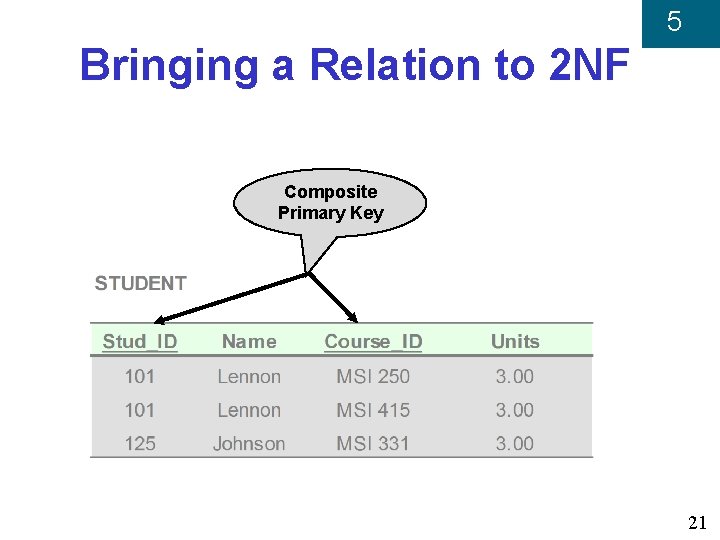
5 Bringing a Relation to 2 NF Composite Primary Key 21
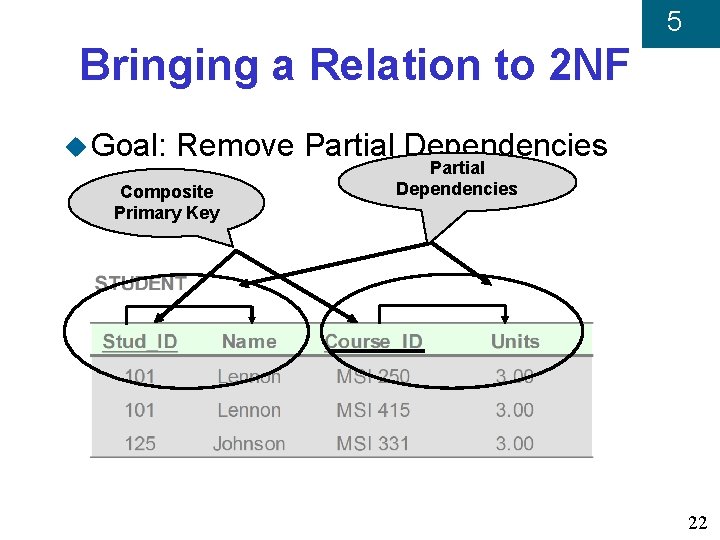
5 Bringing a Relation to 2 NF u Goal: Remove Partial Dependencies Composite Primary Key Partial Dependencies 22
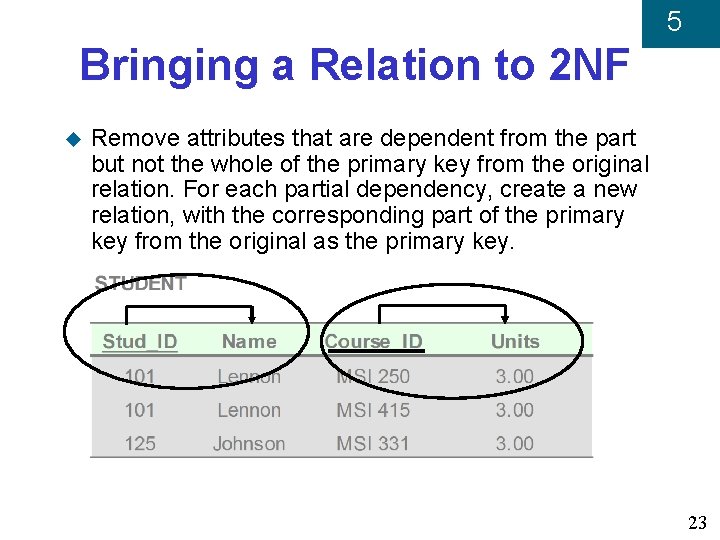
5 Bringing a Relation to 2 NF u Remove attributes that are dependent from the part but not the whole of the primary key from the original relation. For each partial dependency, create a new relation, with the corresponding part of the primary key from the original as the primary key. 23
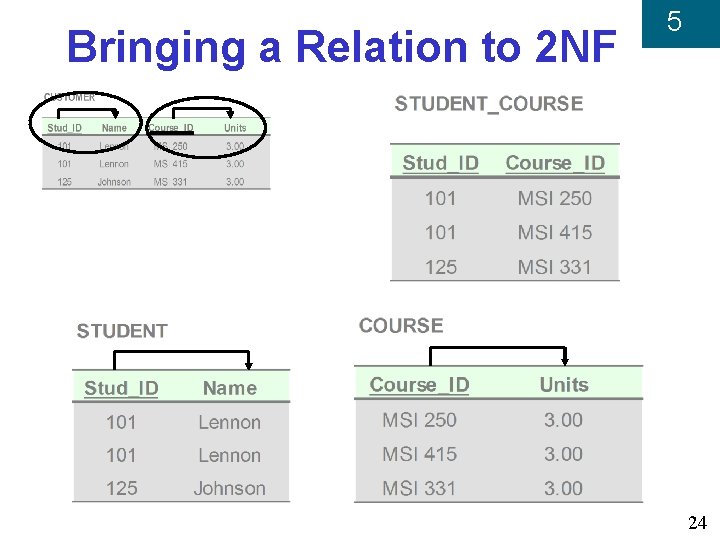
Bringing a Relation to 2 NF 5 24
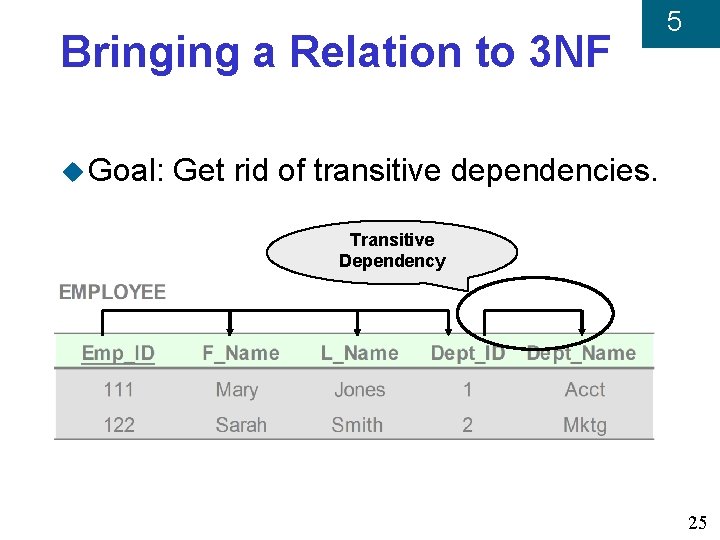
Bringing a Relation to 3 NF u Goal: 5 Get rid of transitive dependencies. Transitive Dependency 25
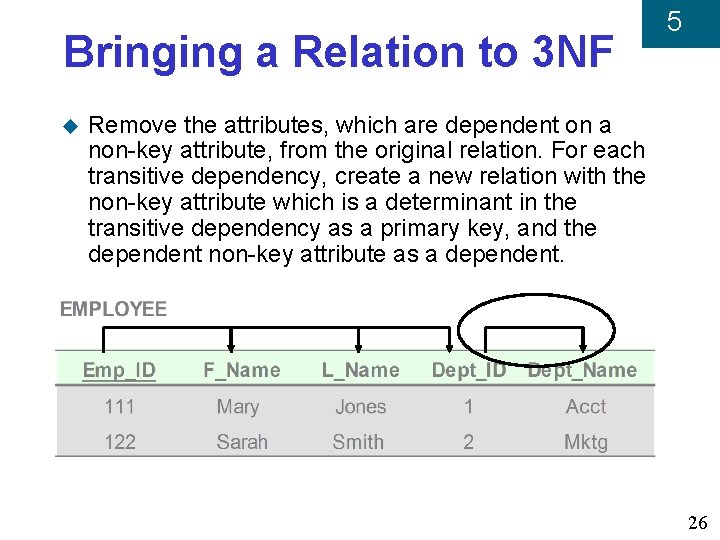
Bringing a Relation to 3 NF u 5 Remove the attributes, which are dependent on a non-key attribute, from the original relation. For each transitive dependency, create a new relation with the non-key attribute which is a determinant in the transitive dependency as a primary key, and the dependent non-key attribute as a dependent. 26
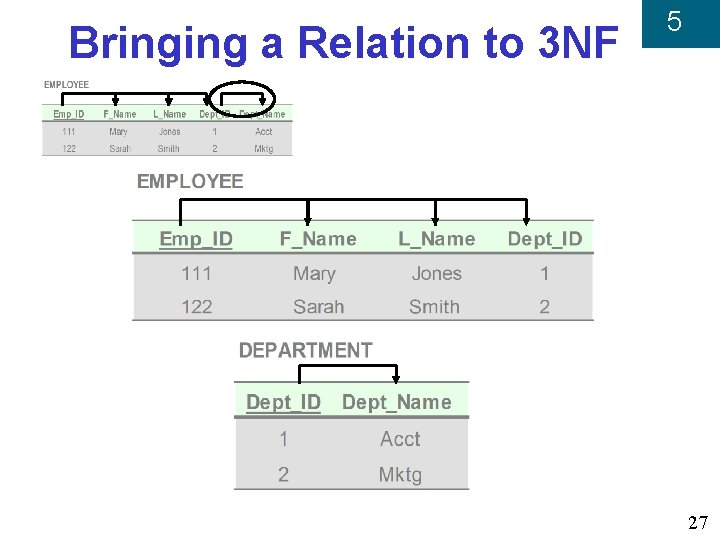
Bringing a Relation to 3 NF 5 27
- Slides: 27