
CHAPTER 5 5 2 SOURCE AND DISTRIBUTION Electrical
CHAPTER 5 5. 2 : SOURCE AND DISTRIBUTION
Electrical Supply n n n Electricity is a basic part of nature and it is one of most widely used forms of energy. It is a secondary energy source which means it comes from the conversion of other sources of energy, like coal, natural gas, oil, nuclear power and other natural sources, which are called primary sources. The energy sources used to make electricity can be renewable or non-renewable.
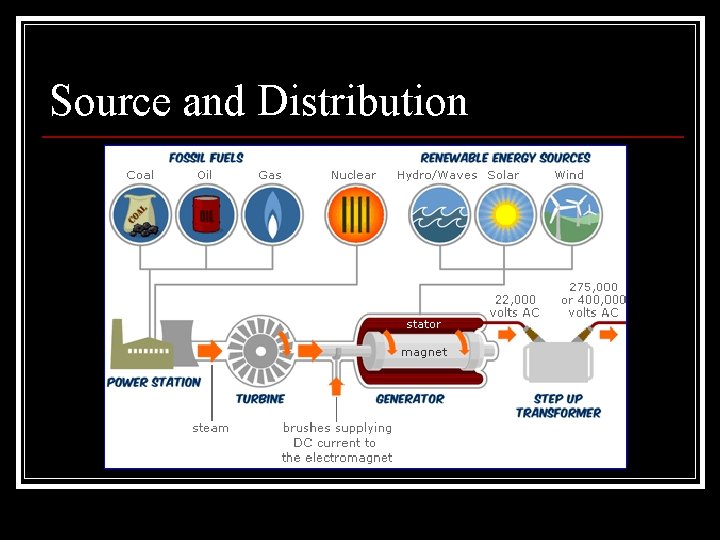
Source and Distribution
Primary Source (Renewable Energy) n Hydropower Ø Ø Flowing water is used to spin a turbine connected to a generator. Two basic types of hydroelectric systems Ø Ø Flowing water accumulates in reservoirs created by the use of dams. The water falls through a pipe called a penstock and applies pressure against the turbine blades to drive the generator to produce electricity. Run-of-river, the force of the river current (rather than falling water) applies pressure to the turbine blades to produce electricity.
Primary Source (Renewable Energy) n Solar power Ø Ø Power is derived from the energy of the sun. Photovoltaic conversion generates electric power directly from the light of the sun in a photovoltaic (solar) cell. Solar-thermal electric generators use the radiant energy from the sun to produce steam to drive turbines. Weaknesses: Ø Ø sun's energy is not available full-time and it is widely scattered. The processes used to produce electricity using the sun's energy have historically been more expensive than using conventional fossil fuels.
Primary Source (Renewable Energy) n Wind power Ø Ø Ø Wind power is derived from the conversion of the energy contained in wind into electricity. Wind power is a rapidly growing source of electricity. A wind turbine is similar to a typical wind mill.
Primary Source (Non-Renewable Energy) n Coal Ø Ø Ø It is a black solid that is reasonably soft. Consists of carbon atoms that come from plant material from ancient swamp forests. When coal is burns, it will produces mainly carbon dioxide, some carbon monoxide and soot (which are unburned carbon). Many coals when burned produce smoky flames. There are different types of coal. Some contain impurities such as sulphur that pollute the atmosphere further when they burn, contributing to acid rain. The energy from coal content weight is not as great as oil because when coal burns it produces more carbon dioxide than oil.
Primary Source (Non-Renewable Energy) n Natural Gas Ø In addition to being burned to heat water for steam, can also be burned to produce hot combustion gases that pass directly through a turbine, spinning the blades of the turbine to generate electricity. Gas turbines are commonly used when electricity utility usage is in high demand.
Primary Source (Non-Renewable Energy) n Petroleum (oil) Ø Ø Ø Ø Petroleum can be used to make steam to turn a turbine. Residual fuel oil, a product refined from crude oil, is often the petroleum product used in electric plants that use petroleum to make steam. Petroleum and gas are non-renewable: they will not last forever. New sources of petroleum and gas are constantly being sought. Natural gas and crude oil can be found in many places around the world. When gas and oil is burnt they produce mainly carbon dioxide and water, releasing the energy they contain. Crude oil is a mixture of different chemicals and is usually separated out into fuels such as petrol, paraffin, kerosene and heavy fuel oils. The oil-based fuels provide less energy per kilogram than natural gas. Both oil and natural gas produce carbon dioxide, which is a greenhouse gas.
Primary Source (Non-Renewable Energy) n Nuclear Ø Nuclear power is a method in which steam is produced by heating water through a process called nuclear fission. In a nuclear power plant, a reactor contains a core of nuclear fuel, primarily enriched uranium. When atoms of uranium fuel are hit by neutrons they fission (split), releasing heat and more neutrons. Under controlled conditions, these other neutrons can strike more uranium atoms, splitting more atoms, and so on. Thereby, continuous fission can take place, forming a chain reaction releasing heat. The heat is used to turn water into steam that, in turn, spins a turbine that generates electricity.
Power Station In Malaysia n n n In Malaysia, the electricity generation capacity is about 82% from thermal power stations and 18% from hydroelectric power stations. Coal power stations: n Manjung Power Station, Manjung, Perak n Sultan Salahuddin Abdul Aziz Shah Power Station, Kapar, Selangor n Jimah Power Station, Lukut, Negri Sembilan n Tanjung Bin Power Station, Pontian, Johor Oil power stations: n Tuanku Jaafar Power Station, Port Dickson, Negeri Sembilan n Tanjung Kling Power Station, Melaka n Gas turbine power stations: n Lumut Power Station, at Pantai Remis, Perak n Sultan Iskandar Power Station, Pasir Gudang, Johor n Serdang Power Station, Serdang, Selangor n n n Oil and gas turbine power station: Sultan Ismail Power Station, Paka, Terengganu. Steam turbine power station: Connaught Bridge Power Station, Klang, Selangor. Hydroelectric power stations: n Sultan Mahmud Power Station, Tasik Kenyir, Terengganu n Sultan Ismail Petra Power Station, Pergau, Kelantan n Temenggor Power Station, Temenggor Dam, Perak n Kenering Power Station - Kenering Dam, Perak n Chenderoh Power Station - Tasik Chenderoh, Perak n Sultan Idris Power Station, Lata Iskandar, Perak
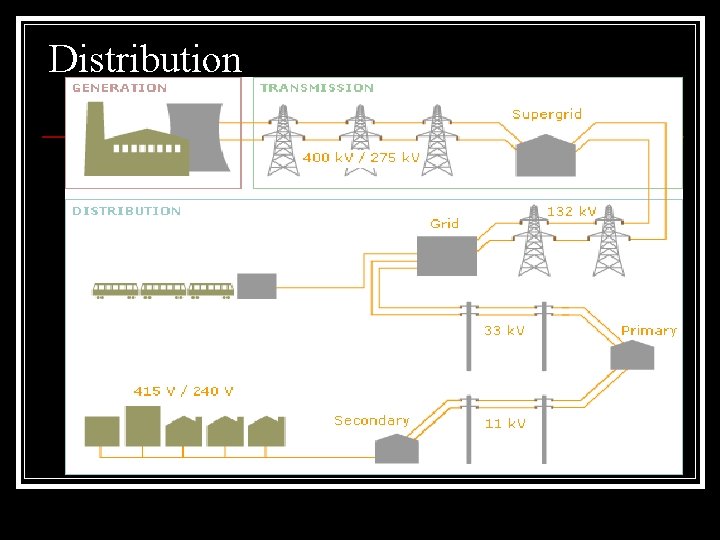
Distribution
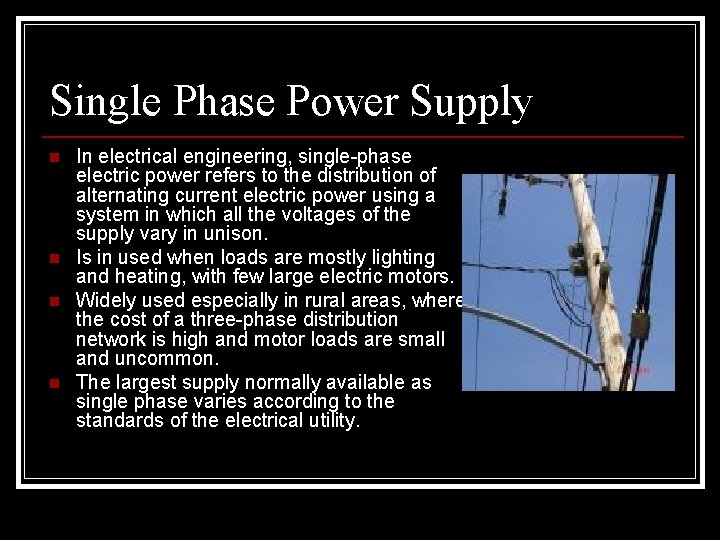
Single Phase Power Supply n n In electrical engineering, single-phase electric power refers to the distribution of alternating current electric power using a system in which all the voltages of the supply vary in unison. Is in used when loads are mostly lighting and heating, with few large electric motors. Widely used especially in rural areas, where the cost of a three-phase distribution network is high and motor loads are small and uncommon. The largest supply normally available as single phase varies according to the standards of the electrical utility.
Three Phase Power Supply n n n n The most common method used by electric power distribution grids worldwide to distribute power. Also used to power large motors and other large loads. Larger consumers such as large buildings, shopping centres, factories, office blocks, and multiple-unit apartment blocks usually need three-phase service. High power systems, in hundreds of k. VA or larger, are nearly always three phase. More economical than others because it uses less conductor material to transmit electric power than equivalent single-phase or two-phase systems at the same voltage. Three circuit conductors carry three alternating currents (of the same frequency) which reach their instantaneous peak values at different times. The currents in each conductor reach their peak instantaneous values sequentially, not simultaneously; in each cycle of the power frequency. The waveforms of the three supply conductors are offset from one another in time (delayed in phase) by one-third of their period. This delay between phases has the effect of giving constant power transfer over each cycle of the current, and also makes it possible to produce a rotating magnetic field in an electric motor.
Three Phase Power Supply n n A common method of electric power transmission. It is a type of poly-phase system mainly used to power motors and many other devices. Uses less conductor material to transmit electric power than equivalent single-phase, two-phase, or direct-current systems at the same voltage. In a three-phase system, three circuit conductors carry three alternating currents (of the same frequency) which reach their instantaneous peak values at different times. Taking one conductor as the reference, the other two currents are delayed in time by onethird and two-thirds of one cycle of the electrical current. This delay between "phases" has the effect of giving constant power transfer over each cycle of the current, and also makes it possible to produce a rotating magnetic field in an electric motor.
Three Phase Power Supply n Three phase systems may or may not have a neutral wire. A neutral wire allows the three phase system to use a higher voltage while still supporting lower voltage single phase appliances n Three phase has properties that make it very desirable in electric power systems: Ø The phase currents tend to cancel out one another, summing to zero in the case of a linear balanced load. This makes it possible to eliminate or reduce the size of the neutral conductor; all the phase conductors carry the same current and so can be the same size, for a balanced load. Ø Power transfer into a linear balanced load is constant, which helps to reduce generator and motor vibrations. Ø Three-phase systems can produce a magnetic field that rotates in a specified direction, which simplifies the design of electric motors.
- Slides: 16