
Chapter 5 1 What is often the source
- Slides: 31
Chapter 5
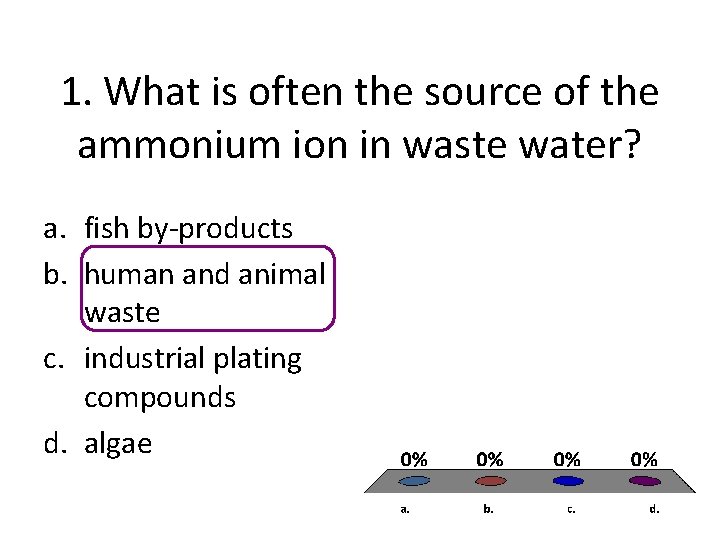
1. What is often the source of the ammonium ion in waste water? a. fish by-products b. human and animal waste c. industrial plating compounds d. algae
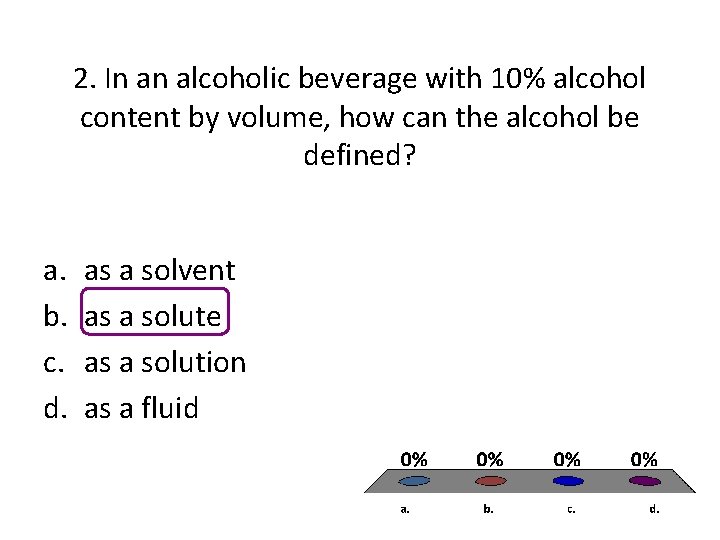
2. In an alcoholic beverage with 10% alcohol content by volume, how can the alcohol be defined? a. b. c. d. as a solvent as a solute as a solution as a fluid
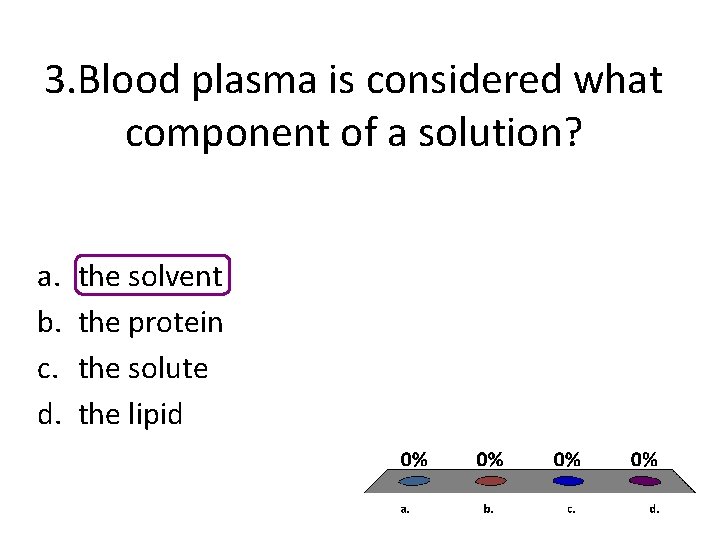
3. Blood plasma is considered what component of a solution? a. b. c. d. the solvent the protein the solute the lipid
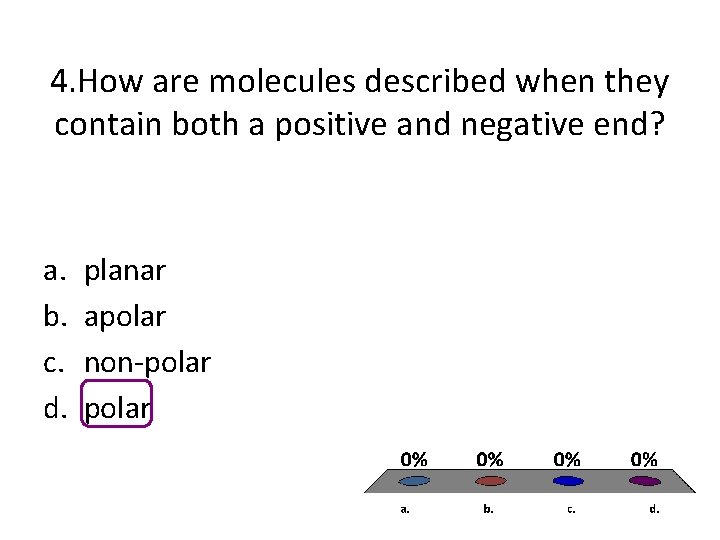
4. How are molecules described when they contain both a positive and negative end? a. b. c. d. planar apolar non-polar
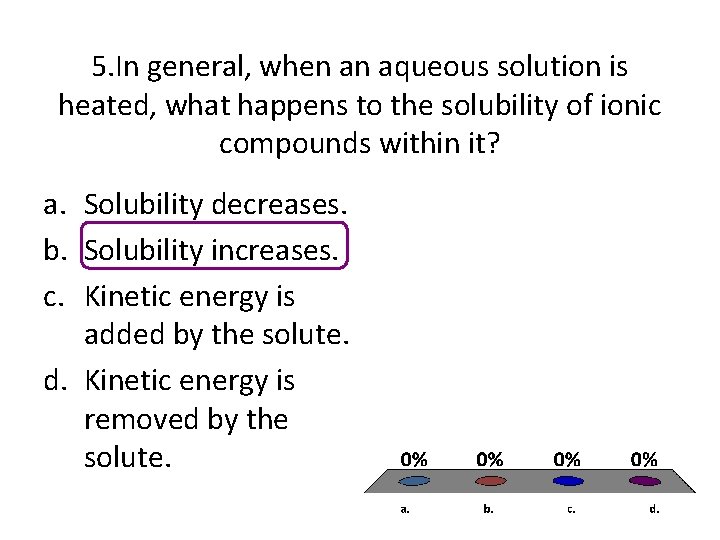
5. In general, when an aqueous solution is heated, what happens to the solubility of ionic compounds within it? a. Solubility decreases. b. Solubility increases. c. Kinetic energy is added by the solute. d. Kinetic energy is removed by the solute.
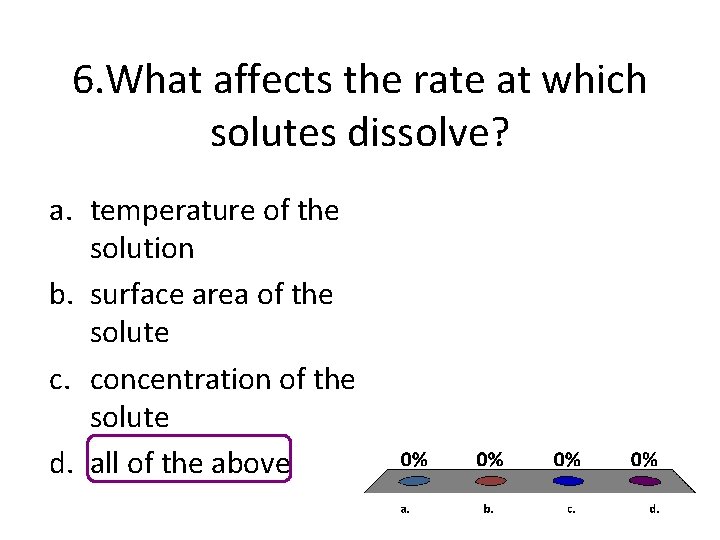
6. What affects the rate at which solutes dissolve? a. temperature of the solution b. surface area of the solute c. concentration of the solute d. all of the above
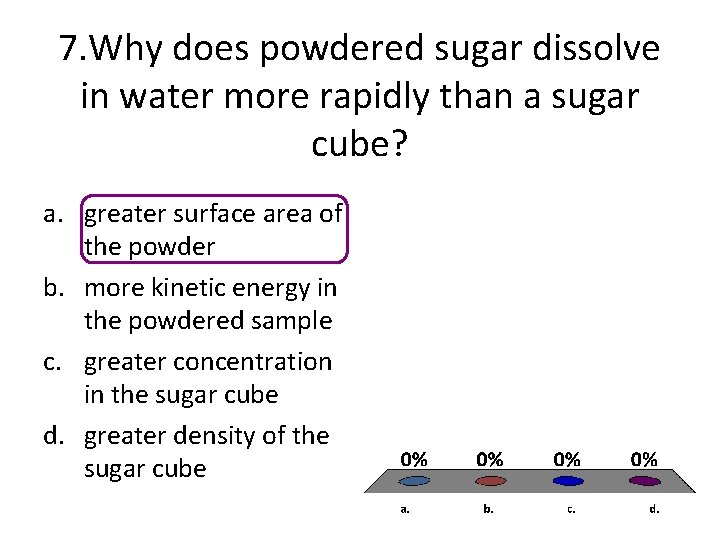
7. Why does powdered sugar dissolve in water more rapidly than a sugar cube? a. greater surface area of the powder b. more kinetic energy in the powdered sample c. greater concentration in the sugar cube d. greater density of the sugar cube
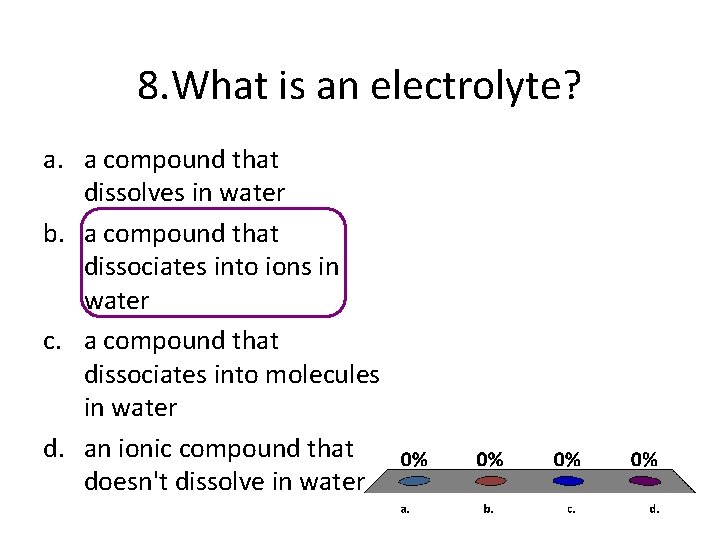
8. What is an electrolyte? a. a compound that dissolves in water b. a compound that dissociates into ions in water c. a compound that dissociates into molecules in water d. an ionic compound that doesn't dissolve in water
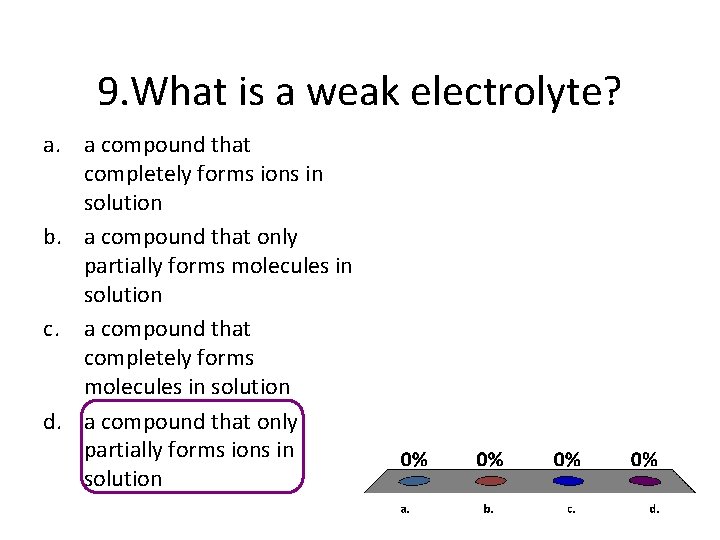
9. What is a weak electrolyte? a. a compound that completely forms ions in solution b. a compound that only partially forms molecules in solution c. a compound that completely forms molecules in solution d. a compound that only partially forms ions in solution
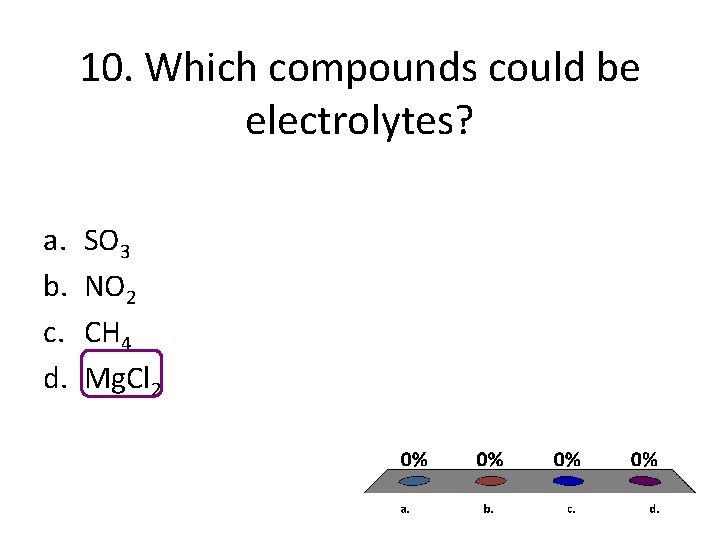
10. Which compounds could be electrolytes? a. b. c. d. SO 3 NO 2 CH 4 Mg. Cl 2
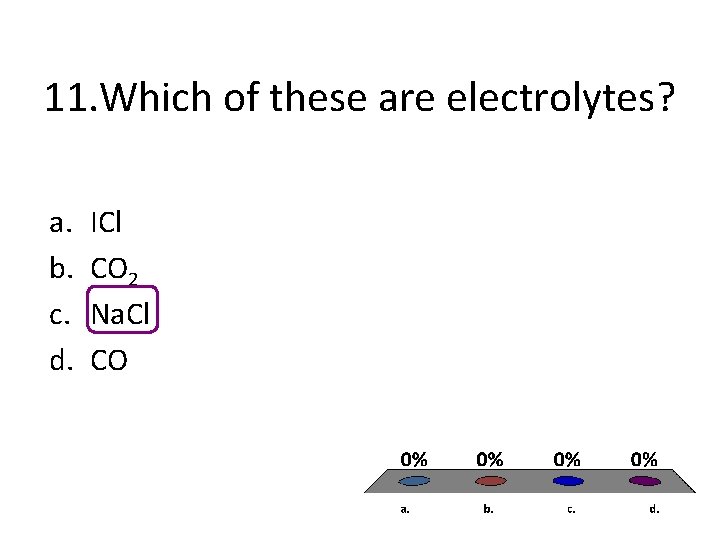
11. Which of these are electrolytes? a. b. c. d. ICl CO 2 Na. Cl CO
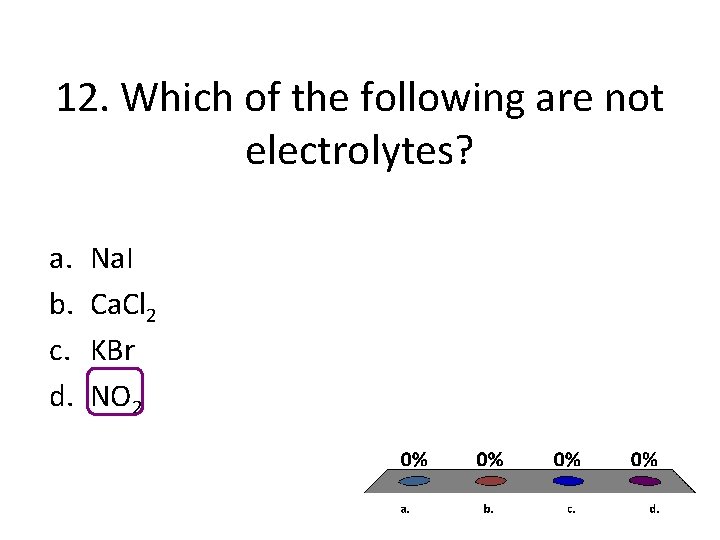
12. Which of the following are not electrolytes? a. b. c. d. Na. I Ca. Cl 2 KBr NO 2
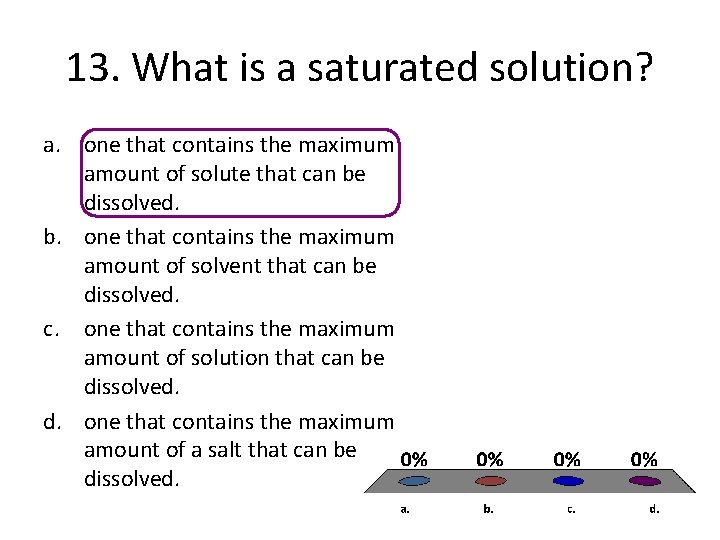
13. What is a saturated solution? a. one that contains the maximum amount of solute that can be dissolved. b. one that contains the maximum amount of solvent that can be dissolved. c. one that contains the maximum amount of solution that can be dissolved. d. one that contains the maximum amount of a salt that can be dissolved.
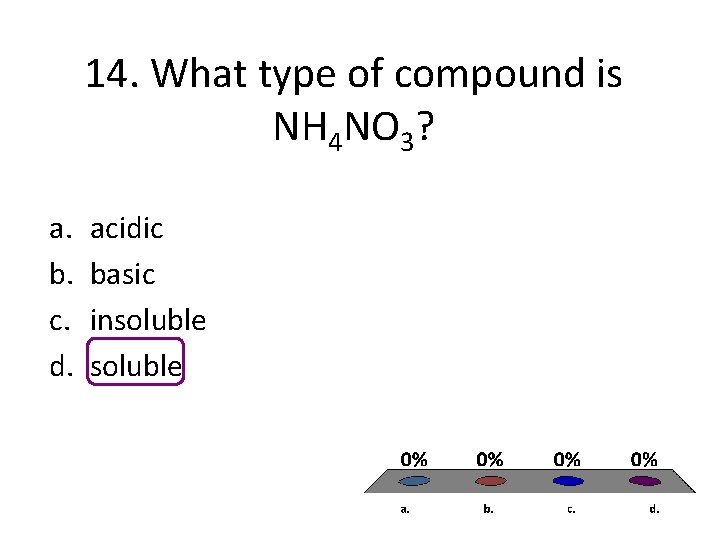
14. What type of compound is NH 4 NO 3? a. b. c. d. acidic basic insoluble
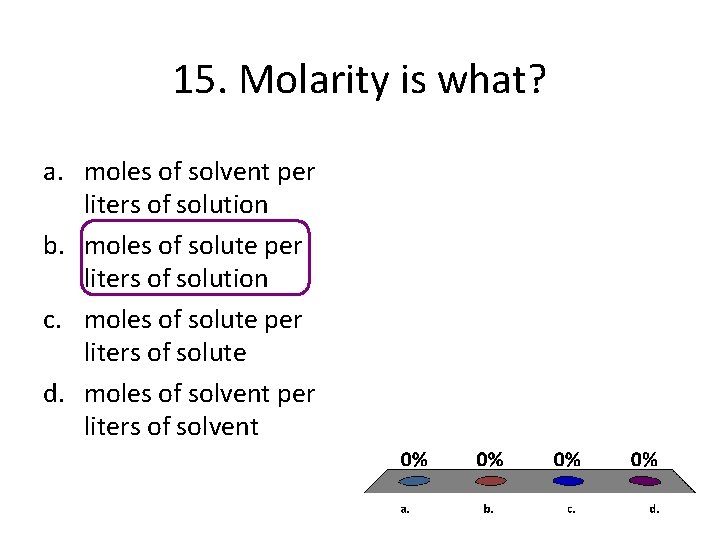
15. Molarity is what? a. moles of solvent per liters of solution b. moles of solute per liters of solution c. moles of solute per liters of solute d. moles of solvent per liters of solvent
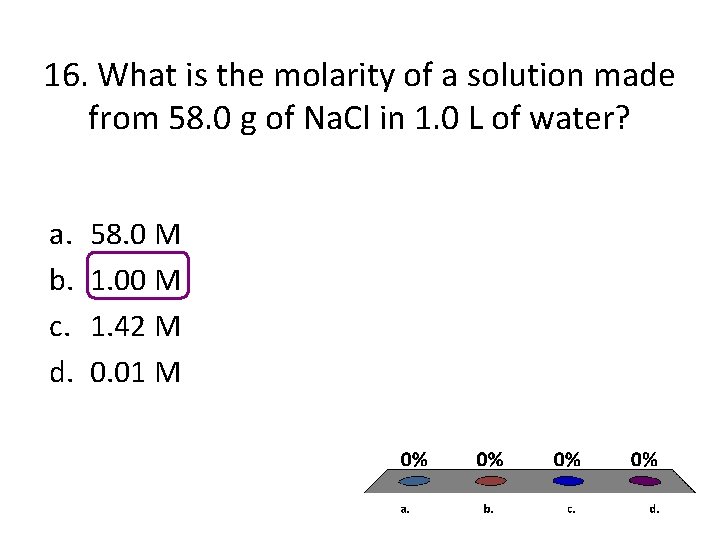
16. What is the molarity of a solution made from 58. 0 g of Na. Cl in 1. 0 L of water? a. b. c. d. 58. 0 M 1. 00 M 1. 42 M 0. 01 M
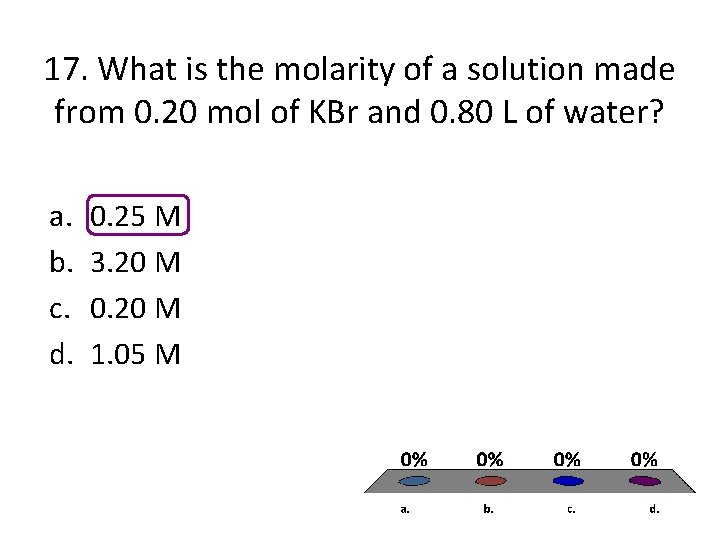
17. What is the molarity of a solution made from 0. 20 mol of KBr and 0. 80 L of water? a. b. c. d. 0. 25 M 3. 20 M 0. 20 M 1. 05 M
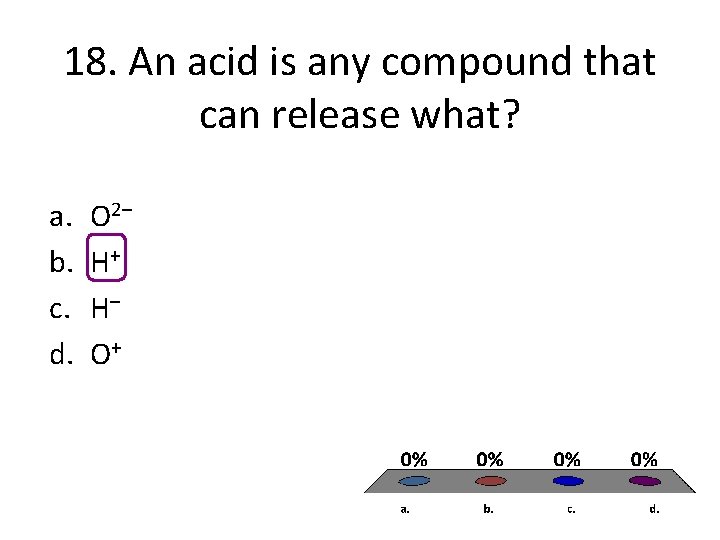
18. An acid is any compound that can release what? a. b. c. d. O 2– H+ H– O+
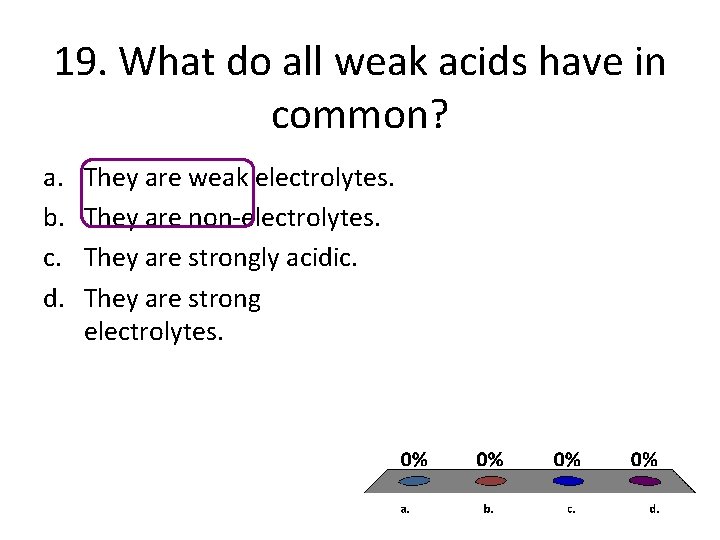
19. What do all weak acids have in common? a. b. c. d. They are weak electrolytes. They are non-electrolytes. They are strongly acidic. They are strong electrolytes.
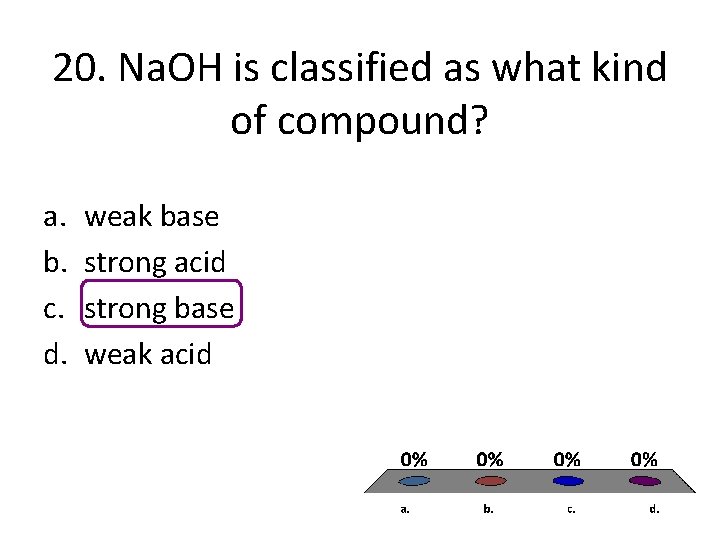
20. Na. OH is classified as what kind of compound? a. b. c. d. weak base strong acid strong base weak acid
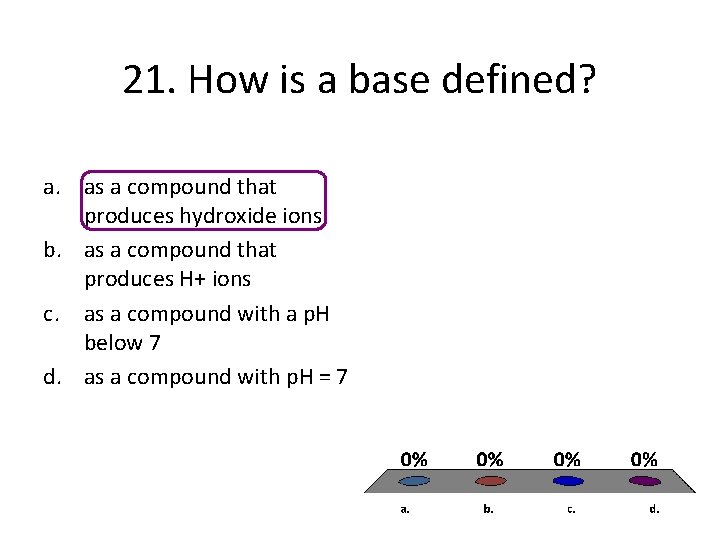
21. How is a base defined? a. as a compound that produces hydroxide ions b. as a compound that produces H+ ions c. as a compound with a p. H below 7 d. as a compound with p. H = 7
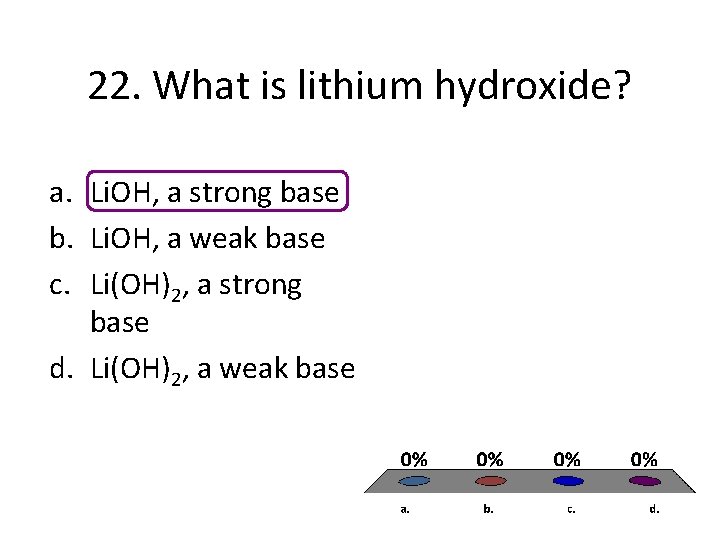
22. What is lithium hydroxide? a. Li. OH, a strong base b. Li. OH, a weak base c. Li(OH)2, a strong base d. Li(OH)2, a weak base
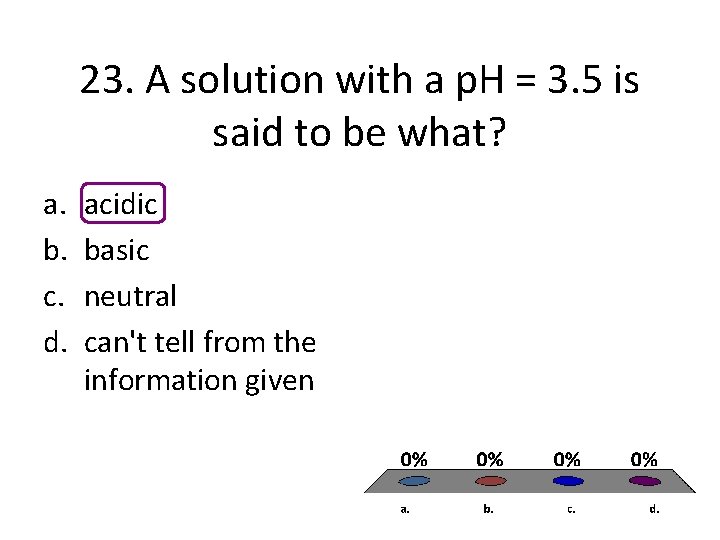
23. A solution with a p. H = 3. 5 is said to be what? a. b. c. d. acidic basic neutral can't tell from the information given
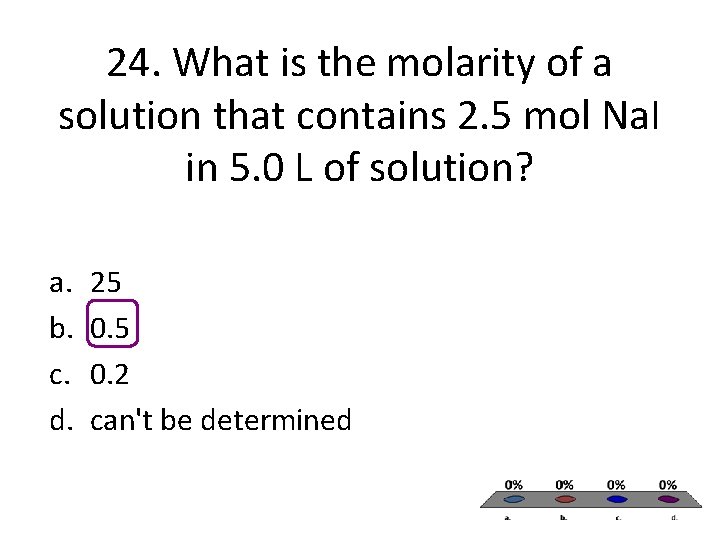
24. What is the molarity of a solution that contains 2. 5 mol Na. I in 5. 0 L of solution? a. b. c. d. 25 0. 2 can't be determined
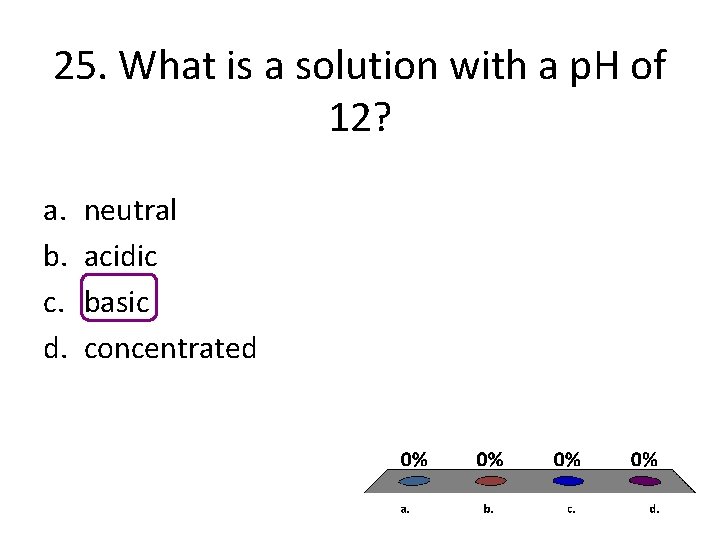
25. What is a solution with a p. H of 12? a. b. c. d. neutral acidic basic concentrated
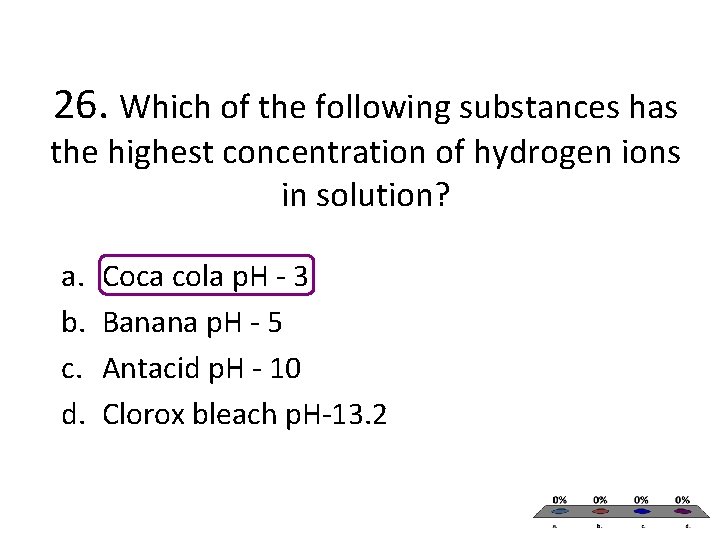
26. Which of the following substances has the highest concentration of hydrogen ions in solution? a. b. c. d. Coca cola p. H - 3 Banana p. H - 5 Antacid p. H - 10 Clorox bleach p. H-13. 2
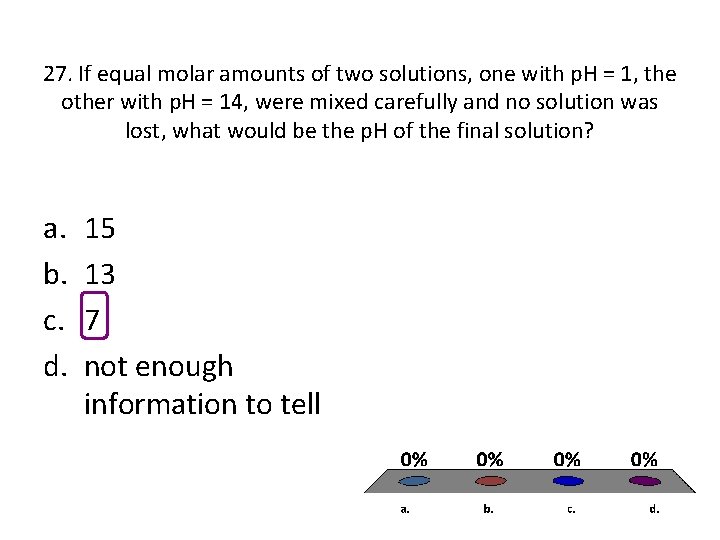
27. If equal molar amounts of two solutions, one with p. H = 1, the other with p. H = 14, were mixed carefully and no solution was lost, what would be the p. H of the final solution? a. b. c. d. 15 13 7 not enough information to tell
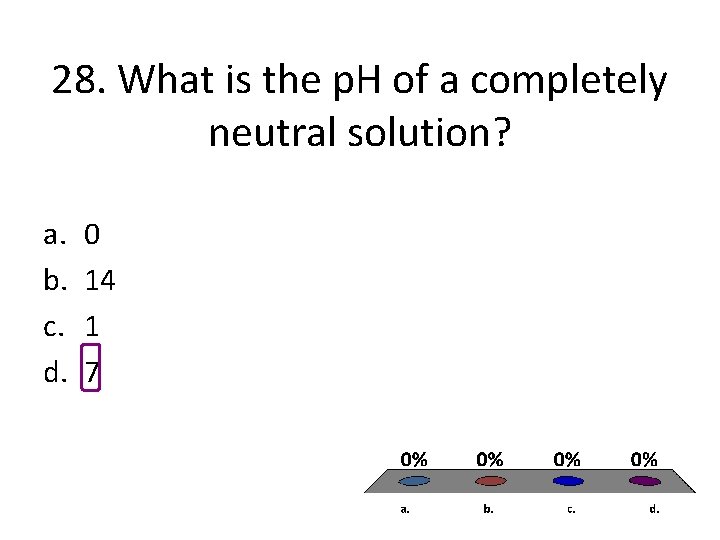
28. What is the p. H of a completely neutral solution? a. b. c. d. 0 14 1 7
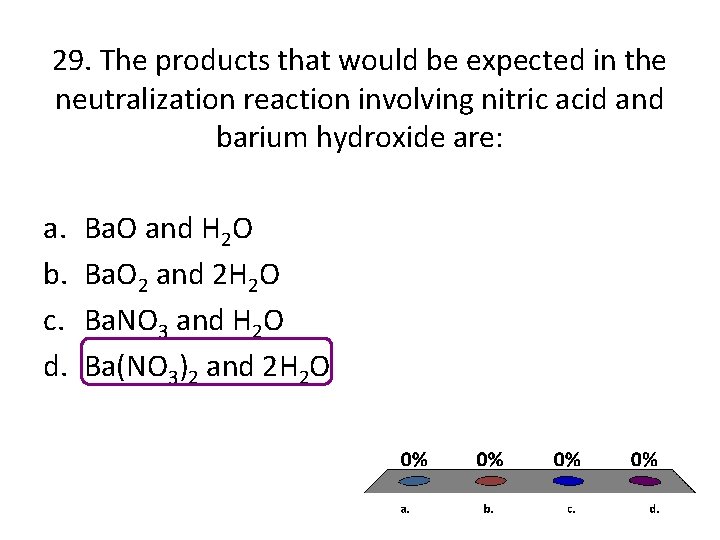
29. The products that would be expected in the neutralization reaction involving nitric acid and barium hydroxide are: a. b. c. d. Ba. O and H 2 O Ba. O 2 and 2 H 2 O Ba. NO 3 and H 2 O Ba(NO 3)2 and 2 H 2 O
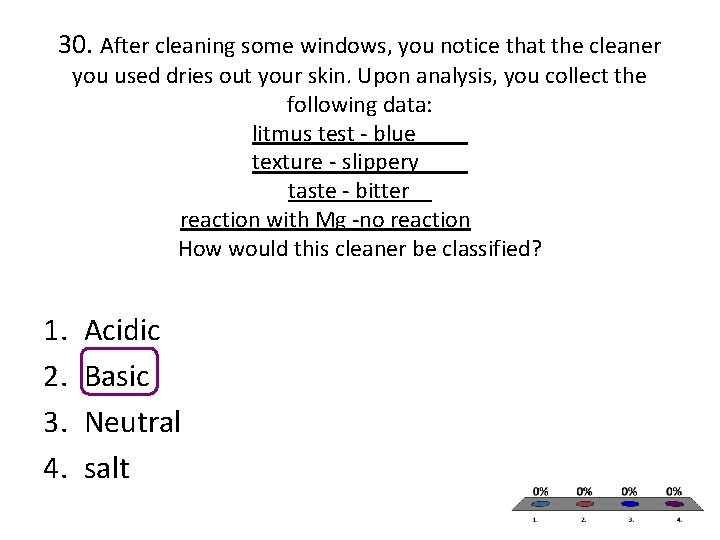
30. After cleaning some windows, you notice that the cleaner you used dries out your skin. Upon analysis, you collect the following data: litmus test - blue texture - slippery taste - bitter reaction with Mg -no reaction How would this cleaner be classified? 1. 2. 3. 4. Acidic Basic Neutral salt