
Chapter 4849 Neurons and the Nervous System Overview
- Slides: 42
Chapter 48/49 Neurons and the Nervous System
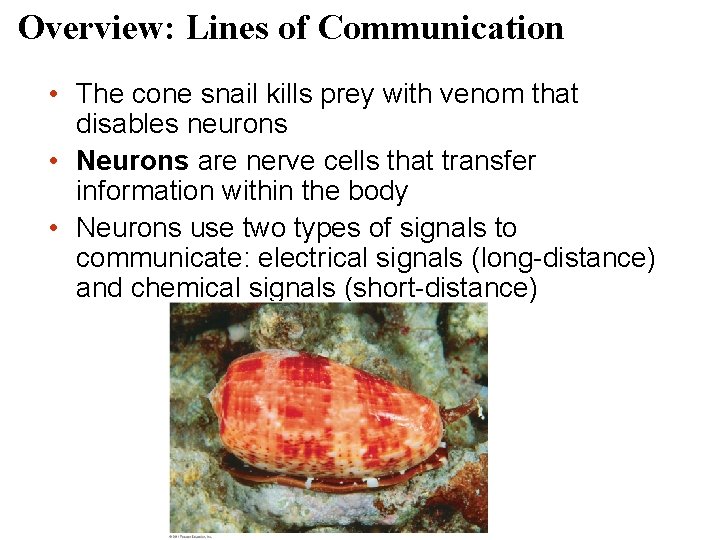
Overview: Lines of Communication • The cone snail kills prey with venom that disables neurons • Neurons are nerve cells that transfer information within the body • Neurons use two types of signals to communicate: electrical signals (long-distance) and chemical signals (short-distance)
• Interpreting signals in the nervous system involves sorting a complex set of paths and connections • Processing of information takes place in simple clusters of neurons called ganglia or a more complex organization of neurons called a brain
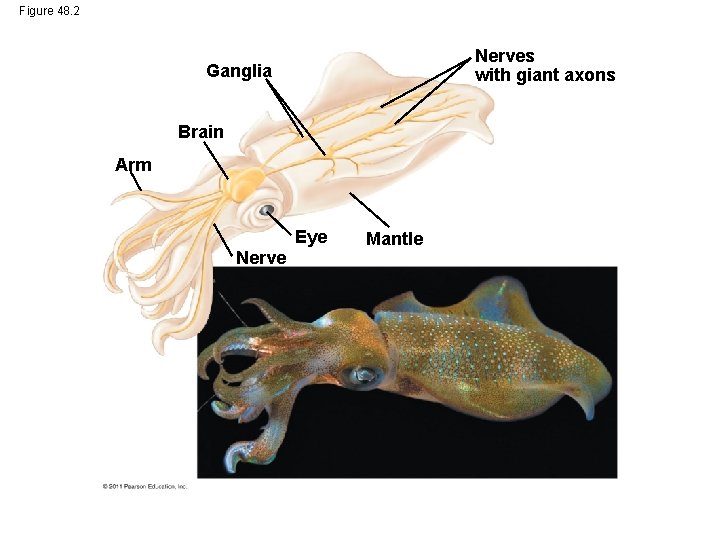
Concept 48. 1: Neuron organization and structure reflect function in information transfer • The squid possesses extremely large nerve cells and has played a crucial role in the discovery of how neurons transmit signals
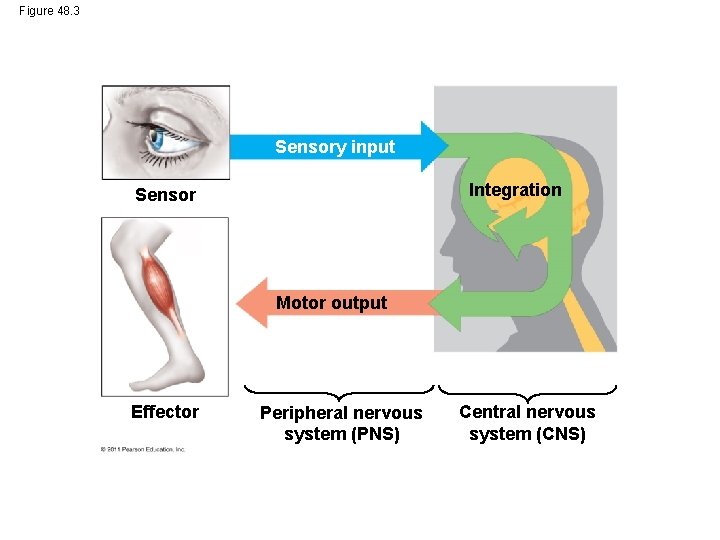
Introduction to Information Processing • Nervous systems process information in three stages: sensory input, integration, and motor output
Figure 48. 2 Nerves with giant axons Ganglia Brain Arm Eye Nerve Mantle
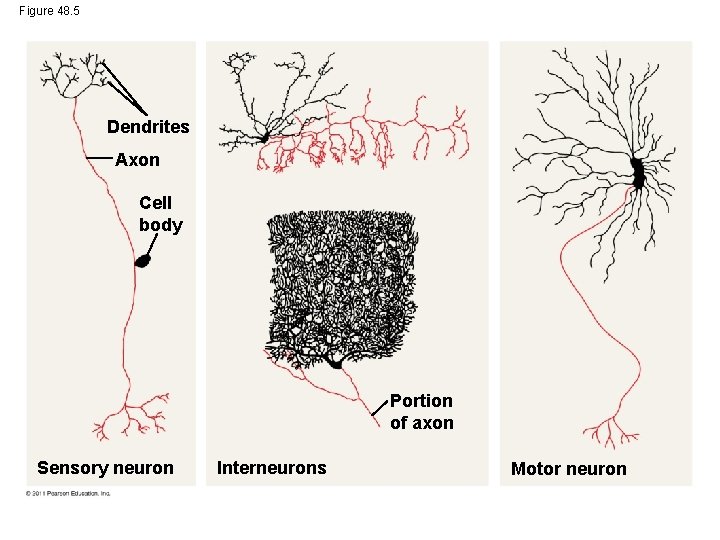
• Sensors detect external stimuli and internal conditions and transmit information along sensory neurons • Sensory information is sent to the brain or ganglia, where interneurons integrate the information • Motor output leaves the brain or ganglia via motor neurons, which trigger muscle or gland activity
• Many animals have a complex nervous system that consists of – A central nervous system (CNS) where integration takes place; this includes the brain and a nerve cord – A peripheral nervous system (PNS), which carries information into and out of the CNS – The neurons of the PNS, when bundled together, form nerves
Figure 48. 3 Sensory input Integration Sensor Motor output Effector Peripheral nervous system (PNS) Central nervous system (CNS)
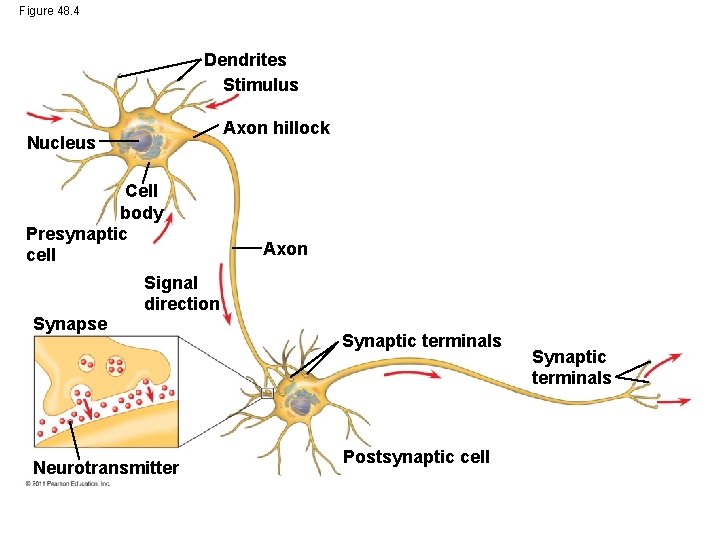
Neuron Structure and Function • Most of a neuron’s organelles are in the cell body • Most neurons have dendrites, highly branched extensions that receive signals from other neurons • The axon is typically a much longer extension that transmits signals to other cells at synapses • The cone-shaped base of an axon is called the axon hillock
Figure 48. 4 Dendrites Stimulus Axon hillock Nucleus Cell body Presynaptic cell Synapse Axon Signal direction Neurotransmitter Synaptic terminals Postsynaptic cell Synaptic terminals
• The synaptic terminal of one axon passes information across the synapse in the form of chemical messengers called neurotransmitters • A synapse is a junction between an axon and another cell
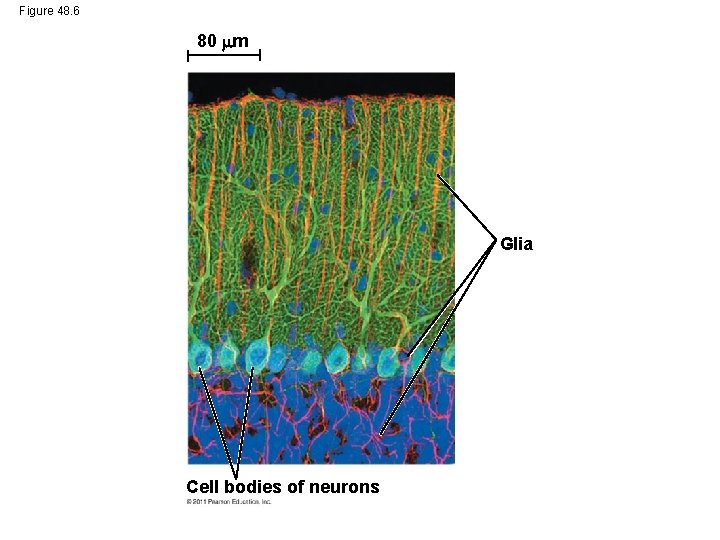
• Information is transmitted from a presynaptic cell (a neuron) to a postsynaptic cell (a neuron, muscle, or gland cell) • Most neurons are nourished or insulated by cells called glia
Figure 48. 5 Dendrites Axon Cell body Portion of axon Sensory neuron Interneurons Motor neuron
Figure 48. 6 80 m Glia Cell bodies of neurons
Concept 48. 2: Ion pumps and ion channels establish the resting potential of a neuron • Every cell has a voltage (difference in electrical charge) across its plasma membrane called a membrane potential • The resting potential is the membrane potential of a neuron not sending signals • Changes in membrane potential act as signals, transmitting and processing information
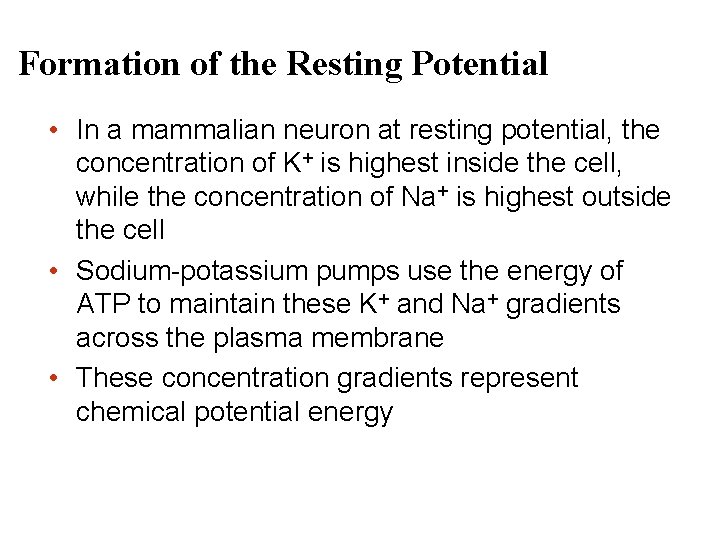
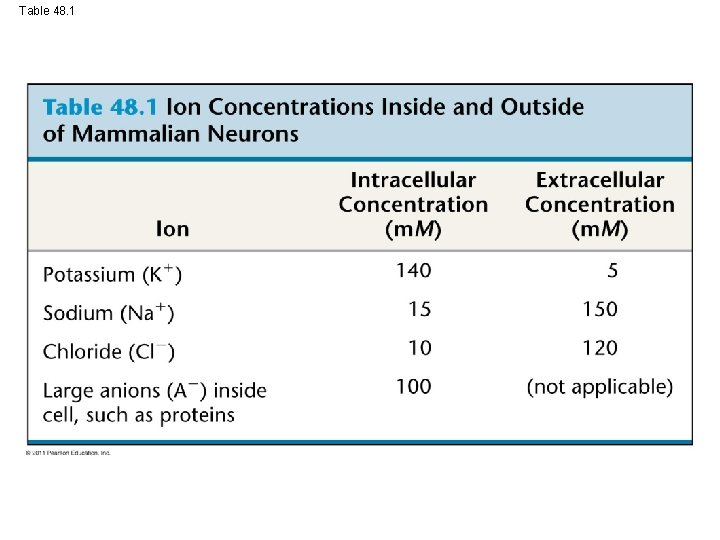
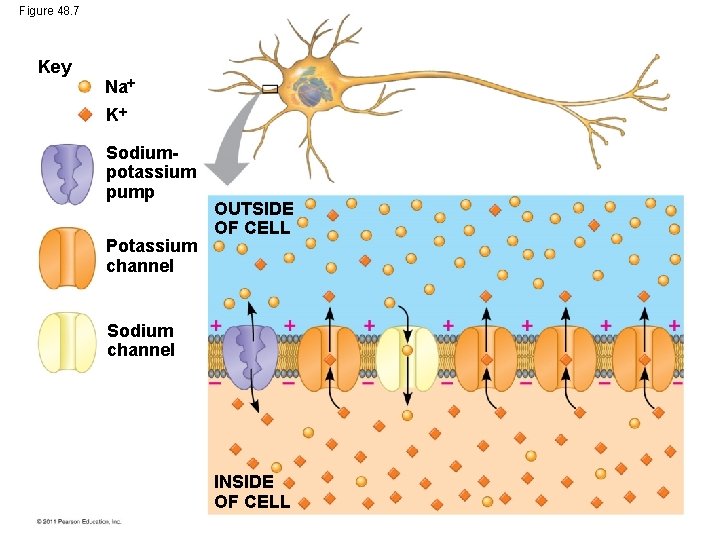
Formation of the Resting Potential • In a mammalian neuron at resting potential, the concentration of K+ is highest inside the cell, while the concentration of Na+ is highest outside the cell • Sodium-potassium pumps use the energy of ATP to maintain these K+ and Na+ gradients across the plasma membrane • These concentration gradients represent chemical potential energy
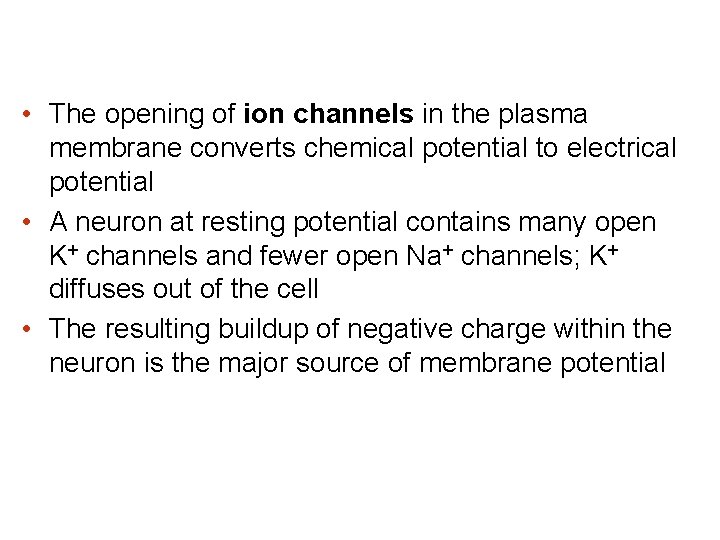
• The opening of ion channels in the plasma membrane converts chemical potential to electrical potential • A neuron at resting potential contains many open K+ channels and fewer open Na+ channels; K+ diffuses out of the cell • The resulting buildup of negative charge within the neuron is the major source of membrane potential
Table 48. 1
Figure 48. 7 Key Na K Sodiumpotassium pump Potassium channel OUTSIDE OF CELL Sodium channel INSIDE OF CELL
• In a resting neuron, the currents of K+ and Na+ are equal and opposite, and the resting potential across the membrane remains steady
Concept 48. 3: Action potentials are the signals conducted by axons • Changes in membrane potential occur because neurons contain gated ion channels that open or close in response to stimuli
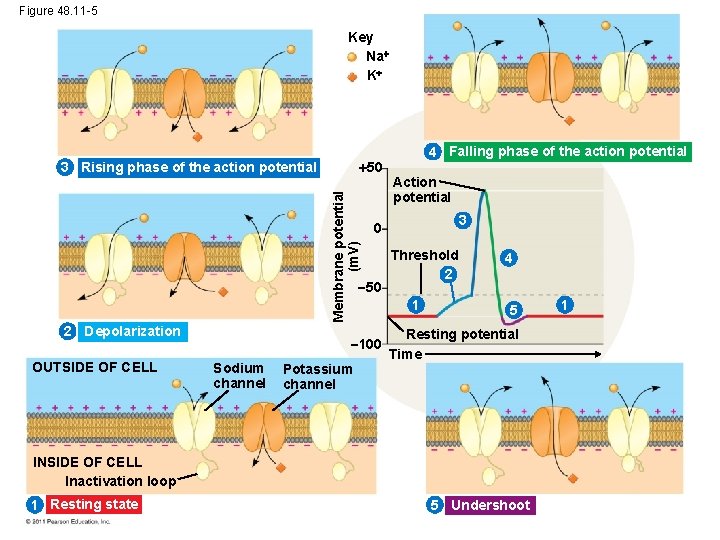
Figure 48. 11 -5 Key Na K 50 Membrane potential (m. V) 3 Rising phase of the action potential OUTSIDE OF CELL 100 Sodium channel Potassium channel Action potential 3 0 50 2 Depolarization 4 Falling phase of the action potential Threshold 2 1 4 5 Resting potential Time INSIDE OF CELL Inactivation loop 1 Resting state 5 Undershoot 1
• During the refractory period after an action potential, a second action potential cannot be initiated • The refractory period is a result of a temporary inactivation of the Na+ channels
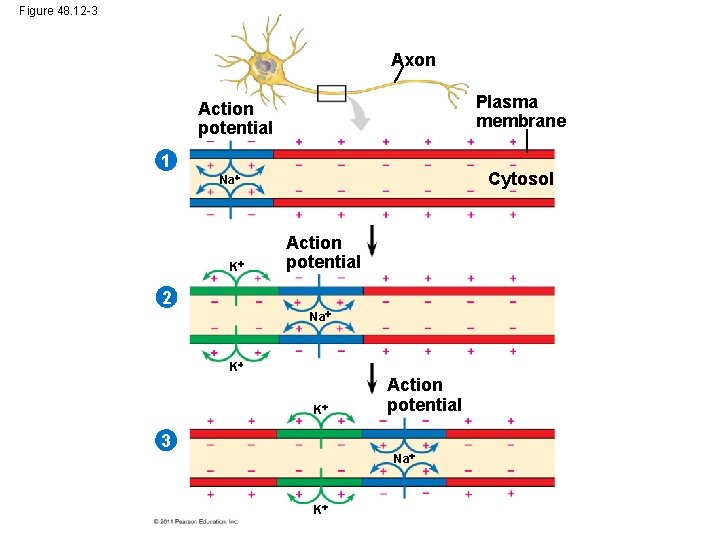
Conduction of Action Potentials • At the site where the action potential is generated, usually the axon hillock, an electrical current depolarizes the neighboring region of the axon membrane • Action potentials travel in only one direction: toward the synaptic terminals
Figure 48. 12 -3 Axon Plasma membrane Action potential 1 Cytosol Na K 2 Action potential Na K K 3 Action potential Na K
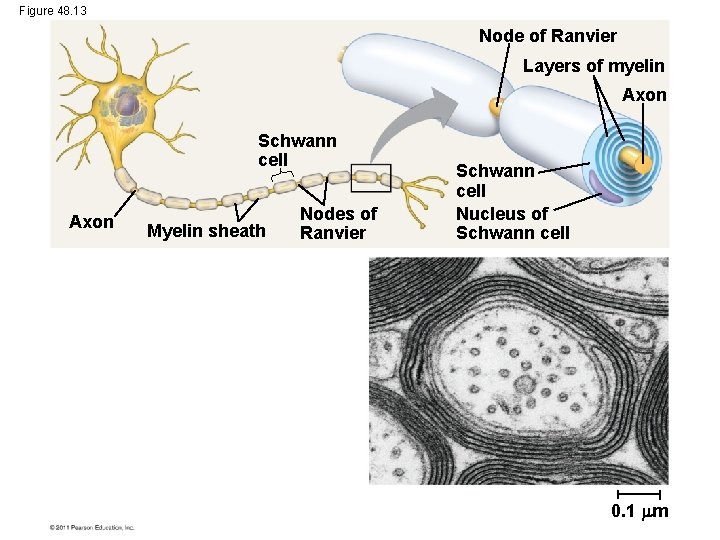
Evolutionary Adaptation of Axon Structure • The speed of an action potential increases with the axon’s diameter • In vertebrates, axons are insulated by a myelin sheath, which causes an action potential’s speed to increase • Myelin sheaths are made by glia— oligodendrocytes in the CNS and Schwann cells in the PNS
Figure 48. 13 Node of Ranvier Layers of myelin Axon Schwann cell Axon Myelin sheath Nodes of Ranvier Schwann cell Nucleus of Schwann cell 0. 1 m
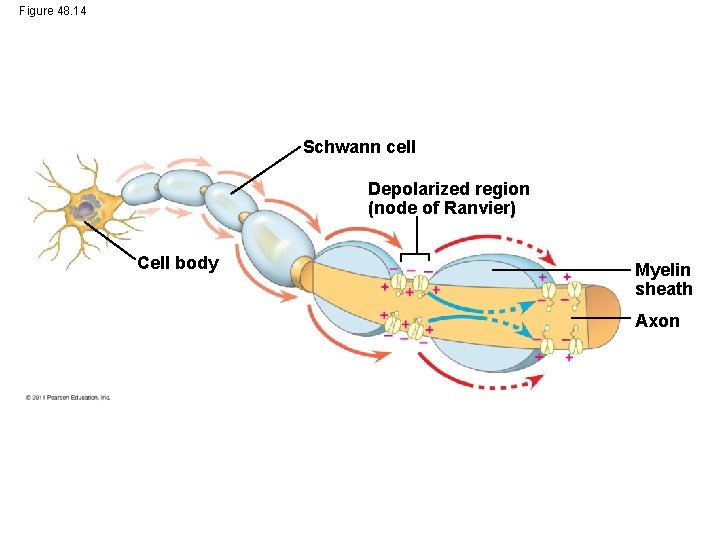
• Action potentials are formed only at nodes of Ranvier, gaps in the myelin sheath where voltage-gated Na+ channels are found • Action potentials in myelinated axons jump between the nodes of Ranvier in a process called saltatory conduction
Figure 48. 14 Schwann cell Depolarized region (node of Ranvier) Cell body Myelin sheath Axon
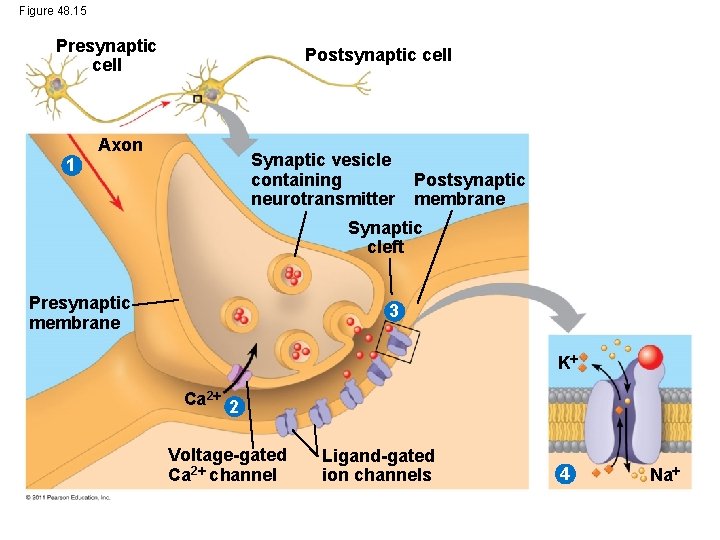
Concept 48. 4: Neurons communicate with other cells at synapses • At electrical synapses, the electrical current flows from one neuron to another • At chemical synapses, a chemical neurotransmitter carries information across the gap junction • Most synapses are chemical synapses
• The presynaptic neuron synthesizes and packages the neurotransmitter in synaptic vesicles located in the synaptic terminal • The action potential causes the release of the neurotransmitter • The neurotransmitter diffuses across the synaptic cleft and is received by the postsynaptic cell
Figure 48. 15 Presynaptic cell Postsynaptic cell Axon Synaptic vesicle containing neurotransmitter 1 Postsynaptic membrane Synaptic cleft Presynaptic membrane 3 K Ca 2 2 Voltage-gated Ca 2 channel Ligand-gated ion channels 4 Na
• After release, the neurotransmitter – May diffuse out of the synaptic cleft – May be taken up by surrounding cells – May be degraded by enzymes
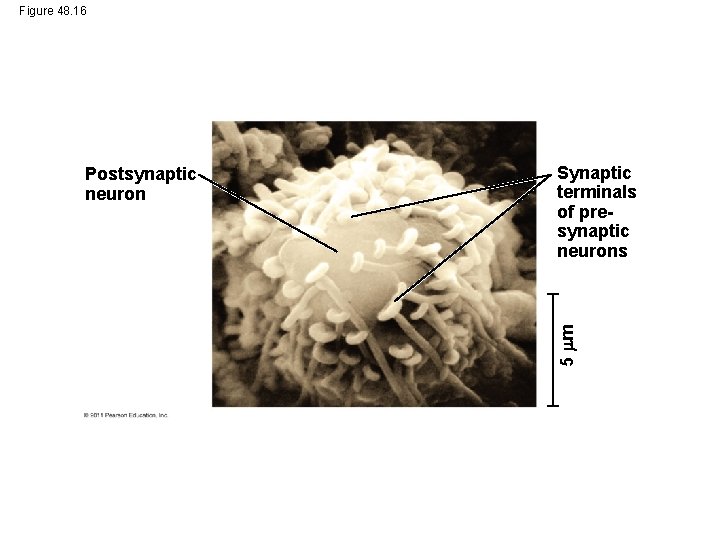
Figure 48. 16 Synaptic terminals of presynaptic neurons 5 m Postsynaptic neuron
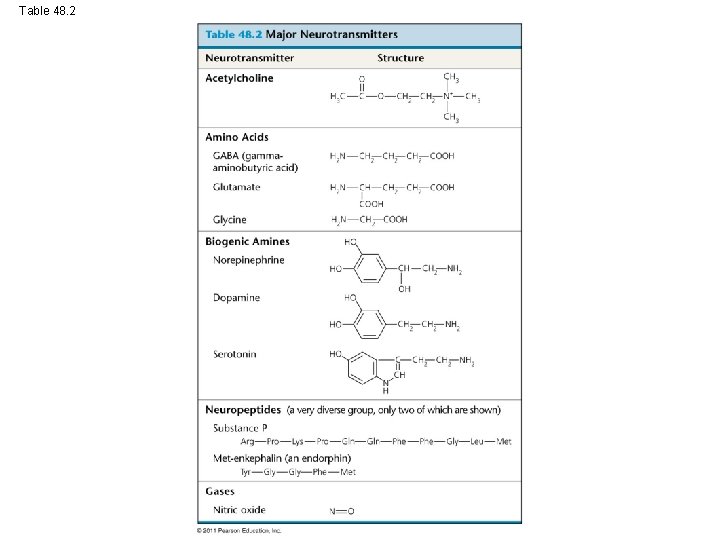
Neurotransmitters • There are more than 100 neurotransmitters, belonging to five groups: acetylcholine, biogenic amines, amino acids, neuropeptides, and gases • A single neurotransmitter may have more than a dozen different receptors
Table 48. 2
Acetylcholine • Acetylcholine is a common neurotransmitter in vertebrates and invertebrates • It is involved in muscle stimulation, memory formation, and learning • Vertebrates have two major classes of acetylcholine receptor, one that is ligand gated and one that is metabotropic
Amino Acids • Amino acid neurotransmitters are active in the CNS and PNS • Known to function in the CNS are – Glutamate – Gamma-aminobutyric acid (GABA) – Glycine
Biogenic Amines • Biogenic amines include – Epinephrine – Norepinephrine – Dopamine – Serotonin • They are active in the CNS and PNS
Neuropeptides • Several neuropeptides, relatively short chains of amino acids, also function as neurotransmitters • Neuropeptides include substance P and endorphins, which both affect our perception of pain • Opiates bind to the same receptors as endorphins and can be used as painkillers
Gases • Gases such as nitric oxide and carbon monoxide are local regulators in the PNS