
Chapter 46 Personal Property and Bailments Introduction Definition
Chapter 46 Personal Property and Bailments
Introduction Definition: Property consists of legally protected rights and interests a person has in anything with an ascertainable value that is subject to ownership. üDifference Between Real and Personal Property. üOwnership rights in each. Acquiring Ownership of Personal Property. Laws Governing Mislaid, Lost, or Abandoned Property.
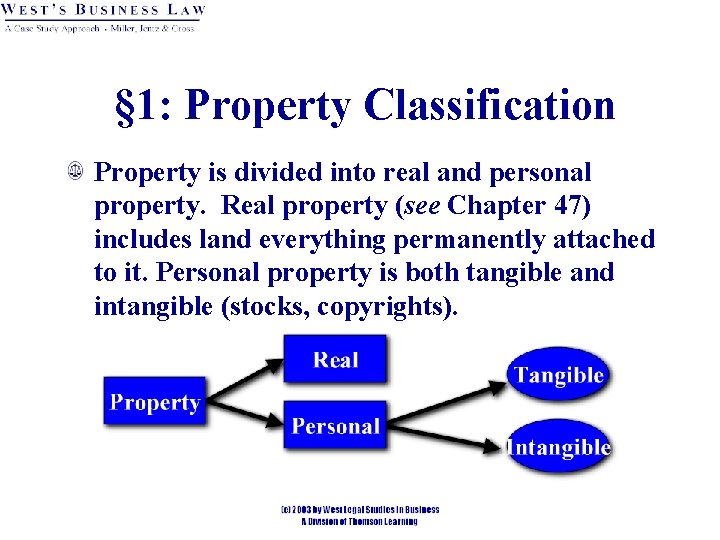
§ 1: Property Classification Property is divided into real and personal property. Real property (see Chapter 47) includes land everything permanently attached to it. Personal property is both tangible and intangible (stocks, copyrights).
§ 2: Fixtures A fixture is personal property that becomes permanently affixed to real property. üIntent that it become a fixture is necessary. üIntent is determined by: • The fact that the property cannot be removed without causing damage to the realty. • The fact that the property is so adapted to the realty that it has become part of the realty.
![Fixtures [2] Trade fixtures: installed for commercial purposes by a tenant. They remain the](http://slidetodoc.com/presentation_image_h/1d14864d9b5b834533b7116163b3bc3d/image-5.jpg "Fixtures [2] Trade fixtures: installed for commercial purposes by a tenant. They remain the")
Fixtures [2] Trade fixtures: installed for commercial purposes by a tenant. They remain the property of the tenant and can be removed when tenant leaves, repairing any damage caused by removal.

§ 3: Property Ownership Property ownership is viewed as a “bundle of rights”, including the: üRight to possess. üRight to sell. üRight to give. üRight to lease. üRight to destroy.
Fee Simple Person who owns the entire “bundle of rights” is said to be the owner in fee simple. Fee simple gives the owner the maximum possible estate or right of ownership of real property, continuing forever. Chapter 47 will deal with realty estates.
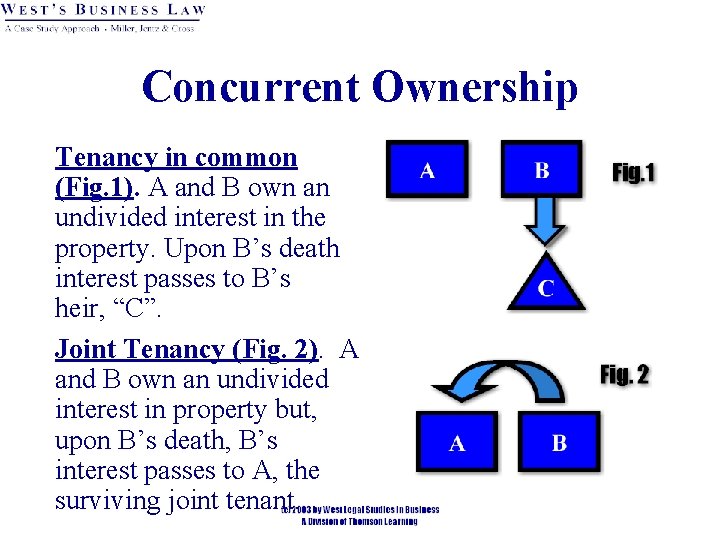
Concurrent Ownership Tenancy in common (Fig. 1). A and B own an undivided interest in the property. Upon B’s death interest passes to B’s heir, “C”. Joint Tenancy (Fig. 2). A and B own an undivided interest in property but, upon B’s death, B’s interest passes to A, the surviving joint tenant.
![Concurrent Ownership [2] Tenancy by the Entirety (not common) üUsually between husband wife. Community](http://slidetodoc.com/presentation_image_h/1d14864d9b5b834533b7116163b3bc3d/image-9.jpg "Concurrent Ownership [2] Tenancy by the Entirety (not common) üUsually between husband wife. Community")
Concurrent Ownership [2] Tenancy by the Entirety (not common) üUsually between husband wife. Community Property (limited # of states) üProperty acquired by couple during their marriage is owned as an undivided ½ interest in property (real and personal).
§ 4: Acquiring Ownership of Personal Property Personal property can be acquired through: üPossession. üProduction. üGift. üWill or Inheritance. üAccession. üConfusion.
Possession Capture of wild animals (wild animals belong to no one). Finding of abandoned property. Adverse Possession.
Production Writers, inventors, manufacturers, and others who produce personal property acquire title to it.
Gifts Voluntary transfer of property ownership from Donor (owner) to Donee (recipient) for no consideration. Three types üIntervivos—while onor is living. üCausa Mortis: -- made by donor in contemplation of imminent death. üTestamentary – after death, by will/inheritance.
![Gifts [2] Three requirements for valid gift: üDelivery—actual or “constructive” (symbolic, such as keys](http://slidetodoc.com/presentation_image_h/1d14864d9b5b834533b7116163b3bc3d/image-14.jpg "Gifts [2] Three requirements for valid gift: üDelivery—actual or “constructive” (symbolic, such as keys")
Gifts [2] Three requirements for valid gift: üDelivery—actual or “constructive” (symbolic, such as keys to car). • Donor must give up complete control or dominion. Delivery by a 3 rd party is OK. üDonative intent on the part of the donor üAcceptance by the Donee.
Accession “Something added. ” Someone adds value to a piece of personal property by use of either labor or materials. With owner’s consent. Without owner’s consent.
Confusion Commingling so that a person’s personal property cannot be distinguished from another’s. Fungible goods consists of identical particles such as oil or grain. • Commingled in bad faith. • Commingled in good faith.
§ 5: Mislaid, Lost or Abandoned Property Mislaid Property: Voluntary placed somewhere, then inadvertently forgotten. Finder is steward for true owner. Lost Property: Involuntarily left. Property owner acquires title against whole world, except for true owner. Finder should return to true owner or be liable for conversion. Abandoned Property: Discarded by true owner with no intention of recovering. Acquires title against all the world, including the original owner.
§ 6: Bailments A bailment is formed by the delivery of personal property, without transfer of title, by one person (Bailor) to another (Bailee), usually under an agreement for a particular purpose. The property must be returned by the Bailee to the Bailor, or a third party as directed by the Bailor, in the same or better condition.
Elements of a Bailment Personal Property. (Tangible or Intangible --but not persons or realty. ) Delivery of Possession. üBailee given exclusive control or possession. üMay be actual or constructive. üBailee must knowingly accept (Bailee must intend to exercise control over chattel). Bailment Agreement. üExpress or Implied.
§ 7: Ordinary Bailments Bailment for the sole benefit of the Bailor: üA gratuitous Bailment; Bailee owes Bailor a low duty of care, liable only for gross negligence. Bailment for the sole benefit of the Bailee: üBailee owes Bailor a high duty of care and is liable for even slight negligence. Mutual Benefit Bailment: most common. üEach party owes the other a reasonable duty of care.
Rights and Duties of the Bailee Right To Possess: Bailee may acquire or use property temporarily. Title does not pass. Right to Use Bailed Property. Rights of Compensation: Reimbursed for costs or services as provided in the agreement. Right to Limit Liability. Duty to Return bailed property in same condition to Bailor. Bailee may liable for conversion and/or negligence.
Rights and Duties of the Bailor Right to have property protected and used as agreed. Right to have property back at end of bailment with service or repair done properly. Right to have the Bailee not convert. Right to not be bound to limitation of liability unless Bailor knows. Duty to Provide safe goods: üMutual Benefit Bailment: free from known or hidden defects; Sole Benefit of Bailee: notify if any known defect.
Termination of Bailments Mutual agreement of both parties. Demand by either party. Completion of the purpose of the bailment. Act by the bailee that is inconsistent with the terms of the bailment. Operation of law.
§ 8: Special Types of Bailments Documents of Title and Article 7. Negotiability of Documents of Title. üPossessor of document is entitled to receive, hold, and dispose of the document and the goods it covers. üA good faith purchaser of the document may acquire a greater right to the document and goods it covers than the transferor had.
Common Carriers Publicly licenses to provide transportation services to general public. Common Carriers are strictly liable for damages except if the damages caused by: üAn act of God. üAn act of the public enemy. üAn order of the public authority. üAn act of the shipper. üThe inherent nature of the goods. Shipper’s loss. Connecting Carriers.
Warehouses and Innkeepers Warehouses: üOwe duty of reasonable care. üCan’t exculpate, can limit. Innkeepers: üOwe duty of strict liability, modified by state statutes; if innkeeper provides safe and notifies guests. üIf parking area provided and innkeeper accepts bailment, then may be liable.
Case 46. 1: In Re Sand & Sage Farm (Fixtures) FACTS: üArdery bought an eighty-acre tract of land (Sand Sage Farm) that contained an eight-tower center-pivot irrigation system, consisting of an underground well and pump connected to a pipe that ran to the pivot where the water line was attached to a further system of pipes and sprinklers suspended from the towers, extending over the land in a circular fashion. üThe system’s engine and gear head were bolted to a concrete slab above the pump and well, and attached to the pipe.
Case 46. 1: In Re Sand & Sage Farm (Fixtures) FACTS (cont’d) üThe Arderys granted to Farmers State Bank a mortgage that covered “all buildings, improvements, and fixtures. ” üSand & Sage Farm granted Ag Svcs. a security interest in the farm’s “equipment. ” Nothing in the security agreement or financing statement referred to fixtures. üWhen the Arderys and Sand & Sage filed for bankruptcy and asked for permission to sell the land, with the irrigation system, to Bohn Enterprises, Ag Services claimed that it had priority to the proceeds covering the value of the irrigation system. The bank responded that it had priority because the system was a “fixture. ”
Case 46. 1: In Re Sand & Sage Farm (Fixtures) HELD: FOR BANK. IRRIGATION SYSTEM WAS A FIXTURE. üFactors to consider to determine whether personal property attached to land is a fixture depends on “(i) how firmly the goods are attached or the ease of their removal (annexation); (ii) the relationship of the parties involved (intent); and (iii) how operation of the goods is related to the use of the land (adaptation). üIntent is the controlling factor.
Case 46. 2: In Re Estate of Piper (Gifts) FACTS: üFor eight years preceding Piper’s death, Kauffman took Piper to the doctor, beauty shop, and grocery store; wrote her checks to pay her bills; and helped care for her home. üGladys died intestate. Among her other property were two diamond rings. Clara filed a claim in a Missouri state court against the estate, maintaining that Gladys had promised the rings as a gift to her. The trial court awarded her the rings. Gladys’s heirs and the administrator of her estate appealed.
Case 46. 2: In Re Estate of Piper (Gifts) HELD: FOR CHILDREN. NO GIFT. üThe appellate court reversed, ruling that no effective gift of the rings had been made because Gladys had never delivered them to Clara. üThe expression of a desire to give does not constitute a gift unless the intention is executed by a complete and unconditional delivery of the subject matter or delivery of a proper written instrument evidencing a gift.
Case 46. 3: Sea Hunt v. Unidentified Shipwrecked Vessel (Mislaid, Lost or Abandoned Property) FACTS: üIn 1750, La Galga sank in a hurricane off the coast of the Virginia. In 1802, Juno sank in a storm off the Virginia coast. üThe Virginia Marine Resources Commission granted Sea Hunt, Inc. , a maritime salvage company, permits to explore for shipwrecks off the Virginia coast and conduct salvage operations. üSea Hunt found the remains of La Galga and Juno. Virginia sued for ownership under the Abandoned Shipwreck Act of 1987 (ASA).
Case 46. 3: Sea Hunt v. Unidentified Shipwrecked Vessel (Mislaid, Lost or Abandoned Property) HELD: AGAINST SEAHUNT. THE WRECKS WERE NOT ABANDONED. üThe Fourth Circuit ruled that the ships were not abandoned and therefore did not belong to Virginia. üThe court explained that “for Virginia to acquire title to the shipwrecks and to issue salvage permits to Sea Hunt, these vessels must have been abandoned by Spain. üThe court concluded, however, that “[a]n owner who comes forward has definitely indicated his claim of possession, and in such a case abandonment cannot be implied. ”
Case 46. 4: Lembaga v. Cace Trucking (Duties of a Bailee) FACTS: üCace picked up shipment containers for Lembaga, stored them in its warehouse, and delivered them. üOne afternoon, Cace picked up two containers of perfume. While the first container was brought into the warehouse and unloaded, the second container disappeared. Part of a broken lock was found where the container had been. üLembaga sued Cace, alleging negligence and conversion.
Case 46. 4: Lembaga v. Cace Trucking (Duties of a Bailee) HELD: FOR LEMBAGA. üProof of damage to or loss of goods while in the custody of a bailee gives rise to a presumption of conversion by the bailee. üThe bailee may rebut the presumption by proof that the bailee did not intentionally or negligently convert the goods and that it was not negligent in preventing third parties from causing the loss or damage. ”
- Slides: 35