
CHAPTER 44 NUTRITION SCIENTIFIC KNOWLEDGE BASE NUTRIENTS Carbohydrates
CHAPTER 44 NUTRITION
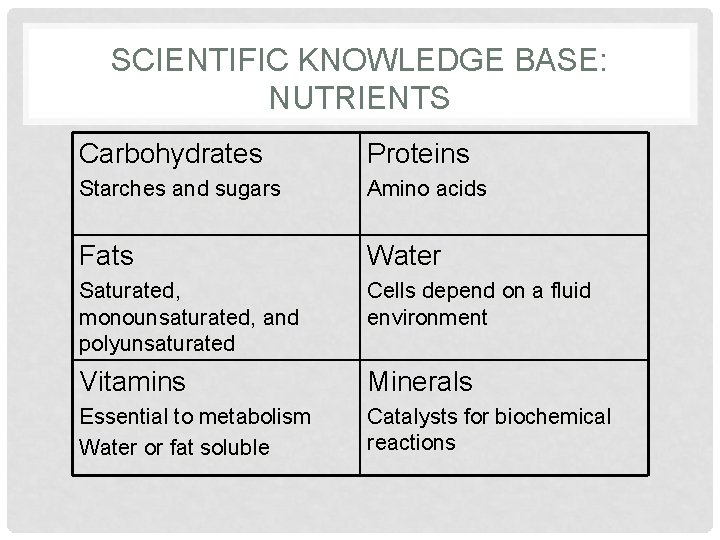
SCIENTIFIC KNOWLEDGE BASE: NUTRIENTS Carbohydrates Proteins Starches and sugars Amino acids Fats Water Saturated, monounsaturated, and polyunsaturated Cells depend on a fluid environment Vitamins Minerals Essential to metabolism Water or fat soluble Catalysts for biochemical reactions
KNOWLEDGE BASE • Carbohydrates (CHO) • • Main source of energy (should be primary source of energy) Carbs are starches & sugars Obtained primarily from plant foods except for lactose Each gram porduces 4 Kcal & serves as the main energy source of fuel (energy) for: • the brain & skeletal muscles during exercise • Erythrocytes & leukocytes production • Cell function of the renal medulla • Simple carbohydrates • Complex carbohydrates • Fiber
KNOWLEDGE BASE • Proteins • Provide source of energy at 4 kcal/g • Used for synthesis (building) of body tissue growth, maintenance and repair • Also used for blood clotting, fluid regulations and acid-base balance & providing positive nitrogen balance • Proteins are amino acids (simplest form of protein) • Complete proteins are ones that contain all essential amino acids needed to support growth and a positive nitrogen balance. • Food ex: fish, chicken, soybean, turkey & cheese • Incomplete proteins – does not contain all essential amino acids • Food ex: cereals, peanuts, legumes (beans or peas) & vegetables. • peas & beans are good protein choices for limited budgets
KNOWLEDGE BASE • Nitrogen Balance • When one has equal intake & output of nitrogen. • Positive Nitrogen Balance If intake is greater than output, then there is a positive nitrogen balance Positive balance is needed for growth, normal pregnancy, maintenance of muscle mass & vital organs and wound healing. • Negative Nitrogen Balance • Negative balance occurs when the body looses more nitrogen than body gains. • Occurs with infection, sepsis, burns, fever, starvation, head injury and trauma
KNOWLEDGE BASE • Fats (Lipids) • • • Provides energy at 9 kcal/kg Most calorie dene nutrients Composed of fatty acids & triglycerides Saturated Monosaturated Polyunsaturated
FOOD SOURCES FOR LIPIDS • Present in animal and plant foods • Animal foods: • • Meat: Richest source of fats Milk and cream; butter; cheeses Egg yolks Fatty fish: tuna, salmon • Plant foods: • Oils: richest sources; e. g. sunflower, safflower, sesame seeds; corn; peanuts; soybeans; olives • Coconut; cocoa butter; avocados, nuts 7
KNOWLEDGE BASE • Water • Makes up 60 -70% of total body weight • Increased need for water with fever, GI illnesses • Decreased need with renal disease
KNOWLEDGE BASE • Vitamins • Organic substance present in small amounts in food • Essential to normal metabolism • Some vitamins are being reviewed for role as antioxidents & believed to neutralize free radicals (which can cause disease & cancer) • Vitamins believed to have oxidative effects are: • beta caroten (spinish, carrots, sweet potatoes • Vitamins A, C, & E
KNOWLEDGE BASE • Fat Soluble Vitamins • • A, D, E, K Stored in fatty compartments of the body Available in diet except for Vit D Vitamins incorporated with absorbed fat and transported by chylomicrons • Best absorbed when eaten with fat • May be stored for long periods • Water Soluble Vitamins • C & B complex • Available in dietary intake & absorbed in the GI tract • Not stored • Hypervitaminosis • Too much intake of vitamins. • Minerals • Inorganic elements needed for biochemical reactions in body.
FAT-SOLUBLE VITAMINS: VITAMIN A (RETINOL) • ***Functions • Vision • Tissue strength and immunity • Growth • Food sources • foods fish liver oils, liver, egg yolk, butter, and cream 11
BETA CARTENE • Pro vitamin A – is a pigment in yellow, orange, and deep green vegetables, that the body converts to retinol. 12
VITAMIN D (CHOLECALCIFEROL) • Functions • Absorption of calcium and phosphorus • Bone mineralization • Requirements (if exposed to sun may not need supplement) • Food sources • Milk & dairy products, yeast, fish loils 13
VITAMIN E (TOCOPHEROL) • Functions • Antioxidant function • Relation to selenium metabolism • Food sources • wheat germ, soybean, sunflower oil fortified cereals, avocado 14
VITAMIN K • Functions • Blood clotting • Bone development • Food sources • Broccoli, Brussels sprouts, Kale, Mustard greens, spinach and turnip greens. 15
WATER-SOLUBLE VITAMINS: VITAMIN C (ASCORBIC ACID) • Functions • Connective tissue • General body metabolism • Antioxidant function • Food sources –green pepper, hot chili, kiwi, lemon juice, orange juice, papaya, and strawberries. 16
THIAMIN (VITAMIN B 1) • Functions • Gastrointestinal system • Nervous system • Cardiovascular system • Food sources- bread, cereals, pasta, rice, ham, pork loin, 17
RIBOFLAVIN (VITAMIN B 2) • Functions • Energy production • Tissue protein building • Food sources- beef liver, chicken liver, buttermilk, yogurt 18
NIACIN (VITAMIN B 3) • Functions • Energy metabolism • DNA repair • Food sources • cereals, beef liver, chicken, salmon, sirloin steak 19
VITAMIN B 6 (PYRIDOXINE) • Functions • Protein metabolism • Neurotransmitter • Food sources • grains, enriched cereal, liver and kidney and other meats. 20
FOLATE • Functions • Converted to tetrahydrofolate, which aids in: • DNA synthesis • Regulation of blood homocysteine levels • Food sources green leafy vegetables, orange juice, dried beans, and liver. 21
COBALAMIN (VITAMIN B 12) • Functions • Regulation of blood homocysteine levels • Heme synthesis • Nervous system functioning • Food sources ( animal products) • beef and chicken liver, lean meat, calms, oysters, and crab 22
BIOTIN • Functions • Coenzyme for carboxylases • Food sources • Liver, egg yolk, soy flour, cereals (except bound forms in wheat), meats, tomatoes, and yeast 23
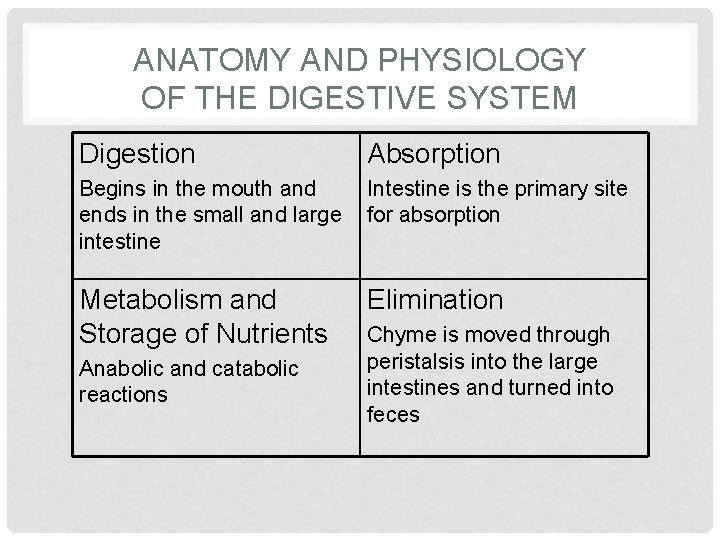
ANATOMY AND PHYSIOLOGY OF THE DIGESTIVE SYSTEM Digestion Absorption Begins in the mouth and ends in the small and large intestine Intestine is the primary site for absorption Metabolism and Storage of Nutrients Elimination Anabolic and catabolic reactions Chyme is moved through peristalsis into the large intestines and turned into feces
DIETARY GUIDELINES • Dietary reference intakes • Acceptable range of amounts of vitamins and minerals to avoid deficiencies for age and gender groups • Food guidelines • Food Pyramid Guide, basic guide for meal preparations • Figure 44 -2 • Daily values • Needed protein, vitamins, minerals, fats, cholesterol, carbohydrates, fiber, sodium, and potassium • Box 44 -2
NURSING KNOWLEDGE BASE: NUTRITION DURING HUMAN GROWTH AND DEVELOPMENT • • Infants through school age Adolescents Young and middle adults Older adults
ALTERNATIVE FOOD PATTERNS • Based on religion, cultural background, ethics, health beliefs, preference • 44 -3 • Vegetarian diet • Ovolactovegetarian • Avoid meat, fish & chicken but eat eggs & milk • Vegans • Eat brown rice, other grains, herb teas • Fruitarian • Eat only fruit, nuts, honey, olive oil
ASSESSMENT • Screening • Table 44 -2 (drug interactions) • Anthropometry • Compare height to weight (Ideal body weight) • BMI • • • Laboratory and biochemical tests (next slide) Dietary and health history Physical examination- Table 44 -4 Assessment questions: Table 44 -6 Sample Nutritional Assessments • Figure 44 -4 and Fig 44 -5
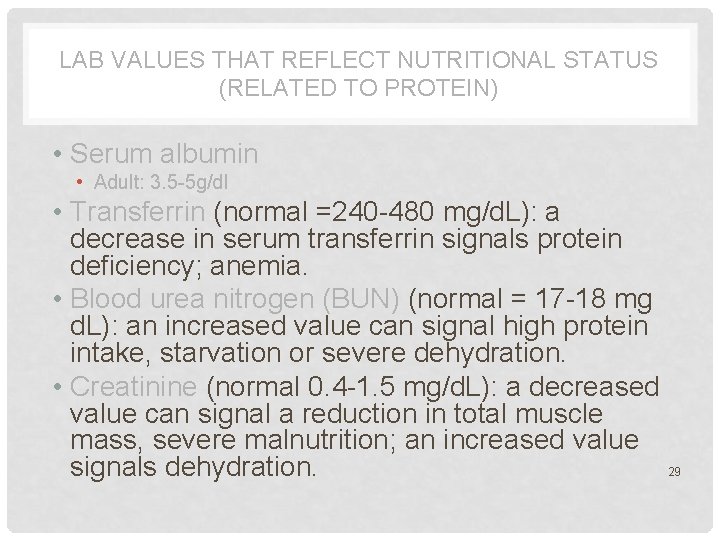
LAB VALUES THAT REFLECT NUTRITIONAL STATUS (RELATED TO PROTEIN) • Serum albumin • Adult: 3. 5 -5 g/dl • Transferrin (normal =240 -480 mg/d. L): a decrease in serum transferrin signals protein deficiency; anemia. • Blood urea nitrogen (BUN) (normal = 17 -18 mg d. L): an increased value can signal high protein intake, starvation or severe dehydration. • Creatinine (normal 0. 4 -1. 5 mg/d. L): a decreased value can signal a reduction in total muscle mass, severe malnutrition; an increased value signals dehydration. 29
NURSING DIAGNOSIS AND PLANNING • Selected from the NANDA-I–approved list after assessment • Planning outcomes and goals to assist client’s needs
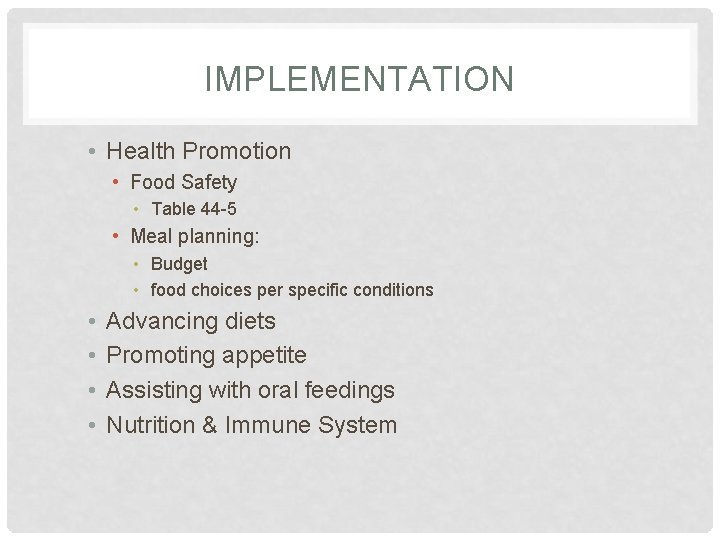
IMPLEMENTATION • Health Promotion • Food Safety • Table 44 -5 • Meal planning: • Budget • food choices per specific conditions • • Advancing diets Promoting appetite Assisting with oral feedings Nutrition & Immune System
MEDICAL NUTRITION THERAPY • Treatment used to treat certain stomach/intestinal diseases such as peptic ulcer disease and malabsorption syndromes
This work is licensed under a Creative Commons Attribution 4. 0 International License. Except where otherwise noted, this content by Southern Regional Technical College is licensed under the Creative Commons Attribution 4. 0 International License. To view a copy of this license, click https: //creativecommons. org/licenses/by/4. 0/ Healthcare Careers Work!(HCW) is sponsored by a $2. 3 million grant from the U. S. Department of Labor, Employment & Training Administration. TAACCCT Grant #TC- 26488 -14 -60 -A-13. Southern Regional Technical College is an equal opportunity employer and will make adaptive equipment available to persons with disabilities upon request. This workforce product was funded by a grant awarded by the U. S. Department of Labor’s Employment and Training Administration. The product was created by the grantee and does not necessarily reflect the official position of the U. S. Department of Labor. The U. S. Department of Labor makes no guarantees, warranties, or assurances of any kind, express or implied, with respect to such information, including any information on linked sites and including, but not limited to, accuracy of the information or its completeness, timeliness, usefulness, adequacy, continued availability, or ownership.
- Slides: 33