
Chapter 4 Workplace Emotions Attitudes and Stress Mc
- Slides: 35
Chapter 4 Workplace Emotions, Attitudes, and Stress Mc. Shane/Von Glinow OB 5 e 1 © 2010 The Mc. Graw-Hill Companies, Inc. All rights reserved
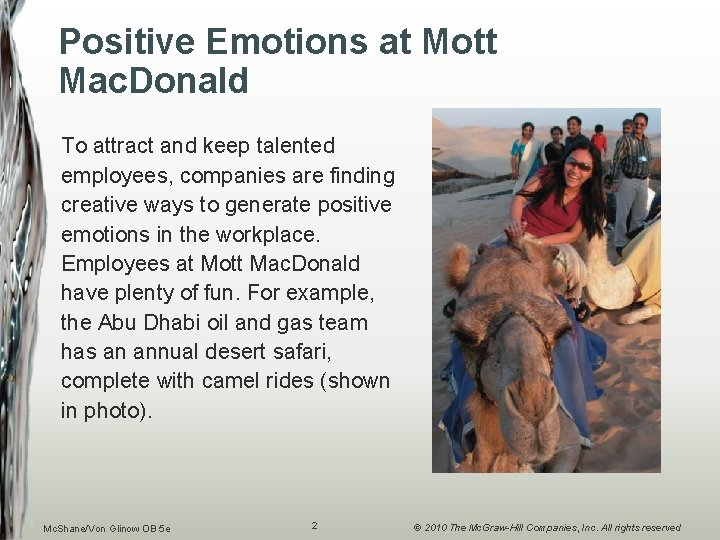
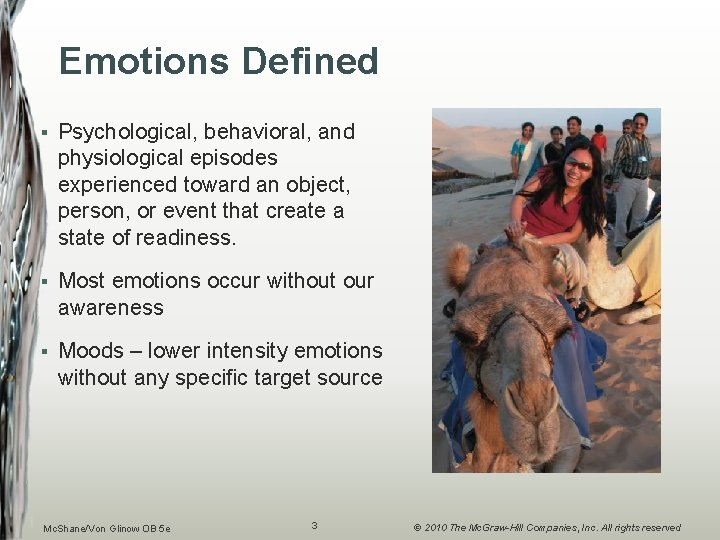
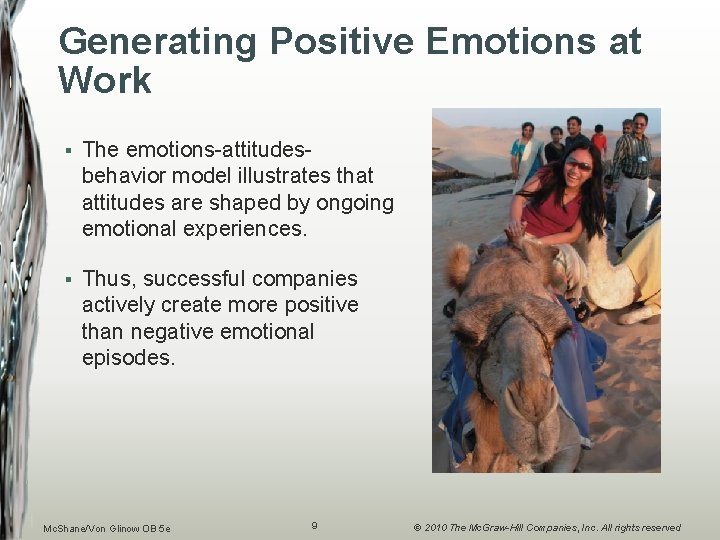
Positive Emotions at Mott Mac. Donald To attract and keep talented employees, companies are finding creative ways to generate positive emotions in the workplace. Employees at Mott Mac. Donald have plenty of fun. For example, the Abu Dhabi oil and gas team has an annual desert safari, complete with camel rides (shown in photo). Mc. Shane/Von Glinow OB 5 e 2 © 2010 The Mc. Graw-Hill Companies, Inc. All rights reserved
Emotions Defined § Psychological, behavioral, and physiological episodes experienced toward an object, person, or event that create a state of readiness. § Most emotions occur without our awareness § Moods – lower intensity emotions without any specific target source Mc. Shane/Von Glinow OB 5 e 3 © 2010 The Mc. Graw-Hill Companies, Inc. All rights reserved
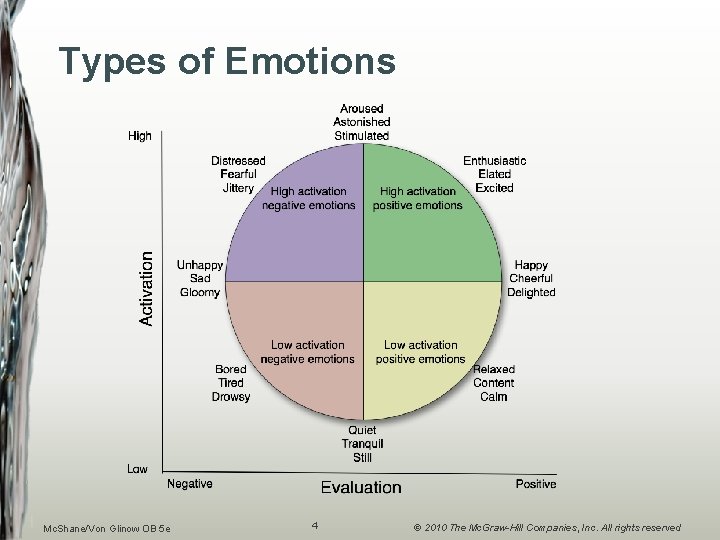
Types of Emotions Mc. Shane/Von Glinow OB 5 e 4 © 2010 The Mc. Graw-Hill Companies, Inc. All rights reserved
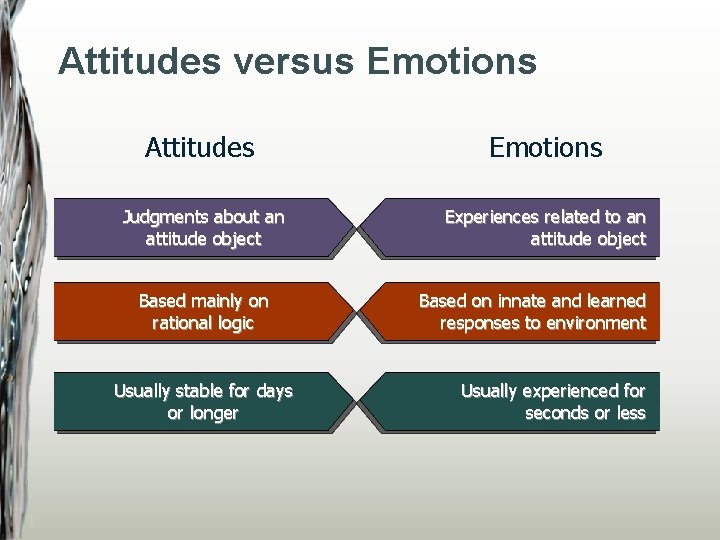
Attitudes versus Emotions Attitudes Emotions Judgments about an attitude object Experiences related to an attitude object Based mainly on rational logic Usually stable for days or longer Based on innate and learned responses to environment Usually experienced for seconds or less
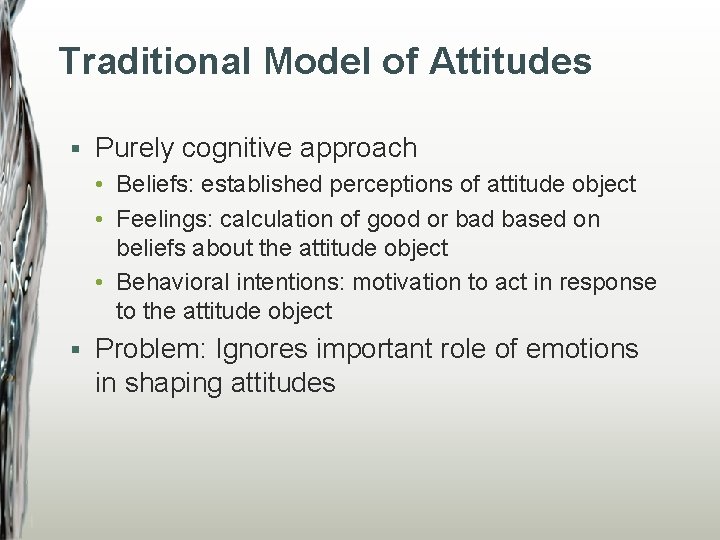
Traditional Model of Attitudes § Purely cognitive approach • Beliefs: established perceptions of attitude object • Feelings: calculation of good or bad based on beliefs about the attitude object • Behavioral intentions: motivation to act in response to the attitude object § Problem: Ignores important role of emotions in shaping attitudes
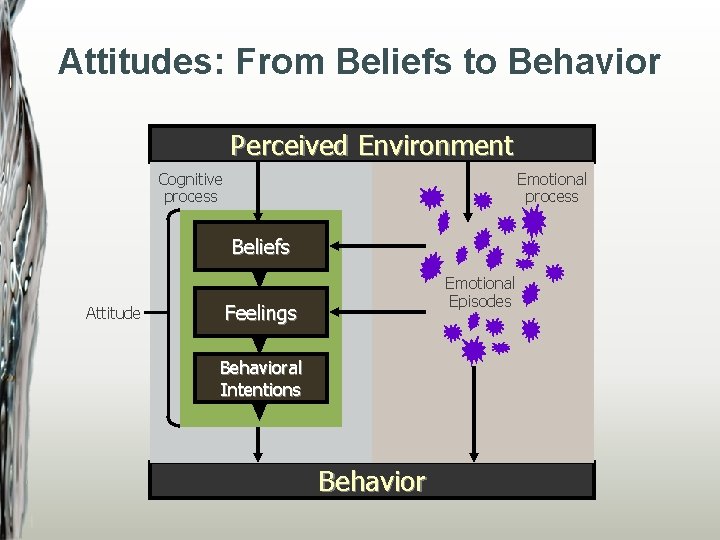
Attitudes: From Beliefs to Behavior Perceived Environment Cognitive process Emotional process Beliefs Attitude Emotional Episodes Feelings Behavioral Intentions Behavior
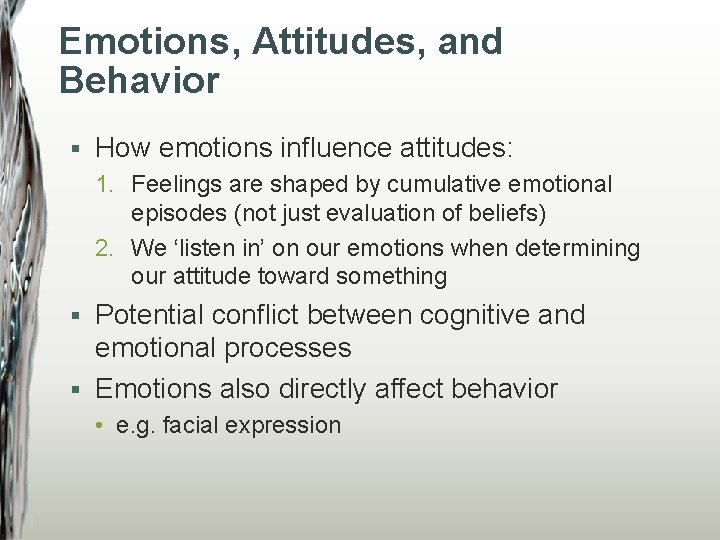
Emotions, Attitudes, and Behavior § How emotions influence attitudes: 1. Feelings are shaped by cumulative emotional episodes (not just evaluation of beliefs) 2. We ‘listen in’ on our emotions when determining our attitude toward something Potential conflict between cognitive and emotional processes § Emotions also directly affect behavior § • e. g. facial expression
Generating Positive Emotions at Work § The emotions-attitudesbehavior model illustrates that attitudes are shaped by ongoing emotional experiences. § Thus, successful companies actively create more positive than negative emotional episodes. Mc. Shane/Von Glinow OB 5 e 9 © 2010 The Mc. Graw-Hill Companies, Inc. All rights reserved
Cognitive Dissonance § A state of anxiety that occurs when an individual’s beliefs, feelings and behaviors are inconsistent with one another § Most common when behavior is: • known to others • done voluntarily • can’t be undone
Emotional Labor Defined Effort, planning and control needed to express organizationally desired emotions during interpersonal transactions. Emotional labor is higher when job requires: • frequent and long duration display of emotions • displaying a variety of emotions • displaying more intense emotions 11 Mc. Shane/Von Glinow OB 5 e © 2010 The Mc. Graw-Hill Companies, Inc. All rights reserved
Emotional Labor Across Cultures § Displaying or hiding emotions varies across cultures • Minimal emotional expression and monotonic voice in Korea, Japan, Austria • Encourage emotional expression in Kuwait, Egypt, Spain, Russia
Emotional Labor Challenges § Difficult to display expected emotions accurately, and to hide true emotions § Emotional dissonance • Conflict between true and required emotions • Potentially stressful with surface acting • Less stress through deep acting
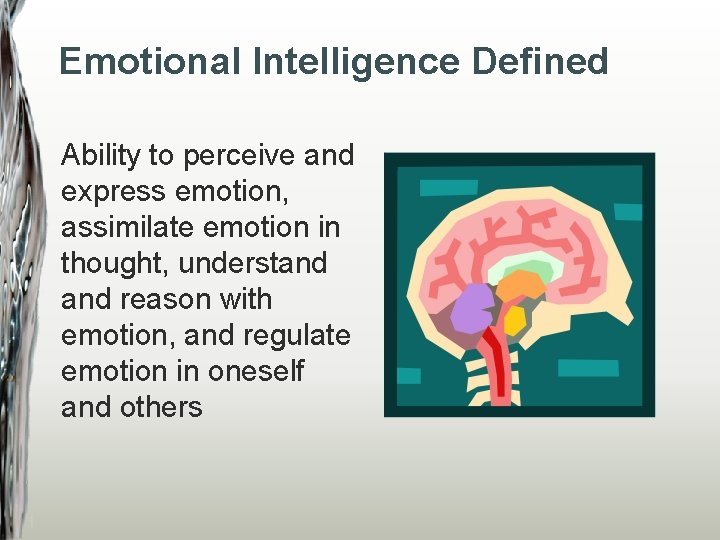
Emotional Intelligence Defined Ability to perceive and express emotion, assimilate emotion in thought, understand reason with emotion, and regulate emotion in oneself and others
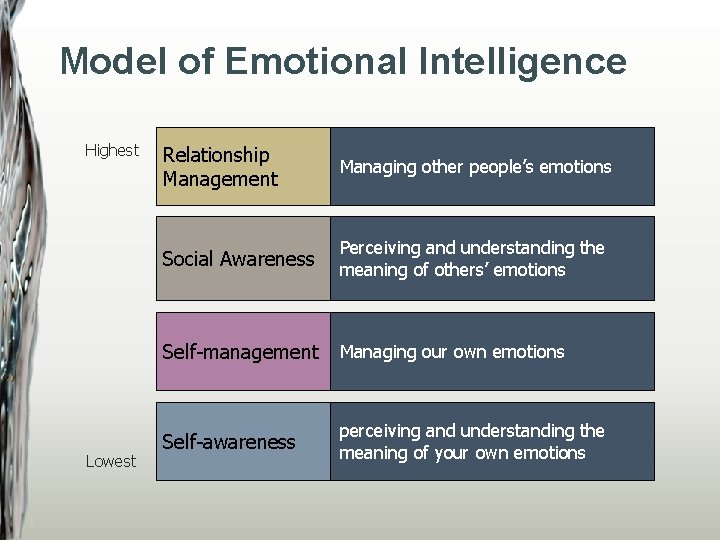
Model of Emotional Intelligence Highest Lowest Relationship Management Managing other people’s emotions Social Awareness Perceiving and understanding the meaning of others’ emotions Self-management Managing our own emotions Self-awareness perceiving and understanding the meaning of your own emotions
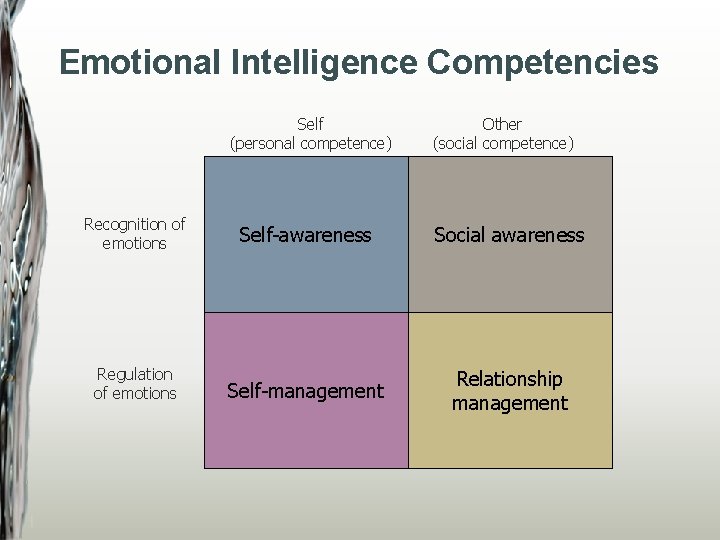
Emotional Intelligence Competencies Self (personal competence) Other (social competence) Recognition of emotions Self-awareness Social awareness Regulation of emotions Self-management Relationship management
Improving Emotional Intelligence § Emotional intelligence is a set of competencies (aptitudes, skills) § Can be learned, especially through coaching § EI increases with age -- maturity
Job Satisfaction A person's evaluation of his or her job and work context § A collection of attitudes about specific facets of the job §
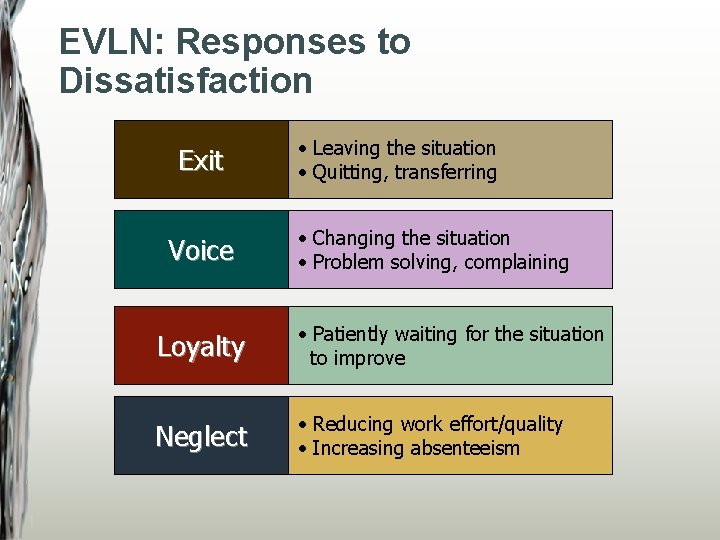
EVLN: Responses to Dissatisfaction Exit Voice • Leaving the situation • Quitting, transferring • Changing the situation • Problem solving, complaining Loyalty • Patiently waiting for the situation to improve Neglect • Reducing work effort/quality • Increasing absenteeism
Job Satisfaction and Performance Happy workers are somewhat more productive workers, but: 1. General attitude is a poor predictor of specific behaviors 2. Job performance affects satisfaction only when rewarded 3. Effect on performance strongest in complex jobs because of greater employee influence on job performance (e. g. limited in assembly lines)
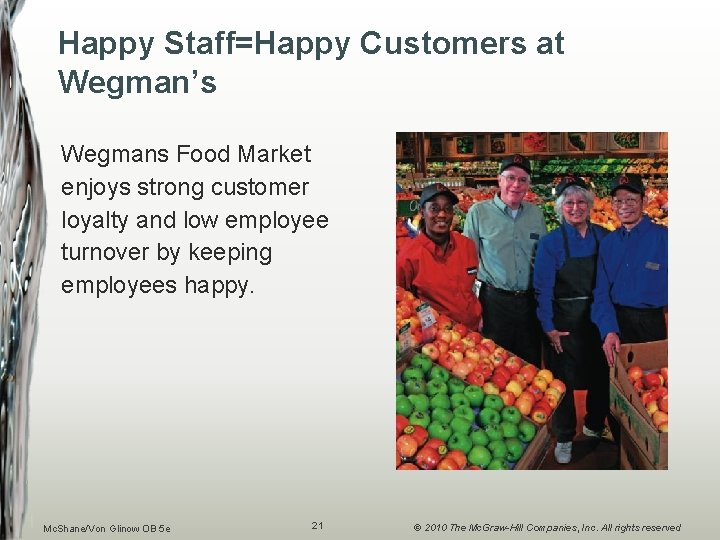
Happy Staff=Happy Customers at Wegman’s Wegmans Food Market enjoys strong customer loyalty and low employee turnover by keeping employees happy. Mc. Shane/Von Glinow OB 5 e 21 © 2010 The Mc. Graw-Hill Companies, Inc. All rights reserved
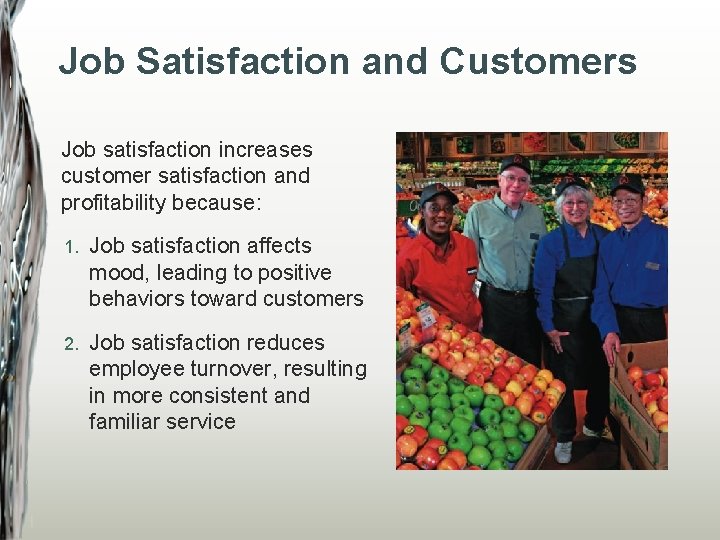
Job Satisfaction and Customers Job satisfaction increases customer satisfaction and profitability because: 1. Job satisfaction affects mood, leading to positive behaviors toward customers 2. Job satisfaction reduces employee turnover, resulting in more consistent and familiar service
Organizational Commitment § Affective commitment • Emotional attachment to, identification with, and involvement in an organization § Continuance commitment • Calculative attachment – stay because too costly to quit
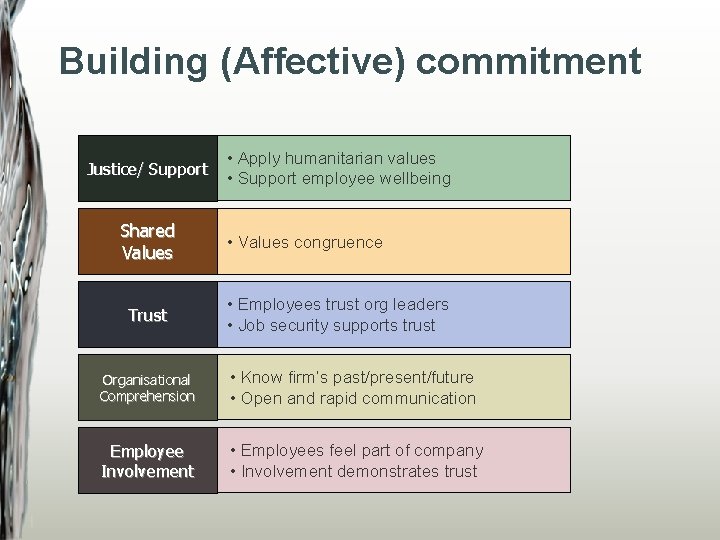
Building (Affective) commitment Justice/ Support Shared Values Trust • Apply humanitarian values • Support employee wellbeing • Values congruence • Employees trust org leaders • Job security supports trust Organisational Comprehension • Know firm’s past/present/future • Open and rapid communication Employee Involvement • Employees feel part of company • Involvement demonstrates trust
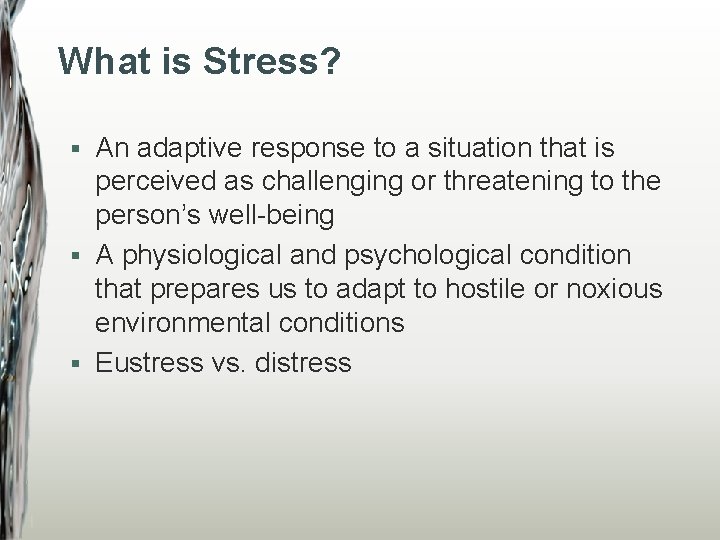
What is Stress? An adaptive response to a situation that is perceived as challenging or threatening to the person’s well-being § A physiological and psychological condition that prepares us to adapt to hostile or noxious environmental conditions § Eustress vs. distress §
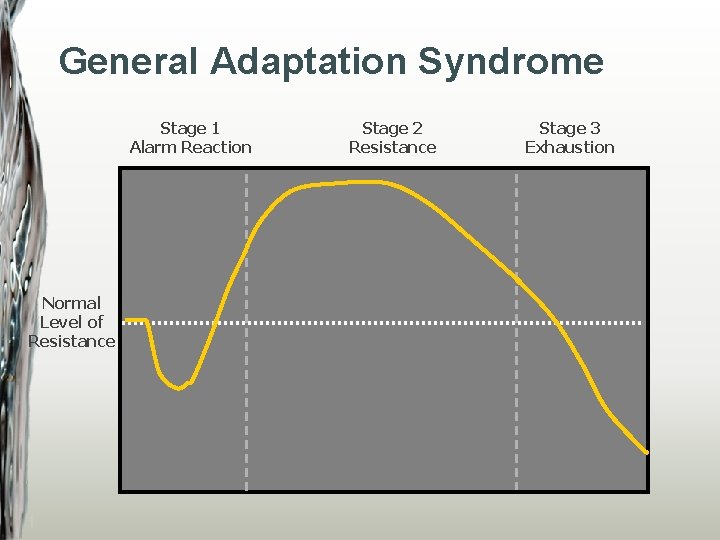
General Adaptation Syndrome Stage 1 Alarm Reaction Normal Level of Resistance Stage 2 Resistance Stage 3 Exhaustion
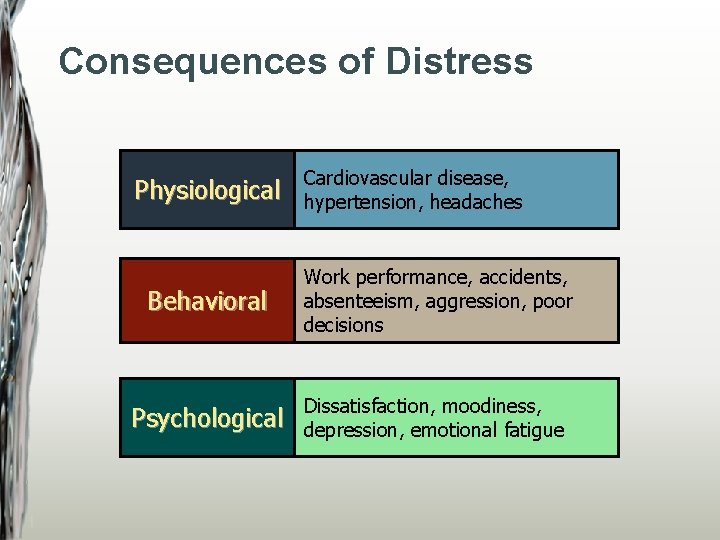
Consequences of Distress Physiological Cardiovascular disease, hypertension, headaches Behavioral Work performance, accidents, absenteeism, aggression, poor decisions Psychological Dissatisfaction, moodiness, depression, emotional fatigue
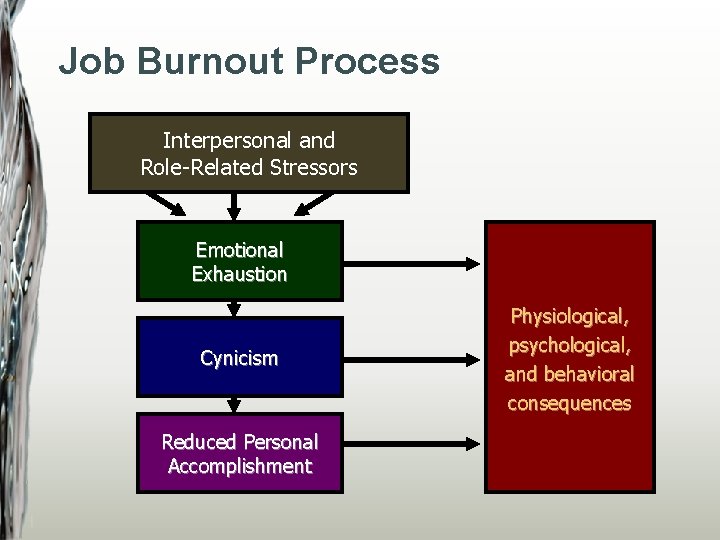
Job Burnout Process Interpersonal and Role-Related Stressors Emotional Exhaustion Cynicism Reduced Personal Accomplishment Physiological, psychological, and behavioral consequences
What are Stressors? Stressors are the causes of stress -- any environmental condition that places a physical or emotional demand on the person. § Some common workplace stressors include: § • Harassment an incivility • Work overload • Low task control
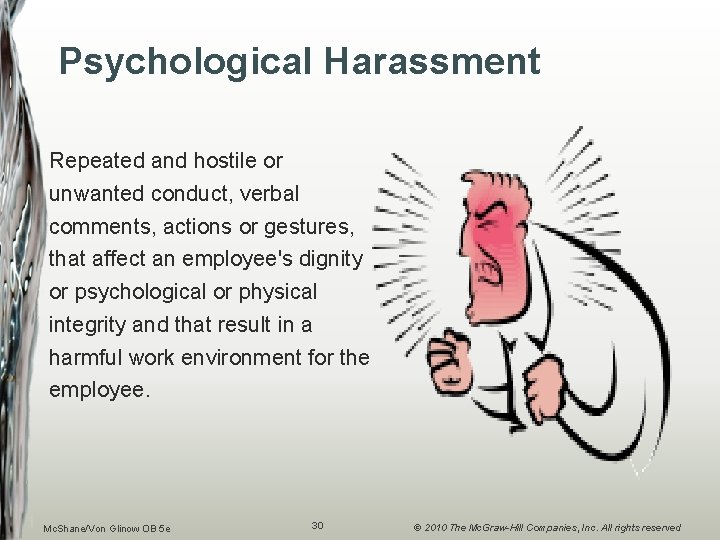
Psychological Harassment Repeated and hostile or unwanted conduct, verbal comments, actions or gestures, that affect an employee's dignity or psychological or physical integrity and that result in a harmful work environment for the employee. Mc. Shane/Von Glinow OB 5 e 30 © 2010 The Mc. Graw-Hill Companies, Inc. All rights reserved
Sexual Harassment § Unwelcome conduct -- detrimental effect on work environment or job performance § Quid pro quo • employment or job performance is conditional on unwanted sexual relations § Hostile work environment • an intimidating, hostile, or offensive working environment
Work Overload and Task Control Stressors § Work Overload Stressor • Working more hours, more intensely than one can cope • Affected by globalization, consumerism, ideal worker norm § Task Control Stressor • Due to lack control over how and when tasks are performed • Stress increases with responsibility
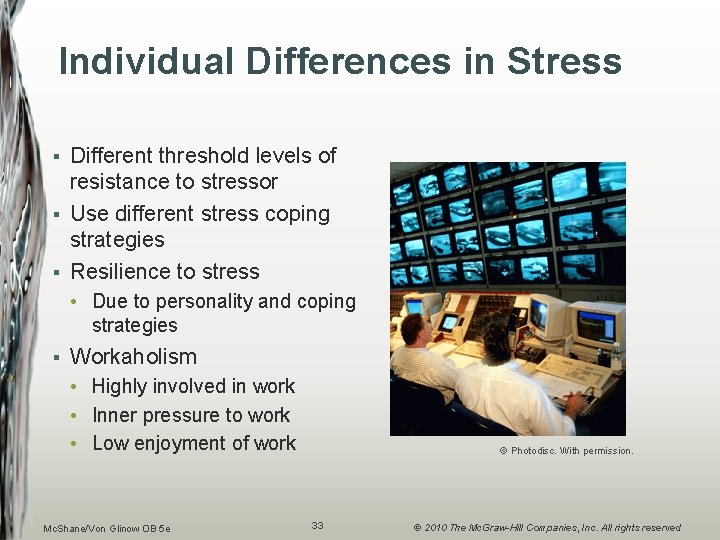
Individual Differences in Stress Different threshold levels of resistance to stressor § Use different stress coping strategies § Resilience to stress § • Due to personality and coping strategies § Workaholism • Highly involved in work • Inner pressure to work • Low enjoyment of work Mc. Shane/Von Glinow OB 5 e © Photodisc. With permission. 33 © 2010 The Mc. Graw-Hill Companies, Inc. All rights reserved
Managing Work-Related Stress § Remove the stressor • Minimize/remove stressors § Withdraw from the stressor • Vacation, rest breaks § Change stress perceptions • Positive self-concept, humor § Control stress consequences • Healthy lifestyle, fitness, wellness § Receive social support
Chapter 4 Workplace Emotions, Attitudes, and Stress Mc. Shane/Von Glinow OB 5 e 35 © 2010 The Mc. Graw-Hill Companies, Inc. All rights reserved