
Chapter 4 Voice Communications Public Switched Telephone Network
Chapter 4 Voice Communications • Public Switched Telephone Network or Plain Old Telephone Service (POTS) • Private Telephone Systems • Computer Telephone Integration • Wireless Communication • Voice Transmission alternatives
Public Switched Telephone Network • • • Central office Lines Voice digitization Numbering Services
Telephone Set • Transmitter – Analog signal • Receiver – Sidetone • Switchhook – On-hook and off-hook • Dialing – Rotary dial – Dual-tone-multifrequency (DTMF) or touch tone • Ringing – Call setup time

Central Office • Equipment – Manual switching – Electromechanical switching – Electronic switching • • Reliable One total failure in 40 years Quite & efficient Less Labor costs with higher skill levels • Functions – AT & T dynamic non hierarchical routing (DNHR) • direct, redundancy, and alternate routing • Maximum 4 toll office
Central Office Hierarchy • • • Class 5: local central office Tandem office Class 4: toll center Class 3: primary center Class 2: sectional center Class 1 regional center
Inter Office Signaling • Special network between central offices to set up telephone calls • Common channel interoffice signaling system (CCIS) by CCITT • Signaling system No. 7 (SS 7) By CCITT – Advanced intelligent network (AIN) – Software-defined network (SDN) – Calling number identification
Lines • • • Local loop (pair of copper wires: tip and ring) Drop wire Distribution cable Feeder cable Trunk – – Copper wire Coaxial cable Microwave radio Fiber optic cable • Internet line usage problem
Voice Digitization • Analog signals to digital signals (8000 samples/ sec) • Equipment – coder/decoder or codec (signal conversion) – Channel (signal conversion & loading into T-1) • Methods – Pulse amplitude modulation (PAM) – Pulse duration modulation (PDM) or pulse width modulaiton (PWM) – Pulse position modulation (PPM) – Pulse code modulation (PCM): most used with 256 possible amplitudes (2 to 8) – Adaptive differential pulse code modulation (ADPCM)
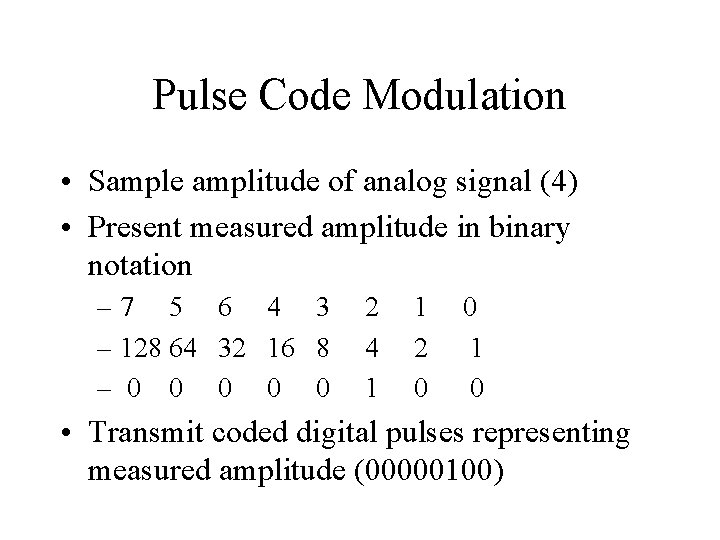
Pulse Code Modulation • Sample amplitude of analog signal (4) • Present measured amplitude in binary notation – 7 5 6 4 3 – 128 64 32 16 8 – 0 0 0 2 4 1 1 2 0 0 1 0 • Transmit coded digital pulses representing measured amplitude (00000100)
Voice Digitization Bandwidth • DS-0 with 64, 000 bits/sec • T-1 with 24 Ds-0 • Adaptive differential pulse code modulation (ADPCM) – Need half of bandwidth for PCM – Used for voice compression with less quality

Telephone Numbering • 9 geographic zones in the entire world • Composition – Access code, carrier’s code, – Zone and country code – Area/city code – Exchange code – Subscriber code
Telephone Services - I • Types of calls – Local calling – Long distance calls – International calls – Operator services
Telephone Services - II • Calling card calls • Discounted calls • 800 or 888 service – Geographic: interstate, intrastate, international (Universal International Freephone Numbering -UIFN) – Call direction: in, out, or both • 900 service
Telephone Services - III • • Software defined network (SDN) Foreign exchange (FX) lines Integrated Services Digital Network (ISDN) Selection criteria for telephone service – – – Time Duration Number Location Usage pattern (busy hour) 1 -5% (Blocking) grade service level
Private Telephone Systems • Key systems: 3 to 50 telephones • Private branch exchange (PBX) / private automatic branch exchange (PABX) / computer branch exchange (CBX): 50 to 10, 000 or more • Centrex
PBX System Feature • • • Automatic Call Distribution (ACD) Data communication Direct inward dialing (DID) Hunt group (alternative trunks) Least cost routing Paging Pick-up group Prioritization Night mode Station message detail recording/call detail recording (SMDR)/(CDR) • Voice messaging
PBX Station Feature • • • Automatic redial Automatic reminder Call forward Call transfer Call waiting Camp on (call back) Conference calls Distinctive ringing Do not disturb Speed dialing
PBX Data/Voice Integration • • ISDN support T-1 support Data Interfaces PBX-to-host interfaces
PBX Auxiliary Service • Automated attendant • Voice mail • Voice response units (VRUs) or interactive voice response • Voice processor same as VRU • Voice server • Music/ads on hold
PBX Security • Block remote access • Change access code and password • Block outgoing calls during off-hours
Selection Criteria of PBX • • Maintenance Training Other support Price System feature Station feature Security feature
PBX Trends • Multivendor interoperability standards • PBX integration with wireless phones • Mini-PBXs for home and small business
Centrex Service • Regulated by public utilities commission • PBX equipment in central office
Selection Criteria Between PBX and Centrex • • • Regulation Maintenance Reliability Growth Control Capital investment
Computer Telephone Integration (CTI) • Architectures • Functions • Application standard
CTI Architectures • PBX-to-host interfaces • Desktop to CTI • Client/server CTI
CTI Functions • • Call control (on- line directory, conference calls) Automated attendant Automated call distribution Audiotex Fax-on-demand Interactive voice response (IVR) Outbound dialing Unified messaging or universal in-box for voice mail, e-mail, faxes and paper messages
CTI LAN-based Application Standards & Tools • Standards – TSAPI (telephony services application program interface) by AT&T and Novell – TAPI (telephony application program interface) by Intel and Microsoft • Development tools – Visual Basic or Visual C++ – Graphical code generator, debugging tool, interfaces to other applications (fax, sound)
Wireless Communication - I • Cordless telephone • Cellular telephone service – Transmitting voice & data – Security • Eavesdropping • Spread spectrum • Accident
Wireless Communication - II • Personal communication service – personal communication network (PCN) / personal handyphone system (PHS) / personal communication service (PCS) – Communication levels • Macrocells - car • Microcells -walking • Picells - building • Marine and aeronautical telephone services – Radio communication
Voice Transmission Alternatives • • Internet - IP Frame relay Asynchronous transfer mode Others
Internet Telephone Calls • Facilities – Hardware – Software • • Benefits Problems Impacts (industry & regulation) Future
Frame Relay • Problems – Variable-length frames – Delay • Frame relay access device (FRAD) – Voice prioritization – Data frame size limitation – Separate voice and data queues
Asynchronous Transfer Mode • Fixed-length frames (53 bytes cells) • Constant bit rate (not efficient) • Optimal methods – Voice compression – Silence compression – Variable bit rate (max: peak voice bit rate, min: guaranteed voice bit rate)
Others • Voice/data multiplexers via T-1 • Voice/data modem – Analog simultaneous voice and data: use switches – Digital simultaneous voice and data: digitize voice using analog line • ISDN BRI (basic rate interface) with two 64 -kbps channels

Assignment • Review chapters 1 -4 • Read chapter 5 • Prepare exam 1
- Slides: 36