
Chapter 4 Types of Chemical Reactions and Solution
- Slides: 28
Chapter 4 Types of Chemical Reactions and Solution Stiochiometry 1
Preview the contents of this chapter will introduce you to the following topics: Ø Water, Nature of aqueous solutions, types of electrolytes, and dilution Ø Types of chemical reactions: precipitation, acid base reactions and oxidation-reduction reaction Ø Stoichiometry of reactions and balancing the chemical equations 2
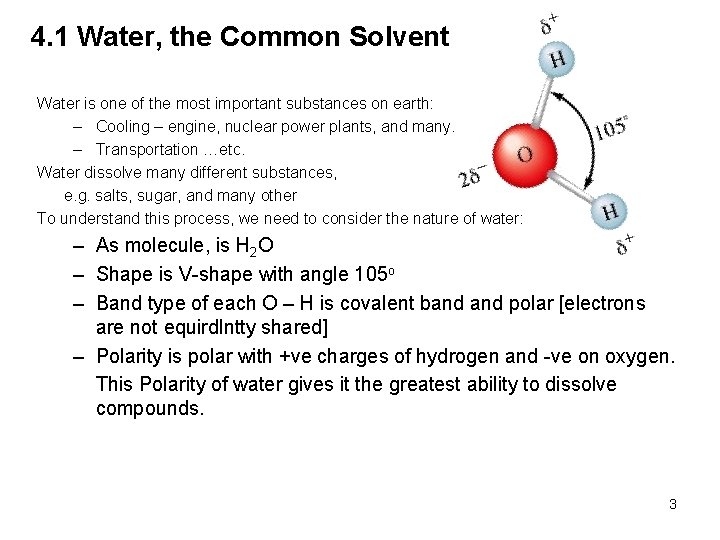
4. 1 Water, the Common Solvent Water is one of the most important substances on earth: – Cooling – engine, nuclear power plants, and many. – Transportation …etc. Water dissolve many different substances, e. g. salts, sugar, and many other To understand this process, we need to consider the nature of water: – As molecule, is H 2 O – Shape is V-shape with angle 105 o – Band type of each O – H is covalent band polar [electrons are not equirdlntty shared] – Polarity is polar with +ve charges of hydrogen and -ve on oxygen. This Polarity of water gives it the greatest ability to dissolve compounds. 3
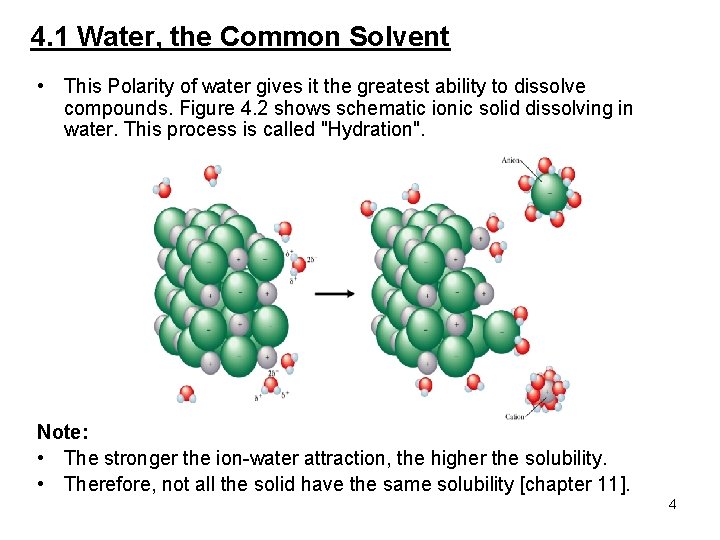
4. 1 Water, the Common Solvent • This Polarity of water gives it the greatest ability to dissolve compounds. Figure 4. 2 shows schematic ionic solid dissolving in water. This process is called "Hydration". Note: • The stronger the ion-water attraction, the higher the solubility. • Therefore, not all the solid have the same solubility [chapter 11]. 4
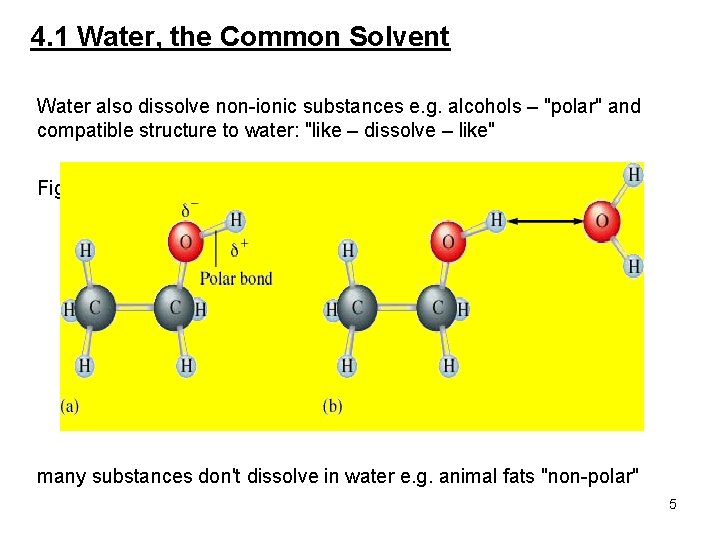
4. 1 Water, the Common Solvent Water also dissolve non-ionic substances e. g. alcohols – "polar" and compatible structure to water: "like – dissolve – like" Figure 4. 3 many substances don't dissolve in water e. g. animal fats "non-polar" 5
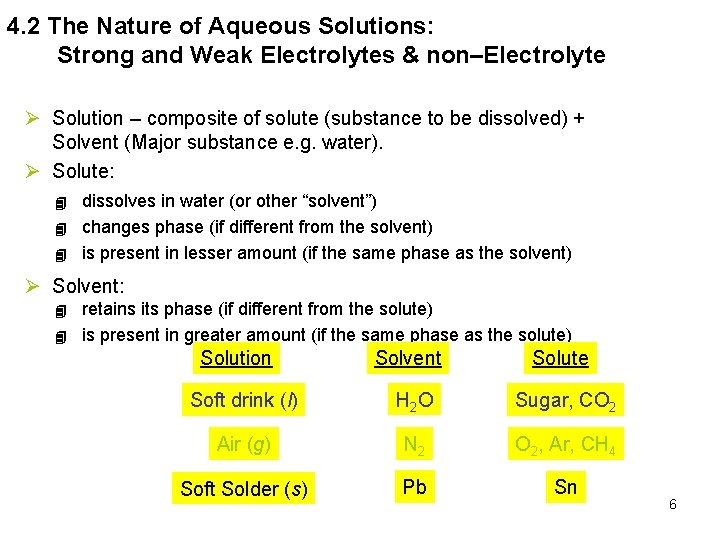
4. 2 The Nature of Aqueous Solutions: Strong and Weak Electrolytes & non–Electrolyte Ø Solution – composite of solute (substance to be dissolved) + Solvent (Major substance e. g. water). Ø Solute: 4 4 4 dissolves in water (or other “solvent”) changes phase (if different from the solvent) is present in lesser amount (if the same phase as the solvent) Ø Solvent: 4 4 retains its phase (if different from the solute) is present in greater amount (if the same phase as the solute) Solution Solvent Solute Soft drink (l) H 2 O Sugar, CO 2 Air (g) N 2 O 2, Ar, CH 4 Soft Solder (s) Pb Sn 6
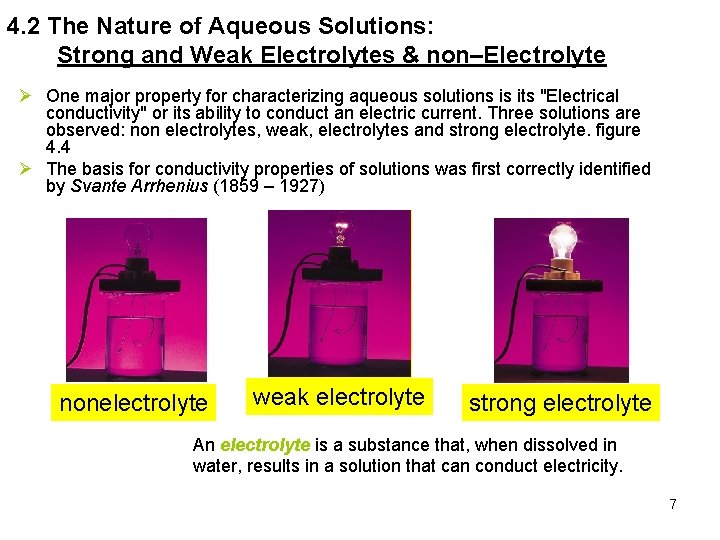
4. 2 The Nature of Aqueous Solutions: Strong and Weak Electrolytes & non–Electrolyte Ø One major property for characterizing aqueous solutions is its "Electrical conductivity" or its ability to conduct an electric current. Three solutions are observed: non electrolytes, weak, electrolytes and strong electrolyte. figure 4. 4 Ø The basis for conductivity properties of solutions was first correctly identified by Svante Arrhenius (1859 – 1927) nonelectrolyte weak electrolyte strong electrolyte An electrolyte is a substance that, when dissolved in water, results in a solution that can conduct electricity. 7
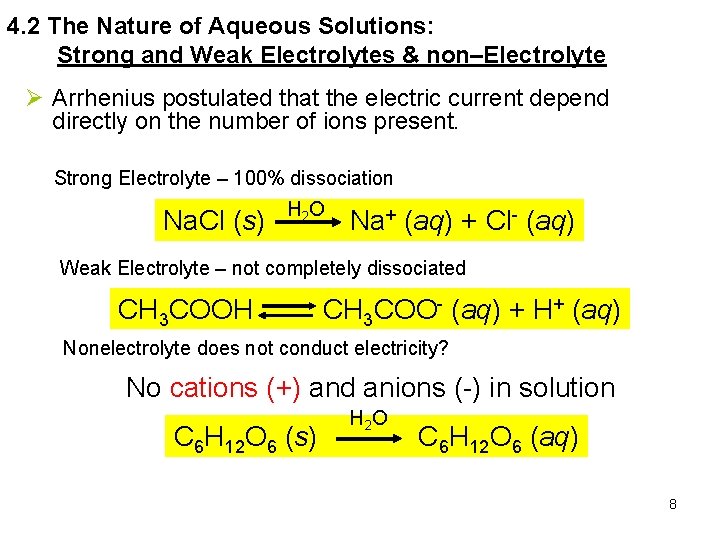
4. 2 The Nature of Aqueous Solutions: Strong and Weak Electrolytes & non–Electrolyte Ø Arrhenius postulated that the electric current depend directly on the number of ions present. Strong Electrolyte – 100% dissociation Na. Cl (s) H 2 O Na+ (aq) + Cl- (aq) Weak Electrolyte – not completely dissociated CH 3 COOH CH 3 COO- (aq) + H+ (aq) Nonelectrolyte does not conduct electricity? No cations (+) and anions (-) in solution C 6 H 12 O 6 (s) H 2 O C 6 H 12 O 6 (aq) 8
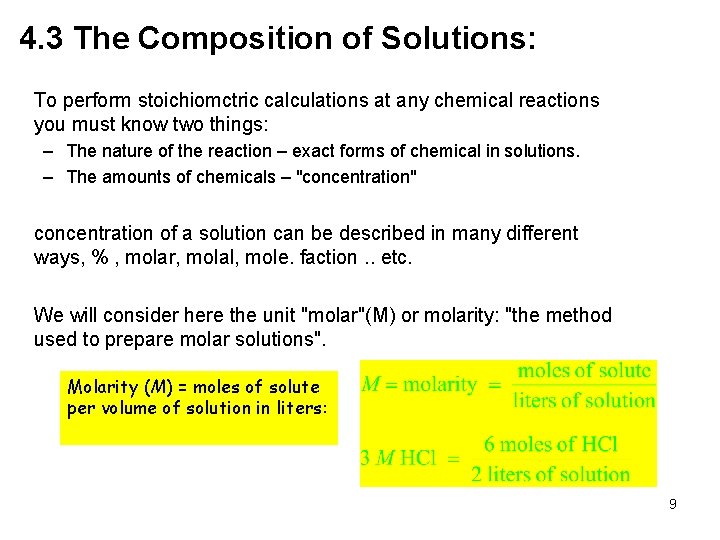
4. 3 The Composition of Solutions: To perform stoichiomctric calculations at any chemical reactions you must know two things: – The nature of the reaction – exact forms of chemical in solutions. – The amounts of chemicals – "concentration" concentration of a solution can be described in many different ways, % , molar, molal, mole. faction. . etc. We will consider here the unit "molar"(M) or molarity: "the method used to prepare molar solutions". Molarity (M) = moles of solute per volume of solution in liters: 9
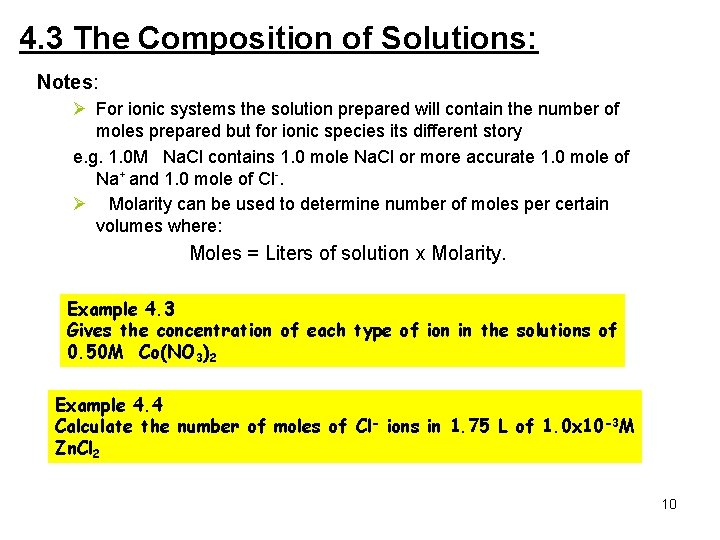
4. 3 The Composition of Solutions: Notes: Ø For ionic systems the solution prepared will contain the number of moles prepared but for ionic species its different story e. g. 1. 0 M Na. Cl contains 1. 0 mole Na. Cl or more accurate 1. 0 mole of Na+ and 1. 0 mole of Cl-. Ø Molarity can be used to determine number of moles per certain volumes where: Moles = Liters of solution x Molarity. Example 4. 3 Gives the concentration of each type of ion in the solutions of 0. 50 M Co(NO 3)2 Example 4. 4 Calculate the number of moles of Cl- ions in 1. 75 L of 1. 0 x 10 -3 M Zn. Cl 2 10
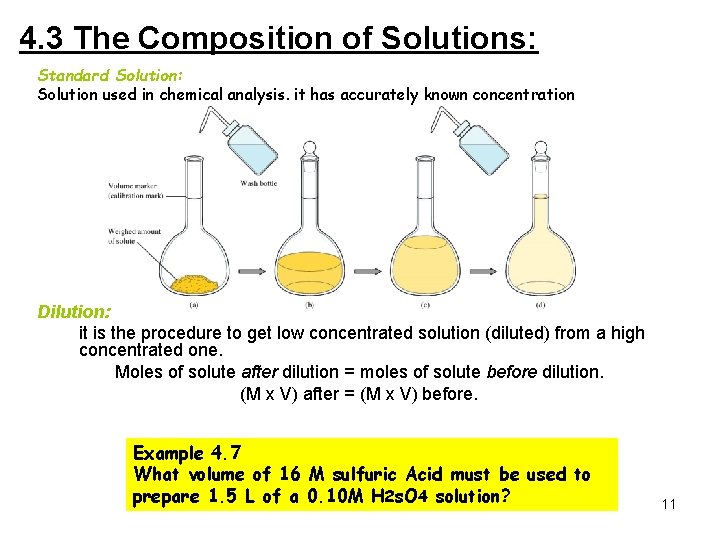
4. 3 The Composition of Solutions: Standard Solution: Solution used in chemical analysis. it has accurately known concentration Dilution: it is the procedure to get low concentrated solution (diluted) from a high concentrated one. Moles of solute after dilution = moles of solute before dilution. (M x V) after = (M x V) before. Example 4. 7 What volume of 16 M sulfuric Acid must be used to prepare 1. 5 L of a 0. 10 M H 2 s. O 4 solution? 11
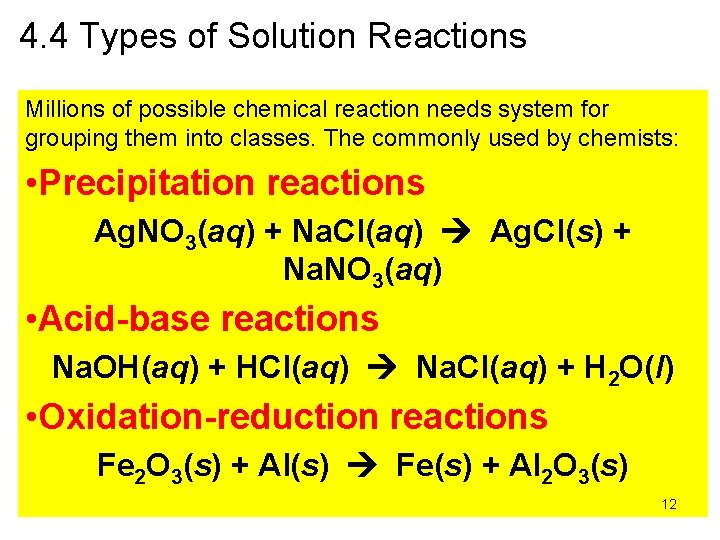
4. 4 Types of Solution Reactions Millions of possible chemical reaction needs system for grouping them into classes. The commonly used by chemists: • Precipitation reactions Ag. NO 3(aq) + Na. Cl(aq) Ag. Cl(s) + Na. NO 3(aq) • Acid-base reactions Na. OH(aq) + HCl(aq) Na. Cl(aq) + H 2 O(l) • Oxidation-reduction reactions Fe 2 O 3(s) + Al(s) Fe(s) + Al 2 O 3(s) 12
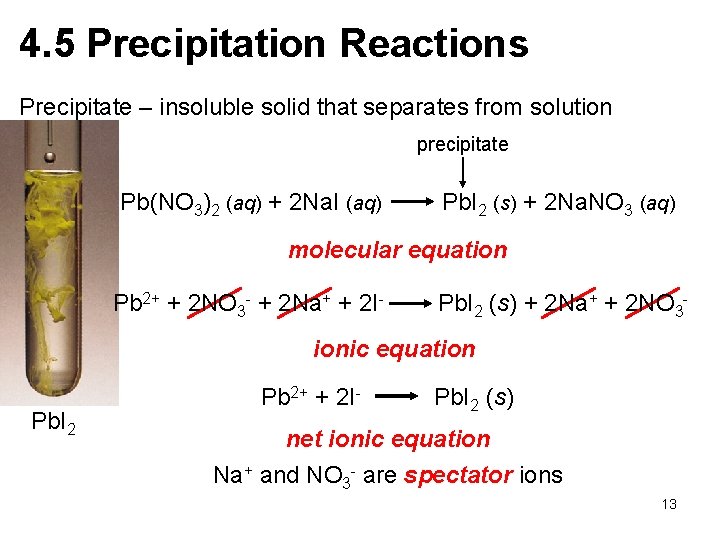
4. 5 Precipitation Reactions Precipitate – insoluble solid that separates from solution precipitate Pb(NO 3)2 (aq) + 2 Na. I (aq) Pb. I 2 (s) + 2 Na. NO 3 (aq) molecular equation Pb 2+ + 2 NO 3 - + 2 Na+ + 2 I- Pb. I 2 (s) + 2 Na+ + 2 NO 3 - ionic equation Pb. I 2 Pb 2+ + 2 I- Pb. I 2 (s) net ionic equation Na+ and NO 3 - are spectator ions 13
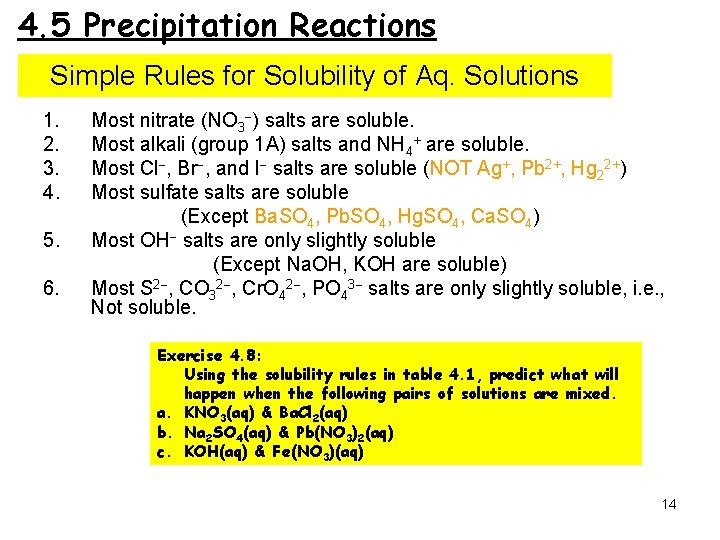
4. 5 Precipitation Reactions Simple Rules for Solubility of Aq. Solutions 1. 2. 3. 4. 5. 6. Most nitrate (NO 3 ) salts are soluble. Most alkali (group 1 A) salts and NH 4+ are soluble. Most Cl , Br , and I salts are soluble (NOT Ag+, Pb 2+, Hg 22+) Most sulfate salts are soluble (Except Ba. SO 4, Pb. SO 4, Hg. SO 4, Ca. SO 4) Most OH salts are only slightly soluble (Except Na. OH, KOH are soluble) Most S 2 , CO 32 , Cr. O 42 , PO 43 salts are only slightly soluble, i. e. , Not soluble. Exercise 4. 8: Using the solubility rules in table 4. 1, predict what will happen when the following pairs of solutions are mixed. a. KNO 3(aq) & Ba. Cl 2(aq) b. Na 2 SO 4(aq) & Pb(NO 3)2(aq) c. KOH(aq) & Fe(NO 3)(aq) 14
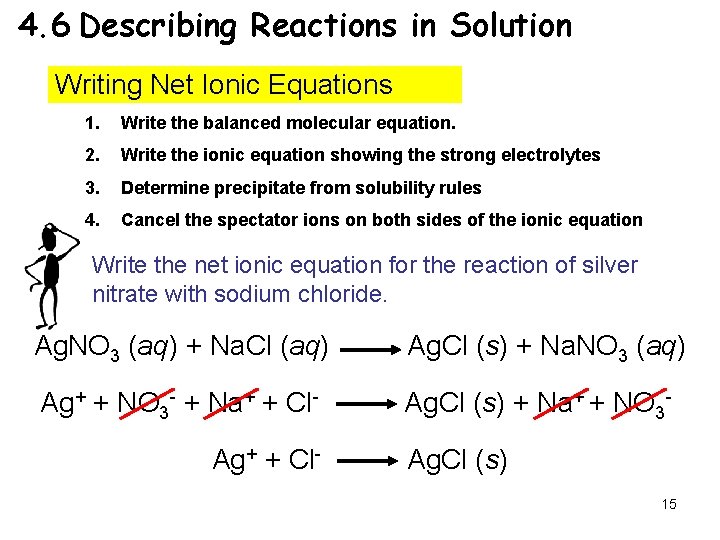
4. 6 Describing Reactions in Solution Writing Net Ionic Equations 1. Write the balanced molecular equation. 2. Write the ionic equation showing the strong electrolytes 3. Determine precipitate from solubility rules 4. Cancel the spectator ions on both sides of the ionic equation Write the net ionic equation for the reaction of silver nitrate with sodium chloride. Ag. NO 3 (aq) + Na. Cl (aq) Ag. Cl (s) + Na. NO 3 (aq) Ag+ + NO 3 - + Na+ + Cl- Ag. Cl (s) + Na+ + NO 3 - Ag+ + Cl- Ag. Cl (s) 15
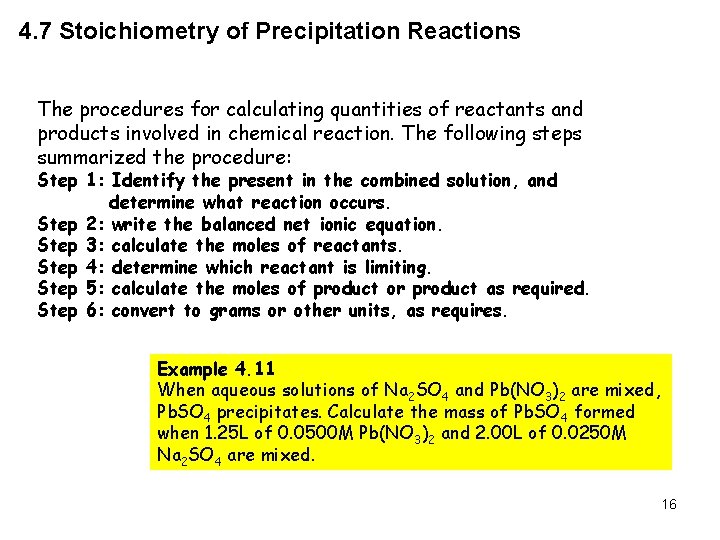
4. 7 Stoichiometry of Precipitation Reactions The procedures for calculating quantities of reactants and products involved in chemical reaction. The following steps summarized the procedure: Step 1: Identify the present in the combined solution, and determine what reaction occurs. Step 2: write the balanced net ionic equation. Step 3: calculate the moles of reactants. Step 4: determine which reactant is limiting. Step 5: calculate the moles of product or product as required. Step 6: convert to grams or other units, as requires. Example 4. 11 When aqueous solutions of Na 2 SO 4 and Pb(NO 3)2 are mixed, Pb. SO 4 precipitates. Calculate the mass of Pb. SO 4 formed when 1. 25 L of 0. 0500 M Pb(NO 3)2 and 2. 00 L of 0. 0250 M Na 2 SO 4 are mixed. 16
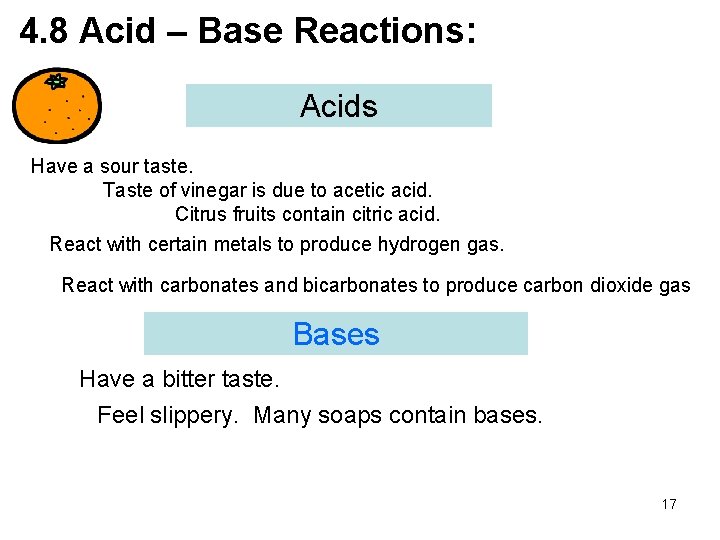
4. 8 Acid – Base Reactions: Acids Have a sour taste. Taste of vinegar is due to acetic acid. Citrus fruits contain citric acid. React with certain metals to produce hydrogen gas. React with carbonates and bicarbonates to produce carbon dioxide gas Bases Have a bitter taste. Feel slippery. Many soaps contain bases. 17
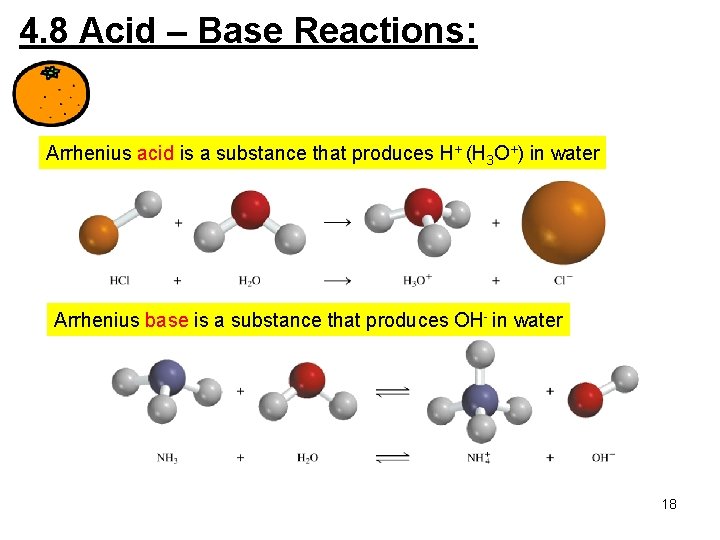
4. 8 Acid – Base Reactions: Arrhenius acid is a substance that produces H+ (H 3 O+) in water Arrhenius base is a substance that produces OH- in water 18
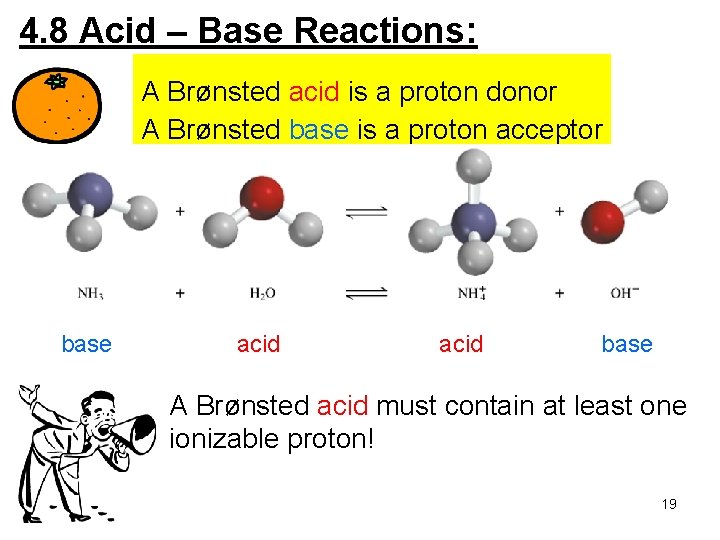
4. 8 Acid – Base Reactions: A Brønsted acid is a proton donor A Brønsted base is a proton acceptor base acid base A Brønsted acid must contain at least one ionizable proton! 19
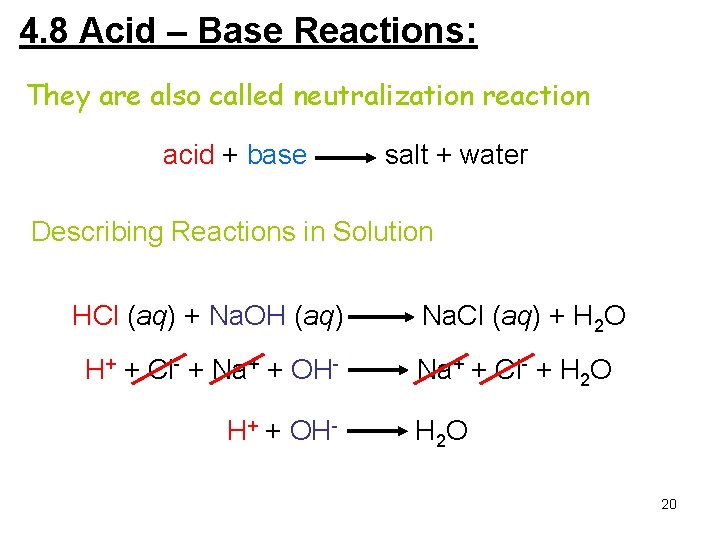
4. 8 Acid – Base Reactions: They are also called neutralization reaction acid + base salt + water Describing Reactions in Solution HCl (aq) + Na. OH (aq) H+ + Cl- + Na+ + OHH+ + OH- Na. Cl (aq) + H 2 O Na+ + Cl- + H 2 O 20
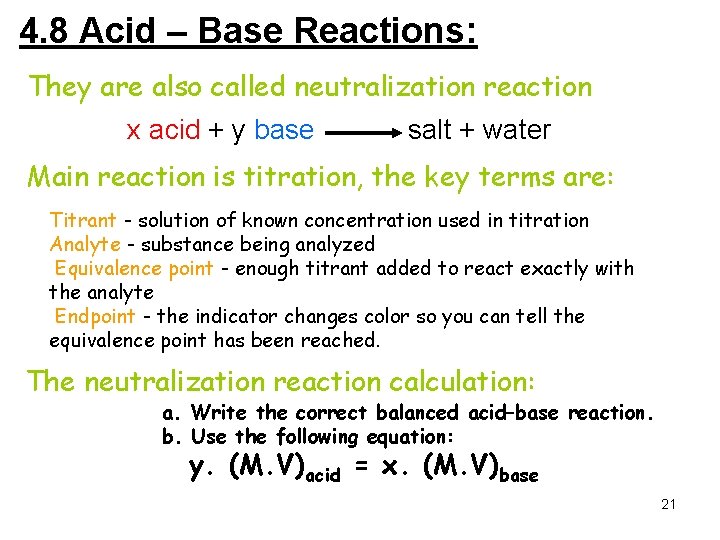
4. 8 Acid – Base Reactions: They are also called neutralization reaction x acid + y base salt + water Main reaction is titration, the key terms are: Titrant - solution of known concentration used in titration Analyte - substance being analyzed Equivalence point - enough titrant added to react exactly with the analyte Endpoint - the indicator changes color so you can tell the equivalence point has been reached. The neutralization reaction calculation: a. Write the correct balanced acid–base reaction. b. Use the following equation: y. (M. V)acid = x. (M. V)base 21
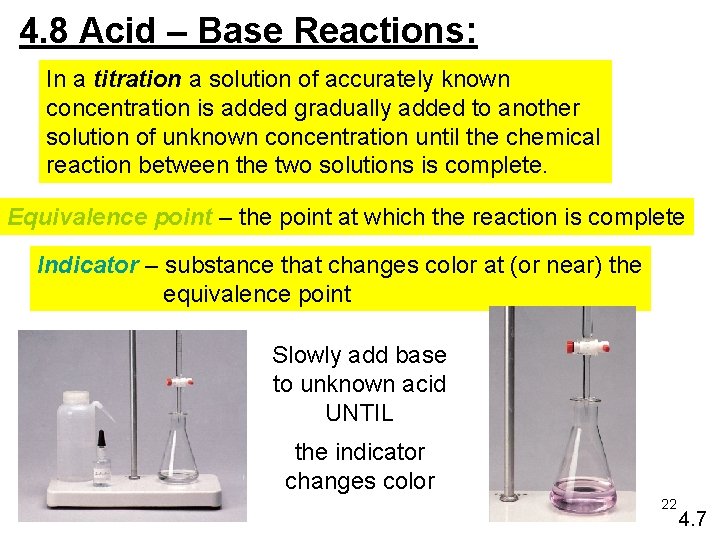
4. 8 Acid – Base Reactions: In a titration a solution of accurately known concentration is added gradually added to another solution of unknown concentration until the chemical reaction between the two solutions is complete. Equivalence point – the point at which the reaction is complete Indicator – substance that changes color at (or near) the equivalence point Slowly add base to unknown acid UNTIL the indicator changes color 22 4. 7
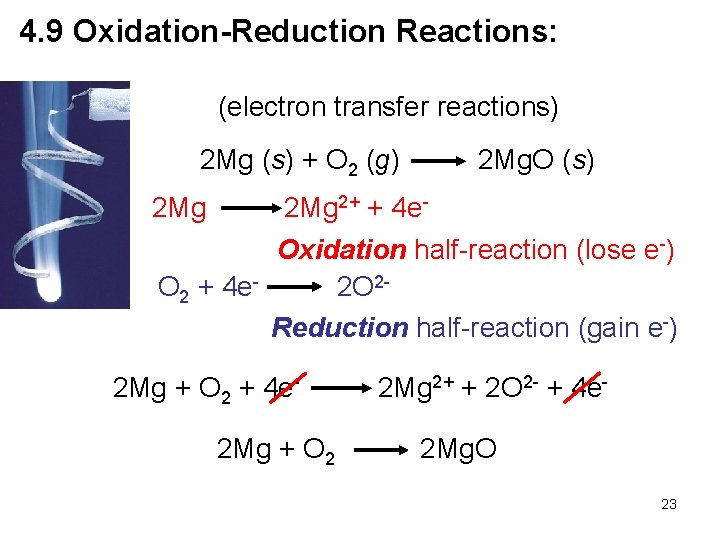
4. 9 Oxidation-Reduction Reactions: (electron transfer reactions) 2 Mg (s) + O 2 (g) 2 Mg. O (s) 2 Mg 2+ + 4 e. Oxidation half-reaction (lose e-) O 2 + 4 e 2 O 2 Reduction half-reaction (gain e-) 2 Mg + O 2 + 4 e 2 Mg + O 2 2 Mg 2+ + 2 O 2 - + 4 e 2 Mg. O 23
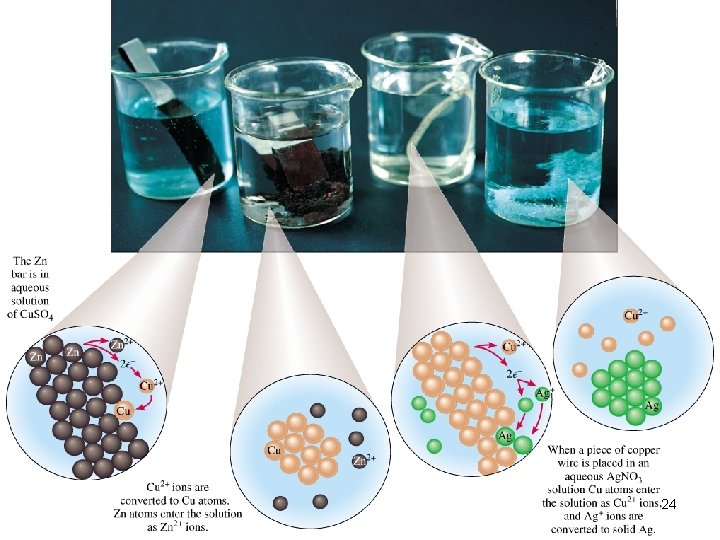
4. 9 Oxidation-Reduction Reactions: 24
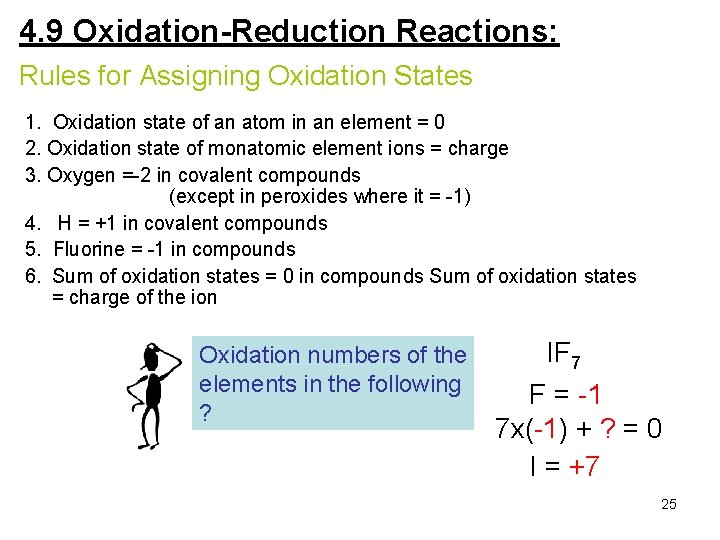
4. 9 Oxidation-Reduction Reactions: Rules for Assigning Oxidation States 1. Oxidation state of an atom in an element = 0 2. Oxidation state of monatomic element ions = charge 3. Oxygen =-2 in covalent compounds (except in peroxides where it = -1) 4. H = +1 in covalent compounds 5. Fluorine = -1 in compounds 6. Sum of oxidation states = 0 in compounds Sum of oxidation states = charge of the ion Oxidation numbers of the elements in the following ? IF 7 F = -1 7 x(-1) + ? = 0 I = +7 25
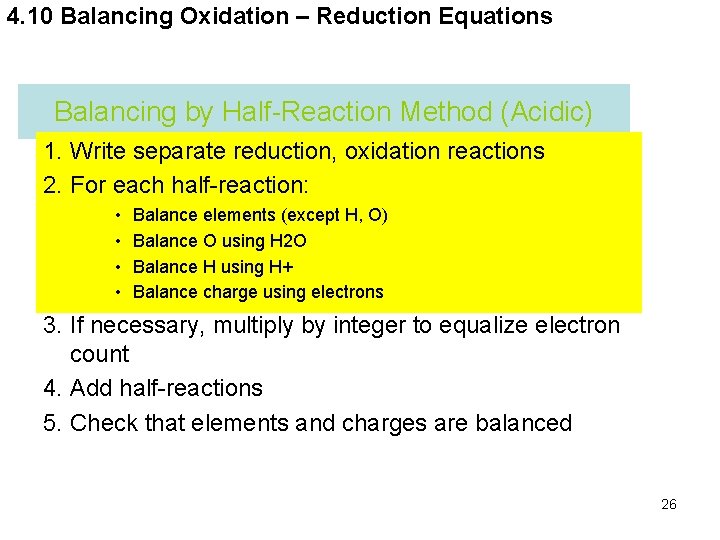
4. 10 Balancing Oxidation – Reduction Equations Balancing by Half-Reaction Method (Acidic) 1. Write separate reduction, oxidation reactions 2. For each half-reaction: • • Balance elements (except H, O) Balance O using H 2 O Balance H using H+ Balance charge using electrons 3. If necessary, multiply by integer to equalize electron count 4. Add half-reactions 5. Check that elements and charges are balanced 26
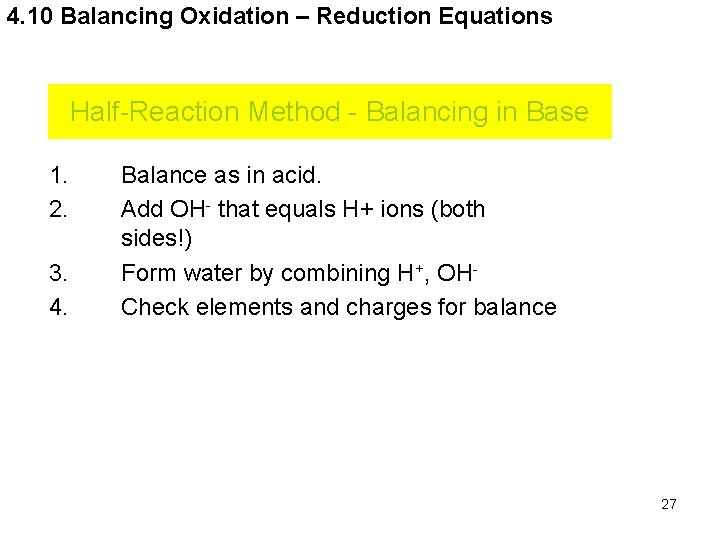
4. 10 Balancing Oxidation – Reduction Equations Half-Reaction Method - Balancing in Base 1. 2. 3. 4. Balance as in acid. Add OH- that equals H+ ions (both sides!) Form water by combining H+, OHCheck elements and charges for balance 27
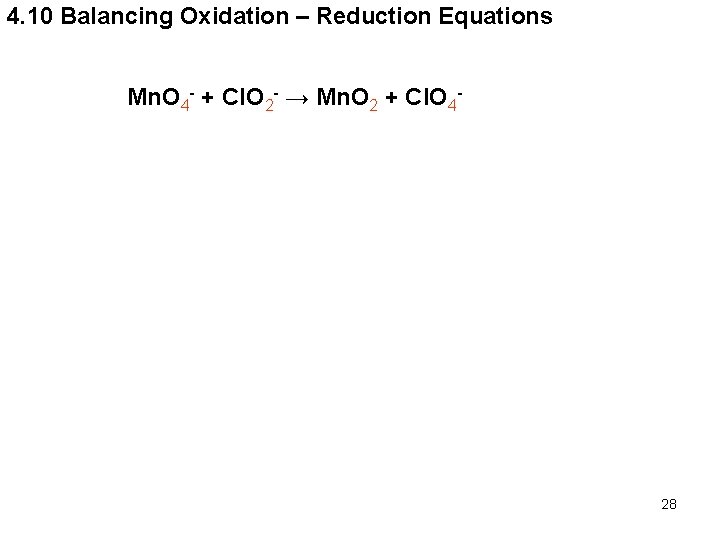
4. 10 Balancing Oxidation – Reduction Equations Mn. O 4 - + Cl. O 2 - → Mn. O 2 + Cl. O 4 - 28