
Chapter 4 TYPES OF CHEMICAL REACTIONS AND SOLUTION
- Slides: 16
Chapter 4 TYPES OF CHEMICAL REACTIONS AND SOLUTION STOICHIOMETRY
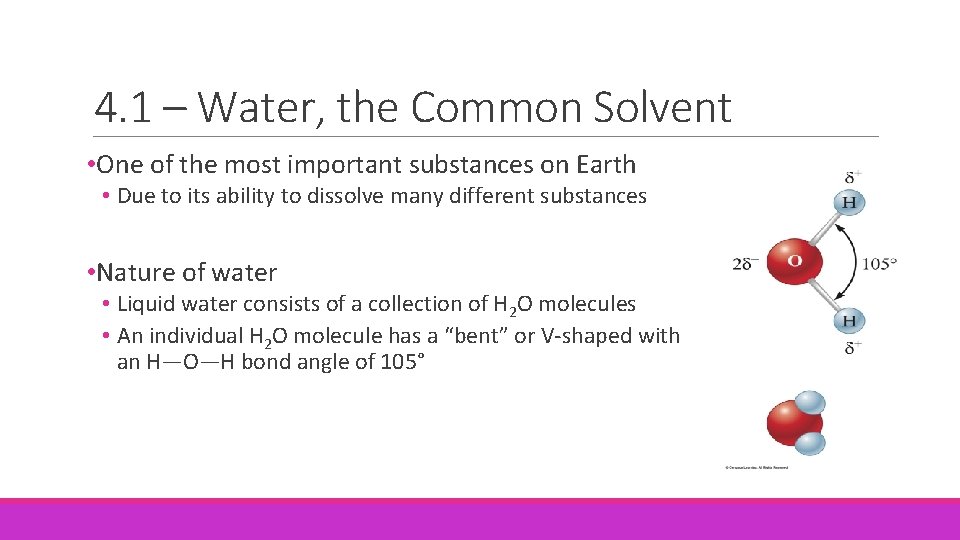
4. 1 – Water, the Common Solvent • One of the most important substances on Earth • Due to its ability to dissolve many different substances • Nature of water • Liquid water consists of a collection of H 2 O molecules • An individual H 2 O molecule has a “bent” or V-shaped with an H—O—H bond angle of 105°
4. 1 – Water’s Structure and Polarity • The O—H bonds in water are covalent bonds (sharing electrons) formed between oxygen and hydrogen atoms • Electrons are not shared equally between the two atoms • Oxygen has a greater attraction for the electrons than does hydrogen (Electronegativity) • The oxygen atom has a slightly negative charge while the hydrogen atoms have a slightly positive charge due to this • Partial charges are denoted by the symbol δ (delta) • Due to this unequal distribution of charge, water is said to be a polar molecule
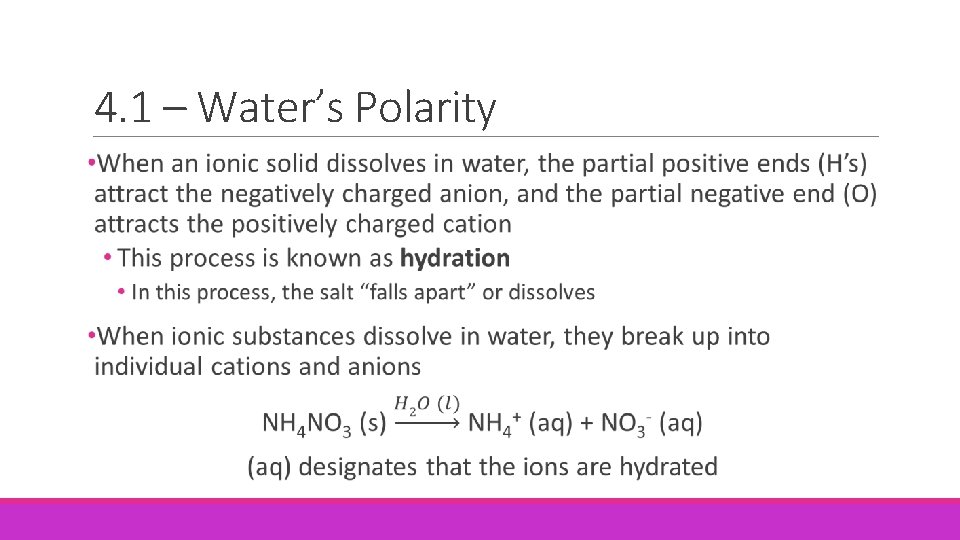
4. 1 – Water’s Polarity
4. 1 - Solubility • The solubility (degree to which a substance dissolves) varies greatly in water • Ex: sodium chloride (Na. Cl) is extremely soluble in water whereas silver chloride (Ag. Cl) is slightly soluble • Solubility is dependent on the relative attraction of ions (we’ll elaborate further in Ch. 11) • Water can also dissolve nonionic substances, such as ethanol (C 2 H 5 OH) • This is due to ethanol being a polar compound • Water cannot however dissolve molecules such as animal fats • This is due to fats being nonpolar substances • The general rule for solubility is “like dissolves like” (polar molecules dissolve polar molecules)
4. 2 - Electrolytes • Solute: Substance that is dissolved in a solution • Solution: Liquid that dissolves solute in a solution • An important characteristic of a solution is electrical conductivity • Water is not a natural conductor, however some aqueous solutions are efficient conductors • Solution that can efficiently conduct electricity contain strong electrolytes • Weakly conducting solutions contain weak electrolytes • Nonconducting solutions contain nonelectrolytes
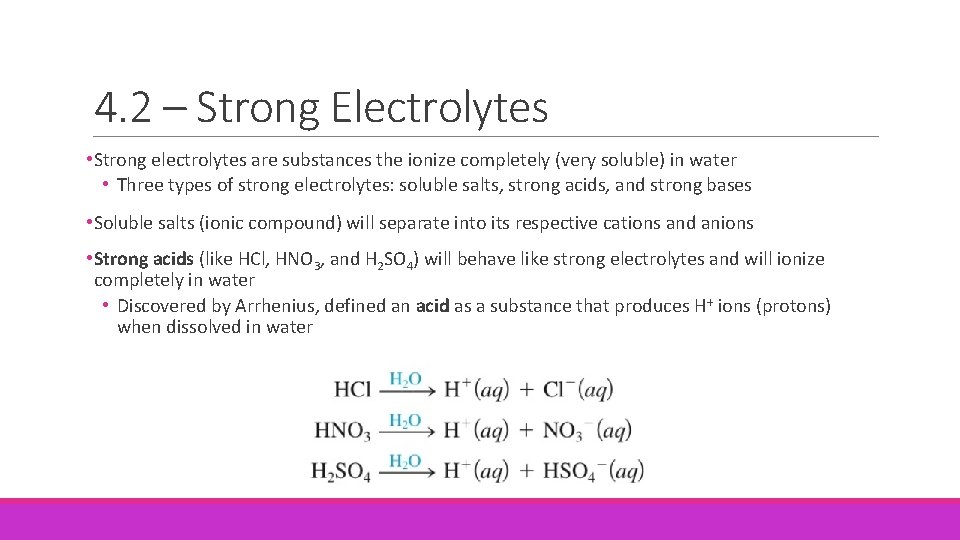
4. 2 – Strong Electrolytes • Strong electrolytes are substances the ionize completely (very soluble) in water • Three types of strong electrolytes: soluble salts, strong acids, and strong bases • Soluble salts (ionic compound) will separate into its respective cations and anions • Strong acids (like HCl, HNO 3, and H 2 SO 4) will behave like strong electrolytes and will ionize completely in water • Discovered by Arrhenius, defined an acid as a substance that produces H+ ions (protons) when dissolved in water
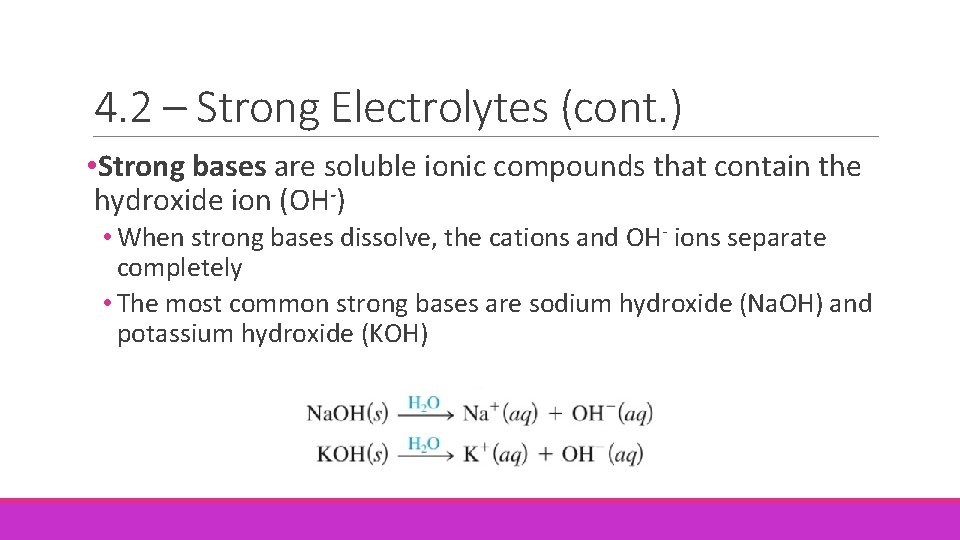
4. 2 – Strong Electrolytes (cont. ) • Strong bases are soluble ionic compounds that contain the hydroxide ion (OH-) • When strong bases dissolve, the cations and OH- ions separate completely • The most common strong bases are sodium hydroxide (Na. OH) and potassium hydroxide (KOH)
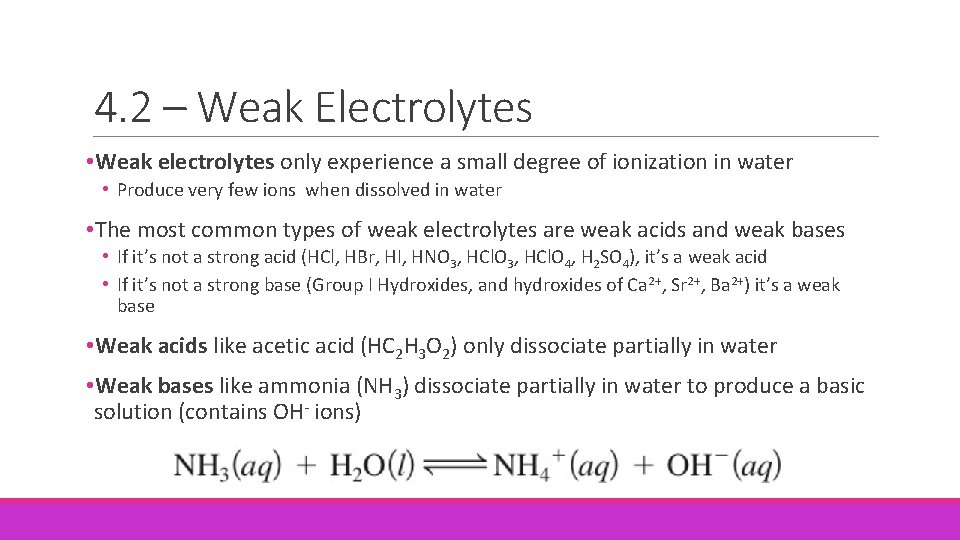
4. 2 – Weak Electrolytes • Weak electrolytes only experience a small degree of ionization in water • Produce very few ions when dissolved in water • The most common types of weak electrolytes are weak acids and weak bases • If it’s not a strong acid (HCl, HBr, HI, HNO 3, HCl. O 4, H 2 SO 4), it’s a weak acid • If it’s not a strong base (Group I Hydroxides, and hydroxides of Ca 2+, Sr 2+, Ba 2+) it’s a weak base • Weak acids like acetic acid (HC 2 H 3 O 2) only dissociate partially in water • Weak bases like ammonia (NH 3) dissociate partially in water to produce a basic solution (contains OH- ions)
4. 2 - Nonelectrolytes • Nonelectrolytes dissolve in water but do not produce any ions • When ethanol dissolves in water, the entire C 2 H 5 OH molecules disperse in through the water, however they do not form ions • Covalent polar compounds will not produce any ions when dissolved in water
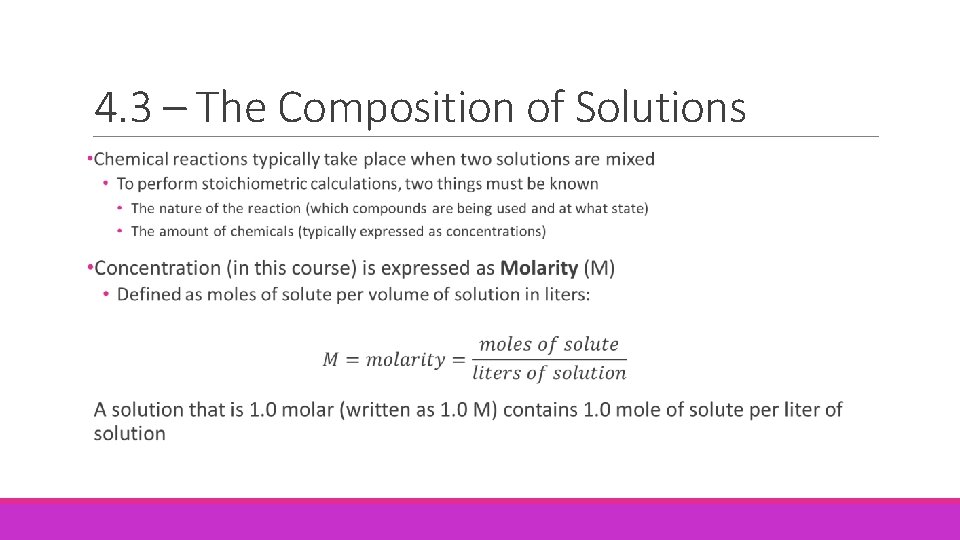
4. 3 – The Composition of Solutions
4. 3 – Calculation of Molarity Calculate the molarity of a solution prepared by dissolving 11. 5 g of solid Na. OH in enough water to make 1. 50 L of solution. Known: mass of Na. OH: 11. 5 g Na. OH volume of solution: 1. 50 L Information needed to find molarity: moles of solute (Na. OH) Molarity Equation = M = mol solute/L of solution
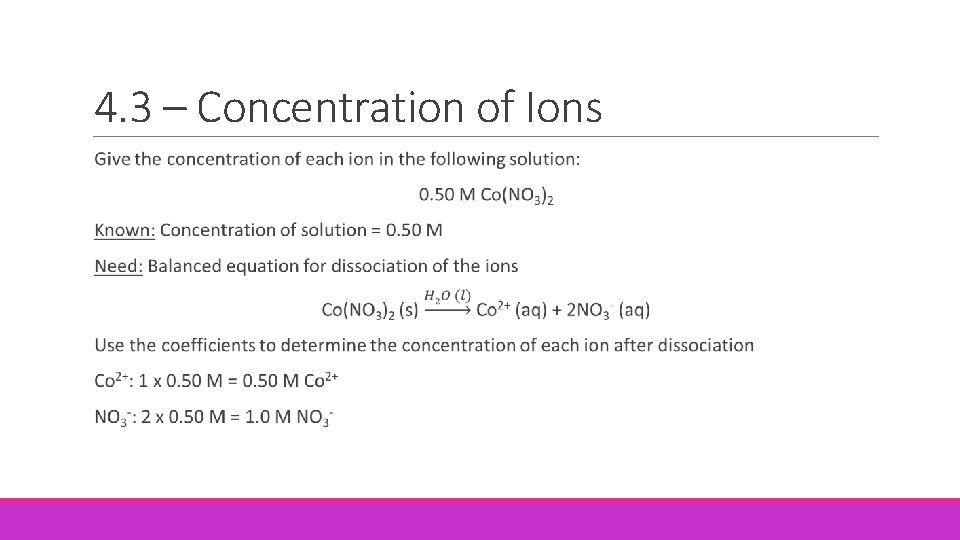
4. 3 – Concentration of Ions
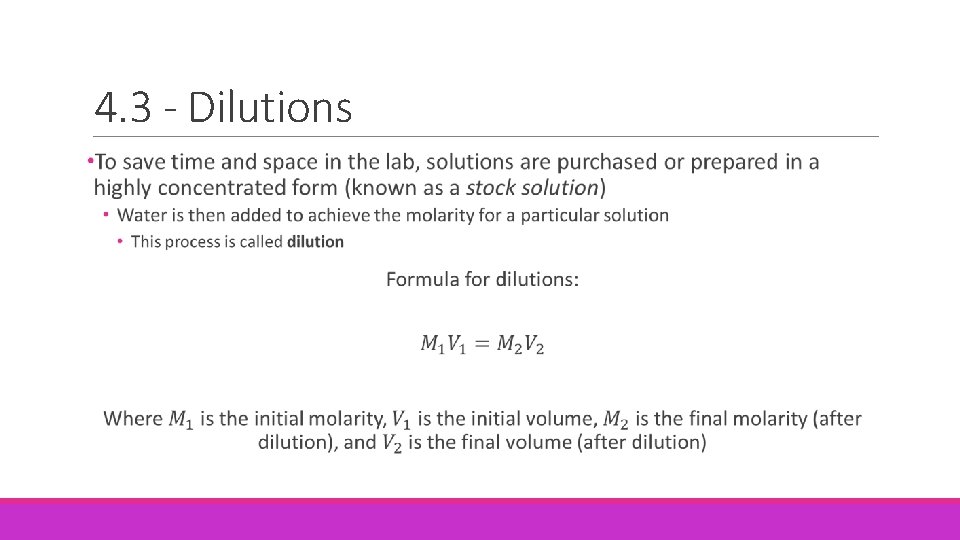
4. 3 - Dilutions
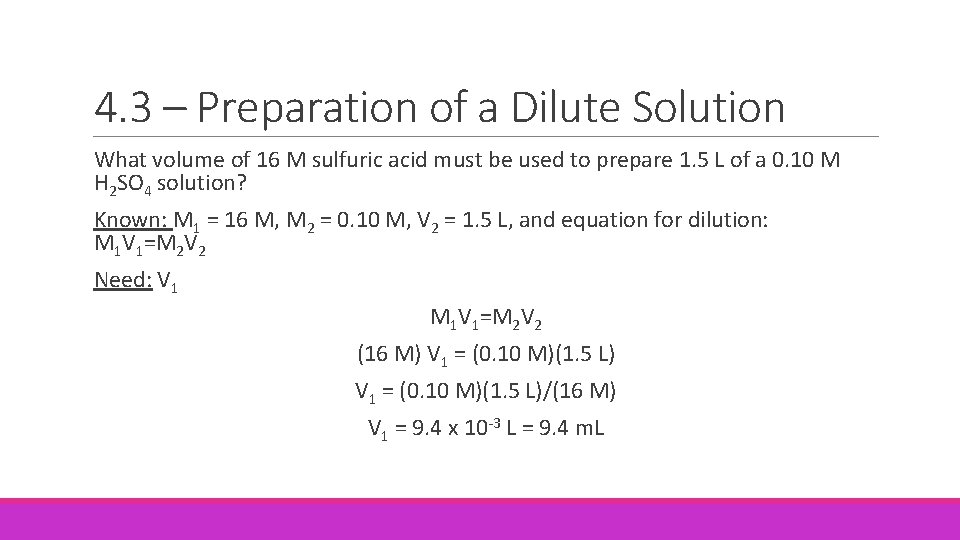
4. 3 – Preparation of a Dilute Solution What volume of 16 M sulfuric acid must be used to prepare 1. 5 L of a 0. 10 M H 2 SO 4 solution? Known: M 1 = 16 M, M 2 = 0. 10 M, V 2 = 1. 5 L, and equation for dilution: M 1 V 1=M 2 V 2 Need: V 1 M 1 V 1=M 2 V 2 (16 M) V 1 = (0. 10 M)(1. 5 L)/(16 M) V 1 = 9. 4 x 10 -3 L = 9. 4 m. L
4. 4 – Types of Chemical Reactions