
Chapter 4 Trigonometric Functions 4 5 Graphs of



- Slides: 49
Chapter 4 Trigonometric Functions 4. 5 Graphs of Sine and Cosine Functions Copyright © 2014, 2010, 2007 Pearson Education, Inc. 1
Objectives: • • • Understand the graph of y = sin x. Graph variations of y = sin x. Understand the graph of y = cos x. Graph variations of y = cos x. Use vertical shifts of sine and cosine curves. Model periodic behavior. Copyright © 2014, 2010, 2007 Pearson Education, Inc. 2
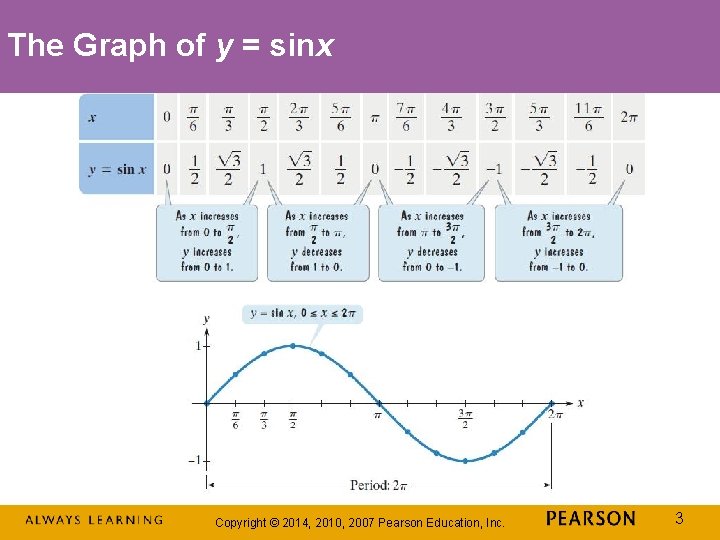
The Graph of y = sinx Copyright © 2014, 2010, 2007 Pearson Education, Inc. 3
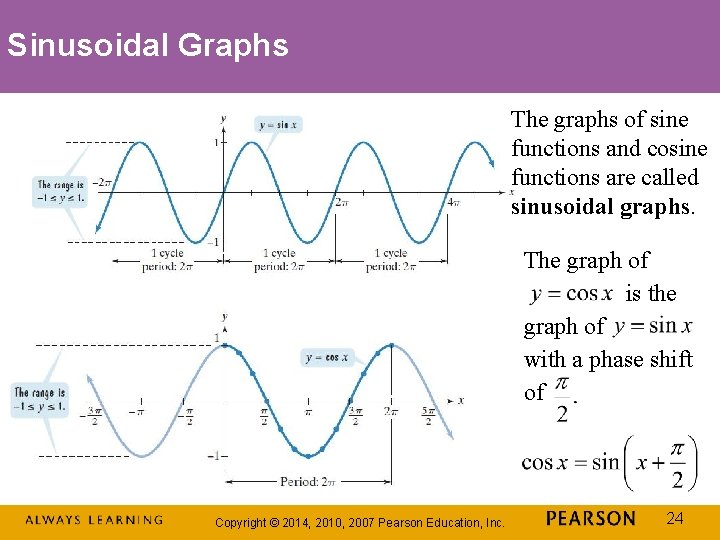
Some Properties of the Graph of y = sinx The domain is The period is The range is [– 1, 1]. The function is an odd function: Copyright © 2014, 2010, 2007 Pearson Education, Inc. 4
Graphing Variations of y = sinx Copyright © 2014, 2010, 2007 Pearson Education, Inc. 5
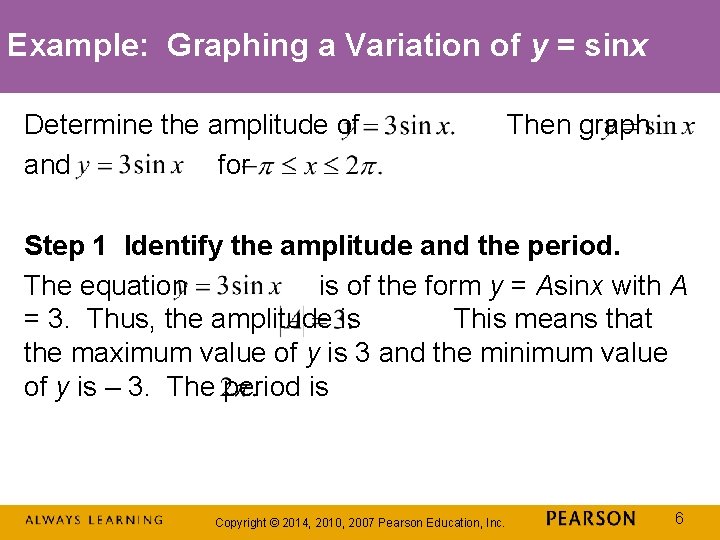
Example: Graphing a Variation of y = sinx Determine the amplitude of and for Then graph Step 1 Identify the amplitude and the period. The equation is of the form y = Asinx with A = 3. Thus, the amplitude is This means that the maximum value of y is 3 and the minimum value of y is – 3. The period is Copyright © 2014, 2010, 2007 Pearson Education, Inc. 6
Example: Graphing a Variation of y = sinx (continued) Determine the amplitude of Then graph and for Step 2 Find the values of x for the five key points. To generate x-values for each of the five key points, we begin by dividing the period, by 4. The cycle begins at x 1 = 0. We add quarter periods to generate x-values for each of the key points. Copyright © 2014, 2010, 2007 Pearson Education, Inc. 7
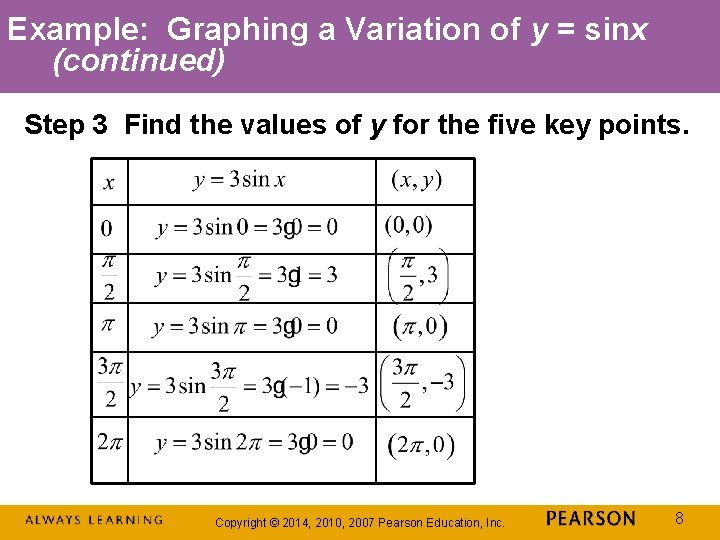
Example: Graphing a Variation of y = sinx (continued) Step 3 Find the values of y for the five key points. Copyright © 2014, 2010, 2007 Pearson Education, Inc. 8
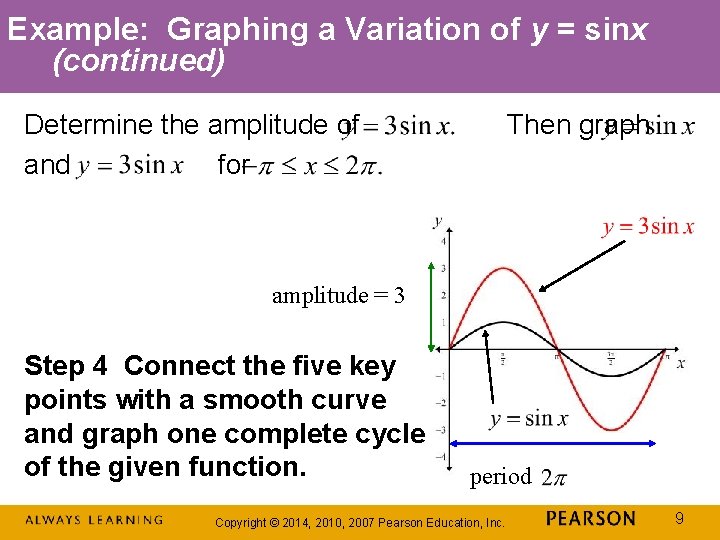
Example: Graphing a Variation of y = sinx (continued) Determine the amplitude of and for Then graph amplitude = 3 Step 4 Connect the five key points with a smooth curve and graph one complete cycle of the given function. period Copyright © 2014, 2010, 2007 Pearson Education, Inc. 9
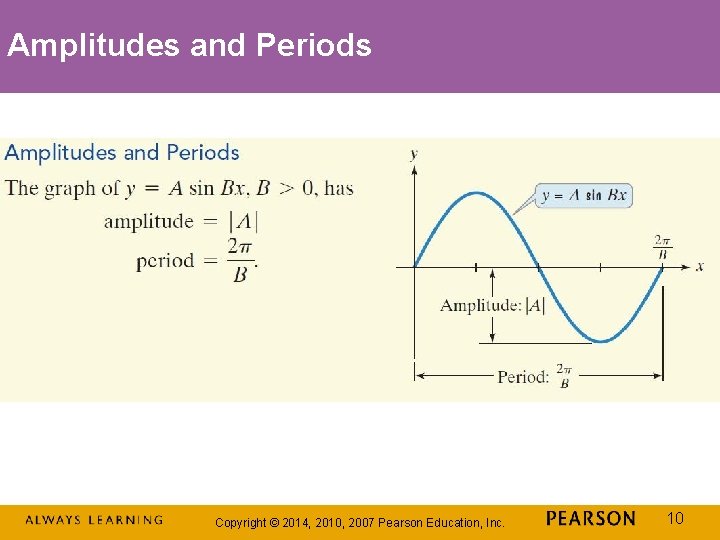
Amplitudes and Periods Copyright © 2014, 2010, 2007 Pearson Education, Inc. 10
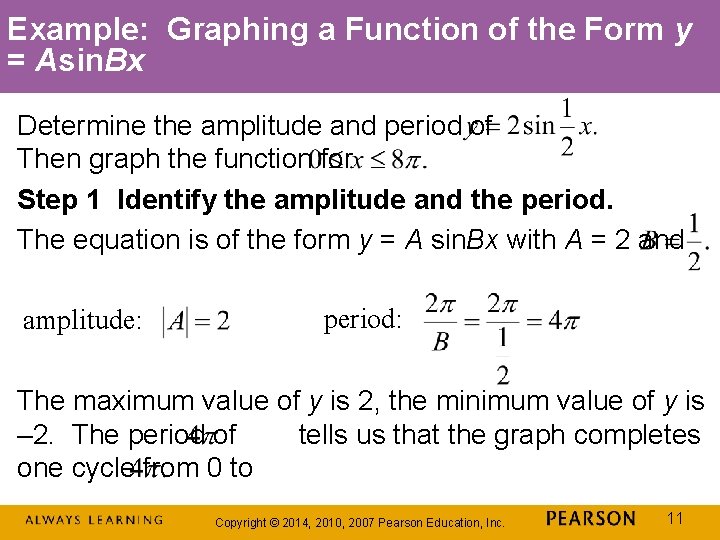
Example: Graphing a Function of the Form y = Asin. Bx Determine the amplitude and period of Then graph the function for Step 1 Identify the amplitude and the period. The equation is of the form y = A sin. Bx with A = 2 and amplitude: period: The maximum value of y is 2, the minimum value of y is – 2. The period of tells us that the graph completes one cycle from 0 to Copyright © 2014, 2010, 2007 Pearson Education, Inc. 11
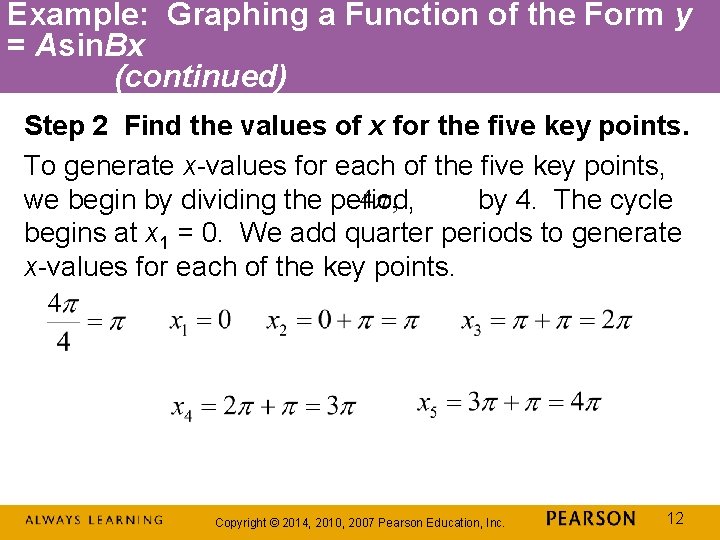
Example: Graphing a Function of the Form y = Asin. Bx (continued) Step 2 Find the values of x for the five key points. To generate x-values for each of the five key points, we begin by dividing the period, by 4. The cycle begins at x 1 = 0. We add quarter periods to generate x-values for each of the key points. Copyright © 2014, 2010, 2007 Pearson Education, Inc. 12
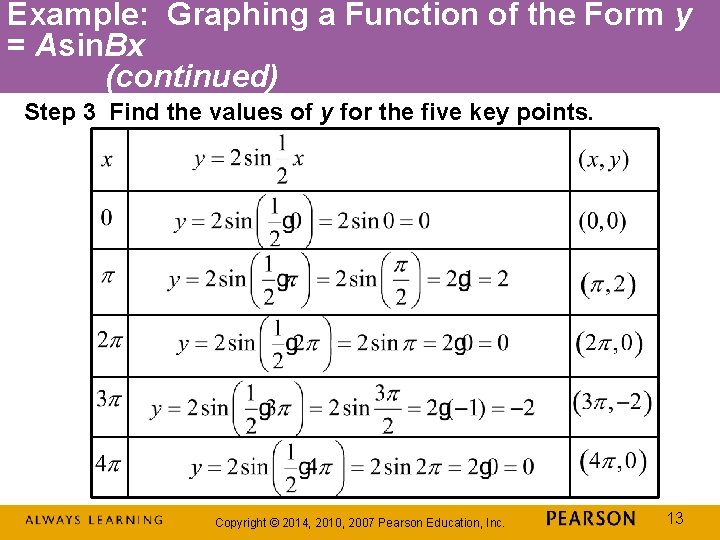
Example: Graphing a Function of the Form y = Asin. Bx (continued) Step 3 Find the values of y for the five key points. Copyright © 2014, 2010, 2007 Pearson Education, Inc. 13
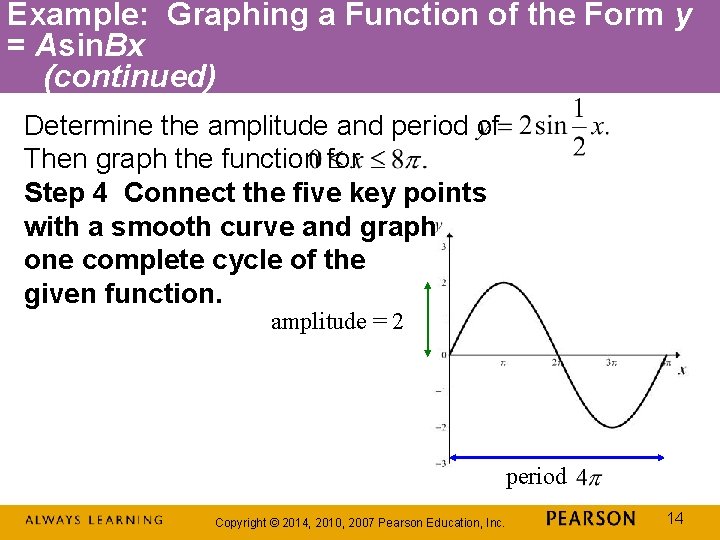
Example: Graphing a Function of the Form y = Asin. Bx (continued) Determine the amplitude and period of Then graph the function for Step 4 Connect the five key points with a smooth curve and graph one complete cycle of the given function. amplitude = 2 period Copyright © 2014, 2010, 2007 Pearson Education, Inc. 14
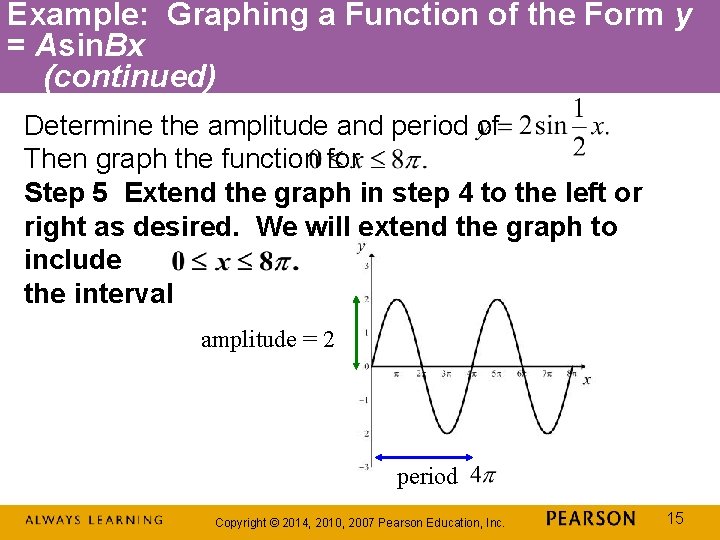
Example: Graphing a Function of the Form y = Asin. Bx (continued) Determine the amplitude and period of Then graph the function for Step 5 Extend the graph in step 4 to the left or right as desired. We will extend the graph to include the interval amplitude = 2 period Copyright © 2014, 2010, 2007 Pearson Education, Inc. 15
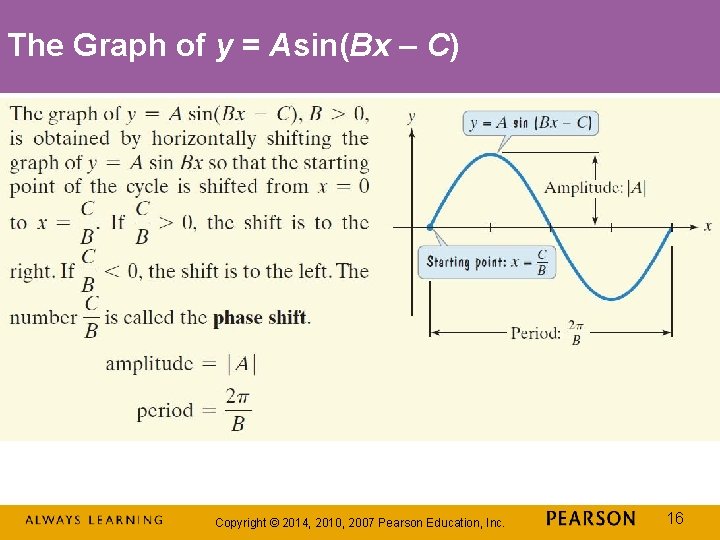
The Graph of y = Asin(Bx – C) Copyright © 2014, 2010, 2007 Pearson Education, Inc. 16
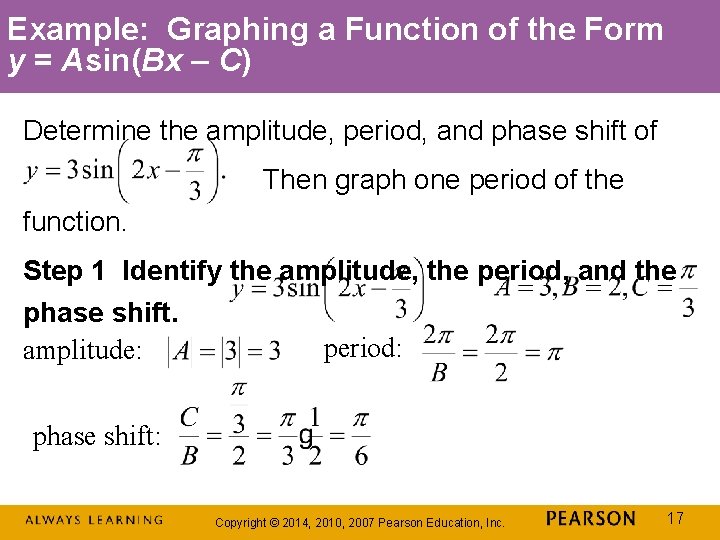
Example: Graphing a Function of the Form y = Asin(Bx – C) Determine the amplitude, period, and phase shift of Then graph one period of the function. Step 1 Identify the amplitude, the period, and the phase shift. period: amplitude: phase shift: Copyright © 2014, 2010, 2007 Pearson Education, Inc. 17
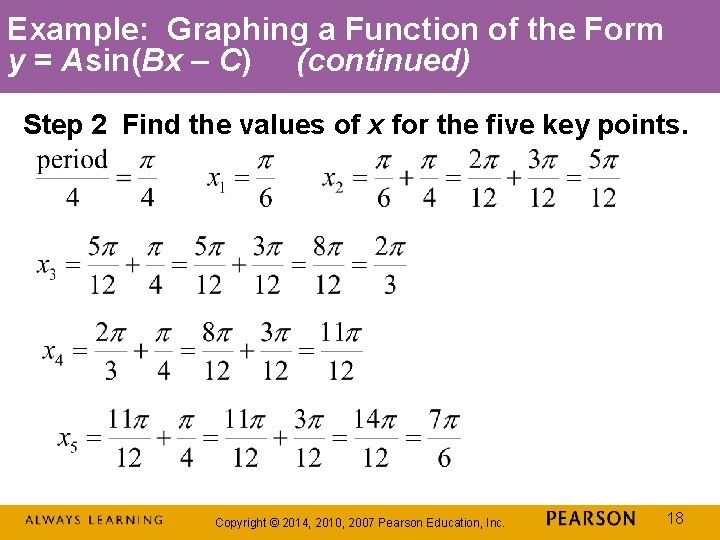
Example: Graphing a Function of the Form y = Asin(Bx – C) (continued) Step 2 Find the values of x for the five key points. Copyright © 2014, 2010, 2007 Pearson Education, Inc. 18
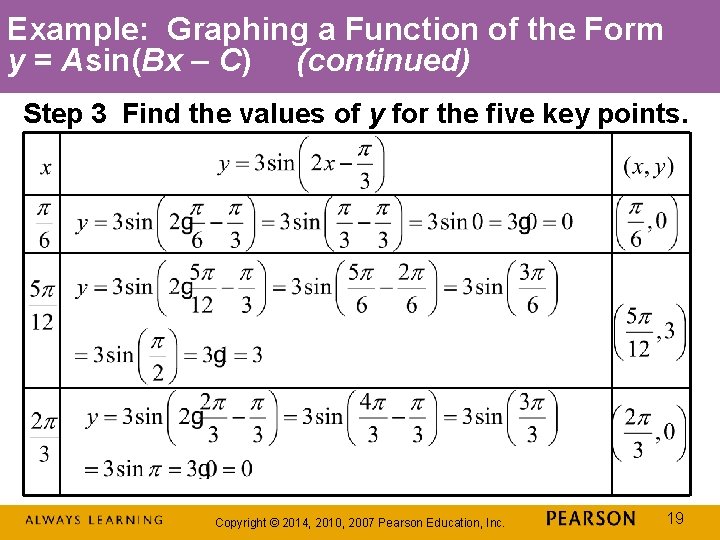
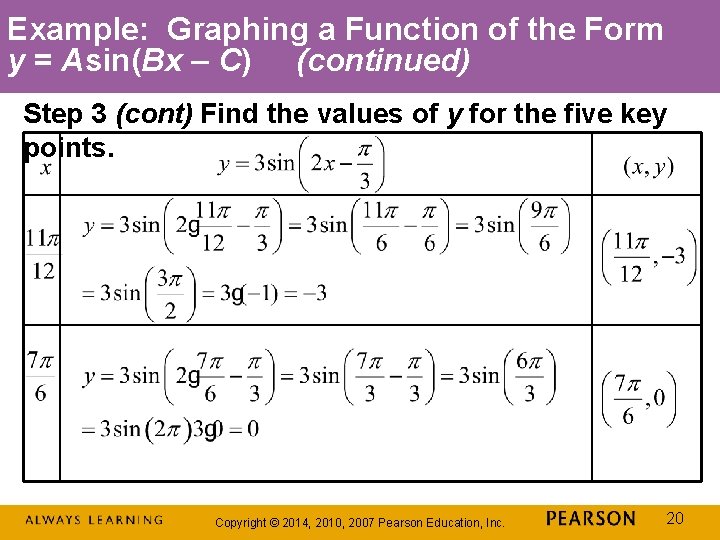
Example: Graphing a Function of the Form y = Asin(Bx – C) (continued) Step 3 Find the values of y for the five key points. Copyright © 2014, 2010, 2007 Pearson Education, Inc. 19
Example: Graphing a Function of the Form y = Asin(Bx – C) (continued) Step 3 (cont) Find the values of y for the five key points. Copyright © 2014, 2010, 2007 Pearson Education, Inc. 20
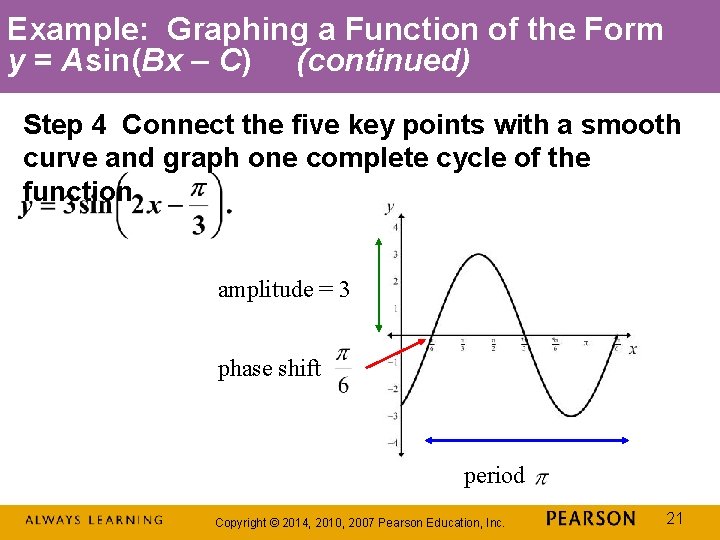
Example: Graphing a Function of the Form y = Asin(Bx – C) (continued) Step 4 Connect the five key points with a smooth curve and graph one complete cycle of the function amplitude = 3 phase shift period Copyright © 2014, 2010, 2007 Pearson Education, Inc. 21
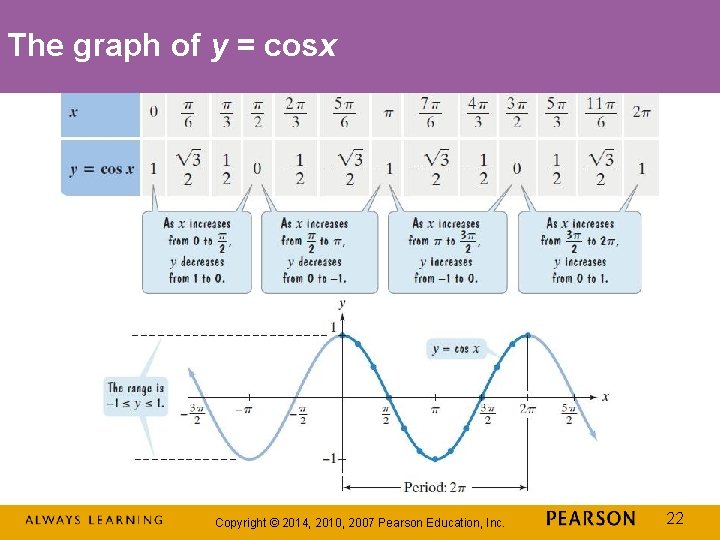
The graph of y = cosx Copyright © 2014, 2010, 2007 Pearson Education, Inc. 22
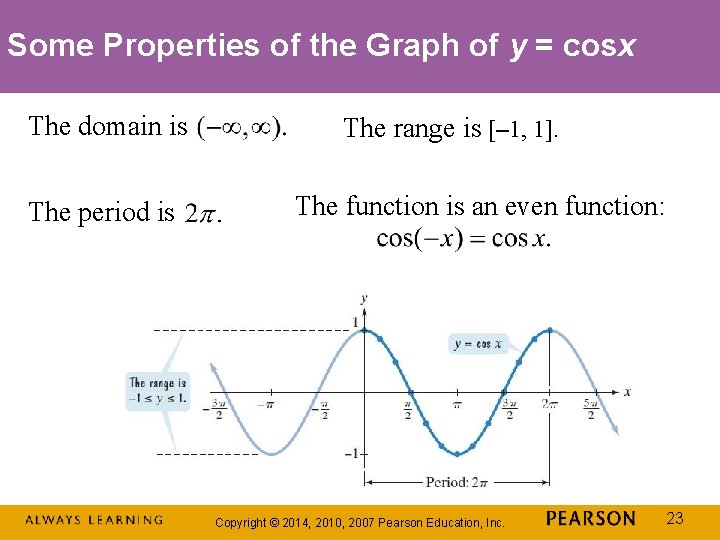
Some Properties of the Graph of y = cosx The domain is The period is The range is [– 1, 1]. The function is an even function: Copyright © 2014, 2010, 2007 Pearson Education, Inc. 23
Sinusoidal Graphs The graphs of sine functions and cosine functions are called sinusoidal graphs. The graph of is the graph of with a phase shift of Copyright © 2014, 2010, 2007 Pearson Education, Inc. 24
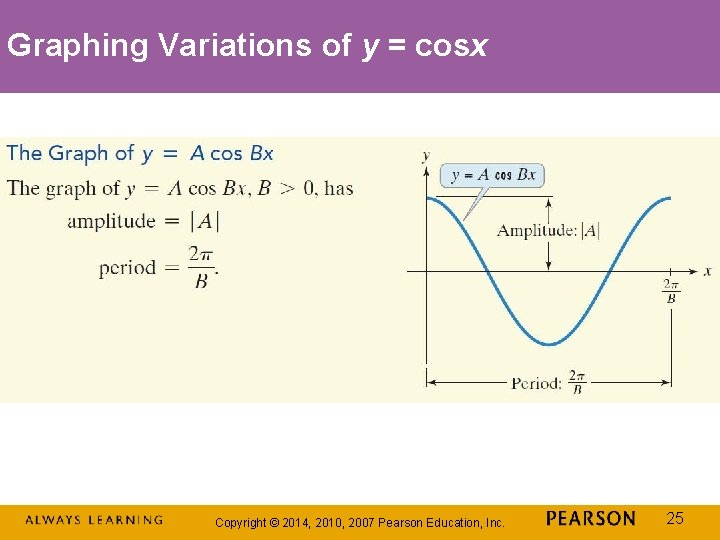
Graphing Variations of y = cosx Copyright © 2014, 2010, 2007 Pearson Education, Inc. 25
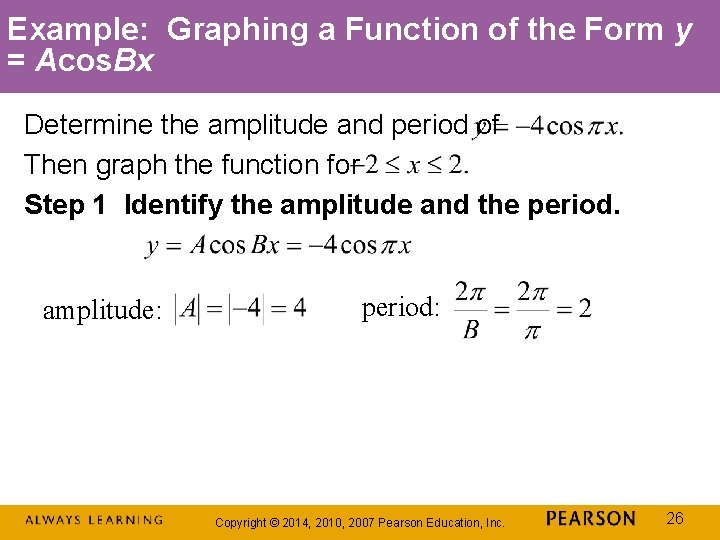
Example: Graphing a Function of the Form y = Acos. Bx Determine the amplitude and period of Then graph the function for Step 1 Identify the amplitude and the period. amplitude: period: Copyright © 2014, 2010, 2007 Pearson Education, Inc. 26
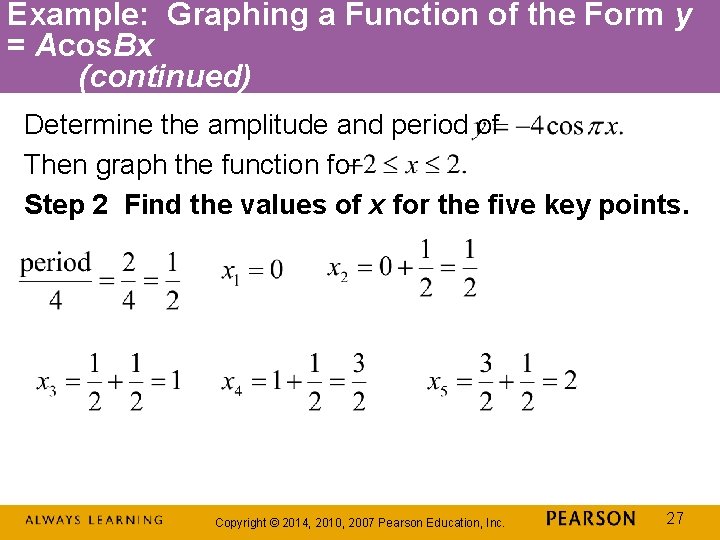
Example: Graphing a Function of the Form y = Acos. Bx (continued) Determine the amplitude and period of Then graph the function for Step 2 Find the values of x for the five key points. Copyright © 2014, 2010, 2007 Pearson Education, Inc. 27
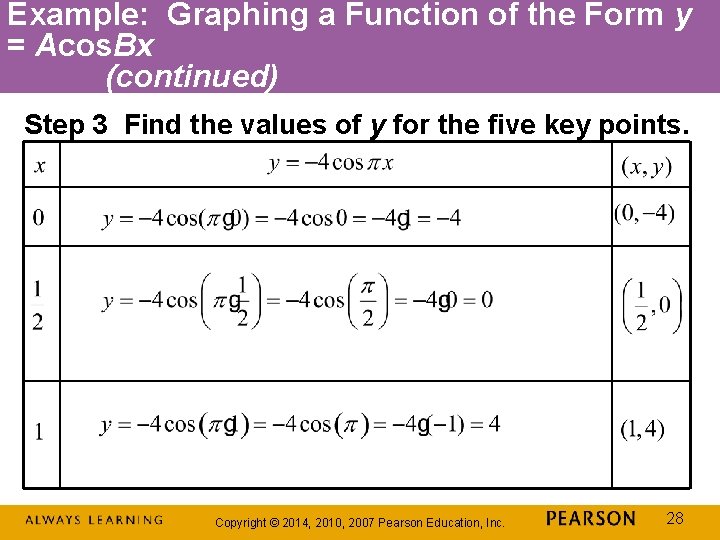
Example: Graphing a Function of the Form y = Acos. Bx (continued) Step 3 Find the values of y for the five key points. Copyright © 2014, 2010, 2007 Pearson Education, Inc. 28
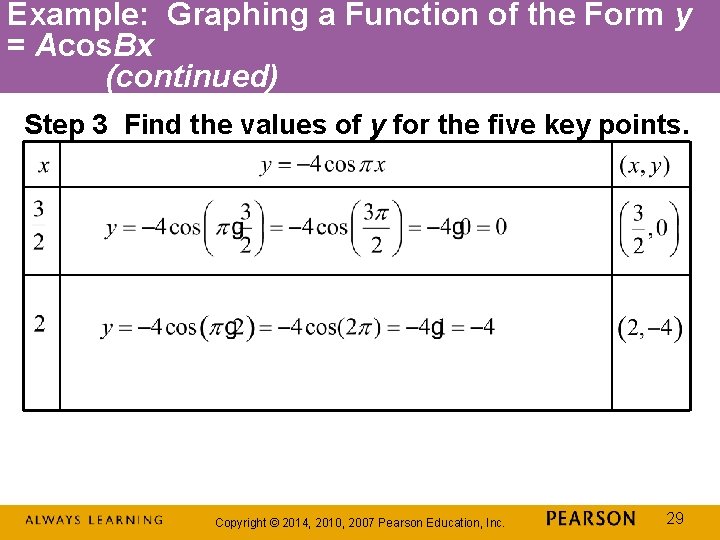
Example: Graphing a Function of the Form y = Acos. Bx (continued) Step 3 Find the values of y for the five key points. Copyright © 2014, 2010, 2007 Pearson Education, Inc. 29
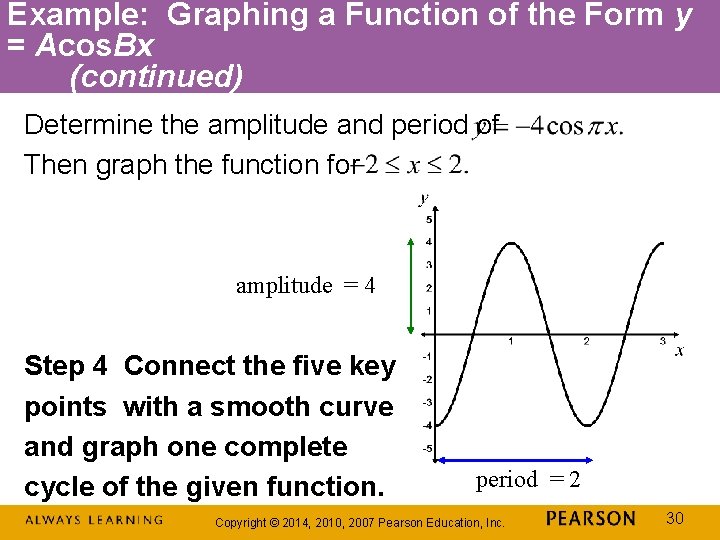
Example: Graphing a Function of the Form y = Acos. Bx (continued) Determine the amplitude and period of Then graph the function for amplitude = 4 Step 4 Connect the five key points with a smooth curve and graph one complete cycle of the given function. period = 2 Copyright © 2014, 2010, 2007 Pearson Education, Inc. 30
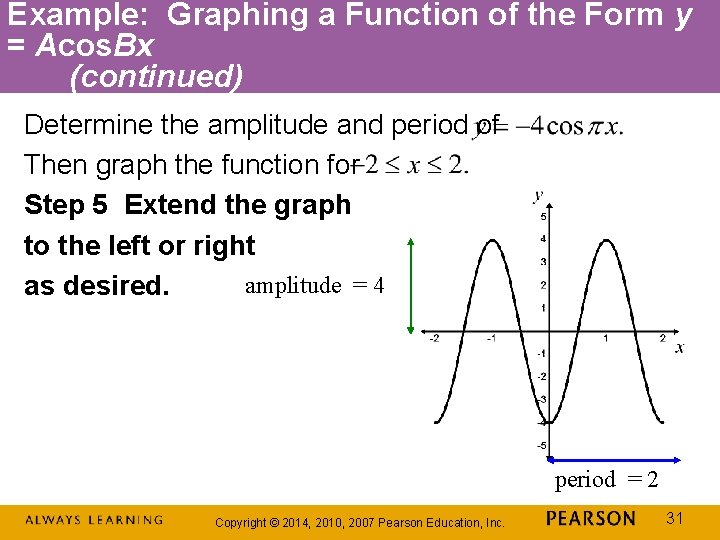
Example: Graphing a Function of the Form y = Acos. Bx (continued) Determine the amplitude and period of Then graph the function for Step 5 Extend the graph to the left or right amplitude = 4 as desired. period = 2 Copyright © 2014, 2010, 2007 Pearson Education, Inc. 31
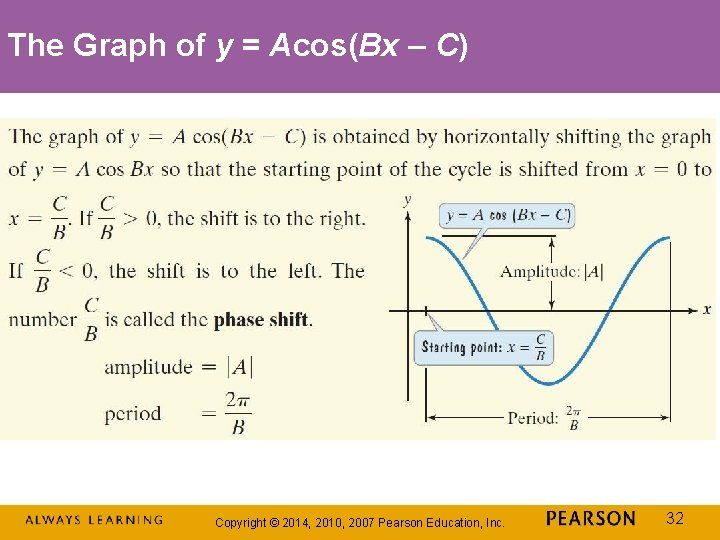
The Graph of y = Acos(Bx – C) Copyright © 2014, 2010, 2007 Pearson Education, Inc. 32
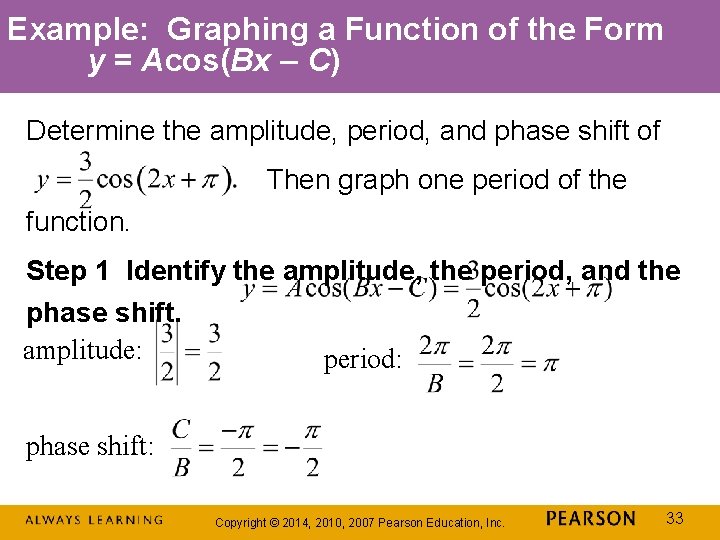
Example: Graphing a Function of the Form y = Acos(Bx – C) Determine the amplitude, period, and phase shift of Then graph one period of the function. Step 1 Identify the amplitude, the period, and the phase shift. amplitude: period: phase shift: Copyright © 2014, 2010, 2007 Pearson Education, Inc. 33
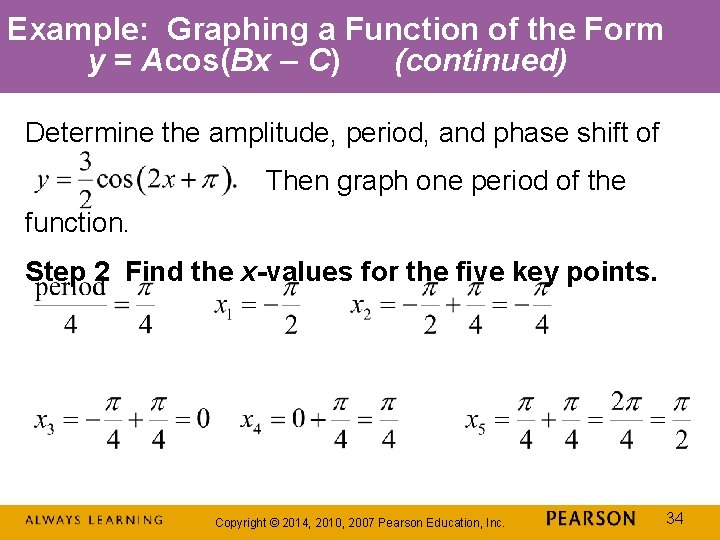
Example: Graphing a Function of the Form y = Acos(Bx – C) (continued) Determine the amplitude, period, and phase shift of Then graph one period of the function. Step 2 Find the x-values for the five key points. Copyright © 2014, 2010, 2007 Pearson Education, Inc. 34
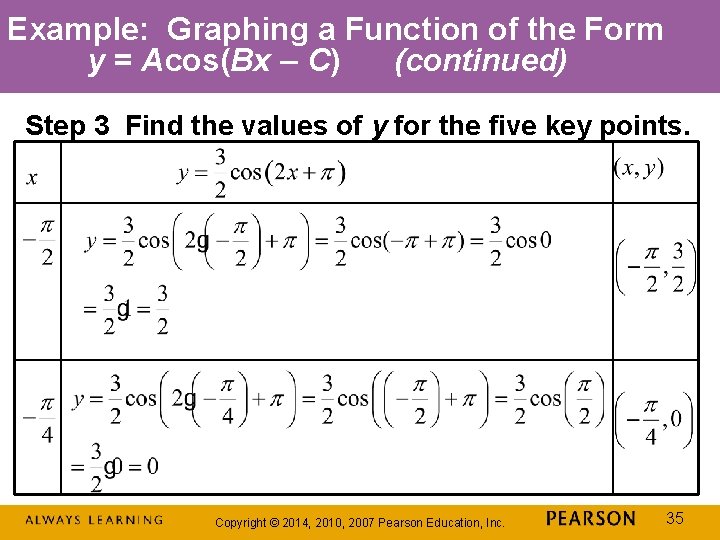
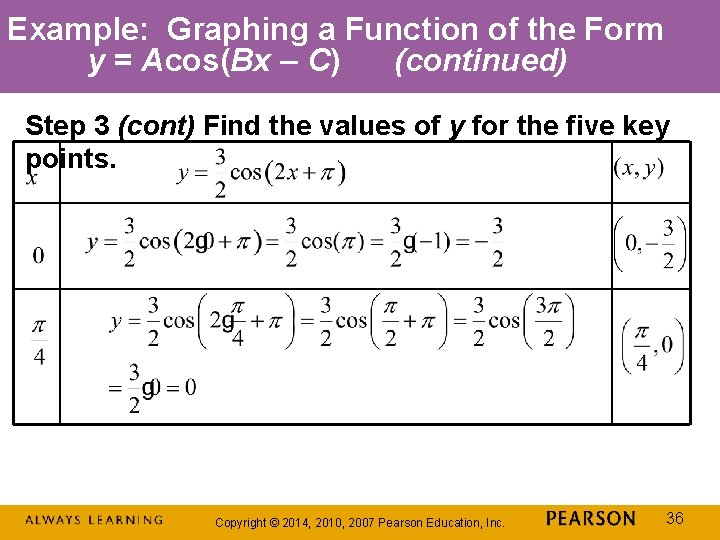
Example: Graphing a Function of the Form y = Acos(Bx – C) (continued) Step 3 Find the values of y for the five key points. Copyright © 2014, 2010, 2007 Pearson Education, Inc. 35
Example: Graphing a Function of the Form y = Acos(Bx – C) (continued) Step 3 (cont) Find the values of y for the five key points. Copyright © 2014, 2010, 2007 Pearson Education, Inc. 36
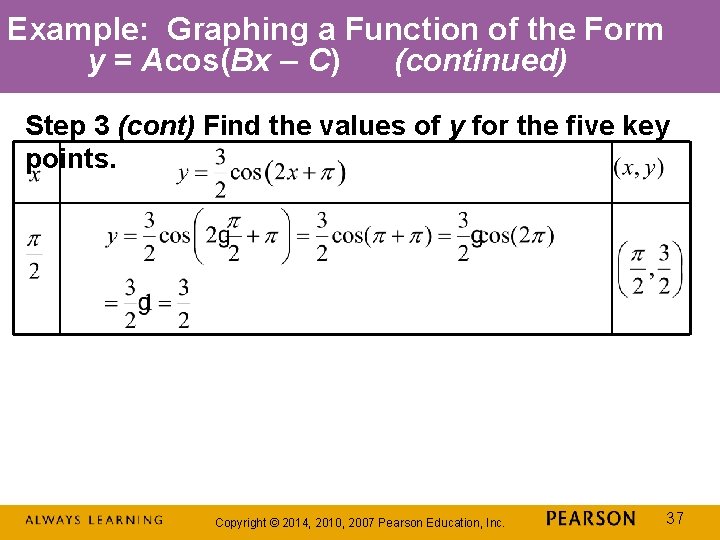
Example: Graphing a Function of the Form y = Acos(Bx – C) (continued) Step 3 (cont) Find the values of y for the five key points. Copyright © 2014, 2010, 2007 Pearson Education, Inc. 37
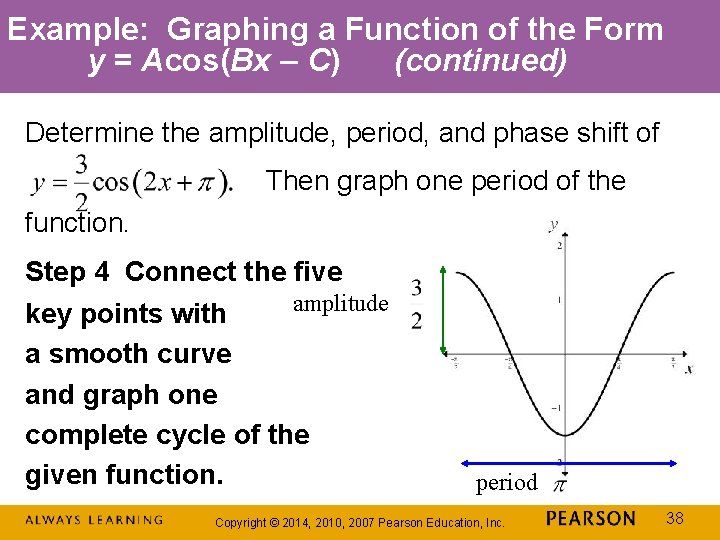
Example: Graphing a Function of the Form y = Acos(Bx – C) (continued) Determine the amplitude, period, and phase shift of Then graph one period of the function. Step 4 Connect the five amplitude key points with a smooth curve and graph one complete cycle of the given function. period Copyright © 2014, 2010, 2007 Pearson Education, Inc. 38
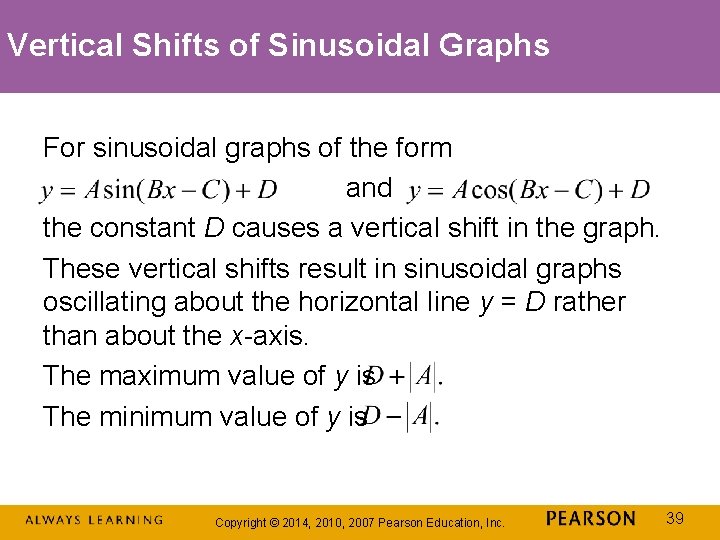
Vertical Shifts of Sinusoidal Graphs For sinusoidal graphs of the form and the constant D causes a vertical shift in the graph. These vertical shifts result in sinusoidal graphs oscillating about the horizontal line y = D rather than about the x-axis. The maximum value of y is The minimum value of y is Copyright © 2014, 2010, 2007 Pearson Education, Inc. 39
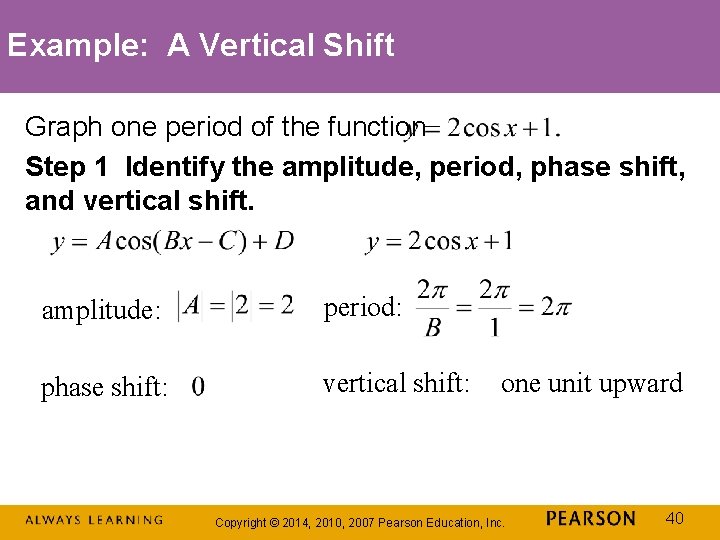
Example: A Vertical Shift Graph one period of the function Step 1 Identify the amplitude, period, phase shift, and vertical shift. amplitude: period: phase shift: vertical shift: one unit upward Copyright © 2014, 2010, 2007 Pearson Education, Inc. 40
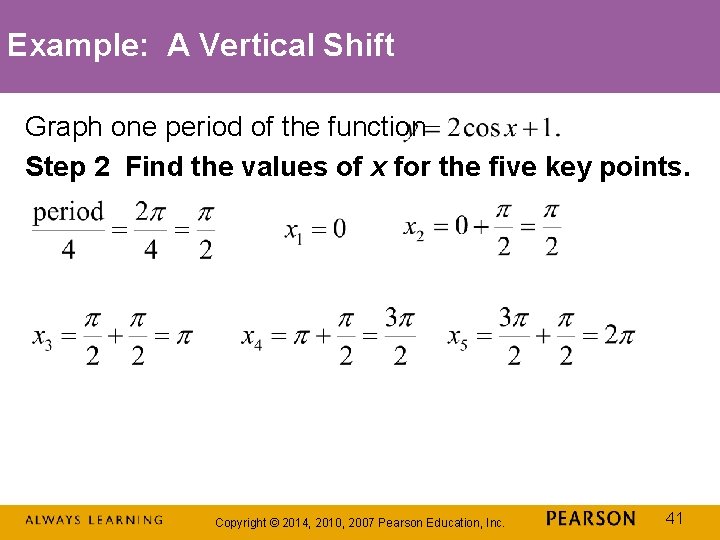
Example: A Vertical Shift Graph one period of the function Step 2 Find the values of x for the five key points. Copyright © 2014, 2010, 2007 Pearson Education, Inc. 41
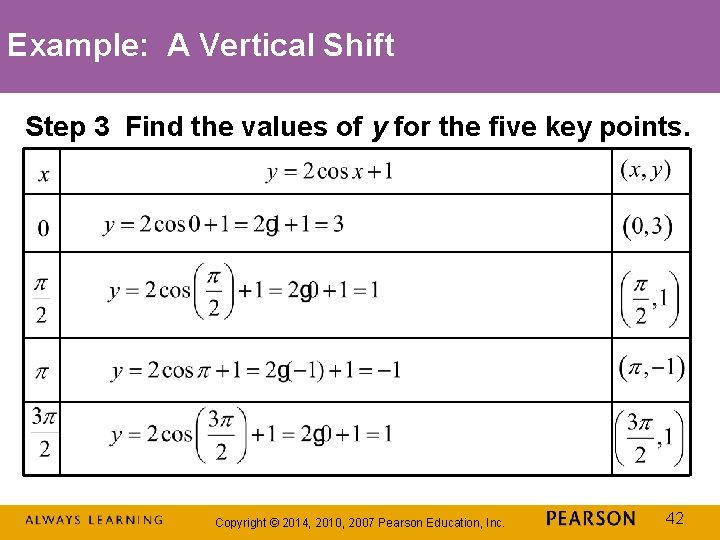
Example: A Vertical Shift Step 3 Find the values of y for the five key points. Copyright © 2014, 2010, 2007 Pearson Education, Inc. 42
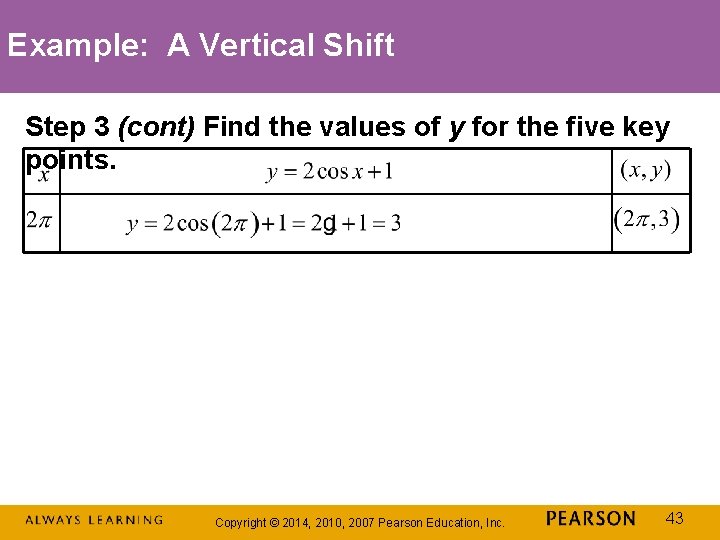
Example: A Vertical Shift Step 3 (cont) Find the values of y for the five key points. Copyright © 2014, 2010, 2007 Pearson Education, Inc. 43
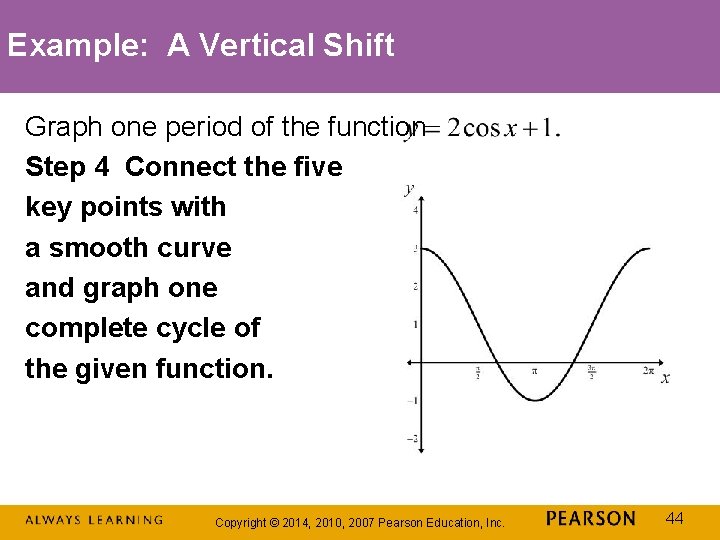
Example: A Vertical Shift Graph one period of the function Step 4 Connect the five key points with a smooth curve and graph one complete cycle of the given function. Copyright © 2014, 2010, 2007 Pearson Education, Inc. 44
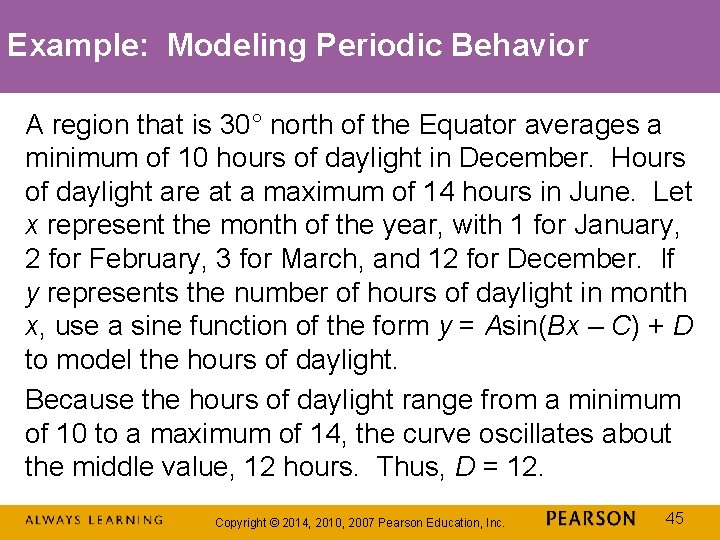
Example: Modeling Periodic Behavior A region that is 30° north of the Equator averages a minimum of 10 hours of daylight in December. Hours of daylight are at a maximum of 14 hours in June. Let x represent the month of the year, with 1 for January, 2 for February, 3 for March, and 12 for December. If y represents the number of hours of daylight in month x, use a sine function of the form y = Asin(Bx – C) + D to model the hours of daylight. Because the hours of daylight range from a minimum of 10 to a maximum of 14, the curve oscillates about the middle value, 12 hours. Thus, D = 12. Copyright © 2014, 2010, 2007 Pearson Education, Inc. 45
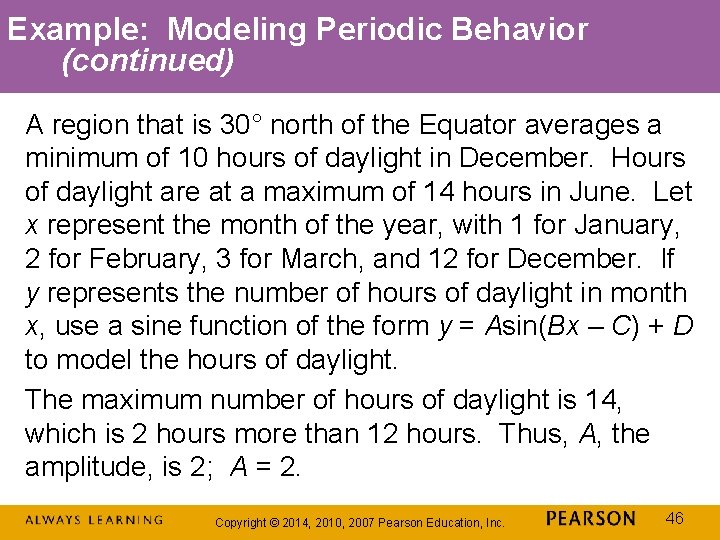
Example: Modeling Periodic Behavior (continued) A region that is 30° north of the Equator averages a minimum of 10 hours of daylight in December. Hours of daylight are at a maximum of 14 hours in June. Let x represent the month of the year, with 1 for January, 2 for February, 3 for March, and 12 for December. If y represents the number of hours of daylight in month x, use a sine function of the form y = Asin(Bx – C) + D to model the hours of daylight. The maximum number of hours of daylight is 14, which is 2 hours more than 12 hours. Thus, A, the amplitude, is 2; A = 2. Copyright © 2014, 2010, 2007 Pearson Education, Inc. 46
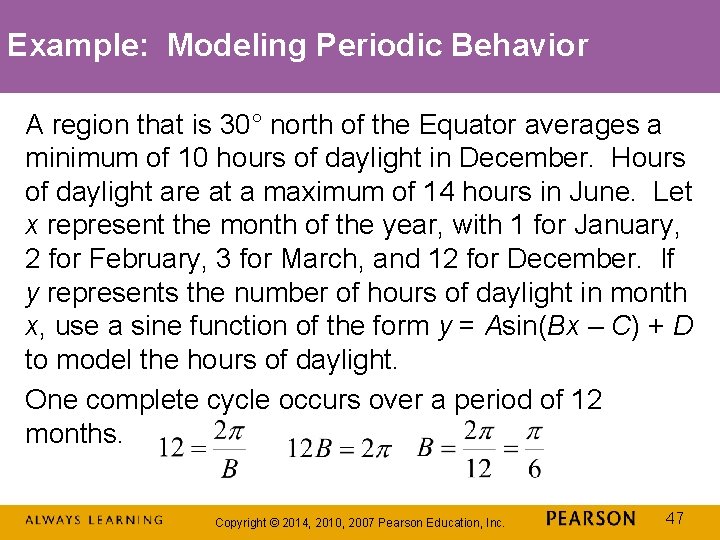
Example: Modeling Periodic Behavior A region that is 30° north of the Equator averages a minimum of 10 hours of daylight in December. Hours of daylight are at a maximum of 14 hours in June. Let x represent the month of the year, with 1 for January, 2 for February, 3 for March, and 12 for December. If y represents the number of hours of daylight in month x, use a sine function of the form y = Asin(Bx – C) + D to model the hours of daylight. One complete cycle occurs over a period of 12 months. Copyright © 2014, 2010, 2007 Pearson Education, Inc. 47
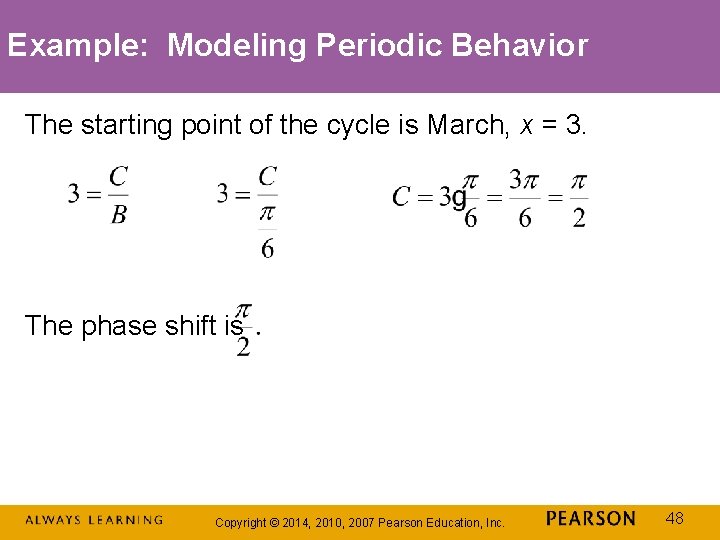
Example: Modeling Periodic Behavior The starting point of the cycle is March, x = 3. The phase shift is Copyright © 2014, 2010, 2007 Pearson Education, Inc. 48
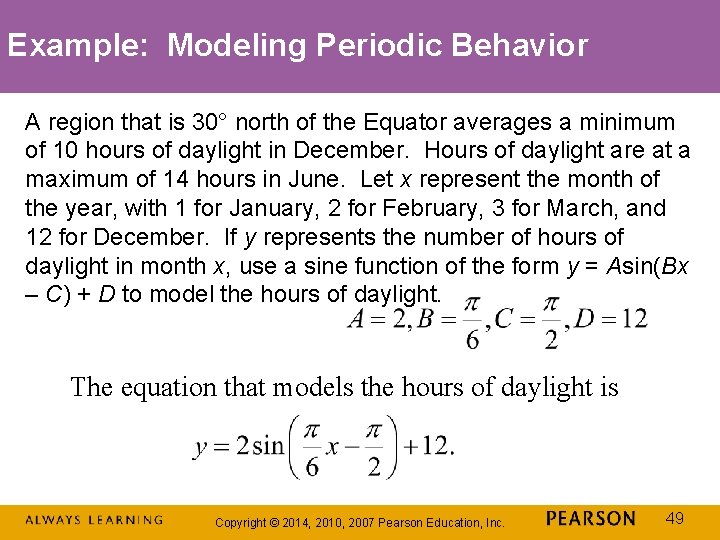
Example: Modeling Periodic Behavior A region that is 30° north of the Equator averages a minimum of 10 hours of daylight in December. Hours of daylight are at a maximum of 14 hours in June. Let x represent the month of the year, with 1 for January, 2 for February, 3 for March, and 12 for December. If y represents the number of hours of daylight in month x, use a sine function of the form y = Asin(Bx – C) + D to model the hours of daylight. The equation that models the hours of daylight is Copyright © 2014, 2010, 2007 Pearson Education, Inc. 49