
Chapter 4 Transceiver Architectures 4 1 General Considerations
- Slides: 137
Chapter 4 Transceiver Architectures Ø Ø 4. 1 General Considerations 4. 2 Receiver Architectures 4. 3 Transmitter Architectures 4. 4 OOK Transceivers Behzad Razavi, RF Microelectronics. 1 Prepared by Bo Wen, UCLA
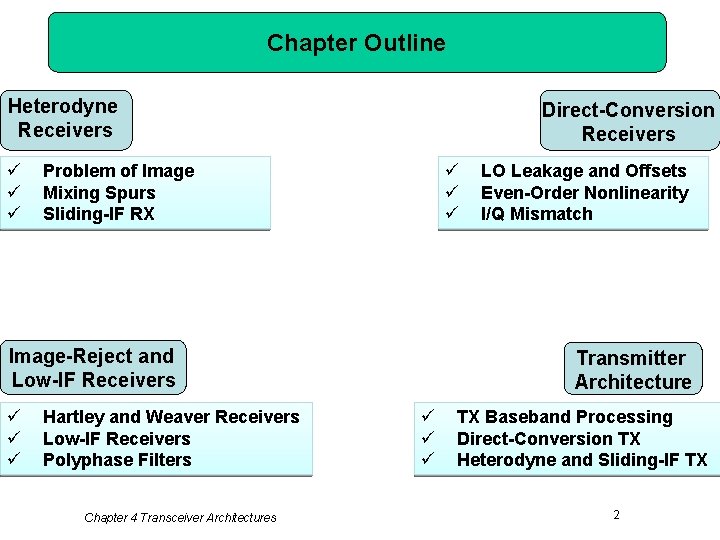
Chapter Outline Heterodyne Receivers ü ü ü Direct-Conversion Receivers ü ü ü Problem of Image Mixing Spurs Sliding-IF RX Image-Reject and Low-IF Receivers ü ü ü Hartley and Weaver Receivers Low-IF Receivers Polyphase Filters Chapter 4 Transceiver Architectures LO Leakage and Offsets Even-Order Nonlinearity I/Q Mismatch Transmitter Architecture ü ü ü TX Baseband Processing Direct-Conversion TX Heterodyne and Sliding-IF TX 2
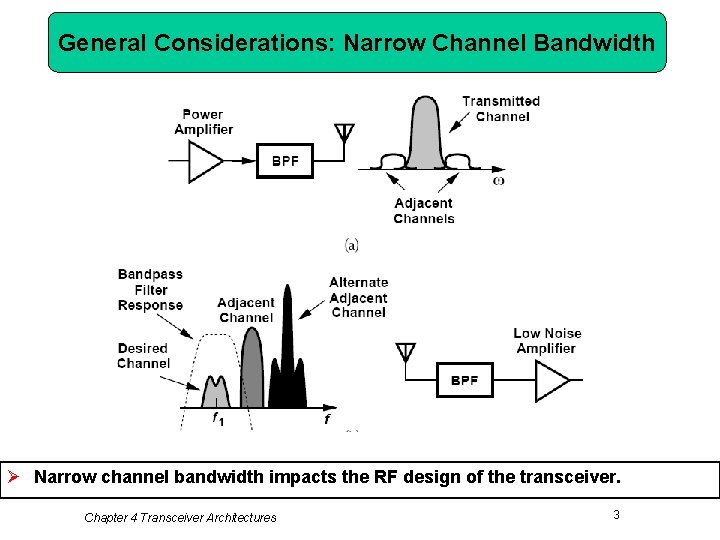
General Considerations: Narrow Channel Bandwidth Ø Narrow channel bandwidth impacts the RF design of the transceiver. Chapter 4 Transceiver Architectures 3
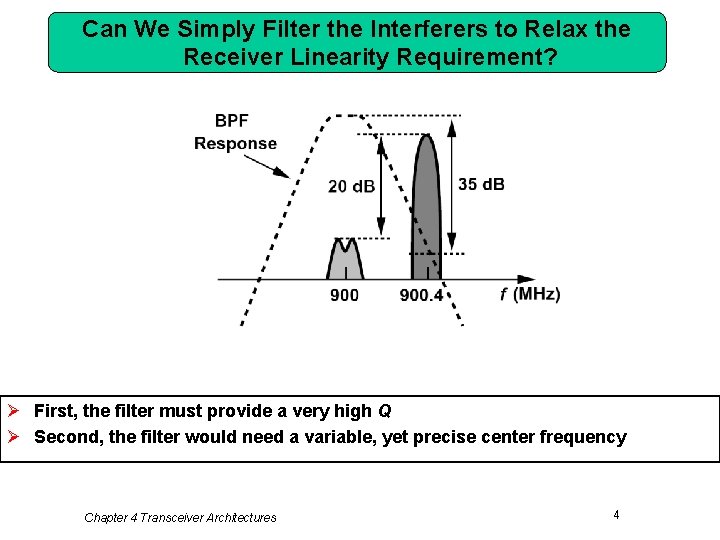
Can We Simply Filter the Interferers to Relax the Receiver Linearity Requirement? Ø First, the filter must provide a very high Q Ø Second, the filter would need a variable, yet precise center frequency Chapter 4 Transceiver Architectures 4
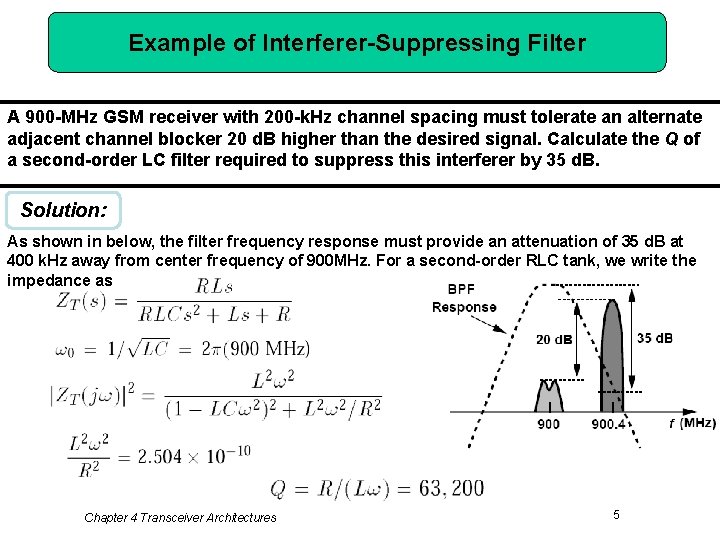
Example of Interferer-Suppressing Filter A 900 -MHz GSM receiver with 200 -k. Hz channel spacing must tolerate an alternate adjacent channel blocker 20 d. B higher than the desired signal. Calculate the Q of a second-order LC filter required to suppress this interferer by 35 d. B. Solution: As shown in below, the filter frequency response must provide an attenuation of 35 d. B at 400 k. Hz away from center frequency of 900 MHz. For a second-order RLC tank, we write the impedance as Chapter 4 Transceiver Architectures 5
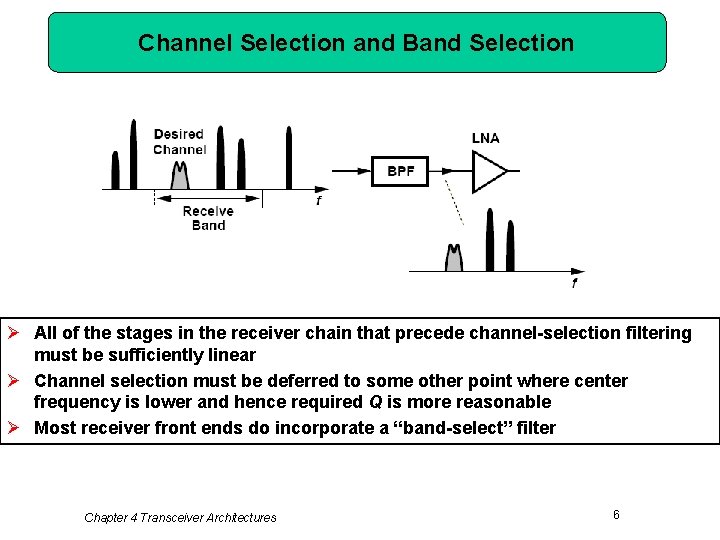
Channel Selection and Band Selection Ø All of the stages in the receiver chain that precede channel-selection filtering must be sufficiently linear Ø Channel selection must be deferred to some other point where center frequency is lower and hence required Q is more reasonable Ø Most receiver front ends do incorporate a “band-select” filter Chapter 4 Transceiver Architectures 6
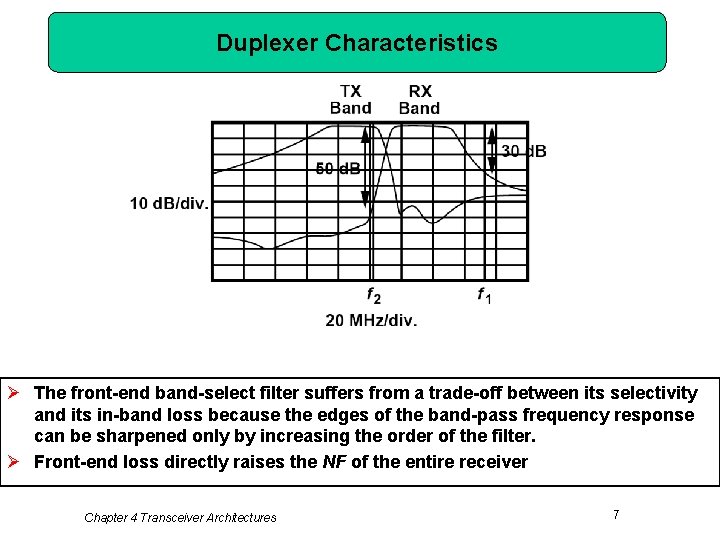
Duplexer Characteristics Ø The front-end band-select filter suffers from a trade-off between its selectivity and its in-band loss because the edges of the band-pass frequency response can be sharpened only by increasing the order of the filter. Ø Front-end loss directly raises the NF of the entire receiver Chapter 4 Transceiver Architectures 7
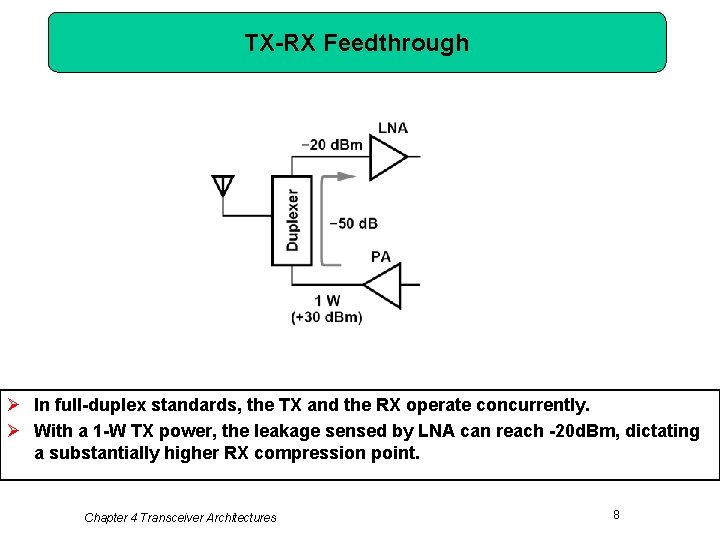
TX-RX Feedthrough Ø In full-duplex standards, the TX and the RX operate concurrently. Ø With a 1 -W TX power, the leakage sensed by LNA can reach -20 d. Bm, dictating a substantially higher RX compression point. Chapter 4 Transceiver Architectures 8
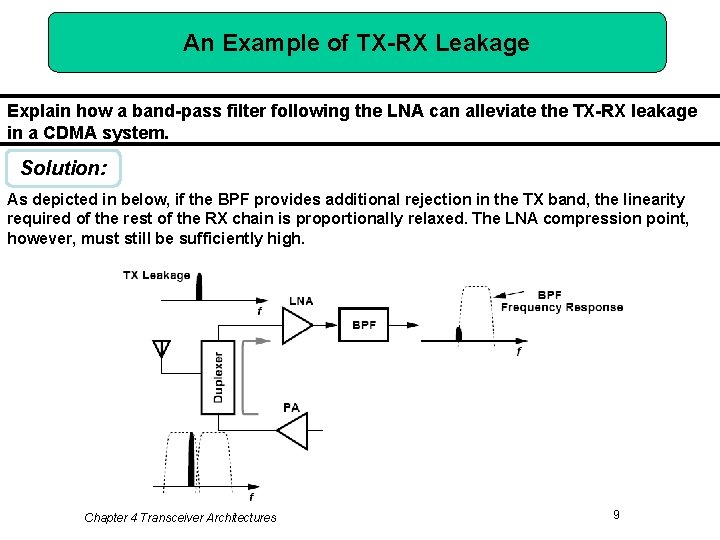
An Example of TX-RX Leakage Explain how a band-pass filter following the LNA can alleviate the TX-RX leakage in a CDMA system. Solution: As depicted in below, if the BPF provides additional rejection in the TX band, the linearity required of the rest of the RX chain is proportionally relaxed. The LNA compression point, however, must still be sufficiently high. Chapter 4 Transceiver Architectures 9
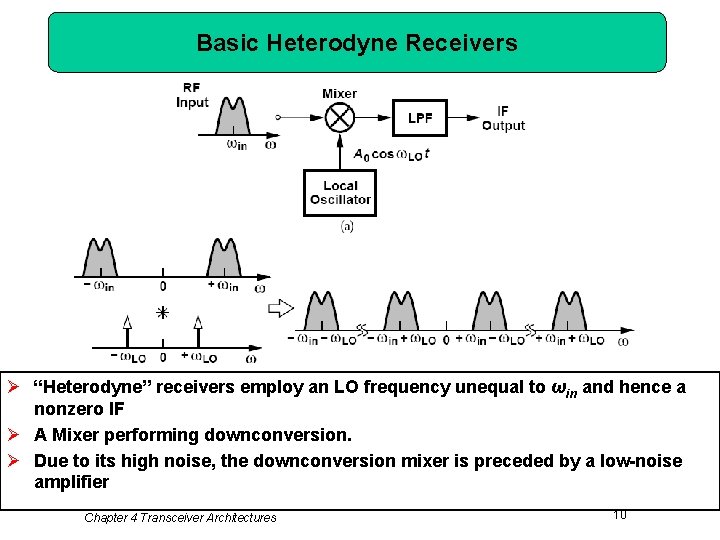
Basic Heterodyne Receivers Ø “Heterodyne” receivers employ an LO frequency unequal to ωin and hence a nonzero IF Ø A Mixer performing downconversion. Ø Due to its high noise, the downconversion mixer is preceded by a low-noise amplifier Chapter 4 Transceiver Architectures 10
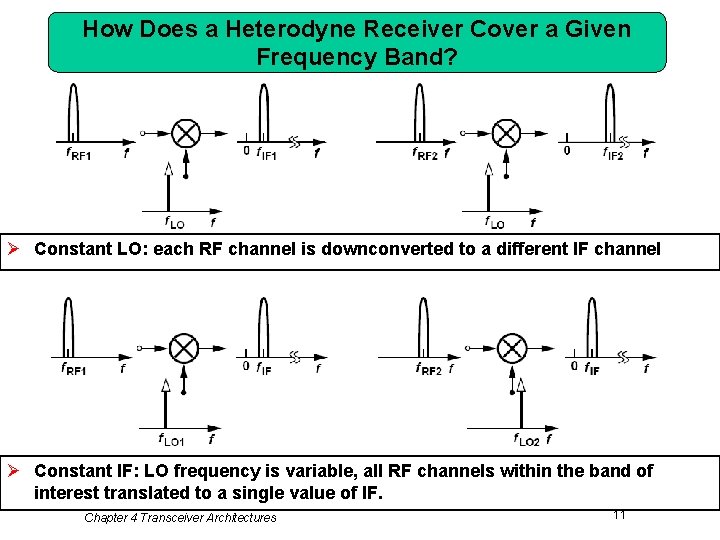
How Does a Heterodyne Receiver Cover a Given Frequency Band? Ø Constant LO: each RF channel is downconverted to a different IF channel Ø Constant IF: LO frequency is variable, all RF channels within the band of interest translated to a single value of IF. Chapter 4 Transceiver Architectures 11
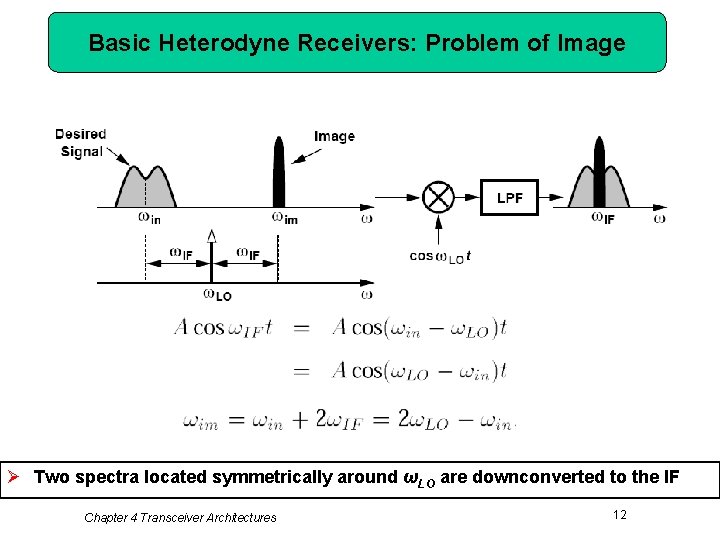
Basic Heterodyne Receivers: Problem of Image Ø Two spectra located symmetrically around ωLO are downconverted to the IF Chapter 4 Transceiver Architectures 12
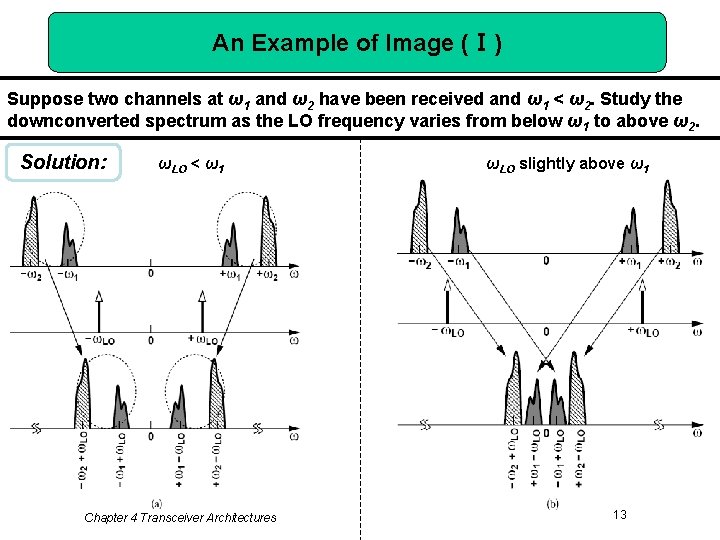
An Example of Image (Ⅰ) Suppose two channels at ω1 and ω2 have been received and ω1 < ω2. Study the downconverted spectrum as the LO frequency varies from below ω1 to above ω2. Solution: ωLO < ω1 Chapter 4 Transceiver Architectures ωLO slightly above ω1 13
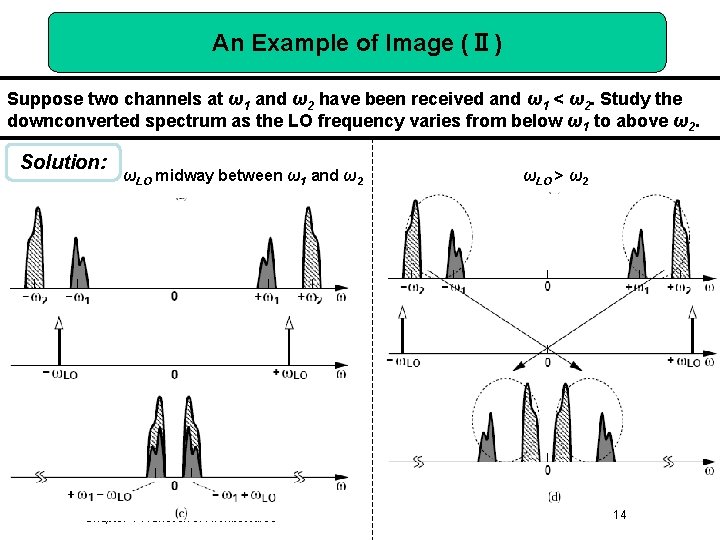
An Example of Image (Ⅱ) Suppose two channels at ω1 and ω2 have been received and ω1 < ω2. Study the downconverted spectrum as the LO frequency varies from below ω1 to above ω2. Solution: ωLO midway between ω1 and ω2 Chapter 4 Transceiver Architectures ωLO > ω2 14
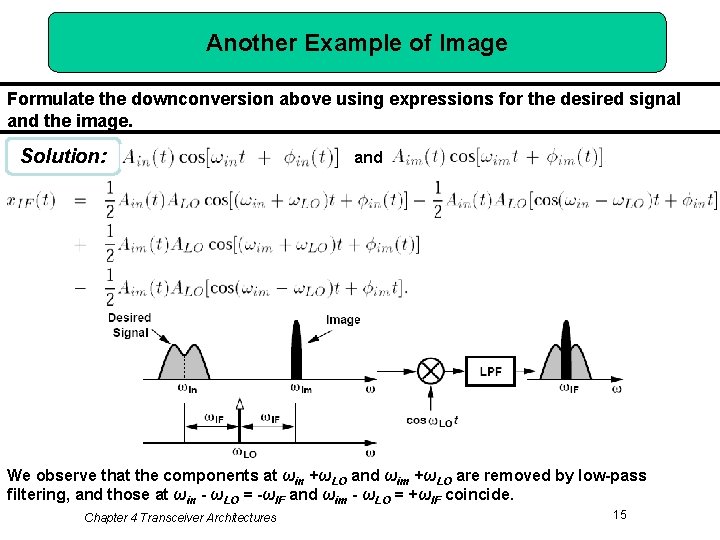
Another Example of Image Formulate the downconversion above using expressions for the desired signal and the image. Solution: and We observe that the components at ωin +ωLO and ωim +ωLO are removed by low-pass filtering, and those at ωin - ωLO = -ωIF and ωim - ωLO = +ωIF coincide. Chapter 4 Transceiver Architectures 15
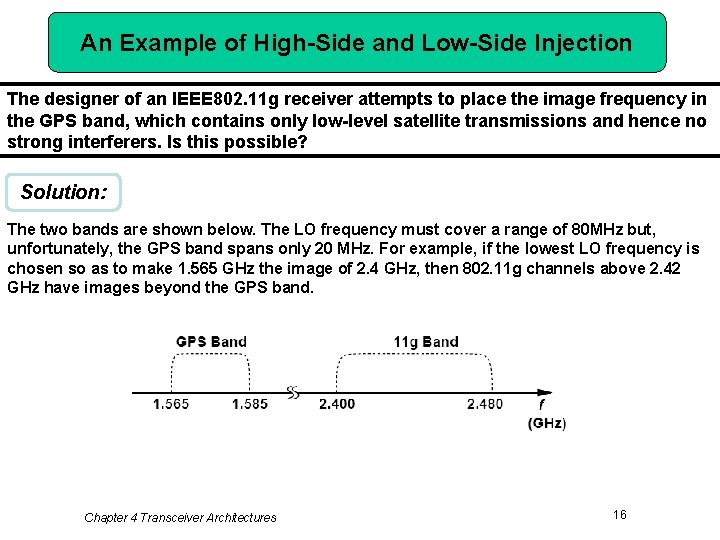
An Example of High-Side and Low-Side Injection The designer of an IEEE 802. 11 g receiver attempts to place the image frequency in the GPS band, which contains only low-level satellite transmissions and hence no strong interferers. Is this possible? Solution: The two bands are shown below. The LO frequency must cover a range of 80 MHz but, unfortunately, the GPS band spans only 20 MHz. For example, if the lowest LO frequency is chosen so as to make 1. 565 GHz the image of 2. 4 GHz, then 802. 11 g channels above 2. 42 GHz have images beyond the GPS band. Chapter 4 Transceiver Architectures 16
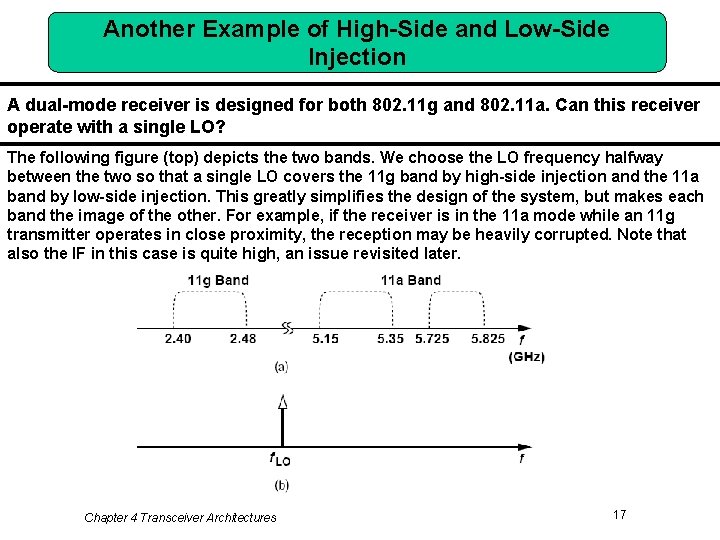
Another Example of High-Side and Low-Side Injection A dual-mode receiver is designed for both 802. 11 g and 802. 11 a. Can this receiver operate with a single LO? The following figure (top) depicts the two bands. We choose the LO frequency halfway between the two so that a single LO covers the 11 g band by high-side injection and the 11 a band by low-side injection. This greatly simplifies the design of the system, but makes each band the image of the other. For example, if the receiver is in the 11 a mode while an 11 g transmitter operates in close proximity, the reception may be heavily corrupted. Note that also the IF in this case is quite high, an issue revisited later. Chapter 4 Transceiver Architectures 17
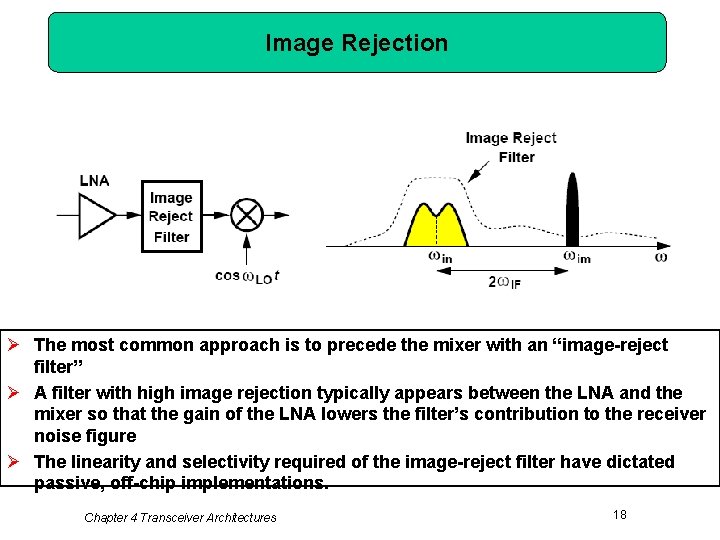
Image Rejection Ø The most common approach is to precede the mixer with an “image-reject filter” Ø A filter with high image rejection typically appears between the LNA and the mixer so that the gain of the LNA lowers the filter’s contribution to the receiver noise figure Ø The linearity and selectivity required of the image-reject filter have dictated passive, off-chip implementations. Chapter 4 Transceiver Architectures 18
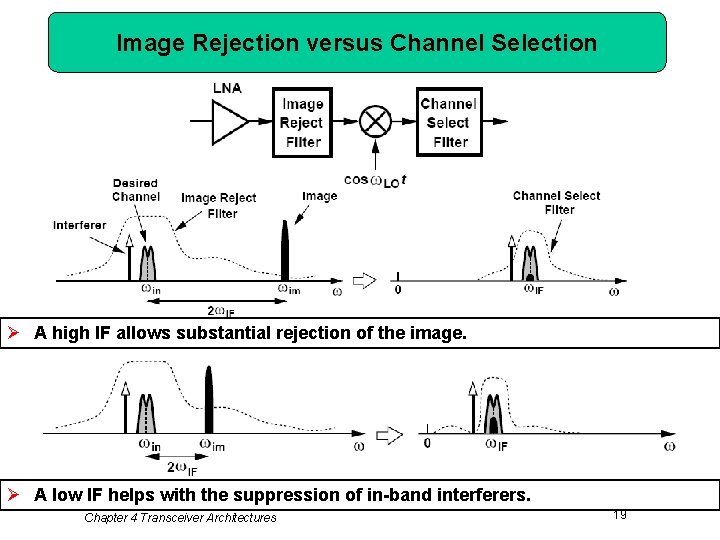
Image Rejection versus Channel Selection Ø A high IF allows substantial rejection of the image. Ø A low IF helps with the suppression of in-band interferers. Chapter 4 Transceiver Architectures 19
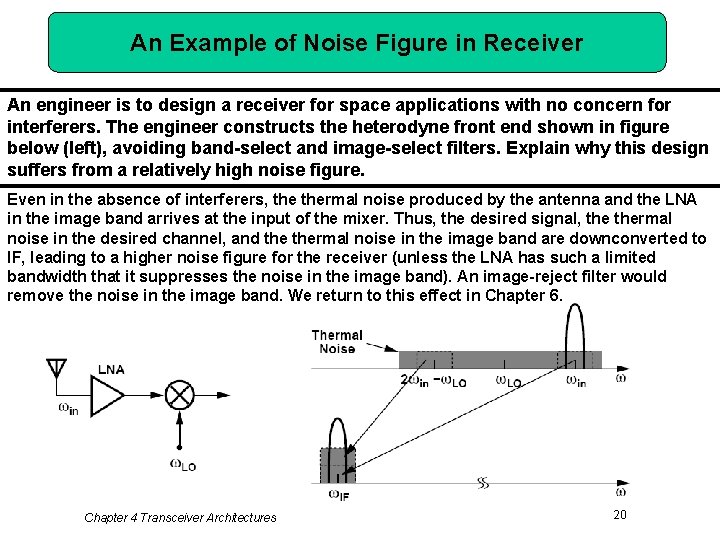
An Example of Noise Figure in Receiver An engineer is to design a receiver for space applications with no concern for interferers. The engineer constructs the heterodyne front end shown in figure below (left), avoiding band-select and image-select filters. Explain why this design suffers from a relatively high noise figure. Even in the absence of interferers, thermal noise produced by the antenna and the LNA in the image band arrives at the input of the mixer. Thus, the desired signal, thermal noise in the desired channel, and thermal noise in the image band are downconverted to IF, leading to a higher noise figure for the receiver (unless the LNA has such a limited bandwidth that it suppresses the noise in the image band). An image-reject filter would remove the noise in the image band. We return to this effect in Chapter 6. Chapter 4 Transceiver Architectures 20
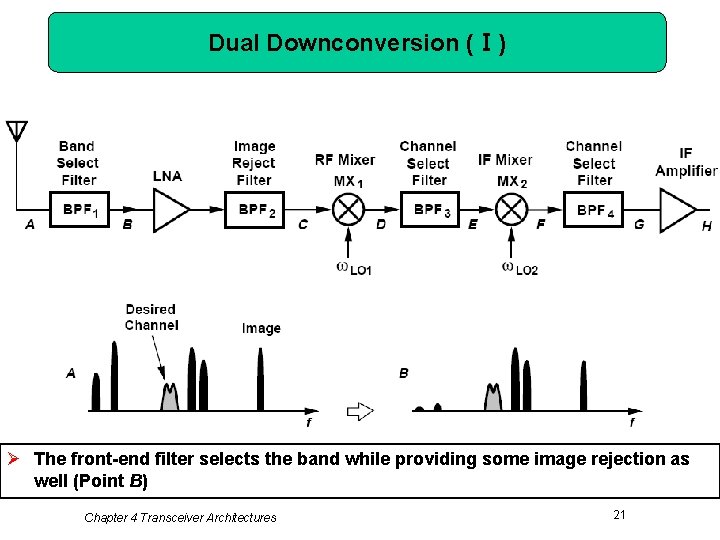
Dual Downconversion (Ⅰ) Ø The front-end filter selects the band while providing some image rejection as well (Point B) Chapter 4 Transceiver Architectures 21
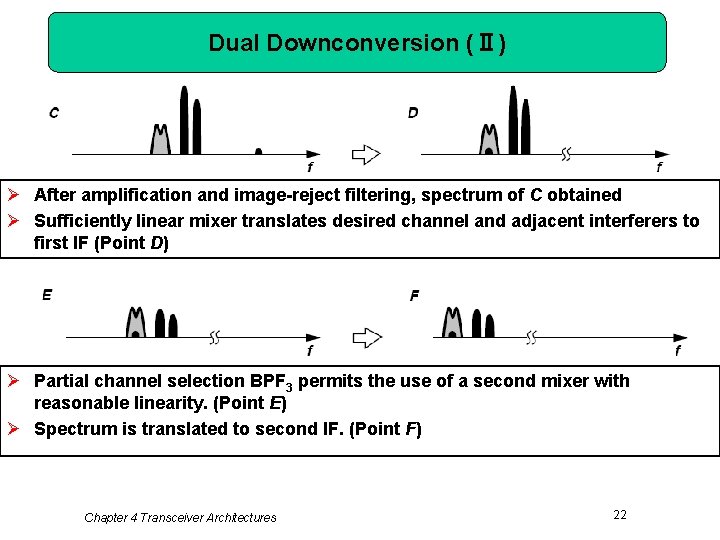
Dual Downconversion (Ⅱ) Ø After amplification and image-reject filtering, spectrum of C obtained Ø Sufficiently linear mixer translates desired channel and adjacent interferers to first IF (Point D) Ø Partial channel selection BPF 3 permits the use of a second mixer with reasonable linearity. (Point E) Ø Spectrum is translated to second IF. (Point F) Chapter 4 Transceiver Architectures 22
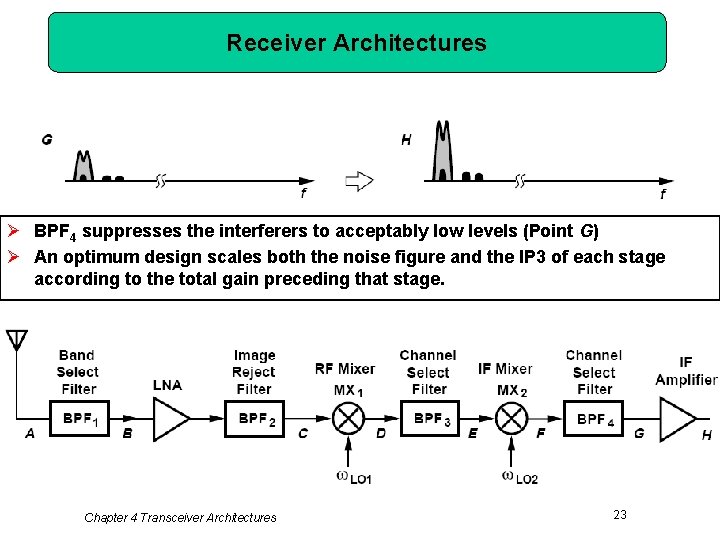
Receiver Architectures Ø BPF 4 suppresses the interferers to acceptably low levels (Point G) Ø An optimum design scales both the noise figure and the IP 3 of each stage according to the total gain preceding that stage. Chapter 4 Transceiver Architectures 23
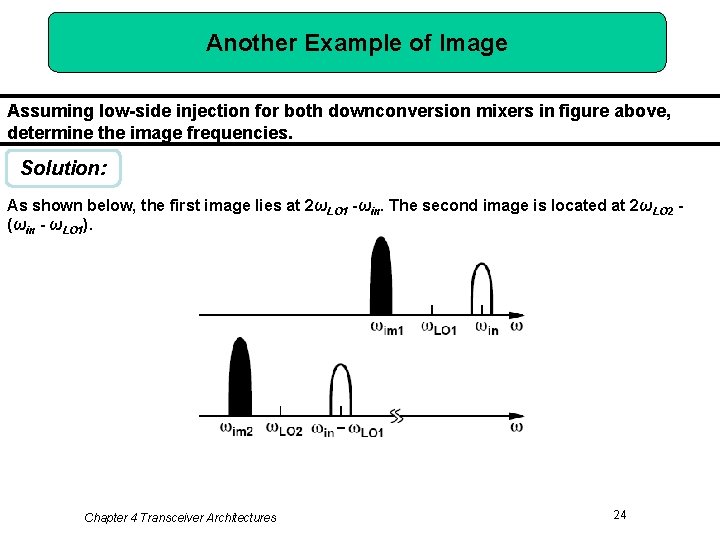
Another Example of Image Assuming low-side injection for both downconversion mixers in figure above, determine the image frequencies. Solution: As shown below, the first image lies at 2ωLO 1 -ωin. The second image is located at 2ωLO 2 (ωin - ωLO 1). Chapter 4 Transceiver Architectures 24
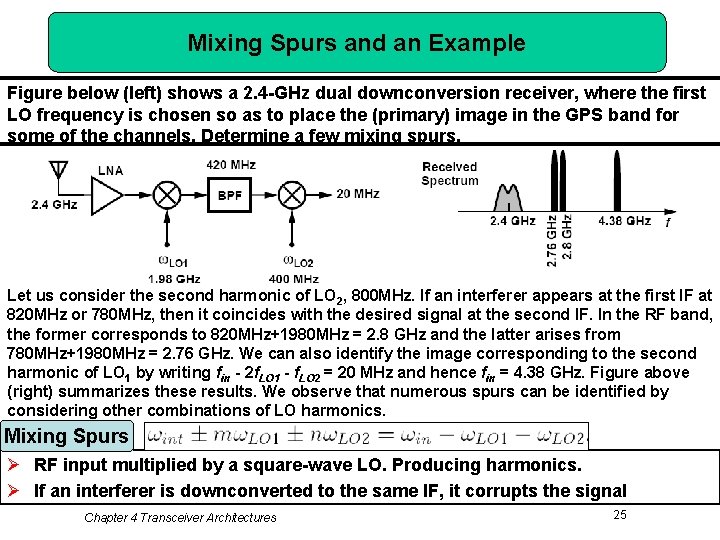
Mixing Spurs and an Example Figure below (left) shows a 2. 4 -GHz dual downconversion receiver, where the first LO frequency is chosen so as to place the (primary) image in the GPS band for some of the channels. Determine a few mixing spurs. Let us consider the second harmonic of LO 2, 800 MHz. If an interferer appears at the first IF at 820 MHz or 780 MHz, then it coincides with the desired signal at the second IF. In the RF band, the former corresponds to 820 MHz+1980 MHz = 2. 8 GHz and the latter arises from 780 MHz+1980 MHz = 2. 76 GHz. We can also identify the image corresponding to the second harmonic of LO 1 by writing fin - 2 f. LO 1 - f. LO 2 = 20 MHz and hence fin = 4. 38 GHz. Figure above (right) summarizes these results. We observe that numerous spurs can be identified by considering other combinations of LO harmonics. Mixing Spurs Ø RF input multiplied by a square-wave LO. Producing harmonics. Ø If an interferer is downconverted to the same IF, it corrupts the signal Chapter 4 Transceiver Architectures 25
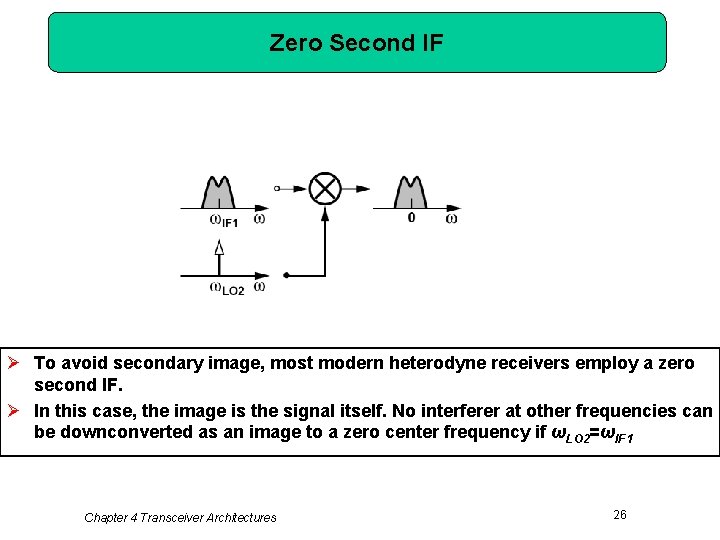
Zero Second IF Ø To avoid secondary image, most modern heterodyne receivers employ a zero second IF. Ø In this case, the image is the signal itself. No interferer at other frequencies can be downconverted as an image to a zero center frequency if ωLO 2=ωIF 1 Chapter 4 Transceiver Architectures 26
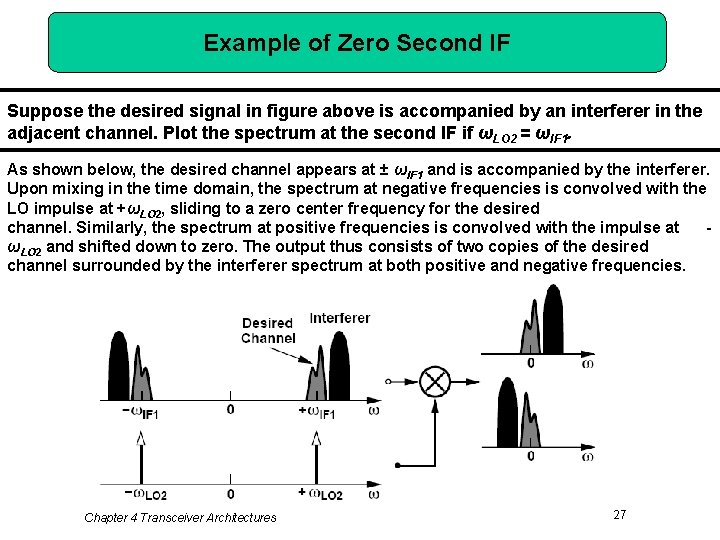
Example of Zero Second IF Suppose the desired signal in figure above is accompanied by an interferer in the adjacent channel. Plot the spectrum at the second IF if ωLO 2 = ωIF 1. As shown below, the desired channel appears at ± ωIF 1 and is accompanied by the interferer. Upon mixing in the time domain, the spectrum at negative frequencies is convolved with the LO impulse at +ωLO 2, sliding to a zero center frequency for the desired channel. Similarly, the spectrum at positive frequencies is convolved with the impulse at ωLO 2 and shifted down to zero. The output thus consists of two copies of the desired channel surrounded by the interferer spectrum at both positive and negative frequencies. Chapter 4 Transceiver Architectures 27
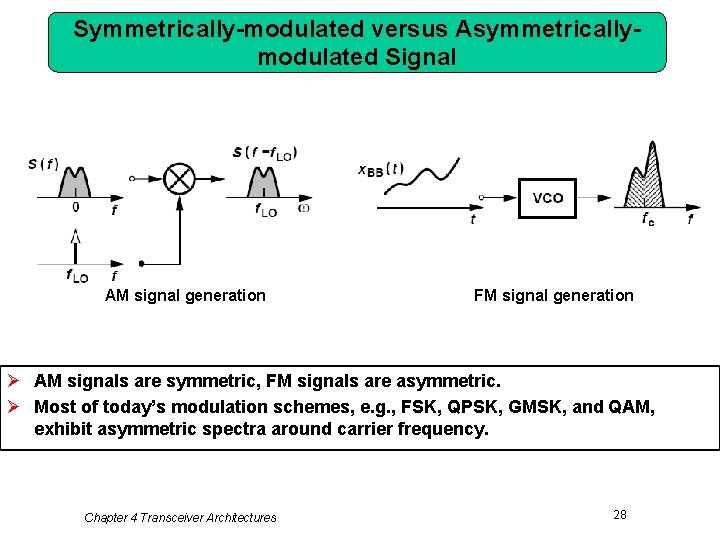
Symmetrically-modulated versus Asymmetricallymodulated Signal AM signal generation FM signal generation Ø AM signals are symmetric, FM signals are asymmetric. Ø Most of today’s modulation schemes, e. g. , FSK, QPSK, GMSK, and QAM, exhibit asymmetric spectra around carrier frequency. Chapter 4 Transceiver Architectures 28
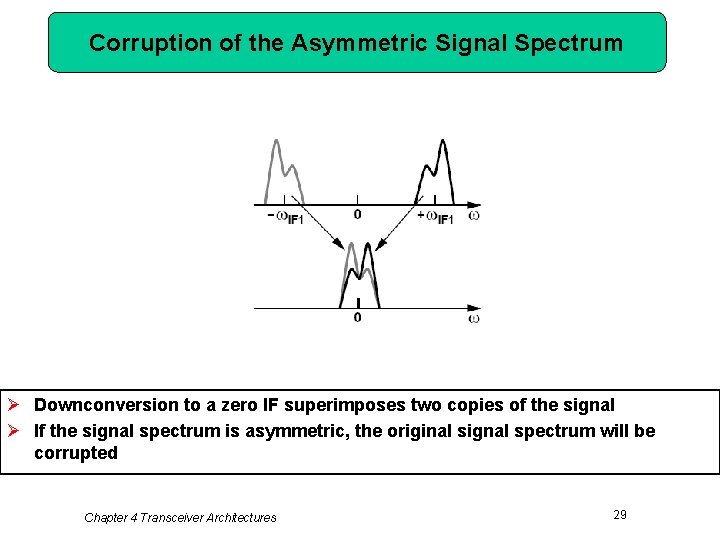
Corruption of the Asymmetric Signal Spectrum Ø Downconversion to a zero IF superimposes two copies of the signal Ø If the signal spectrum is asymmetric, the original signal spectrum will be corrupted Chapter 4 Transceiver Architectures 29
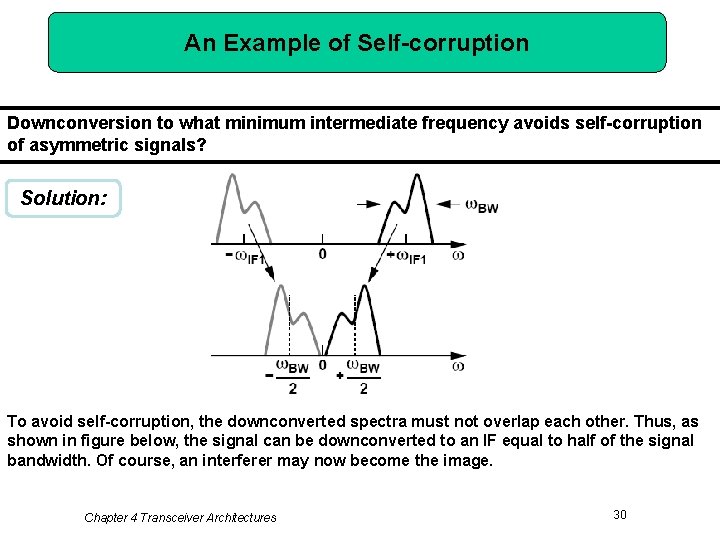
An Example of Self-corruption Downconversion to what minimum intermediate frequency avoids self-corruption of asymmetric signals? Solution: To avoid self-corruption, the downconverted spectra must not overlap each other. Thus, as shown in figure below, the signal can be downconverted to an IF equal to half of the signal bandwidth. Of course, an interferer may now become the image. Chapter 4 Transceiver Architectures 30
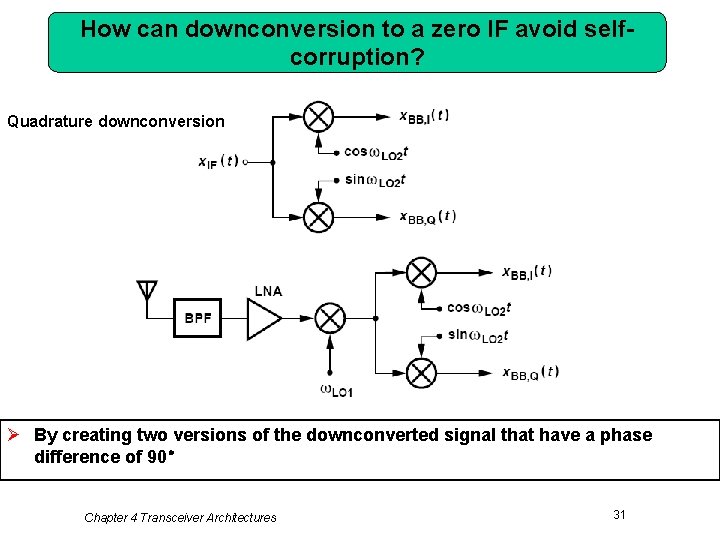
How can downconversion to a zero IF avoid selfcorruption? Quadrature downconversion Ø By creating two versions of the downconverted signal that have a phase difference of 90。 Chapter 4 Transceiver Architectures 31
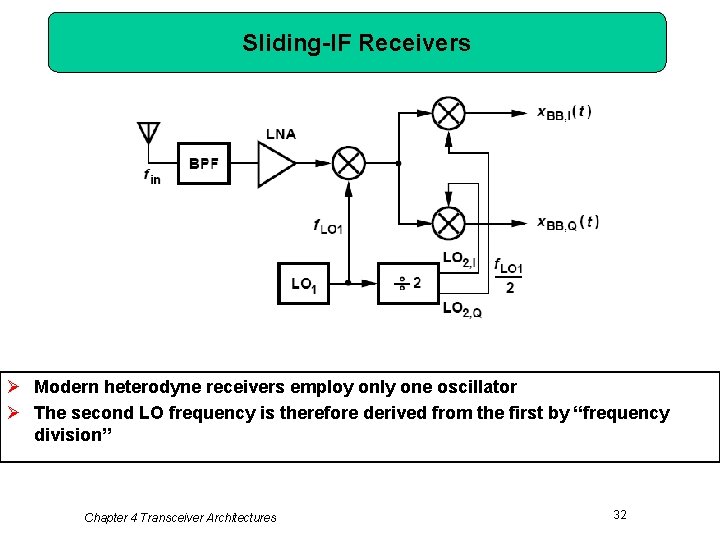
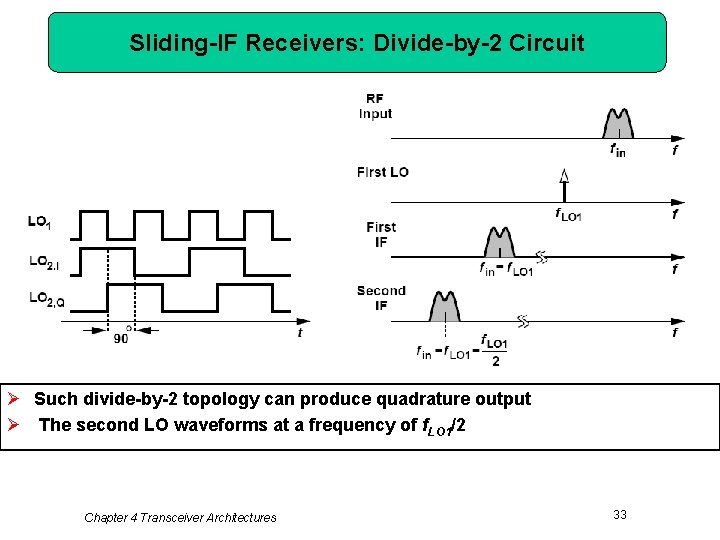
Sliding-IF Receivers Ø Modern heterodyne receivers employ only one oscillator Ø The second LO frequency is therefore derived from the first by “frequency division” Chapter 4 Transceiver Architectures 32
Sliding-IF Receivers: Divide-by-2 Circuit Ø Such divide-by-2 topology can produce quadrature output Ø The second LO waveforms at a frequency of f. LO 1/2 Chapter 4 Transceiver Architectures 33
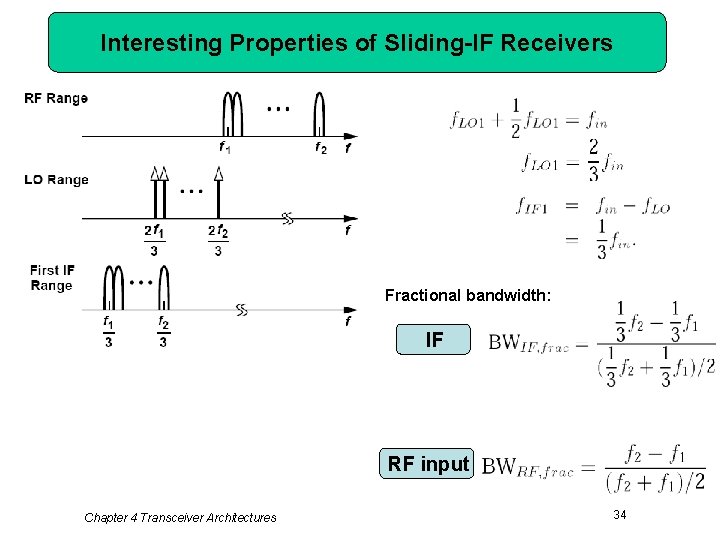
Interesting Properties of Sliding-IF Receivers Fractional bandwidth: IF RF input Chapter 4 Transceiver Architectures 34
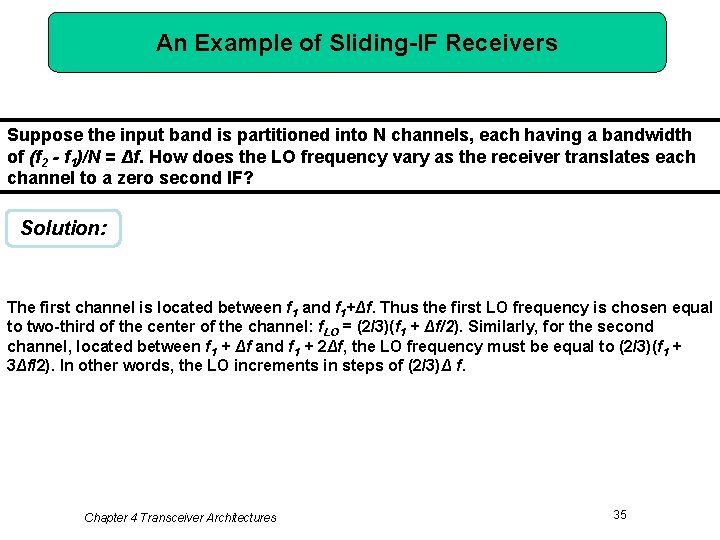
An Example of Sliding-IF Receivers Suppose the input band is partitioned into N channels, each having a bandwidth of (f 2 - f 1)/N = Δf. How does the LO frequency vary as the receiver translates each channel to a zero second IF? Solution: The first channel is located between f 1 and f 1+Δf. Thus the first LO frequency is chosen equal to two-third of the center of the channel: f. LO = (2/3)(f 1 + Δf/2). Similarly, for the second channel, located between f 1 + Δf and f 1 + 2Δf, the LO frequency must be equal to (2/3)(f 1 + 3Δf/2). In other words, the LO increments in steps of (2/3)Δ f. Chapter 4 Transceiver Architectures 35
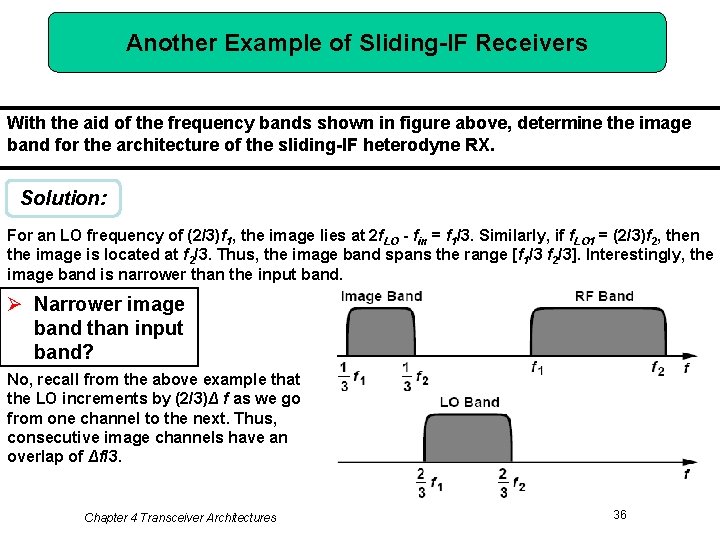
Another Example of Sliding-IF Receivers With the aid of the frequency bands shown in figure above, determine the image band for the architecture of the sliding-IF heterodyne RX. Solution: For an LO frequency of (2/3)f 1, the image lies at 2 f. LO - fin = f 1/3. Similarly, if f. LO 1 = (2/3)f 2, then the image is located at f 2/3. Thus, the image band spans the range [f 1/3 f 2/3]. Interestingly, the image band is narrower than the input band. Ø Narrower image band than input band? No, recall from the above example that the LO increments by (2/3)Δ f as we go from one channel to the next. Thus, consecutive image channels have an overlap of Δf/3. Chapter 4 Transceiver Architectures 36
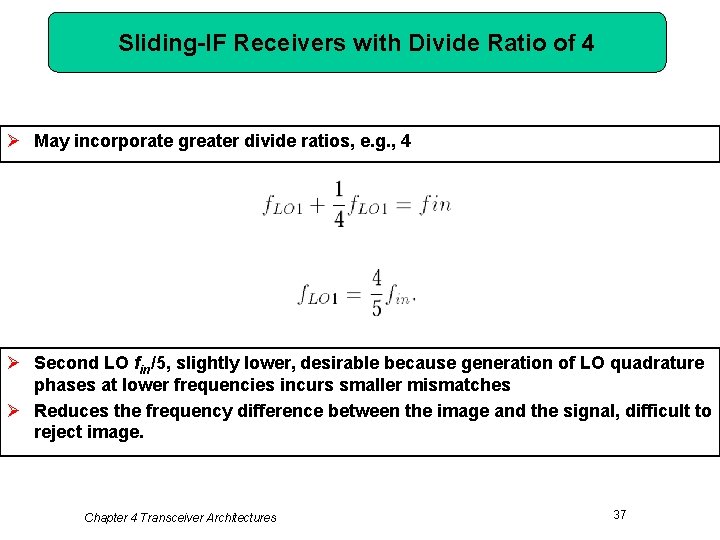
Sliding-IF Receivers with Divide Ratio of 4 Ø May incorporate greater divide ratios, e. g. , 4 Ø Second LO fin/5, slightly lower, desirable because generation of LO quadrature phases at lower frequencies incurs smaller mismatches Ø Reduces the frequency difference between the image and the signal, difficult to reject image. Chapter 4 Transceiver Architectures 37
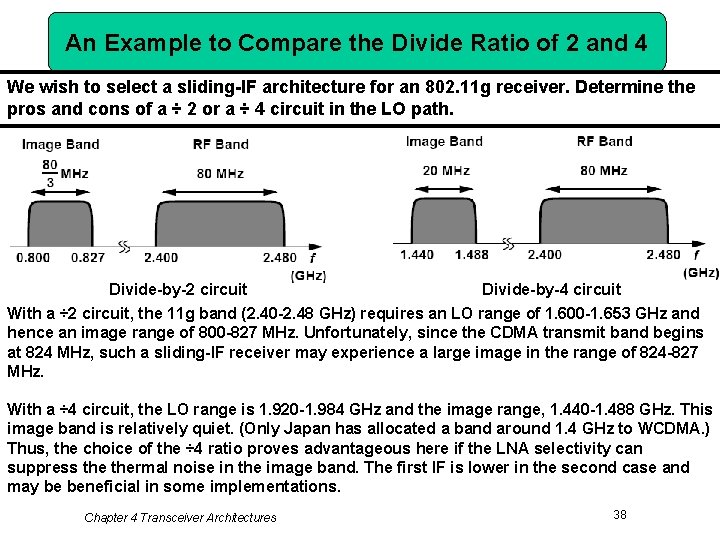
An Example to Compare the Divide Ratio of 2 and 4 We wish to select a sliding-IF architecture for an 802. 11 g receiver. Determine the pros and cons of a ÷ 2 or a ÷ 4 circuit in the LO path. Divide-by-2 circuit Divide-by-4 circuit With a ÷ 2 circuit, the 11 g band (2. 40 -2. 48 GHz) requires an LO range of 1. 600 -1. 653 GHz and hence an image range of 800 -827 MHz. Unfortunately, since the CDMA transmit band begins at 824 MHz, such a sliding-IF receiver may experience a large image in the range of 824 -827 MHz. With a ÷ 4 circuit, the LO range is 1. 920 -1. 984 GHz and the image range, 1. 440 -1. 488 GHz. This image band is relatively quiet. (Only Japan has allocated a band around 1. 4 GHz to WCDMA. ) Thus, the choice of the ÷ 4 ratio proves advantageous here if the LNA selectivity can suppress thermal noise in the image band. The first IF is lower in the second case and may be beneficial in some implementations. Chapter 4 Transceiver Architectures 38
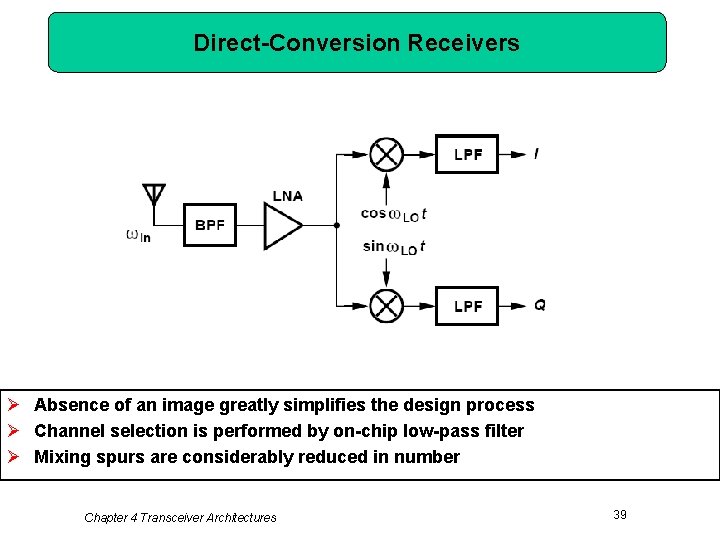
Direct-Conversion Receivers Ø Absence of an image greatly simplifies the design process Ø Channel selection is performed by on-chip low-pass filter Ø Mixing spurs are considerably reduced in number Chapter 4 Transceiver Architectures 39
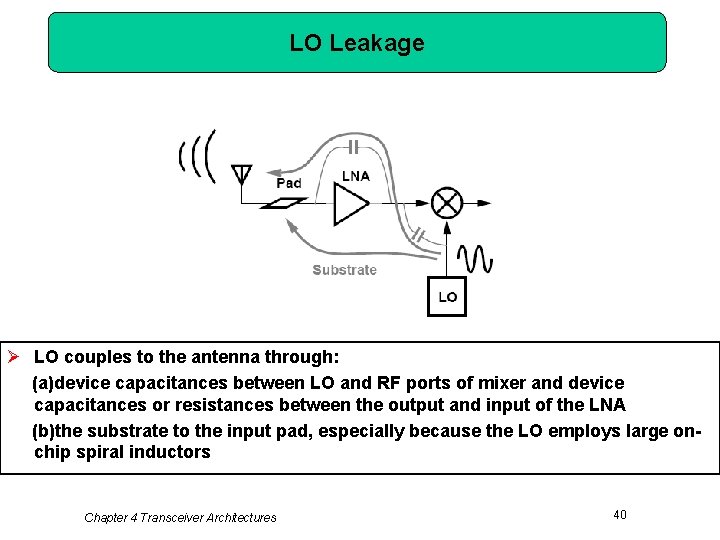
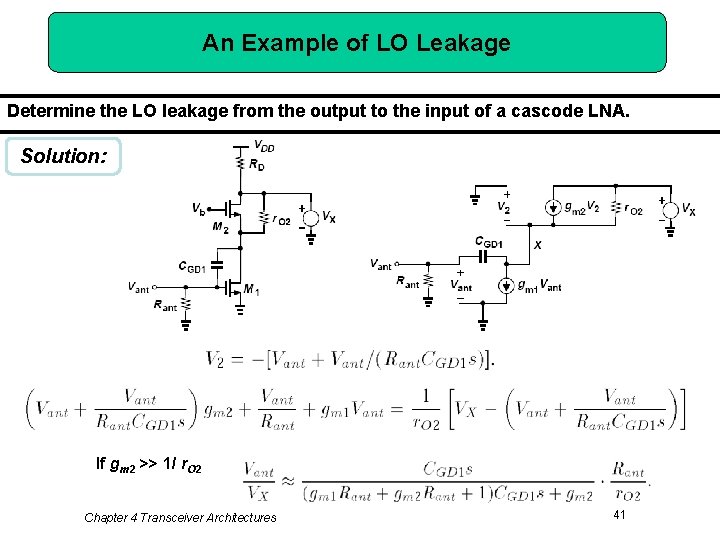
LO Leakage Ø LO couples to the antenna through: (a)device capacitances between LO and RF ports of mixer and device capacitances or resistances between the output and input of the LNA (b)the substrate to the input pad, especially because the LO employs large onchip spiral inductors Chapter 4 Transceiver Architectures 40
An Example of LO Leakage Determine the LO leakage from the output to the input of a cascode LNA. Solution: If gm 2 >> 1/ r. O 2 Chapter 4 Transceiver Architectures 41
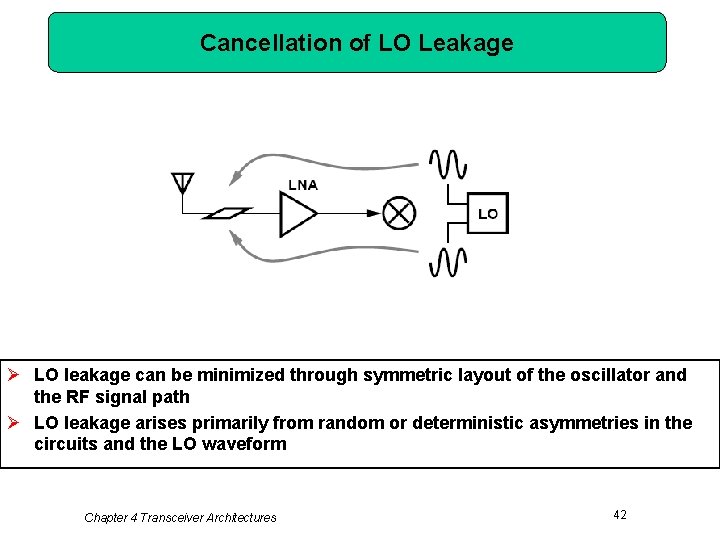
Cancellation of LO Leakage Ø LO leakage can be minimized through symmetric layout of the oscillator and the RF signal path Ø LO leakage arises primarily from random or deterministic asymmetries in the circuits and the LO waveform Chapter 4 Transceiver Architectures 42
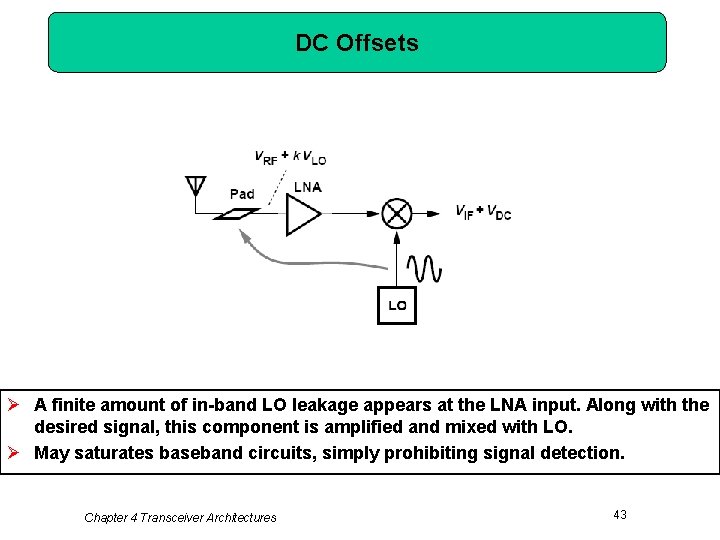
DC Offsets Ø A finite amount of in-band LO leakage appears at the LNA input. Along with the desired signal, this component is amplified and mixed with LO. Ø May saturates baseband circuits, simply prohibiting signal detection. Chapter 4 Transceiver Architectures 43
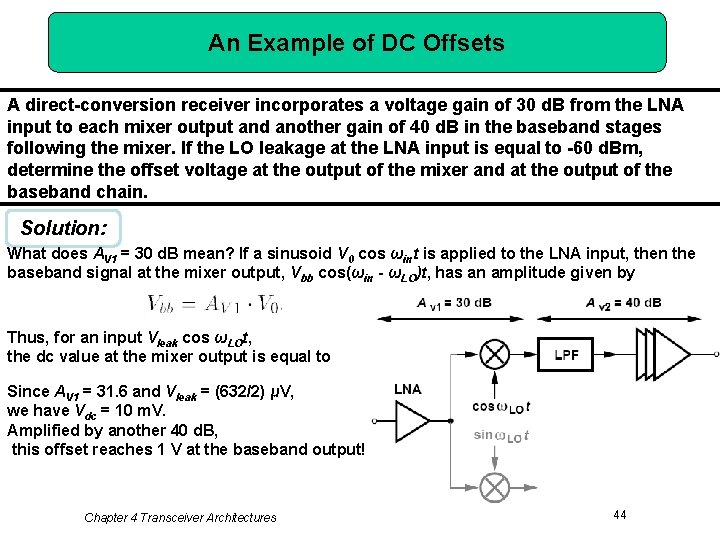
An Example of DC Offsets A direct-conversion receiver incorporates a voltage gain of 30 d. B from the LNA input to each mixer output and another gain of 40 d. B in the baseband stages following the mixer. If the LO leakage at the LNA input is equal to -60 d. Bm, determine the offset voltage at the output of the mixer and at the output of the baseband chain. Solution: What does AV 1 = 30 d. B mean? If a sinusoid V 0 cos ωint is applied to the LNA input, then the baseband signal at the mixer output, Vbb cos(ωin - ωLO)t, has an amplitude given by Thus, for an input Vleak cos ωLOt, the dc value at the mixer output is equal to Since AV 1 = 31. 6 and Vleak = (632/2) μV, we have Vdc = 10 m. V. Amplified by another 40 d. B, this offset reaches 1 V at the baseband output! Chapter 4 Transceiver Architectures 44
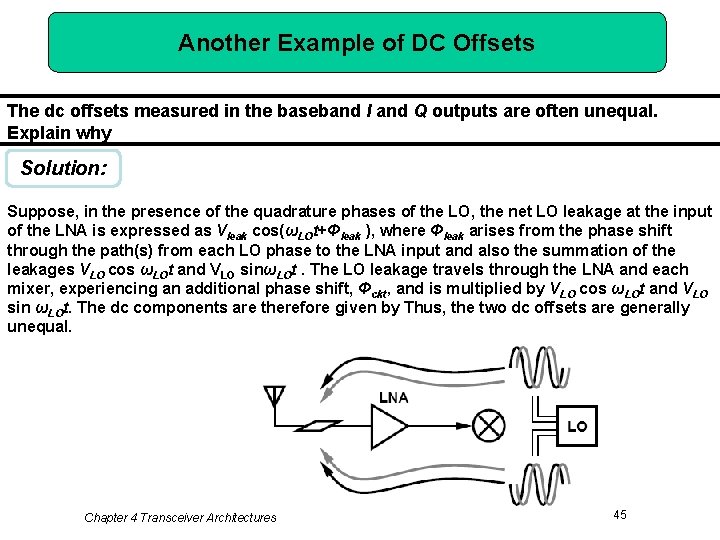
Another Example of DC Offsets The dc offsets measured in the baseband I and Q outputs are often unequal. Explain why Solution: Suppose, in the presence of the quadrature phases of the LO, the net LO leakage at the input of the LNA is expressed as Vleak cos(ωLOt+Φleak ), where Φleak arises from the phase shift through the path(s) from each LO phase to the LNA input and also the summation of the leakages VLO cos ωLOt and VLO sinωLOt. The LO leakage travels through the LNA and each mixer, experiencing an additional phase shift, Φckt, and is multiplied by VLO cos ωLOt and VLO sin ωLOt. The dc components are therefore given by Thus, the two dc offsets are generally unequal. Chapter 4 Transceiver Architectures 45
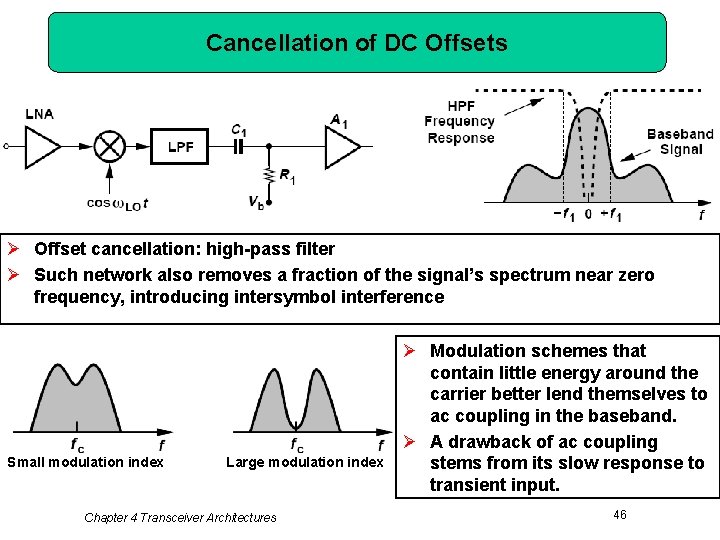
Cancellation of DC Offsets Ø Offset cancellation: high-pass filter Ø Such network also removes a fraction of the signal’s spectrum near zero frequency, introducing intersymbol interference Small modulation index Large modulation index Chapter 4 Transceiver Architectures Ø Modulation schemes that contain little energy around the carrier better lend themselves to ac coupling in the baseband. Ø A drawback of ac coupling stems from its slow response to transient input. 46
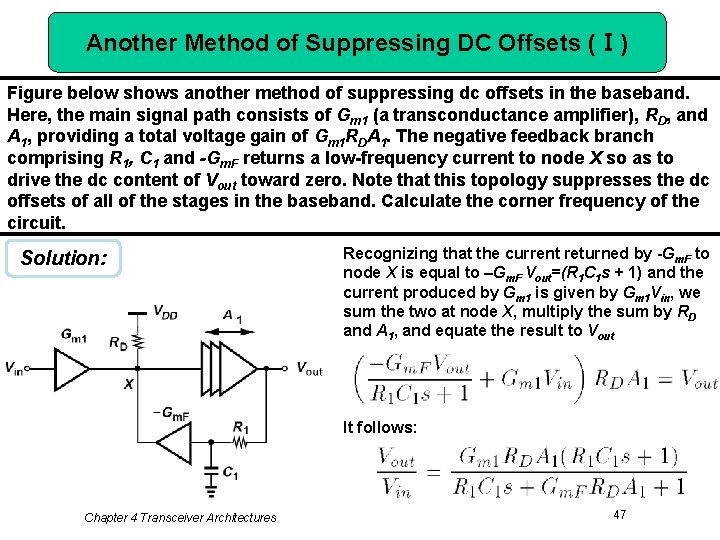
Another Method of Suppressing DC Offsets (Ⅰ) Figure below shows another method of suppressing dc offsets in the baseband. Here, the main signal path consists of Gm 1 (a transconductance amplifier), RD, and A 1, providing a total voltage gain of Gm 1 RDA 1. The negative feedback branch comprising R 1, C 1 and -Gm. F returns a low-frequency current to node X so as to drive the dc content of Vout toward zero. Note that this topology suppresses the dc offsets of all of the stages in the baseband. Calculate the corner frequency of the circuit. Solution: Recognizing that the current returned by -Gm. F to node X is equal to –Gm. F Vout=(R 1 C 1 s + 1) and the current produced by Gm 1 is given by Gm 1 Vin, we sum the two at node X, multiply the sum by RD and A 1, and equate the result to Vout It follows: Chapter 4 Transceiver Architectures 47
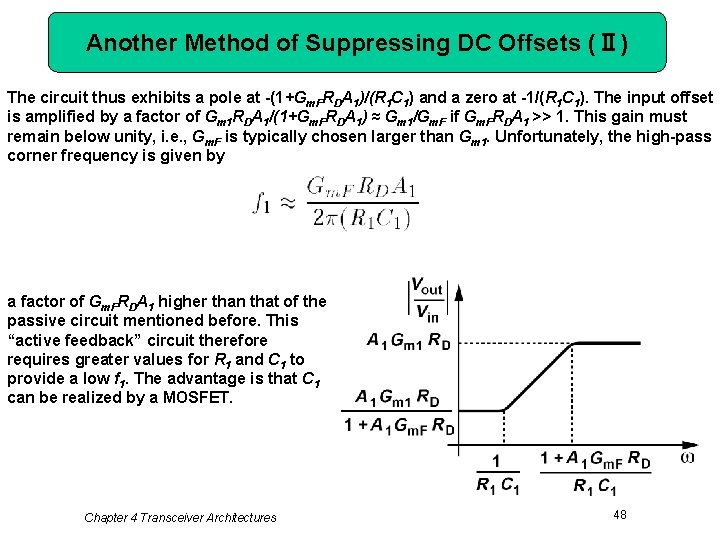
Another Method of Suppressing DC Offsets (Ⅱ) The circuit thus exhibits a pole at -(1+Gm. FRDA 1)/(R 1 C 1) and a zero at -1/(R 1 C 1). The input offset is amplified by a factor of Gm 1 RDA 1/(1+Gm. FRDA 1) ≈ Gm 1/Gm. F if Gm. FRDA 1 >> 1. This gain must remain below unity, i. e. , Gm. F is typically chosen larger than Gm 1. Unfortunately, the high-pass corner frequency is given by a factor of Gm. FRDA 1 higher than that of the passive circuit mentioned before. This “active feedback” circuit therefore requires greater values for R 1 and C 1 to provide a low f 1. The advantage is that C 1 can be realized by a MOSFET. Chapter 4 Transceiver Architectures 48
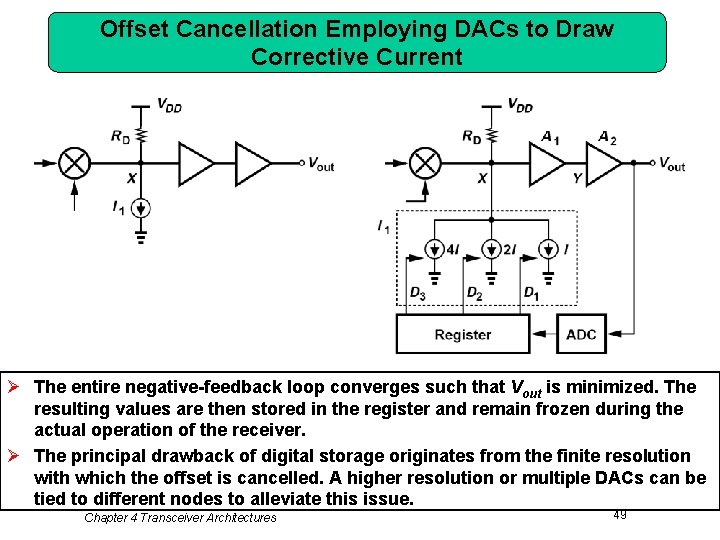
Offset Cancellation Employing DACs to Draw Corrective Current Ø The entire negative-feedback loop converges such that Vout is minimized. The resulting values are then stored in the register and remain frozen during the actual operation of the receiver. Ø The principal drawback of digital storage originates from the finite resolution with which the offset is cancelled. A higher resolution or multiple DACs can be tied to different nodes to alleviate this issue. Chapter 4 Transceiver Architectures 49
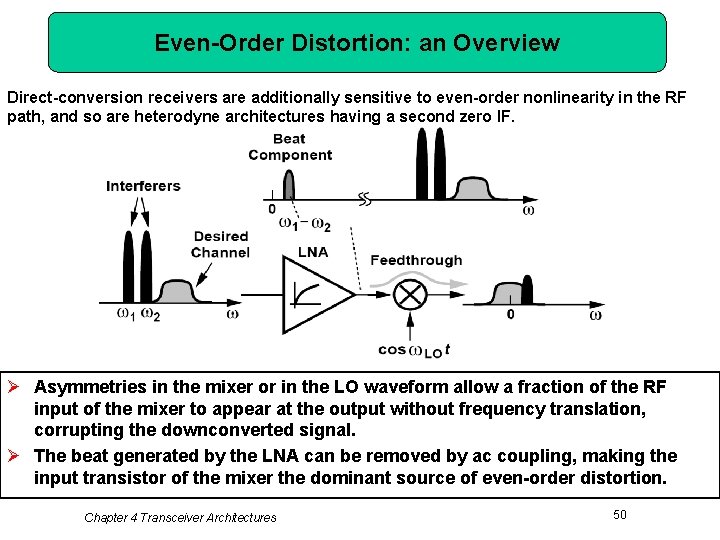
Even-Order Distortion: an Overview Direct-conversion receivers are additionally sensitive to even-order nonlinearity in the RF path, and so are heterodyne architectures having a second zero IF. Ø Asymmetries in the mixer or in the LO waveform allow a fraction of the RF input of the mixer to appear at the output without frequency translation, corrupting the downconverted signal. Ø The beat generated by the LNA can be removed by ac coupling, making the input transistor of the mixer the dominant source of even-order distortion. Chapter 4 Transceiver Architectures 50
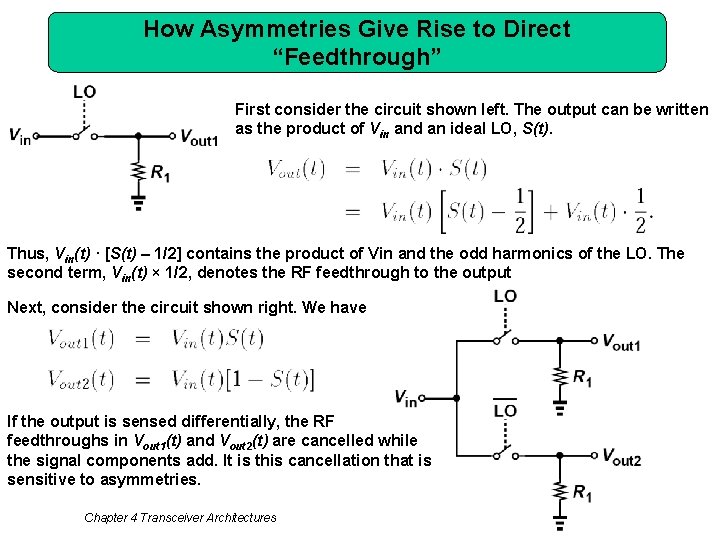
How Asymmetries Give Rise to Direct “Feedthrough” First consider the circuit shown left. The output can be written as the product of Vin and an ideal LO, S(t). Thus, Vin(t) · [S(t) – 1/2] contains the product of Vin and the odd harmonics of the LO. The second term, Vin(t) × 1/2, denotes the RF feedthrough to the output Next, consider the circuit shown right. We have If the output is sensed differentially, the RF feedthroughs in Vout 1(t) and Vout 2(t) are cancelled while the signal components add. It is this cancellation that is sensitive to asymmetries. Chapter 4 Transceiver Architectures 51
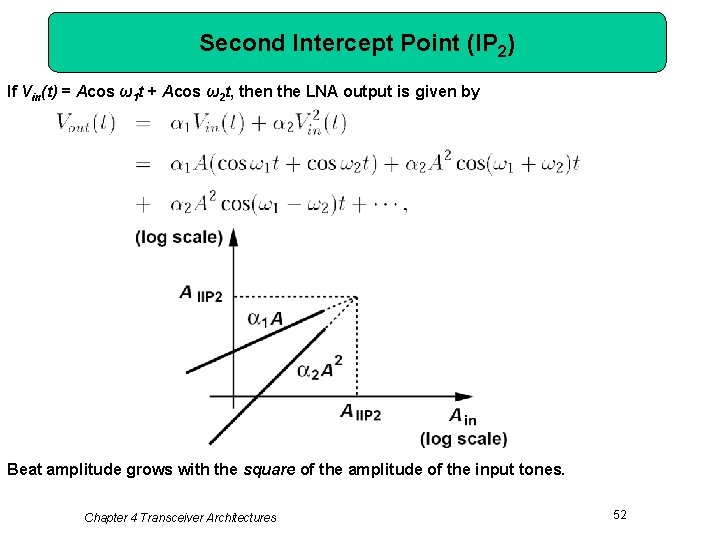
Second Intercept Point (IP 2) If Vin(t) = Acos ω1 t + Acos ω2 t, then the LNA output is given by Beat amplitude grows with the square of the amplitude of the input tones. Chapter 4 Transceiver Architectures 52
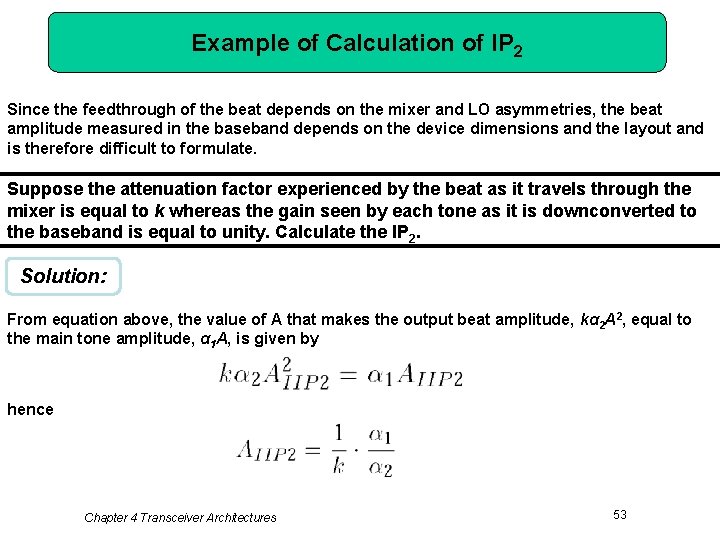
Example of Calculation of IP 2 Since the feedthrough of the beat depends on the mixer and LO asymmetries, the beat amplitude measured in the baseband depends on the device dimensions and the layout and is therefore difficult to formulate. Suppose the attenuation factor experienced by the beat as it travels through the mixer is equal to k whereas the gain seen by each tone as it is downconverted to the baseband is equal to unity. Calculate the IP 2. Solution: From equation above, the value of A that makes the output beat amplitude, kα 2 A 2, equal to the main tone amplitude, α 1 A, is given by hence Chapter 4 Transceiver Architectures 53
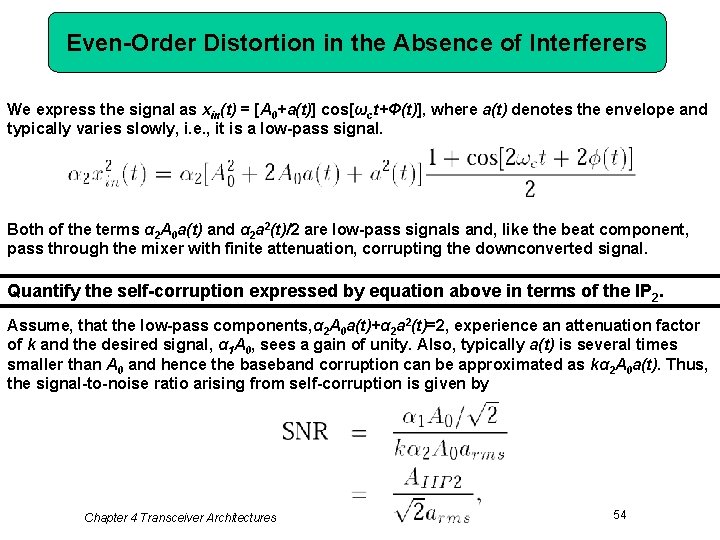
Even-Order Distortion in the Absence of Interferers We express the signal as xin(t) = [A 0+a(t)] cos[ωct+Φ(t)], where a(t) denotes the envelope and typically varies slowly, i. e. , it is a low-pass signal. Both of the terms α 2 A 0 a(t) and α 2 a 2(t)/2 are low-pass signals and, like the beat component, pass through the mixer with finite attenuation, corrupting the downconverted signal. Quantify the self-corruption expressed by equation above in terms of the IP 2. Assume, that the low-pass components, α 2 A 0 a(t)+α 2 a 2(t)=2, experience an attenuation factor of k and the desired signal, α 1 A 0, sees a gain of unity. Also, typically a(t) is several times smaller than A 0 and hence the baseband corruption can be approximated as kα 2 A 0 a(t). Thus, the signal-to-noise ratio arising from self-corruption is given by Chapter 4 Transceiver Architectures 54
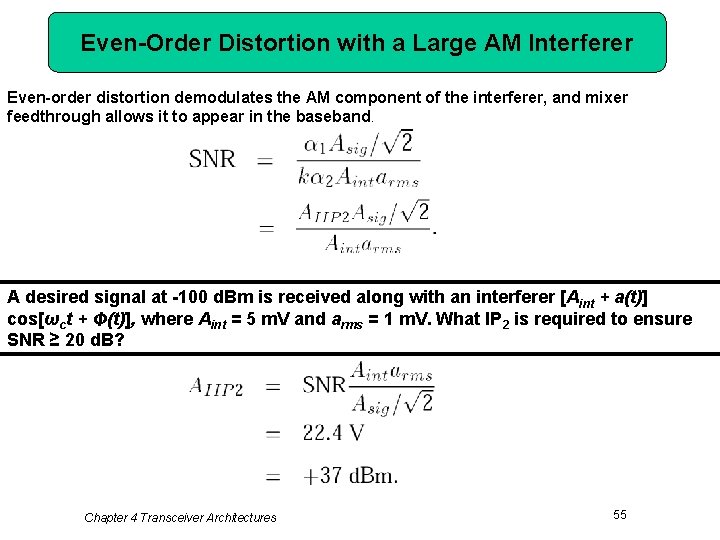
Even-Order Distortion with a Large AM Interferer Even-order distortion demodulates the AM component of the interferer, and mixer feedthrough allows it to appear in the baseband. A desired signal at -100 d. Bm is received along with an interferer [Aint + a(t)] cos[ωct + Φ(t)], where Aint = 5 m. V and arms = 1 m. V. What IP 2 is required to ensure SNR ≥ 20 d. B? Chapter 4 Transceiver Architectures 55
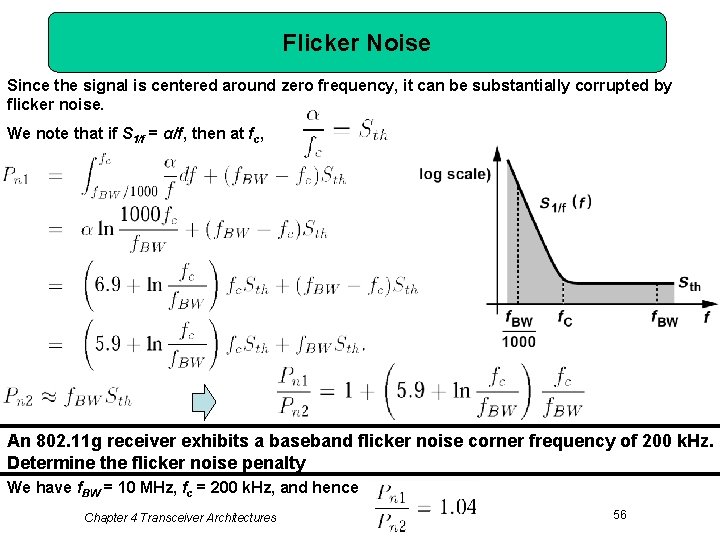
Flicker Noise Since the signal is centered around zero frequency, it can be substantially corrupted by flicker noise. We note that if S 1/f = α/f, then at fc, An 802. 11 g receiver exhibits a baseband flicker noise corner frequency of 200 k. Hz. Determine the flicker noise penalty We have f. BW = 10 MHz, fc = 200 k. Hz, and hence Chapter 4 Transceiver Architectures 56
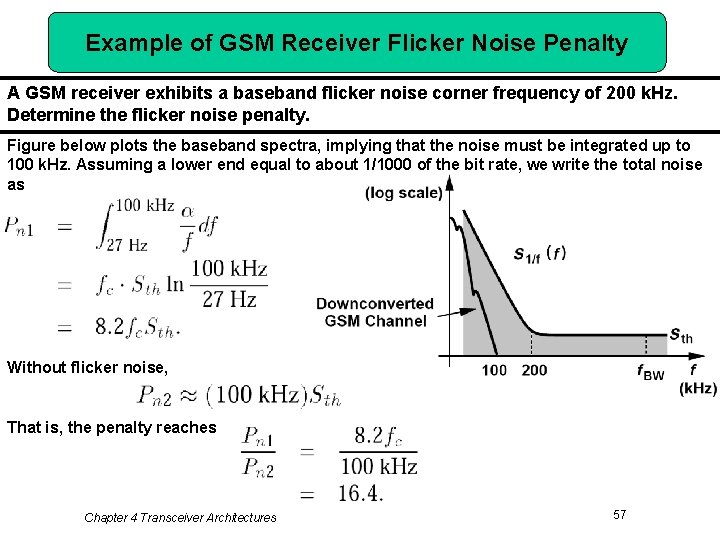
Example of GSM Receiver Flicker Noise Penalty A GSM receiver exhibits a baseband flicker noise corner frequency of 200 k. Hz. Determine the flicker noise penalty. Figure below plots the baseband spectra, implying that the noise must be integrated up to 100 k. Hz. Assuming a lower end equal to about 1/1000 of the bit rate, we write the total noise as Without flicker noise, That is, the penalty reaches Chapter 4 Transceiver Architectures 57
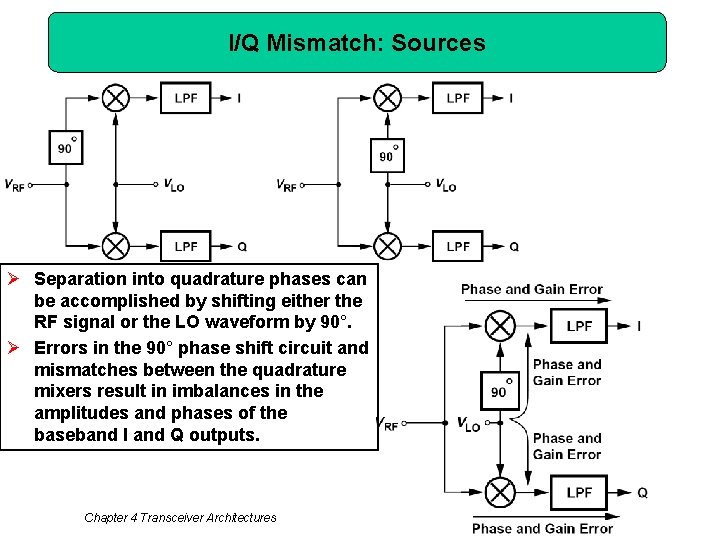
I/Q Mismatch: Sources Ø Separation into quadrature phases can be accomplished by shifting either the RF signal or the LO waveform by 90°. Ø Errors in the 90° phase shift circuit and mismatches between the quadrature mixers result in imbalances in the amplitudes and phases of the baseband I and Q outputs. Chapter 4 Transceiver Architectures 58
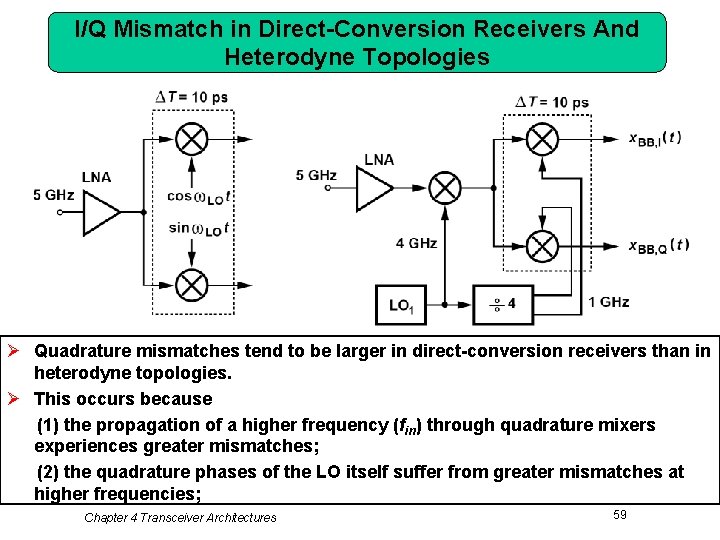
I/Q Mismatch in Direct-Conversion Receivers And Heterodyne Topologies Ø Quadrature mismatches tend to be larger in direct-conversion receivers than in heterodyne topologies. Ø This occurs because (1) the propagation of a higher frequency (fin) through quadrature mixers experiences greater mismatches; (2) the quadrature phases of the LO itself suffer from greater mismatches at higher frequencies; Chapter 4 Transceiver Architectures 59
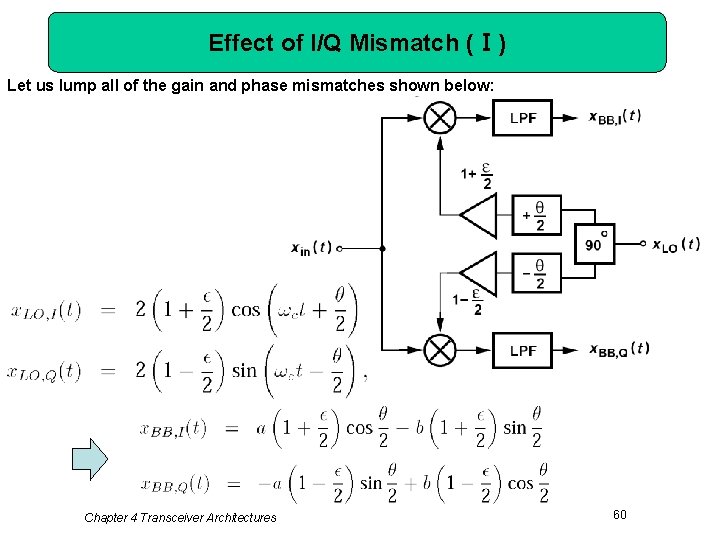
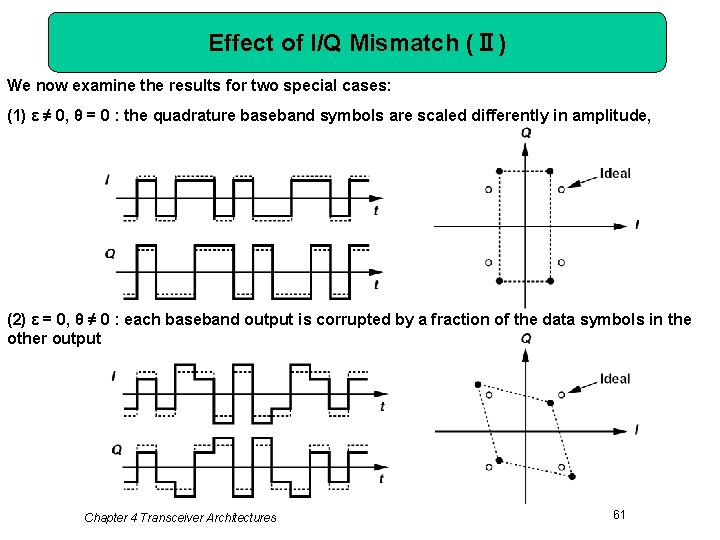
Effect of I/Q Mismatch (Ⅰ) Let us lump all of the gain and phase mismatches shown below: Chapter 4 Transceiver Architectures 60
Effect of I/Q Mismatch (Ⅱ) We now examine the results for two special cases: (1) ε ≠ 0, θ = 0 : the quadrature baseband symbols are scaled differently in amplitude, (2) ε = 0, θ ≠ 0 : each baseband output is corrupted by a fraction of the data symbols in the other output Chapter 4 Transceiver Architectures 61
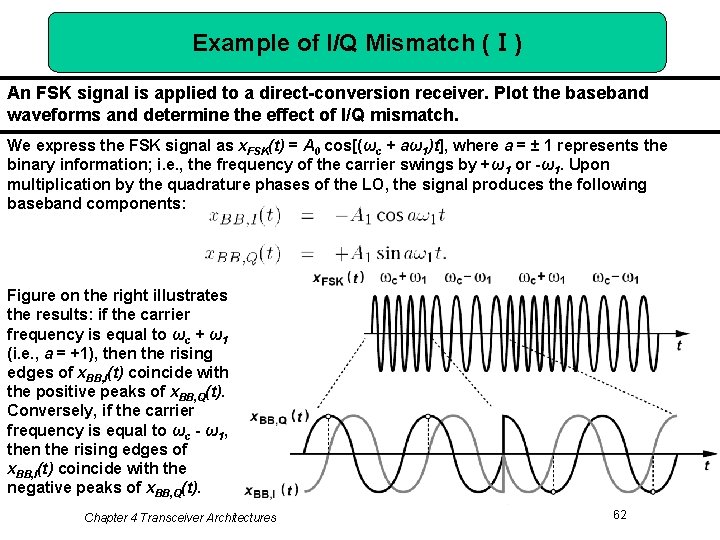
Example of I/Q Mismatch (Ⅰ) An FSK signal is applied to a direct-conversion receiver. Plot the baseband waveforms and determine the effect of I/Q mismatch. We express the FSK signal as x. FSK(t) = A 0 cos[(ωc + aω1)t], where a = ± 1 represents the binary information; i. e. , the frequency of the carrier swings by +ω1 or -ω1. Upon multiplication by the quadrature phases of the LO, the signal produces the following baseband components: Figure on the right illustrates the results: if the carrier frequency is equal to ωc + ω1 (i. e. , a = +1), then the rising edges of x. BB, I(t) coincide with the positive peaks of x. BB, Q(t). Conversely, if the carrier frequency is equal to ωc - ω1, then the rising edges of x. BB, I(t) coincide with the negative peaks of x. BB, Q(t). Chapter 4 Transceiver Architectures 62
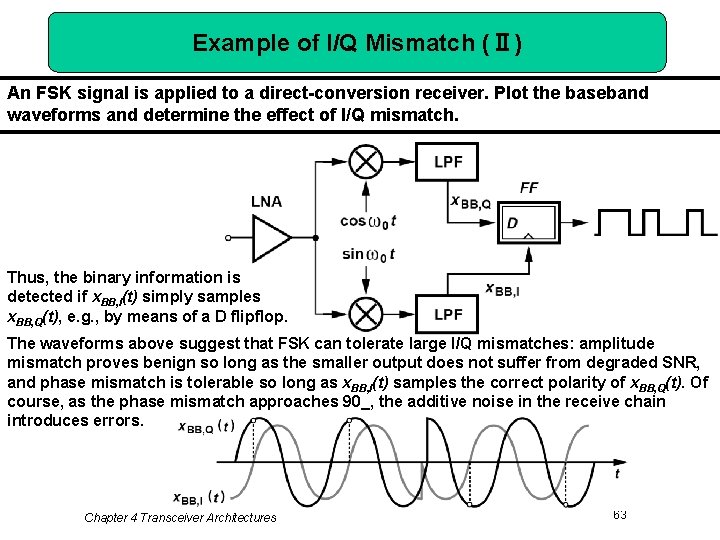
Example of I/Q Mismatch (Ⅱ) An FSK signal is applied to a direct-conversion receiver. Plot the baseband waveforms and determine the effect of I/Q mismatch. Thus, the binary information is detected if x. BB, I(t) simply samples x. BB, Q(t), e. g. , by means of a D flipflop. The waveforms above suggest that FSK can tolerate large I/Q mismatches: amplitude mismatch proves benign so long as the smaller output does not suffer from degraded SNR, and phase mismatch is tolerable so long as x. BB, I(t) samples the correct polarity of x. BB, Q(t). Of course, as the phase mismatch approaches 90_, the additive noise in the receive chain introduces errors. Chapter 4 Transceiver Architectures 63
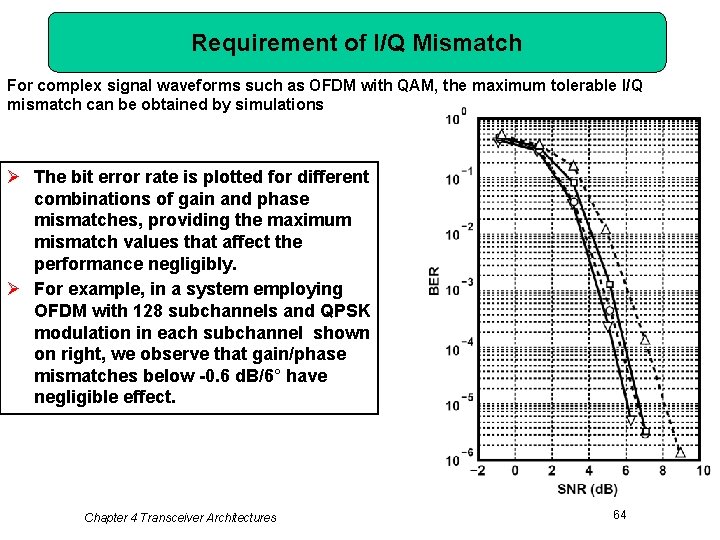
Requirement of I/Q Mismatch For complex signal waveforms such as OFDM with QAM, the maximum tolerable I/Q mismatch can be obtained by simulations Ø The bit error rate is plotted for different combinations of gain and phase mismatches, providing the maximum mismatch values that affect the performance negligibly. Ø For example, in a system employing OFDM with 128 subchannels and QPSK modulation in each subchannel shown on right, we observe that gain/phase mismatches below -0. 6 d. B/6° have negligible effect. Chapter 4 Transceiver Architectures 64
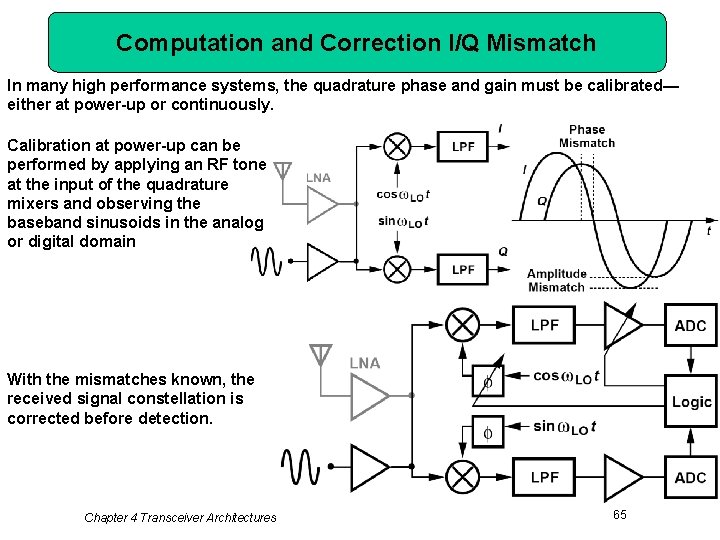
Computation and Correction I/Q Mismatch In many high performance systems, the quadrature phase and gain must be calibrated— either at power-up or continuously. Calibration at power-up can be performed by applying an RF tone at the input of the quadrature mixers and observing the baseband sinusoids in the analog or digital domain With the mismatches known, the received signal constellation is corrected before detection. Chapter 4 Transceiver Architectures 65
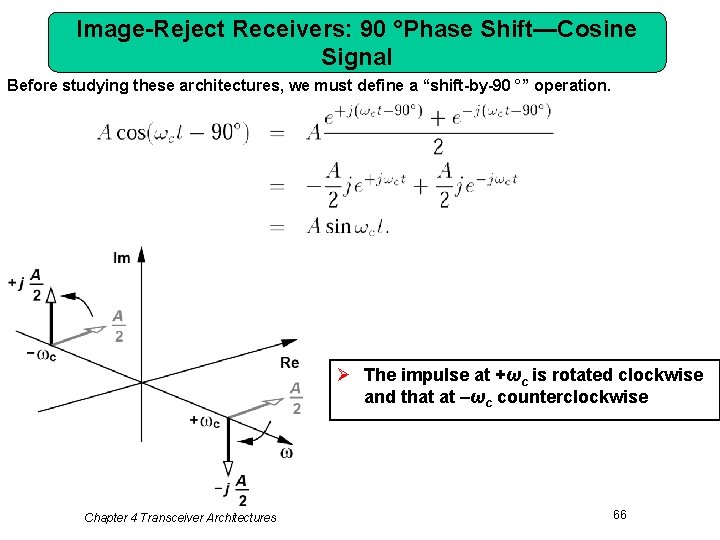
Image-Reject Receivers: 90 °Phase Shift—Cosine Signal Before studying these architectures, we must define a “shift-by-90 °” operation. Ø The impulse at +ωc is rotated clockwise and that at –ωc counterclockwise Chapter 4 Transceiver Architectures 66
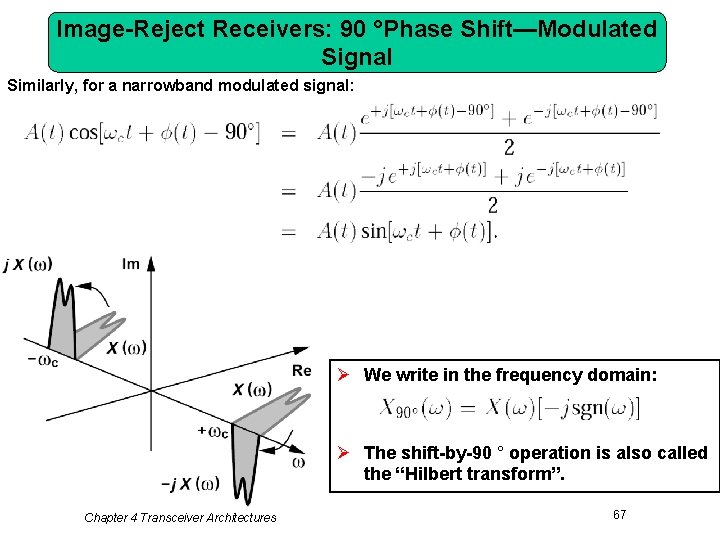
Image-Reject Receivers: 90 °Phase Shift—Modulated Signal Similarly, for a narrowband modulated signal: Ø We write in the frequency domain: Ø The shift-by-90 ° operation is also called the “Hilbert transform”. Chapter 4 Transceiver Architectures 67
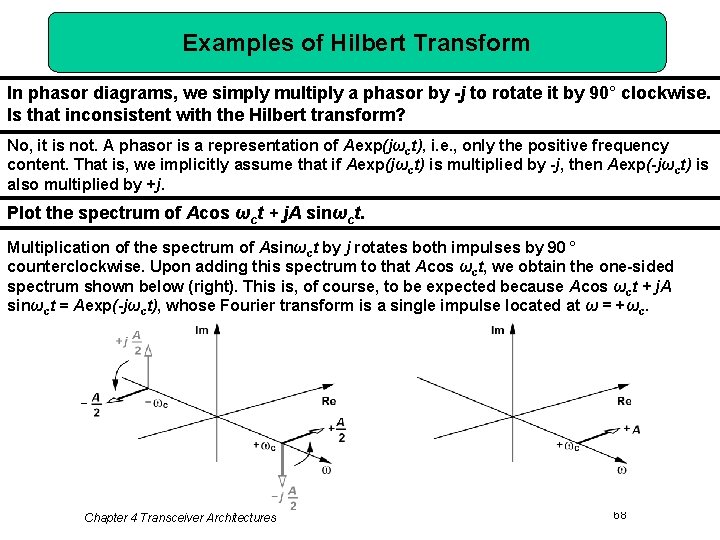
Examples of Hilbert Transform In phasor diagrams, we simply multiply a phasor by -j to rotate it by 90° clockwise. Is that inconsistent with the Hilbert transform? No, it is not. A phasor is a representation of Aexp(jωct), i. e. , only the positive frequency content. That is, we implicitly assume that if Aexp(jωct) is multiplied by -j, then Aexp(-jωct) is also multiplied by +j. Plot the spectrum of Acos ωct + j. A sinωct. Multiplication of the spectrum of Asinωct by j rotates both impulses by 90 ° counterclockwise. Upon adding this spectrum to that Acos ωct, we obtain the one-sided spectrum shown below (right). This is, of course, to be expected because Acos ωct + j. A sinωct = Aexp(-jωct), whose Fourier transform is a single impulse located at ω = +ωc. Chapter 4 Transceiver Architectures 68
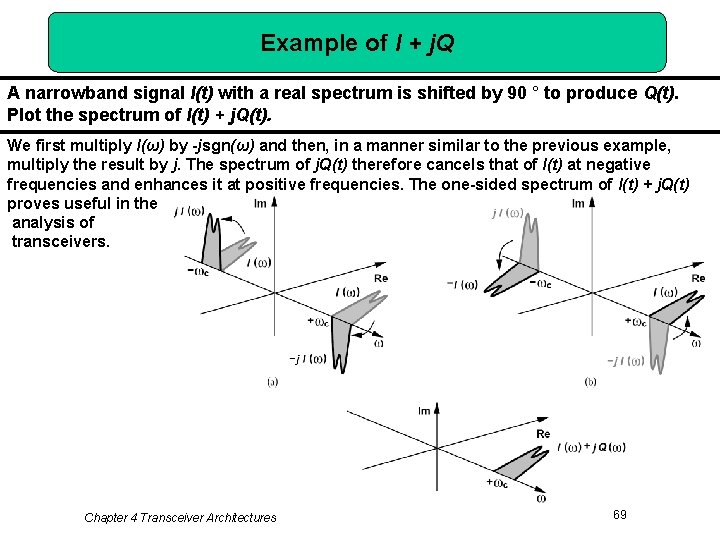
Example of I + j. Q A narrowband signal I(t) with a real spectrum is shifted by 90 ° to produce Q(t). Plot the spectrum of I(t) + j. Q(t). We first multiply I(ω) by -jsgn(ω) and then, in a manner similar to the previous example, multiply the result by j. The spectrum of j. Q(t) therefore cancels that of I(t) at negative frequencies and enhances it at positive frequencies. The one-sided spectrum of I(t) + j. Q(t) proves useful in the analysis of transceivers. Chapter 4 Transceiver Architectures 69
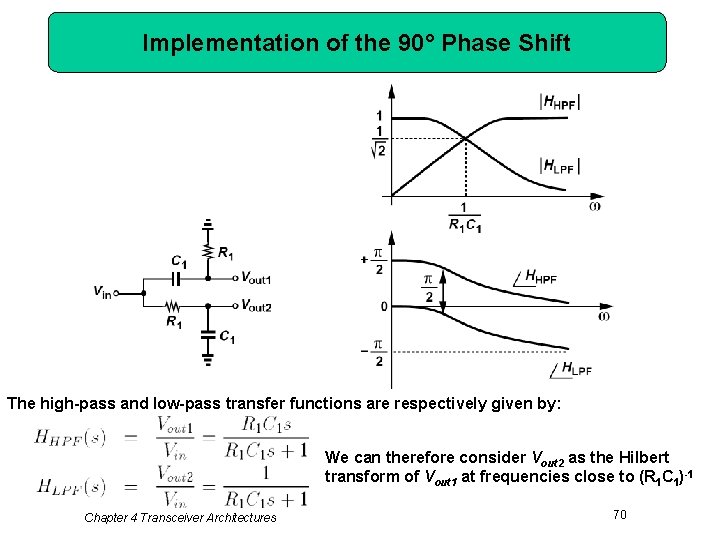
Implementation of the 90° Phase Shift The high-pass and low-pass transfer functions are respectively given by: We can therefore consider Vout 2 as the Hilbert transform of Vout 1 at frequencies close to (R 1 C 1)-1 Chapter 4 Transceiver Architectures 70
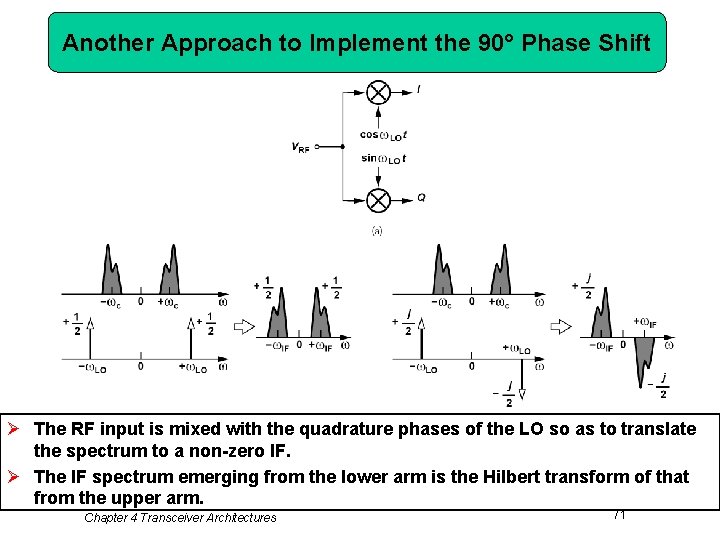
Another Approach to Implement the 90° Phase Shift Ø The RF input is mixed with the quadrature phases of the LO so as to translate the spectrum to a non-zero IF. Ø The IF spectrum emerging from the lower arm is the Hilbert transform of that from the upper arm. Chapter 4 Transceiver Architectures 71
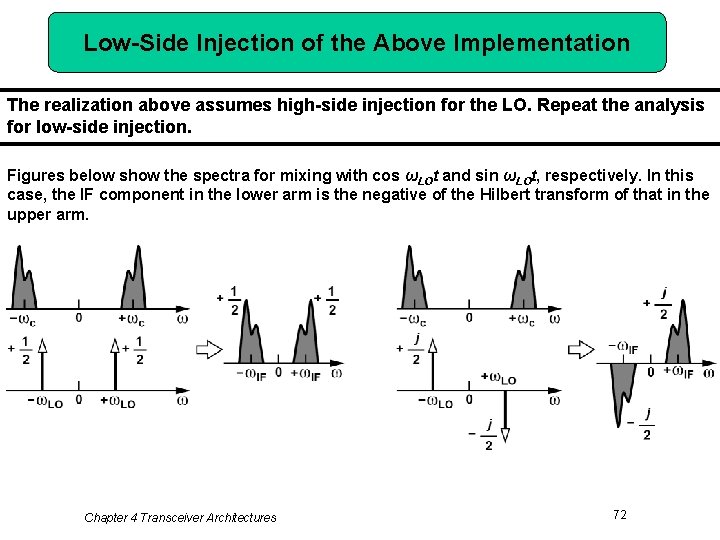
Low-Side Injection of the Above Implementation The realization above assumes high-side injection for the LO. Repeat the analysis for low-side injection. Figures below show the spectra for mixing with cos ωLOt and sin ωLOt, respectively. In this case, the IF component in the lower arm is the negative of the Hilbert transform of that in the upper arm. Chapter 4 Transceiver Architectures 72
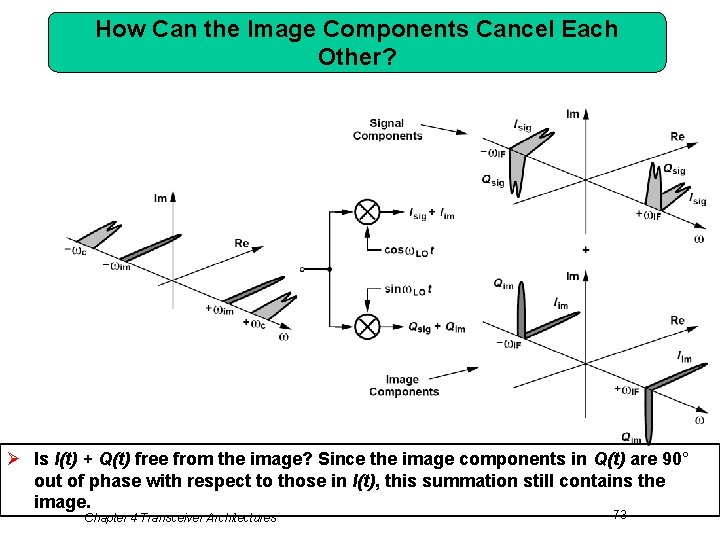
How Can the Image Components Cancel Each Other? Ø Is I(t) + Q(t) free from the image? Since the image components in Q(t) are 90° out of phase with respect to those in I(t), this summation still contains the image. Chapter 4 Transceiver Architectures 73
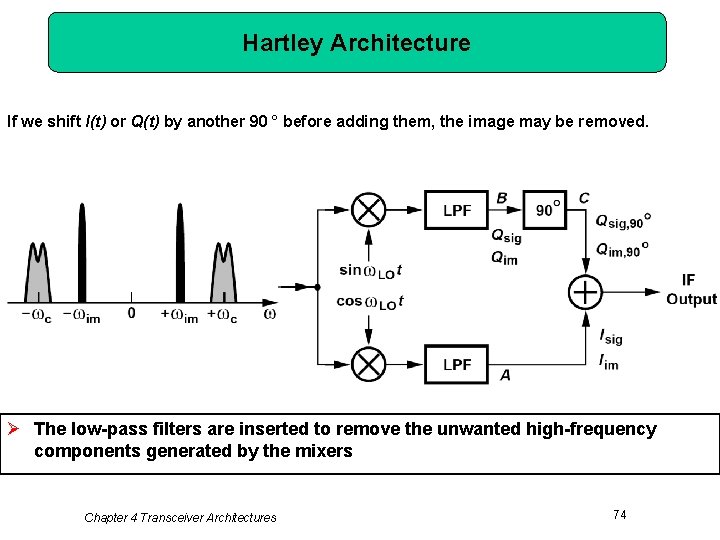
Hartley Architecture If we shift I(t) or Q(t) by another 90 ° before adding them, the image may be removed. Ø The low-pass filters are inserted to remove the unwanted high-frequency components generated by the mixers Chapter 4 Transceiver Architectures 74
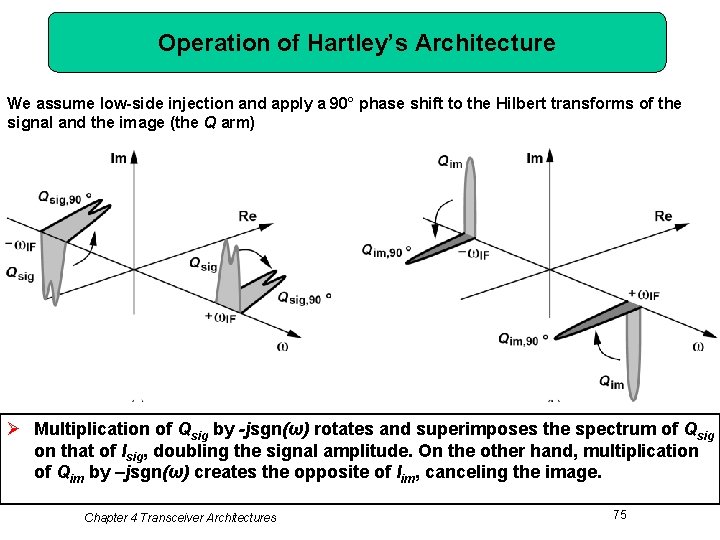
Operation of Hartley’s Architecture We assume low-side injection and apply a 90° phase shift to the Hilbert transforms of the signal and the image (the Q arm). Ø Multiplication of Qsig by -jsgn(ω) rotates and superimposes the spectrum of Qsig on that of Isig, doubling the signal amplitude. On the other hand, multiplication of Qim by –jsgn(ω) creates the opposite of Iim, canceling the image. Chapter 4 Transceiver Architectures 75
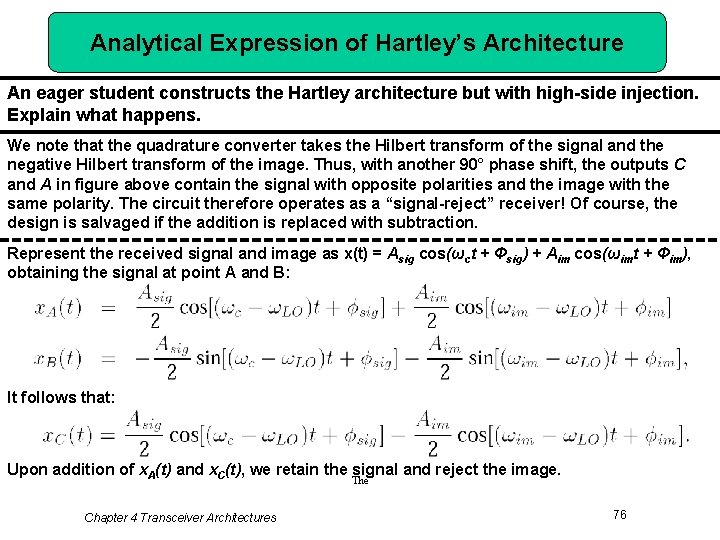
Analytical Expression of Hartley’s Architecture An eager student constructs the Hartley architecture but with high-side injection. Explain what happens. We note that the quadrature converter takes the Hilbert transform of the signal and the negative Hilbert transform of the image. Thus, with another 90° phase shift, the outputs C and A in figure above contain the signal with opposite polarities and the image with the same polarity. The circuit therefore operates as a “signal-reject” receiver! Of course, the design is salvaged if the addition is replaced with subtraction. Represent the received signal and image as x(t) = Asig cos(ωct + Φsig) + Aim cos(ωimt + Φim), obtaining the signal at point A and B: It follows that: Upon addition of x. A(t) and x. C(t), we retain the signal and reject the image. The Chapter 4 Transceiver Architectures 76
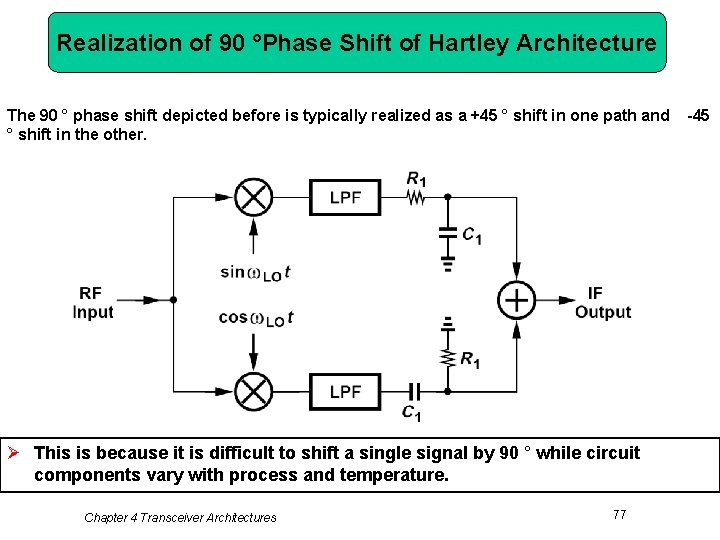
Realization of 90 °Phase Shift of Hartley Architecture The 90 ° phase shift depicted before is typically realized as a +45 ° shift in one path and ° shift in the other. Ø This is because it is difficult to shift a single signal by 90 ° while circuit components vary with process and temperature. Chapter 4 Transceiver Architectures 77 -45
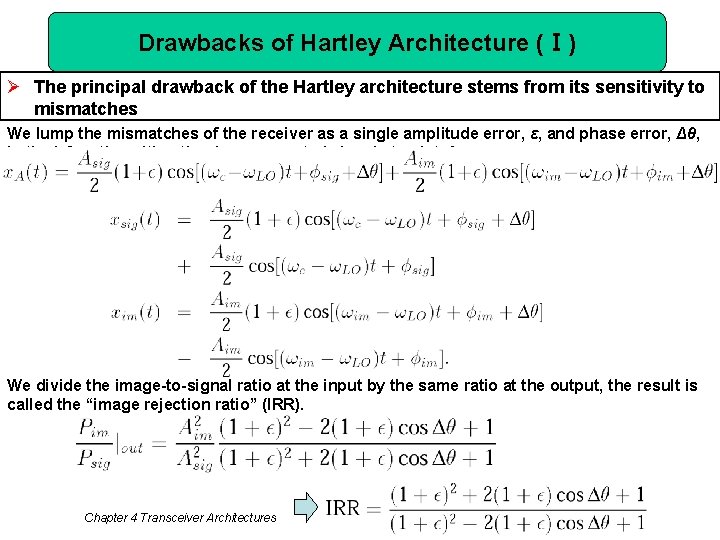
Drawbacks of Hartley Architecture (Ⅰ) Ø The principal drawback of the Hartley architecture stems from its sensitivity to mismatches We lump the mismatches of the receiver as a single amplitude error, ε, and phase error, Δθ, in the LO path, writing the downconverted signal at point A as: We divide the image-to-signal ratio at the input by the same ratio at the output, the result is called the “image rejection ratio” (IRR). Chapter 4 Transceiver Architectures 78
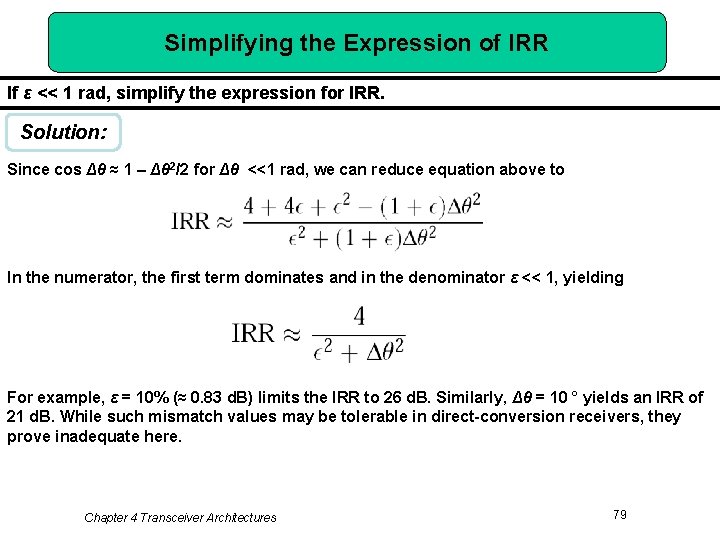
Simplifying the Expression of IRR If ε << 1 rad, simplify the expression for IRR. Solution: Since cos Δθ ≈ 1 – Δθ 2/2 for Δθ <<1 rad, we can reduce equation above to In the numerator, the first term dominates and in the denominator ε << 1, yielding For example, ε = 10% (≈ 0. 83 d. B) limits the IRR to 26 d. B. Similarly, Δθ = 10 ° yields an IRR of 21 d. B. While such mismatch values may be tolerable in direct-conversion receivers, they prove inadequate here. Chapter 4 Transceiver Architectures 79
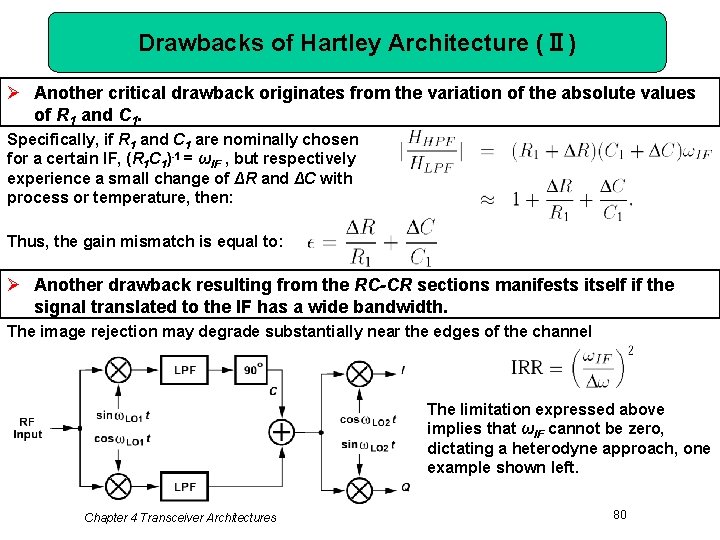
Drawbacks of Hartley Architecture (Ⅱ) Ø Another critical drawback originates from the variation of the absolute values of R 1 and C 1. Specifically, if R 1 and C 1 are nominally chosen for a certain IF, (R 1 C 1)-1 = ωIF , but respectively experience a small change of ΔR and ΔC with process or temperature, then: Thus, the gain mismatch is equal to: Ø Another drawback resulting from the RC-CR sections manifests itself if the signal translated to the IF has a wide bandwidth. The image rejection may degrade substantially near the edges of the channel The limitation expressed above implies that ωIF cannot be zero, dictating a heterodyne approach, one example shown left. Chapter 4 Transceiver Architectures 80
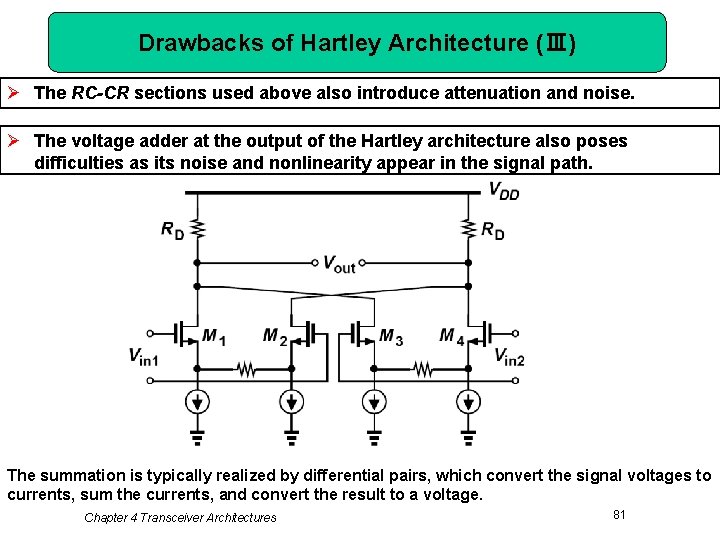
Drawbacks of Hartley Architecture (Ⅲ) Ø The RC-CR sections used above also introduce attenuation and noise. Ø The voltage adder at the output of the Hartley architecture also poses difficulties as its noise and nonlinearity appear in the signal path. The summation is typically realized by differential pairs, which convert the signal voltages to currents, sum the currents, and convert the result to a voltage. Chapter 4 Transceiver Architectures 81
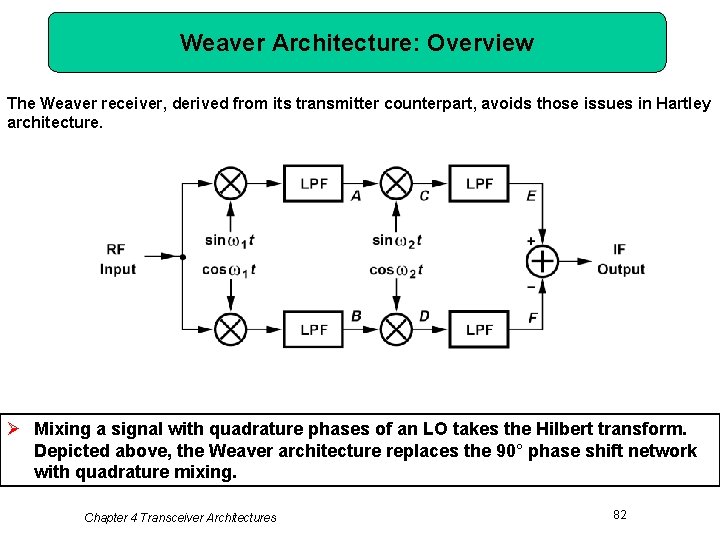
Weaver Architecture: Overview The Weaver receiver, derived from its transmitter counterpart, avoids those issues in Hartley architecture. Ø Mixing a signal with quadrature phases of an LO takes the Hilbert transform. Depicted above, the Weaver architecture replaces the 90° phase shift network with quadrature mixing. Chapter 4 Transceiver Architectures 82
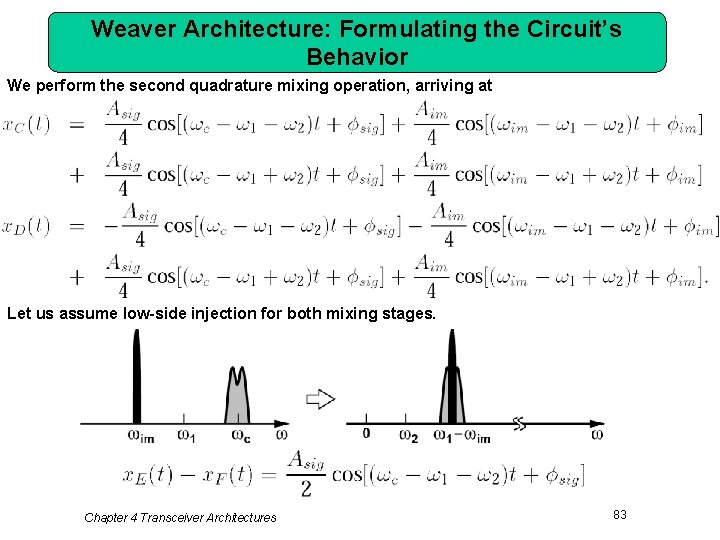
Weaver Architecture: Formulating the Circuit’s Behavior We perform the second quadrature mixing operation, arriving at Let us assume low-side injection for both mixing stages. Chapter 4 Transceiver Architectures 83
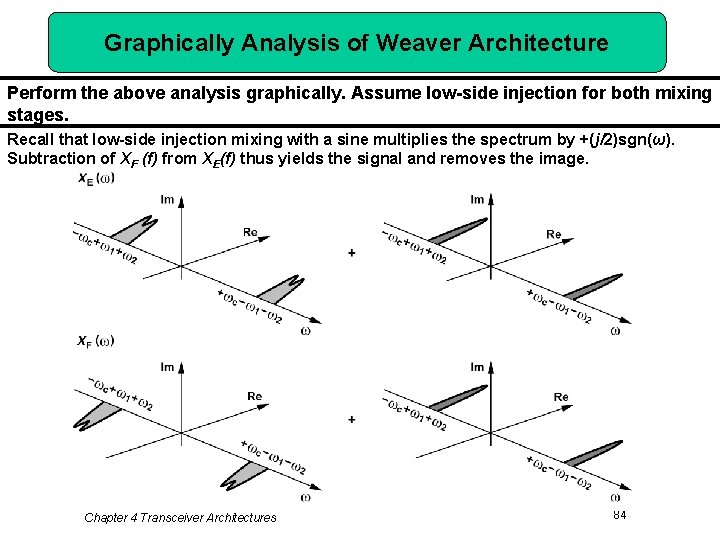
Graphically Analysis of Weaver Architecture Perform the above analysis graphically. Assume low-side injection for both mixing stages. Recall that low-side injection mixing with a sine multiplies the spectrum by +(j/2)sgn(ω). Subtraction of XF (f) from XE(f) thus yields the signal and removes the image. Chapter 4 Transceiver Architectures 84
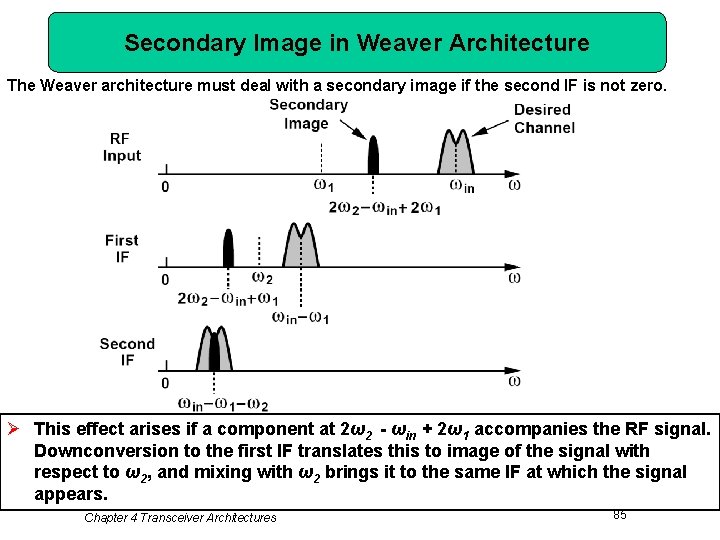
Secondary Image in Weaver Architecture The Weaver architecture must deal with a secondary image if the second IF is not zero. Ø This effect arises if a component at 2ω2 - ωin + 2ω1 accompanies the RF signal. Downconversion to the first IF translates this to image of the signal with respect to ω2, and mixing with ω2 brings it to the same IF at which the signal appears. Chapter 4 Transceiver Architectures 85
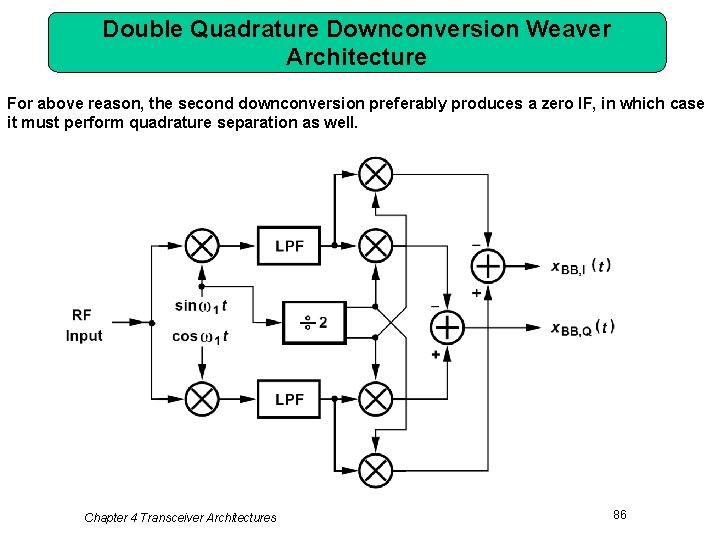
Double Quadrature Downconversion Weaver Architecture For above reason, the second downconversion preferably produces a zero IF, in which case it must perform quadrature separation as well. Chapter 4 Transceiver Architectures 86
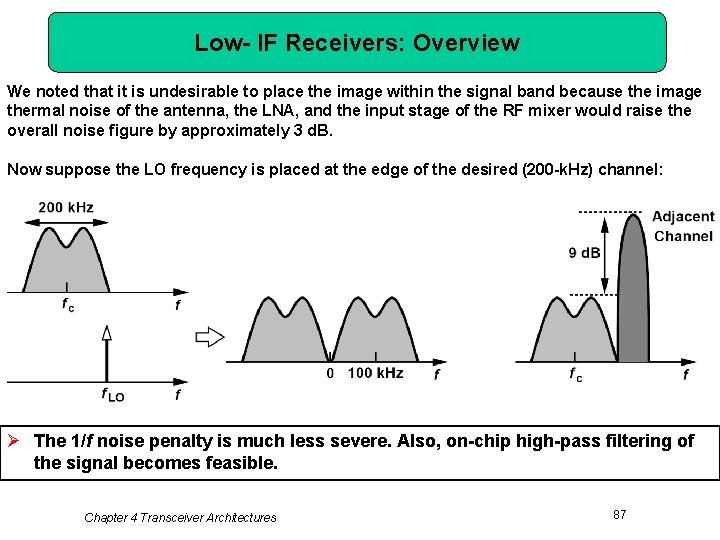
Low- IF Receivers: Overview We noted that it is undesirable to place the image within the signal band because the image thermal noise of the antenna, the LNA, and the input stage of the RF mixer would raise the overall noise figure by approximately 3 d. B. Now suppose the LO frequency is placed at the edge of the desired (200 -k. Hz) channel: Ø The 1/f noise penalty is much less severe. Also, on-chip high-pass filtering of the signal becomes feasible. Chapter 4 Transceiver Architectures 87
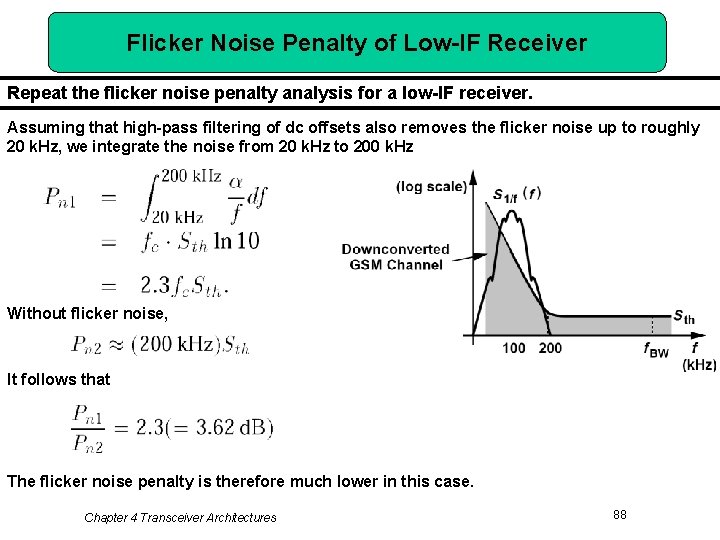
Flicker Noise Penalty of Low-IF Receiver Repeat the flicker noise penalty analysis for a low-IF receiver. Assuming that high-pass filtering of dc offsets also removes the flicker noise up to roughly 20 k. Hz, we integrate the noise from 20 k. Hz to 200 k. Hz Without flicker noise, It follows that The flicker noise penalty is therefore much lower in this case. Chapter 4 Transceiver Architectures 88
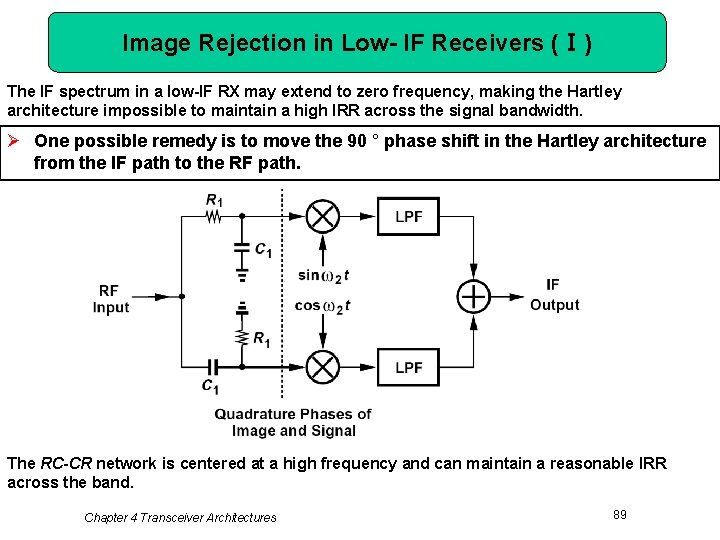
Image Rejection in Low- IF Receivers (Ⅰ) The IF spectrum in a low-IF RX may extend to zero frequency, making the Hartley architecture impossible to maintain a high IRR across the signal bandwidth. Ø One possible remedy is to move the 90 ° phase shift in the Hartley architecture from the IF path to the RF path. The RC-CR network is centered at a high frequency and can maintain a reasonable IRR across the band. Chapter 4 Transceiver Architectures 89
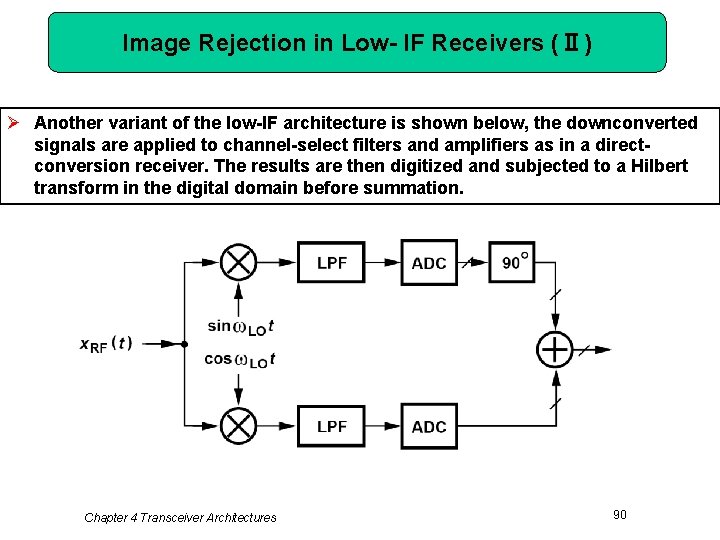
Image Rejection in Low- IF Receivers (Ⅱ) Ø Another variant of the low-IF architecture is shown below, the downconverted signals are applied to channel-select filters and amplifiers as in a directconversion receiver. The results are then digitized and subjected to a Hilbert transform in the digital domain before summation. Chapter 4 Transceiver Architectures 90
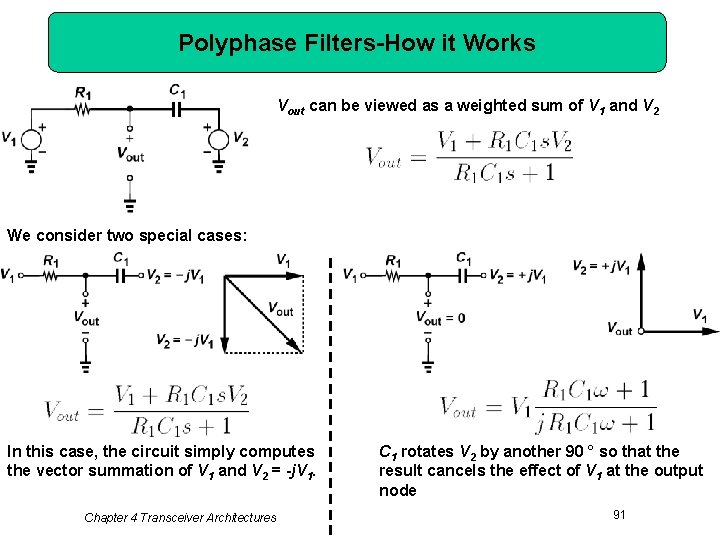
Polyphase Filters-How it Works Vout can be viewed as a weighted sum of V 1 and V 2 We consider two special cases: In this case, the circuit simply computes the vector summation of V 1 and V 2 = -j. V 1. Chapter 4 Transceiver Architectures C 1 rotates V 2 by another 90 ° so that the result cancels the effect of V 1 at the output node 91
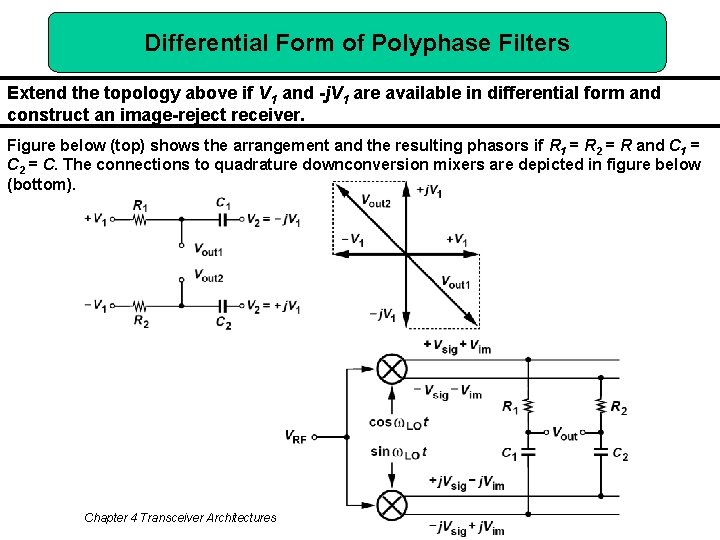
Differential Form of Polyphase Filters Extend the topology above if V 1 and -j. V 1 are available in differential form and construct an image-reject receiver. Figure below (top) shows the arrangement and the resulting phasors if R 1 = R 2 = R and C 1 = C 2 = C. The connections to quadrature downconversion mixers are depicted in figure below (bottom). Chapter 4 Transceiver Architectures 92
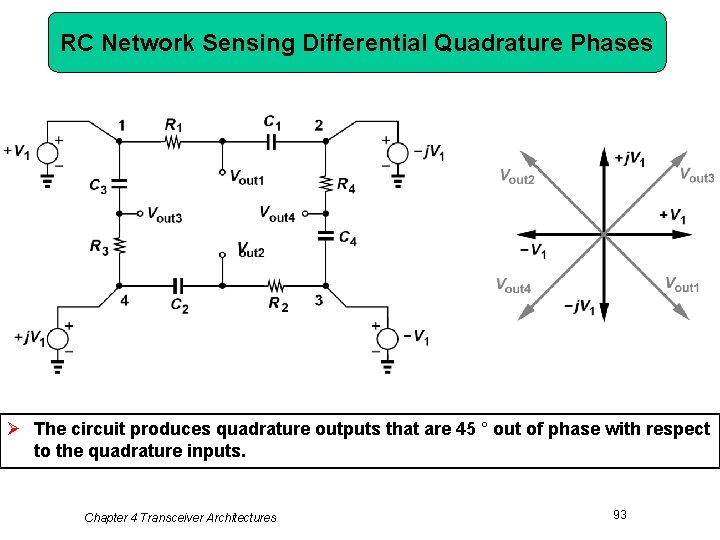
RC Network Sensing Differential Quadrature Phases Ø The circuit produces quadrature outputs that are 45 ° out of phase with respect to the quadrature inputs. Chapter 4 Transceiver Architectures 93
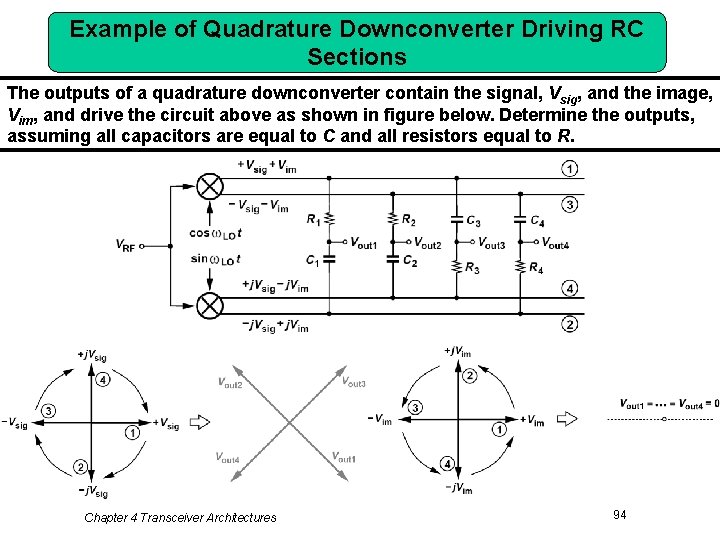
Example of Quadrature Downconverter Driving RC Sections The outputs of a quadrature downconverter contain the signal, Vsig, and the image, Vim, and drive the circuit above as shown in figure below. Determine the outputs, assuming all capacitors are equal to C and all resistors equal to R. Chapter 4 Transceiver Architectures 94
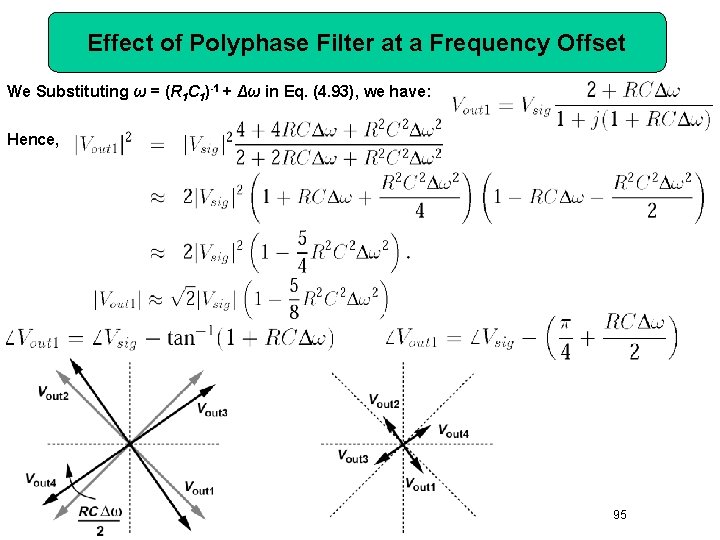
Effect of Polyphase Filter at a Frequency Offset We Substituting ω = (R 1 C 1)-1 + Δω in Eq. (4. 93), we have: Hence, Chapter 4 Transceiver Architectures 95
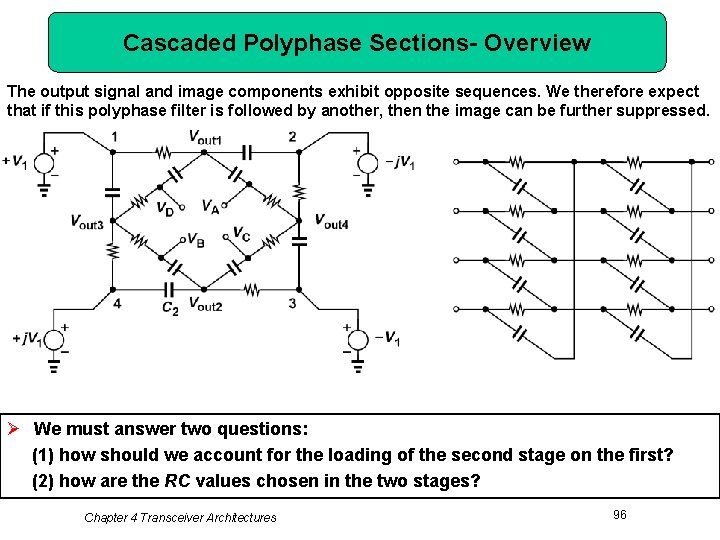
Cascaded Polyphase Sections- Overview The output signal and image components exhibit opposite sequences. We therefore expect that if this polyphase filter is followed by another, then the image can be further suppressed. Ø We must answer two questions: (1) how should we account for the loading of the second stage on the first? (2) how are the RC values chosen in the two stages? Chapter 4 Transceiver Architectures 96
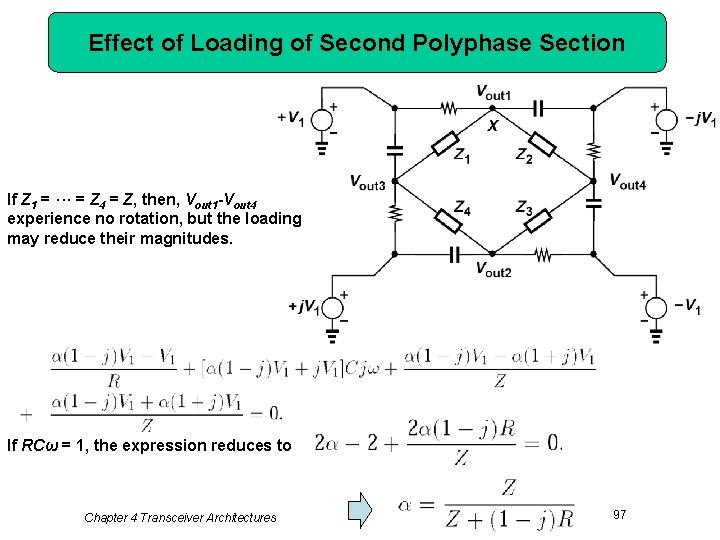
Effect of Loading of Second Polyphase Section If Z 1 = ··· = Z 4 = Z, then, Vout 1 -Vout 4 experience no rotation, but the loading may reduce their magnitudes. If RCω = 1, the expression reduces to Chapter 4 Transceiver Architectures 97
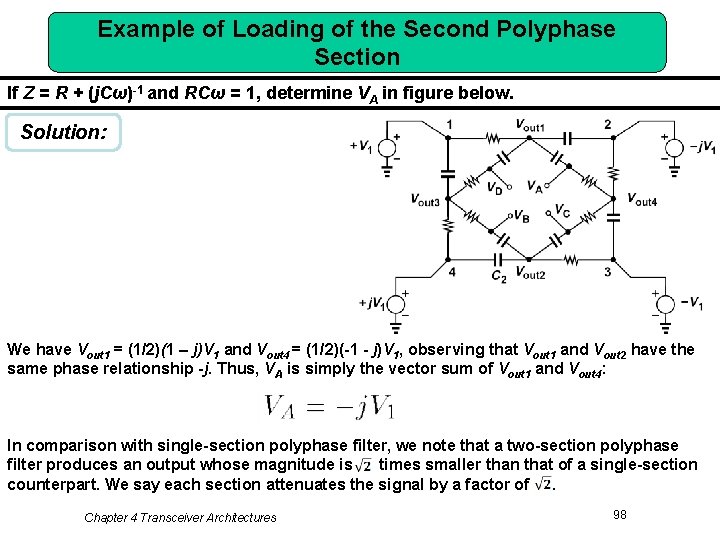
Example of Loading of the Second Polyphase Section If Z = R + (j. Cω)-1 and RCω = 1, determine VA in figure below. Solution: We have Vout 1 = (1/2)(1 – j)V 1 and Vout 4 = (1/2)(-1 - j)V 1, observing that Vout 1 and Vout 2 have the same phase relationship -j. Thus, VA is simply the vector sum of Vout 1 and Vout 4: In comparison with single-section polyphase filter, we note that a two-section polyphase filter produces an output whose magnitude is times smaller than that of a single-section counterpart. We say each section attenuates the signal by a factor of. Chapter 4 Transceiver Architectures 98
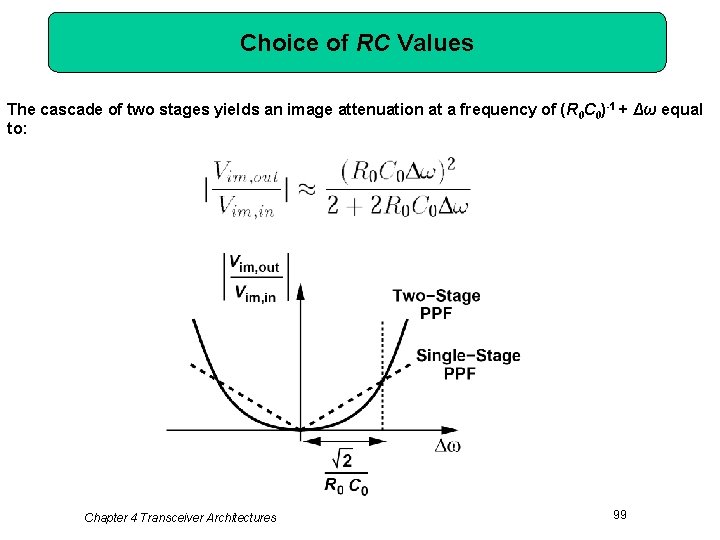
Choice of RC Values The cascade of two stages yields an image attenuation at a frequency of (R 0 C 0)-1 + Δω equal to: Chapter 4 Transceiver Architectures 99
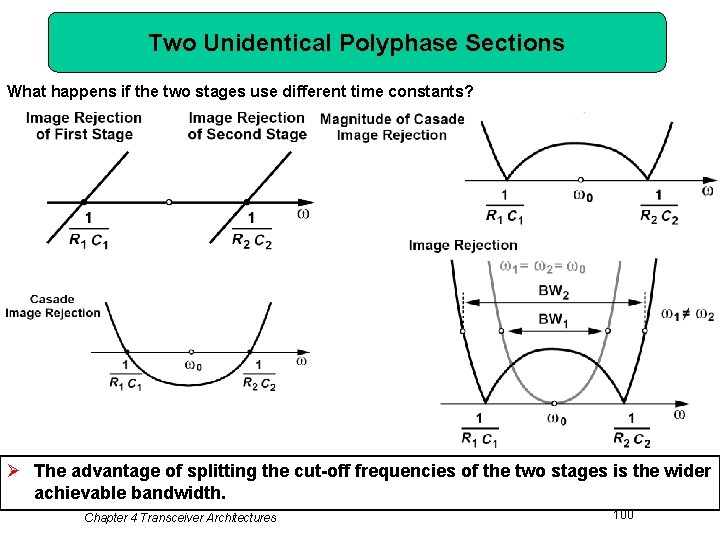
Two Unidentical Polyphase Sections What happens if the two stages use different time constants? Ø The advantage of splitting the cut-off frequencies of the two stages is the wider achievable bandwidth. Chapter 4 Transceiver Architectures 100
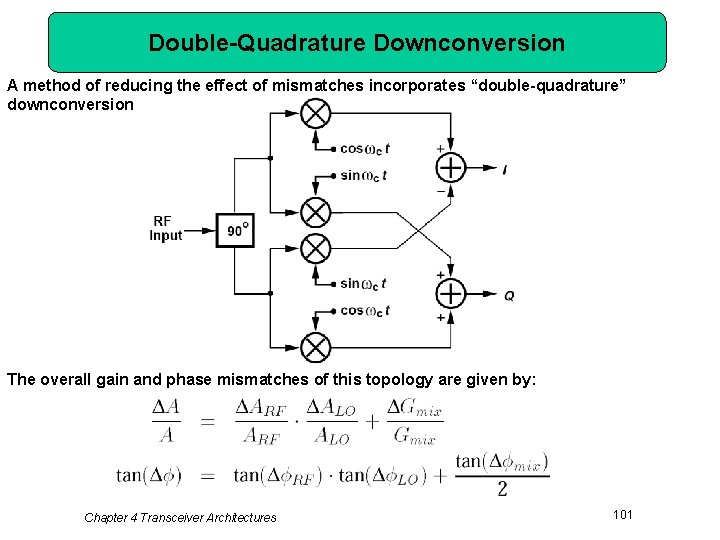
Double-Quadrature Downconversion A method of reducing the effect of mismatches incorporates “double-quadrature” downconversion The overall gain and phase mismatches of this topology are given by: Chapter 4 Transceiver Architectures 101
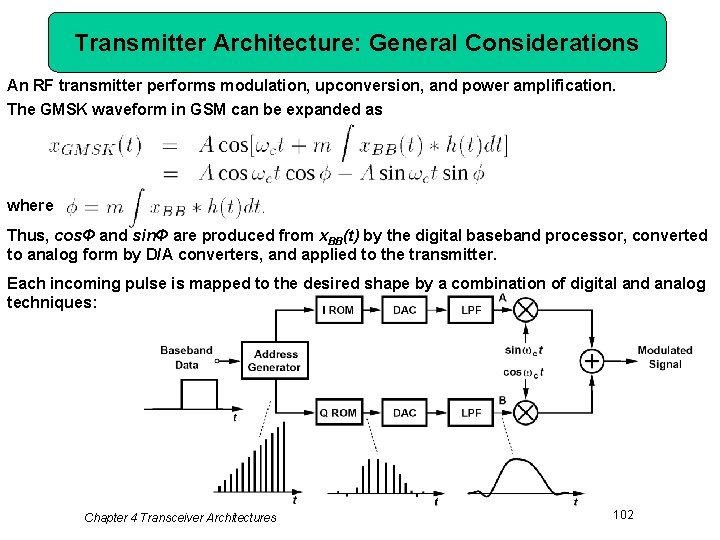
Transmitter Architecture: General Considerations An RF transmitter performs modulation, upconversion, and power amplification. The GMSK waveform in GSM can be expanded as where Thus, cosΦ and sinΦ are produced from x. BB(t) by the digital baseband processor, converted to analog form by D/A converters, and applied to the transmitter. Each incoming pulse is mapped to the desired shape by a combination of digital and analog techniques: Chapter 4 Transceiver Architectures 102
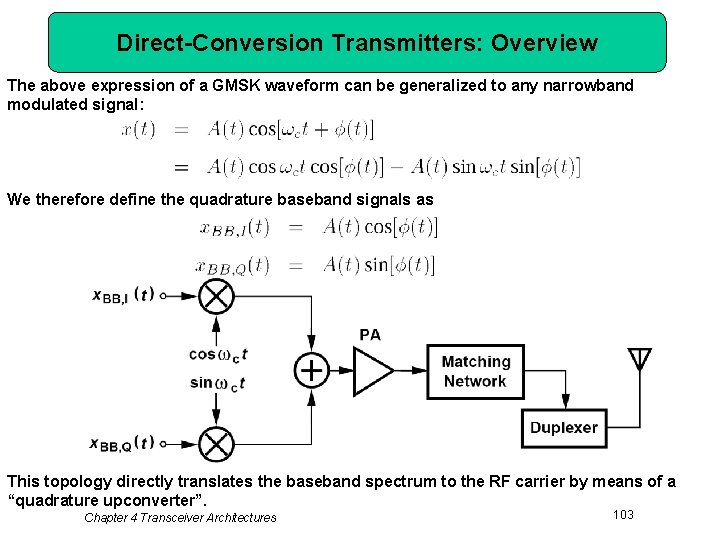
Direct-Conversion Transmitters: Overview The above expression of a GMSK waveform can be generalized to any narrowband modulated signal: We therefore define the quadrature baseband signals as This topology directly translates the baseband spectrum to the RF carrier by means of a “quadrature upconverter”. Chapter 4 Transceiver Architectures 103
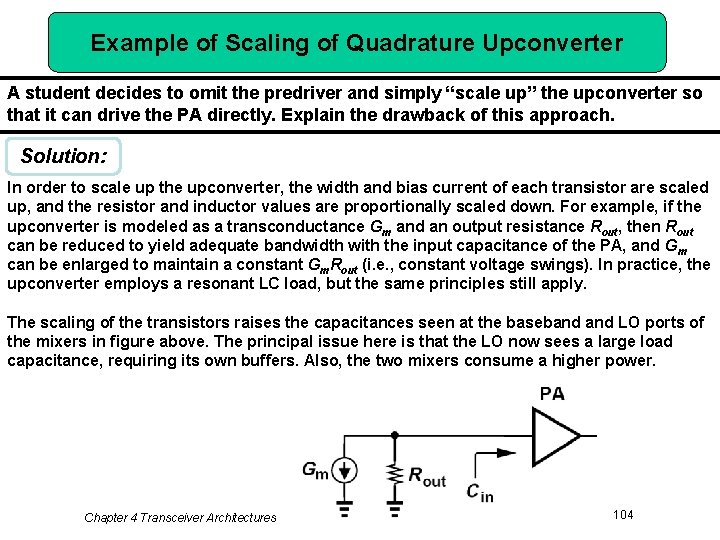
Example of Scaling of Quadrature Upconverter A student decides to omit the predriver and simply “scale up” the upconverter so that it can drive the PA directly. Explain the drawback of this approach. Solution: In order to scale up the upconverter, the width and bias current of each transistor are scaled up, and the resistor and inductor values are proportionally scaled down. For example, if the upconverter is modeled as a transconductance Gm and an output resistance Rout, then Rout can be reduced to yield adequate bandwidth with the input capacitance of the PA, and Gm can be enlarged to maintain a constant Gm. Rout (i. e. , constant voltage swings). In practice, the upconverter employs a resonant LC load, but the same principles still apply. The scaling of the transistors raises the capacitances seen at the baseband LO ports of the mixers in figure above. The principal issue here is that the LO now sees a large load capacitance, requiring its own buffers. Also, the two mixers consume a higher power. Chapter 4 Transceiver Architectures 104
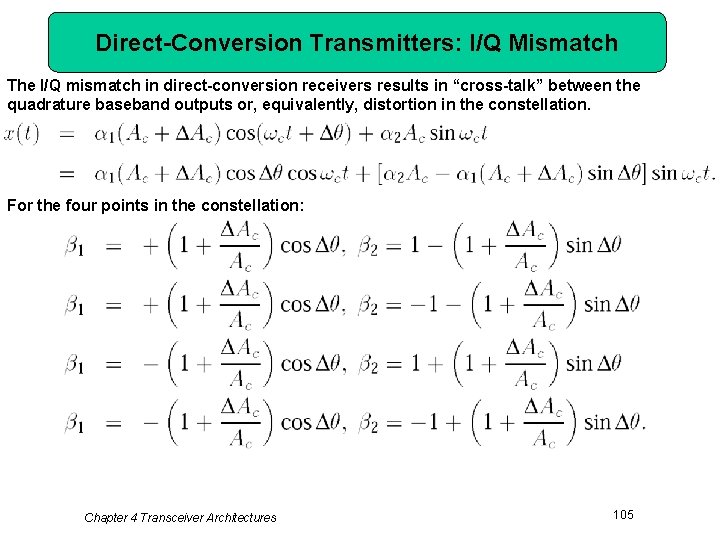
Direct-Conversion Transmitters: I/Q Mismatch The I/Q mismatch in direct-conversion receivers results in “cross-talk” between the quadrature baseband outputs or, equivalently, distortion in the constellation. For the four points in the constellation: Chapter 4 Transceiver Architectures 105
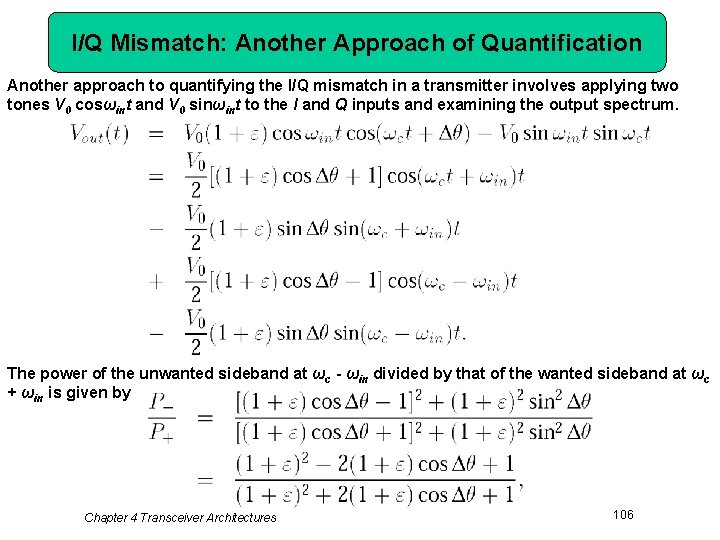
I/Q Mismatch: Another Approach of Quantification Another approach to quantifying the I/Q mismatch in a transmitter involves applying two tones V 0 cosωint and V 0 sinωint to the I and Q inputs and examining the output spectrum. The power of the unwanted sideband at ωc - ωin divided by that of the wanted sideband at ωc + ωin is given by Chapter 4 Transceiver Architectures 106
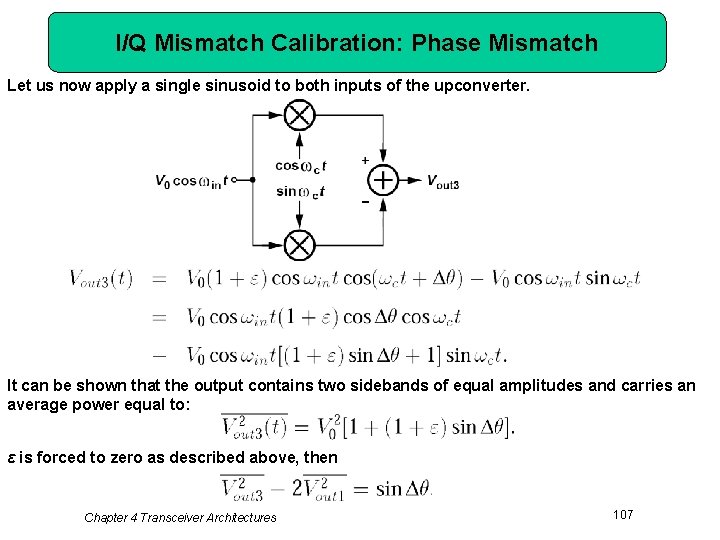
I/Q Mismatch Calibration: Phase Mismatch Let us now apply a single sinusoid to both inputs of the upconverter. It can be shown that the output contains two sidebands of equal amplitudes and carries an average power equal to: ε is forced to zero as described above, then Chapter 4 Transceiver Architectures 107
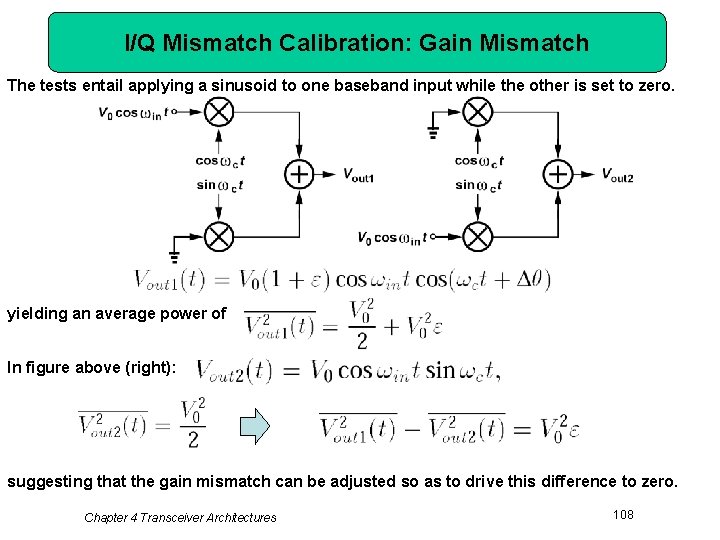
I/Q Mismatch Calibration: Gain Mismatch The tests entail applying a sinusoid to one baseband input while the other is set to zero. yielding an average power of In figure above (right): suggesting that the gain mismatch can be adjusted so as to drive this difference to zero. Chapter 4 Transceiver Architectures 108
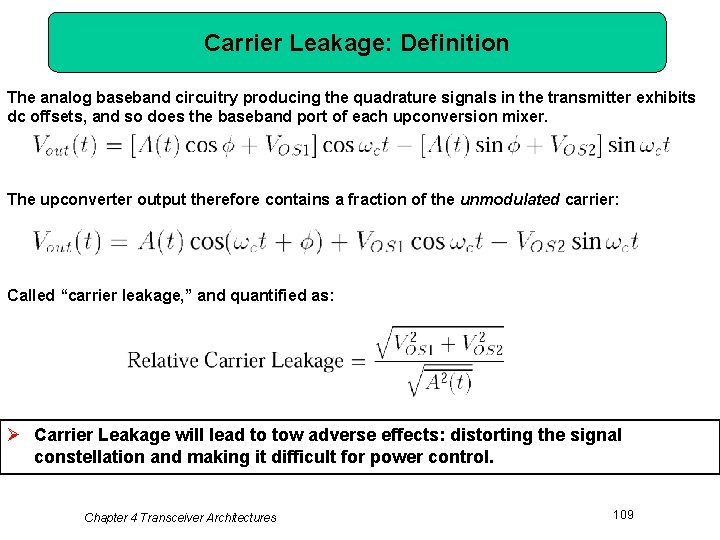
Carrier Leakage: Definition The analog baseband circuitry producing the quadrature signals in the transmitter exhibits dc offsets, and so does the baseband port of each upconversion mixer. The upconverter output therefore contains a fraction of the unmodulated carrier: Called “carrier leakage, ” and quantified as: Ø Carrier Leakage will lead to tow adverse effects: distorting the signal constellation and making it difficult for power control. Chapter 4 Transceiver Architectures 109
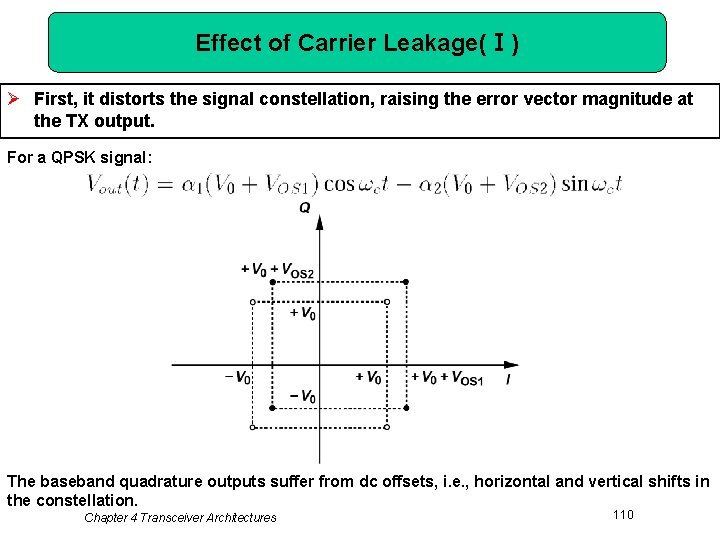
Effect of Carrier Leakage(Ⅰ) Ø First, it distorts the signal constellation, raising the error vector magnitude at the TX output. For a QPSK signal: The baseband quadrature outputs suffer from dc offsets, i. e. , horizontal and vertical shifts in the constellation. Chapter 4 Transceiver Architectures 110
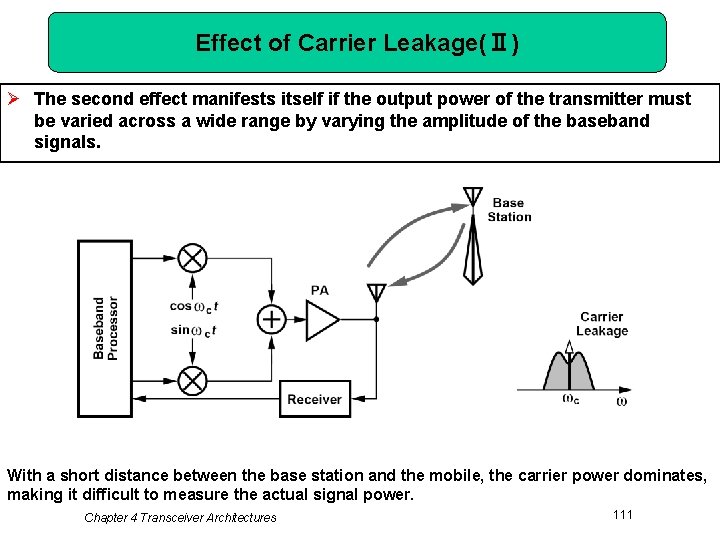
Effect of Carrier Leakage(Ⅱ) Ø The second effect manifests itself if the output power of the transmitter must be varied across a wide range by varying the amplitude of the baseband signals. With a short distance between the base station and the mobile, the carrier power dominates, making it difficult to measure the actual signal power. Chapter 4 Transceiver Architectures 111
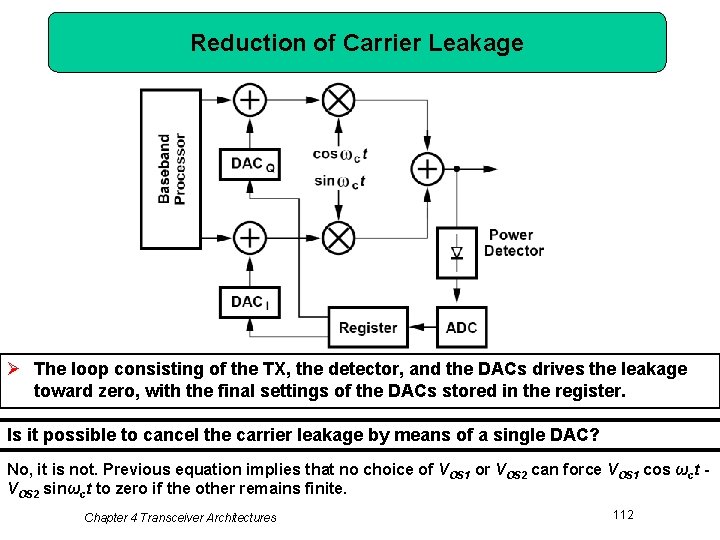
Reduction of Carrier Leakage Ø The loop consisting of the TX, the detector, and the DACs drives the leakage toward zero, with the final settings of the DACs stored in the register. Is it possible to cancel the carrier leakage by means of a single DAC? No, it is not. Previous equation implies that no choice of VOS 1 or VOS 2 can force VOS 1 cos ωct VOS 2 sinωct to zero if the other remains finite. Chapter 4 Transceiver Architectures 112
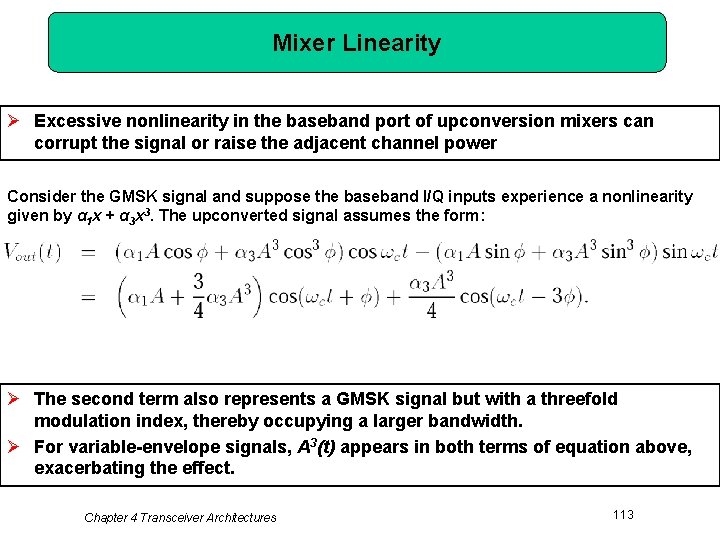
Mixer Linearity Ø Excessive nonlinearity in the baseband port of upconversion mixers can corrupt the signal or raise the adjacent channel power Consider the GMSK signal and suppose the baseband I/Q inputs experience a nonlinearity given by α 1 x + α 3 x 3. The upconverted signal assumes the form: Ø The second term also represents a GMSK signal but with a threefold modulation index, thereby occupying a larger bandwidth. Ø For variable-envelope signals, A 3(t) appears in both terms of equation above, exacerbating the effect. Chapter 4 Transceiver Architectures 113
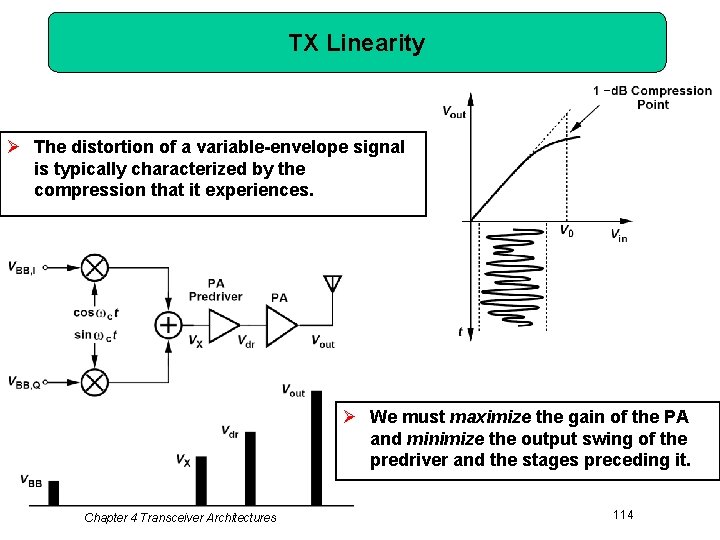
TX Linearity Ø The distortion of a variable-envelope signal is typically characterized by the compression that it experiences. Ø We must maximize the gain of the PA and minimize the output swing of the predriver and the stages preceding it. Chapter 4 Transceiver Architectures 114
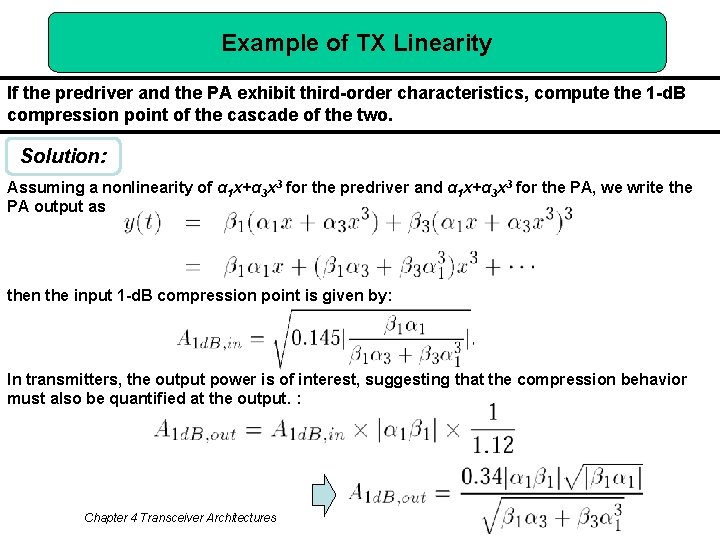
Example of TX Linearity If the predriver and the PA exhibit third-order characteristics, compute the 1 -d. B compression point of the cascade of the two. Solution: Assuming a nonlinearity of α 1 x+α 3 x 3 for the predriver and α 1 x+α 3 x 3 for the PA, we write the PA output as then the input 1 -d. B compression point is given by: In transmitters, the output power is of interest, suggesting that the compression behavior must also be quantified at the output. : Chapter 4 Transceiver Architectures 115
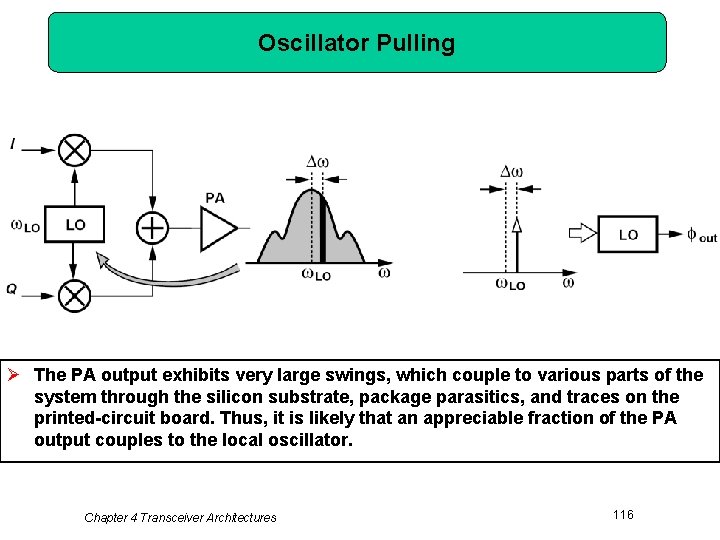
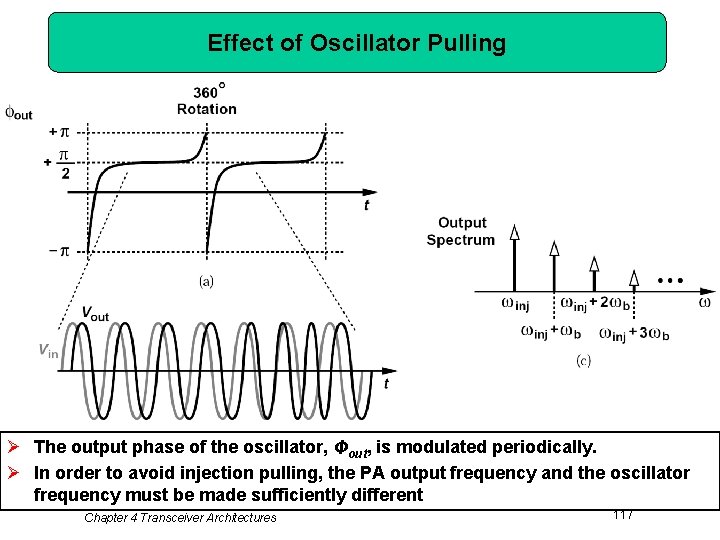
Oscillator Pulling Ø The PA output exhibits very large swings, which couple to various parts of the system through the silicon substrate, package parasitics, and traces on the printed-circuit board. Thus, it is likely that an appreciable fraction of the PA output couples to the local oscillator. Chapter 4 Transceiver Architectures 116
Effect of Oscillator Pulling Ø The output phase of the oscillator, Φout, is modulated periodically. Ø In order to avoid injection pulling, the PA output frequency and the oscillator frequency must be made sufficiently different Chapter 4 Transceiver Architectures 117
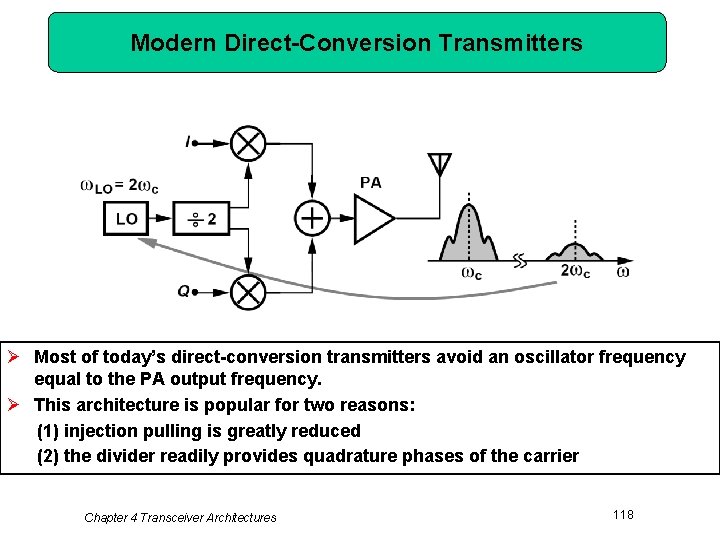
Modern Direct-Conversion Transmitters Ø Most of today’s direct-conversion transmitters avoid an oscillator frequency equal to the PA output frequency. Ø This architecture is popular for two reasons: (1) injection pulling is greatly reduced (2) the divider readily provides quadrature phases of the carrier Chapter 4 Transceiver Architectures 118
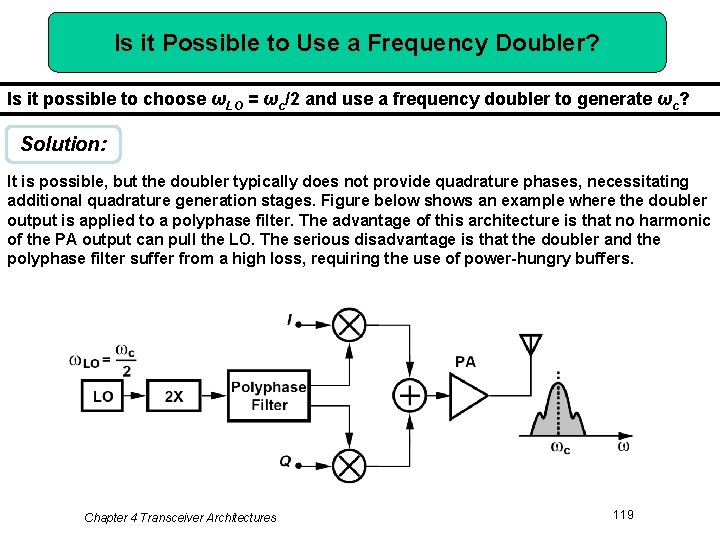
Is it Possible to Use a Frequency Doubler? Is it possible to choose ωLO = ωc/2 and use a frequency doubler to generate ωc? Solution: It is possible, but the doubler typically does not provide quadrature phases, necessitating additional quadrature generation stages. Figure below shows an example where the doubler output is applied to a polyphase filter. The advantage of this architecture is that no harmonic of the PA output can pull the LO. The serious disadvantage is that the doubler and the polyphase filter suffer from a high loss, requiring the use of power-hungry buffers. Chapter 4 Transceiver Architectures 119
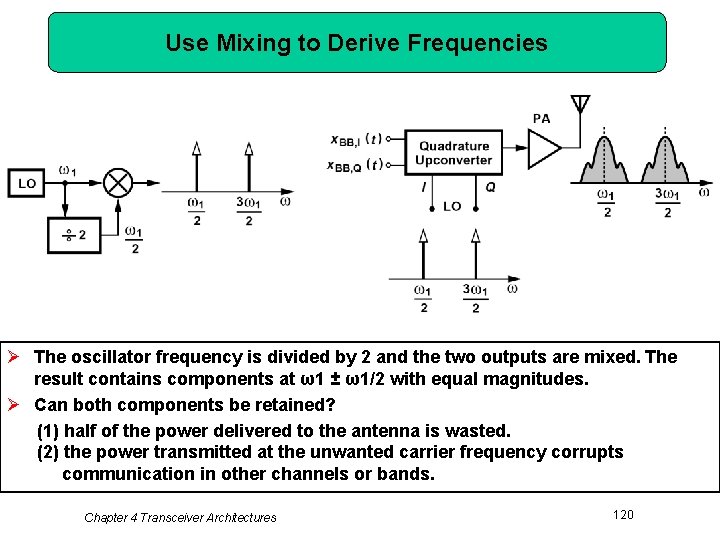
Use Mixing to Derive Frequencies Ø The oscillator frequency is divided by 2 and the two outputs are mixed. The result contains components at ω1 ± ω1/2 with equal magnitudes. Ø Can both components be retained? (1) half of the power delivered to the antenna is wasted. (2) the power transmitted at the unwanted carrier frequency corrupts communication in other channels or bands. Chapter 4 Transceiver Architectures 120
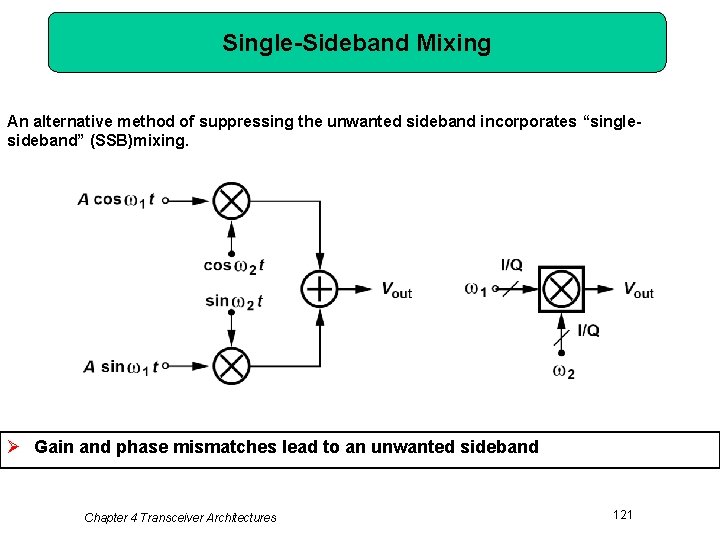
Single-Sideband Mixing An alternative method of suppressing the unwanted sideband incorporates “singlesideband” (SSB)mixing. Ø Gain and phase mismatches lead to an unwanted sideband Chapter 4 Transceiver Architectures 121
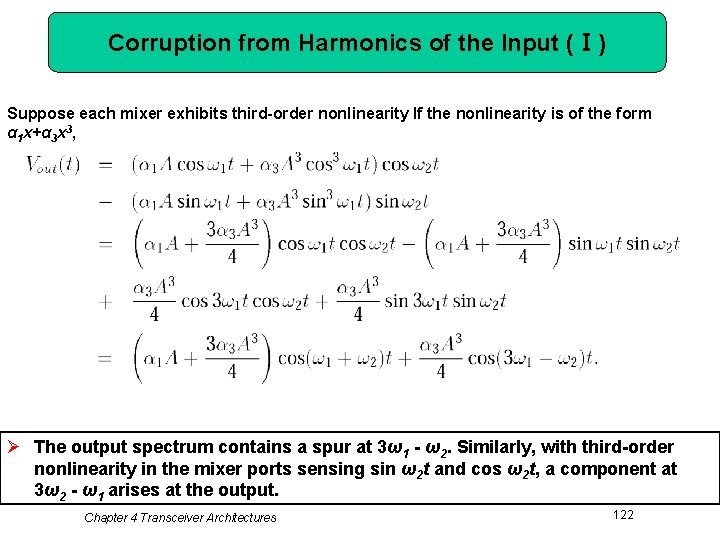
Corruption from Harmonics of the Input (Ⅰ) Suppose each mixer exhibits third-order nonlinearity If the nonlinearity is of the form α 1 x+α 3 x 3, Ø The output spectrum contains a spur at 3ω1 - ω2. Similarly, with third-order nonlinearity in the mixer ports sensing sin ω2 t and cos ω2 t, a component at 3ω2 - ω1 arises at the output. Chapter 4 Transceiver Architectures 122
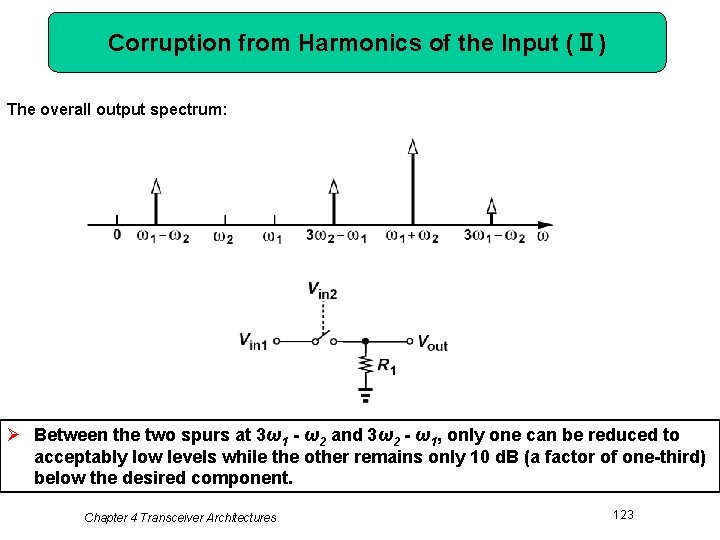
Corruption from Harmonics of the Input (Ⅱ) The overall output spectrum: Ø Between the two spurs at 3ω1 - ω2 and 3ω2 - ω1, only one can be reduced to acceptably low levels while the other remains only 10 d. B (a factor of one-third) below the desired component. Chapter 4 Transceiver Architectures 123
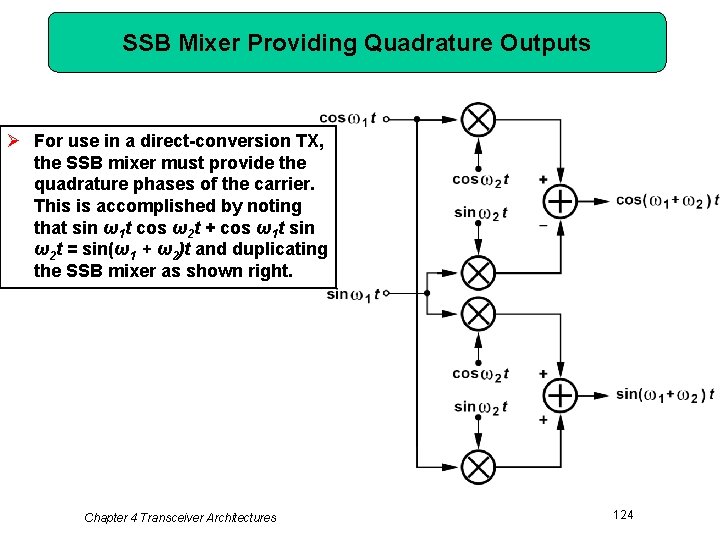
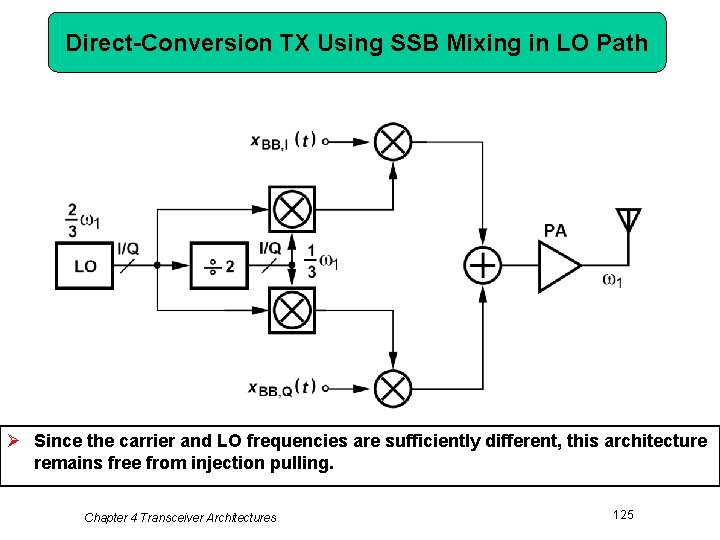
SSB Mixer Providing Quadrature Outputs Ø For use in a direct-conversion TX, the SSB mixer must provide the quadrature phases of the carrier. This is accomplished by noting that sin ω1 t cos ω2 t + cos ω1 t sin ω2 t = sin(ω1 + ω2)t and duplicating the SSB mixer as shown right. Chapter 4 Transceiver Architectures 124
Direct-Conversion TX Using SSB Mixing in LO Path Ø Since the carrier and LO frequencies are sufficiently different, this architecture remains free from injection pulling. Chapter 4 Transceiver Architectures 125
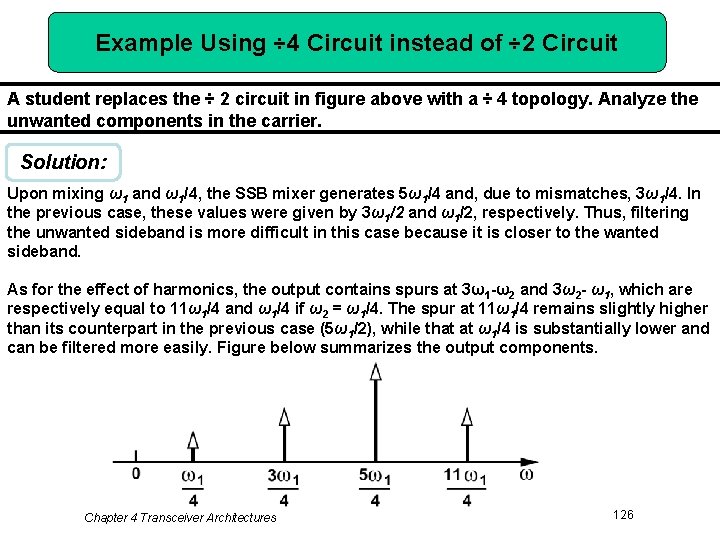
Example Using ÷ 4 Circuit instead of ÷ 2 Circuit A student replaces the ÷ 2 circuit in figure above with a ÷ 4 topology. Analyze the unwanted components in the carrier. Solution: Upon mixing ω1 and ω1/4, the SSB mixer generates 5ω1/4 and, due to mismatches, 3ω1/4. In the previous case, these values were given by 3ω1/2 and ω1/2, respectively. Thus, filtering the unwanted sideband is more difficult in this case because it is closer to the wanted sideband. As for the effect of harmonics, the output contains spurs at 3ω1 -ω2 and 3ω2 - ω1, which are respectively equal to 11ω1/4 and ω1/4 if ω2 = ω1/4. The spur at 11ω1/4 remains slightly higher than its counterpart in the previous case (5ω1/2), while that at ω1/4 is substantially lower and can be filtered more easily. Figure below summarizes the output components. Chapter 4 Transceiver Architectures 126
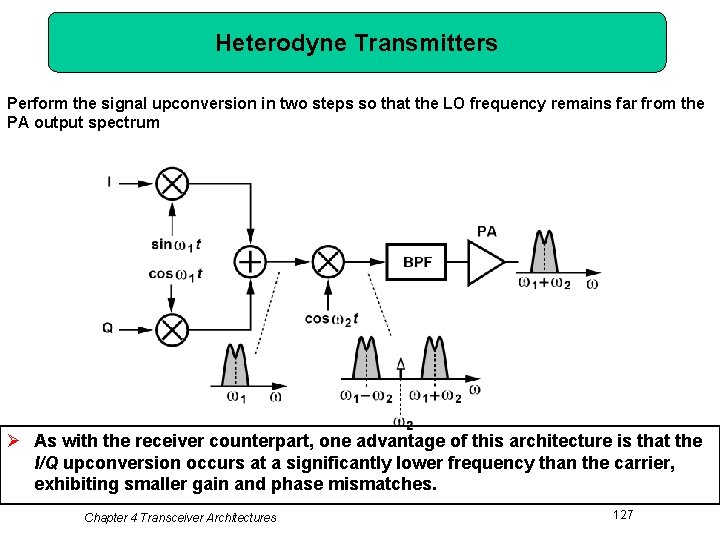
Heterodyne Transmitters Perform the signal upconversion in two steps so that the LO frequency remains far from the PA output spectrum Ø As with the receiver counterpart, one advantage of this architecture is that the I/Q upconversion occurs at a significantly lower frequency than the carrier, exhibiting smaller gain and phase mismatches. Chapter 4 Transceiver Architectures 127
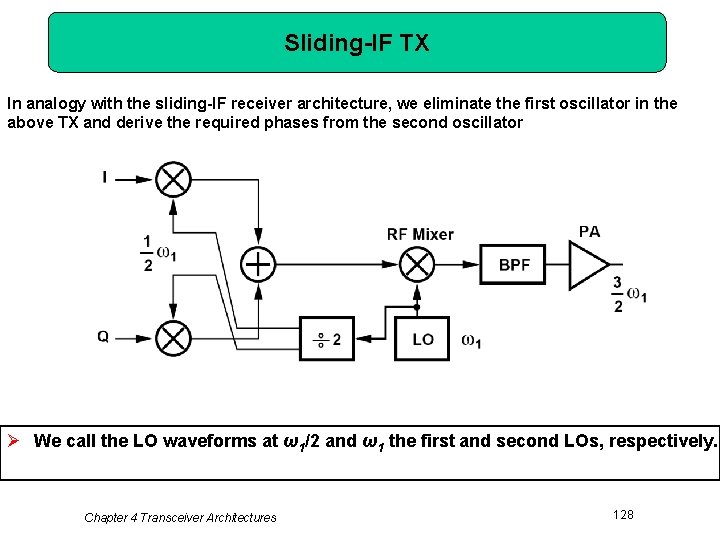
Sliding-IF TX In analogy with the sliding-IF receiver architecture, we eliminate the first oscillator in the above TX and derive the required phases from the second oscillator Ø We call the LO waveforms at ω1/2 and ω1 the first and second LOs, respectively. Chapter 4 Transceiver Architectures 128
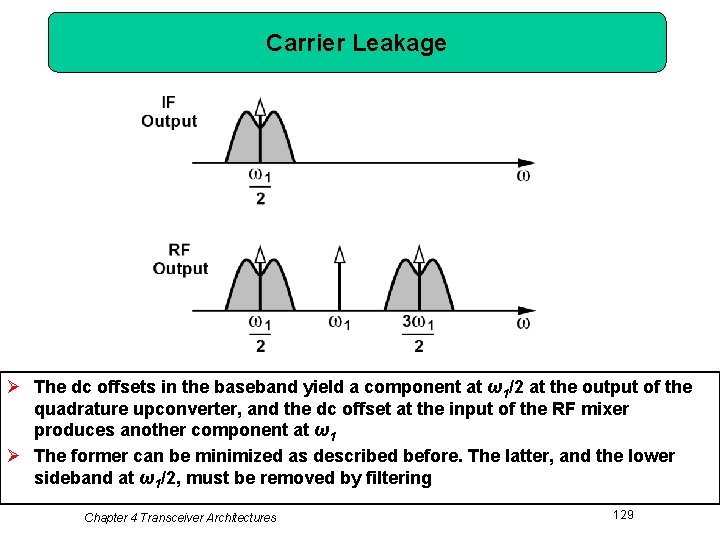
Carrier Leakage Ø The dc offsets in the baseband yield a component at ω1/2 at the output of the quadrature upconverter, and the dc offset at the input of the RF mixer produces another component at ω1 Ø The former can be minimized as described before. The latter, and the lower sideband at ω1/2, must be removed by filtering Chapter 4 Transceiver Architectures 129
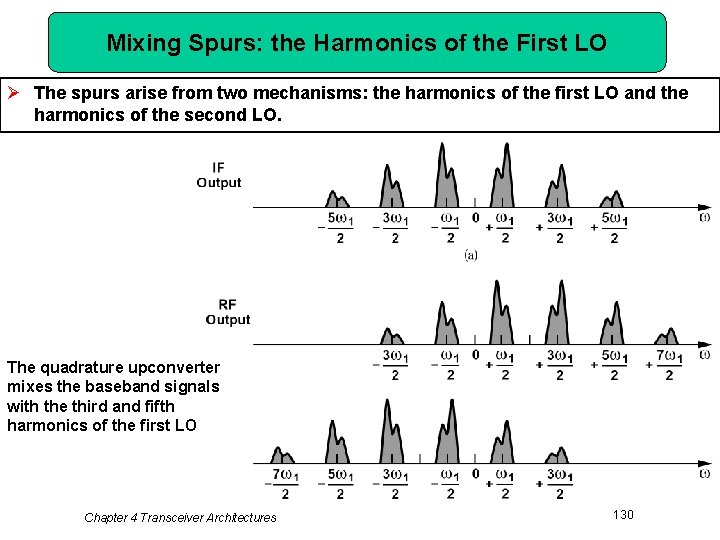
Mixing Spurs: the Harmonics of the First LO Ø The spurs arise from two mechanisms: the harmonics of the first LO and the harmonics of the second LO. The quadrature upconverter mixes the baseband signals with the third and fifth harmonics of the first LO Chapter 4 Transceiver Architectures 130
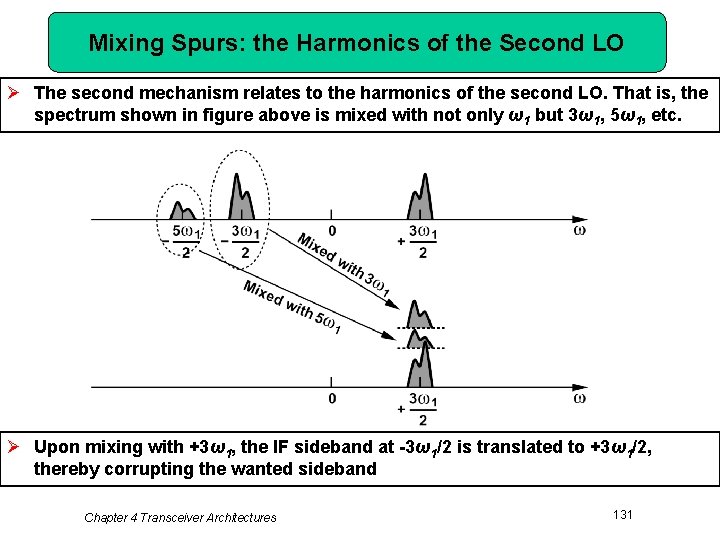
Mixing Spurs: the Harmonics of the Second LO Ø The second mechanism relates to the harmonics of the second LO. That is, the spectrum shown in figure above is mixed with not only ω1 but 3ω1, 5ω1, etc. Ø Upon mixing with +3ω1, the IF sideband at -3ω1/2 is translated to +3ω1/2, thereby corrupting the wanted sideband Chapter 4 Transceiver Architectures 131
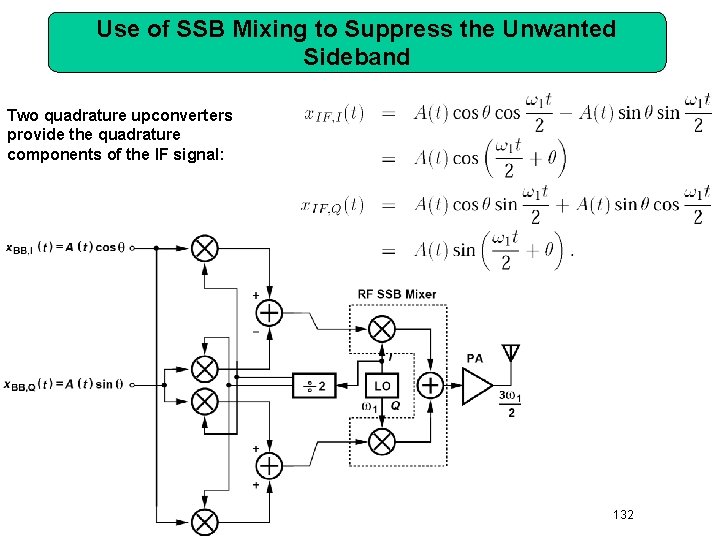
Use of SSB Mixing to Suppress the Unwanted Sideband Two quadrature upconverters provide the quadrature components of the IF signal: Chapter 4 Transceiver Architectures 132
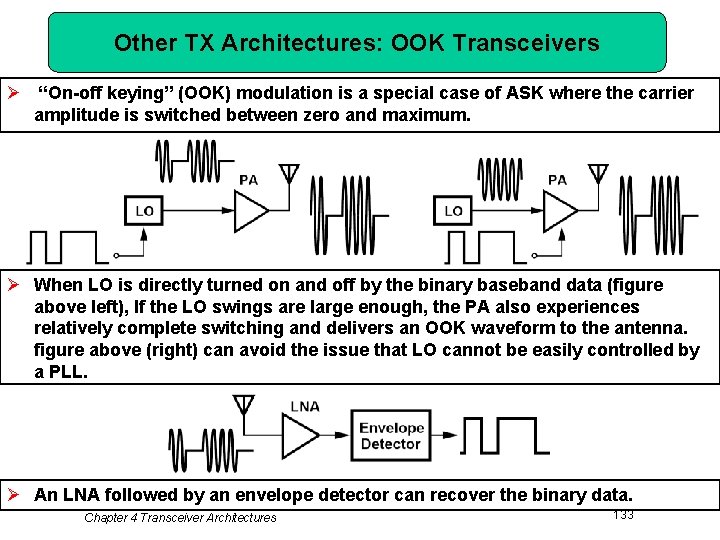
Other TX Architectures: OOK Transceivers Ø “On-off keying” (OOK) modulation is a special case of ASK where the carrier amplitude is switched between zero and maximum. Ø When LO is directly turned on and off by the binary baseband data (figure above left), If the LO swings are large enough, the PA also experiences relatively complete switching and delivers an OOK waveform to the antenna. figure above (right) can avoid the issue that LO cannot be easily controlled by a PLL. Ø An LNA followed by an envelope detector can recover the binary data. Chapter 4 Transceiver Architectures 133
References (Ⅰ) Chapter 4 Transceiver Architectures 134
References (Ⅱ) Chapter 4 Transceiver Architectures 135
References (Ⅲ) Chapter 4 Transceiver Architectures 136
References (Ⅳ) Chapter 4 Transceiver Architectures 137