
Chapter 4 Transactions That Affect Assets Liabilities and

Chapter 4 Transactions That Affect Assets, Liabilities, and Owner’s Capital What You’ll Learn § § Prepare a chart of accounts. Explain the purpose of double-entry accounting. Identify the normal balance of accounts. Use T accounts to illustrate the rules of debit and credit for asset accounts, liability accounts, and the owner’s capital account and to express the accounting equation. § Use T accounts to analyze transactions that affect assets, liabilities, and the owner’s capital account. Glencoe Accounting Unit 2 Chapter 4 Copyright © by The Mc. Graw-Hill Companies, Inc. All rights reserved. 0

Chapter 4 Transactions That Affect Assets, Liabilities, and Owner’s Capital What You’ll Learn § Calculate the account balances after recording business transactions. § Define the accounting terms introduced in this chapter. Glencoe Accounting Unit 2 Chapter 4 Copyright © by The Mc. Graw-Hill Companies, Inc. All rights reserved. 1
Chapter 4, Section 1 Accounts and the Double-Entry Accounting System What Do You Think? Based on what you have reviewed about transactions, why do you think we use a double-entry accounting system? Glencoe Accounting Unit 2 Chapter 4 Copyright © by The Mc. Graw-Hill Companies, Inc. All rights reserved. 2
SECTION 4. 1 Accounts and the Double-Entry Accounting System Main Idea The double-entry accounting system uses debits and credits. Debit means “left side” and credit means “right side. ” You Will Learn § about the chart of accounts. § about the double-entry accounting system. Glencoe Accounting Unit 2 Chapter 4 Copyright © by The Mc. Graw-Hill Companies, Inc. All rights reserved. 3
Accounts and the Double-Entry Accounting System SECTION 4. 1 Key Terms § § § § chart of accounts ledger double-entry accounting debit credit T account normal balance Glencoe Accounting Unit 2 Chapter 4 Copyright © by The Mc. Graw-Hill Companies, Inc. All rights reserved. 4
SECTION 4. 1 Accounts and the Double-Entry Accounting System The Chart of Accounts A chart of accounts is a list of accounts used by a business. Accounts are grouped together in a ledger, also known as a general ledger. “Keeping the books” refers to maintaining accounts in the ledger. Accounts are easier to locate in the ledger if they are numbered. A typical numbering system is as follows: § Asset accounts begin with 1. § Liability accounts begin with 2. § Owner’s equity accounts begin with 3. § Revenue accounts begin with 4. § Expense accounts begin with 5. Glencoe Accounting Unit 2 Chapter 4 Copyright © by The Mc. Graw-Hill Companies, Inc. All rights reserved. 5
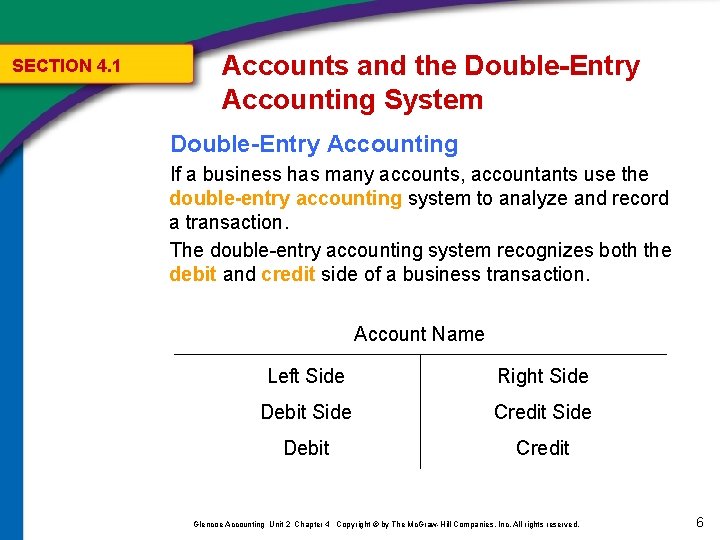
SECTION 4. 1 Accounts and the Double-Entry Accounting System Double-Entry Accounting If a business has many accounts, accountants use the double-entry accounting system to analyze and record a transaction. The double-entry accounting system recognizes both the debit and credit side of a business transaction. Account Name Left Side Right Side Debit Side Credit Side Debit Credit Glencoe Accounting Unit 2 Chapter 4 Copyright © by The Mc. Graw-Hill Companies, Inc. All rights reserved. 6

SECTION 4. 1 Accounts and the Double-Entry Accounting System T Accounts The T account is a tool for using the double-entry accounting system. It shows the dollar increase and decrease caused by a transaction. The T account gets its name from being shaped like a T: § Account name is on the top. § The left side is used for debits. § The right side is used for credits. Glencoe Accounting Unit 2 Chapter 4 Copyright © by The Mc. Graw-Hill Companies, Inc. All rights reserved. 7
SECTION 4. 1 Accounts and the Double-Entry Accounting System The Rules of Debit and Credit In double-entry accounting, for each debit in one account, there must be an equal credit in another account. The rules of debit and credit vary depending on the type of account. Each account has a normal balance to record increases to the account. The word normal in this case means usual. Glencoe Accounting Unit 2 Chapter 4 Copyright © by The Mc. Graw-Hill Companies, Inc. All rights reserved. 8
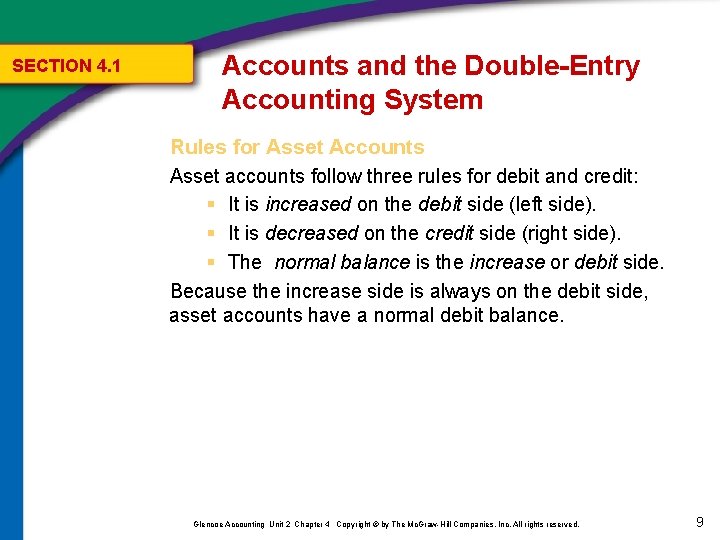
SECTION 4. 1 Accounts and the Double-Entry Accounting System Rules for Asset Accounts Asset accounts follow three rules for debit and credit: § It is increased on the debit side (left side). § It is decreased on the credit side (right side). § The normal balance is the increase or debit side. Because the increase side is always on the debit side, asset accounts have a normal debit balance. Glencoe Accounting Unit 2 Chapter 4 Copyright © by The Mc. Graw-Hill Companies, Inc. All rights reserved. 9

SECTION 4. 1 Accounts and the Double-Entry Accounting System Rules for Liability and Owner’s Capital Accounts Liability and owner’s capital accounts follow three rules for debit and credit: § It is increased on the credit side (right side). § It is decreased on the debit side (left side). § The normal balance is the increase or credit side. Glencoe Accounting Unit 2 Chapter 4 Copyright © by The Mc. Graw-Hill Companies, Inc. All rights reserved. 10
- Slides: 11