
Chapter 4 Tissue Level of Organization WHAT IS

- Slides: 18
Chapter 4 – Tissue Level of Organization WHAT IS A TISSUE? A tissue is a collection of cells and cell products that perform a limited number of functions.
Four Tissue Types 1. Epithelial (skin/outer layer/glands) tissue 2. Connective tissue (never exposed to the outside) 3. Muscle tissue (in muscles) 4. Neural tissue (nerves, spinal cord, brain)
Epithelial Tissue �Characteristics: Cells are in close proximity, tightly packed Exposed to the environment (skin/free surface) or an internal passageway (digestive, respiratory, reproductive, urinary tracts) Have a basement membrane that attaches connective tissue to underlying layer No blood vessels – where do nutrients come from? Damaged and lost, so continually replaced
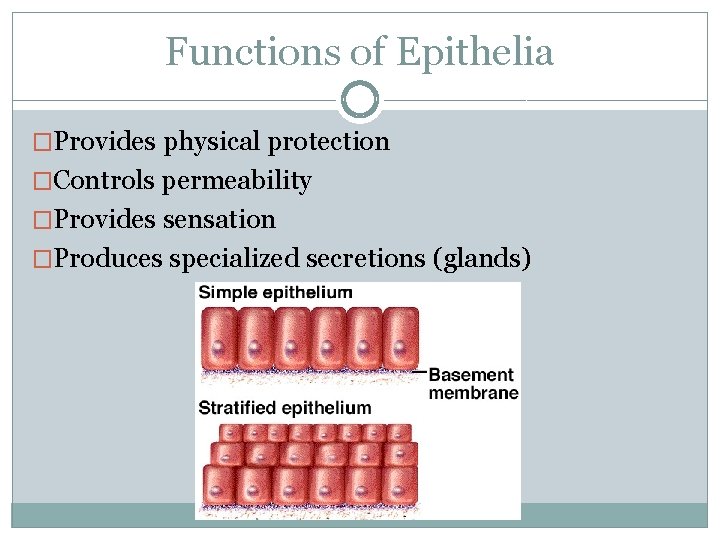
Functions of Epithelia �Provides physical protection �Controls permeability �Provides sensation �Produces specialized secretions (glands)
Intercellular Connections in Epithelial Tissues �Epithelial cell membranes have proteins called cell adhesion molecules (CAMs) �The adhesion molecules and intercellular cement (made of composed protein-polysaccharide mixture) hold neighboring cells together �Types: Tight junctions – layers of lipids tightly bound by proteins on the cell membranes Gap junctions – embedded membrane proteins hold them together Desmosome – membranes bound together by intercellular cement
Layer Types of Epithelial �Simple – single layer of cells over a basement membrane Thin cells Only in protected, internal parts �Stratified – several layers of cells above the basement membrane A little greater protection Survive mechanical and chemical stresses better
Intercellular Connections �Tight junctions Formed by fusion of neighboring cell membranes Found in the digestive tract �Gap junctions Allow for an electrical current and small molecule exchange Commonly found in cardiac and smooth muscle tissue and the liver �Desmosome Reinforced with fine protein filaments Top layers of skin and between heart cells
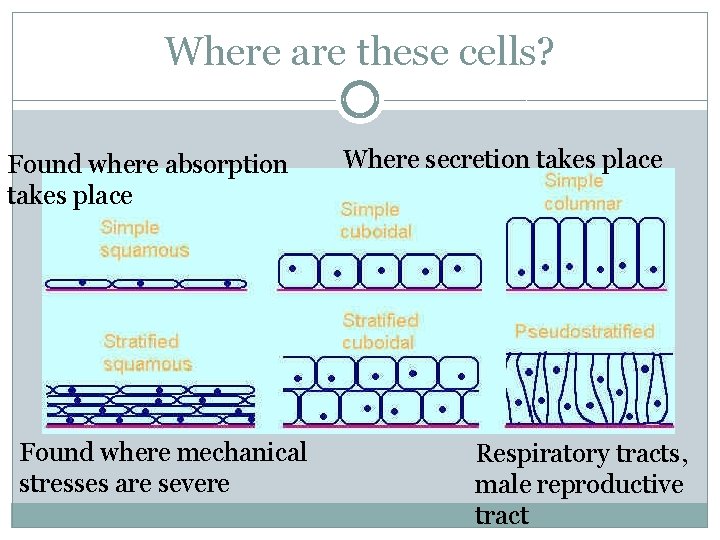
Cell Shapes in Epithelial Tissue �Three types: �Squamous epithelium Squama – plate Thin and flat cells with the thickest part containing the nucleus �Cuboidal epithelium 3 D are hexagonally shaped, under microscope are cubed Often form a neat row �Columnar epithelium Taller hexagonally shaped cells Nuclei are located closer to the basement membrane
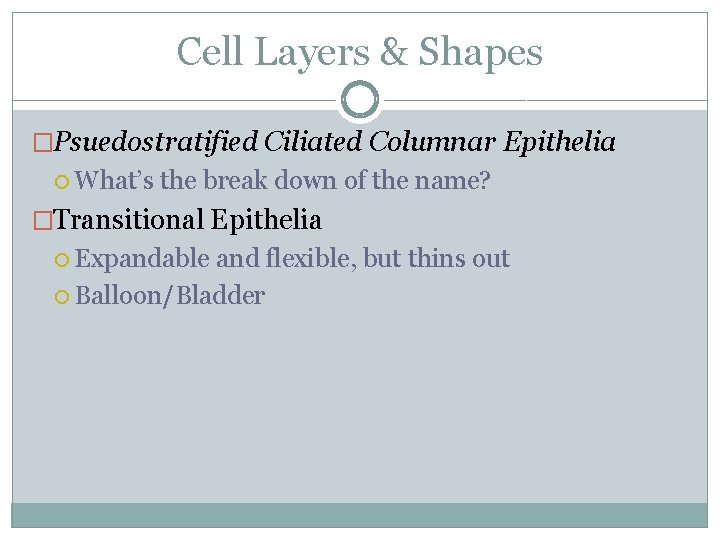
Cell Layers & Shapes �Psuedostratified Ciliated Columnar Epithelia What’s the break down of the name? �Transitional Epithelia Expandable and flexible, but thins out Balloon/Bladder
Where are these cells? Found where absorption takes place Found where mechanical stresses are severe Where secretion takes place Respiratory tracts, male reproductive tract
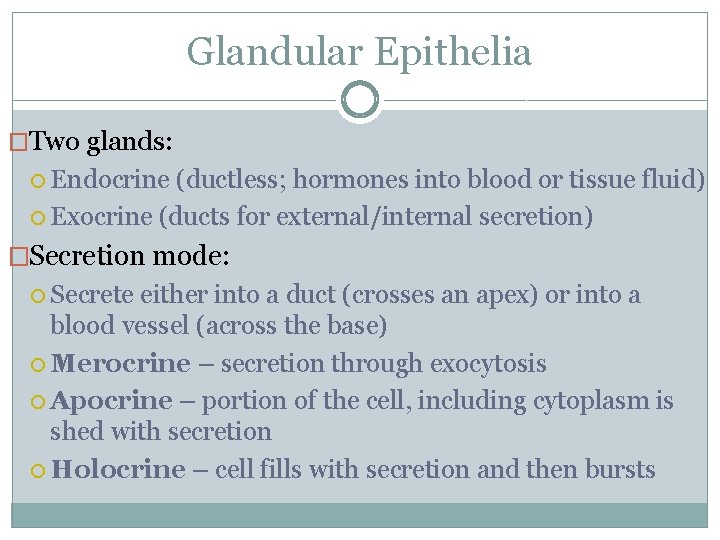
Glandular Epithelia �Two glands: Endocrine (ductless; hormones into blood or tissue fluid) Exocrine (ducts for external/internal secretion) �Secretion mode: Secrete either into a duct (crosses an apex) or into a blood vessel (across the base) Merocrine – secretion through exocytosis Apocrine – portion of the cell, including cytoplasm is shed with secretion Holocrine – cell fills with secretion and then bursts
Glandular Epithelia �Secretion type: Serous glands – watery with enzymes Mucous glands – thick, but slippery Mixed glands – more than one type NOTE: mucous is the descriptive adjective; mucus is the noun or actual product
Connective Tissue �A matrix (most of the tissue volume; formed by ground substance and extracellular protein fibers) that supports scattered cells – seems like conglomerate of unrelated tissues �Widely distributed throughout the body �Three components: Specialized cells Protein fibers A surrounding fluid, ground substance
Functions & Types of Connective Tissues �Support and protection �Transport materials �Store energy �Defend the body Types: Connective Tissue Proper Fluid Connective Tissue Supporting Connective Tissue
Connective Tissue Proper – Cell Types Major Cell Types: �Fibroblasts – most abundant �Microphages – scattered, can be fixed or free �Fat Cells/ Adipocytes – amount of fat varies �Mast Cells – full of enzymes, near blood vessels
Connective Tissue Proper – Fiber Types �Collagen fibers – long & straight; strong & flexible Most common fiber in Connective Tissue Proper �Elastic fibers – contain protein elastin; branched and wavy Stretch, but return to original length �Reticular fibers – thinner than collagen Form branching, interwoven network in organs
Connective Tissue Proper �Categorized as loose or dense connective tissue �LOOSE: least specialized, contains cells and fibers of Connective Tissue Proper and blood vessels Layer between skin and muscles Provides padding