
Chapter 4 Theory of Consumer Behavior 1 Utility
Chapter 4 Theory of Consumer Behavior 1
Utility Theory Ø Utility – The want-satisfying power of a good or service Ø Utility Analysis – The analysis of consumer decision making based on utility maximization Ø Util – A representative unit by which utility is measured 2
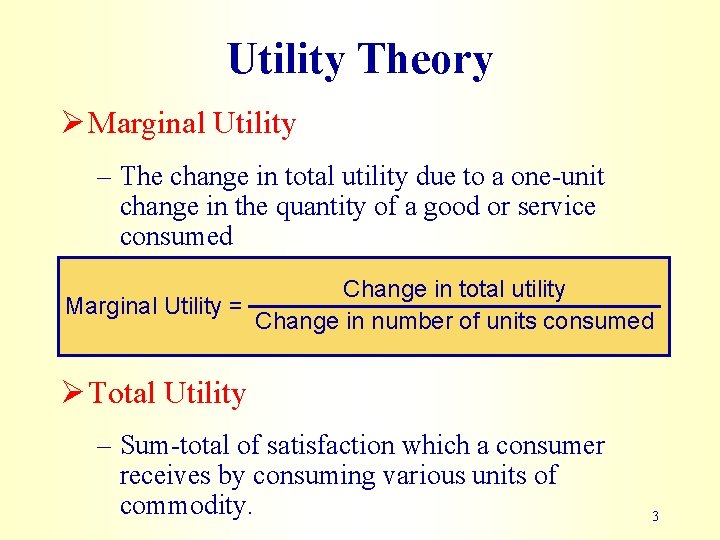
Utility Theory Ø Marginal Utility – The change in total utility due to a one-unit change in the quantity of a good or service consumed Change in total utility Marginal Utility = Change in number of units consumed Ø Total Utility – Sum-total of satisfaction which a consumer receives by consuming various units of commodity. 3
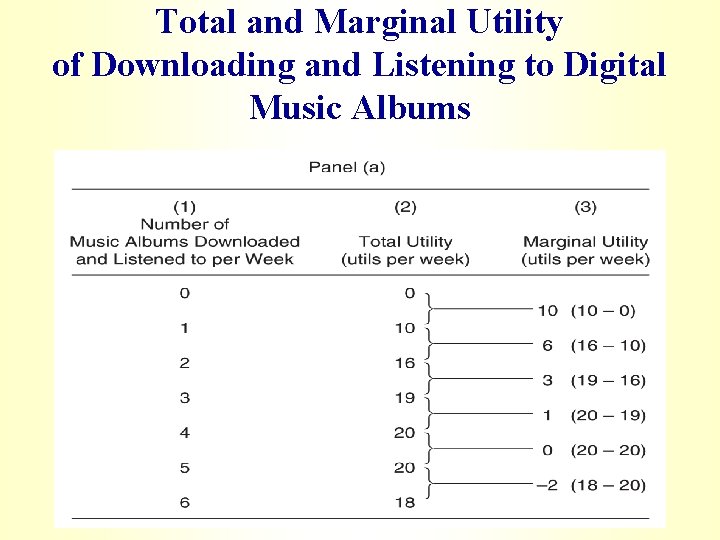
Total and Marginal Utility of Downloading and Listening to Digital Music Albums 4
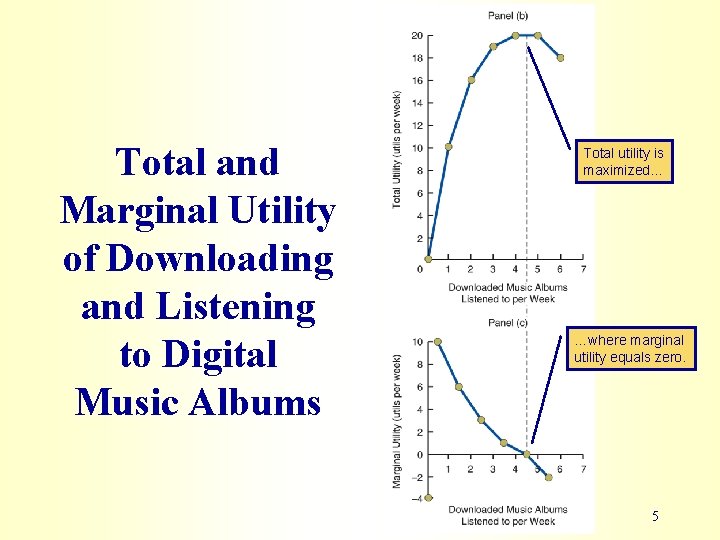
Total and Marginal Utility of Downloading and Listening to Digital Music Albums Total utility is maximized. . . …where marginal utility equals zero. 5
Graphical Analysis Ø Observations – Marginal utility falls as more is consumed. – Marginal utility equals zero when total utility is at its maximum. 6
Diminishing Marginal Utility Ø Law of Diminishing Marginal Utility – The principle that as more of any good or service is consumed, its extra benefit declines – Increases in total utility from consumption of a good or service become smaller and smaller as more is consumed during a given time period. 7
Optimizing Consumption Choices Ø Consumer Optimum – A choice of a set of goods and services that maximizes the level of satisfaction for each consumer, subject to limited income 8
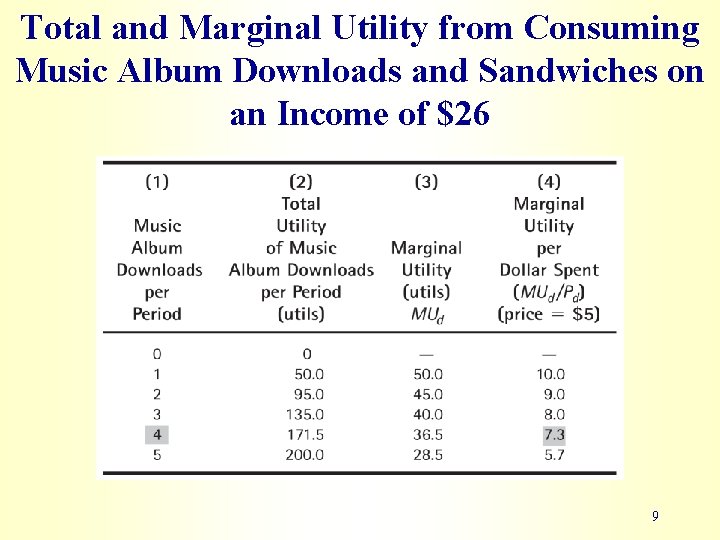
Total and Marginal Utility from Consuming Music Album Downloads and Sandwiches on an Income of $26 9
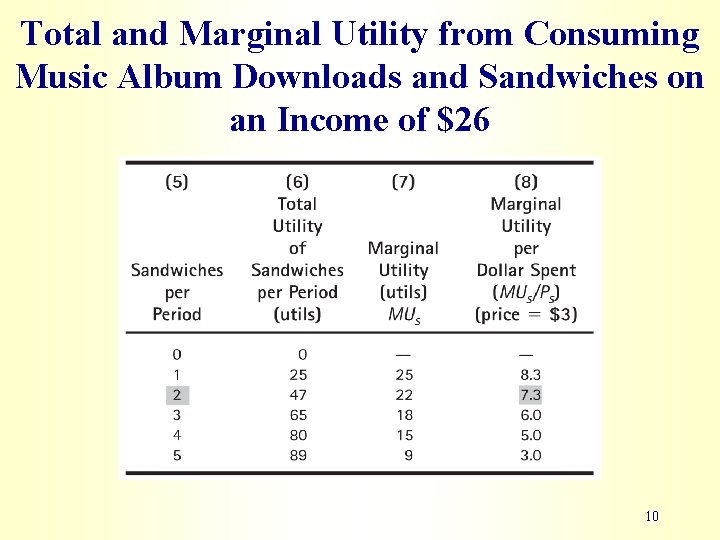
Total and Marginal Utility from Consuming Music Album Downloads and Sandwiches on an Income of $26 10
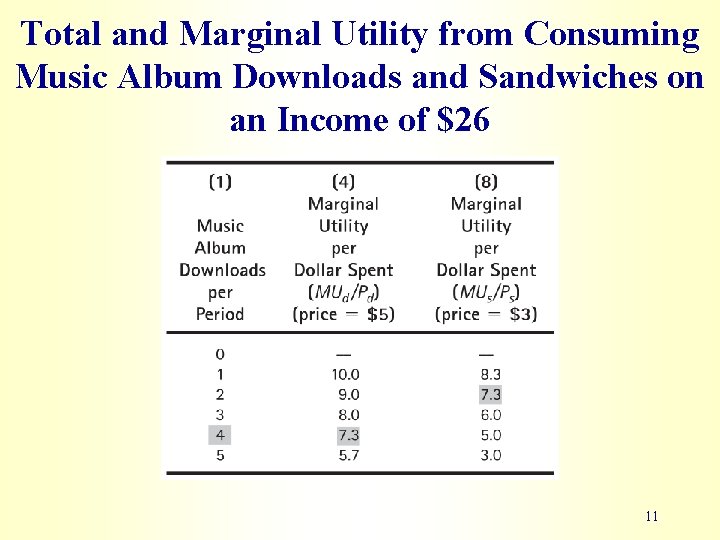
Total and Marginal Utility from Consuming Music Album Downloads and Sandwiches on an Income of $26 11
Optimizing Consumption Choices Ø A consumer’s money income should be allocated so that the last dollar spent on each good purchased yields the same amount of marginal utility (when all income is spent), because this rule yields the largest possible total utility. 12
Optimizing Consumption Choices Ø Law of Equi-marginal Utility – The rule of equal marginal utilities per dollar spent • A consumer maximizes personal satisfaction when allocating money income in such a way that the last dollars spent on good A, good B, good C, and so on, yield equal amounts of marginal utility. 13
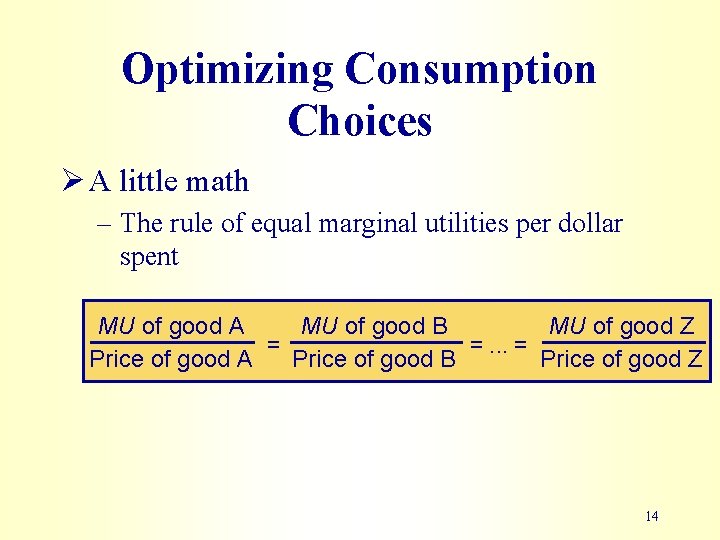
Optimizing Consumption Choices Ø A little math – The rule of equal marginal utilities per dollar spent MU of good A MU of good B MU of good Z = =. . . = Price of good A Price of good B Price of good Z 14
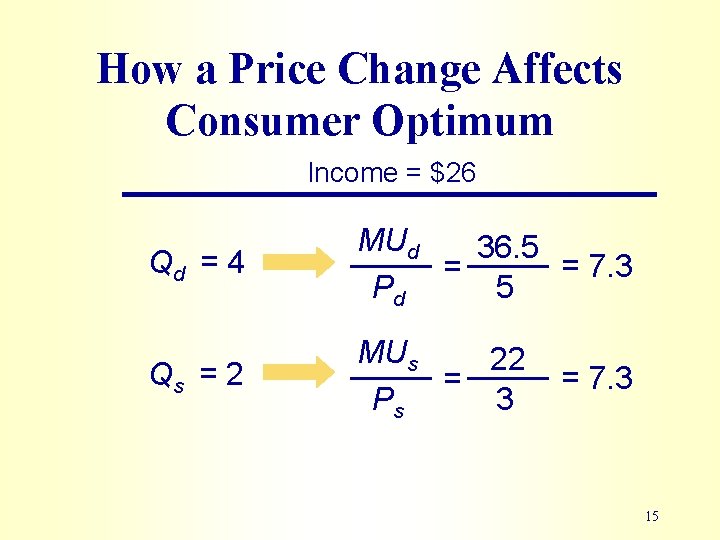
How a Price Change Affects Consumer Optimum Income = $26 Qd = 4 MUd 36. 5 = 7. 3 = Pd 5 Qs = 2 MUs 22 = Ps 3 = 7. 3 15
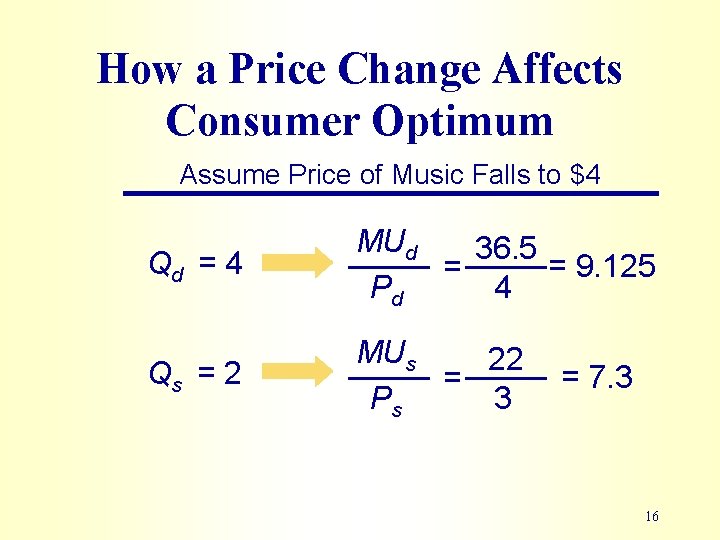
How a Price Change Affects Consumer Optimum Assume Price of Music Falls to $4 Qd = 4 MUd 36. 5 = 9. 125 = Pd 4 Qs = 2 MUs 22 = Ps 3 = 7. 3 16
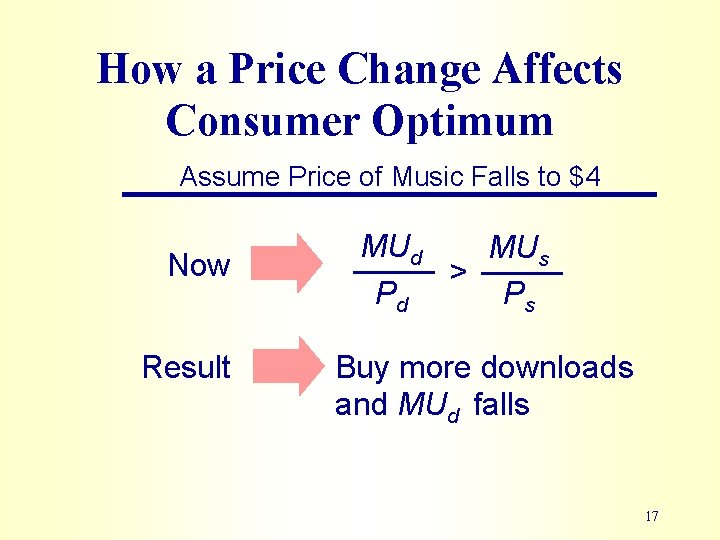
How a Price Change Affects Consumer Optimum Assume Price of Music Falls to $4 Now Result MUd MUs > Pd Ps Buy more downloads and MUd falls 17
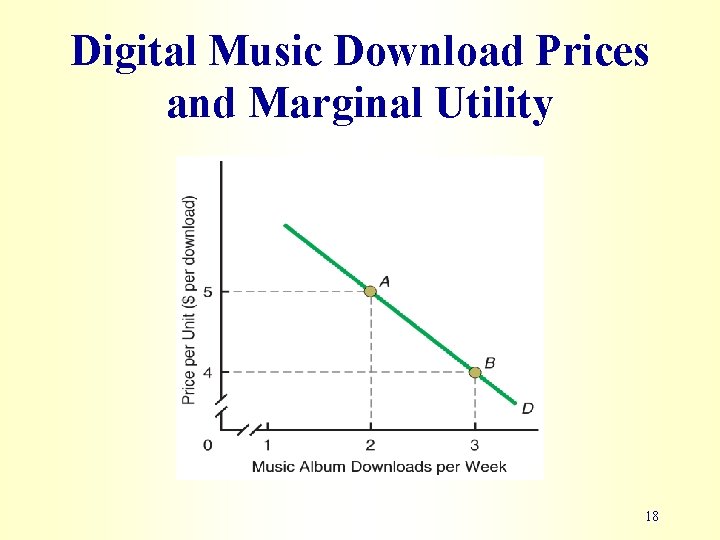
Digital Music Download Prices and Marginal Utility 18
How a Price Change Affects Consumer Optimum Ø Consumption decisions are summarized in the law of demand – The amount purchased is inversely related to price. Ø A consumer’s response to a price change – At higher consumption rate, marginal utility per dollar falls. 19
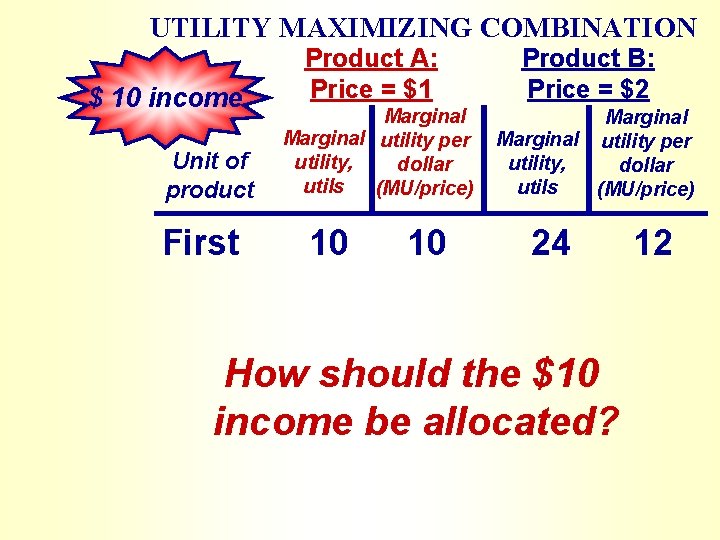
UTILITY MAXIMIZING COMBINATION $ 10 income Unit of product First Product A: Price = $1 Marginal utility per utility, dollar utils (MU/price) 10 10 Product B: Price = $2 Marginal utility per utility, dollar utils (MU/price) 24 How should the $10 income be allocated? 12
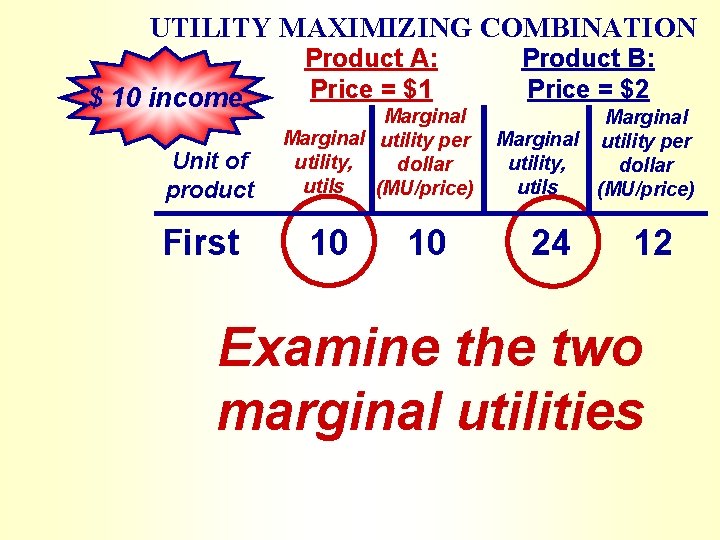
UTILITY MAXIMIZING COMBINATION $ 10 income Unit of product First Product A: Price = $1 Marginal utility per utility, dollar utils (MU/price) 10 10 Product B: Price = $2 Marginal utility per utility, dollar utils (MU/price) 24 12 Examine the two marginal utilities
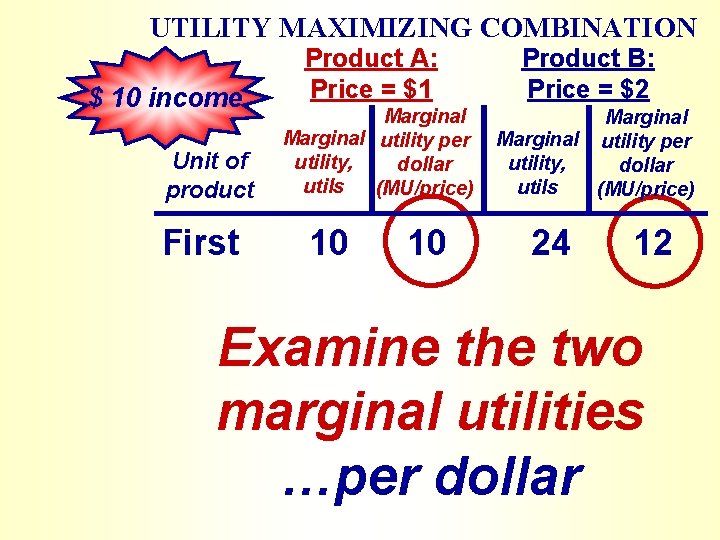
UTILITY MAXIMIZING COMBINATION $ 10 income Unit of product First Product A: Price = $1 Marginal utility per utility, dollar utils (MU/price) 10 10 Product B: Price = $2 Marginal utility per utility, dollar utils (MU/price) 24 12 Examine the two marginal utilities …per dollar
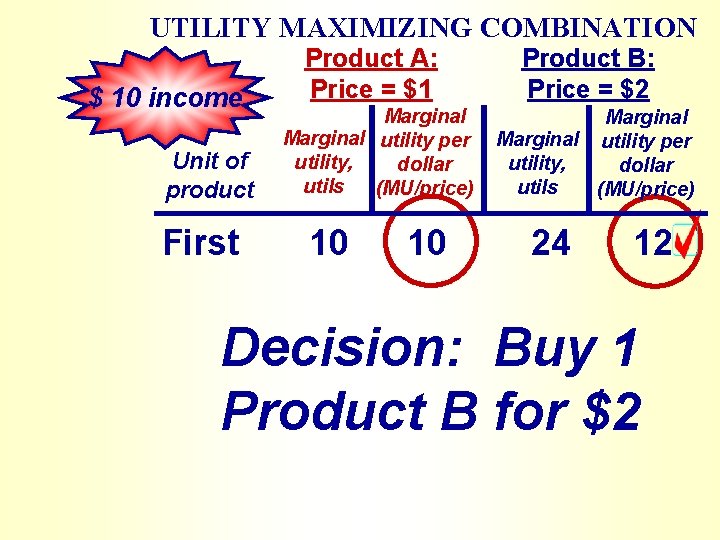
UTILITY MAXIMIZING COMBINATION $ 10 income Unit of product First Product A: Price = $1 Marginal utility per utility, dollar utils (MU/price) 10 10 Product B: Price = $2 Marginal utility per utility, dollar utils (MU/price) 24 12 Decision: Buy 1 Product B for $2
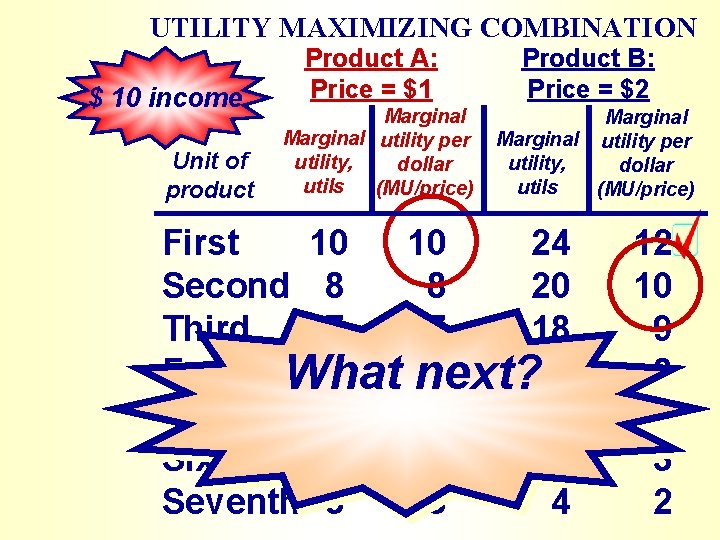
UTILITY MAXIMIZING COMBINATION $ 10 income Unit of product Product A: Price = $1 Marginal utility per utility, dollar utils (MU/price) Product B: Price = $2 Marginal utility per utility, dollar utils (MU/price) First 10 10 24 Second 8 8 20 Third 7 7 18 Fourth What 6 6 16 next? Fifth 5 5 12 Sixth 4 4 6 Seventh 3 3 4 12 10 9 8 6 3 2
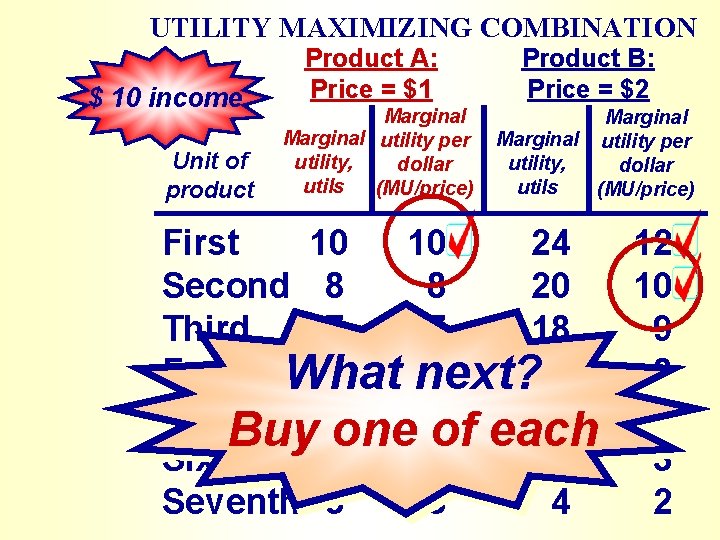
UTILITY MAXIMIZING COMBINATION $ 10 income Unit of product Product A: Price = $1 Marginal utility per utility, dollar utils (MU/price) Product B: Price = $2 Marginal utility per utility, dollar utils (MU/price) First 10 10 24 12 Second 8 8 20 10 Third 7 7 18 9 Fourth What 6 6 16 8 next? Fifth 5 5 12 6 Buy one of each Sixth 4 4 6 3 Seventh 3 3 4 2
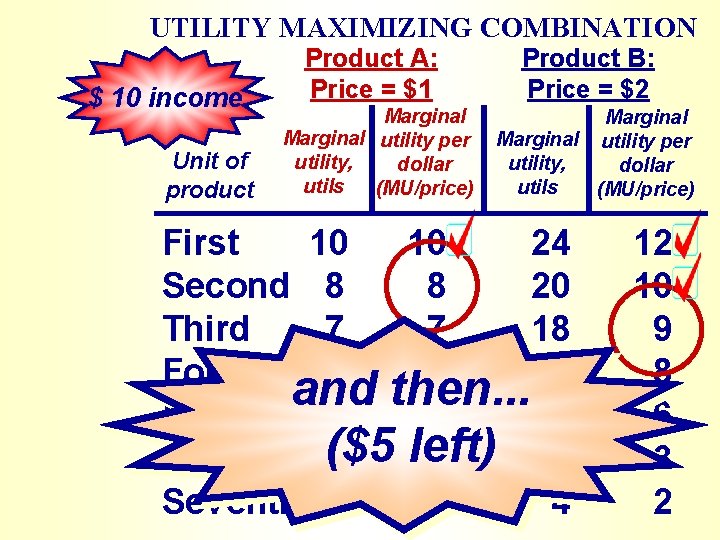
UTILITY MAXIMIZING COMBINATION $ 10 income Unit of product Product A: Price = $1 Marginal utility per utility, dollar utils (MU/price) Product B: Price = $2 Marginal utility per utility, dollar utils (MU/price) First 10 10 24 Second 8 8 20 Third 7 7 18 Fourth 6 6 16 and then. . . Fifth 5 5 12 ($5 left) Sixth 4 4 6 Seventh 3 3 4 12 10 9 8 6 3 2
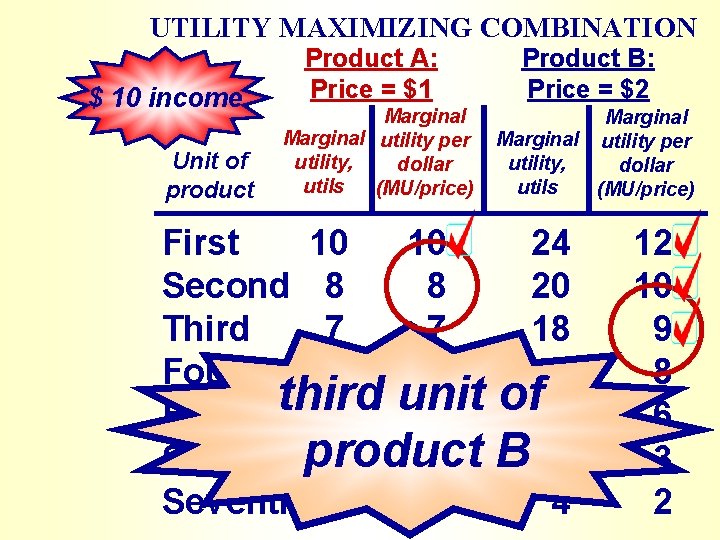
UTILITY MAXIMIZING COMBINATION $ 10 income Unit of product Product A: Price = $1 Marginal utility per utility, dollar utils (MU/price) Product B: Price = $2 Marginal utility per utility, dollar utils (MU/price) First 10 10 24 Second 8 8 20 Third 7 7 18 Fourth 6 6 16 third unit of Fifth 5 5 12 product Sixth 4 4 B 6 Seventh 3 3 4 12 10 9 8 6 3 2
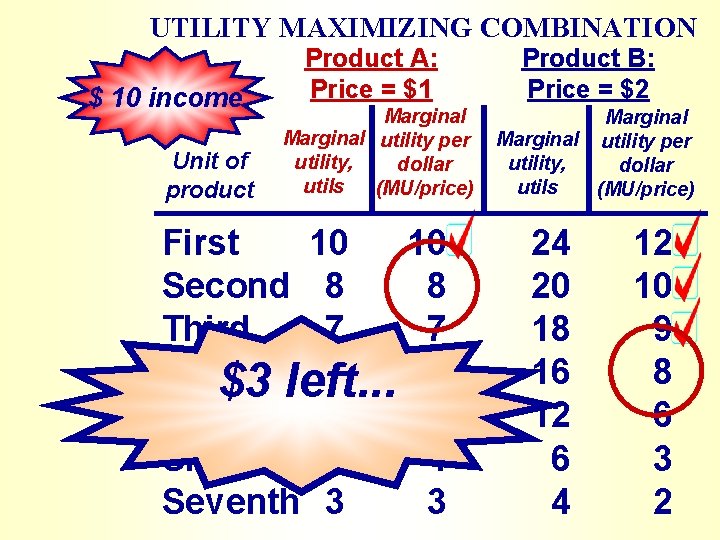
UTILITY MAXIMIZING COMBINATION $ 10 income Unit of product Product A: Price = $1 Marginal utility per utility, dollar utils (MU/price) First 10 Second 8 Third 7 Fourth 6 $3 left. . . Fifth 5 Sixth 4 Seventh 3 10 8 7 6 5 4 3 Product B: Price = $2 Marginal utility per utility, dollar utils (MU/price) 24 20 18 16 12 6 4 12 10 9 8 6 3 2
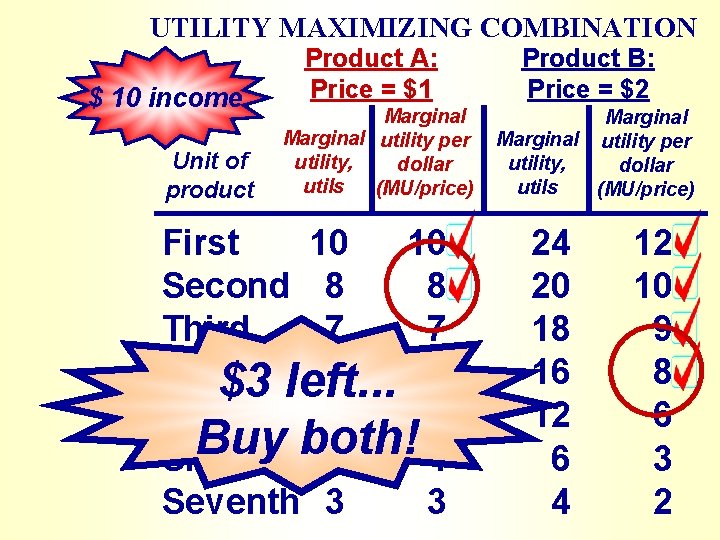
UTILITY MAXIMIZING COMBINATION $ 10 income Unit of product Product A: Price = $1 Marginal utility per utility, dollar utils (MU/price) First 10 10 Second 8 8 Third 7 7 Fourth 6 6 $3 left. . . Fifth 5 5 Buy both! Sixth 4 4 Seventh 3 3 Product B: Price = $2 Marginal utility per utility, dollar utils (MU/price) 24 20 18 16 12 6 4 12 10 9 8 6 3 2
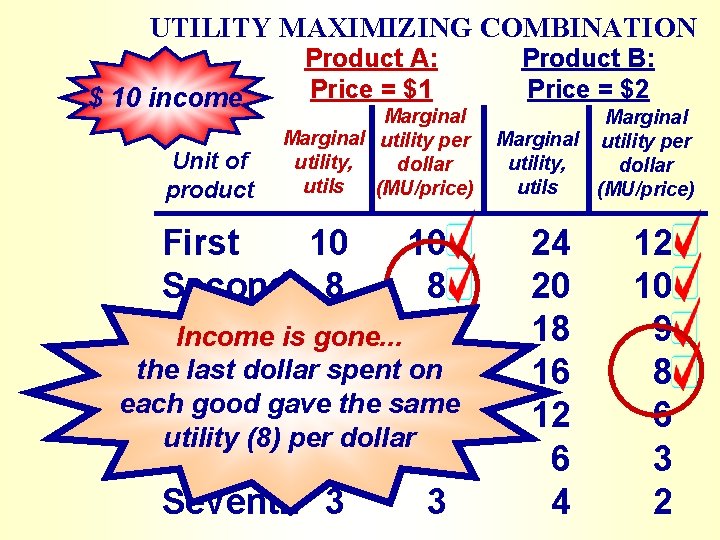
UTILITY MAXIMIZING COMBINATION $ 10 income Unit of product Product A: Price = $1 Marginal utility per utility, dollar utils (MU/price) First 10 10 Second 8 8 Third 7 7 Income is gone. . . the last dollar 6 spent on Fourth 6 each good gave the same Fifth 5 5 utility (8) per dollar Sixth 4 4 Seventh 3 3 Product B: Price = $2 Marginal utility per utility, dollar utils (MU/price) 24 20 18 16 12 6 4 12 10 9 8 6 3 2
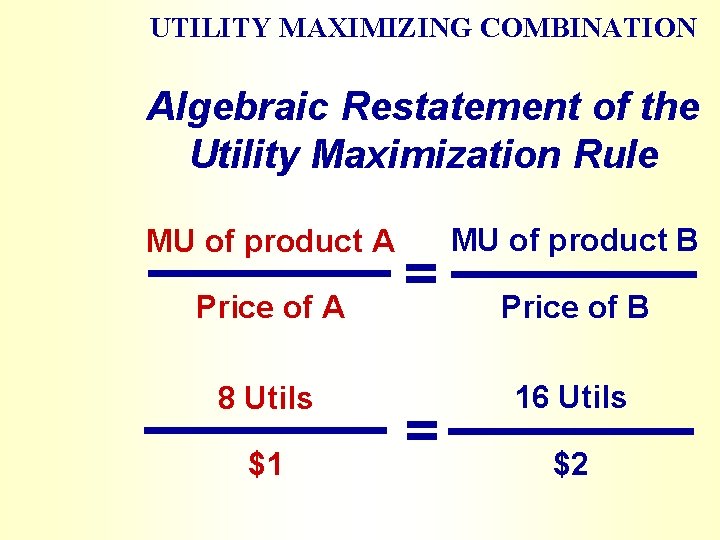
UTILITY MAXIMIZING COMBINATION Algebraic Restatement of the Utility Maximization Rule MU of product A Price of A 8 Utils $1 = = MU of product B Price of B 16 Utils $2
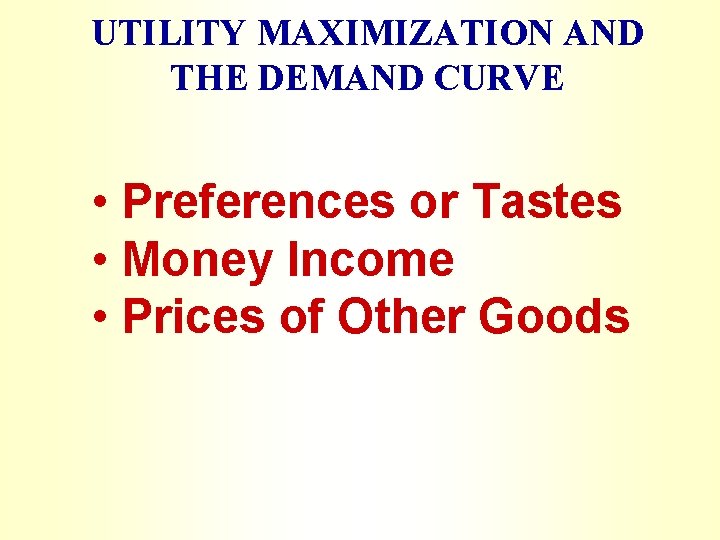
UTILITY MAXIMIZATION AND THE DEMAND CURVE • Preferences or Tastes • Money Income • Prices of Other Goods
How a Price Change Affects Consumer Optimum Ø The Substitution Effect – The tendency of people to substitute cheaper commodities for more expensive commodities – Consumers and producers shift away from goods and resources that become priced relatively higher in favor of goods and resources that are now priced relatively lower. 33
How a Price Change Affects Consumer Optimum Ø Real-Income Effect – The value of money for buying goods and services – The change in people’s purchasing power that occurs when, other things being constant, the price of one good that they purchase changes – When that price goes up (down), real income, or purchasing power, falls (increases). 34
The Demand Curve Revisited Ø Question – How is the demand curve derived? Ø Answer – By presuming income, tastes, expectations, and the price of related goods are not changing as the price of the good changes 35
Summary Ø Total utility versus marginal utility – Total utility is total satisfaction from consumption. – Marginal utility is the additional satisfaction from consuming an additional unit. Ø Law of diminishing marginal utility – Marginal utility ultimately decides as a person consumes more and more of a good or service. 36
Summary Ø The consumer optimum – Occurs when the marginal utility per dollar spent on the last unit consumed is equalized Ø The substitution effect of a price change – A person will substitute among goods by buying less of a good when its price increases. 37
Summary Ø The real-income effect of a price change – A price change affects the purchasing power of an individual’s available income. Ø Why the price of diamonds exceeds the price of water even though people cannot long survive without water – Marginal utility, not total utility, determines how much people are willing to pay. 38
- Slides: 38