
Chapter 4 The Structure of the Atom Section
- Slides: 59
Chapter 4 The Structure of the Atom
Section 1 Early Ideas About Matter
Section 1: Early Ideas About Matter The ancient Greeks tried to explain matter, but the scientific study of the atom began with John Dalton in the early 1800 s. K What I Know W What I Want to Find Out L What I Learned
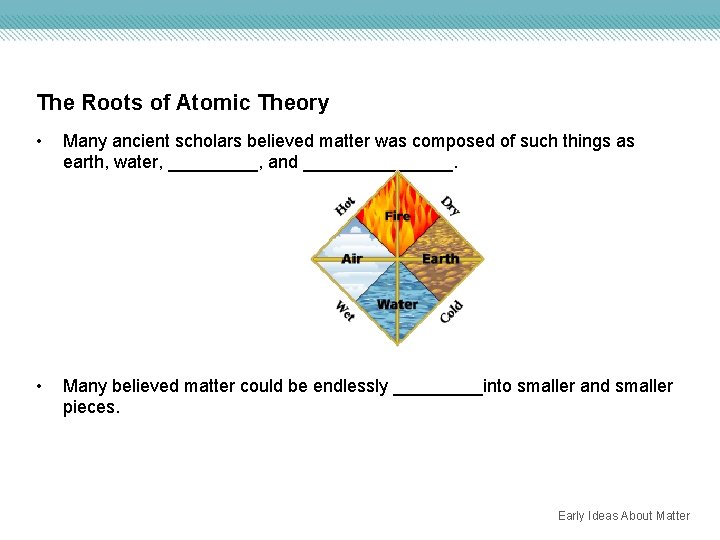
The Roots of Atomic Theory • Many ancient scholars believed matter was composed of such things as earth, water, _____, and ________. • Many believed matter could be endlessly _____into smaller and smaller pieces. Early Ideas About Matter
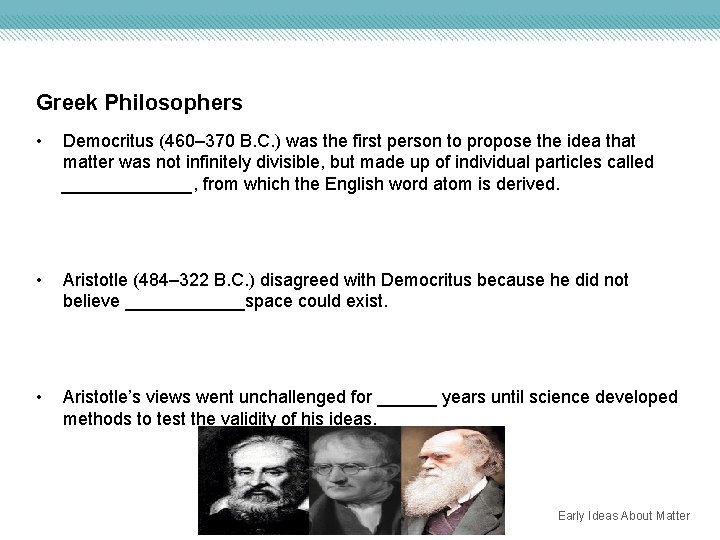
Greek Philosophers • Democritus (460– 370 B. C. ) was the first person to propose the idea that matter was not infinitely divisible, but made up of individual particles called _______, from which the English word atom is derived. • Aristotle (484– 322 B. C. ) disagreed with Democritus because he did not believe ______space could exist. • Aristotle’s views went unchallenged for ______ years until science developed methods to test the validity of his ideas. Early Ideas About Matter
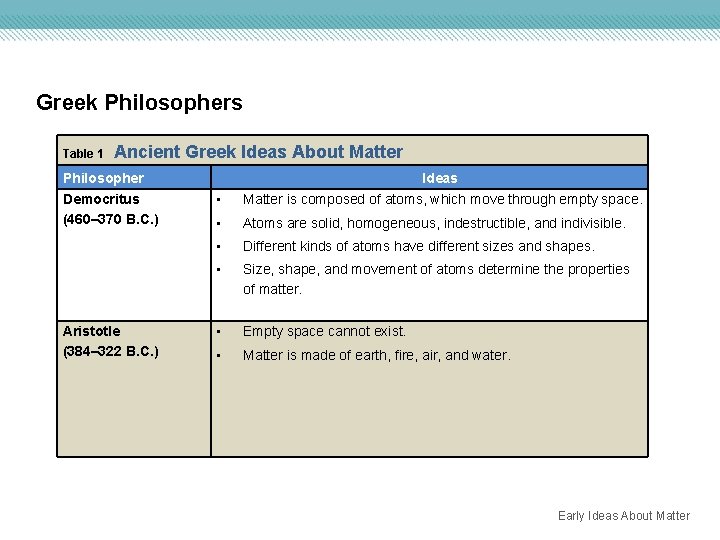
Greek Philosophers Table 1 Ancient Greek Ideas About Matter Philosopher Democritus (460– 370 B. C. ) Ideas • Matter is composed of atoms, which move through empty space. • Atoms are solid, homogeneous, indestructible, and indivisible. • Different kinds of atoms have different sizes and shapes. • Size, shape, and movement of atoms determine the properties of matter. • Empty space cannot exist. • Matter is made of earth, fire, air, and water. Aristotle (384– 322 B. C. ) Early Ideas About Matter
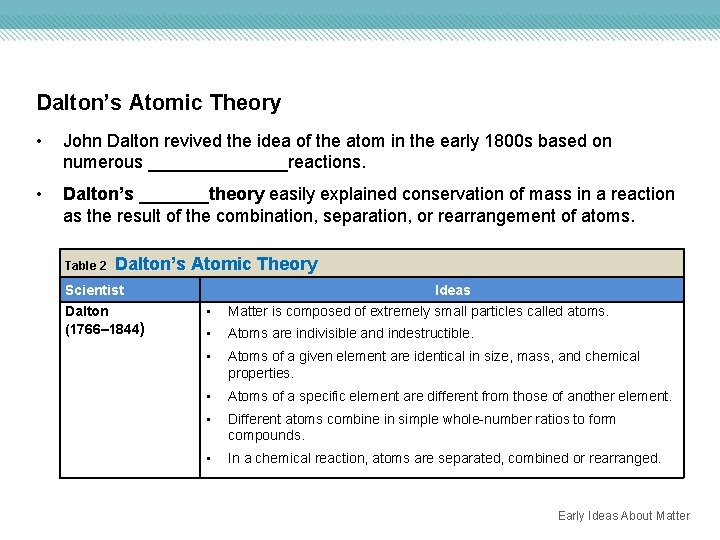
Dalton’s Atomic Theory • John Dalton revived the idea of the atom in the early 1800 s based on numerous _______reactions. • Dalton’s _______theory easily explained conservation of mass in a reaction as the result of the combination, separation, or rearrangement of atoms. Table 2 Dalton’s Atomic Theory Scientist Dalton (1766– 1844) • Ideas Matter is composed of extremely small particles called atoms. • Atoms are indivisible and indestructible. • Atoms of a given element are identical in size, mass, and chemical properties. • Atoms of a specific element are different from those of another element. • Different atoms combine in simple whole-number ratios to form compounds. • In a chemical reaction, atoms are separated, combined or rearranged. Early Ideas About Matter
Essential Questions • What are the similarities and differences of the atomic models of Democritus, Aristotle, and Dalton? • How was Dalton’s theory used to explain the conservation of mass? Early Ideas About Matter
Section 2 Defining the Atom
Section 2: Defining the Atom An atom is made of a nucleus containing protons and neutrons; electrons move around the nucleus. K What I Know W What I Want to Find Out L What I Learned
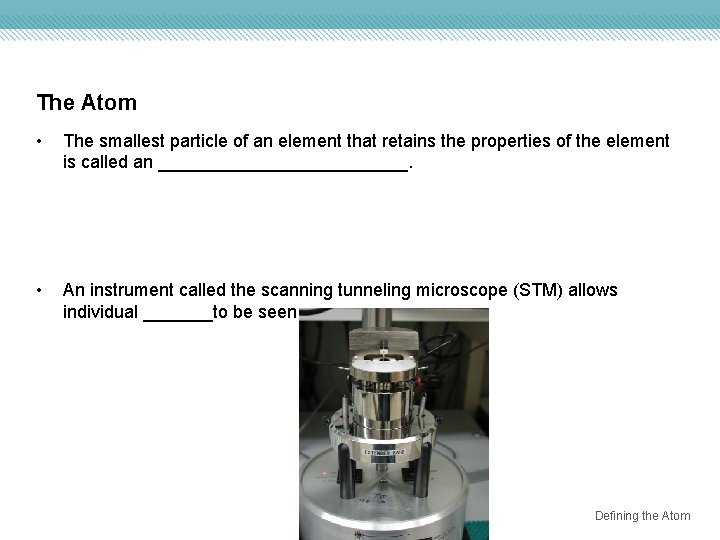
The Atom • The smallest particle of an element that retains the properties of the element is called an _____________. • An instrument called the scanning tunneling microscope (STM) allows individual _______to be seen. Defining the Atom
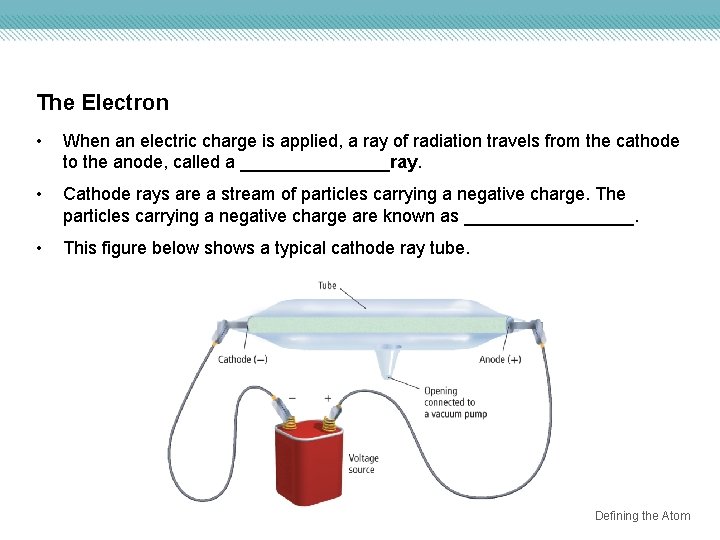
The Electron • When an electric charge is applied, a ray of radiation travels from the cathode to the anode, called a ________ray. • Cathode rays are a stream of particles carrying a negative charge. The particles carrying a negative charge are known as _________. • This figure below shows a typical cathode ray tube. Defining the Atom
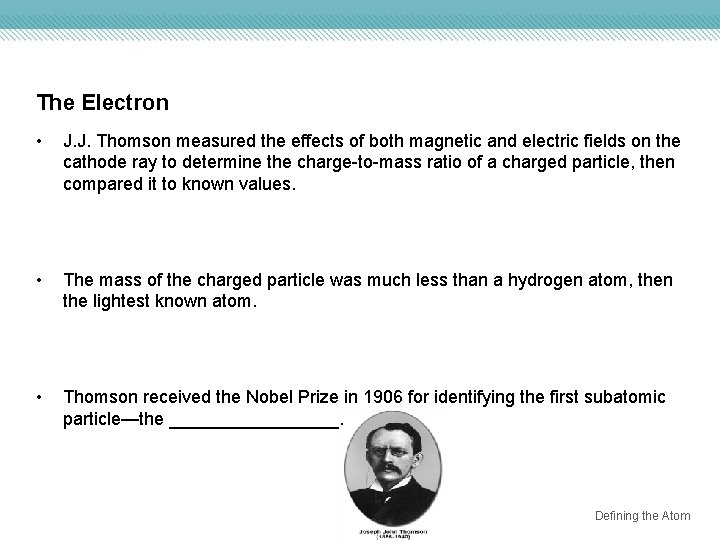
The Electron • J. J. Thomson measured the effects of both magnetic and electric fields on the cathode ray to determine the charge-to-mass ratio of a charged particle, then compared it to known values. • The mass of the charged particle was much less than a hydrogen atom, then the lightest known atom. • Thomson received the Nobel Prize in 1906 for identifying the first subatomic particle—the _________. Defining the Atom
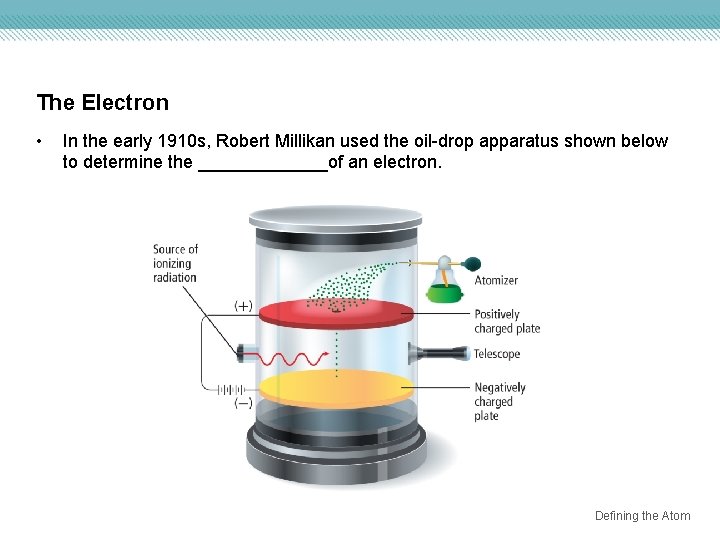
The Electron • In the early 1910 s, Robert Millikan used the oil-drop apparatus shown below to determine the _______of an electron. Defining the Atom
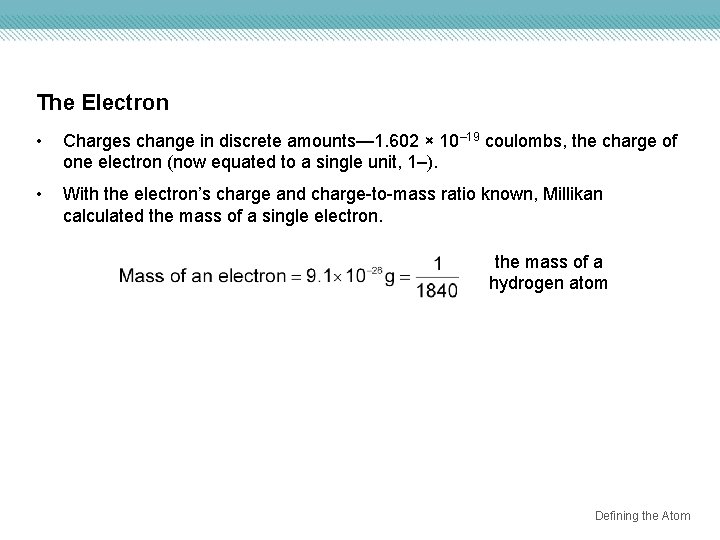
The Electron • Charges change in discrete amounts— 1. 602 × 10– 19 coulombs, the charge of one electron (now equated to a single unit, 1–). • With the electron’s charge and charge-to-mass ratio known, Millikan calculated the mass of a single electron. the mass of a hydrogen atom Defining the Atom
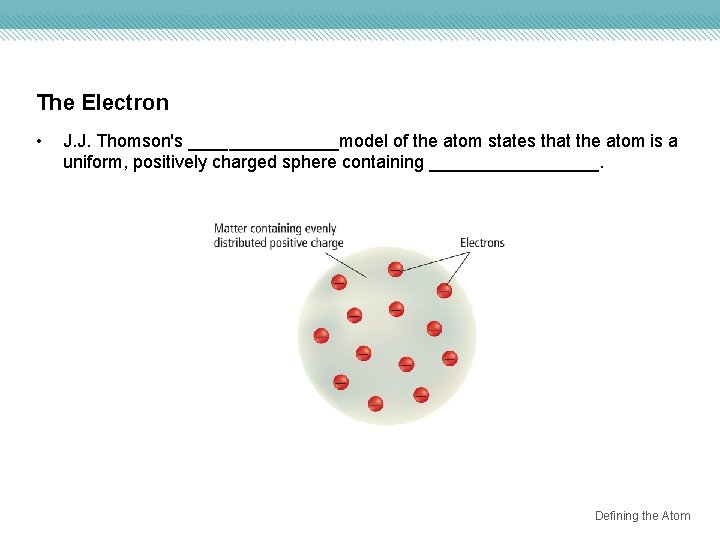
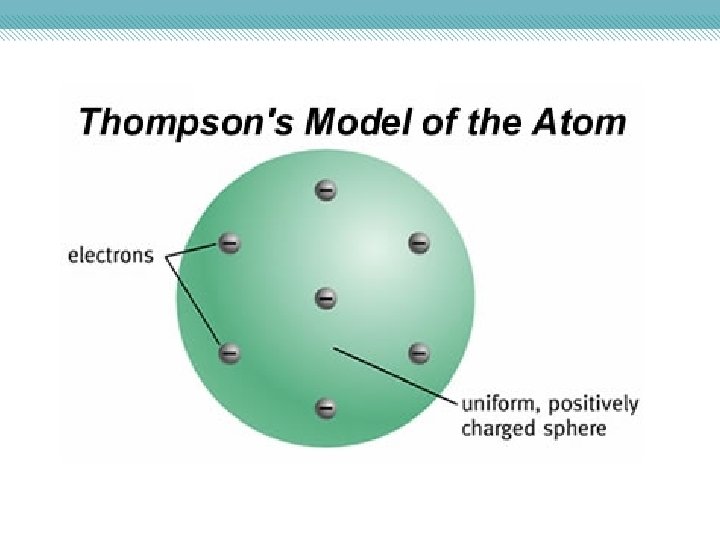
The Electron • Matter is ______. You know that matter is neutral from everyday experiences. You do not receive an electric shock (except under certain conditions) when you touch an object. • If electrons are negative, then how is matter, which is made up of electrons, neutral? • J. J. Thomson proposed a model of the atom to answer this question. Defining the Atom
The Electron • J. J. Thomson's ________model of the atom states that the atom is a uniform, positively charged sphere containing _________. Defining the Atom
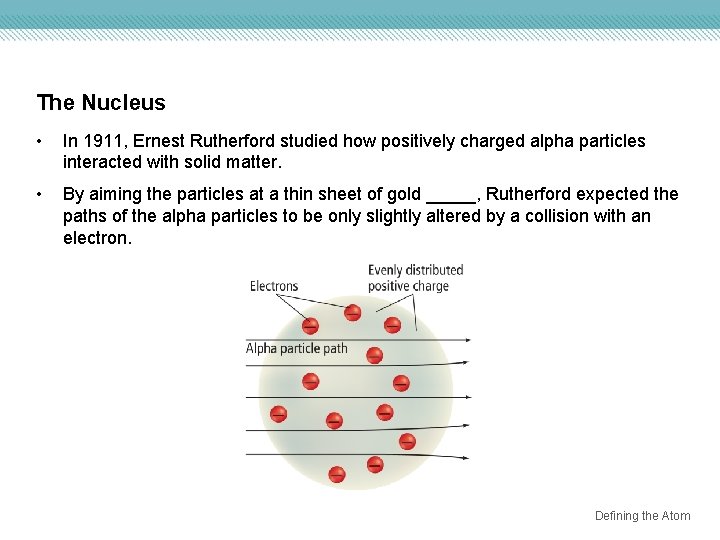
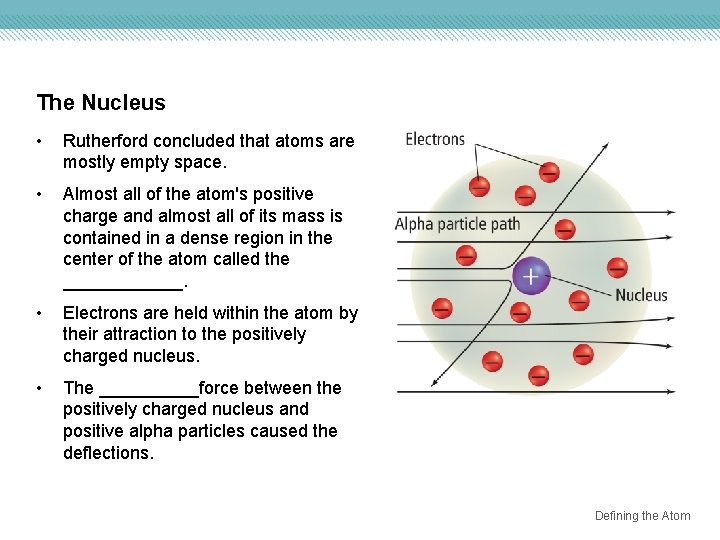
The Nucleus • In 1911, Ernest Rutherford studied how positively charged alpha particles interacted with solid matter. • By aiming the particles at a thin sheet of gold _____, Rutherford expected the paths of the alpha particles to be only slightly altered by a collision with an electron. Defining the Atom
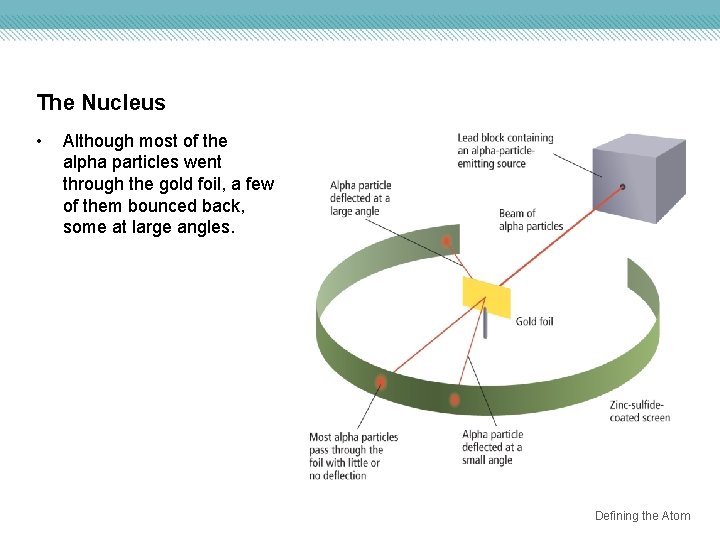
The Nucleus • Although most of the alpha particles went through the gold foil, a few of them bounced back, some at large angles. Defining the Atom
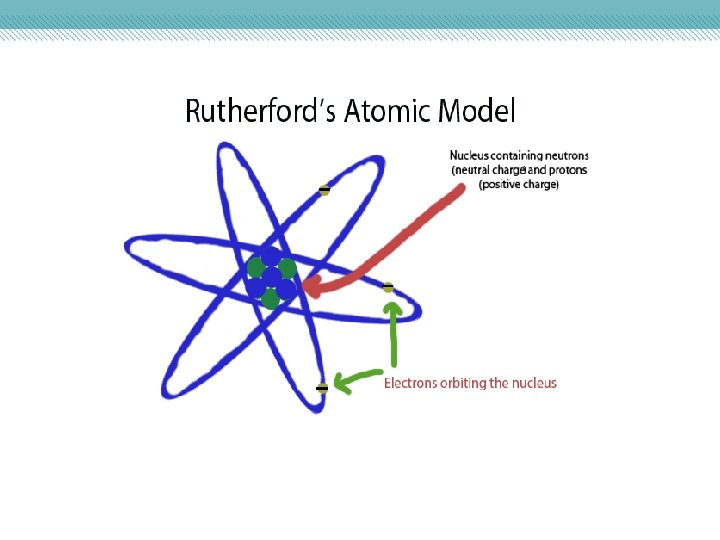
The Nucleus • Rutherford concluded that atoms are mostly empty space. • Almost all of the atom's positive charge and almost all of its mass is contained in a dense region in the center of the atom called the ______. • Electrons are held within the atom by their attraction to the positively charged nucleus. • The _____force between the positively charged nucleus and positive alpha particles caused the deflections. Defining the Atom
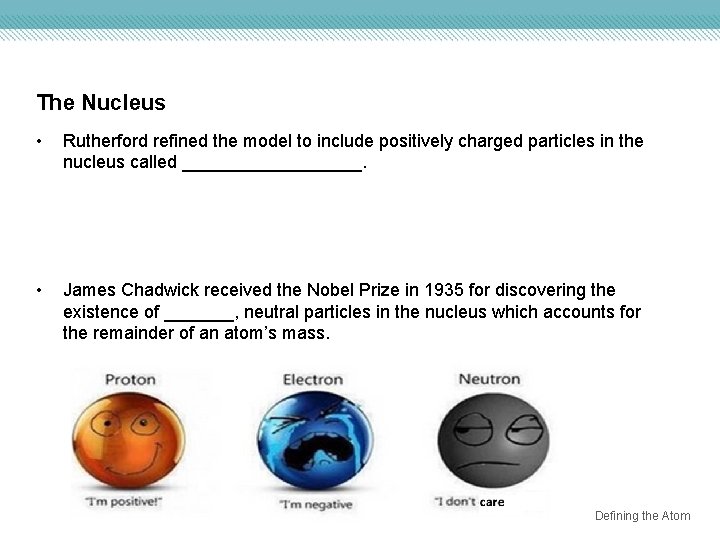
The Nucleus • Rutherford refined the model to include positively charged particles in the nucleus called _________. • James Chadwick received the Nobel Prize in 1935 for discovering the existence of _______, neutral particles in the nucleus which accounts for the remainder of an atom’s mass. Defining the Atom
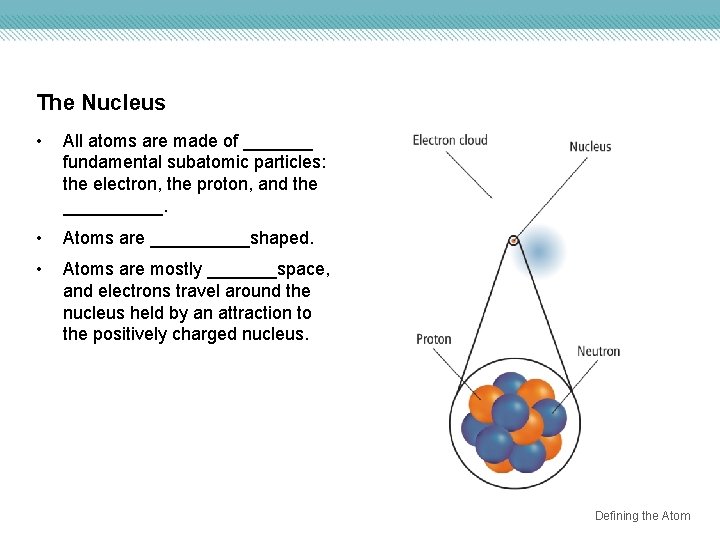
The Nucleus • All atoms are made of _______ fundamental subatomic particles: the electron, the proton, and the _____. • Atoms are _____shaped. • Atoms are mostly _______space, and electrons travel around the nucleus held by an attraction to the positively charged nucleus. Defining the Atom
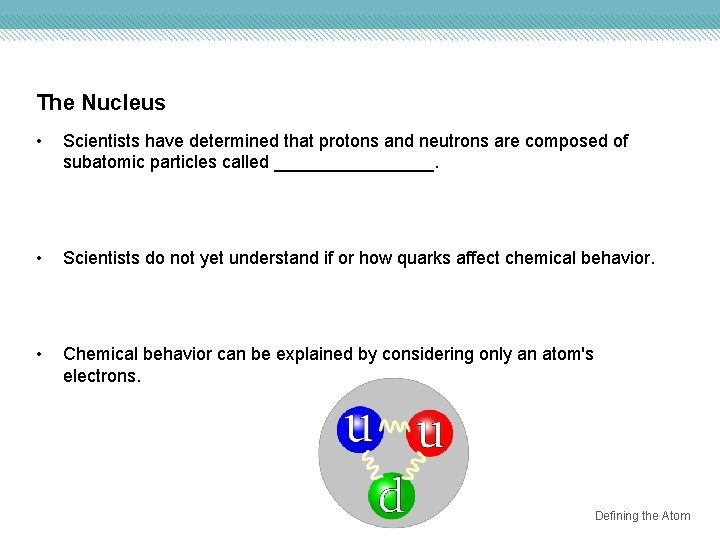
The Nucleus • Scientists have determined that protons and neutrons are composed of subatomic particles called ________. • Scientists do not yet understand if or how quarks affect chemical behavior. • Chemical behavior can be explained by considering only an atom's electrons. Defining the Atom
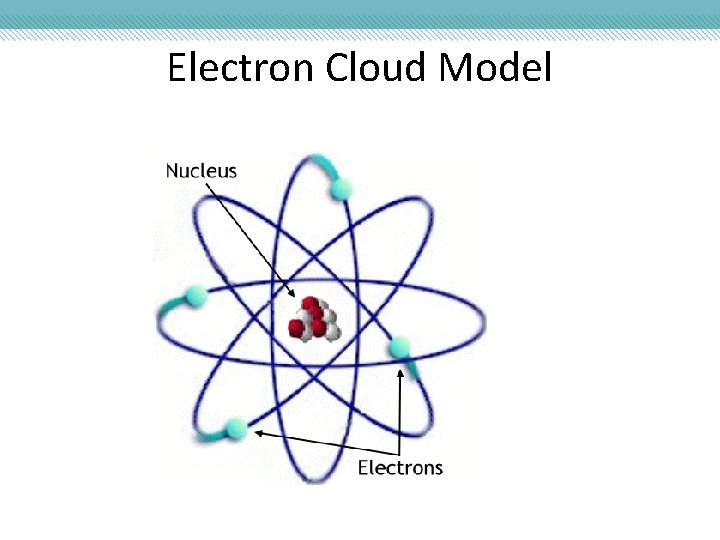
Electron Cloud Model
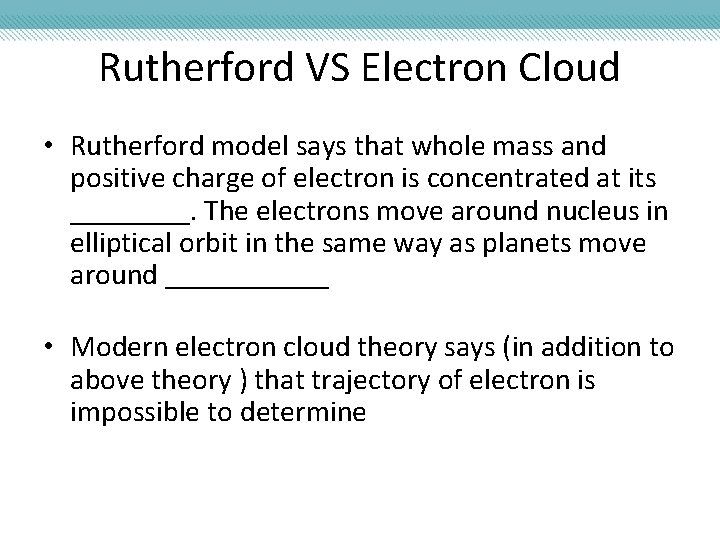
Rutherford VS Electron Cloud • Rutherford model says that whole mass and positive charge of electron is concentrated at its ____. The electrons move around nucleus in elliptical orbit in the same way as planets move around ______ • Modern electron cloud theory says (in addition to above theory ) that trajectory of electron is impossible to determine
History of the Atomic Theory
Atomic Theory Song
Essential Questions • What is an atom? • How can the subatomic particles be distinguished in terms of relative charge and mass? • Where are the locations of the subatomic particles within the structure of the atom? Defining the Atom
Section 3 How Atoms Differ
Section 3: How Atoms Differ The number of protons and the mass number define the type of atom. K What I Know W What I Want to Find Out L What I Learned
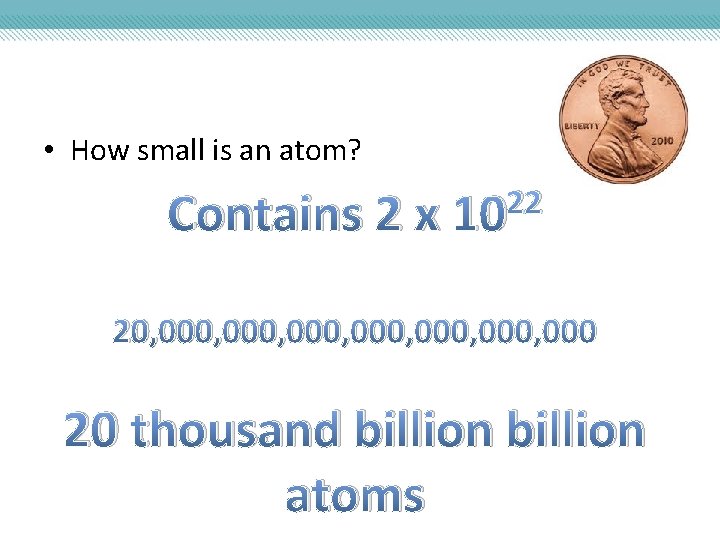
• How small is an atom? Contains 2 x 22 10 20, 000, 000, 000 20 thousand billion atoms
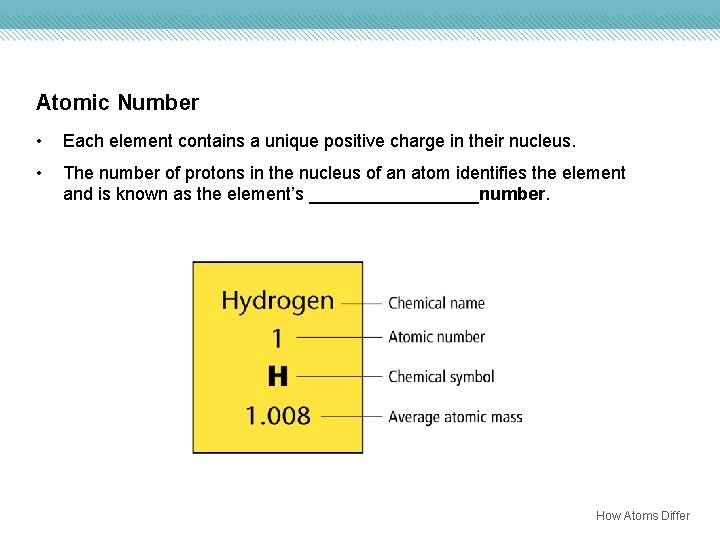
Atomic Number • Each element contains a unique positive charge in their nucleus. • The number of protons in the nucleus of an atom identifies the element and is known as the element’s _________number. How Atoms Differ
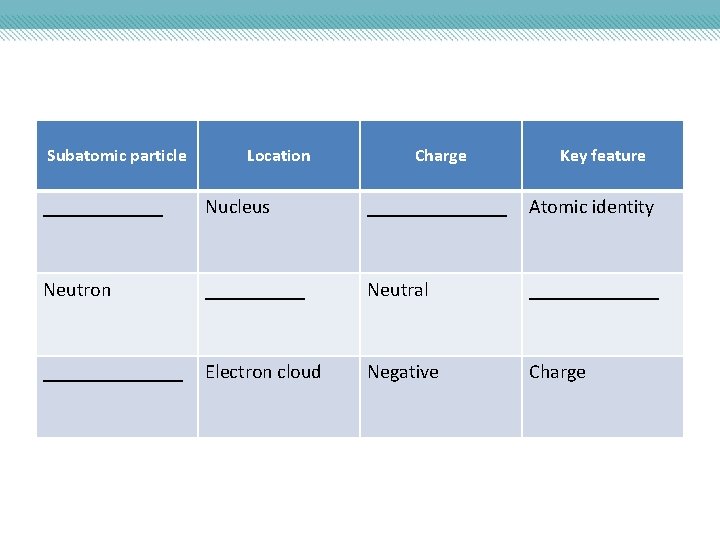
Subatomic particle Location Charge Key feature ______ Nucleus _______ Atomic identity Neutron _____ Neutral ______________ Electron cloud Negative Charge
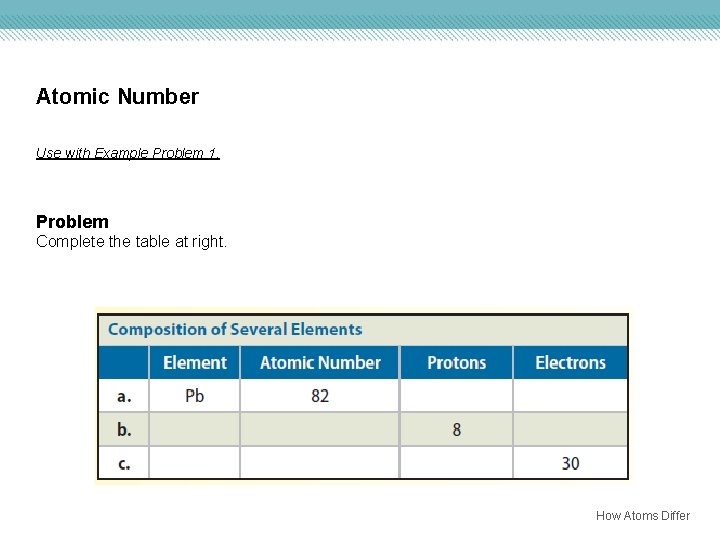
Atomic Number Use with Example Problem 1. Problem Complete the table at right. How Atoms Differ
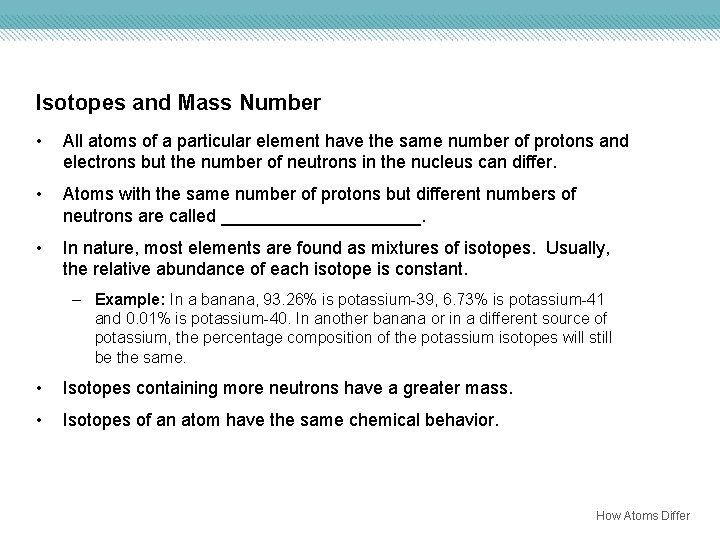
Isotopes and Mass Number • All atoms of a particular element have the same number of protons and electrons but the number of neutrons in the nucleus can differ. • Atoms with the same number of protons but different numbers of neutrons are called __________. • In nature, most elements are found as mixtures of isotopes. Usually, the relative abundance of each isotope is constant. – Example: In a banana, 93. 26% is potassium-39, 6. 73% is potassium-41 and 0. 01% is potassium-40. In another banana or in a different source of potassium, the percentage composition of the potassium isotopes will still be the same. • Isotopes containing more neutrons have a greater mass. • Isotopes of an atom have the same chemical behavior. How Atoms Differ
Atomic #, Mass #, & Isotopes
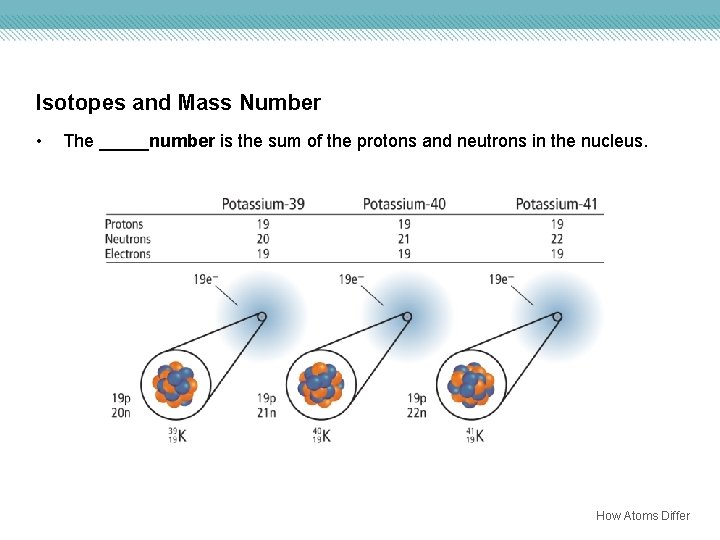
Isotopes and Mass Number • The _____number is the sum of the protons and neutrons in the nucleus. How Atoms Differ
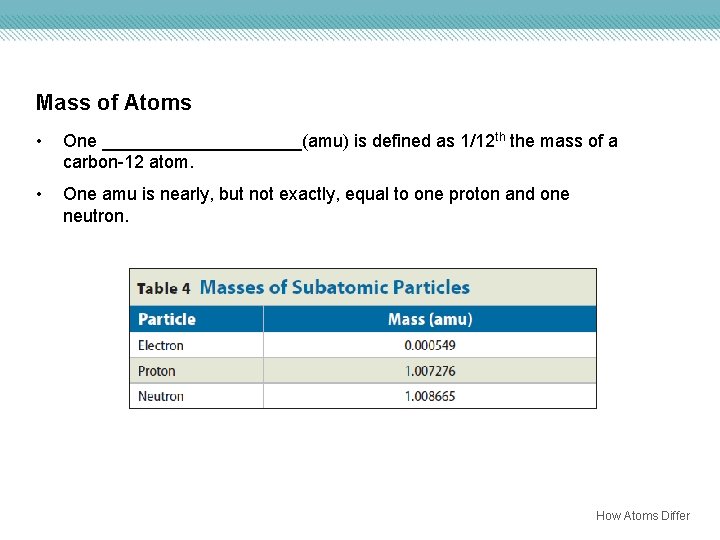
Mass of Atoms • One __________(amu) is defined as 1/12 th the mass of a carbon-12 atom. • One amu is nearly, but not exactly, equal to one proton and one neutron. How Atoms Differ
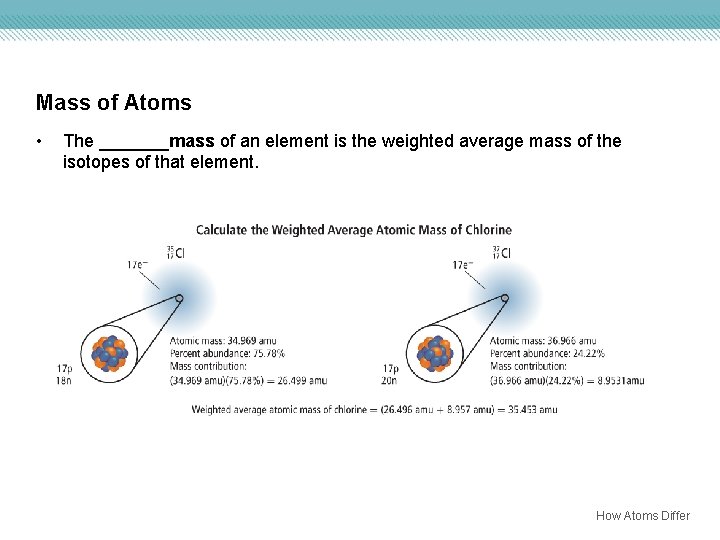
Mass of Atoms • The _______mass of an element is the weighted average mass of the isotopes of that element. How Atoms Differ
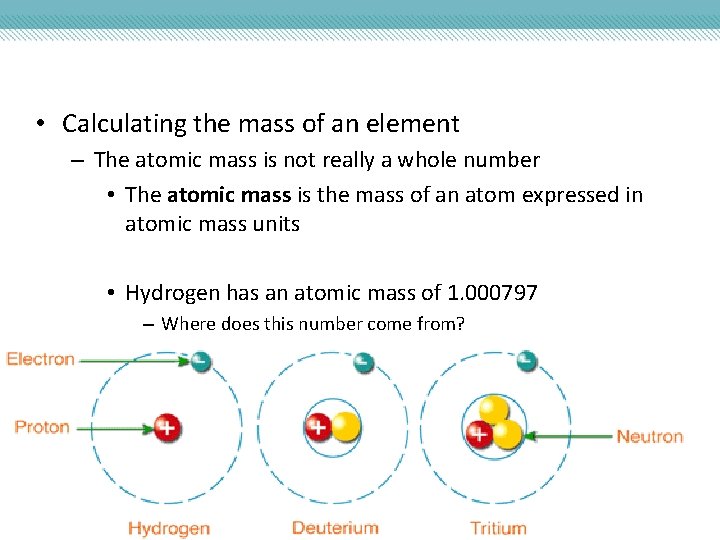
• Calculating the mass of an element – The atomic mass is not really a whole number • The atomic mass is the mass of an atom expressed in atomic mass units • Hydrogen has an atomic mass of 1. 000797 – Where does this number come from?
• Calculating the Mass of an Element – The atomic mass is a weighted _____of the masses of all naturally occurring isotopes of the element • Takes into account that not all isotopes are found equally on earth
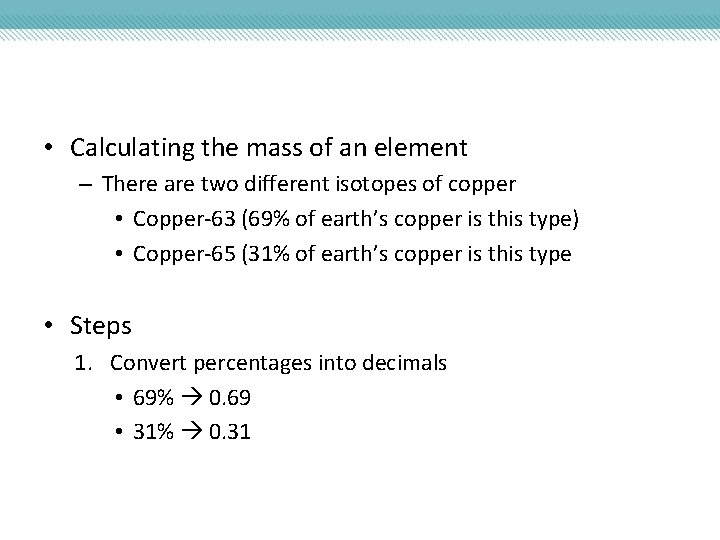
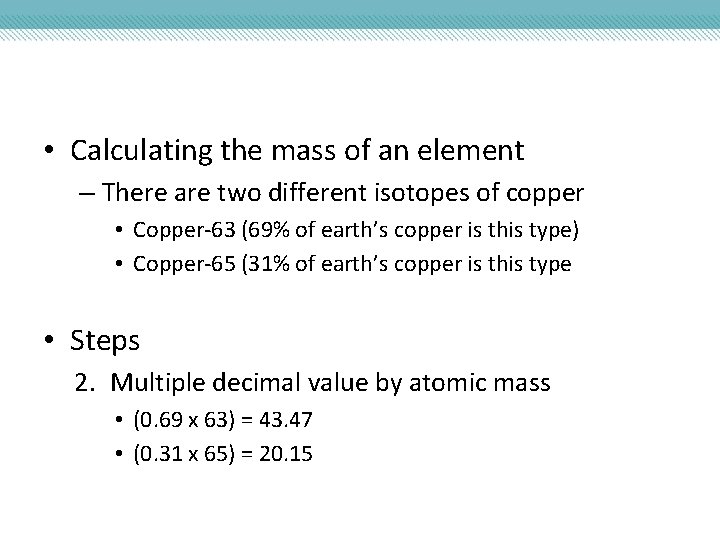
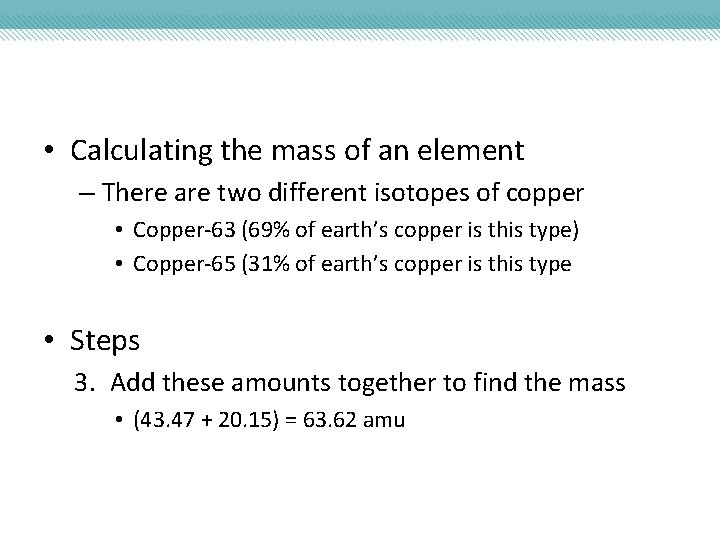
• Calculating the mass of an element – There are two different isotopes of copper • Copper-63 (69% of earth’s copper is this type) • Copper-65 (31% of earth’s copper is this type • Steps 1. Convert percentages into decimals 2. Multiple decimal value by atomic mass 3. Add these amounts together to find the mass
• Calculating the mass of an element – There are two different isotopes of copper • Copper-63 (69% of earth’s copper is this type) • Copper-65 (31% of earth’s copper is this type • Steps 1. Convert percentages into decimals • 69% 0. 69 • 31% 0. 31
• Calculating the mass of an element – There are two different isotopes of copper • Copper-63 (69% of earth’s copper is this type) • Copper-65 (31% of earth’s copper is this type • Steps 2. Multiple decimal value by atomic mass • (0. 69 x 63) = 43. 47 • (0. 31 x 65) = 20. 15
• Calculating the mass of an element – There are two different isotopes of copper • Copper-63 (69% of earth’s copper is this type) • Copper-65 (31% of earth’s copper is this type • Steps 3. Add these amounts together to find the mass • (43. 47 + 20. 15) = 63. 62 amu
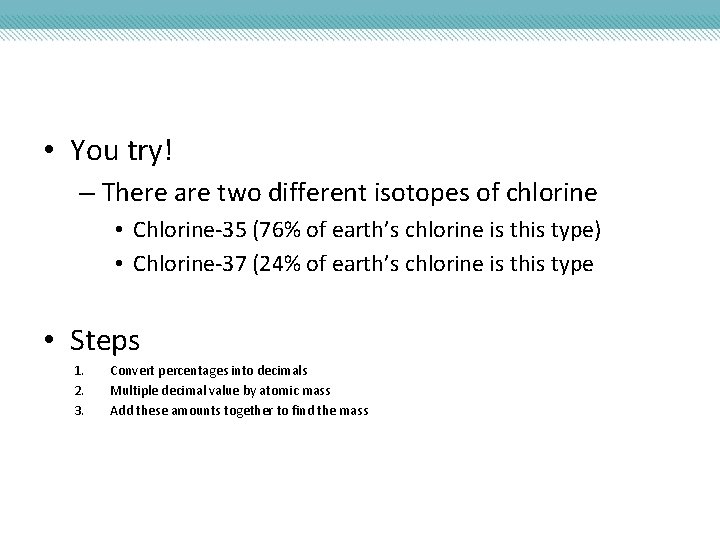
• You try! – There are two different isotopes of chlorine • Chlorine-35 (76% of earth’s chlorine is this type) • Chlorine-37 (24% of earth’s chlorine is this type • Steps 1. 2. 3. Convert percentages into decimals Multiple decimal value by atomic mass Add these amounts together to find the mass
Essential Questions • How is the atomic number used to determine the identity of an atom? • Why are atomic masses not whole numbers? • Given the mass number and atomic number, how are the number of electrons, protons, and neutrons in an atom calculated? How Atoms Differ
Section 4 How Atoms Differ
Section 4: Unstable Nuclei and Radioactive Decay Unstable atoms emit radiation to gain stability. K What I Know W What I Want to Find Out L What I Learned
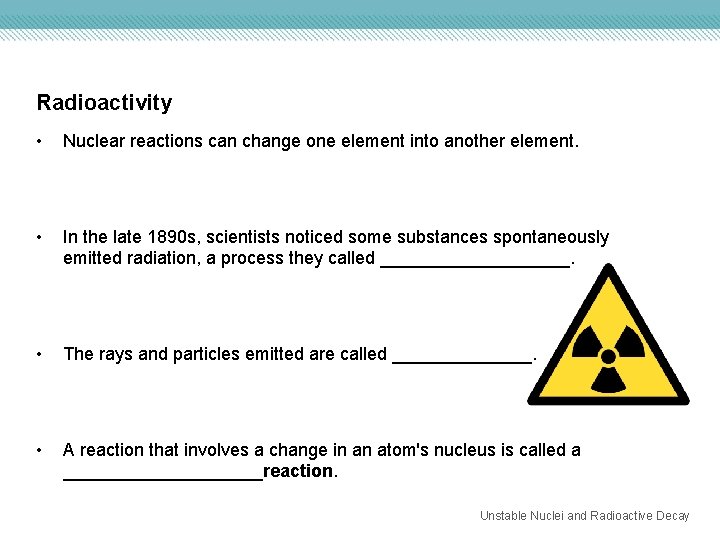
Radioactivity • Nuclear reactions can change one element into another element. • In the late 1890 s, scientists noticed some substances spontaneously emitted radiation, a process they called __________. • The rays and particles emitted are called _______. • A reaction that involves a change in an atom's nucleus is called a __________reaction. Unstable Nuclei and Radioactive Decay
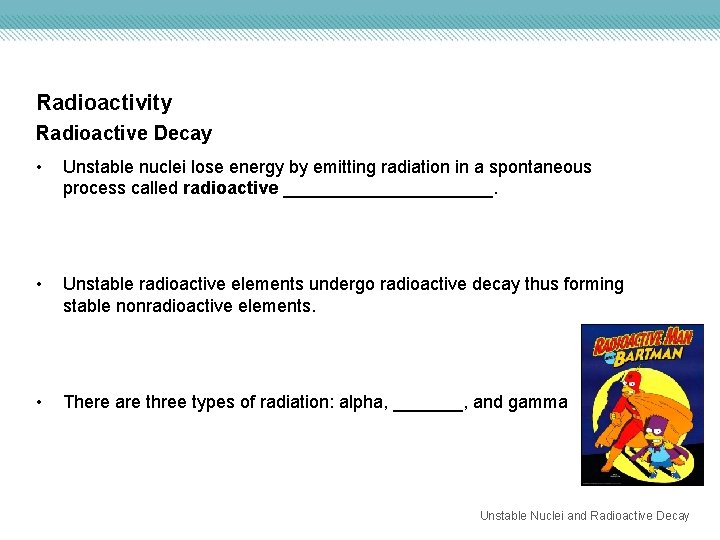
Radioactivity Radioactive Decay • Unstable nuclei lose energy by emitting radiation in a spontaneous process called radioactive ___________. • Unstable radioactive elements undergo radioactive decay thus forming stable nonradioactive elements. • There are three types of radiation: alpha, _______, and gamma Unstable Nuclei and Radioactive Decay
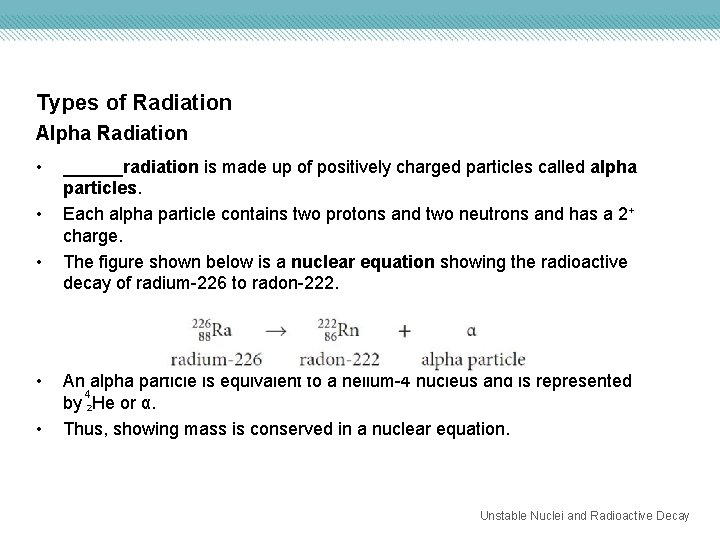
Types of Radiation Alpha Radiation • • • ______radiation is made up of positively charged particles called alpha particles. Each alpha particle contains two protons and two neutrons and has a 2+ charge. The figure shown below is a nuclear equation showing the radioactive decay of radium-226 to radon-222. An alpha particle is equivalent to a helium-4 nucleus and is represented 4 by He or α. 2 Thus, showing mass is conserved in a nuclear equation. Unstable Nuclei and Radioactive Decay
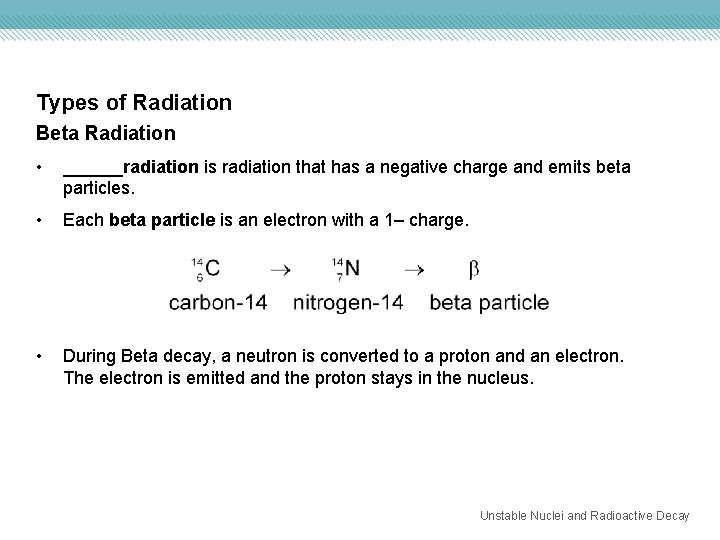
Types of Radiation Beta Radiation • ______radiation is radiation that has a negative charge and emits beta particles. • Each beta particle is an electron with a 1– charge. • During Beta decay, a neutron is converted to a proton and an electron. The electron is emitted and the proton stays in the nucleus. Unstable Nuclei and Radioactive Decay
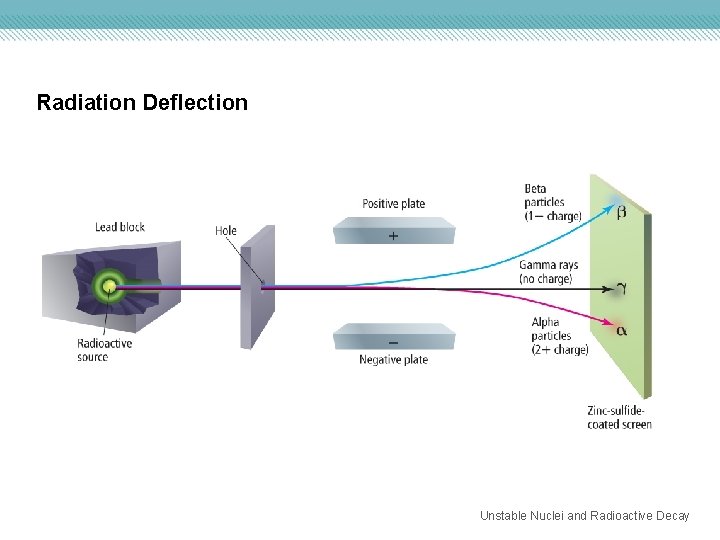
Radiation Deflection Unstable Nuclei and Radioactive Decay
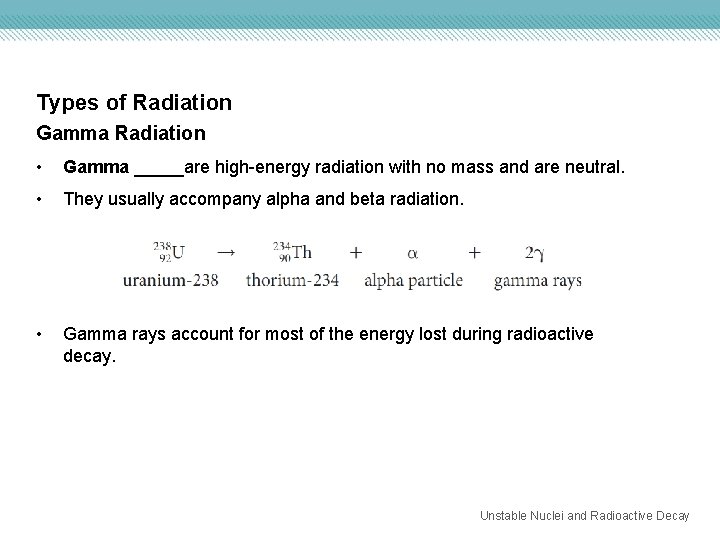
Types of Radiation Gamma Radiation • Gamma _____are high-energy radiation with no mass and are neutral. • They usually accompany alpha and beta radiation. • Gamma rays account for most of the energy lost during radioactive decay. Unstable Nuclei and Radioactive Decay
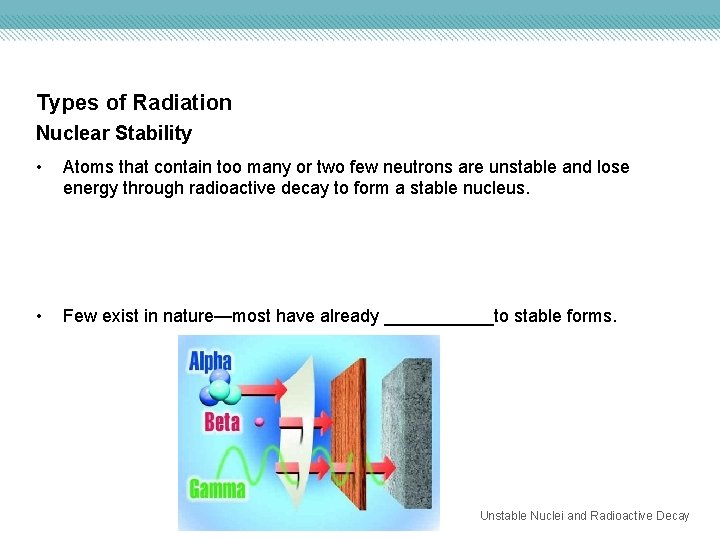
Types of Radiation Nuclear Stability • Atoms that contain too many or two few neutrons are unstable and lose energy through radioactive decay to form a stable nucleus. • Few exist in nature—most have already ______to stable forms. Unstable Nuclei and Radioactive Decay
Essential Questions • What is the relationship between unstable nuclei and radioactive decay? • How are alpha, beta, and gamma radiation characterized in terms of mass and charge? Unstable Nuclei and Radioactive Decay