
CHAPTER 4 THE SCHOOL ENVIRONMENT As an organization
![“The messages [of the hidden curriculum] teach students their position in the social hierarchy,](https://slidetodoc.com/presentation_image_h2/020c8ebb0841e0b9070b899404af8cc7/image-9.jpg "“The messages [of the hidden curriculum] teach students their position in the social hierarchy,")
- Slides: 18
CHAPTER 4: THE SCHOOL ENVIRONMENT
“As an organization, the school is a system of shared experiences whose meanings are created by people. When these meanings are not shared by any one group or groups, the system develops problems” (98).
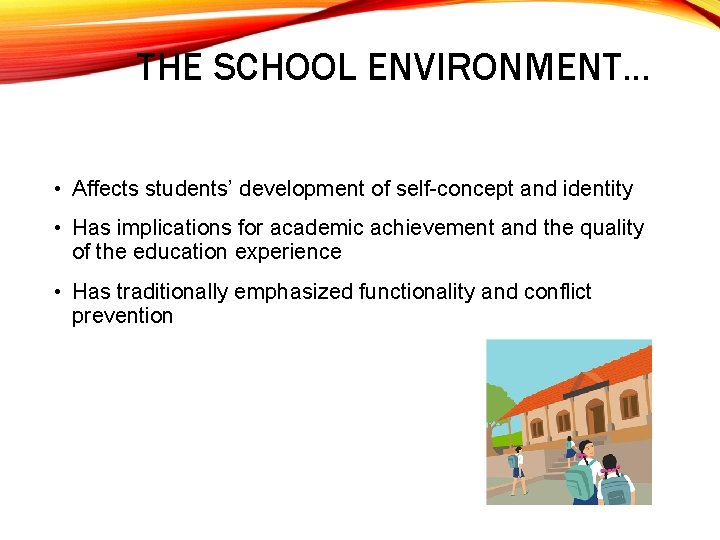
THE SCHOOL ENVIRONMENT… • Affects students’ development of self-concept and identity • Has implications for academic achievement and the quality of the education experience • Has traditionally emphasized functionality and conflict prevention
“Inclusivity encompasses…school culture—the informal patterns of ideas and actions that give meaning to and represent the dominant worldview” (100).
“Students not only need to know about the historical contributions of different cultural groups to their communities, but also how various cultural groups are helping the community to evolve in the present day. Without community awareness, we would be promoting students’ local knowledge gap ‘as evidence of the existence of a macro. Canadian culture that should obviate all talks about diversity’” (113).
SCHOOL CULTURE… • Is founded upon the hidden curriculum • Includes policies for discipline, as problems arise from student resistance to aspects of school • May represent culture clash (between home and school) for some students • Creates a hostile climate for students who are excluded from the content and method of learning • Must recognize instances of bullying and cyberbullying as issues of school violence
THE HIDDEN CURRICULUM… • Consists of the implicit messages transmitted by the teaching process and the school environment • Manifests itself in the organization of student groups, language use, time, roles and relations, and policies and procedures • Is represented in the school’s physical setting • Remains invisible for students and all others involved in education
“While conservative theorists see the hidden curriculum as necessary to maintaining the social order, radical theorists see it as reproducing relations of exploitation and inequality” (99).
“The messages [of the hidden curriculum] teach students their position in the social hierarchy, what kind of person is valued, what type of learning is important, what type of work is socially rewarded, who has authority, what matters and what does not” (100).
CLASSROOM CONFLICTS • Substantive conflicts = differing goals • Procedural conflicts = disagreements over process • Interpersonal conflicts = clashing values, attitudes, and beliefs
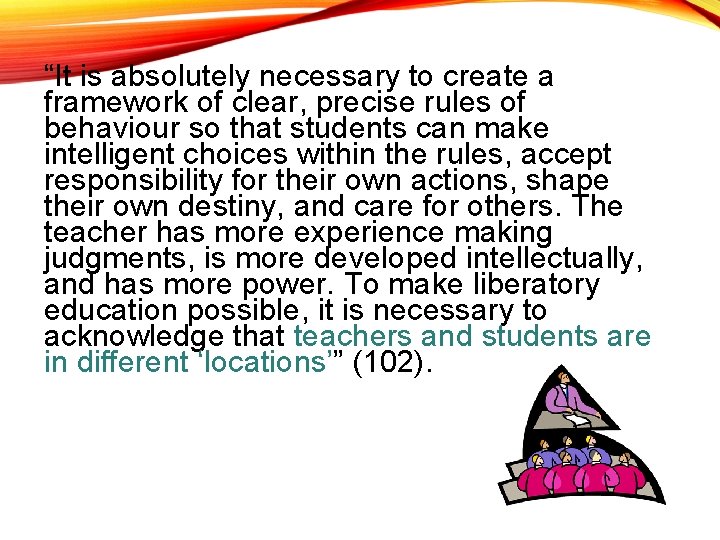
“It is absolutely necessary to create a framework of clear, precise rules of behaviour so that students can make intelligent choices within the rules, accept responsibility for their own actions, shape their own destiny, and care for others. The teacher has more experience making judgments, is more developed intellectually, and has more power. To make liberatory education possible, it is necessary to acknowledge that teachers and students are in different ‘locations’” (102).
BULLYING & CYBERBULLYING • Both individual and school-level factors influence when and where cases occur, as well as to whom and by whom • Historically overlooked as part of normal child development • Teachers’ moral orientation/ethical style (caring- vs. justiceoriented) affects the way that they react • What’s your ethical style? Take the quiz!
“Bullying in all its forms must be recognized as a social justice issue. This is because ‘youths involved in bullying—whether perpetrating, witnessing, or being victimized—face inequitable access to school-based resources and opportunities aimed at academic growth and empowerment’” (103).
“Cyberbullying prevention programs need to incorporate awareness of…varied technological formats in order to simulate more authentic virtual environments that might better engage students in discussion on the topic and help schools address harassment problems” (104).
A MULTICULTURAL SCHOOL CLIMATE… • Recognizes the diversity of students and staff, consideration of the school’s physical setting) (with • Promotes student-centered learning • Allows for all students’ democratic participation (e. g. , extracurricular activities) • Encourages cooperation over competition • Supports parent and community involvement
RESTRUCTURING SCHOOLS FOR MULTICULTURALISM • Responsible leadership • Consideration of staff diversity • Anti-racist, anti-sexist counselling • Equitable policy in respect to cultural differences and ability/language needs • Participatory decision-making • Shared accountability • Empowerment of teachers
“It is important to consider how diversity of staff affects various factors in the interpersonal relationships of teachers and students. The dimensions of the student-teacher relationship are undoubtedly affected by who the teacher is—and different students within the same classroom may view the teacher differently” (107).
“Teachers and other staff must be given a voice in how their work environment will be organized. They must be allowed to function as intellectuals, not treated as technicians” (115).