
Chapter 4 The Reporting Cycle Learning Goals Preparation
- Slides: 50
Chapter 4 The Reporting Cycle
Learning Goals Preparation of financial statements The accounting cycle and closing process The nature of "optional" reversing entries Classified balance sheets The importance of business liquidity and the concept of an operating cycle 2
Preparing Financial Statements The previous chapter presented adjustments that might be needed at the end of an accounting period The adjusted trial balance is ordinarily sufficient to prepare financial statements 3
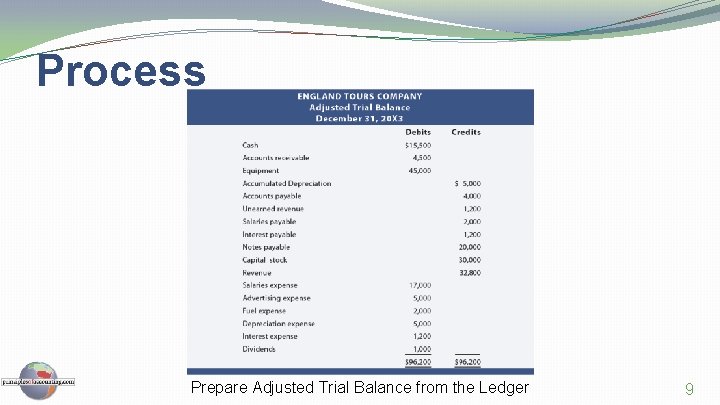
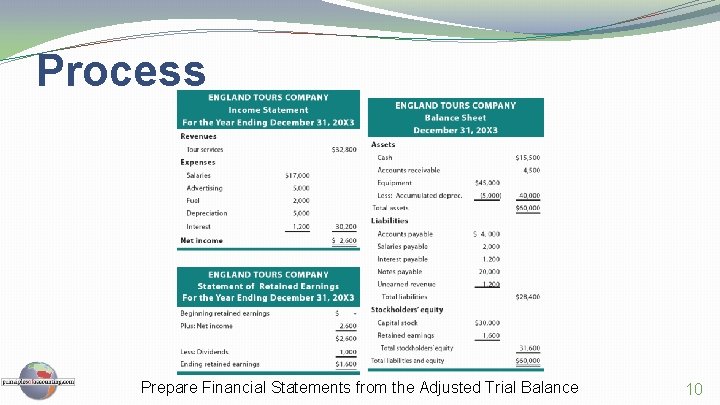
Process Prepare a trial balance Analyze for potential adjustments Develop a list of necessary adjusting entries Requires knowledge about the business and accounting Record adjusting entries in the journal Post entries to the ledger Prepare the adjusted trial balance from the ledger Prepare financial statements from the adjusted trial balance 4
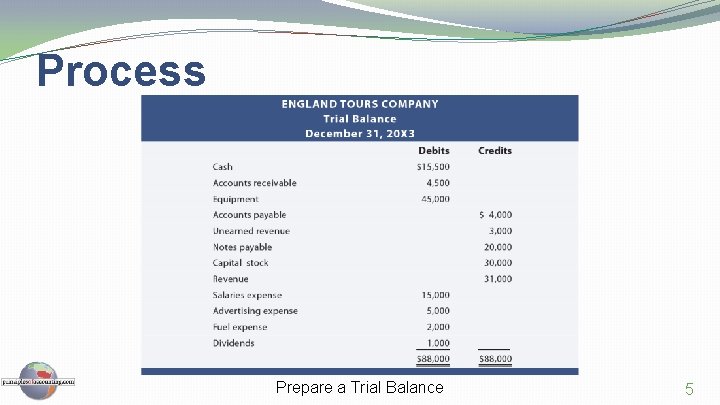
Process Prepare a Trial Balance 5
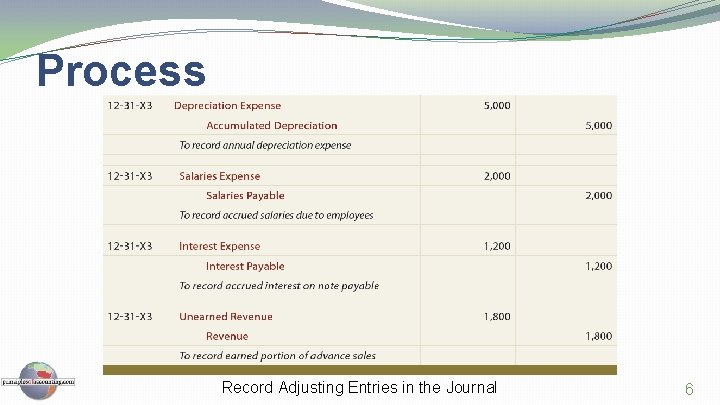
Process Record Adjusting Entries in the Journal 6
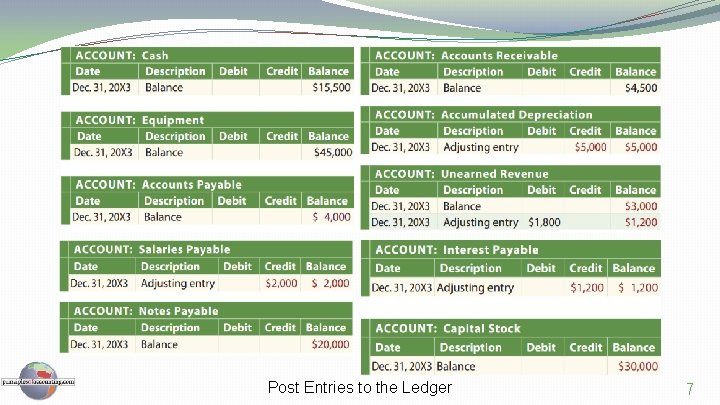
Post Entries to the Ledger 7
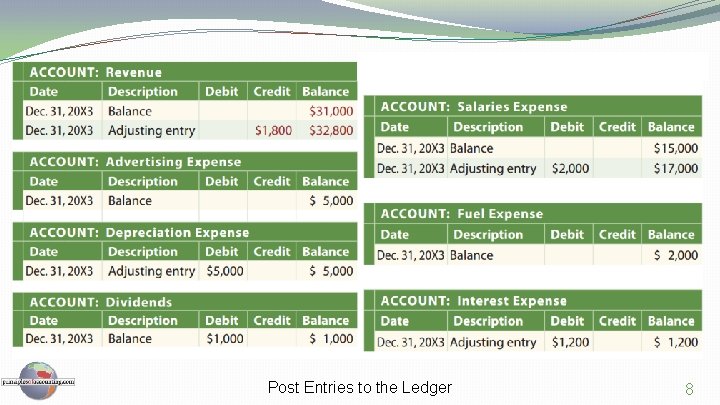
Post Entries to the Ledger 8
Process Prepare Adjusted Trial Balance from the Ledger 9
Process Prepare Financial Statements from the Adjusted Trial Balance 10
Accounting Software Financial statement preparation process is mostly mechanical, and easily automated Once the adjusting entries have been prepared and entered, accounting software packages will race through the steps of processing the data to produce the financial statements Nevertheless, understanding the flow of transactions into financial statements is an essential foundation for furthering one’s knowledge of accounting 11
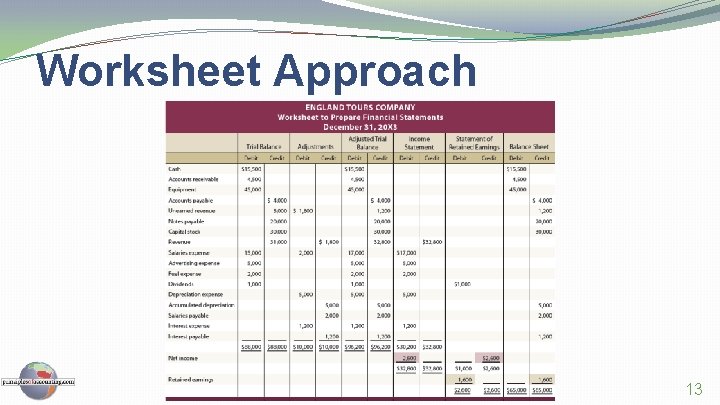
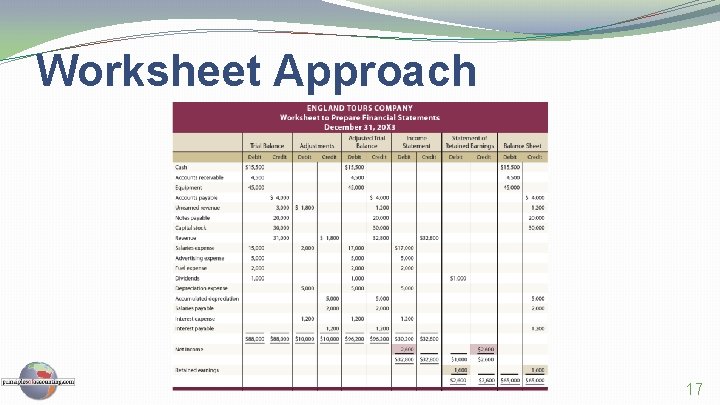
Worksheet Approach A way to prepare financial statements that takes into account necessary adjustments without actually updating journals and ledgers Used to prepare financial statements at any point in time; rather than book entries outside of the normal cycle An auditor may use a worksheet to prepare financial statements that take into account recommended adjustments before proposing that the actual journal/ledger be updated 12
Worksheet Approach 13
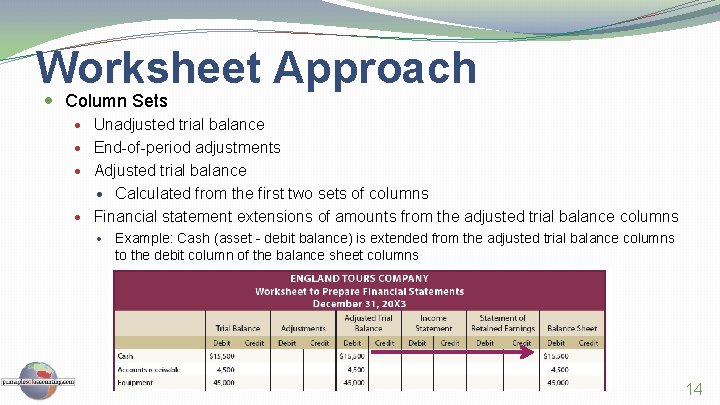
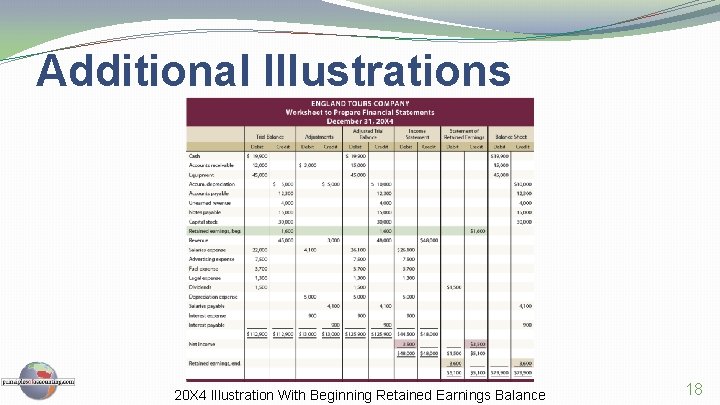
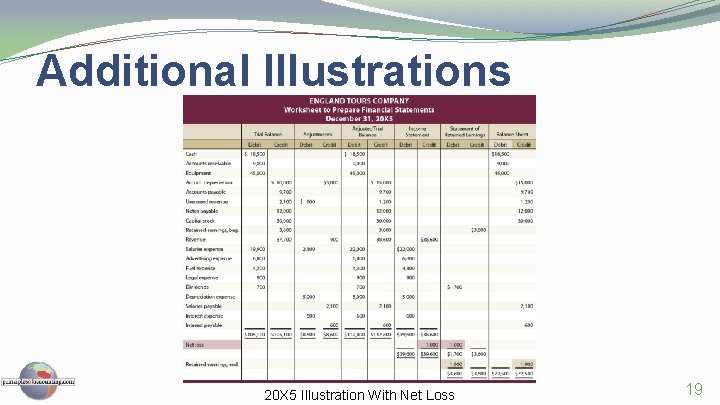
Worksheet Approach Column Sets Unadjusted trial balance End-of-period adjustments Adjusted trial balance Calculated from the first two sets of columns Financial statement extensions of amounts from the adjusted trial balance columns Example: Cash (asset - debit balance) is extended from the adjusted trial balance columns to the debit column of the balance sheet columns 14
Worksheet Approach Income statement columns are subtotaled If credits exceed debits, the company has net income (more revenues than expenses) If debits exceed credits, the company has a net loss The amount of net income/loss is entered in the lower portion of the income statement columns so total debits equal total credits 15
Worksheet Approach An offsetting amount is entered in the lower portion of the retained earnings columns An offsetting credit represents income for the year that must be added to retained earnings Retained Earnings columns are subtotaled The amount by which credits exceed debits is debited in the retained earnings columns and credited in the balance sheet columns, bringing both sets of columns into balance The companion website includes a linked animation that presents the development of the worksheet on a step-by-step basis 16
Worksheet Approach 17
Additional Illustrations 20 X 4 Illustration With Beginning Retained Earnings Balance 18
Additional Illustrations 20 X 5 Illustration With Net Loss 19
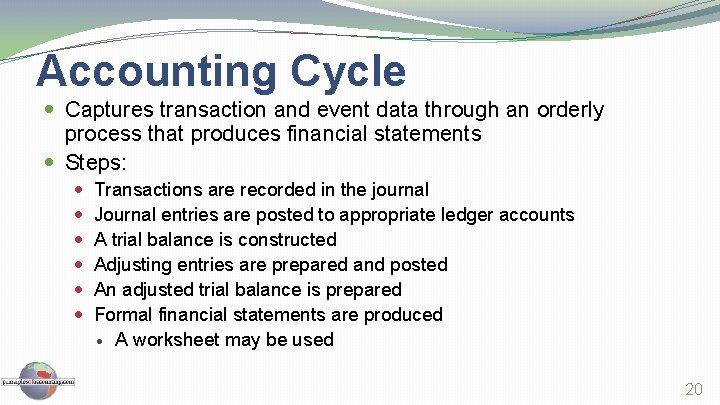
Accounting Cycle Captures transaction and event data through an orderly process that produces financial statements Steps: Transactions are recorded in the journal Journal entries are posted to appropriate ledger accounts A trial balance is constructed Adjusting entries are prepared and posted An adjusted trial balance is prepared Formal financial statements are produced A worksheet may be used 20
Closing Process Updates the Retained Earnings account in the ledger to equal the end-of-period balance Revenues, expenses, and dividends do not automatically produce an updating debit/credit to Retained Earnings “Zero out” temporary/nominal accounts Revenues, expenses, and dividends represent amounts for a period of time Zeroing out resets the accounts for the next period The balances in real accounts (asset, liability, and equity) are carried forward from period to period 21
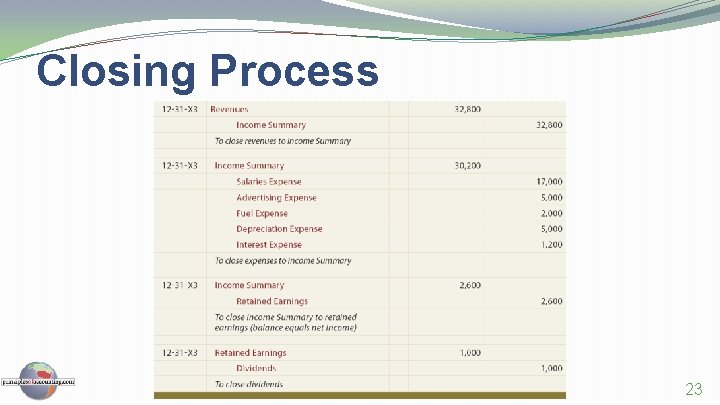
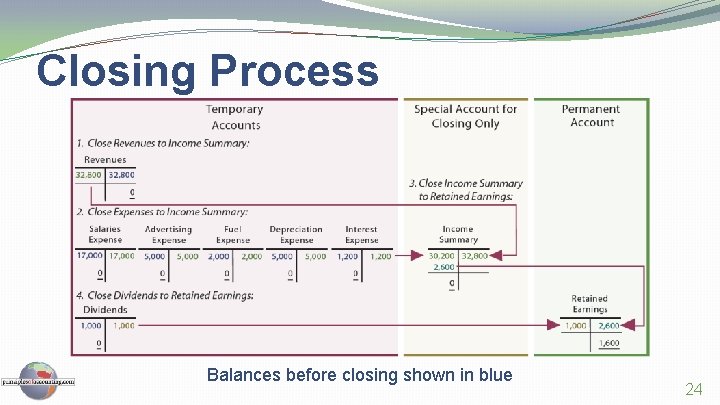
Closing Process Close the Revenue account to a unique account called Income Summary is a non-financial statement account used only to facilitate the closing process Close expense accounts to Income Summary Close the Income Summary account to Retained Earnings Close the Dividends account to Retained Earnings 22
Closing Process 23
Closing Process Balances before closing shown in blue 24
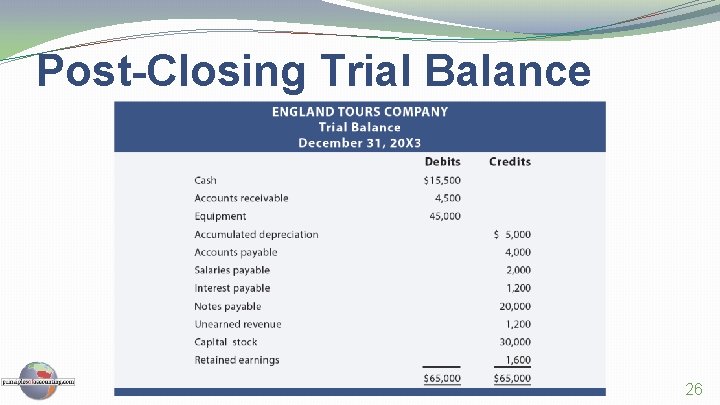
Post-Closing Trial Balance Reveals the balance of accounts after the closing process and consists of balance sheet accounts only All of the revenue, expense, and dividend accounts were zeroed away via closing, and do not appear 25
Post-Closing Trial Balance 26
Revisiting Software Many accounting software programs are based on database logic and allow the user to query Financial results for almost any period of time can easily be created Closing accounts is far less relevant 27
Reversing Entries Optional May simplify record keeping “Undo adjusting entries Appropriate for those adjusting entries that involve the recording of accrued revenues and expenses Specifically, those that involve future cash flows 28
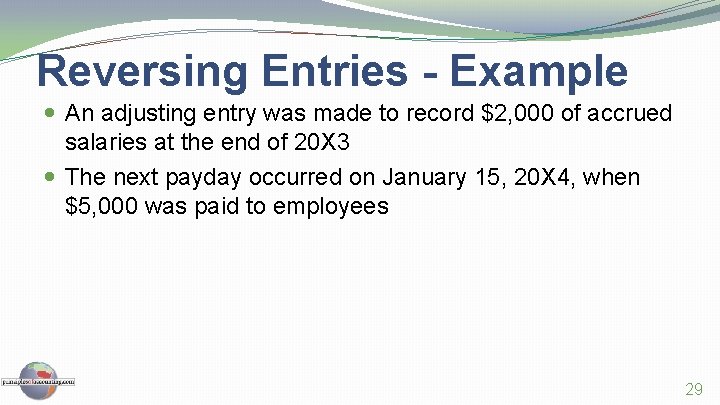
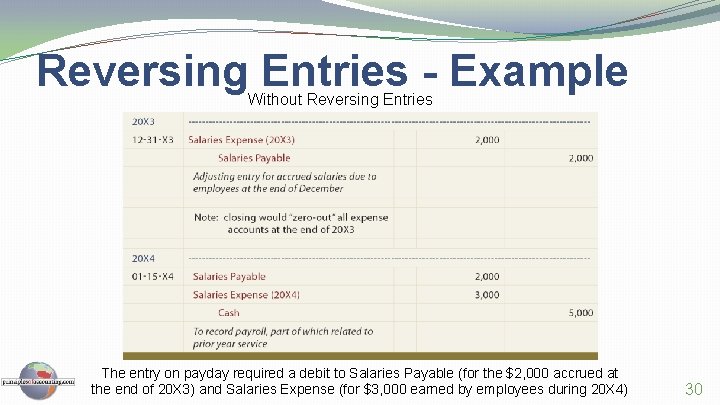
Reversing Entries - Example An adjusting entry was made to record $2, 000 of accrued salaries at the end of 20 X 3 The next payday occurred on January 15, 20 X 4, when $5, 000 was paid to employees 29
Reversing Entries - Example Without Reversing Entries The entry on payday required a debit to Salaries Payable (for the $2, 000 accrued at the end of 20 X 3) and Salaries Expense (for $3, 000 earned by employees during 20 X 4) 30
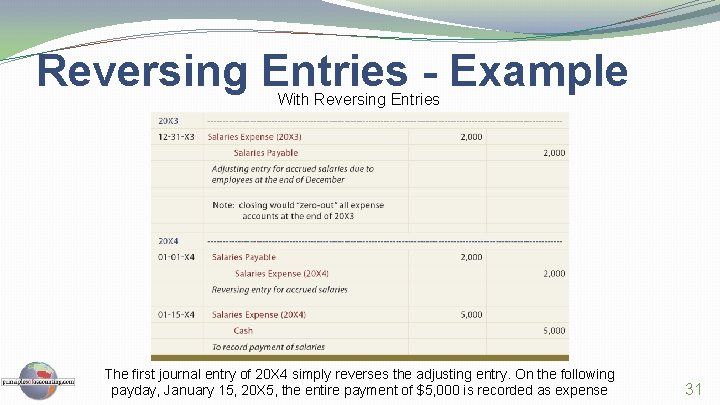
Reversing Entries - Example With Reversing Entries The first journal entry of 20 X 4 simply reverses the adjusting entry. On the following payday, January 15, 20 X 5, the entire payment of $5, 000 is recorded as expense 31
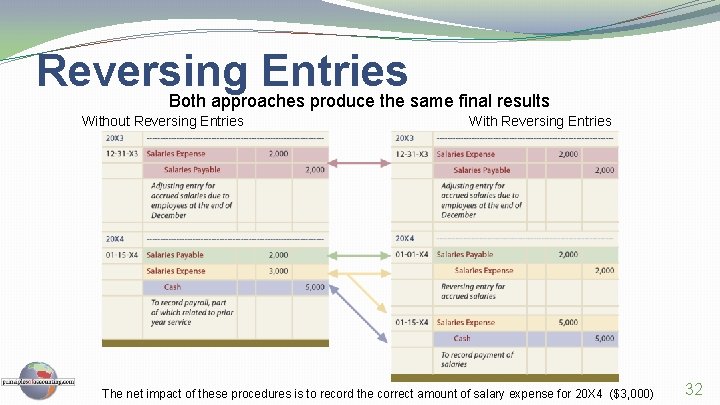
Reversing Entries Both approaches produce the same final results Without Reversing Entries With Reversing Entries The net impact of these procedures is to record the correct amount of salary expense for 20 X 4 ($3, 000) 32
Classified Balance Sheet Not all components listed in a balance sheet are necessarily at fair value Some assets are carried at historical cost Other assets are not reported at all Ex) Brand name, patents, and internally developed resources Careful examination of the balance sheet is essential to analysis of a company’s overall financial condition Balance sheets are divided into categories or classifications to facilitate proper analysis 33
Classified Assets Current Assets: Cash and those assets that will be converted into cash or consumed within one year or the operating cycle, whichever is longer The operating cycle is the period of time it takes to convert cash back into cash Ex) Purchase inventory, sell the inventory on account, and collect the receivable The most liquid assets should be listed first Cash, short-term investments, receivables, inventories, and then prepaid expenses 34
Classified Assets Long-Term Investments Ex) Land purchased for speculation, funds set aside for plant expansion, investments in other entities, etc. Property, Plant, and Equipment Ex) Land, buildings, equipment, etc. Intangible Assets: Lack physical existence Ex) Purchased patents and copyrights, goodwill, etc. Other Assets: Asset accounts that don’t fit elsewhere Ex) Long-term receivable 35
Classified Liabilities Current Liabilities: Obligations that will be liquidated within one year or the operating cycle, whichever is longer Usually paid with current assets Long-Term Liabilities: Noncurrent obligations Ex) Bank loans, mortgage notes, deferred taxes, etc. 36
Classified Liabilities Some long-term notes may be classified partially as a current liability and partially as a long-term liability The portion classified as current would be the principal amount to be repaid within the next year (or operating cycle, if longer) Any amounts due after that period of time would be shown as a long-term liability 37
Classified Equity Presentation depends on the nature of the business organization This book generally assumes an incorporated business Capital Stock: Amounts received from investors for the stock of the company Investors become the owners Ownership is represented by shares Shares can be transferred to others Retained Earnings: The excess of a corporation's income over its dividends Profit that has been retained and will be reinvested into the business 38
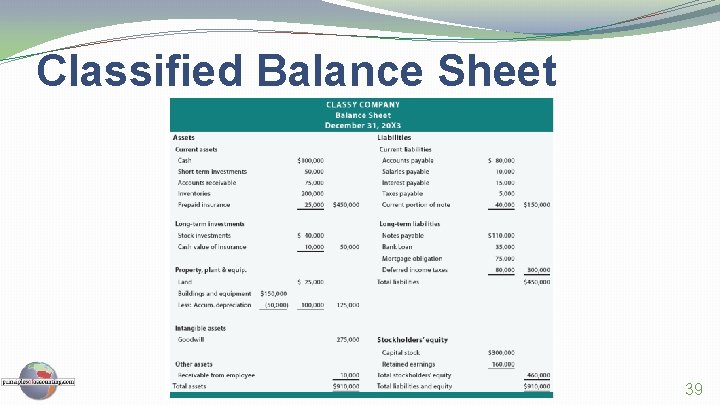
Classified Balance Sheet 39
Other Entity Forms With other entity forms the balance sheet is unchanged except for the equity section Sole proprietorship: Equity consists of a single owner’s capital account Partnership: Equity divided into separate accounts for each partner 40
Full Disclosure Many important details about a company cannot be described in money on the balance sheet Notes are used to describe accounting policies, major business events, pending lawsuits, and other facets of operation Full Disclosure: Financial statements result in a fair presentation, and all relevant facts that would influence investors' and creditors' judgments about the company are disclosed in the financial statements or related notes 41
Business Liquidity & the Operating Cycle Liquidity: The ability of a firm to meet its near-term obligations as they come due Inadequate liquidity can spell doom Working Capital: The difference between current assets and current liabilities A negative amount may be a sign of financial stress, but not always A firm may have a standby letter of credit at a bank that enables it to borrow money as needed Fast food restaurants have virtually no receivables (most sales are for cash) and very low inventory (due to spoilage), but high 42 cash flows
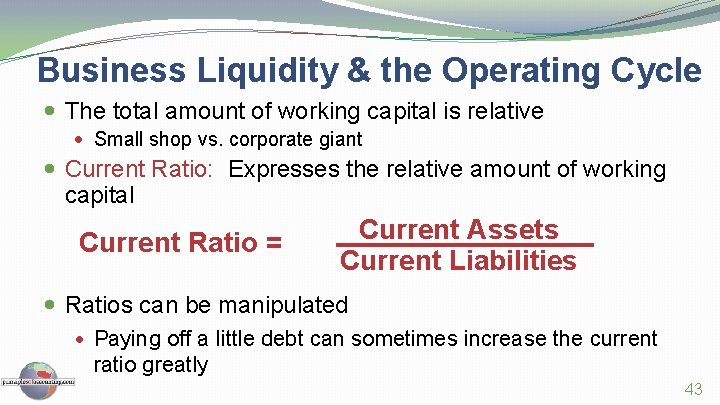
Business Liquidity & the Operating Cycle The total amount of working capital is relative Small shop vs. corporate giant Current Ratio: Expresses the relative amount of working capital Current Ratio = Current Assets Current Liabilities Ratios can be manipulated Paying off a little debt can sometimes increase the current ratio greatly 43
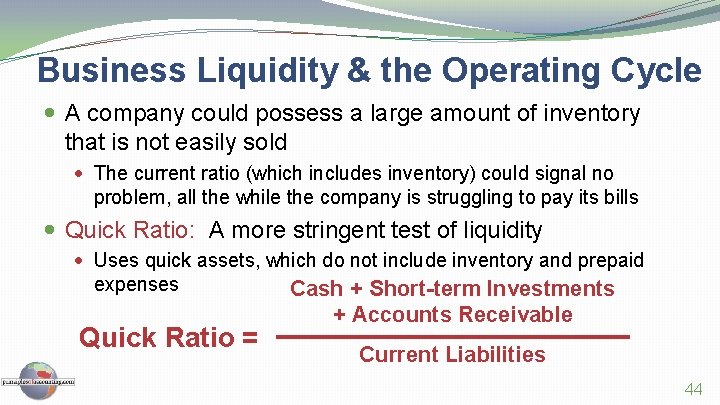
Business Liquidity & the Operating Cycle A company could possess a large amount of inventory that is not easily sold The current ratio (which includes inventory) could signal no problem, all the while the company is struggling to pay its bills Quick Ratio: A more stringent test of liquidity Uses quick assets, which do not include inventory and prepaid expenses Quick Ratio = Cash + Short-term Investments + Accounts Receivable Current Liabilities 44
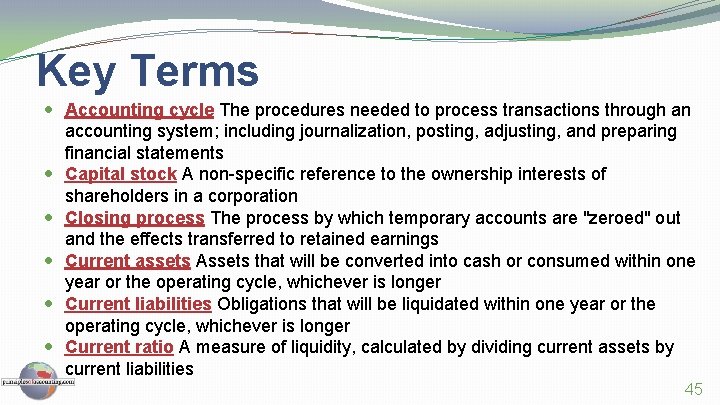
Key Terms Accounting cycle The procedures needed to process transactions through an accounting system; including journalization, posting, adjusting, and preparing financial statements Capital stock A non-specific reference to the ownership interests of shareholders in a corporation Closing process The process by which temporary accounts are "zeroed" out and the effects transferred to retained earnings Current assets Assets that will be converted into cash or consumed within one year or the operating cycle, whichever is longer Current liabilities Obligations that will be liquidated within one year or the operating cycle, whichever is longer Current ratio A measure of liquidity, calculated by dividing current assets by current liabilities 45
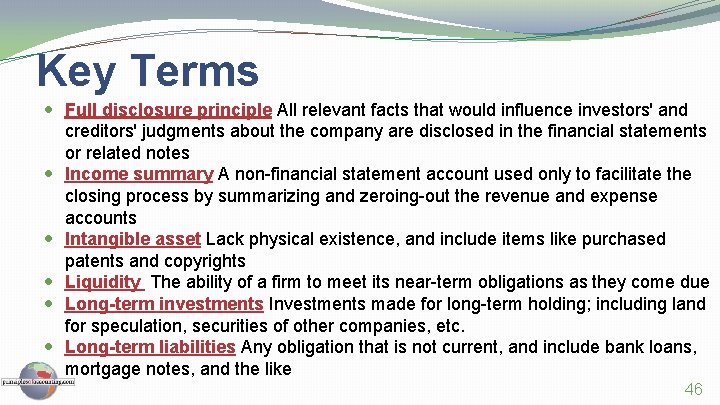
Key Terms Full disclosure principle All relevant facts that would influence investors' and creditors' judgments about the company are disclosed in the financial statements or related notes Income summary A non-financial statement account used only to facilitate the closing process by summarizing and zeroing-out the revenue and expense accounts Intangible asset Lack physical existence, and include items like purchased patents and copyrights Liquidity The ability of a firm to meet its near-term obligations as they come due Long-term investments Investments made for long-term holding; including land for speculation, securities of other companies, etc. Long-term liabilities Any obligation that is not current, and include bank loans, mortgage notes, and the like 46
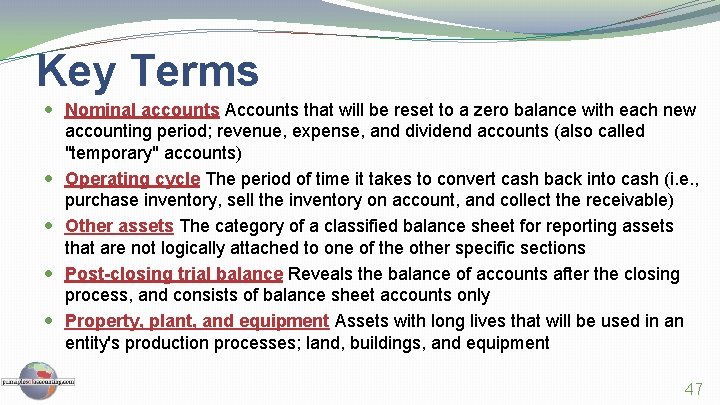
Key Terms Nominal accounts Accounts that will be reset to a zero balance with each new accounting period; revenue, expense, and dividend accounts (also called "temporary" accounts) Operating cycle The period of time it takes to convert cash back into cash (i. e. , purchase inventory, sell the inventory on account, and collect the receivable) Other assets The category of a classified balance sheet for reporting assets that are not logically attached to one of the other specific sections Post-closing trial balance Reveals the balance of accounts after the closing process, and consists of balance sheet accounts only Property, plant, and equipment Assets with long lives that will be used in an entity's production processes; land, buildings, and equipment 47
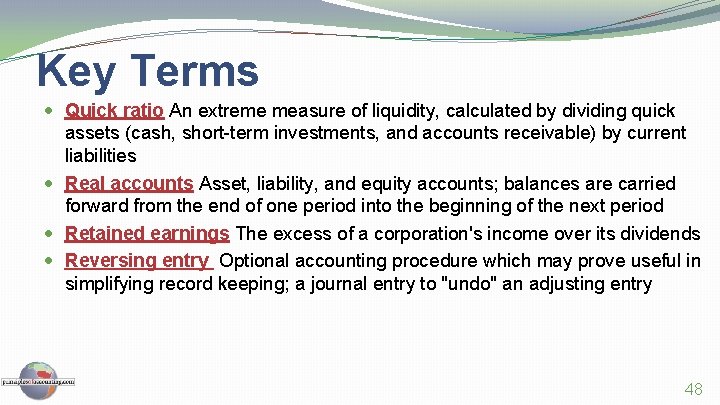
Key Terms Quick ratio An extreme measure of liquidity, calculated by dividing quick assets (cash, short-term investments, and accounts receivable) by current liabilities Real accounts Asset, liability, and equity accounts; balances are carried forward from the end of one period into the beginning of the next period Retained earnings The excess of a corporation's income over its dividends Reversing entry Optional accounting procedure which may prove useful in simplifying record keeping; a journal entry to "undo" an adjusting entry 48
Key Terms Temporary accounts Accounts that will be reset to a zero balance with each new accounting period; revenue, expense, and dividend accounts (also called "nominal" accounts) Working capital The difference between current assets and current liabilities 49
You may contact the author at lwalther@principlesofaccounting. com. Your suggestions & comments are always appreciated! Note: For non-accounting questions or support related to the website, please contact marnie@principlesofaccounting. com. Copyrights 2013, 2012, 2011, 2010, 2009, 2008, 2007, 2006, 2005, 2004, 2003, 2002, & 2001 Larry M. Walther, principlesofaccounting. com, and all licensors. All rights reserved. Updated February 3, 2013