
Chapter 4 The Periodic Table 4 1 How
Chapter 4 – The Periodic Table 4. 1 How are the Elements Organized? 4. 2 – Tour of the Periodic Table
Periodic Pattern l John Newlands – 1 st 16 elements according to atomic mass l Dmitri Mendeleev – 1 st 63 elements according to atomic mass Some discrepancies and gaps l Predicted properties of other elements l l Henry Moseley – x-ray spectra numbers
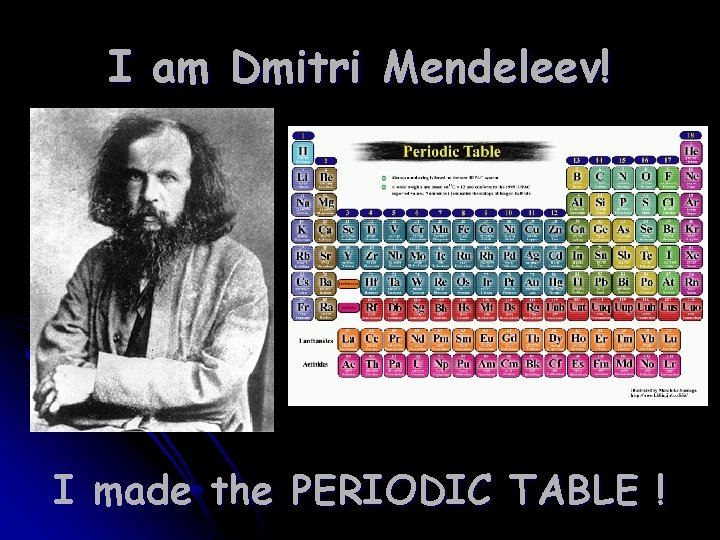
I am Dmitri Mendeleev! I made the PERIODIC TABLE !
Periodic Table l Periodic Law – the repeating physical and chemical properties if elements change periodically with their atomic number l Period – a horizontal row of elements in the periodic table l Similar e- configs
Periodic Table l Group – a vertical column of elements on the p. t. l Similar properties w/ some gradation l MGE – elements in the s-block and the p-block of the periodic table l Having l AKA very regular e- configs representative elements

Group 1 l Alkali metals – highly reactive metallic elements in group 1 that react rapidly with water to form hydrogen and alkaline solutions and that burn in air l Soft, shine (dulls in oxygen/water), stored in oil or kerosene, violent rxn with cold water, good conductors
Group 2 l Alkaline Earth Metals – reactive metallic elements in group 2 with 2 e’s in the outer most E level l Compared to alkali metals a. e. m. are harder, denser, stronger, and have higher m. p. l Less reactive than a. m. and reactivity decreases as you go down the group
Group 17 l Halogens – a nonmetallic element in group 17 of the p. t. that has 7 e -’s in the outermost E level and combines w/metals to form salts l Most l Salt reactive group of nonmetals – a cmpd. Composed of + and – ions arranged in a regular 3 D pattern
Group 18 l Noble Gases – elements in group 18 of the p. t. that are characterized by low reactivity l Stable octet l Hydrogen l Most – class by itself common element l 1 p+ and 1 el Violent rxn with oxygen to make water
Lanthanides and Actinides l Lanthanides – shiny, metallic transition metals with atomic # 58 -71 in which e- are added to the 4 f orbitals l Shiny and reactive l Actinides– shiny, metallic transition metals with atomic # 90 -103 in which e- are added to the 5 f orbitals l All are radioactive

Now you are almost as smart as I am! But not as handsome! Man, I look GOOD!
Metals l Metals – an element that is a good conductor of electricity l Left side of p. t. l Conductivity as temp. l Solids at room temperature l. Alloy – a solid or liquid mixture of 2 or more metals
Periodic Table l Transition Metals – one of the metals that can use the inner shell b 4 using the outer shell aka: d block elements l Less reactive than groups 1 & 2
Periodic Table l Nonmetals – an element that is a poor conductor of electricity l Right of p. t. l Poor conductors (as temp conductivity )
Periodic Table l Semiconductors – a crystalline material with intermediate electrical conductivity l Stair step line l Metalloids l Solids at room temperature l Used in electrical devices
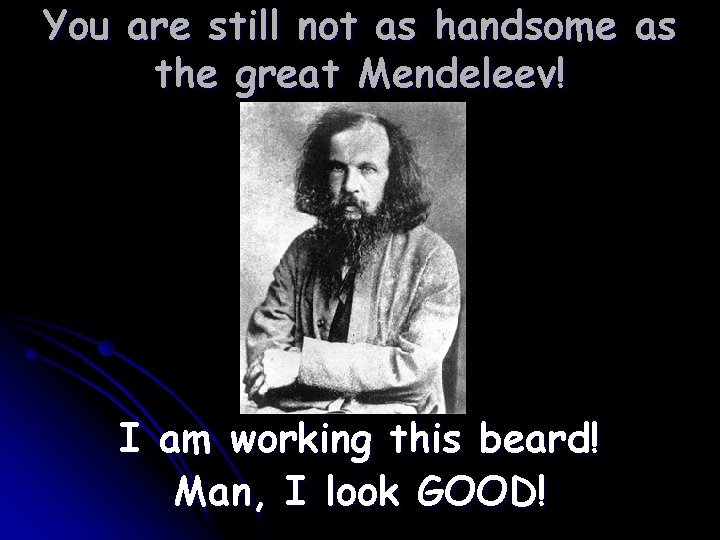
You are still not as handsome as the great Mendeleev! I am working this beard! Man, I look GOOD!
- Slides: 16