
Chapter 4 The Integumentary System Functions of the

- Slides: 45
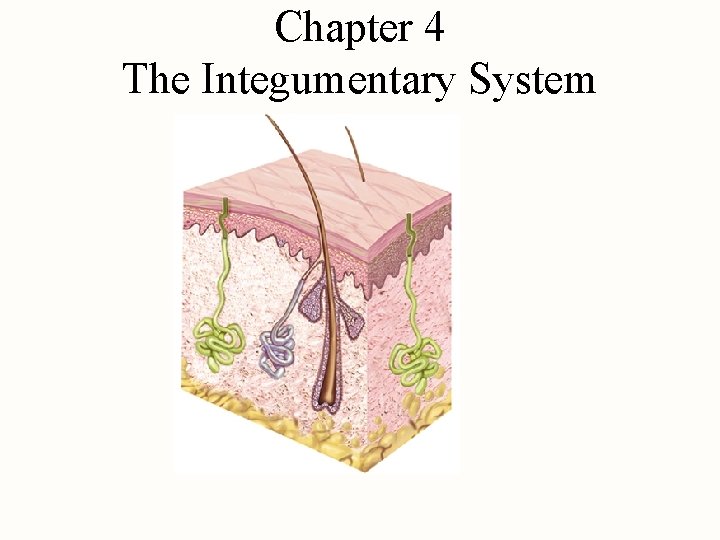
Chapter 4 The Integumentary System
Functions of the Skin • Barrier = tough, dry, water barrier, UV barrier • Vitamin D synthesis – UV light • Cutaneous absorption/excretion – 1 -2 % oxygen absorption by diffusion through skin – fat-soluble vitamins (A, D, E & K) easily absorbed – Excretes urea & uric acid • Sensory functions – receptors for heat, cold, touch, pressure, vibration & pain • Thermoregulation – cutaneous vasodilation & constriction and sweating • Psychological and social functions – appearance & social acceptance – facial expression and nonverbal communication
Overview of the Skin • Largest organ of the body (15% of body weight) • Two layers – epidermis • stratified squamous epithelium that gets hard – dermis • Dense connective tissue layer • Rests on subcutaneous layer or hypodermis • Normal thickness of 1 -2 mm, up to 6 mm – thicker on palms & soles
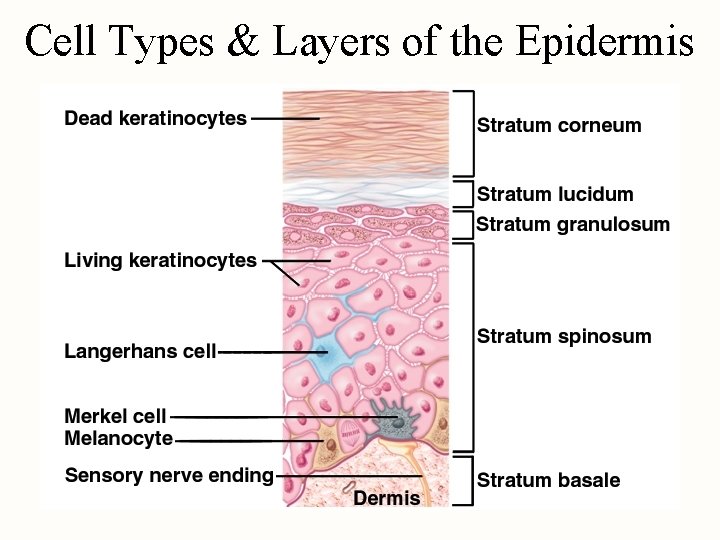
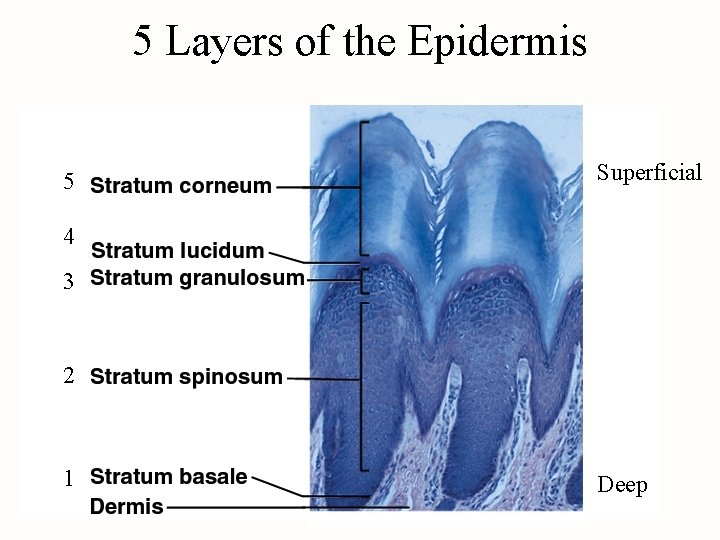
EPIDERMIS • • • - Avascular 5 layers called “strata” From inside out: Stratum basale Spinosum Granulosum Lucidum Corneum
Cell Types & Layers of the Epidermis
5 Layers of the Epidermis 5 Superficial 4 3 2 1 Deep
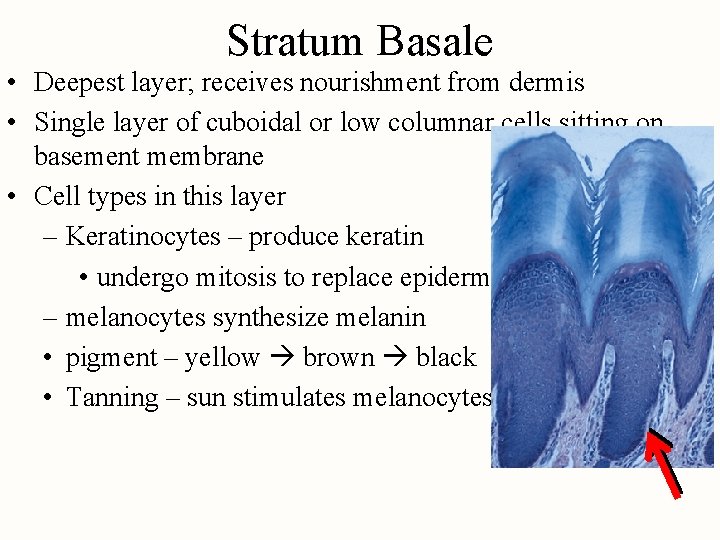
Stratum Basale • Deepest layer; receives nourishment from dermis • Single layer of cuboidal or low columnar cells sitting on basement membrane • Cell types in this layer – Keratinocytes – produce keratin • undergo mitosis to replace epidermis – melanocytes synthesize melanin • pigment – yellow brown black • Tanning – sun stimulates melanocytes
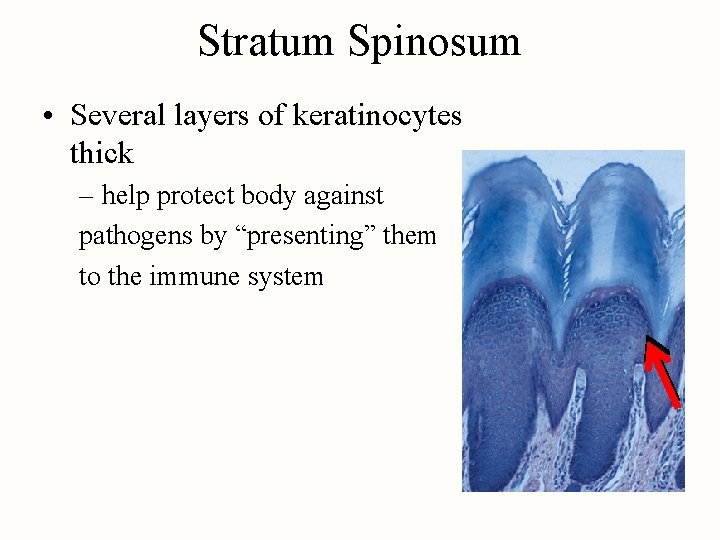
Stratum Spinosum • Several layers of keratinocytes thick – help protect body against pathogens by “presenting” them to the immune system
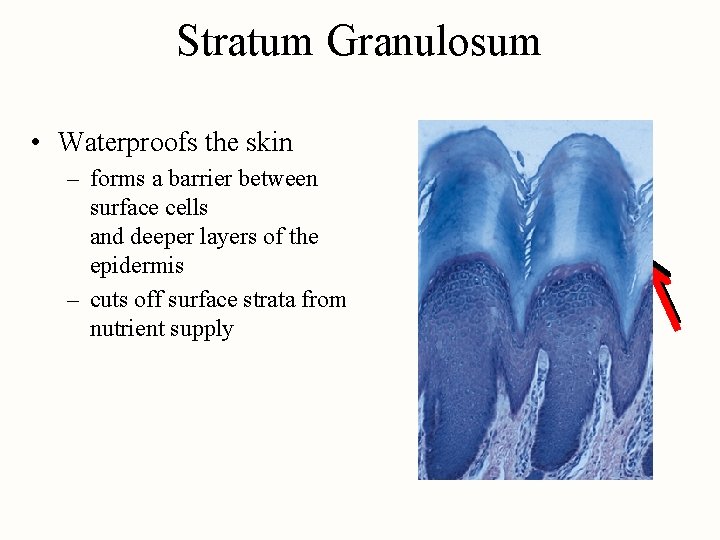
Stratum Granulosum • Waterproofs the skin – forms a barrier between surface cells and deeper layers of the epidermis – cuts off surface strata from nutrient supply
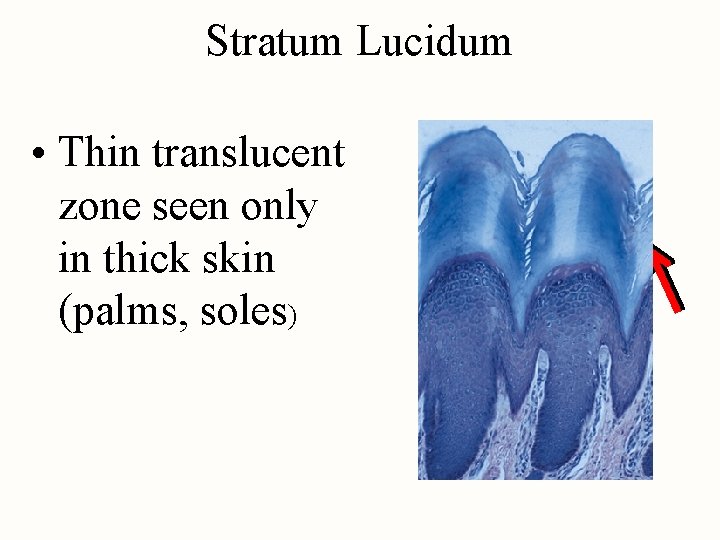
Stratum Lucidum • Thin translucent zone seen only in thick skin (palms, soles)
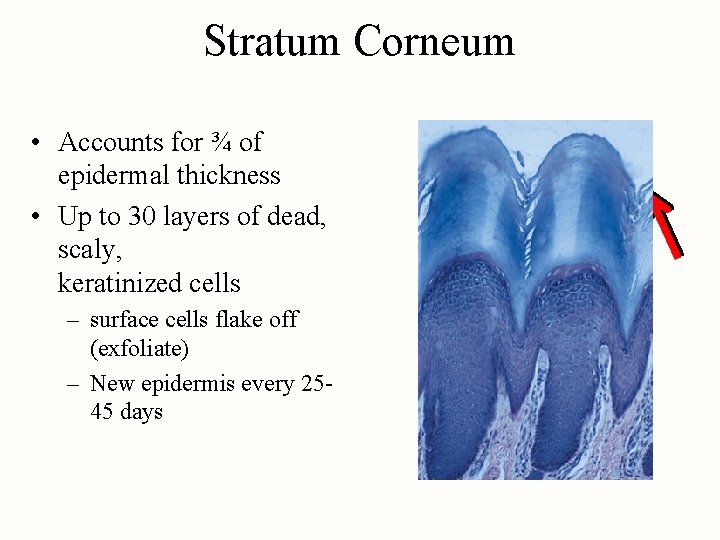
Stratum Corneum • Accounts for ¾ of epidermal thickness • Up to 30 layers of dead, scaly, keratinized cells – surface cells flake off (exfoliate) – New epidermis every 2545 days
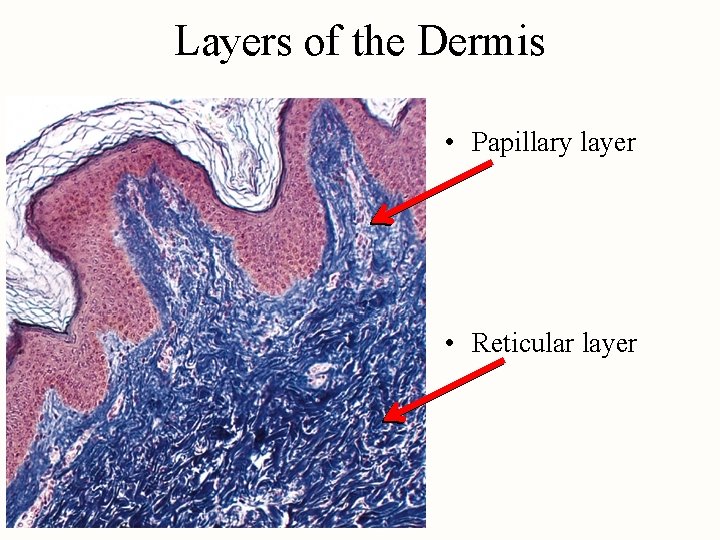
The Dermis • • • - Thickness = 0. 6 mm to 3 mm Strong, stretchy dense connective tissue Layers Papillary layer: upper region Dermal papillae – uneven, fingerlike projections “fingerprints” Reticular Layer – deepest layer Has blood vessels, sweat & oil glands, deep pressure receptors
Layers of the Dermis • Papillary layer • Reticular layer
• Dermis has collagen & elastic fibers • Collagen – makes it tough • Elastic – keeps it firm • Lots of blood vessels
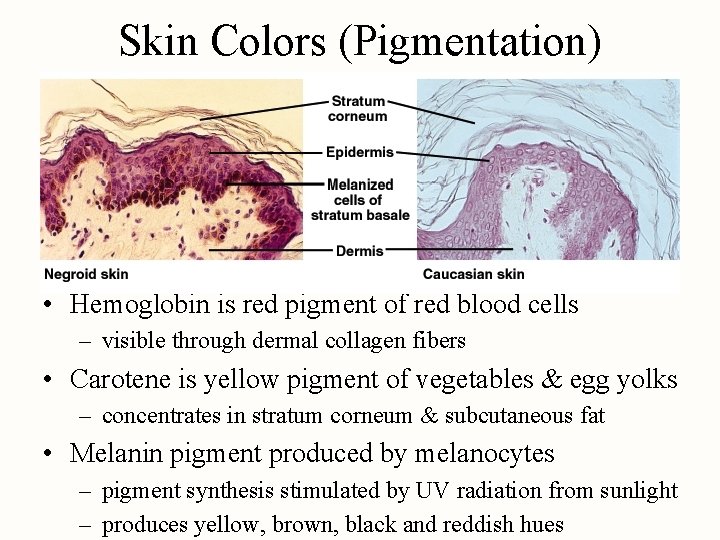
Skin Colors (Pigmentation) • Hemoglobin is red pigment of red blood cells – visible through dermal collagen fibers • Carotene is yellow pigment of vegetables & egg yolks – concentrates in stratum corneum & subcutaneous fat • Melanin pigment produced by melanocytes – pigment synthesis stimulated by UV radiation from sunlight – produces yellow, brown, black and reddish hues
Abnormal Skin Colors • Cyanosis is blueness resulting from deficiency of oxygen in the circulating blood (cold weather) • Erythema is redness due to dilated cutaneous vessels (anger, sunburn, embarrassment) • Jaundice is yellowing of skin & sclera due to excess of bilirubin in blood (liver disease) • Pallor is pale color from lack of blood flow • Albinism is a genetic lack of melanin • Hematoma is a bruise (visible clotted blood)
Skin Markings • Hemangiomas (birthmarks) – discolored skin caused by benign tumors of dermal blood capillaries (strawberry birthmarks disappear in childhood -- port wine birthmarks last for life) • Freckles & moles = aggregations of melanocytes – freckles are flat; moles are elevated
SKIN APPENDAGES • Cutaneous glands • Hair & hair follicles • Nails • All arise from epidermis
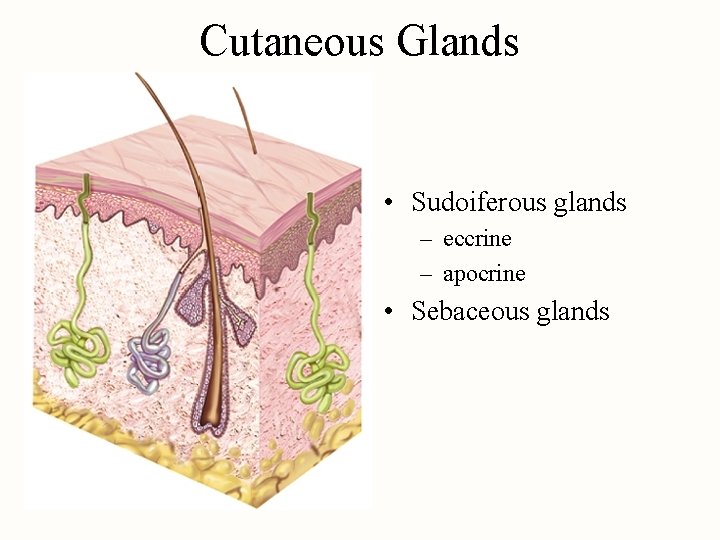
Cutaneous Glands • Sudoiferous glands – eccrine – apocrine • Sebaceous glands
• • • - Sweat Glands 2. 5 million ! 2 Types: Eccrine & Apocirne Eccrine glands Lots all over body Produce sweat (water + salts, vitamin C, metabolic wastes, lactic acid) - Sweat is acidic (p. H 4 – 6) to inhibit growth of bacteria - Important to heat regulation
• Apocrine sweat glands: - Found in axillary & genital areas • Secretes milky or yellowish stuff that smells when it mixes with bacteria
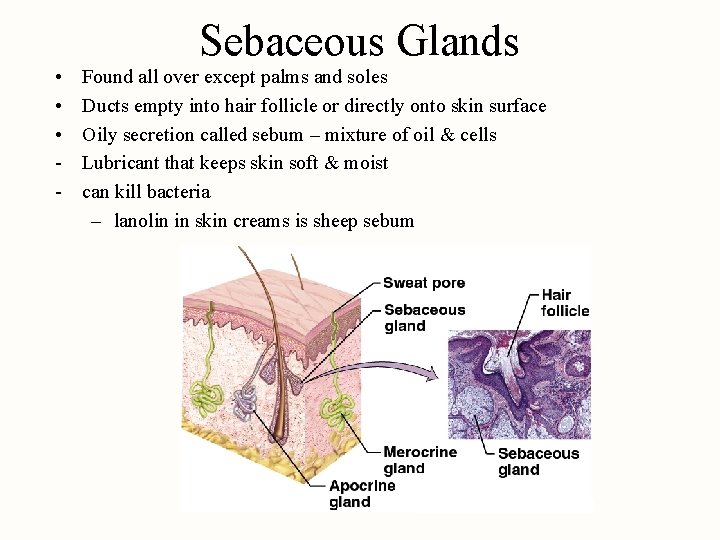
Sebaceous Glands • • • - Found all over except palms and soles Ducts empty into hair follicle or directly onto skin surface Oily secretion called sebum – mixture of oil & cells Lubricant that keeps skin soft & moist can kill bacteria – lanolin in skin creams is sheep sebum
Ceruminous Glands • Found only in external ear canal • Their secretion combines with sebum to produce earwax – waterproof keeps eardrum flexible – bitterness repel mites & other pests
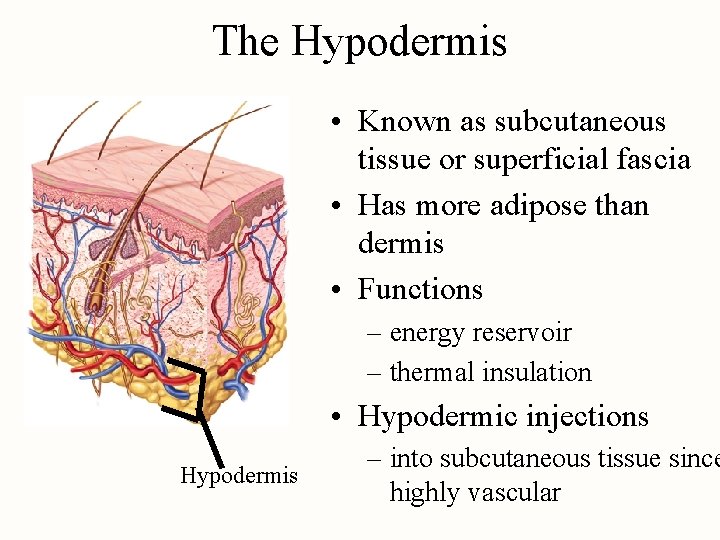
The Hypodermis • Known as subcutaneous tissue or superficial fascia • Has more adipose than dermis • Functions – energy reservoir – thermal insulation • Hypodermic injections Hypodermis – into subcutaneous tissue since highly vascular
HAIRS & HAIR FOLLICLES • Some hair has function, but mostly not • Hair – flexible epithelial structure; dead material made of protein • Produced by hair follicle • Root – part of hair enclosed in follicle • Shaft – part sticking out • Hair bulb matrix- growth area
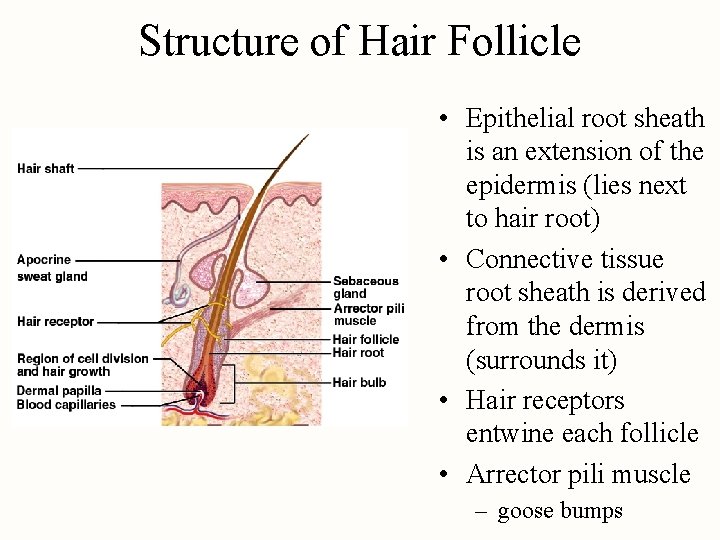
Structure of Hair Follicle • Epithelial root sheath is an extension of the epidermis (lies next to hair root) • Connective tissue root sheath is derived from the dermis (surrounds it) • Hair receptors entwine each follicle • Arrector pili muscle – goose bumps
• - Structure of Hair: Medulla – central core Cortex – surrounds medulla Cuticle – single layer of cells that overlap like shingles- heavily keratinized
Growth of Hair • Grows 1 mm every 3 days for 2 to 4 years – dormant phase lasts 3 to 4 months – as new hair begins to grow it pushes out old hair – eyelashes and eyebrows only grow for 3 to 4 months • Alopecia and pattern baldness (patchy thinning) – baldness gene is dominant in males & expressed with male levels of testosterone • thinning on top & then sides of head in males with 1 baldness alle • baldness in females if homozygous recessive with abnormal testosterone • Hirsutism -- abnormal hairiness in women or children – masculinizing ovarian tumors or adrenal cortex hypersecretion of testosterone
Functions of Hair • Body hair too thin to provide warmth • Sensory functions – alert us to parasites crawling on skin • Scalp hair provides heat retention & sunburn cover • Sex and individual recognition • Beard, pubic & axillary hair indicate sexual maturity & help distribute sexual scents • Guard hairs & eyelashes prevent foreign objects from getting into nostrils, ear canals or eyes • Expression of emotions with eyebrows
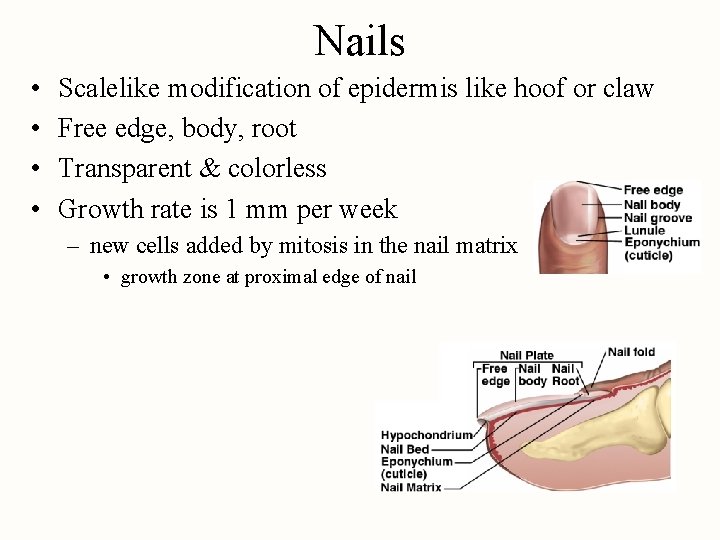
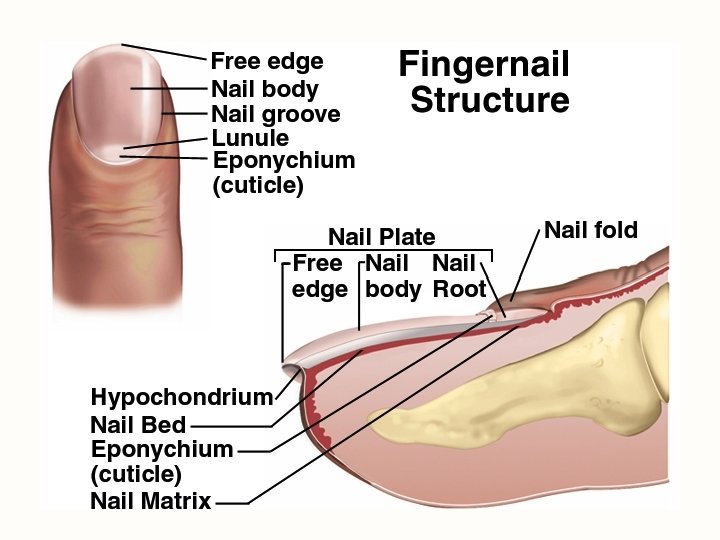
Nails • • Scalelike modification of epidermis like hoof or claw Free edge, body, root Transparent & colorless Growth rate is 1 mm per week – new cells added by mitosis in the nail matrix • growth zone at proximal edge of nail
Breasts and Mammary Glands • Breasts of both sexes rarely contain glands – secondary sexual characteristic of females – mammary glandular tissue found only during lactation and pregnancy • modified apocrine sweat gland • thicker secretion released by ducts at nipple • Mammary ridges or milk lines – 2 rows of mammary glands in most mammals – most milk from anteriormost glandular tissue in row – primates kept only anteriormost glands • Witches identified by additional nipples (polythelia)
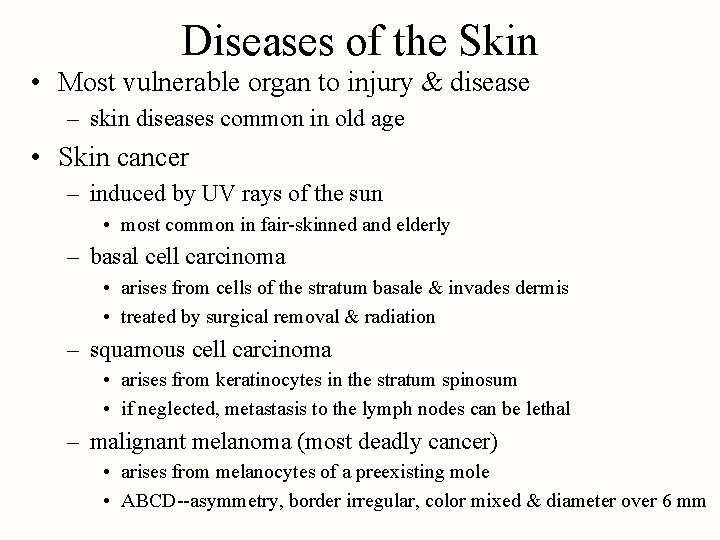
Diseases of the Skin • Most vulnerable organ to injury & disease – skin diseases common in old age • Skin cancer – induced by UV rays of the sun • most common in fair-skinned and elderly – basal cell carcinoma • arises from cells of the stratum basale & invades dermis • treated by surgical removal & radiation – squamous cell carcinoma • arises from keratinocytes in the stratum spinosum • if neglected, metastasis to the lymph nodes can be lethal – malignant melanoma (most deadly cancer) • arises from melanocytes of a preexisting mole • ABCD--asymmetry, border irregular, color mixed & diameter over 6 mm
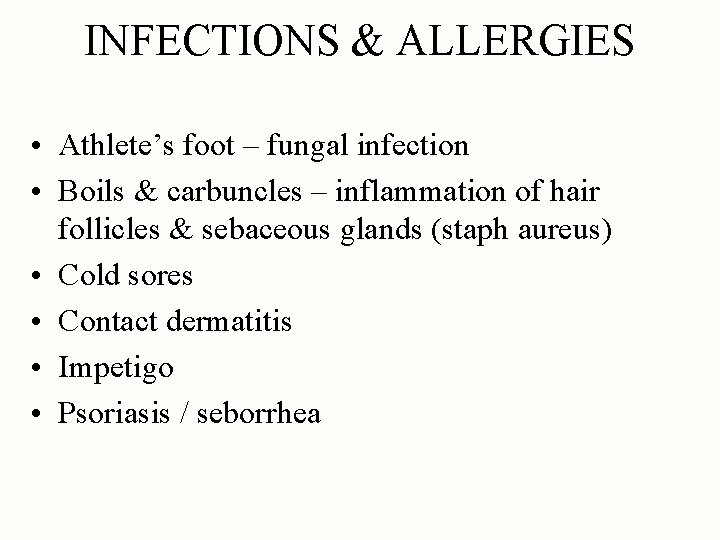
INFECTIONS & ALLERGIES • Athlete’s foot – fungal infection • Boils & carbuncles – inflammation of hair follicles & sebaceous glands (staph aureus) • Cold sores • Contact dermatitis • Impetigo • Psoriasis / seborrhea
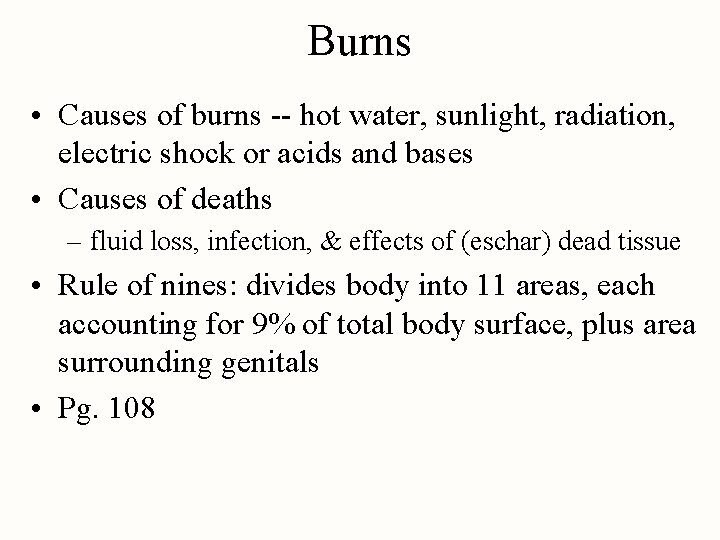
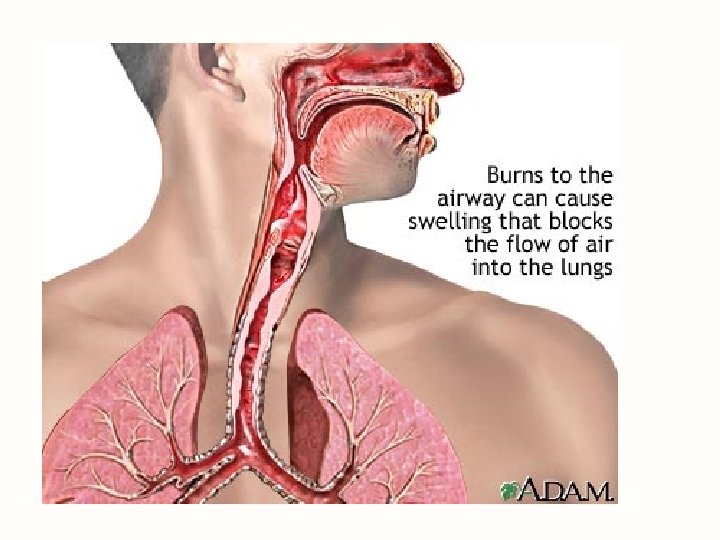
Burns • Causes of burns -- hot water, sunlight, radiation, electric shock or acids and bases • Causes of deaths – fluid loss, infection, & effects of (eschar) dead tissue • Rule of nines: divides body into 11 areas, each accounting for 9% of total body surface, plus area surrounding genitals • Pg. 108
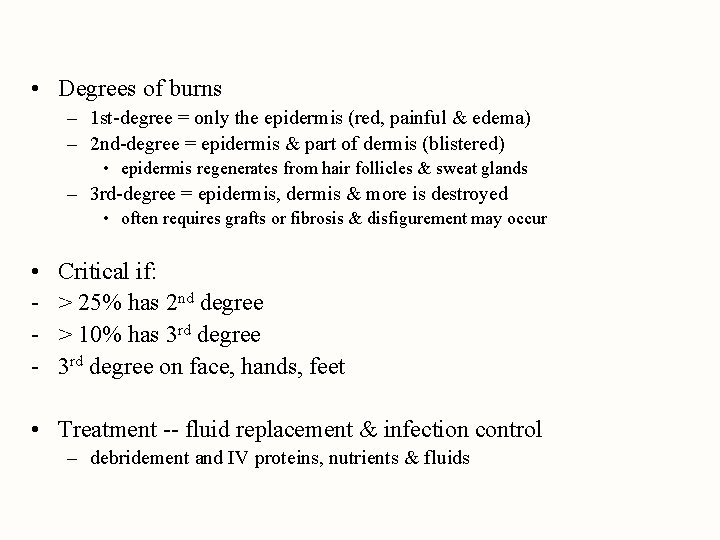
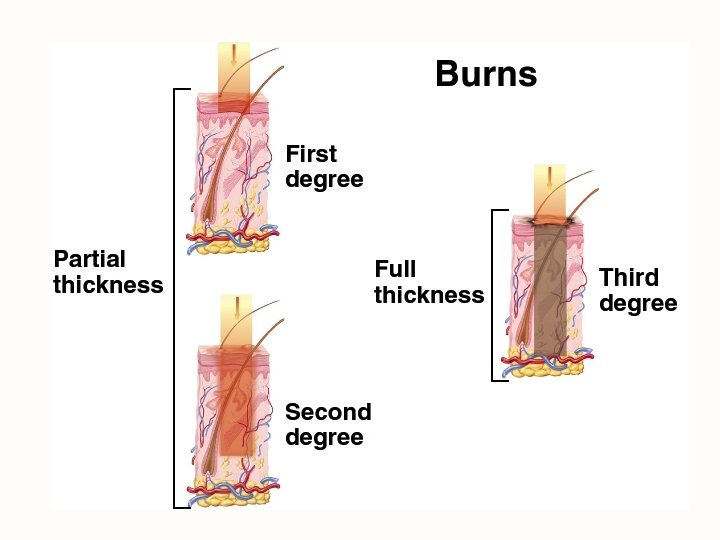
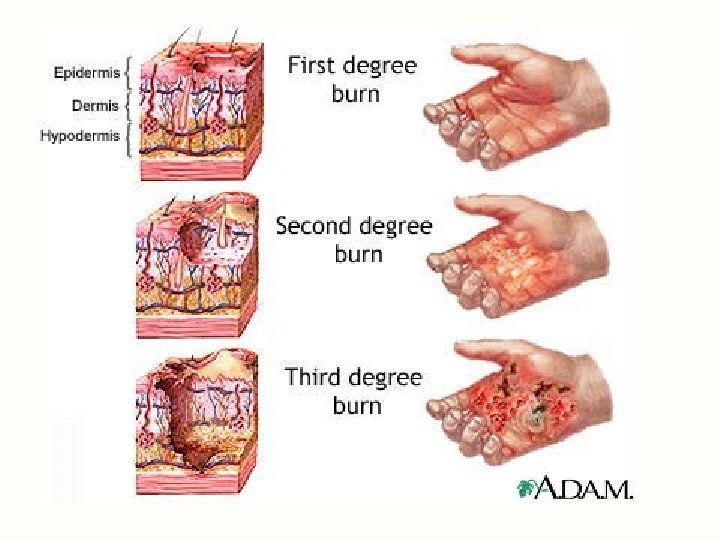
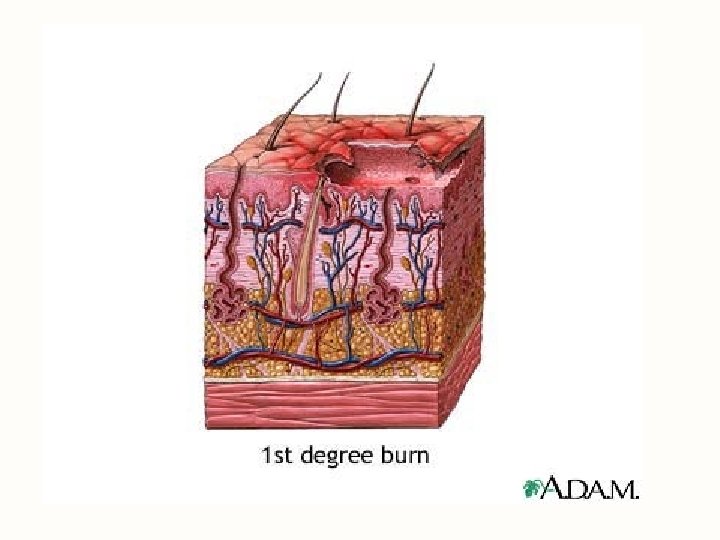
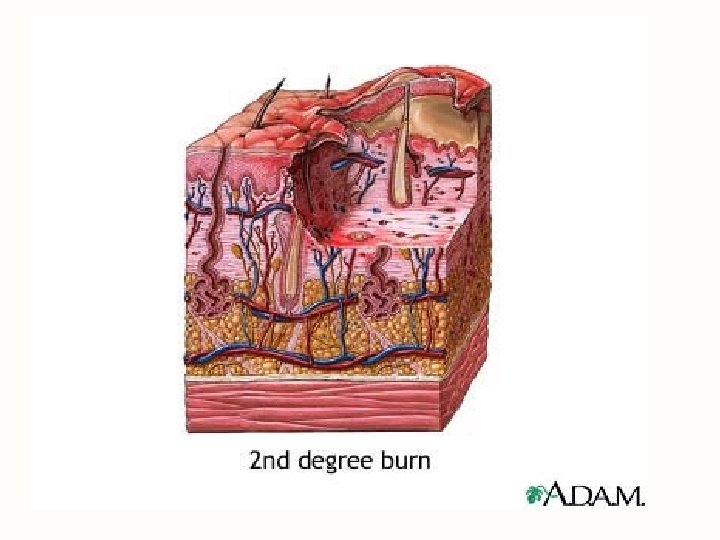
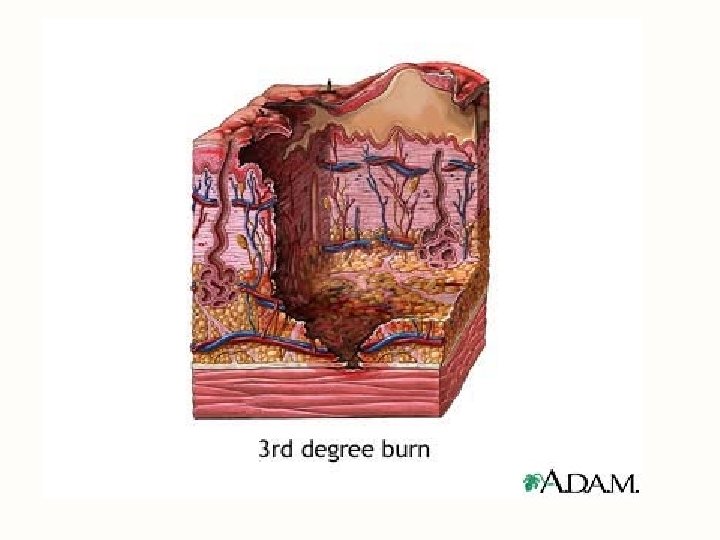
• Degrees of burns – 1 st-degree = only the epidermis (red, painful & edema) – 2 nd-degree = epidermis & part of dermis (blistered) • epidermis regenerates from hair follicles & sweat glands – 3 rd-degree = epidermis, dermis & more is destroyed • often requires grafts or fibrosis & disfigurement may occur • - Critical if: > 25% has 2 nd degree > 10% has 3 rd degree on face, hands, feet • Treatment -- fluid replacement & infection control – debridement and IV proteins, nutrients & fluids
UVA, UVB & Sunscreens • UVA & UVB are called “tanning rays” and “burning rays” – both can burn as well as tan • Both thought to initiate skin cancer • As sale of sunscreens has risen so has skin cancer – those who use have higher incidence of basal cell – chemical in sunscreen damage DNA & generate harmful free radicals • PABA, zinc oxide & titanium dioxide
Skin Grafts & Artificial Skin • Third-degree burns require skin grafts • Graft options – autograft -- tissue from different region of patient – isograft -- skin graft tissue from identical twin – cultured keratinocyte patches • Temporary graft options (immune system) – homograft (allograft) -- graft from unrelated person – heterograft (xenograft) -- tissue from another species – amnion from an afterbirth – artificial skin from silicone and collagen
SYSTEMS IN SYN • Page 112