
Chapter 4 The Complete Health History Copyright 2020


- Slides: 34
Chapter 4 The Complete Health History Copyright © 2020 by Elsevier Inc. All rights reserved.
Purpose of Health History Collect subjective data to combine with objective data from physical exam and lab studies to form the database. Provides a complete picture of patient’s past and present health status Can be used as a screening tool for detection of abnormalities Printed or electronic format that is available for review, validation, and updates Sequence may vary in terms of obtained information. Focus may differ in terms of clinical practice setting and/or nature of complaint. Copyright © 2020 by Elsevier Inc. All rights reserved.
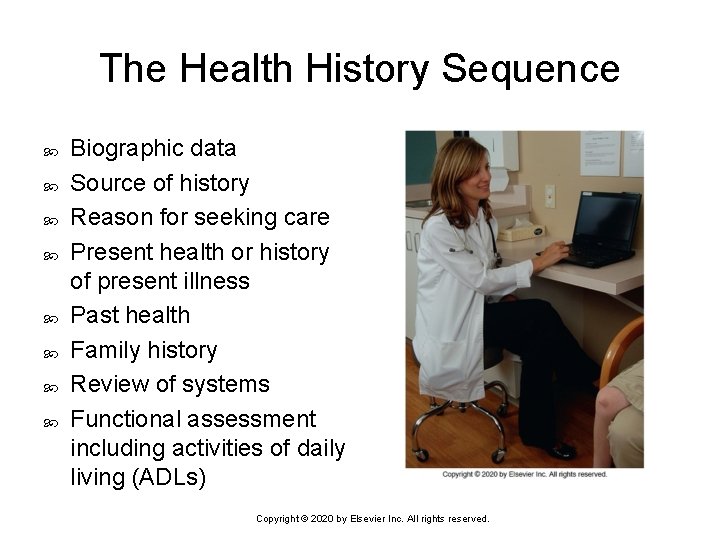
The Health History Sequence Biographic data Source of history Reason for seeking care Present health or history of present illness Past health Family history Review of systems Functional assessment including activities of daily living (ADLs) Copyright © 2020 by Elsevier Inc. All rights reserved.
The Health History Areas of focus may differ slightly in terms of individual patient concerns. Ø developmental considerations. Ø presence of health problem. Ø no detection of health problems. Ø concerns r/t aging. Ø identification of vulnerable population. Ø identified barriers to communication. Ø Copyright © 2020 by Elsevier Inc. All rights reserved.
Biographic Data Name, address, and phone number Age, birth date, and birthplace Gender (identification) and relationship status Race and ethnic origin Occupation: usual and present Primary language Ø Language-concordant provider or medical interpreter Copyright © 2020 by Elsevier Inc. All rights reserved.
Source of History Record who furnishes information, usually the person, although source may be relative or friend. Judge reliability of informant and how willing he or she is to communicate. Ø Reliability leads to consistency of information. Note any special circumstances, such as use of interpreter. Copyright © 2020 by Elsevier Inc. All rights reserved.
Reason for Seeking Care Brief spontaneous statement in person’s own words describing reason for visit Document reported findings Ø Symptom: subjective sensation person feels from disorder documented in quotes Ø Sign: objective abnormality that can be detected on physical examination or in laboratory reports Reason for care is not a diagnostic statement. Focus on patient’s prioritized reasons for seeking care. Copyright © 2020 by Elsevier Inc. All rights reserved.
Present Health or History of Present Illness (HPI) Collect all provided data and identify eight critical characteristics Ø Location, character(quality), quantity(severity), timing, setting, aggravating or relieving factors, associated factors and patient’s perception Make sure that collected data are precise and accurate. Ø Use measureable standards and/or patient’s own words as qualifiers. Use standardized indicators to document findings Ø Reliability and validity of reported results Copyright © 2020 by Elsevier Inc. All rights reserved.
Critical Characteristics 1. 2. 3. 4. 5. 6. Location—be specific and precise Character or quality—provide descriptive terms Quantity or severity—use scales to identify intensity Timing—onset, duration, and frequency Setting—location and/or associated activity Aggravating or relieving factors—what makes it worse or better 7. Associated factors—is the concern r/t any other symptom? 8. Patient’s perception—how does it affect you? Copyright © 2020 by Elsevier Inc. All rights reserved.
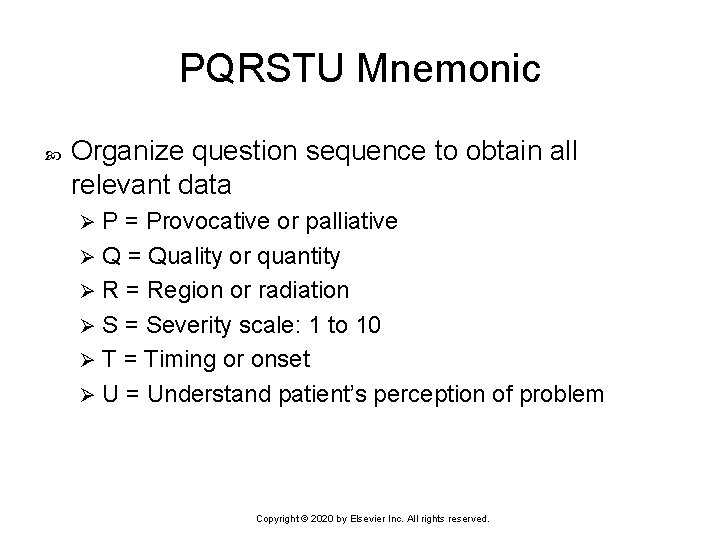
PQRSTU Mnemonic Organize question sequence to obtain all relevant data P = Provocative or palliative Ø Q = Quality or quantity Ø R = Region or radiation Ø S = Severity scale: 1 to 10 Ø T = Timing or onset Ø U = Understand patient’s perception of problem Ø Copyright © 2020 by Elsevier Inc. All rights reserved.
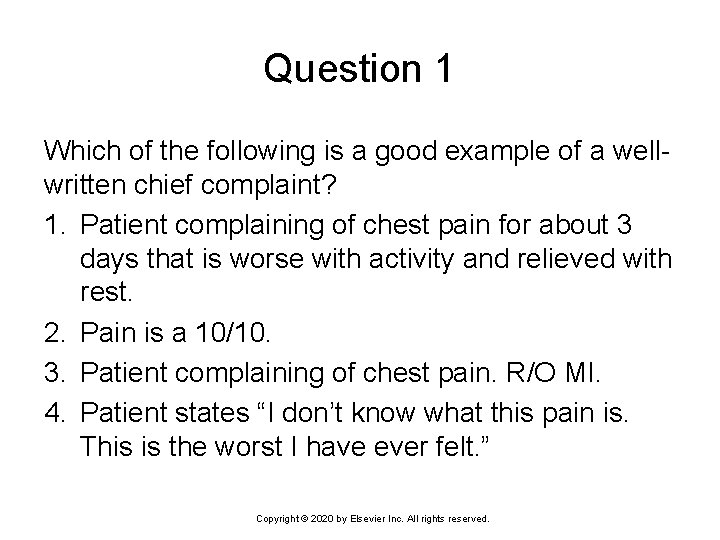
Question 1 Which of the following is a good example of a wellwritten chief complaint? 1. Patient complaining of chest pain for about 3 days that is worse with activity and relieved with rest. 2. Pain is a 10/10. 3. Patient complaining of chest pain. R/O MI. 4. Patient states “I don’t know what this pain is. This is the worst I have ever felt. ” Copyright © 2020 by Elsevier Inc. All rights reserved.
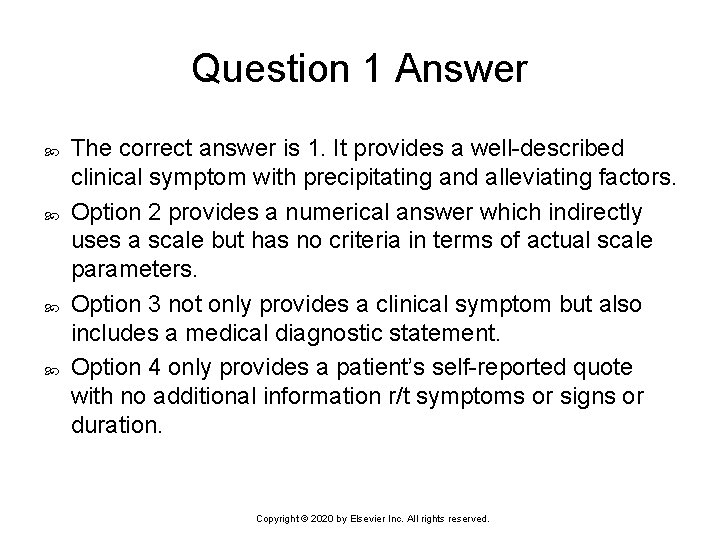
Question 1 Answer The correct answer is 1. It provides a well-described clinical symptom with precipitating and alleviating factors. Option 2 provides a numerical answer which indirectly uses a scale but has no criteria in terms of actual scale parameters. Option 3 not only provides a clinical symptom but also includes a medical diagnostic statement. Option 4 only provides a patient’s self-reported quote with no additional information r/t symptoms or signs or duration. Copyright © 2020 by Elsevier Inc. All rights reserved.
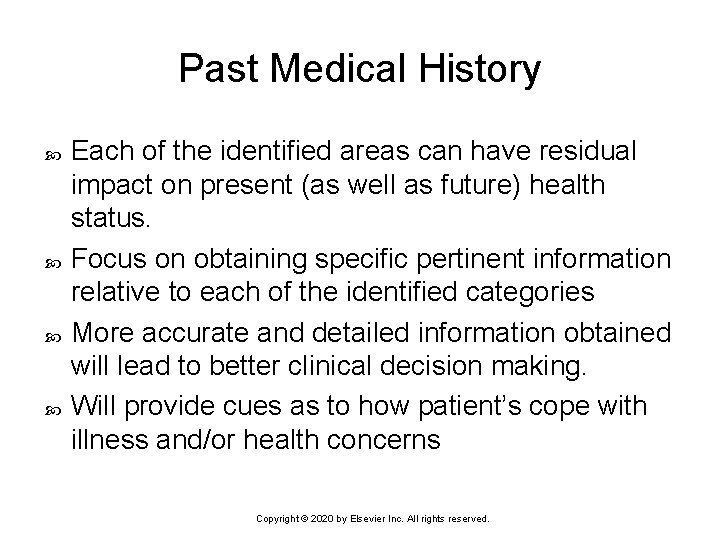
Past Medical History Each of the identified areas can have residual impact on present (as well as future) health status. Focus on obtaining specific pertinent information relative to each of the identified categories More accurate and detailed information obtained will lead to better clinical decision making. Will provide cues as to how patient’s cope with illness and/or health concerns Copyright © 2020 by Elsevier Inc. All rights reserved.
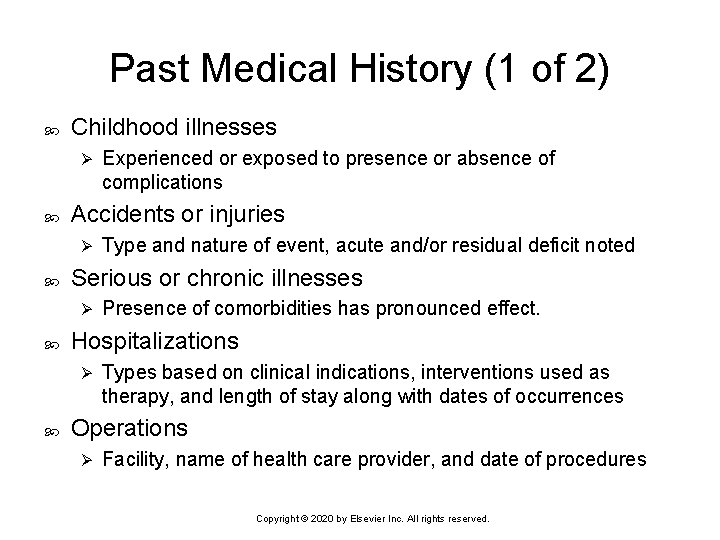
Past Medical History (1 of 2) Childhood illnesses Ø Accidents or injuries Ø Presence of comorbidities has pronounced effect. Hospitalizations Ø Type and nature of event, acute and/or residual deficit noted Serious or chronic illnesses Ø Experienced or exposed to presence or absence of complications Types based on clinical indications, interventions used as therapy, and length of stay along with dates of occurrences Operations Ø Facility, name of health care provider, and date of procedures Copyright © 2020 by Elsevier Inc. All rights reserved.
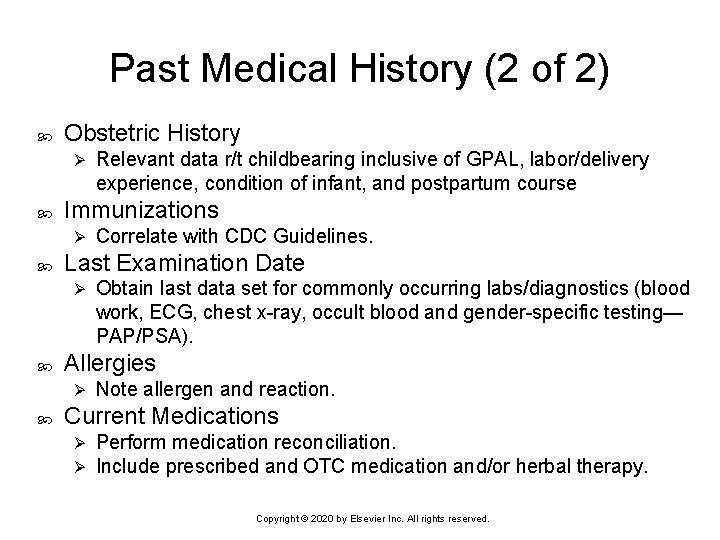
Past Medical History (2 of 2) Obstetric History Ø Immunizations Ø Obtain last data set for commonly occurring labs/diagnostics (blood work, ECG, chest x-ray, occult blood and gender-specific testing— PAP/PSA). Allergies Ø Correlate with CDC Guidelines. Last Examination Date Ø Relevant data r/t childbearing inclusive of GPAL, labor/delivery experience, condition of infant, and postpartum course Note allergen and reaction. Current Medications Ø Ø Perform medication reconciliation. Include prescribed and OTC medication and/or herbal therapy. Copyright © 2020 by Elsevier Inc. All rights reserved.
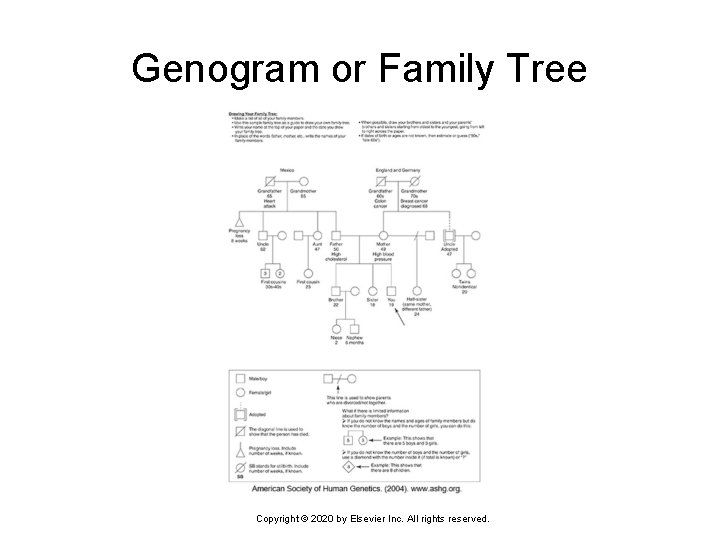
Family History Highlights diseases or conditions that an individual may be at risk for as a result of genetics Provides age and health or cause of death of relatives Ability based on results to seek early screening, make possible lifestyle adjustments, and/or undergo periodic surveillance Pedigree or genogram used as standardized tool to organize data Copyright © 2020 by Elsevier Inc. All rights reserved.
Genogram or Family Tree Copyright © 2020 by Elsevier Inc. All rights reserved.
Cross-Cultural Care Implications Additional questions for new immigrants Biographic data Ø Spiritual resource and religion: assess if certain procedures cannot be done Ø Past health: what immunizations, if any Ø Health perception Ø • How does person describe health and illness? • How does person see problems he or she is now experiencing? Ø Nutrition: taboo foods or food combinations Copyright © 2020 by Elsevier Inc. All rights reserved.
Review of Systems (ROS) (1 of 2) Purpose of ROS Evaluate past and present state of each body system Ø Assess that all pertinent data relative to each body system have been noted Ø Evaluate health promotion practices Ø Cephalocaudal approach Ø Organized manner proceeding in a logical sequence Items within different systems may not be inclusive Ø If information obtained in HPI, then it doesn’t have to be re-assessed again. Copyright © 2020 by Elsevier Inc. All rights reserved.
Review of Systems (ROS) (2 of 2) Use language to facilitate communication. Translate medical terms. Ø Avoid writing negative for body systems as you want to record either presence of absence of symptoms. Ø Do not include objective data. Ø Limit to patient statements or subjective data. Include all relevant body systems. Include pertinent document relevant to the individual patient. Ø Focus on health promotion for each identified area. Ø Copyright © 2020 by Elsevier Inc. All rights reserved.
Systems Approach (1 of 3) General overall health state Skin and hair Head Eyes and ears Ø Nose and sinuses Ø Mouth and throat Ø Neck Ø Breast and axilla Ø Copyright © 2020 by Elsevier Inc. All rights reserved.
Systems Approach (2 of 3) Focus on body systems looking at specific indicators and focusing on health promotion Respiratory Ø Cardiovascular Ø Peripheral vascular Ø Gastrointestinal Ø Urinary Ø Musculoskeletal Ø Neurologic Ø Hematologic Ø Endocrine Ø Copyright © 2020 by Elsevier Inc. All rights reserved.
Systems Approach (3 of 3) Focus on systems specific to gender looking at specific indicators and focusing on health promotion Male genital Ø Female genital Ø Sexual health Ø Copyright © 2020 by Elsevier Inc. All rights reserved.
Functional Assessment ADLs Ø Objectively measure functional status Ø Self-care activities of daily living as they relate to general health status Monitor and assess for changes over time. Relevant data r/t lifestyle and type of living environment May include “sensitive” topics r/t lifestyle behaviors and as such may require attention to privacy concerns Ø Different types of “screening tools” may provide more objective validation of information with regard to substance and/or alcohol abuse. Ø Copyright © 2020 by Elsevier Inc. All rights reserved.
Functional Assessment: ADLs Self-esteem, self-concept Activity and exercise Sleep and rest Nutrition and elimination Interpersonal relationships and resources Spiritual resources Coping and stress management Personal habits Illicit or street drugs Environment and work hazards Intimate partner violence Occupational health Copyright © 2020 by Elsevier Inc. All rights reserved.
Perception of Health Ask questions such as the following: How do you define health? Ø How do you view your situation now? Ø What are your concerns? Ø What do you think will happen in the future? Ø What are your health goals? Ø What do you expect from us as nurses, physicians, or other health care providers? Ø Copyright © 2020 by Elsevier Inc. All rights reserved.
Developmental Competence Child Addresses sections identified previously with regard to health history of the adult Health history adapted to include information: Ø Specific for age and developmental stage of child • Pregnancy, labor and delivery, and perinatal period Ø Nutritional data • As it relates to growth and development Ø Parenting • Family role relationships • Dependent on age of child, information may be obtained from parent or caregiver Copyright © 2020 by Elsevier Inc. All rights reserved.
Past Health History: Child (1 of 4) Each of the identified areas can have residual impact on present (as well as future) health status. Obtain information within the context of developmental age. Communicating with at least “two” patients (parent and child) to obtain information Will provide cues as to how patient’s and child copes in response to illness and/or health concerns Copyright © 2020 by Elsevier Inc. All rights reserved. 28
Past Health History: Child (2 of 4) Prenatal, perinatal, and postnatal status Ø Childhood illnesses Ø Listing of age, types, and potential complications Serious Accidents or injuries Ø Obtain all pertinent data relative to childbirth experience Age of occurrence, types of injury, treatment, and/or possible complications Serious or chronic illnesses Ø Age of onset, types of diseases, treatment, and/or possible complications Copyright © 2020 by Elsevier Inc. All rights reserved.
Past Health History: Child (3 of 4) Operations or Hospitalizations Reason for care, age at admission, length of stay, treatment and/or intervention Ø Hospital facility location, physician/provider, type of surgery, date, reaction to hospitalization Ø Immunizations or Allergies CDC recommendations per established guidelines according to age Ø Indicate allergen and response Ø Obtain information to discriminate between food allergy and food intolerance. Ø Medications Ø Ø Ø Include information about prescribed, OTC, and/or herbal therapy Obtain information r/t vitamin supplements Dosage, schedule, and clinical indication Copyright © 2020 by Elsevier Inc. All rights reserved.
Past Health History: Child (4 of 4) Developmental History Ø Ø Ø Growth and developmental milestones Document activity response to established milestones. Continue to assess and reassess growth and developmental achievements across life cycle. Nutritional History Information collected will vary with age of child. Calorie and nutrient composition for infants with attention to breast or bottle-feeding as source Ø Introduction of solid food pattern and continued assessment of caloric and food intake throughout childhood Ø Ø Family History Ø Obtain pertinent information through interview conversation and genogram. Copyright © 2020 by Elsevier Inc. All rights reserved.
Review of Systems: Child Same method of inquiry used with the adult patient can now be used with the child. Use an organized approach. Ø Include at least “two” individuals—parent and/or child. Ø Differences focus on cognitive and developmental age appropriate behaviors General overall health state Ø Focus on specific body systems looking at specific indicators and health promotion. Ø Focus on systems specific to gender looking at specific indicators and focusing on health promotion. Ø Copyright © 2020 by Elsevier Inc. All rights reserved.
Functional Assessment: Child Consideration of child’s position in family unit Focus on ADLs and how they relate to the child and family unit. Interpersonal relationships Ø Activity and rest Ø Economic status Ø Home environment Ø Environmental hazards Ø Coping and stress management Ø Habits Ø Health promotion Ø Copyright © 2020 by Elsevier Inc. All rights reserved.
Adolescent: HEEADSSS Method of interviewing focuses on assessment of: Home environment Ø Education and employment Ø Eating Ø Activities (peer related) Ø Drugs Ø Sexuality Ø Suicide and depression Ø Safety from injury and violence Ø Copyright © 2020 by Elsevier Inc. All rights reserved.