
Chapter 4 The Bill of Rights 1 st
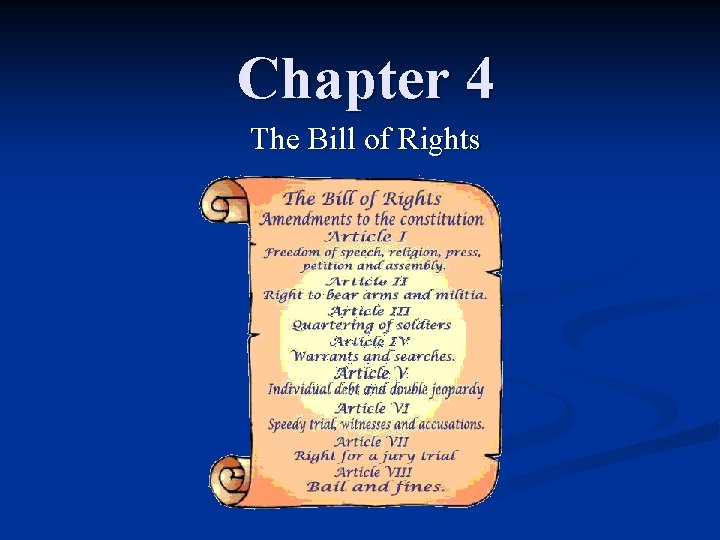
Chapter 4 The Bill of Rights
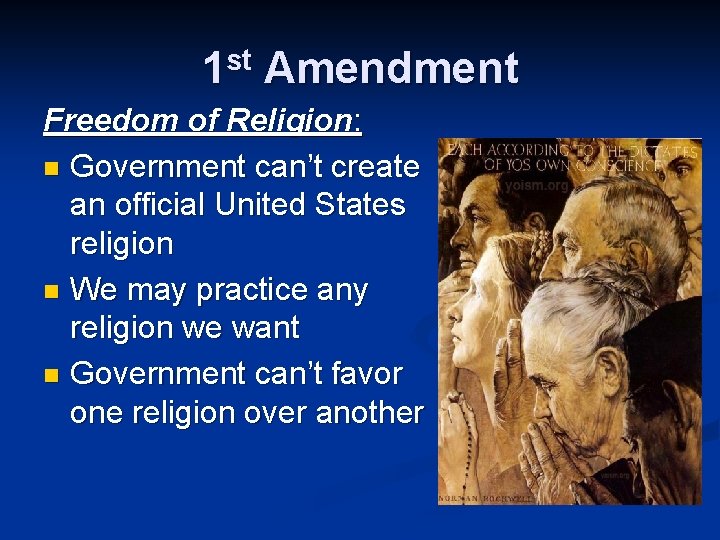
1 st Amendment Freedom of Religion: n Government can’t create an official United States religion n We may practice any religion we want n Government can’t favor one religion over another
1 st Amendment Limitations to the freedom of religion: n May not break other laws while claiming to practice your religion n You may not discriminate against others while practicing your religion
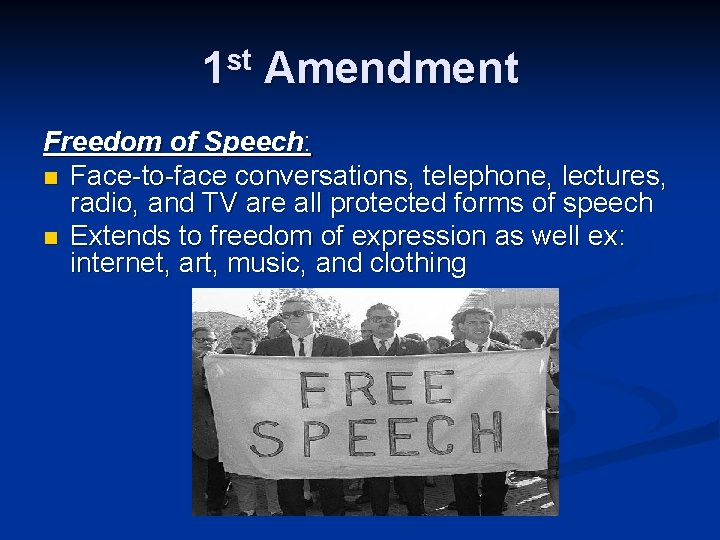
1 st Amendment Freedom of Speech: n Face-to-face conversations, telephone, lectures, radio, and TV are all protected forms of speech n Extends to freedom of expression as well ex: internet, art, music, and clothing
1 st Amendment Limitations to freedom of speech: n Can’t endanger others or the government with your speech n May not provoke riots or crimes or encourage others to commit crimes or overthrow the government n May not tell lies that harm other peoples reputations (slander)
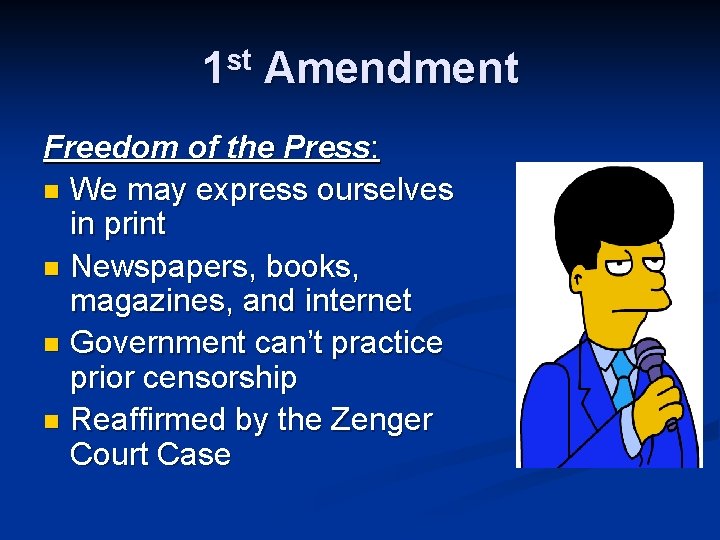
1 st Amendment Freedom of the Press: n We may express ourselves in print n Newspapers, books, magazines, and internet n Government can’t practice prior censorship n Reaffirmed by the Zenger Court Case
1 st Amendment Limitations to freedom of press: n May not print lies (libel) n May not endanger troops with news reports
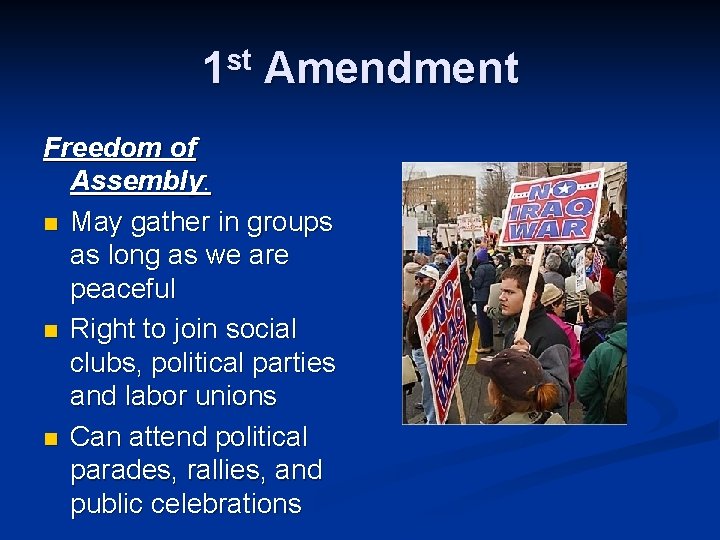
1 st Amendment Freedom of Assembly: n May gather in groups as long as we are peaceful n Right to join social clubs, political parties and labor unions n Can attend political parades, rallies, and public celebrations
1 st Amendment Limitations to the right to Assembly: n Government can make rules about when and where an event can take place to ensure public safety n The group may not break other laws when they meet n Freedom to Petition the Government
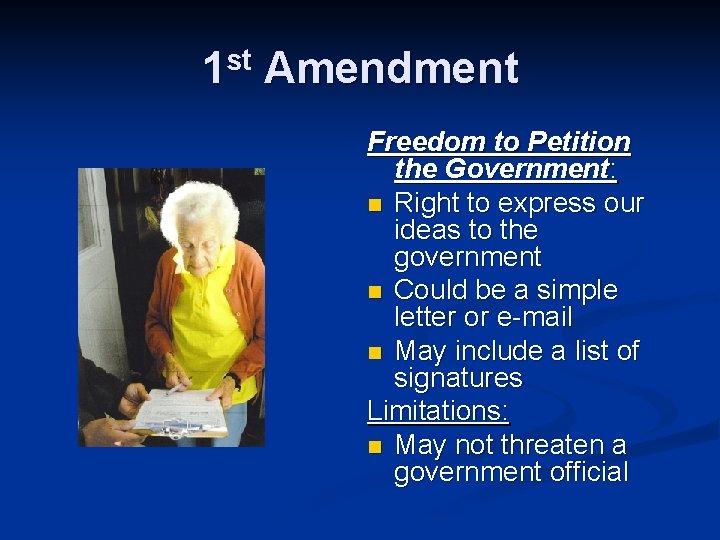
1 st Amendment Freedom to Petition the Government: n Right to express our ideas to the government n Could be a simple letter or e-mail n May include a list of signatures Limitations: n May not threaten a government official
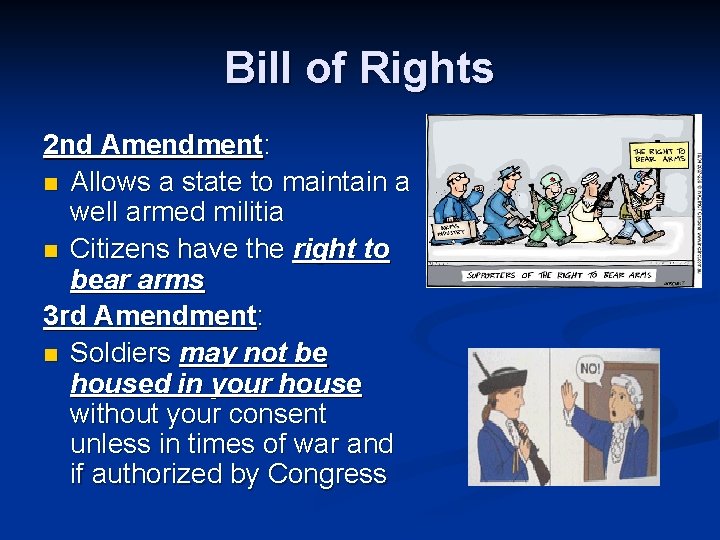
Bill of Rights 2 nd Amendment: n Allows a state to maintain a well armed militia n Citizens have the right to bear arms 3 rd Amendment: n Soldiers may not be housed in your house without your consent unless in times of war and if authorized by Congress
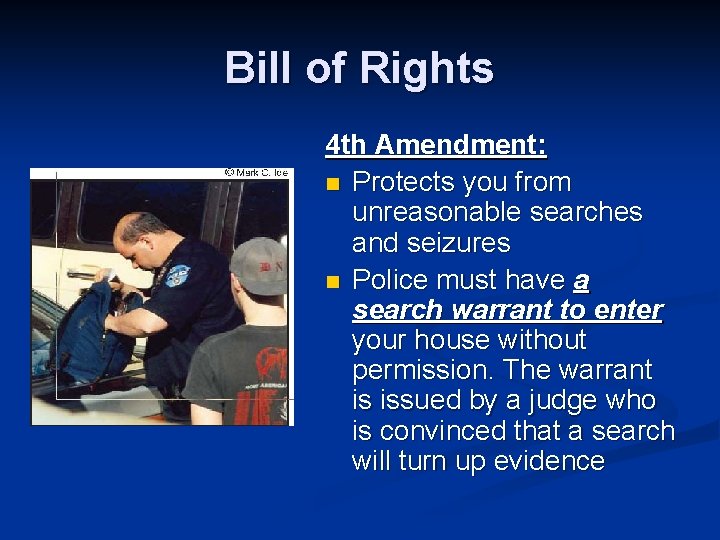
Bill of Rights 4 th Amendment: n Protects you from unreasonable searches and seizures n Police must have a search warrant to enter your house without permission. The warrant is issued by a judge who is convinced that a search will turn up evidence
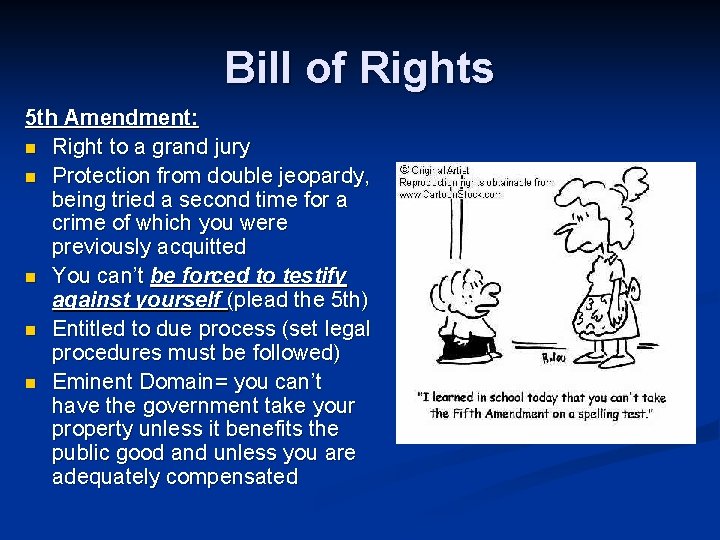
Bill of Rights 5 th Amendment: n Right to a grand jury n Protection from double jeopardy, being tried a second time for a crime of which you were previously acquitted n You can’t be forced to testify against yourself (plead the 5 th) n Entitled to due process (set legal procedures must be followed) n Eminent Domain= you can’t have the government take your property unless it benefits the public good and unless you are adequately compensated
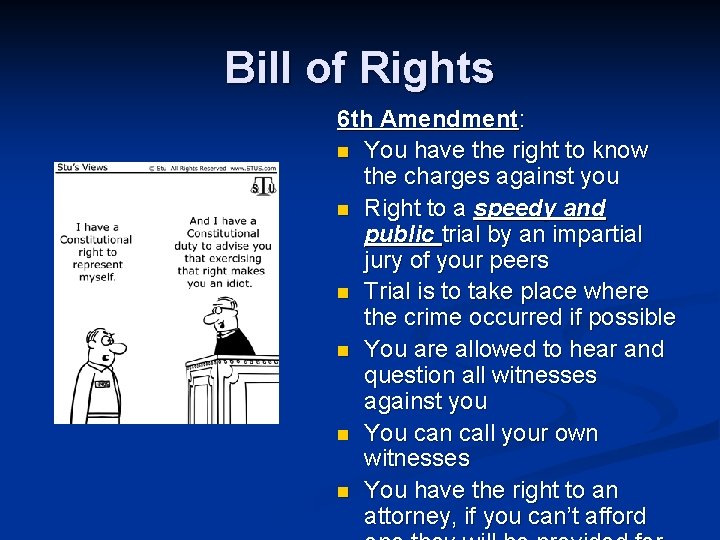
Bill of Rights 6 th Amendment: n You have the right to know the charges against you n Right to a speedy and public trial by an impartial jury of your peers n Trial is to take place where the crime occurred if possible n You are allowed to hear and question all witnesses against you n You can call your own witnesses n You have the right to an attorney, if you can’t afford
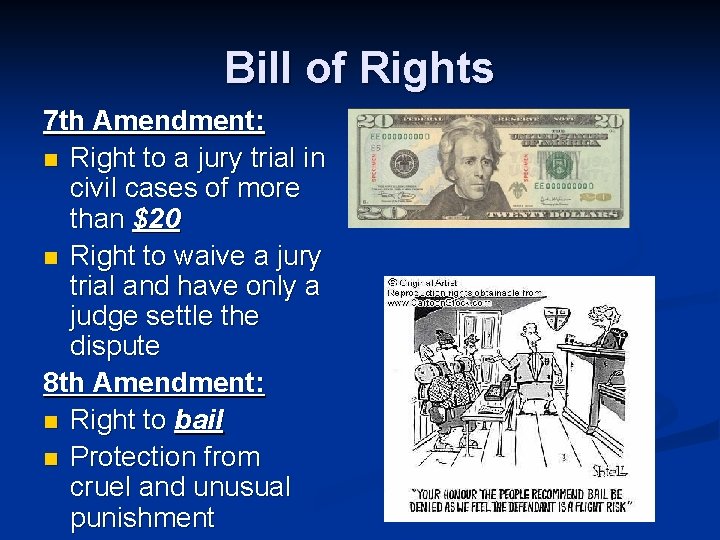
Bill of Rights 7 th Amendment: n Right to a jury trial in civil cases of more than $20 n Right to waive a jury trial and have only a judge settle the dispute 8 th Amendment: n Right to bail n Protection from cruel and unusual punishment
Bill of Rights 9 th Amendment: n You have rights that are not listed ex: pick friends, job, where you live 10 th Amendment: n Any powers not specifically given to the national government, nor prohibited to the states, are reserved for the states
Later Amendments 11 th Amendment: n Places limits on suits against states 12 th Amendment: n Revises procedure for electing President and Vice. President n Originally, 2 nd place vote getter was made the Vice-President n They are now elected on the same ticket with the candidate from their party
Civil War Amendments 13 th Amendment: n Abolished slavery 14 th Amendment: n Defines U. S. citizenship and guarantees all citizens “equal protection of the laws” n Gave all former slaves citizenship in the U. S. A. 15 th Amendment: n Prohibits restrictions on the right to vote based on race n Gave African-American males the right to vote
Later Amendments 16 th Amendment: n Gives Congress the power to collect a income tax 17 th Amendment: n Originally State legislatures picked their state's senators n Now they will be directly elected by the people
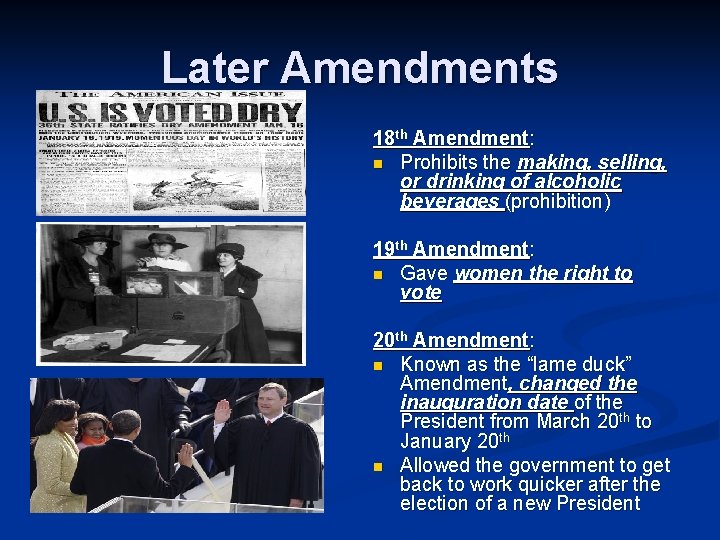
Later Amendments 18 th Amendment: n Prohibits the making, selling, or drinking of alcoholic beverages (prohibition) 19 th Amendment: n Gave women the right to vote 20 th Amendment: n Known as the “lame duck” Amendment, changed the inauguration date of the President from March 20 th to January 20 th n Allowed the government to get back to work quicker after the election of a new President
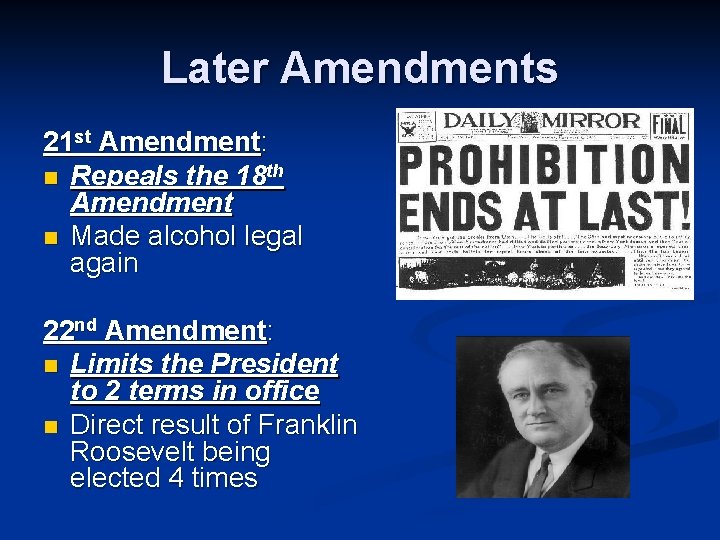
Later Amendments 21 st Amendment: n Repeals the 18 th Amendment n Made alcohol legal again 22 nd Amendment: n Limits the President to 2 terms in office n Direct result of Franklin Roosevelt being elected 4 times
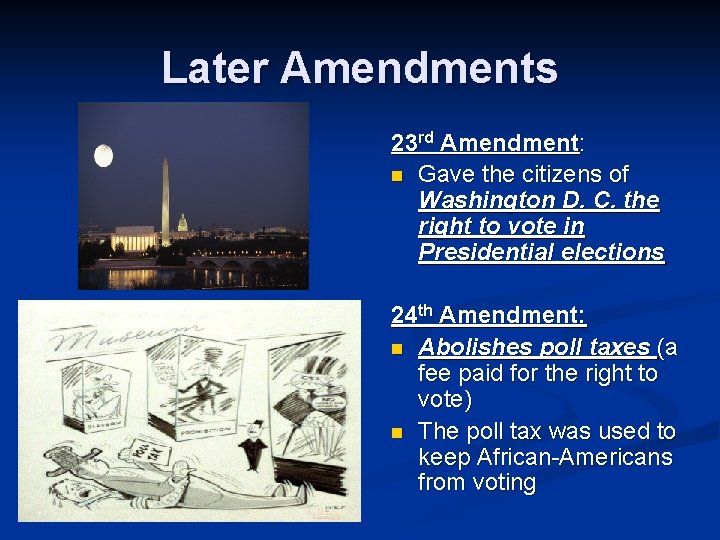
Later Amendments 23 rd Amendment: n Gave the citizens of Washington D. C. the right to vote in Presidential elections 24 th Amendment: n Abolishes poll taxes (a fee paid for the right to vote) n The poll tax was used to keep African-Americans from voting
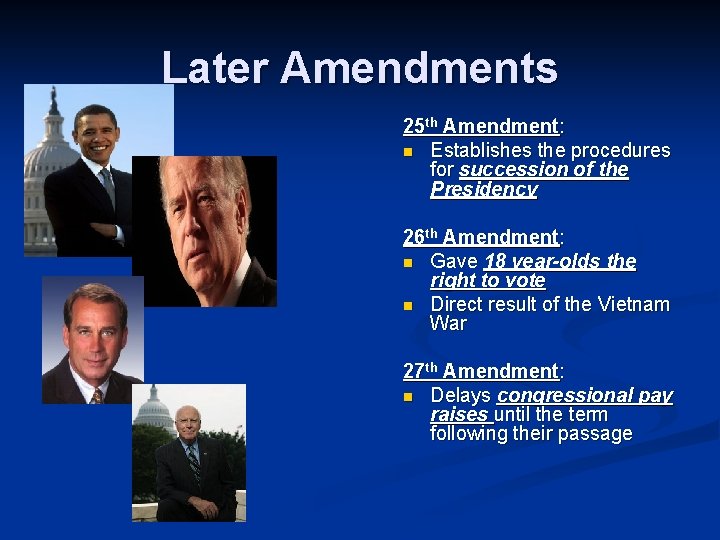
Later Amendments 25 th Amendment: n Establishes the procedures for succession of the Presidency 26 th Amendment: n Gave 18 year-olds the right to vote n Direct result of the Vietnam War 27 th Amendment: n Delays congressional pay raises until the term following their passage
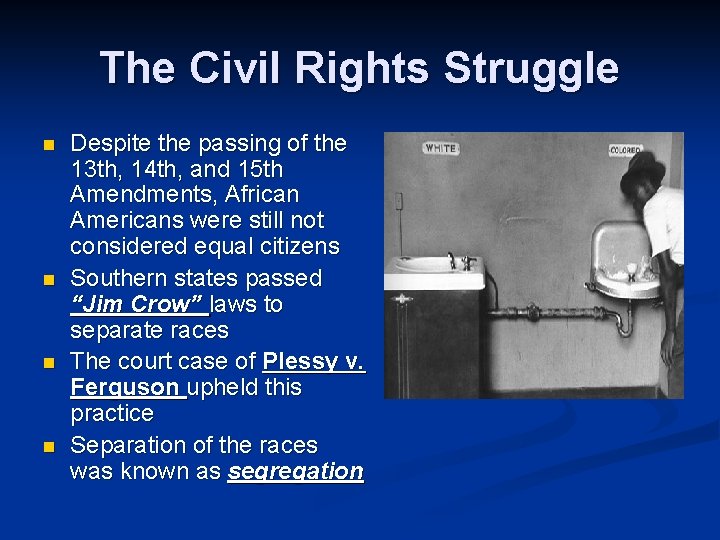
The Civil Rights Struggle n n Despite the passing of the 13 th, 14 th, and 15 th Amendments, African Americans were still not considered equal citizens Southern states passed “Jim Crow” laws to separate races The court case of Plessy v. Ferguson upheld this practice Separation of the races was known as segregation
The Civil Rights Struggle n n To fight this, the National Association of Colored People (NAACP) was formed in 1909 The NAACP used the courts to fight segregation In 1910 the Urban League was formed to help African Americans get jobs in the cities and improve their lives In 1948, President Truman ordered the end to racial segregation in the military
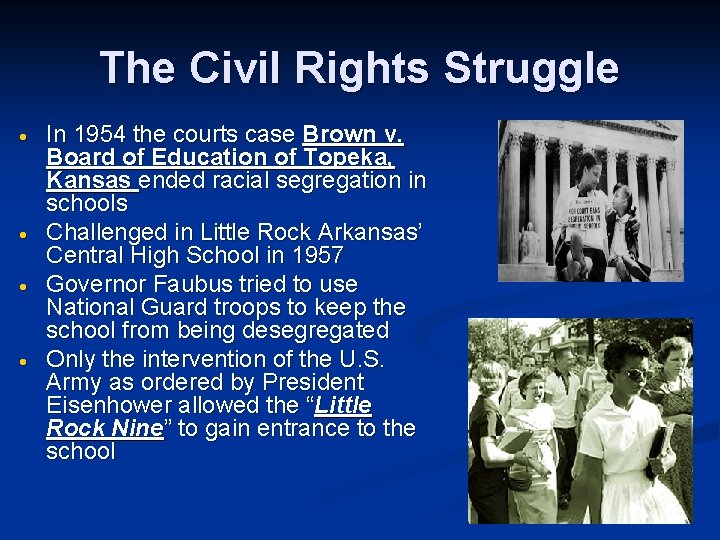
The Civil Rights Struggle In 1954 the courts case Brown v. Board of Education of Topeka, Kansas ended racial segregation in schools Challenged in Little Rock Arkansas’ Central High School in 1957 Governor Faubus tried to use National Guard troops to keep the school from being desegregated Only the intervention of the U. S. Army as ordered by President Eisenhower allowed the “Little Rock Nine” to gain entrance to the school
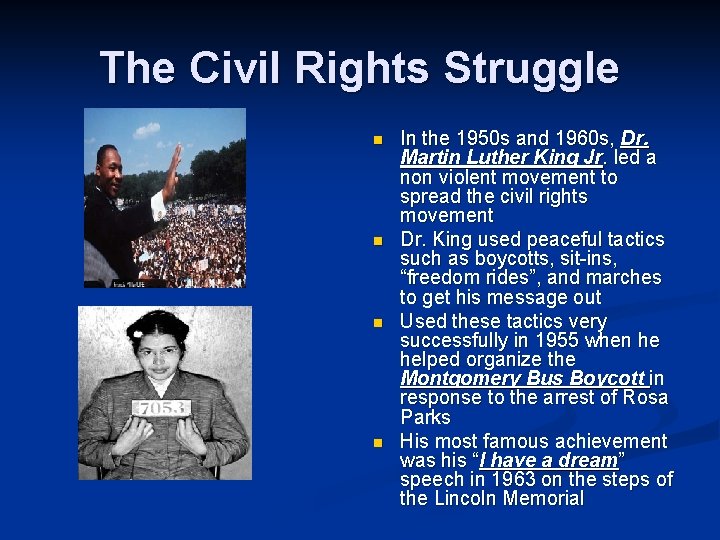
The Civil Rights Struggle n n In the 1950 s and 1960 s, Dr. Martin Luther King Jr. led a non violent movement to spread the civil rights movement Dr. King used peaceful tactics such as boycotts, sit-ins, “freedom rides”, and marches to get his message out Used these tactics very successfully in 1955 when he helped organize the Montgomery Bus Boycott in response to the arrest of Rosa Parks His most famous achievement was his “I have a dream” speech in 1963 on the steps of the Lincoln Memorial
The Civil Rights Struggle His work led to the Civil Rights Act of 1964 which prohibited discrimination in public facilities, employment, education and voter registration n The Voting Rights Act of 1965 took further steps to provide voting rights to all minorities by allowing the federal government to intervene when people are denied the right to register to vote n
Ongoing Challenges In the 1970 s the federal government started affirmative action programs n These programs encouraged the hiring of women and minorities through quota systems n While they were supposed to be a short term answer, they are still in existence today n
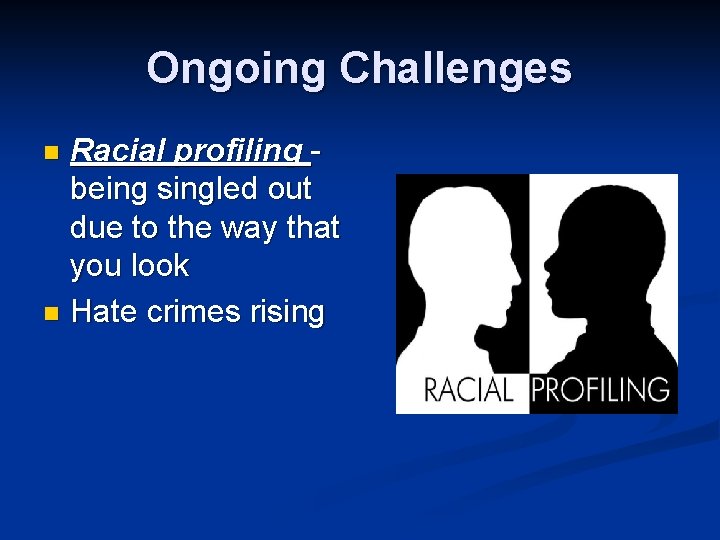
Ongoing Challenges Racial profiling being singled out due to the way that you look n Hate crimes rising n
- Slides: 30