
Chapter 4 The Bill Of Rights 1 Lesson
Chapter 4: The Bill Of Rights 1
Lesson 1: The First Amendment • Objectives: 1. Describe individual and civic responsibilities of citizens of the US. 2. Explain rights of citizens as guaranteed by the Bill of Rights under the Constitution of the US. • Essential Question 1. How do societies balance individual and community rights? 2
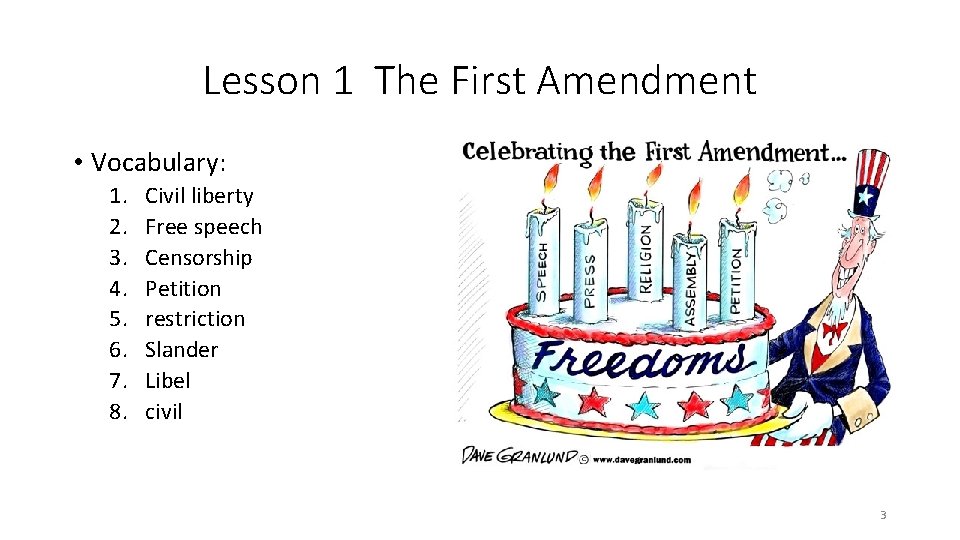
Lesson 1 The First Amendment • Vocabulary: 1. 2. 3. 4. 5. 6. 7. 8. Civil liberty Free speech Censorship Petition restriction Slander Libel civil 3
Lesson 1 The First Amendment • Link: Video—Introduction to the Bill of Rights • C: UserseapplinDownloadsThe. Billof. Rights. mp 4 4
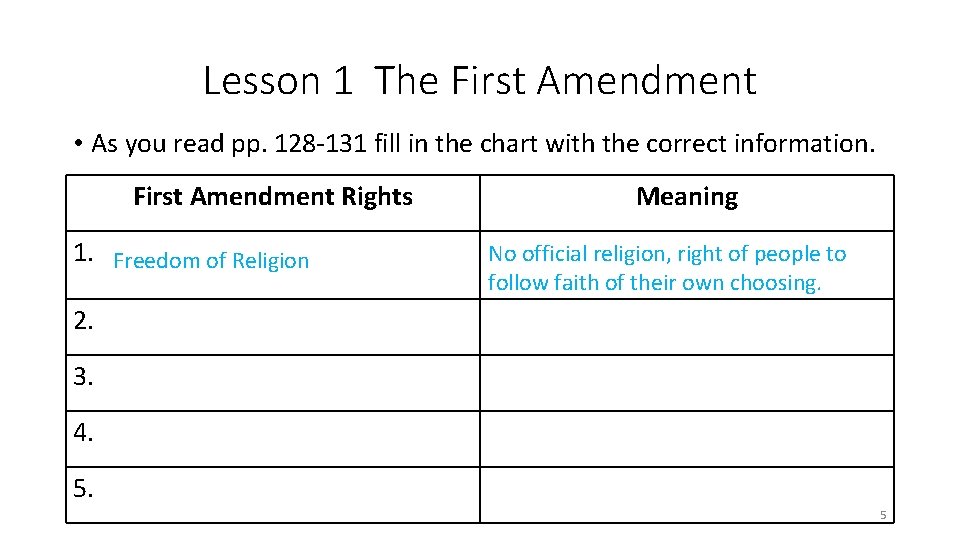
Lesson 1 The First Amendment • As you read pp. 128 -131 fill in the chart with the correct information. First Amendment Rights 1. Freedom of Religion Meaning No official religion, right of people to follow faith of their own choosing. 2. 3. 4. 5. 5
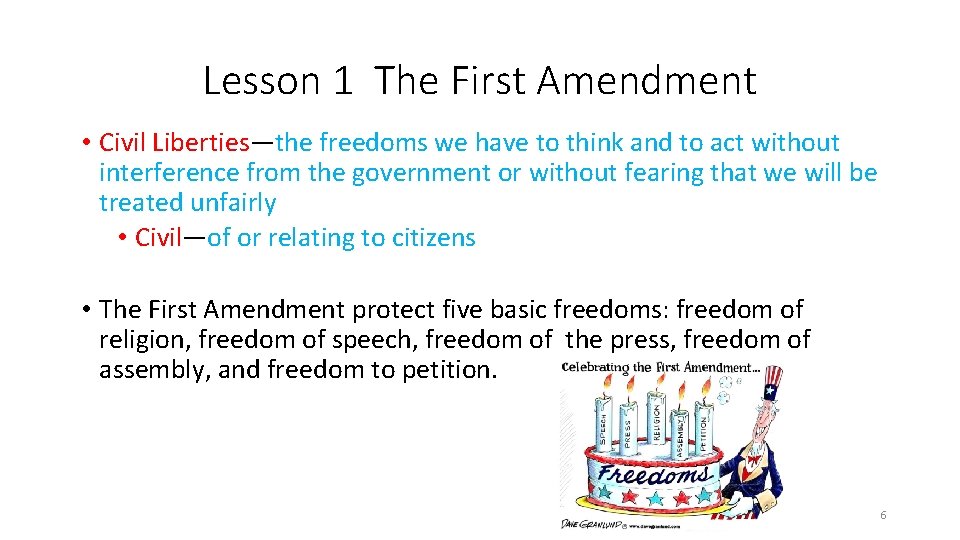
Lesson 1 The First Amendment • Civil Liberties—the freedoms we have to think and to act without interference from the government or without fearing that we will be treated unfairly • Civil—of or relating to citizens • The First Amendment protect five basic freedoms: freedom of religion, freedom of speech, freedom of the press, freedom of assembly, and freedom to petition. 6
Lesson 1 The First Amendment • Free speech: the right to say our opinions in public or in private, without fear of being stopped or punished by the govt. for those ideas. • Censorship: Banning printed materials or films because they have alarming or offensive ideas • Petition: a formal request for the govt. to act. 7

Lesson 1 The First Amendment • Limits on Civil Liberty: • Citizens must use civil liberties responsibly—should not interfere with rights of others • Govt. has right the power to set limits • Restrictions: limits placed of something • Slander: spoken untruths that are harmful to someone’s reputation • Libel: written untruths that are harmful to someone’s reputation • People can not make speeches that will lead to efforts to overthrow the govt. by force 8
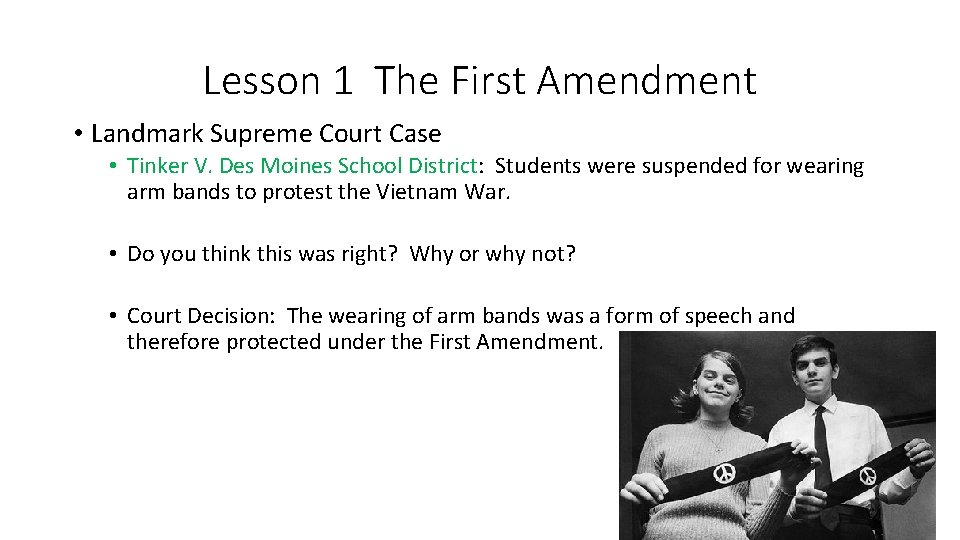
Lesson 1 The First Amendment • Landmark Supreme Court Case • Tinker V. Des Moines School District: Students were suspended for wearing arm bands to protest the Vietnam War. • Do you think this was right? Why or why not? • Court Decision: The wearing of arm bands was a form of speech and therefore protected under the First Amendment. 9
Lesson 1 The First Amendment • Exit Slip: • Why do you think the First Amendment is necessary for a democracy? 10

11

Lesson 2: Other Bill of Rights Protections • Objectives: 1. Describe individual and civic responsibilities of citizens of the US. 2. Explain rights of citizens as guaranteed by the Bill of Rights under the Constitution of the US. • Essential Question: • How do societies balance individual and community rights? 12
Lesson 2: Other Bill of Rights Protections • Vocabulary: 1. Accused 2. Probable cause 3. Search warrant 4. Indictment 5. Double jeopardy 6. Self-incrimination 7. Due process 8. Eminent domain 9. Bail 10. License 11. retain 13
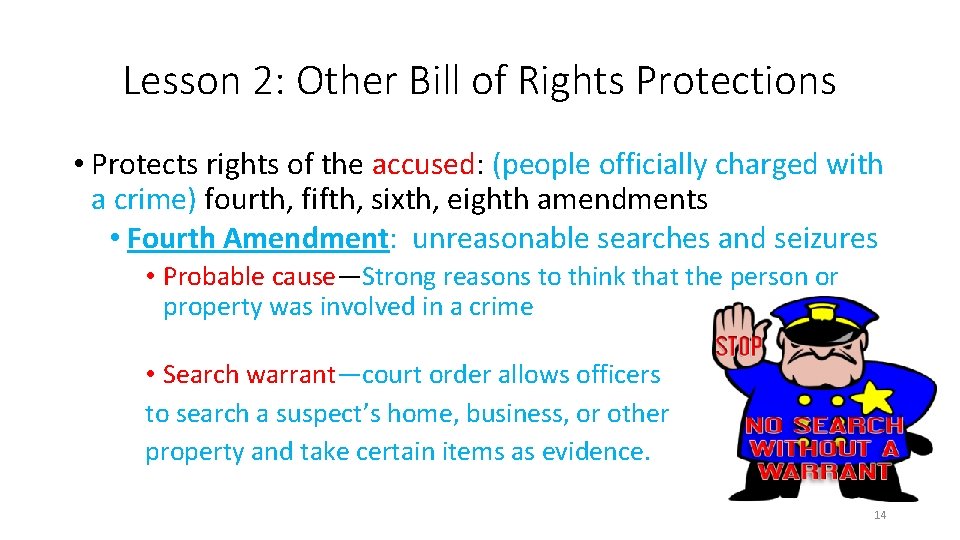
Lesson 2: Other Bill of Rights Protections • Protects rights of the accused: (people officially charged with a crime) fourth, fifth, sixth, eighth amendments • Fourth Amendment: unreasonable searches and seizures • Probable cause—Strong reasons to think that the person or property was involved in a crime • Search warrant—court order allows officers to search a suspect’s home, business, or other property and take certain items as evidence. 14
Lesson 2: Other Bill of Rights Protections • Fifth Amendment • No one can be tried for a serious crime without an indictment (document issued by a body called a grand jury that formally charges someone with a crime. ) • No one can be put on trial more than one time for the same crime. • Double Jeopardy—putting someone on trial for a crime of which he or she was previously found innocent • Protects an accused person’s right to remain silent. • Self-incrimination—giving evidence abut yourself that could lead to you being found guilty of a crime. • Due process—following established legal procedures • Eminent domain--the right of the govt. to take private property, usually land, for public use but must pay a fair price. 15

Lesson 2: Other Bill of Rights Protections • Sixth Amendment • Requires that the persons be told what the charges against them are. • Trial by jury. (speedy and held in public) • Accused has the right to hear and question all witnesses against him/her. • Must be allowed to call witnesses in defense • Has the right to a lawyer. 16
Lesson 2: Other Bill of Rights Protections • Eighth Amendment • Accused may have the choice to remain free until trial by paying a bail (a sum of money used as a security deposit and promises to appear at trial. ) • Judge decides bail but amendment forbids excessive bail • When found guilty of a crime the amendment protect him/her form punishment that is too harsh or fines to high. • Forbids cruel and unusual punishments. 17
Lesson 2: Other Bill of Rights Protections • Additional Protections: • Second Amendment: • Militia • Right to keep and bear Arms. • Govt. can pass laws to control gun ownership • License: document granting the holder permission to do something • Third Amendment • Bans practice of sheltering soldiers in peacetime. 18
Lesson 2: Other Bill of Rights Protections • Seventh Amendment • Civil cases (lawsuits when people’s rights are in conflict) • Right to a jury trial • Disputes over property worth more than $20. • Sets roles for judges and juries • Judges solves issues of law and whether evidence is allowed. • Jury listens to evidence and considers the facts presented in order to reach a verdict 19
Lesson 2: Other Bill of Rights Protections • Ninth Amendment • Citizens have rights beyond those listed in the Constitution and they may not be taken away • Retain– to keep • Tenth Amendment • Recognizes the power of the Federal Govt. is limited • Any power not specifically given to Fed. Govt. belong to the state or the people. 20
The Bill Of Rights • Video link: Future Fright • . . Future_Fright__Losing_the_Bill_of_Rights. mp 4 21

22
Lesson 3: Furthering Civil Liberties • Objectives: • 1. Explain the importance of juvenile, adult, civil, and criminal laws within the judicial system of the United States. • 2. Explain the rights of citizens as guaranteed by the Bill of Rights under the Constitution of the US. • Compare changes in social and economic conditions in the US during the twentieth and twenty-first centuries. • Essential Question: • How do societies balance individual and community rights? 23
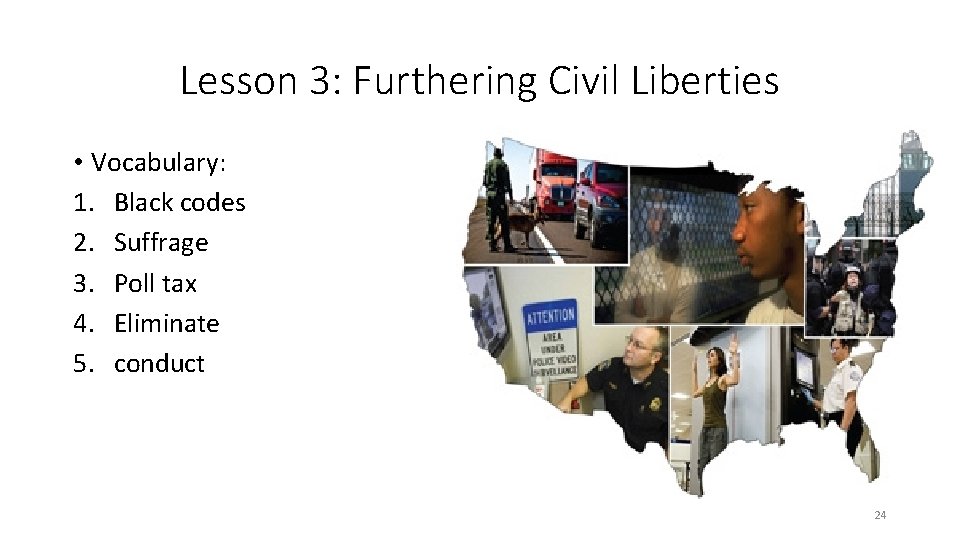
Lesson 3: Furthering Civil Liberties • Vocabulary: 1. Black codes 2. Suffrage 3. Poll tax 4. Eliminate 5. conduct 24
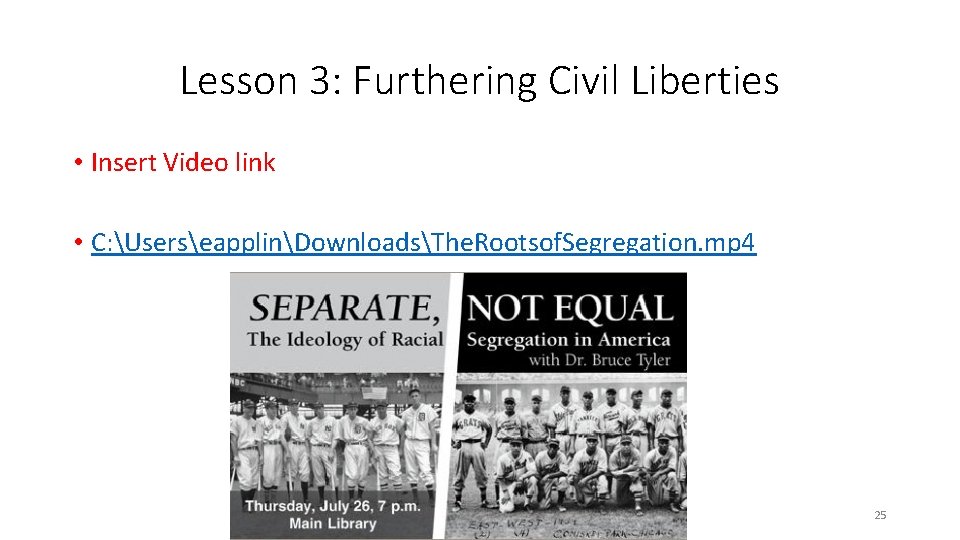
Lesson 3: Furthering Civil Liberties • Insert Video link • C: UserseapplinDownloadsThe. Rootsof. Segregation. mp 4 25
Lesson 3: Furthering Civil Liberties • Civil War Amendments • End of was slavery was eliminated, taken away. • Three amendments were passed to help African Americans. • Thirteenth Amendment—Outlawed slavery • Black codes—laws that kept African Am. from holding certain job, gave them few property rights, and limited their rights in other ways. • Fourteenth Amendment—defines US citizenship; guarantees all citizens “equal protection of the laws” • Fifteenth Amendment—guarantee suffrage, the right to vote, for African Americans 26
Lesson 3: Furthering Civil Liberties • Electoral Process and Voting Rights • Conducted—carried out • Seventeenth Amendment—Allowed voters to elect their senators directly. Gave Americans a greater voice in their govt. • Nineteenth Amendment—Gave women the right to vote in all national and state elections. • Twenty-third Amendment—gave Washington D. C. the right to vote for president and vice-president, with the same number of electoral votes as the smallest state. 27
Lesson 3: Furthering Civil Liberties • Twenty-fourth Amendment—made poll taxes illegal in national elections. • Poll taxes—fee people had to pay to vote. African Americans could not afford the tax so they could not vote. • Twenty-sixth Amendment—Guaranteed the right to vote to citizens 18 years of age and older. 28

29
Lesson 4: The Civil Rights Movement • Objectives: 1. Explain the importance of juvenile, adult, civil, and criminal laws within the judicial system of the United States. 2. Explain the rights of citizens as guaranteed by the Bill of Rights under the Constitution of the US. 3. Identify contemporary American issues since 2001. • Essential Questions: 1. How do societies balance individual and community rights? 2. How does social change influence government? 30
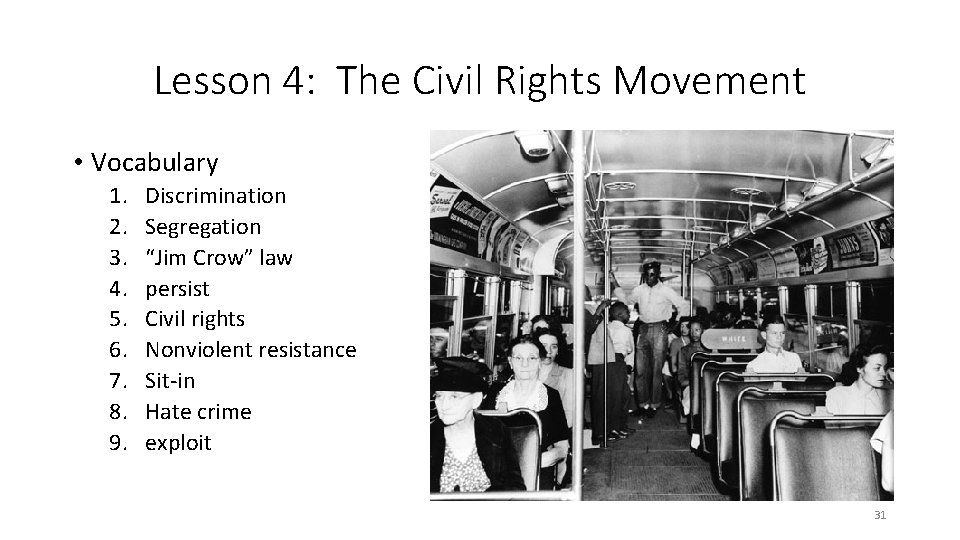
Lesson 4: The Civil Rights Movement • Vocabulary 1. 2. 3. 4. 5. 6. 7. 8. 9. Discrimination Segregation “Jim Crow” law persist Civil rights Nonviolent resistance Sit-in Hate crime exploit 31
Lesson 4: The Civil Rights Movement • Origins of the Civil Rights Movement • • • Discrimination—unfair treatment based on prejudice against a certain group. Segregation—the social separation of the races. “Jim Crow” law—southern segregation laws Persisted—lasted Civil rights—the rights of full citizenship and equality under the law 32
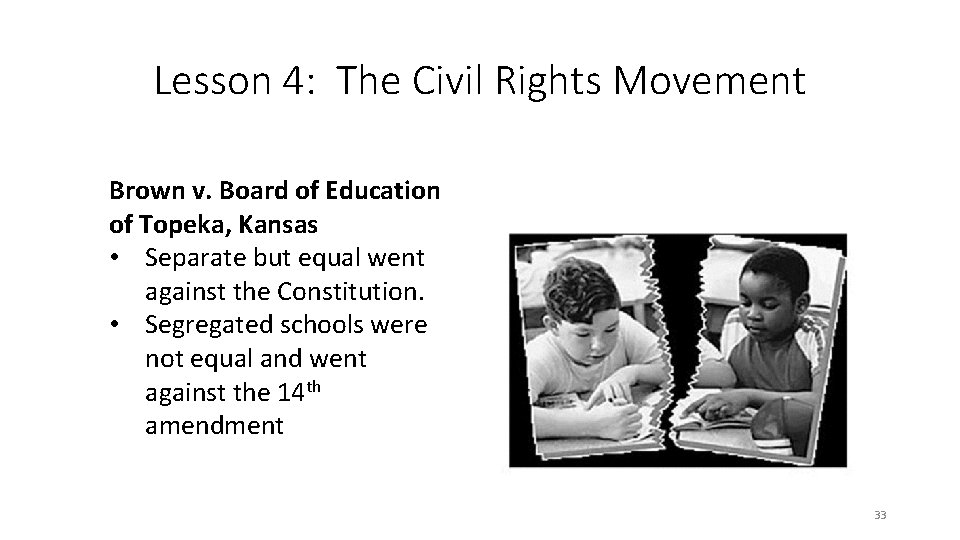
Lesson 4: The Civil Rights Movement Brown v. Board of Education of Topeka, Kansas • Separate but equal went against the Constitution. • Segregated schools were not equal and went against the 14 th amendment 33
Lesson 4: The Civil Rights Movement • Montgomery Buss Boycott • Rosa Parks got on a city bus in Montgomery, Alabama and set in an area set aside for whites. She refused to move and was arrested for breaking the law that segregated city buses. Parks arrest led African Americans in Montgomery to boycott the city’s buses. • Peaceful Protests • Dr. Martin Luther King, Jr. believed in nonviolent resistance– peaceful protest against laws believed to be unfair. • Sit-in—the act of occupying seats or sitting down on the floor of an establishment as a form of organized protest 34
• Video Link • C: UserseapplinDownloadsAlabama. Selmaasa. Centerforthe. Civil. Righ ts. Movement. mp 4 35
- Slides: 35