
Chapter 4 The Appearance of Sri Narada By

Chapter 4 The Appearance of Sri Narada By Amritananda dasa
A humble offering to all the assembled devotees! All Glories to Srila Prabhupada!

SB 1. 2. 4 narayanam namaskrtya naram caiva narottamam devim sarasvatim vyasam tato jayam udirayet Before reciting this Srimad-Bhagavatam, which is the very means of conquest, one should offer respectful obeisances unto the Personality of Godhead, Narayana, unto Nara-Narayana Rsi, the supermost human being, unto mother Sarasvati, the goddess of learning, and unto Srila Vyasadeva, the author.

SB 1. 2. 18 nasta-prayesv abhadresu nityam bhagavata-sevaya bhagavaty uttama-sloke bhaktir bhavati naisthiki By regular attendance in classes on the Bhagavatam and by rendering of service to the pure devotee, all that is troublesome to the heart is almost completely destroyed, and loving service unto the Personality of Godhead, who is praised with transcendental songs, is established as an irrevocable fact.
Ch. 4 Summary Chapter 4 -7 Describes how SB came to be recorded. • 1 -13: Saunaka Inquires from Suta Gosvami • 14 -33: Suta Gosvami Retells Srila Vyasadeva’s Accomplishments in Having Compiled the Vast Vedic Literature
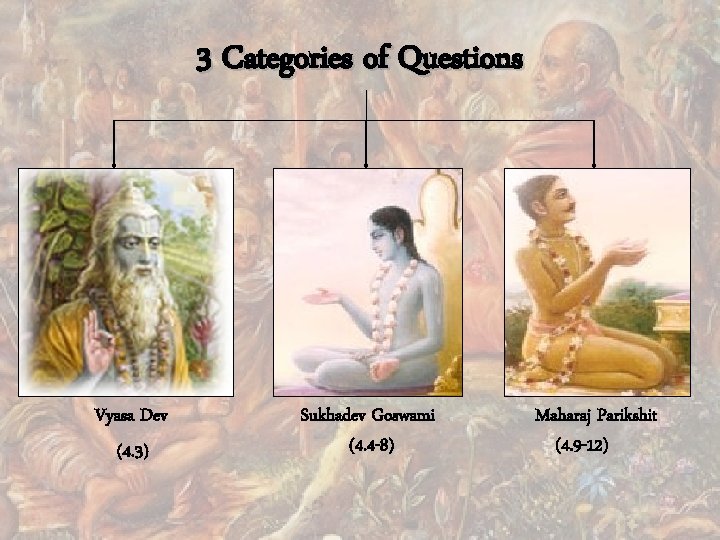
3 Categories of Questions Vyasa Dev (4. 3) Sukhadev Goswami (4. 4 -8) Maharaj Parikshit (4. 9 -12)
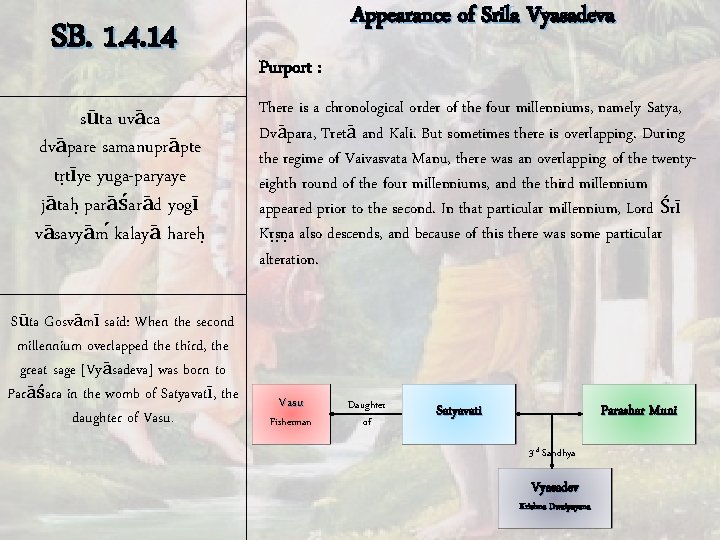
SB. 1. 4. 14 sūta uvāca dvāpare samanuprāpte tr tīye yuga-paryaye jātah parāśarād yogī vāsavyām kalayā hareh Sūta Gosvāmī said: When the second millennium overlapped the third, the great sage [Vyāsadeva] was born to Parāśara in the womb of Satyavatī, the daughter of Vasu. Appearance of Srila Vyasadeva Purport : There is a chronological order of the four millenniums, namely Satya, Dvāpara, Tretā and Kali. But sometimes there is overlapping. During the regime of Vaivasvata Manu, there was an overlapping of the twentyeighth round of the four millenniums, and the third millennium appeared prior to the second. In that particular millennium, Lord Śrī Kr s n a also descends, and because of this there was some particular alteration. Vasu Fisherman Daughter of Satyavati Parashar Muni 3 rd Sandhya Vyasadev Krishna Dwaipayana
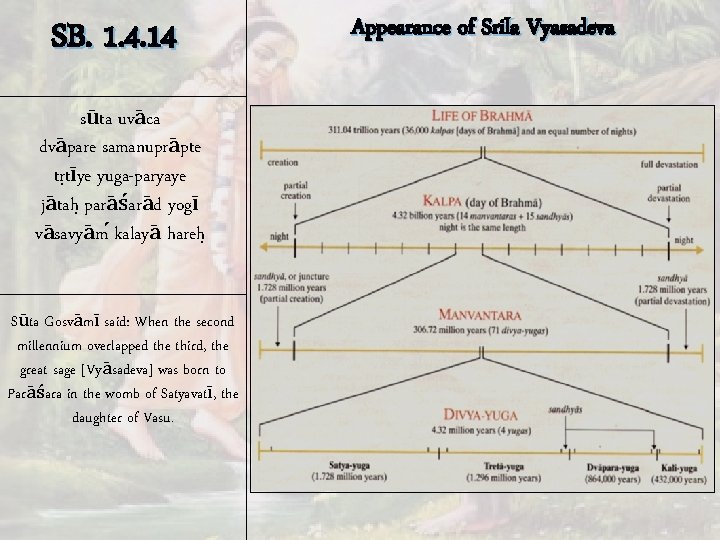
SB. 1. 4. 14 sūta uvāca dvāpare samanuprāpte tr tīye yuga-paryaye jātah parāśarād yogī vāsavyām kalayā hareh Sūta Gosvāmī said: When the second millennium overlapped the third, the great sage [Vyāsadeva] was born to Parāśara in the womb of Satyavatī, the daughter of Vasu. Appearance of Srila Vyasadeva
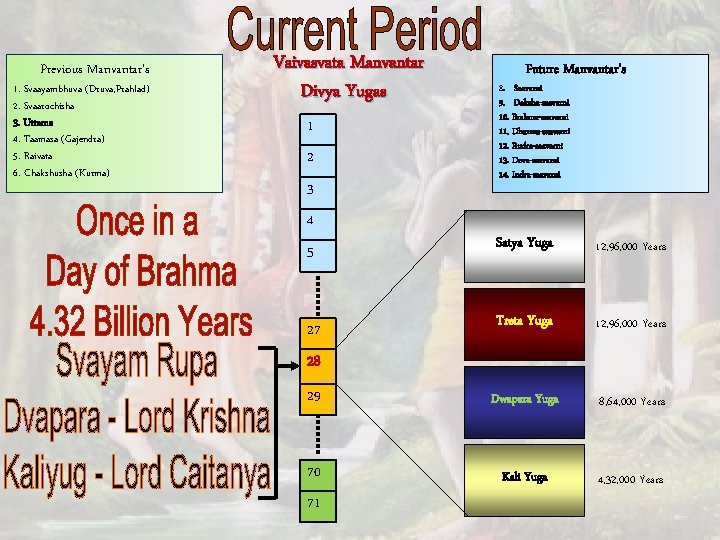
Previous Manvantar’s 1. Svaayambhuva (Druva, Prahlad) 2. Svaarochisha 3. Uttama 4. Taamasa (Gajendra) 5. Raivata 6. Chakshusha (Kurma) Vaivasvata Manvantar Divya Yugas 1 2 3 4 Future Manvantar’s 8. Saavarni 9. Daksha-saavarni 10. Brahma-saavarni 11. Dharma-saavarni 12. Rudra-saavarni 13. Deva-saavarni 14. Indra-saavarni 5 Satya Yuga 12, 96, 000 Years 27 Treta Yuga 12, 96, 000 Years 29 Dwapara Yuga 8, 64, 000 Years 70 Kali Yuga 4, 32, 000 Years 28 71
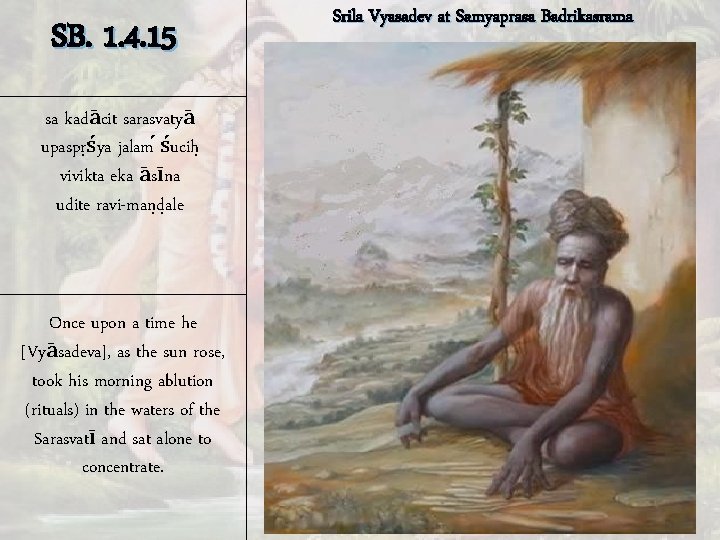
SB. 1. 4. 15 sa kadācit sarasvatyā upaspr śya jalam śucih vivikta eka āsīna udite ravi-man d ale Once upon a time he [Vyāsadeva], as the sun rose, took his morning ablution (rituals) in the waters of the Sarasvatī and sat alone to concentrate. Srila Vyasadev at Samyaprasa Badrikasrama
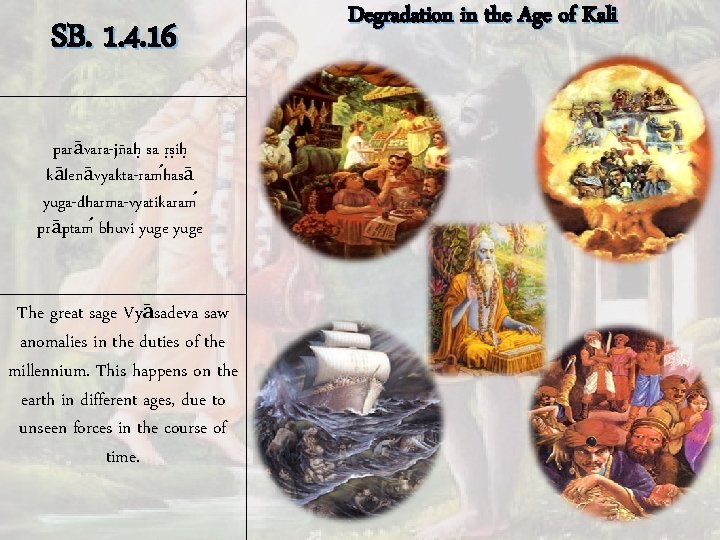
SB. 1. 4. 16 parāvara-jñah sa r s ih kālenāvyakta-ram hasā yuga-dharma-vyatikaram prāptam bhuvi yuge The great sage Vyāsadeva saw anomalies in the duties of the millennium. This happens on the earth in different ages, due to unseen forces in the course of time. Degradation in the Age of Kali
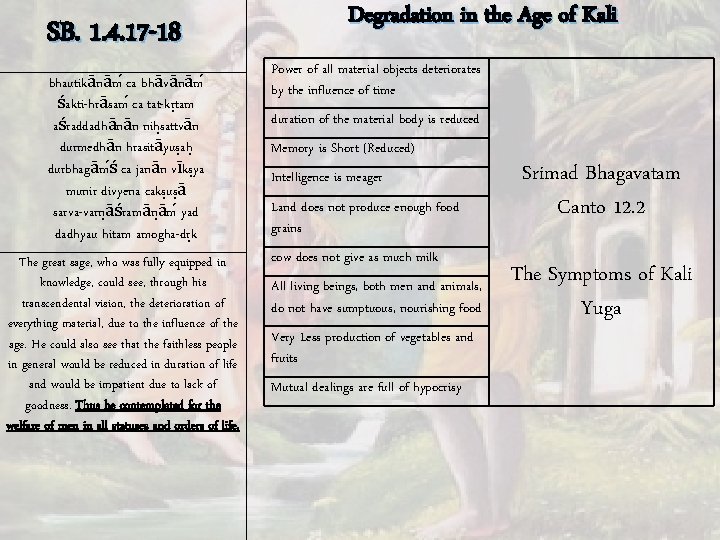
SB. 1. 4. 17 -18 bhautikānām ca bhāvānām śakti-hrāsam ca tat-kr tam aśraddadhānān nih sattvān durmedhān hrasitāyus ah durbhagām ś ca janān vīks ya munir divyena caks us ā sarva-varn āśramān ām yad dadhyau hitam amogha-dr k The great sage, who was fully equipped in knowledge, could see, through his transcendental vision, the deterioration of everything material, due to the influence of the age. He could also see that the faithless people in general would be reduced in duration of life and would be impatient due to lack of goodness. Thus he contemplated for the welfare of men in all statuses and orders of life. Degradation in the Age of Kali Power of all material objects deteriorates by the influence of time duration of the material body is reduced Memory is Short (Reduced) Intelligence is meager Land does not produce enough food grains cow does not give as much milk All living beings, both men and animals, do not have sumptuous, nourishing food Very Less production of vegetables and fruits Mutual dealings are full of hypocrisy Srimad Bhagavatam Canto 12. 2 The Symptoms of Kali Yuga
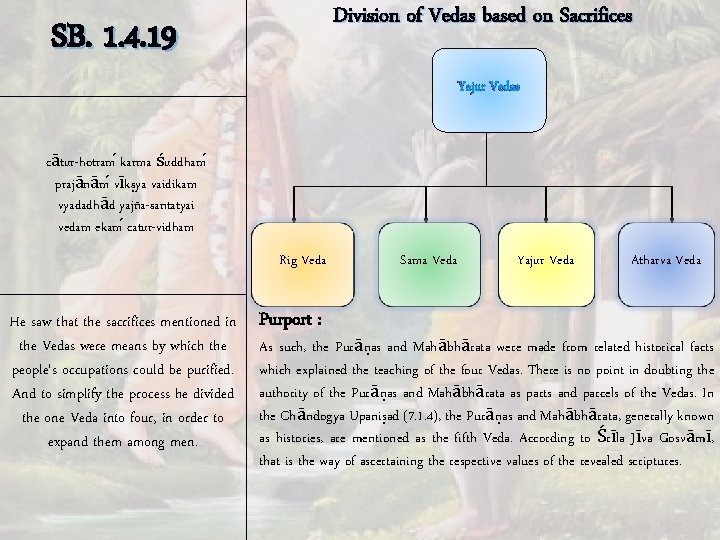
Division of Vedas based on Sacrifices SB. 1. 4. 19 Yajur Vedas cātur-hotram karma śuddham prajānām vīks ya vaidikam vyadadhād yajña-santatyai vedam ekam catur-vidham Rig Veda He saw that the sacrifices mentioned in the Vedas were means by which the people's occupations could be purified. And to simplify the process he divided the one Veda into four, in order to expand them among men. Purport : Sama Veda Yajur Veda Atharva Veda As such, the Purān as and Mahābhārata were made from related historical facts which explained the teaching of the four Vedas. There is no point in doubting the authority of the Purān as and Mahābhārata as parts and parcels of the Vedas. In the Chāndogya Upanis ad (7. 1. 4), the Purān as and Mahābhārata, generally known as histories, are mentioned as the fifth Veda. According to Śrīla Jīva Gosvāmī, that is the way of ascertaining the respective values of the revealed scriptures.

The Fifth Veda - Described SB. 1. 4. 20 Fifth Veda r g-yajuh -sāmātharvākhyā vedāś catvāra uddhr tāh itihāsa-purān am ca pañcamo veda ucyate Puranas The four divisions of the original sources of knowledge [the Vedas] were made separately. But the historical facts and authentic stories mentioned in the Purān as are called the fifth Veda. Romaharsana Suta (Suta Goswami’s Fathers) Itihasas Mahabharata Ramayana
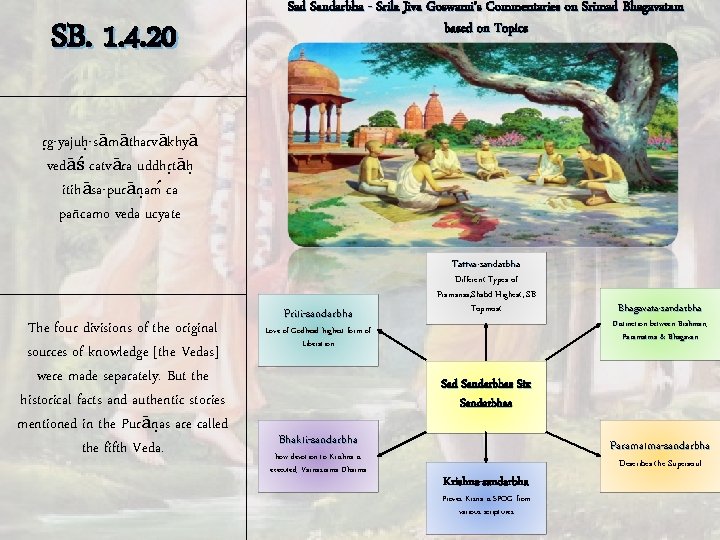
SB. 1. 4. 20 Sad Sandarbha - Srila Jiva Goswami’s Commentaries on Srimad Bhagavatam based on Topics r g-yajuh -sāmātharvākhyā vedāś catvāra uddhr tāh itihāsa-purān am ca pañcamo veda ucyate Tattva-sandarbha The four divisions of the original sources of knowledge [the Vedas] were made separately. But the historical facts and authentic stories mentioned in the Purān as are called the fifth Veda. Priti-sandarbha Different Types of Pramanas, Shabd Highest, SB Topmost Love of Godhead highest form of Liberation Bhagavata-sandarbha Distinction between Brahman, Paramatma & Bhagavan Sad Sandarbhas Six Sandarbhas Bhakti-sandarbha how devotion to Krishna is executed, Varnasrama Dharma Paramatma-sandarbha Describes the Supersoul Krishna-sandarbha Proves Krsna is SPOG from various scriptures

Divisions of Vedas…Contd. SB. 1. 4. 21 Yajur Vedas tatrarg-veda-dharah pailah sāmago jaiminih kavih vaiśampāyana evaiko nis n āto yajus ām uta After the Vedas were divided into four divisions, Paila R s i became the professor of the R g Veda, Jaimini the professor of the Sāma Veda, and Vaiśampāyana alone became glorified by the Yajur Veda. Rig Veda Sama Veda Yajur Veda Paila Rishi Jaimini Rishi Vaisampa-yana Rishi Atharva Veda The original source of knowledge is the Vedas. There are no branches of knowledge, either mundane or transcendental, which do not belong to the original text of the Vedas. They have simply been developed into different branches.

Divisions of Vedas…Contd. SB. 1. 4. 22 Yajur Vedas atharvāńgirasām āsīt sumantur dārun o munih itihāsa-purān ānām pitā me romahars an ah The Sumantu Muni Ańgirā, who was very devotedly engaged, was entrusted with the Atharva Veda. And my father, Romahars an a, was entrusted with the Purān as and historical record Rig Veda Sama Veda Yajur Veda Atharva Veda Paila Rishi Jaimini Rishi Vaisampa-yana Rishi Sumantu Muni Angira
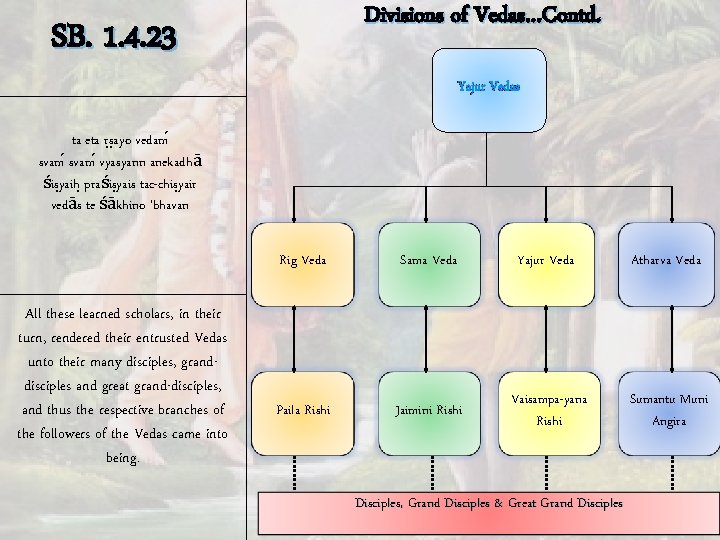
Divisions of Vedas…Contd. SB. 1. 4. 23 Yajur Vedas ta eta r s ayo vedam svam vyasyann anekadhā śis yaih praśis yais tac-chis yair vedās te śākhino 'bhavan All these learned scholars, in their turn, rendered their entrusted Vedas unto their many disciples, granddisciples and great grand-disciples, and thus the respective branches of the followers of the Vedas came into being. Rig Veda Sama Veda Yajur Veda Atharva Veda Paila Rishi Jaimini Rishi Vaisampa-yana Rishi Sumantu Muni Angira Disciples, Grand Disciples & Great Grand Disciples

SB. 1. 4. 24 ta eva vedā durmedhair dhāryante purus air yathā evam cakāra bhagavān vyāsah kr pan a-vatsalah Thus the great sage Vyāsadeva, who is very kind to the ignorant masses, edited the Vedas so they might be assimilated by less intellectual men. Purport : Divisions of Vedas…Contd. The Veda is one, and the reasons for its divisions in many parts are explained herewith. The seed of all knowledge, or the Veda, is not a subject matter which can easily be understood by any ordinary man. There is a stricture that no one should try to learn the Vedas who is not a qualified brāhman a. This stricture has been wrongly interpreted in so many ways. A class of men, who claim brahminical qualification simply by their birthright in the family of a brāhman a, claim that the study of the Vedas is a monopoly of the brāhman a caste only. Another section of the people take this as an injustice to members of other castes, who do not happen to take birth in a brāhman a family. But both of them are misguided. The Vedas are subjects which had to be explained even to Brahmājī by the Supreme Lord. Therefore the subject matter is understood by persons with exceptional qualities of goodness. Persons who are in the modes of passion and ignorance are unable to understand the subject matter of the Vedas. The ultimate goal of Vedic knowledge is Śrī Kr s n a, the Personality of Godhead.
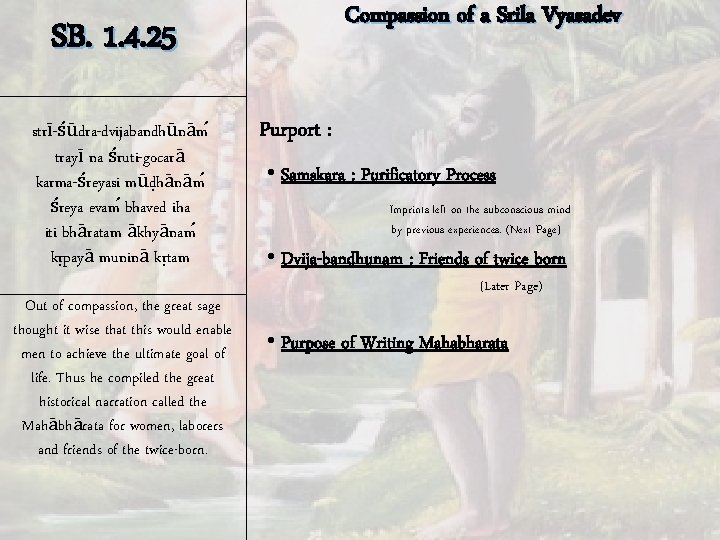
Compassion of a Srila Vyasadev SB. 1. 4. 25 strī-śūdra-dvijabandhūnām trayī na śruti-gocarā karma-śreyasi mūd hānām śreya evam bhaved iha iti bhāratam ākhyānam kr payā muninā kr tam Out of compassion, the great sage thought it wise that this would enable men to achieve the ultimate goal of life. Thus he compiled the great historical narration called the Mahābhārata for women, laborers and friends of the twice-born. Purport : • Samskara : Purificatory Process Imprints left on the subconscious mind by previous experiences. (Next Page) • Dvija-bandhunam : Friends of twice born (Later Page) • Purpose of Writing Mahabharata
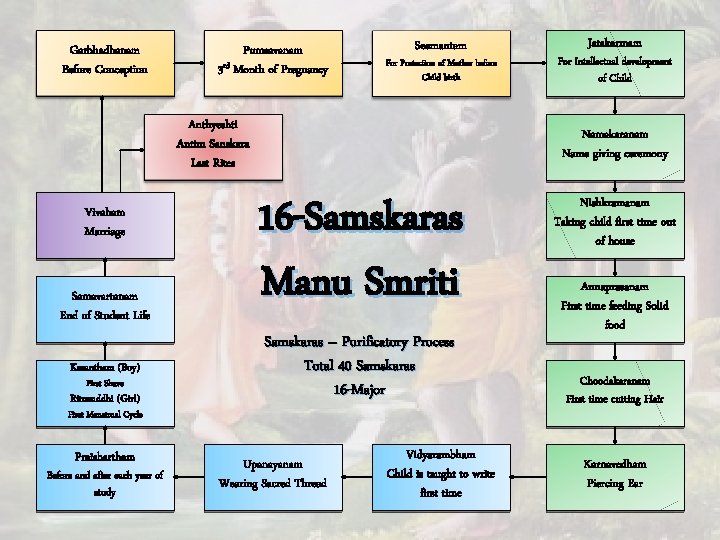
Garbhadhanam Before Conception Pumsavanam rd 3 Month of Pregnancy Seemantam For Protection of Mother before Child birth Anthyeshti Antim Sanskara Last Rites Vivaham Marriage Samavartanam End of Student Life Kesantham (Boy) First Shave Ritusuddhi (Girl) Before and after each year of study For Intellectual development of Child Namakaranam Name giving ceremony 16 -Samskaras Manu Smriti Samskaras – Purificatory Process Total 40 Samskaras 16 -Major First Menstrual Cycle Praishartham Jatakarmam Upanayanam Wearing Sacred Thread Vidyarambham Child is taught to write first time Nishkramanam Taking child first time out of house Annaprasanam First time feeding Solid food Choodakaranam First time cutting Hair Karnavedham Piercing Ear
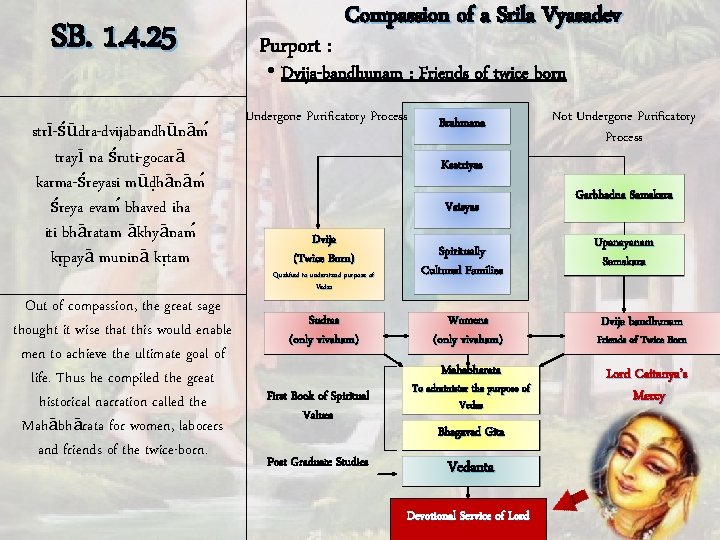
SB. 1. 4. 25 strī-śūdra-dvijabandhūnām trayī na śruti-gocarā karma-śreyasi mūd hānām śreya evam bhaved iha iti bhāratam ākhyānam kr payā muninā kr tam Out of compassion, the great sage thought it wise that this would enable men to achieve the ultimate goal of life. Thus he compiled the great historical narration called the Mahābhārata for women, laborers and friends of the twice-born. Purport : Compassion of a Srila Vyasadev • Dvija-bandhunam : Friends of twice born Undergone Purificatory Process Brahmana Not Undergone Purificatory Process Ksatriyas Vaisyas Dvija (Twice Born) Qualified to understand purpose of Vedas Sudras (only vivaham) Spiritually Cultured Families Womens (only vivaham) Mahabharata First Book of Spiritual Values To administer the purpose of Vedas Post Graduate Studies Vedanta Bhagavad Gita Devotional Service of Lord Garbhadna Samskara Upanayanam Samskara Dvija bandhunam Friends of Twice Born Lord Caitanya’s Mercy
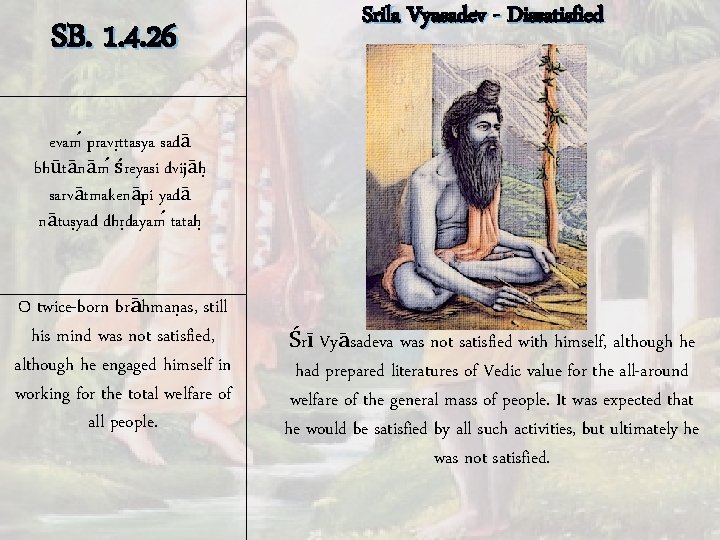
SB. 1. 4. 26 Srila Vyasadev - Dissatisfied evam pravr ttasya sadā bhūtānām śreyasi dvijāh sarvātmakenāpi yadā nātus yad dhr dayam tatah O twice-born brāhman as, still his mind was not satisfied, although he engaged himself in working for the total welfare of all people. Śrī Vyāsadeva was not satisfied with himself, although he had prepared literatures of Vedic value for the all-around welfare of the general mass of people. It was expected that he would be satisfied by all such activities, but ultimately he was not satisfied.
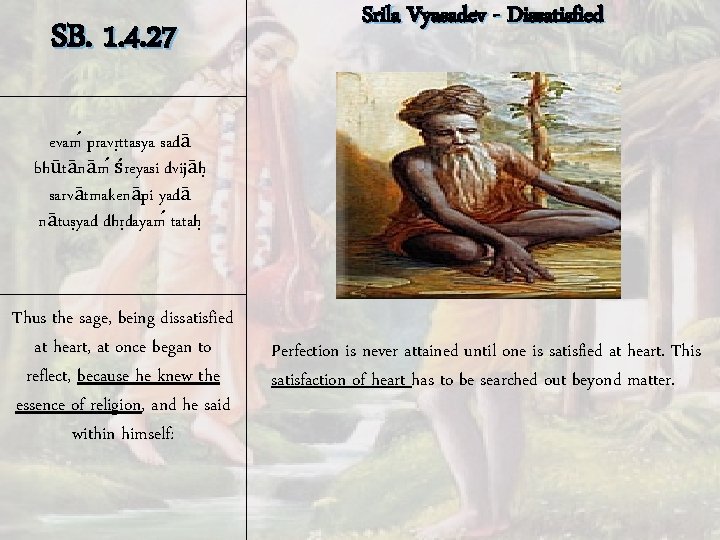
SB. 1. 4. 27 Srila Vyasadev - Dissatisfied evam pravr ttasya sadā bhūtānām śreyasi dvijāh sarvātmakenāpi yadā nātus yad dhr dayam tatah Thus the sage, being dissatisfied at heart, at once began to reflect, because he knew the essence of religion, and he said within himself: Perfection is never attained until one is satisfied at heart. This satisfaction of heart has to be searched out beyond matter.
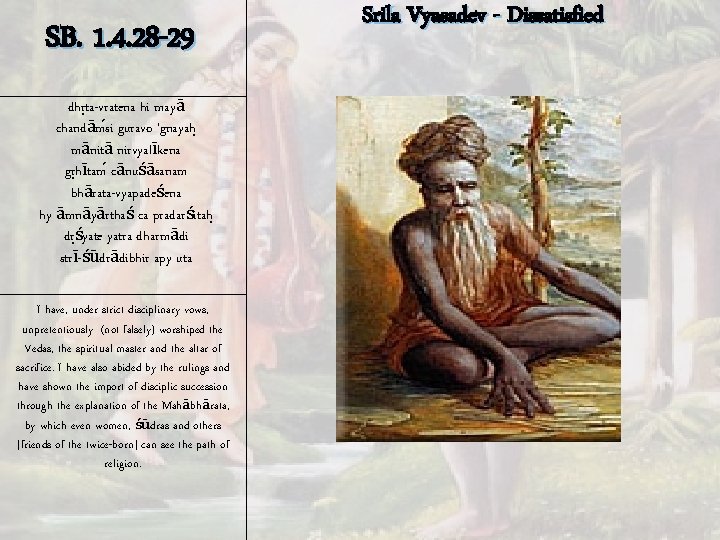
SB. 1. 4. 28 -29 dhr ta-vratena hi mayā chandām si guravo 'gnayah mānitā nirvyalīkena gr hītam cānuśāsanam bhārata-vyapadeśena hy āmnāyārthaś ca pradarśitah dr śyate yatra dharmādi strī-śūdrādibhir apy uta I have, under strict disciplinary vows, unpretentiously (not falsely) worshiped the Vedas, the spiritual master and the altar of sacrifice. I have also abided by the rulings and have shown the import of disciplic succession through the explanation of the Mahābhārata, by which even women, śūdras and others [friends of the twice-born] can see the path of religion. Srila Vyasadev - Dissatisfied
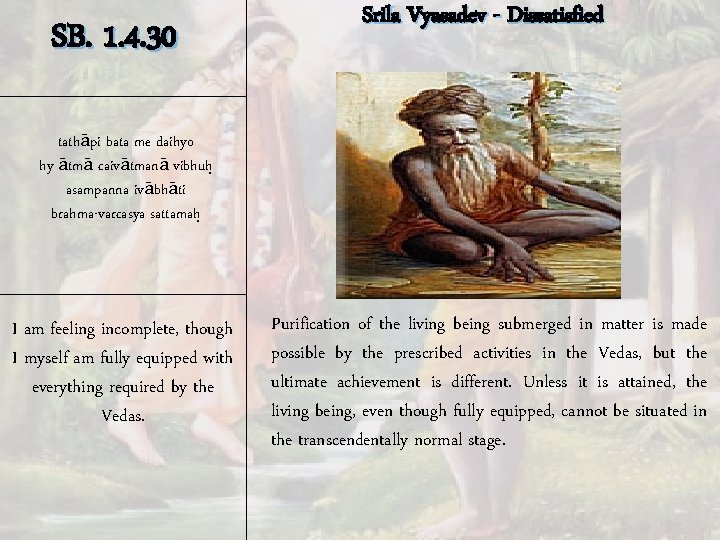
SB. 1. 4. 30 Srila Vyasadev - Dissatisfied tathāpi bata me daihyo hy ātmā caivātmanā vibhuh asampanna ivābhāti brahma-varcasya sattamah I am feeling incomplete, though I myself am fully equipped with everything required by the Vedas. Purification of the living being submerged in matter is made possible by the prescribed activities in the Vedas, but the ultimate achievement is different. Unless it is attained, the living being, even though fully equipped, cannot be situated in the transcendentally normal stage.
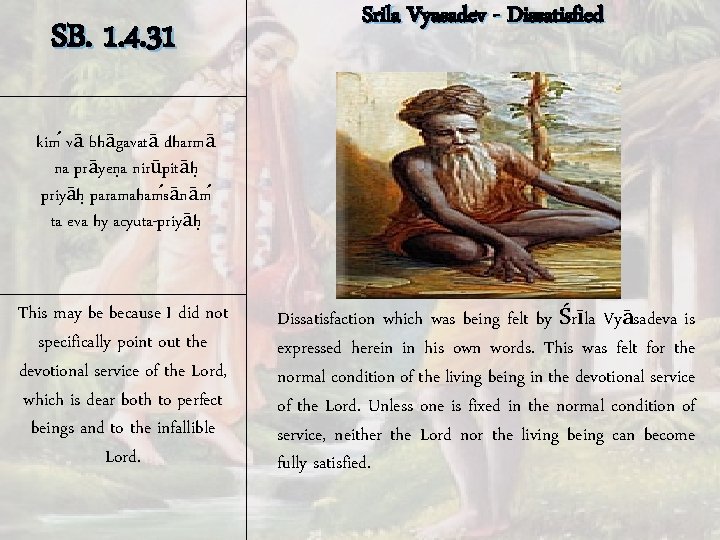
SB. 1. 4. 31 Srila Vyasadev - Dissatisfied kim vā bhāgavatā dharmā na prāyen a nirūpitāh priyāh paramaham sānām ta eva hy acyuta-priyāh This may be because I did not specifically point out the devotional service of the Lord, which is dear both to perfect beings and to the infallible Lord. Dissatisfaction which was being felt by Śrīla Vyāsadeva is expressed herein in his own words. This was felt for the normal condition of the living being in the devotional service of the Lord. Unless one is fixed in the normal condition of service, neither the Lord nor the living being can become fully satisfied.
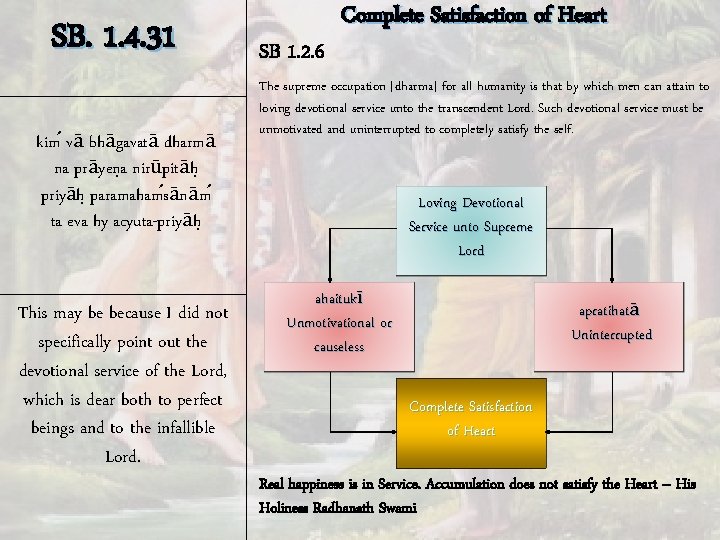
SB. 1. 4. 31 kim vā bhāgavatā dharmā na prāyen a nirūpitāh priyāh paramaham sānām ta eva hy acyuta-priyāh This may be because I did not specifically point out the devotional service of the Lord, which is dear both to perfect beings and to the infallible Lord. SB 1. 2. 6 Complete Satisfaction of Heart The supreme occupation [dharma] for all humanity is that by which men can attain to loving devotional service unto the transcendent Lord. Such devotional service must be unmotivated and uninterrupted to completely satisfy the self. Loving Devotional Service unto Supreme Lord ahaitukī Unmotivational or causeless apratihatā Uninterrupted Complete Satisfaction of Heart Real happiness is in Service. Accumulation does not satisfy the Heart – His Holiness Radhanath Swami
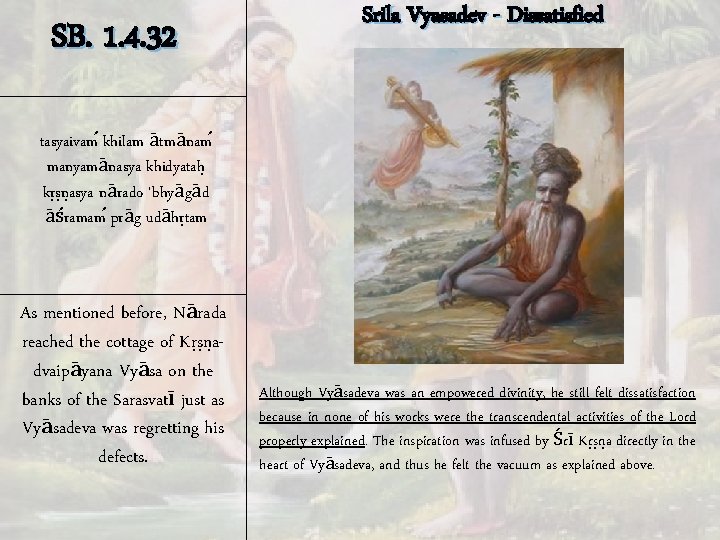
SB. 1. 4. 32 Srila Vyasadev - Dissatisfied tasyaivam khilam ātmānam manyamānasya khidyatah kr s n asya nārado 'bhyāgād āśramam prāg udāhr tam As mentioned before, Nārada reached the cottage of Kr s n advaipāyana Vyāsa on the banks of the Sarasvatī just as Vyāsadeva was regretting his defects. Although Vyāsadeva was an empowered divinity, he still felt dissatisfaction because in none of his works were the transcendental activities of the Lord properly explained. The inspiration was infused by Śrī Kr s n a directly in the heart of Vyāsadeva, and thus he felt the vacuum as explained above.
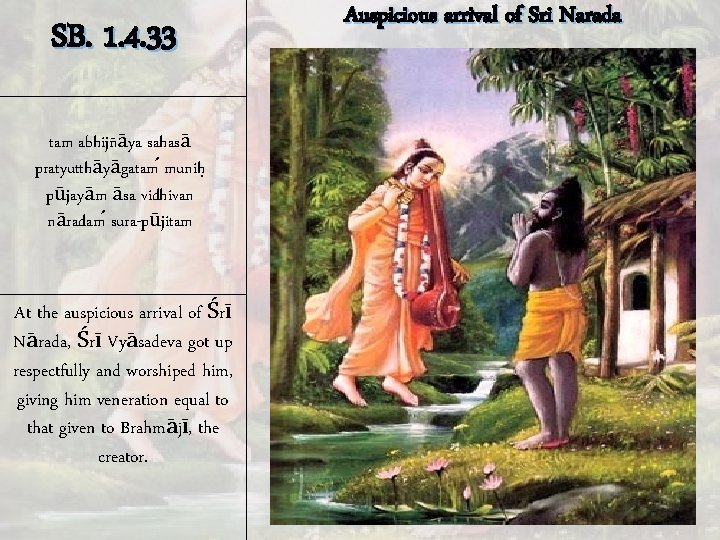
SB. 1. 4. 33 tam abhijñāya sahasā pratyutthāyāgatam munih pūjayām āsa vidhivan nāradam sura-pūjitam At the auspicious arrival of Śrī Nārada, Śrī Vyāsadeva got up respectfully and worshiped him, giving him veneration equal to that given to Brahmājī, the creator. Auspicious arrival of Sri Narada
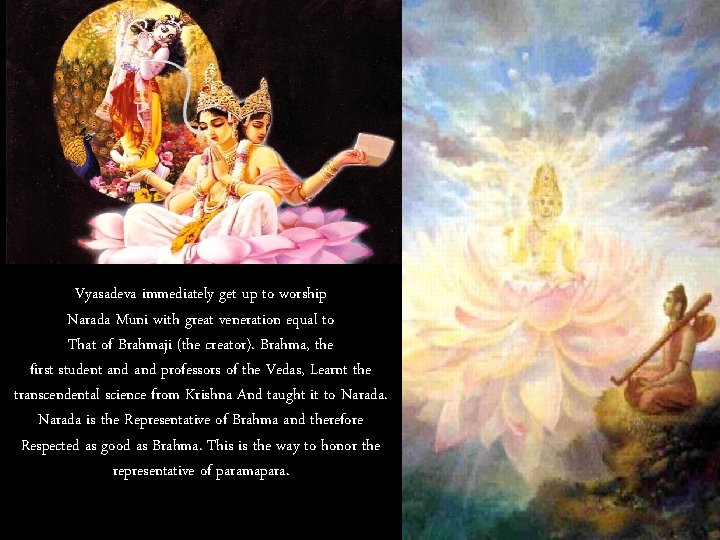
Vyasadeva immediately get up to worship Narada Muni with great veneration equal to That of Brahmaji (the creator). Brahma, the first student and professors of the Vedas, Learnt the transcendental science from Krishna And taught it to Narada is the Representative of Brahma and therefore Respected as good as Brahma. This is the way to honor the representative of paramapara.
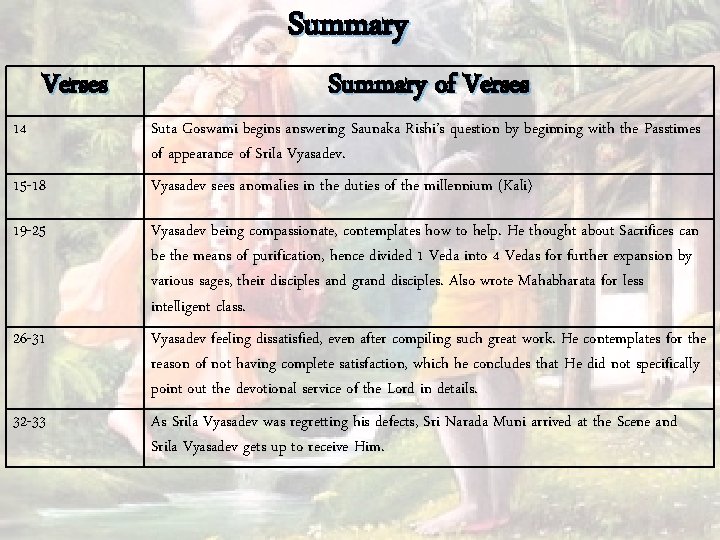
Summary Verses Summary of Verses 14 Suta Goswami begins answering Saunaka Rishi’s question by beginning with the Passtimes of appearance of Srila Vyasadev. 15 -18 Vyasadev sees anomalies in the duties of the millennium (Kali) 19 -25 Vyasadev being compassionate, contemplates how to help. He thought about Sacrifices can be the means of purification, hence divided 1 Veda into 4 Vedas for further expansion by various sages, their disciples and grand disciples. Also wrote Mahabharata for less intelligent class. 26 -31 Vyasadev feeling dissatisfied, even after compiling such great work. He contemplates for the reason of not having complete satisfaction, which he concludes that He did not specifically point out the devotional service of the Lord in details. 32 -33 As Srila Vyasadev was regretting his defects, Sri Narada Muni arrived at the Scene and Srila Vyasadev gets up to receive Him.
Questions
Thank You… References www. rompadaswami. com classes on Canto 1 Chapter 4. 14 -33 Bhakti Vaibhava Classes given by HG Bhurijana Prabhu Unveiling the Lotus Feet
- Slides: 34