
Chapter 4 Systems Design Process Costing Mc GrawHill



- Slides: 79
Chapter 4 Systems Design: Process Costing Mc. Graw-Hill /Irwin Copyright © 2008 by The Mc. Graw-Hill Companies, Inc. All rights reserved.
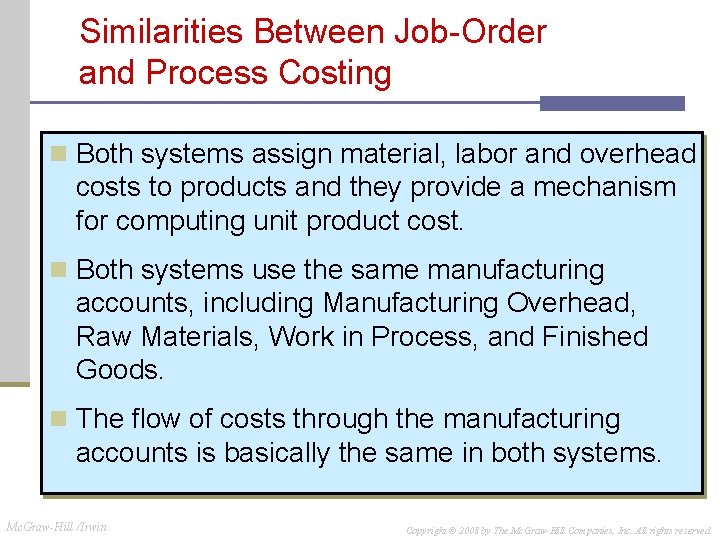
Similarities Between Job-Order and Process Costing n Both systems assign material, labor and overhead costs to products and they provide a mechanism for computing unit product cost. n Both systems use the same manufacturing accounts, including Manufacturing Overhead, Raw Materials, Work in Process, and Finished Goods. n The flow of costs through the manufacturing accounts is basically the same in both systems. Mc. Graw-Hill /Irwin Copyright © 2008 by The Mc. Graw-Hill Companies, Inc. All rights reserved.
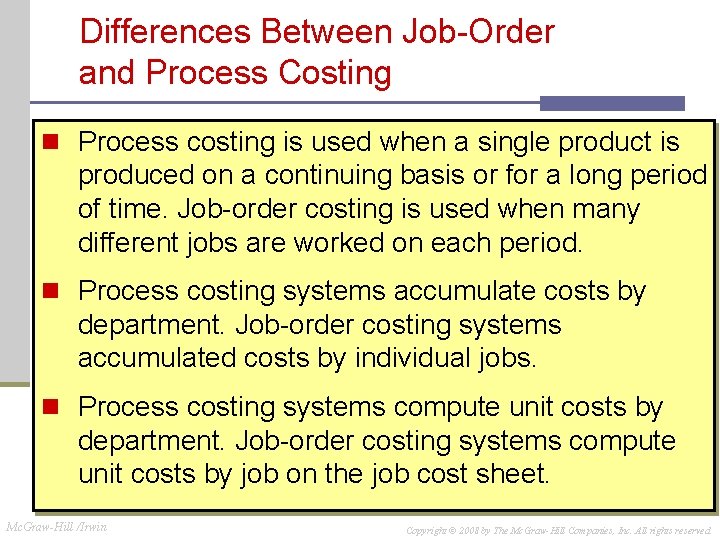
Differences Between Job-Order and Process Costing n Process costing is used when a single product is produced on a continuing basis or for a long period of time. Job-order costing is used when many different jobs are worked on each period. n Process costing systems accumulate costs by department. Job-order costing systems accumulated costs by individual jobs. n Process costing systems compute unit costs by department. Job-order costing systems compute unit costs by job on the job cost sheet. Mc. Graw-Hill /Irwin Copyright © 2008 by The Mc. Graw-Hill Companies, Inc. All rights reserved.
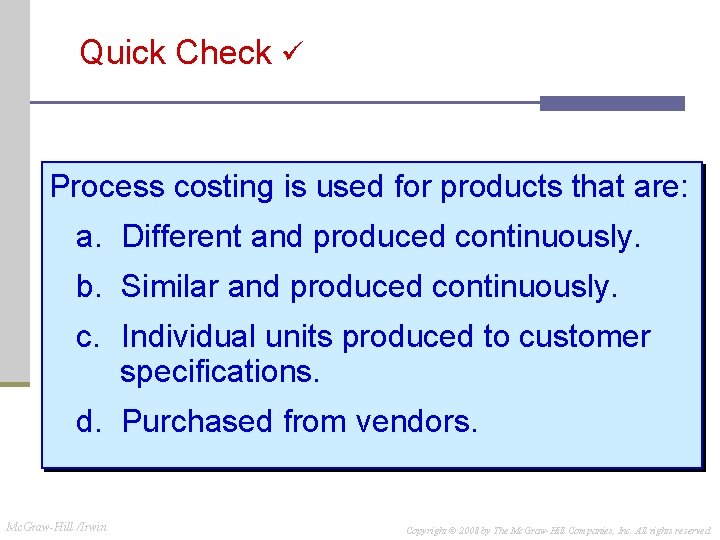
Quick Check Process costing is used for products that are: a. Different and produced continuously. b. Similar and produced continuously. c. Individual units produced to customer specifications. d. Purchased from vendors. Mc. Graw-Hill /Irwin Copyright © 2008 by The Mc. Graw-Hill Companies, Inc. All rights reserved.
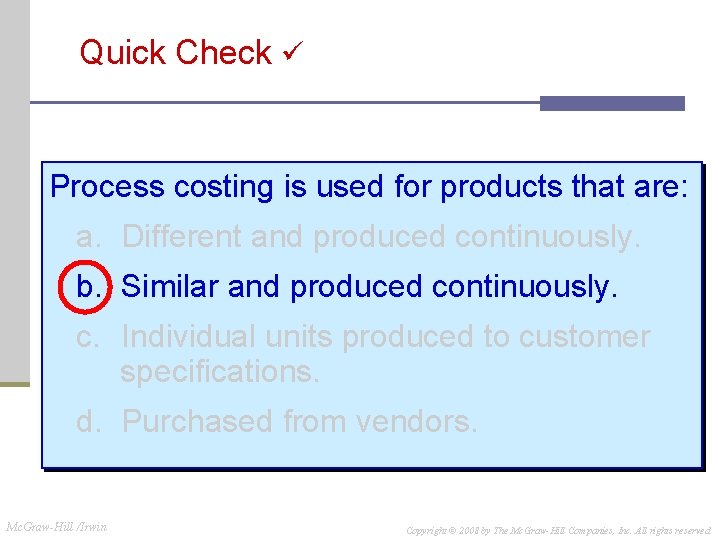
Quick Check Process costing is used for products that are: a. Different and produced continuously. b. Similar and produced continuously. c. Individual units produced to customer specifications. d. Purchased from vendors. Mc. Graw-Hill /Irwin Copyright © 2008 by The Mc. Graw-Hill Companies, Inc. All rights reserved.
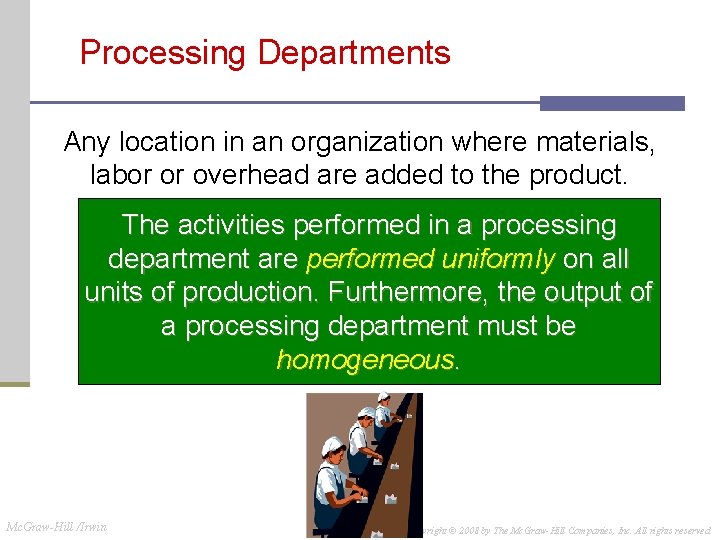
Processing Departments Any location in an organization where materials, labor or overhead are added to the product. The activities performed in a processing department are performed uniformly on all units of production. Furthermore, the output of a processing department must be homogeneous. Mc. Graw-Hill /Irwin Copyright © 2008 by The Mc. Graw-Hill Companies, Inc. All rights reserved.
Learning Objective 1 Record the flow of materials, labor, and overhead through a process costing system. Mc. Graw-Hill /Irwin Copyright © 2008 by The Mc. Graw-Hill Companies, Inc. All rights reserved.
Flow of Materials, Labor and Overhead Costs Direct Materials Direct Labor Manufacturing Overhead Mc. Graw-Hill /Irwin Work in Process Finished Goods Cost of Goods Sold Copyright © 2008 by The Mc. Graw-Hill Companies, Inc. All rights reserved.
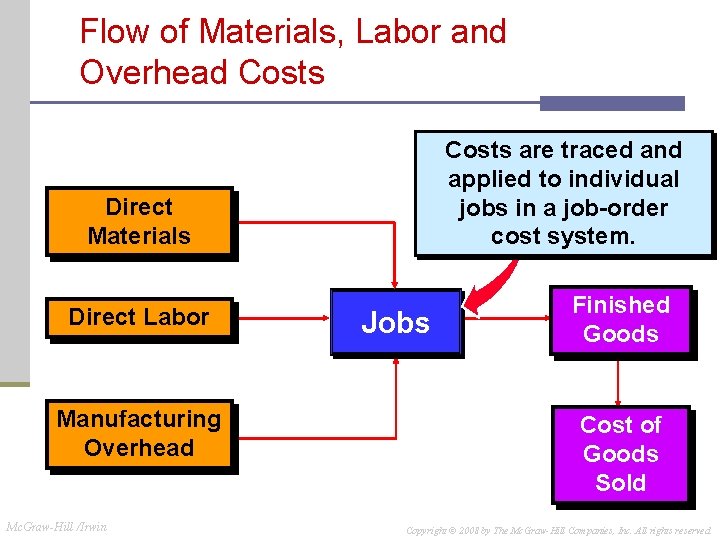
Flow of Materials, Labor and Overhead Costs are traced and applied to individual jobs in a job-order cost system. Direct Materials Direct Labor Manufacturing Overhead Mc. Graw-Hill /Irwin Jobs Finished Goods Cost of Goods Sold Copyright © 2008 by The Mc. Graw-Hill Companies, Inc. All rights reserved.
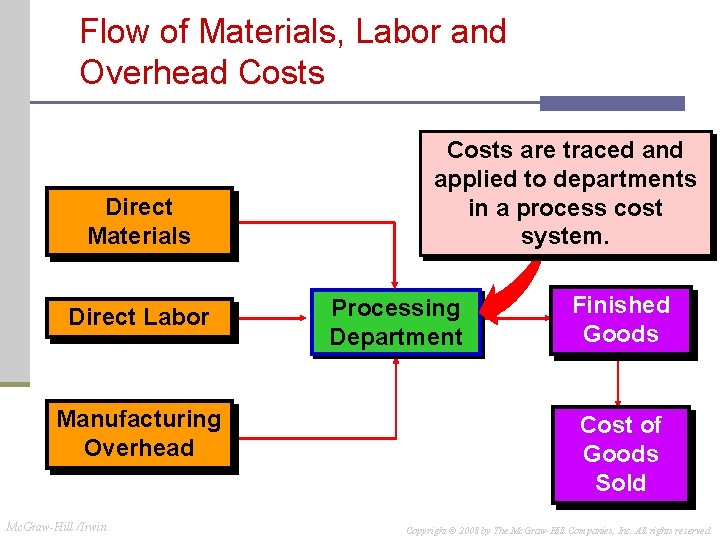
Flow of Materials, Labor and Overhead Costs Direct Materials Direct Labor Manufacturing Overhead Mc. Graw-Hill /Irwin Costs are traced and applied to departments in a process cost system. Processing Department Finished Goods Cost of Goods Sold Copyright © 2008 by The Mc. Graw-Hill Companies, Inc. All rights reserved.
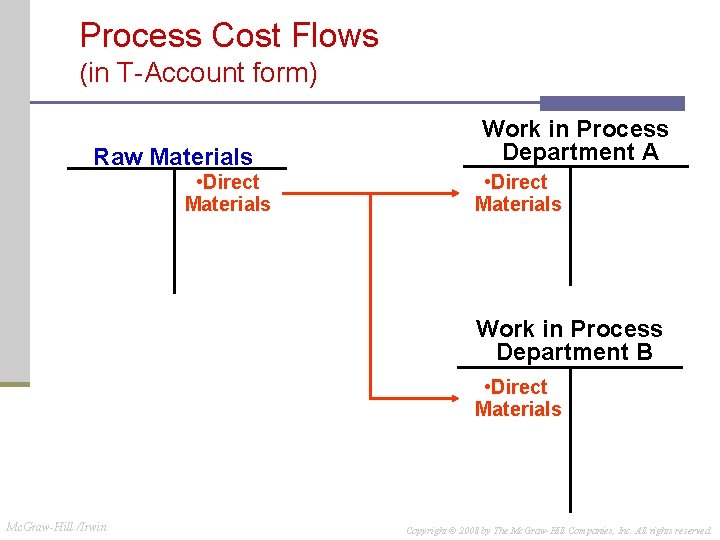
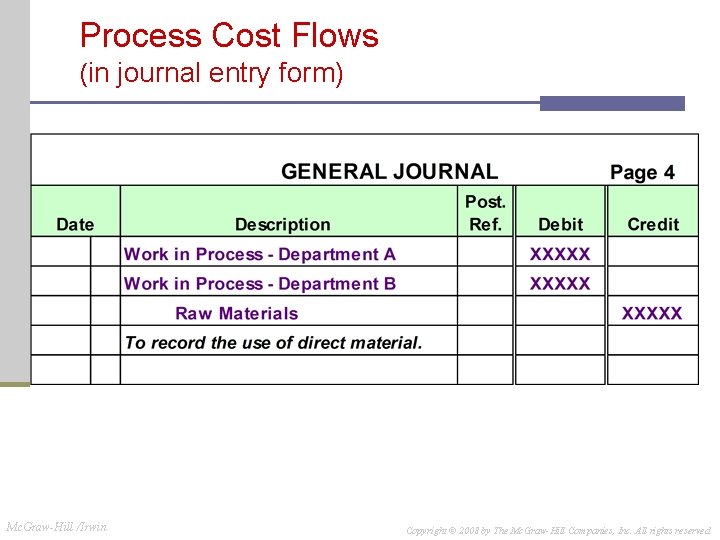
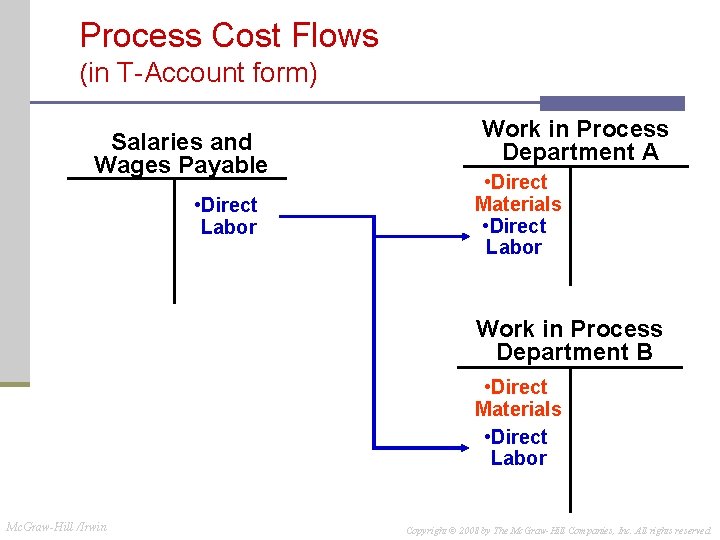
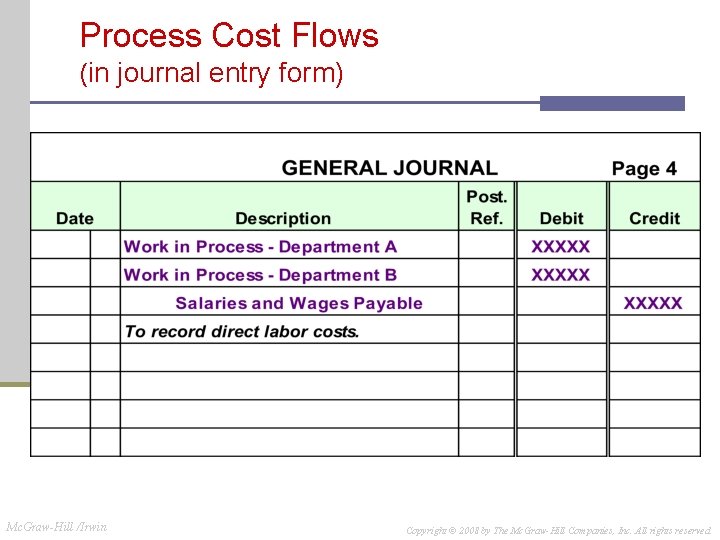
T-Account and Journal Entry Views of Process Cost Flows For purposes of this example, assume there are two processing departments – Departments A and B. We will use T-accounts and journal entries. Mc. Graw-Hill /Irwin Copyright © 2008 by The Mc. Graw-Hill Companies, Inc. All rights reserved.
Process Cost Flows (in T-Account form) Raw Materials • Direct Materials Work in Process Department A • Direct Materials Work in Process Department B • Direct Materials Mc. Graw-Hill /Irwin Copyright © 2008 by The Mc. Graw-Hill Companies, Inc. All rights reserved.
Process Cost Flows (in journal entry form) Mc. Graw-Hill /Irwin Copyright © 2008 by The Mc. Graw-Hill Companies, Inc. All rights reserved.
Process Cost Flows (in T-Account form) Salaries and Wages Payable • Direct Labor Work in Process Department A • Direct Materials • Direct Labor Work in Process Department B • Direct Materials • Direct Labor Mc. Graw-Hill /Irwin Copyright © 2008 by The Mc. Graw-Hill Companies, Inc. All rights reserved.
Process Cost Flows (in journal entry form) Mc. Graw-Hill /Irwin Copyright © 2008 by The Mc. Graw-Hill Companies, Inc. All rights reserved.
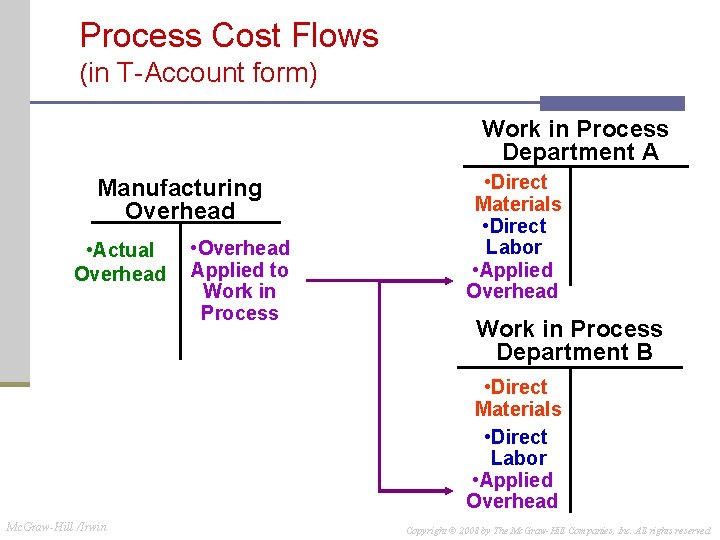
Process Cost Flows (in T-Account form) Work in Process Department A Manufacturing Overhead • Actual Overhead • Overhead Applied to Work in Process • Direct Materials • Direct Labor • Applied Overhead Work in Process Department B • Direct Materials • Direct Labor • Applied Overhead Mc. Graw-Hill /Irwin Copyright © 2008 by The Mc. Graw-Hill Companies, Inc. All rights reserved.
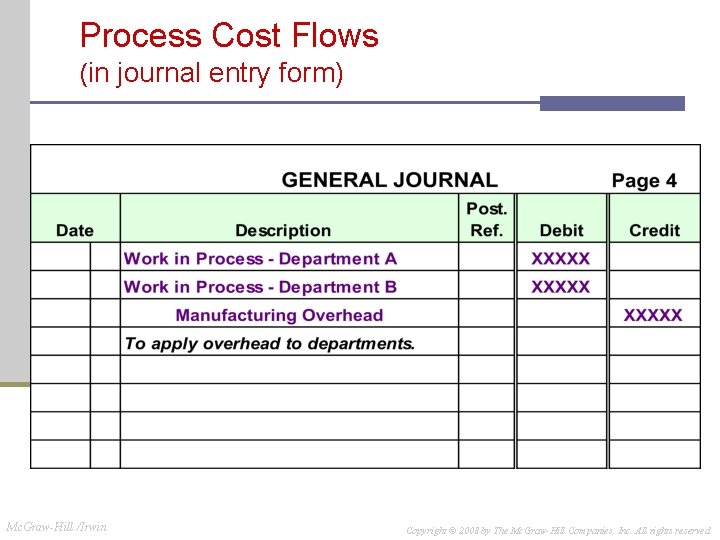
Process Cost Flows (in journal entry form) Mc. Graw-Hill /Irwin Copyright © 2008 by The Mc. Graw-Hill Companies, Inc. All rights reserved.
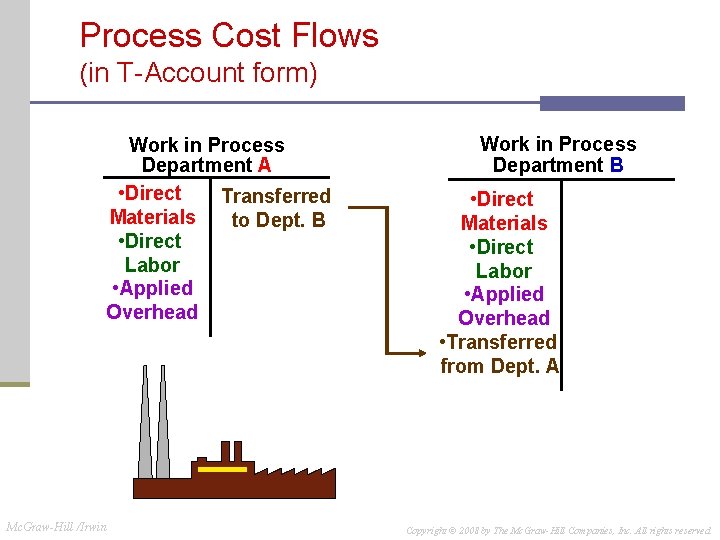
Process Cost Flows (in T-Account form) Work in Process Department A • Direct Transferred Materials to Dept. B • Direct Labor • Applied Overhead Mc. Graw-Hill /Irwin Work in Process Department B • Direct Materials • Direct Labor • Applied Overhead • Transferred from Dept. A Copyright © 2008 by The Mc. Graw-Hill Companies, Inc. All rights reserved.
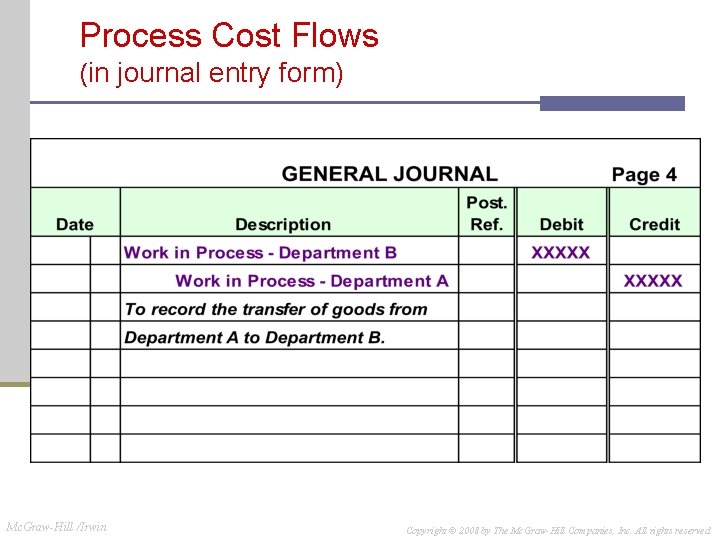
Process Cost Flows (in journal entry form) Mc. Graw-Hill /Irwin Copyright © 2008 by The Mc. Graw-Hill Companies, Inc. All rights reserved.
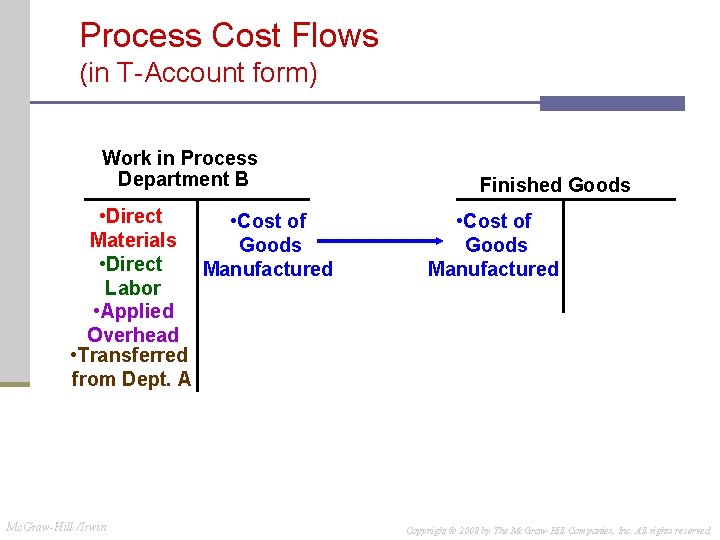
Process Cost Flows (in T-Account form) Work in Process Department B • Direct • Cost of Materials Goods • Direct Manufactured Labor • Applied Overhead • Transferred from Dept. A Mc. Graw-Hill /Irwin Finished Goods • Cost of Goods Manufactured Copyright © 2008 by The Mc. Graw-Hill Companies, Inc. All rights reserved.
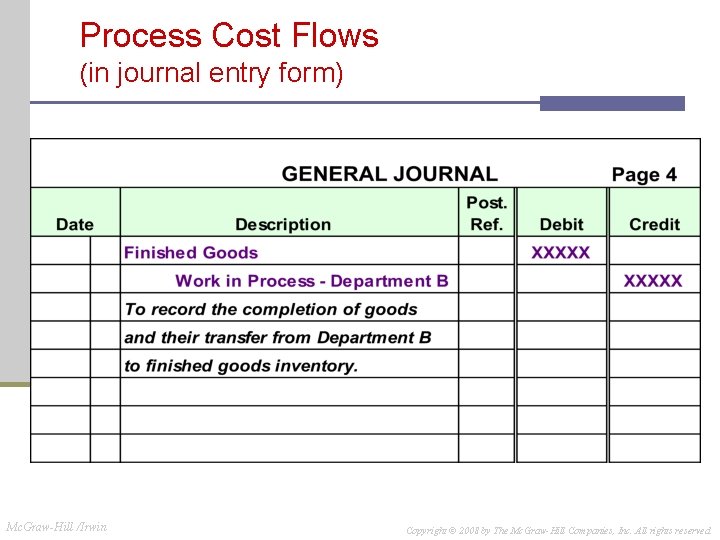
Process Cost Flows (in journal entry form) Mc. Graw-Hill /Irwin Copyright © 2008 by The Mc. Graw-Hill Companies, Inc. All rights reserved.
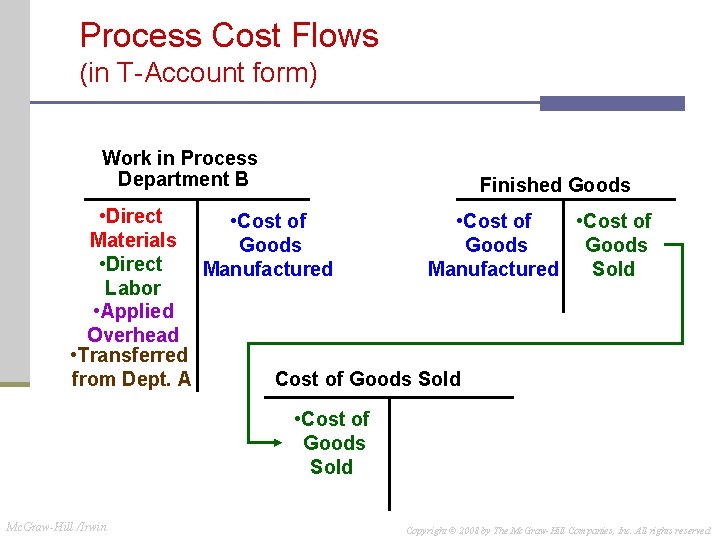
Process Cost Flows (in T-Account form) Work in Process Department B Finished Goods • Direct • Cost of Materials Goods • Direct Manufactured Sold Labor • Applied Overhead • Transferred Cost of Goods Sold from Dept. A • Cost of Goods Sold Mc. Graw-Hill /Irwin Copyright © 2008 by The Mc. Graw-Hill Companies, Inc. All rights reserved.
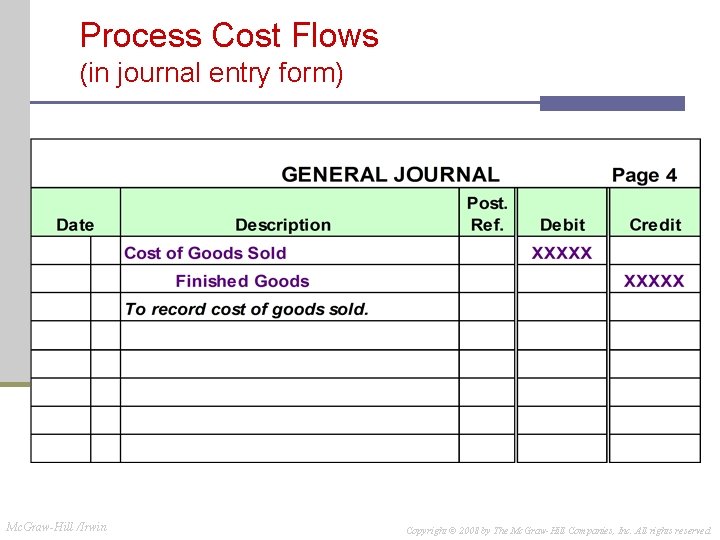
Process Cost Flows (in journal entry form) Mc. Graw-Hill /Irwin Copyright © 2008 by The Mc. Graw-Hill Companies, Inc. All rights reserved.
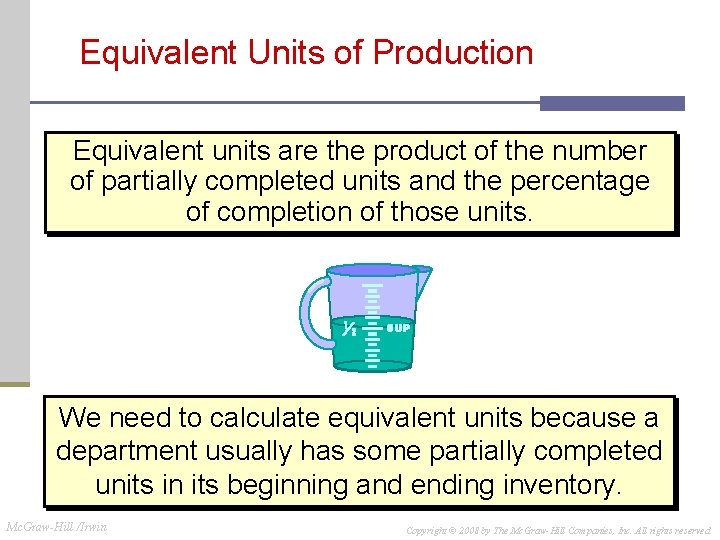
Equivalent Units of Production Equivalent units are the product of the number of partially completed units and the percentage of completion of those units. We need to calculate equivalent units because a department usually has some partially completed units in its beginning and ending inventory. Mc. Graw-Hill /Irwin Copyright © 2008 by The Mc. Graw-Hill Companies, Inc. All rights reserved.
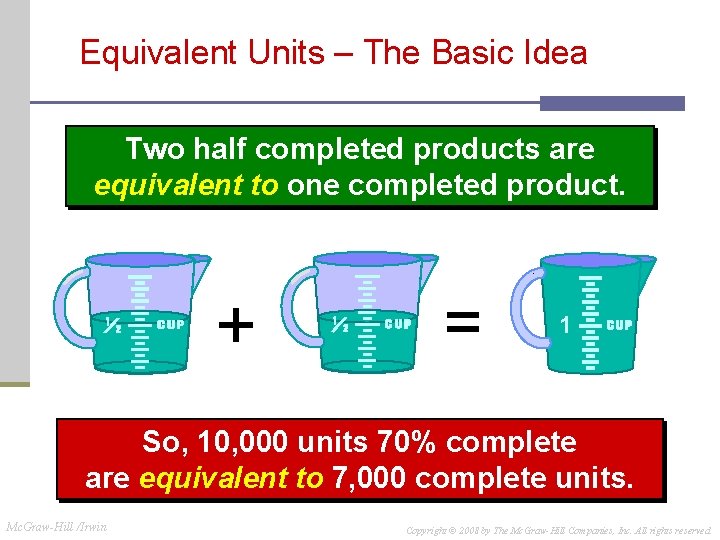
Equivalent Units – The Basic Idea Two half completed products are equivalent to one completed product. + = 1 So, 10, 000 units 70% complete are equivalent to 7, 000 complete units. Mc. Graw-Hill /Irwin Copyright © 2008 by The Mc. Graw-Hill Companies, Inc. All rights reserved.
Quick Check For the current period, Jones started 15, 000 units and completed 10, 000 units, leaving 5, 000 units in process that are 30 percent complete. How many equivalent units of production did Jones have for the period? a. 10, 000 b. 11, 500 c. 13, 500 d. 15, 000 Mc. Graw-Hill /Irwin Copyright © 2008 by The Mc. Graw-Hill Companies, Inc. All rights reserved.
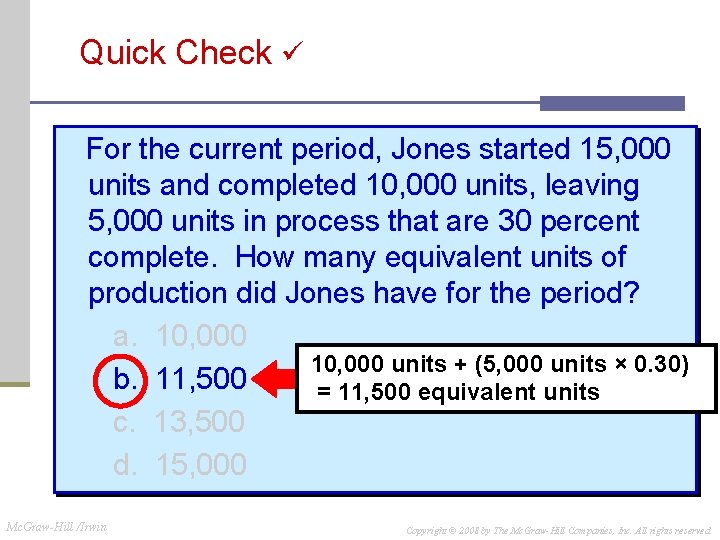
Quick Check For the current period, Jones started 15, 000 units and completed 10, 000 units, leaving 5, 000 units in process that are 30 percent complete. How many equivalent units of production did Jones have for the period? a. 10, 000 units + (5, 000 units × 0. 30) b. 11, 500 = 11, 500 equivalent units c. 13, 500 d. 15, 000 Mc. Graw-Hill /Irwin Copyright © 2008 by The Mc. Graw-Hill Companies, Inc. All rights reserved.
Calculating Equivalent Units Equivalent units can be calculated two ways: The First-In, First-Out Method – FIFO is covered in the appendix to this chapter. The Weighted-Average Method – This method will be covered in the main portion of the chapter. Mc. Graw-Hill /Irwin Copyright © 2008 by The Mc. Graw-Hill Companies, Inc. All rights reserved.
Learning Objective 2 Compute the equivalent units of production using the weighted-average method. Mc. Graw-Hill /Irwin Copyright © 2008 by The Mc. Graw-Hill Companies, Inc. All rights reserved.
Characteristics of the Weighted Average Method The weighted-average method. . . • Makes no distinction between work done in prior or current periods. • Blends together units and costs from prior and current periods. The equivalent units of production for a department are the number of units transferred to the next department (or finished goods) plus the equivalent units in the department’s ending work in process inventory. Mc. Graw-Hill /Irwin Copyright © 2008 by The Mc. Graw-Hill Companies, Inc. All rights reserved.
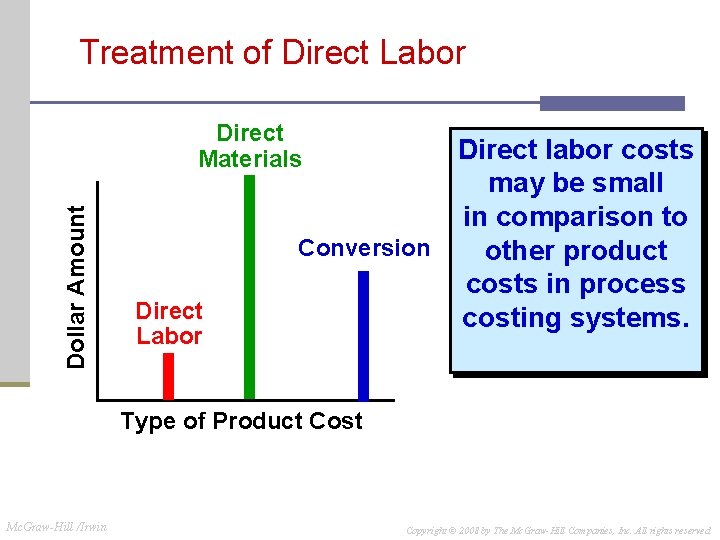
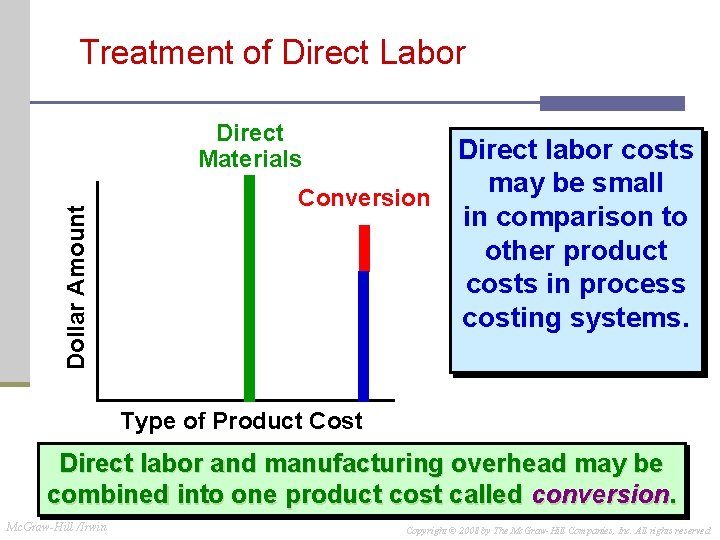
Treatment of Direct Labor Dollar Amount Direct Materials Direct Labor Direct labor costs may be small in comparison to Conversion other product costs in process costing systems. Type of Product Cost Mc. Graw-Hill /Irwin Copyright © 2008 by The Mc. Graw-Hill Companies, Inc. All rights reserved.
Treatment of Direct Labor Dollar Amount Direct Materials Direct labor costs may be small Conversion in comparison to other product costs in process costing systems. Type of Product Cost Direct labor and manufacturing overhead may be combined into one product cost called conversion. Mc. Graw-Hill /Irwin Copyright © 2008 by The Mc. Graw-Hill Companies, Inc. All rights reserved.
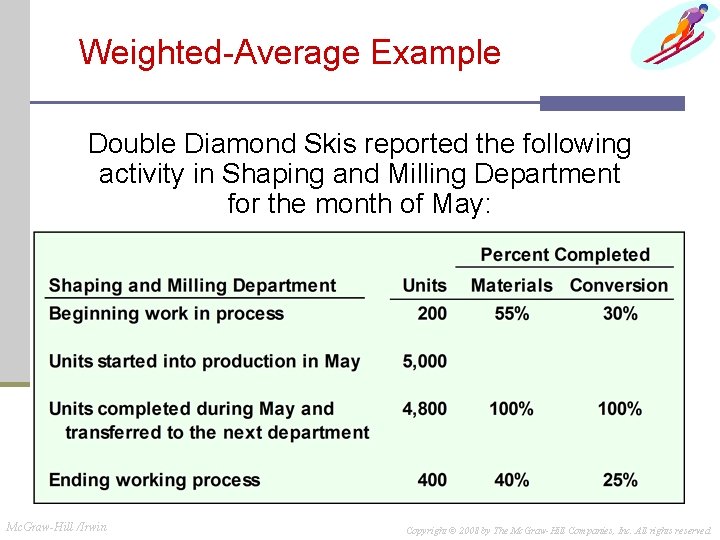
Weighted-Average Example Double Diamond Skis reported the following activity in Shaping and Milling Department for the month of May: Mc. Graw-Hill /Irwin Copyright © 2008 by The Mc. Graw-Hill Companies, Inc. All rights reserved.
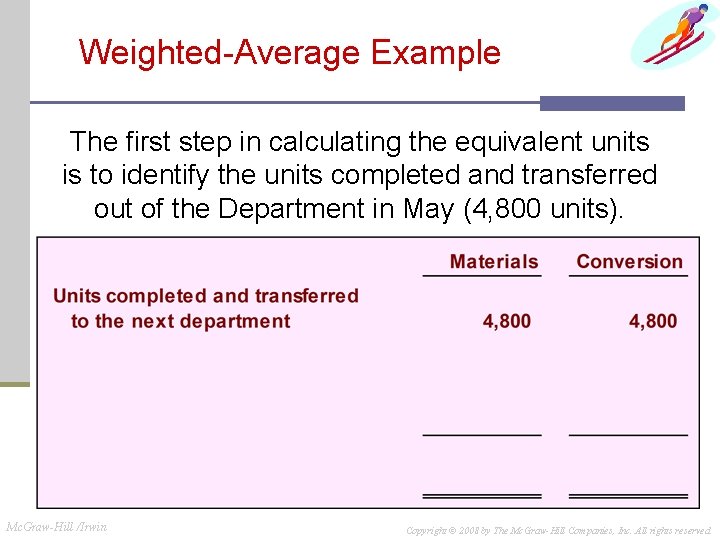
Weighted-Average Example The first step in calculating the equivalent units is to identify the units completed and transferred out of the Department in May (4, 800 units). Mc. Graw-Hill /Irwin Copyright © 2008 by The Mc. Graw-Hill Companies, Inc. All rights reserved.
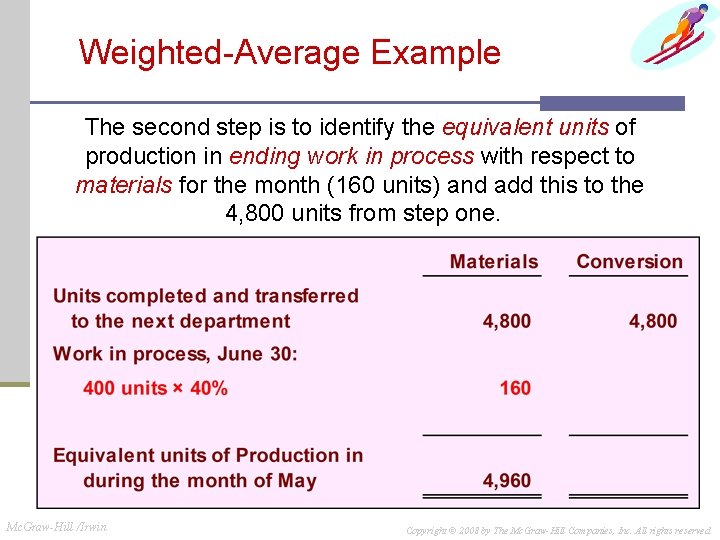
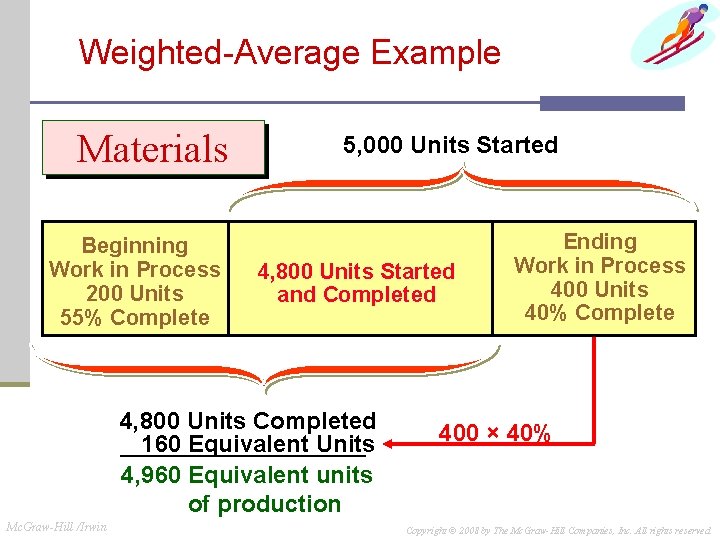
Weighted-Average Example The second step is to identify the equivalent units of production in ending work in process with respect to materials for the month (160 units) and add this to the 4, 800 units from step one. Mc. Graw-Hill /Irwin Copyright © 2008 by The Mc. Graw-Hill Companies, Inc. All rights reserved.
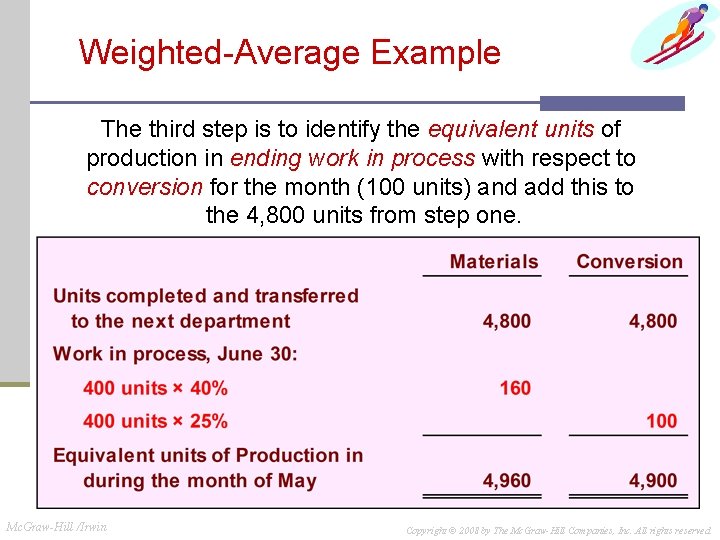
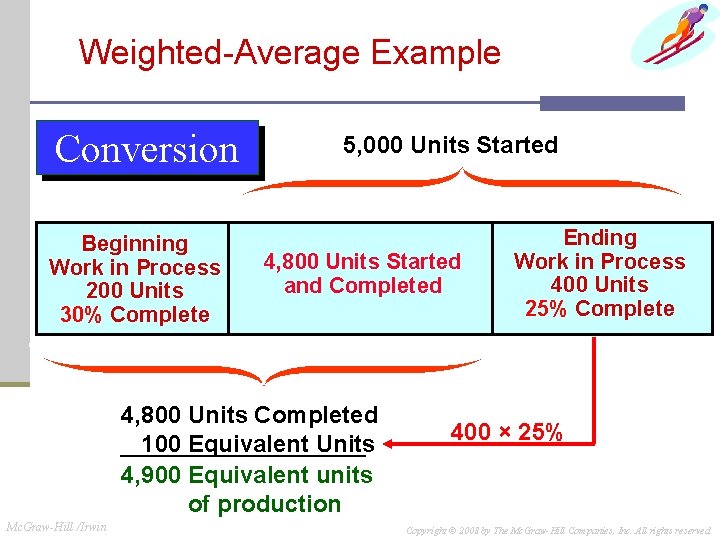
Weighted-Average Example The third step is to identify the equivalent units of production in ending work in process with respect to conversion for the month (100 units) and add this to the 4, 800 units from step one. Mc. Graw-Hill /Irwin Copyright © 2008 by The Mc. Graw-Hill Companies, Inc. All rights reserved.
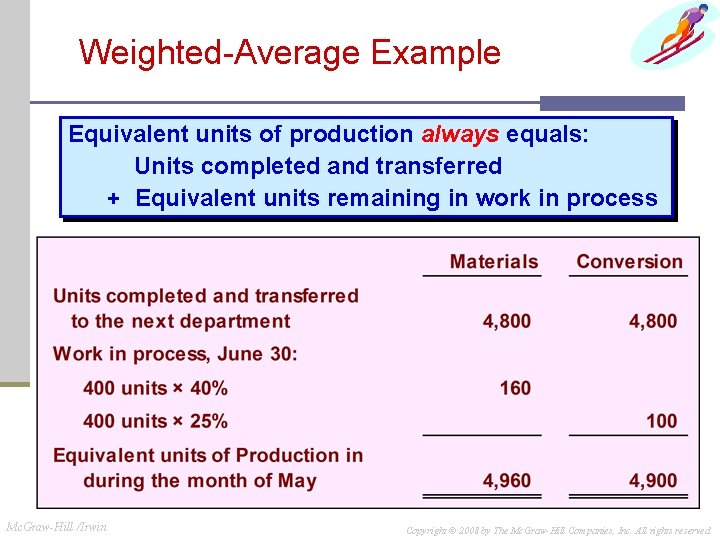
Weighted-Average Example Equivalent units of production always equals: Units completed and transferred + Equivalent units remaining in work in process Mc. Graw-Hill /Irwin Copyright © 2008 by The Mc. Graw-Hill Companies, Inc. All rights reserved.
Weighted-Average Example Materials Beginning Work in Process 200 Units 55% Complete 5, 000 Units Started 4, 800 Units Started and Completed 4, 800 Units Completed 160 Equivalent Units 4, 960 Equivalent units of production Mc. Graw-Hill /Irwin Ending Work in Process 400 Units 40% Complete 400 × 40% Copyright © 2008 by The Mc. Graw-Hill Companies, Inc. All rights reserved.
Weighted-Average Example Conversion Beginning Work in Process 200 Units 30% Complete 5, 000 Units Started 4, 800 Units Started and Completed 4, 800 Units Completed 100 Equivalent Units 4, 900 Equivalent units of production Mc. Graw-Hill /Irwin Ending Work in Process 400 Units 25% Complete 400 × 25% Copyright © 2008 by The Mc. Graw-Hill Companies, Inc. All rights reserved.
Learning Objective 3 Compute the costs per equivalent unit using the weighted-average method. Mc. Graw-Hill /Irwin Copyright © 2008 by The Mc. Graw-Hill Companies, Inc. All rights reserved.
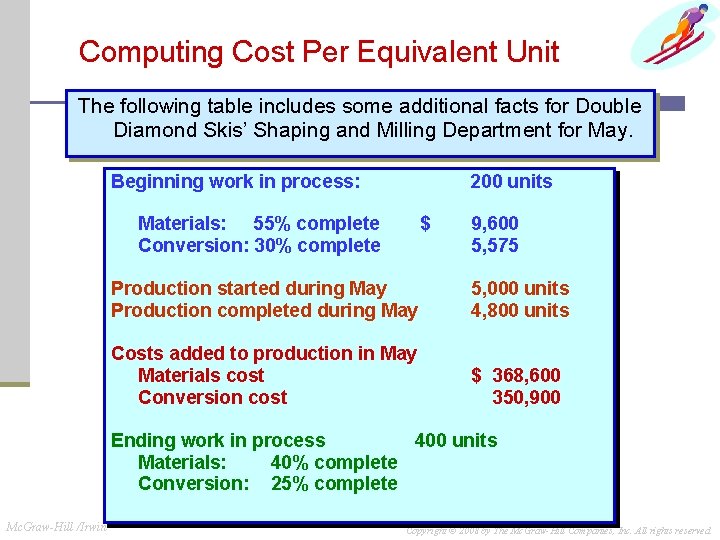
Computing Cost Per Equivalent Unit The following table includes some additional facts for Double Diamond Skis’ Shaping and Milling Department for May. Beginning work in process: 200 units Materials: 55% complete Conversion: 30% complete $ 9, 600 5, 575 Production started during May Production completed during May 5, 000 units 4, 800 units Costs added to production in May Materials cost Conversion cost $ 368, 600 350, 900 Ending work in process 400 units Materials: 40% complete Conversion: 25% complete Mc. Graw-Hill /Irwin Copyright © 2008 by The Mc. Graw-Hill Companies, Inc. All rights reserved.
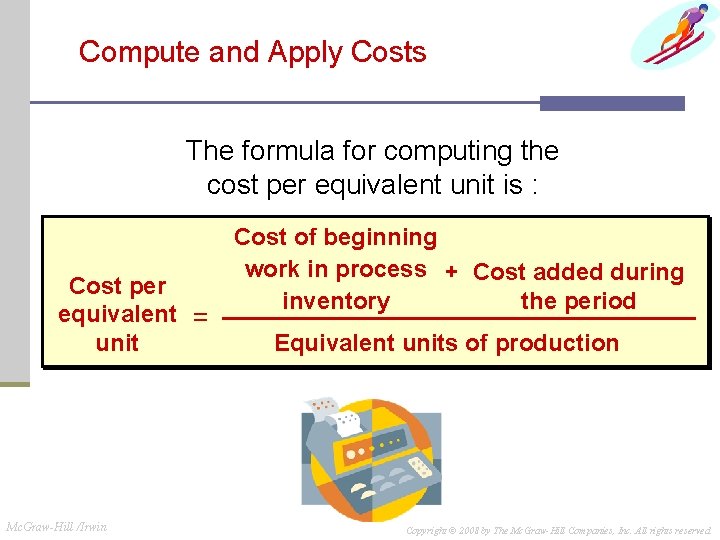
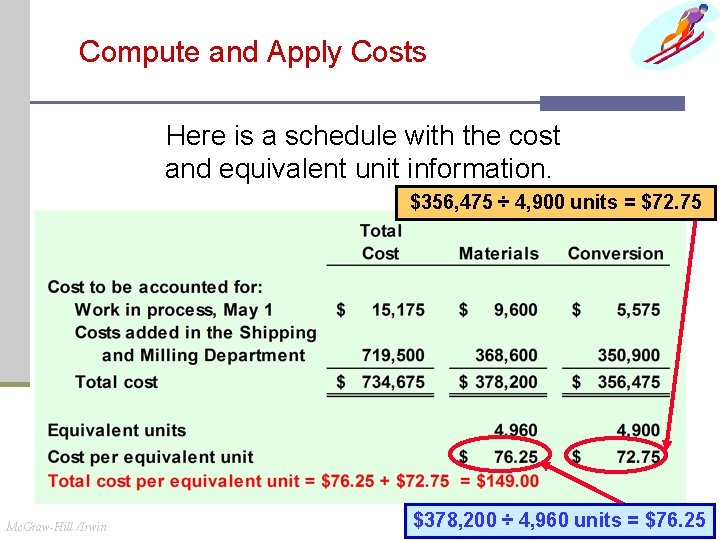
Compute and Apply Costs The formula for computing the cost per equivalent unit is : Cost per equivalent = unit Mc. Graw-Hill /Irwin Cost of beginning work in process + Cost added during inventory the period Equivalent units of production Copyright © 2008 by The Mc. Graw-Hill Companies, Inc. All rights reserved.
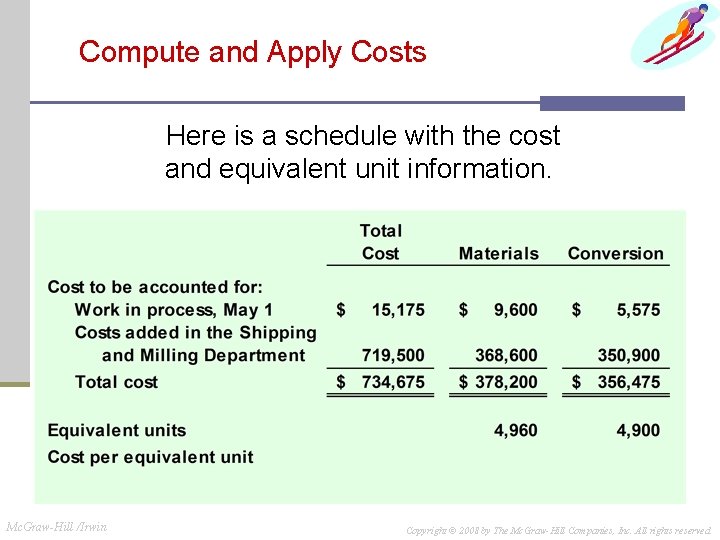
Compute and Apply Costs Here is a schedule with the cost and equivalent unit information. Mc. Graw-Hill /Irwin Copyright © 2008 by The Mc. Graw-Hill Companies, Inc. All rights reserved.
Compute and Apply Costs Here is a schedule with the cost and equivalent unit information. $356, 475 ÷ 4, 900 units = $72. 75 Mc. Graw-Hill /Irwin $378, 200 ÷ 4, 960 units = $76. 25 Copyright © 2008 by The Mc. Graw-Hill Companies, Inc. All rights reserved.
Learning Objective 4 Assign costs to units using the weighted-average method. Mc. Graw-Hill /Irwin Copyright © 2008 by The Mc. Graw-Hill Companies, Inc. All rights reserved.
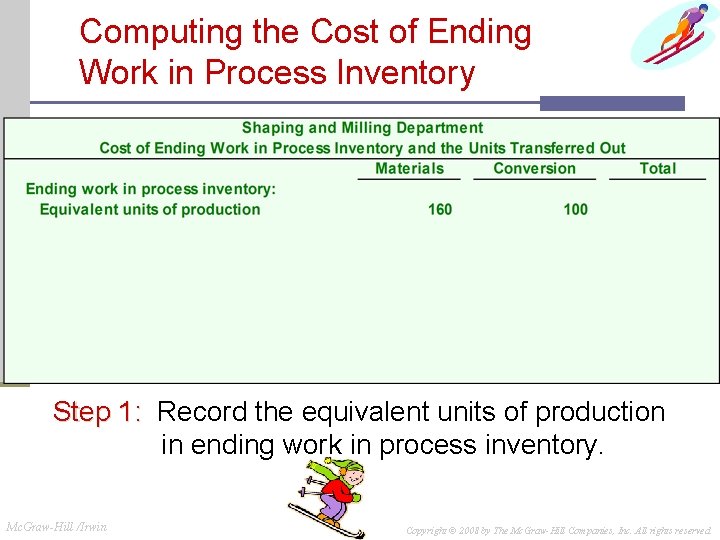
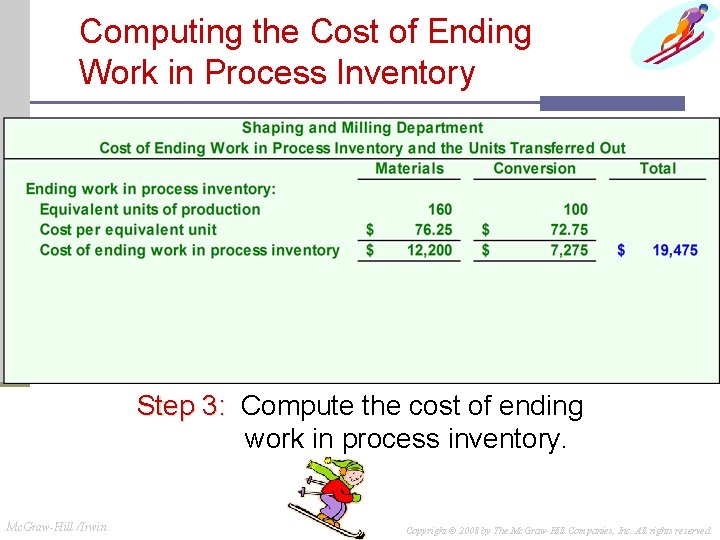
Computing the Cost of Ending Work in Process Inventory Step 1: Record the equivalent units of production in ending work in process inventory. Mc. Graw-Hill /Irwin Copyright © 2008 by The Mc. Graw-Hill Companies, Inc. All rights reserved.
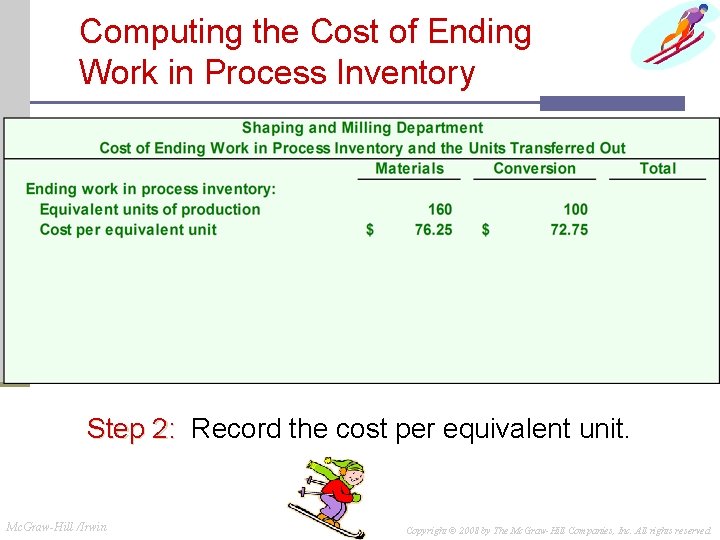
Computing the Cost of Ending Work in Process Inventory Step 2: Record the cost per equivalent unit. Mc. Graw-Hill /Irwin Copyright © 2008 by The Mc. Graw-Hill Companies, Inc. All rights reserved.
Computing the Cost of Ending Work in Process Inventory Step 3: Compute the cost of ending work in process inventory. Mc. Graw-Hill /Irwin Copyright © 2008 by The Mc. Graw-Hill Companies, Inc. All rights reserved.
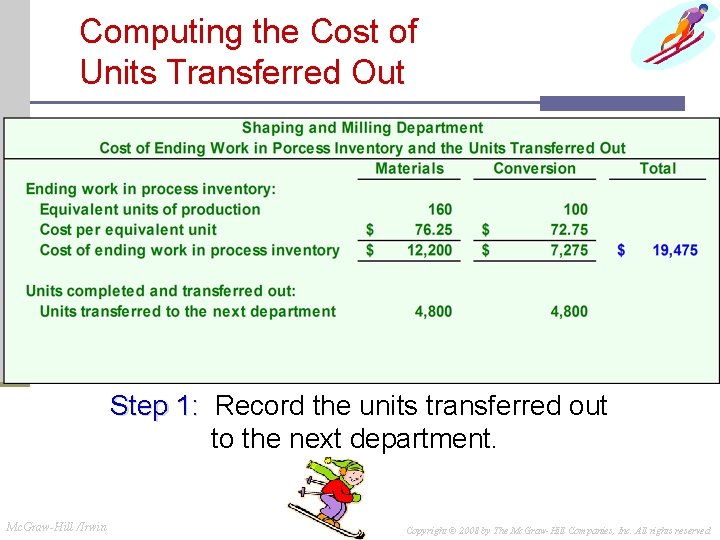
Computing the Cost of Units Transferred Out Step 1: Record the units transferred out to the next department. Mc. Graw-Hill /Irwin Copyright © 2008 by The Mc. Graw-Hill Companies, Inc. All rights reserved.
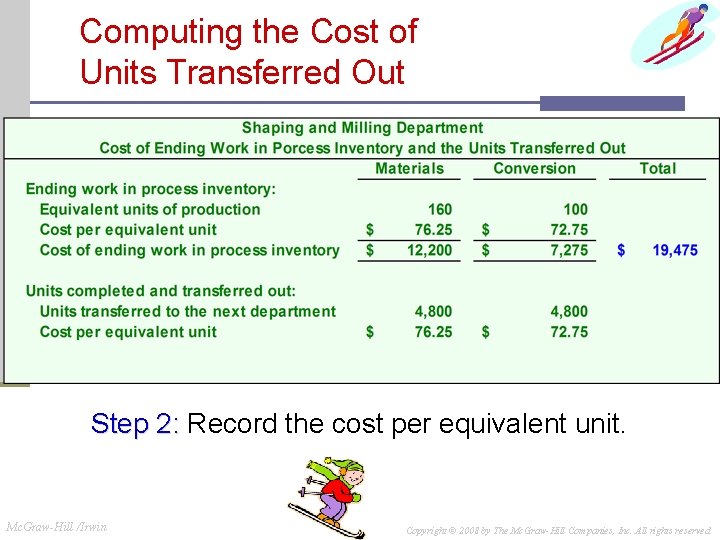
Computing the Cost of Units Transferred Out Step 2: Record the cost per equivalent unit. Mc. Graw-Hill /Irwin Copyright © 2008 by The Mc. Graw-Hill Companies, Inc. All rights reserved.
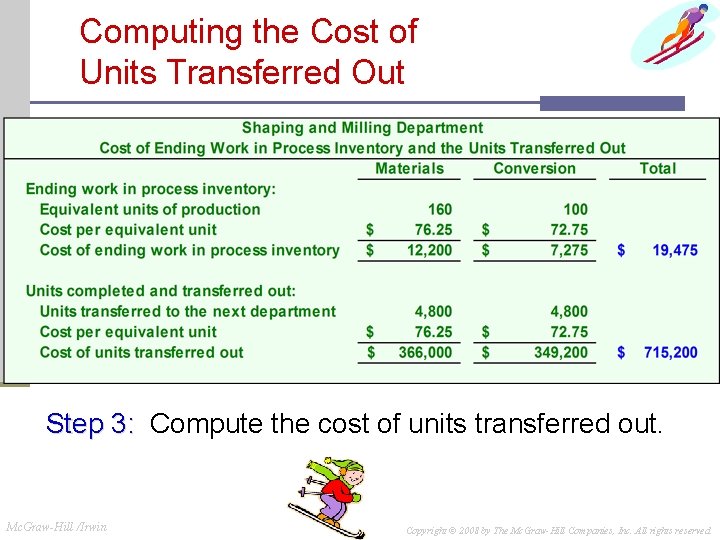
Computing the Cost of Units Transferred Out Step 3: Compute the cost of units transferred out. Mc. Graw-Hill /Irwin Copyright © 2008 by The Mc. Graw-Hill Companies, Inc. All rights reserved.
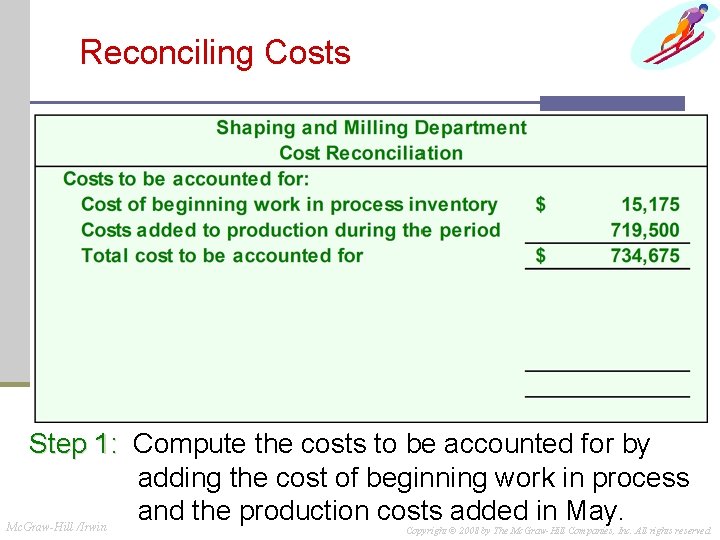
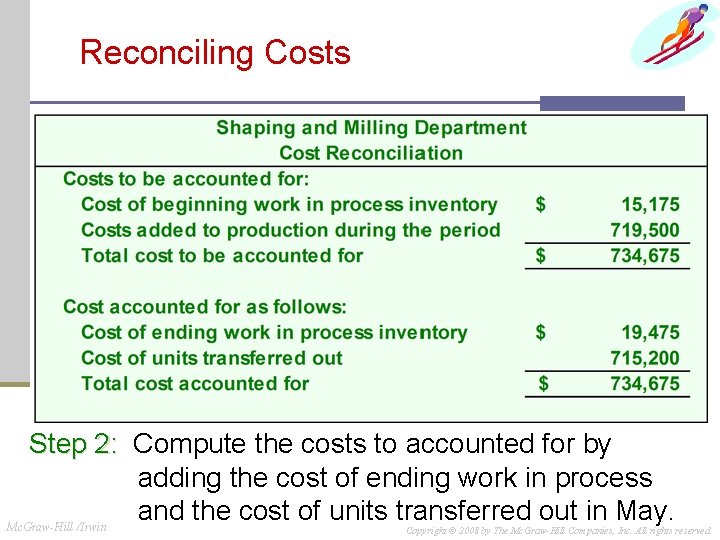
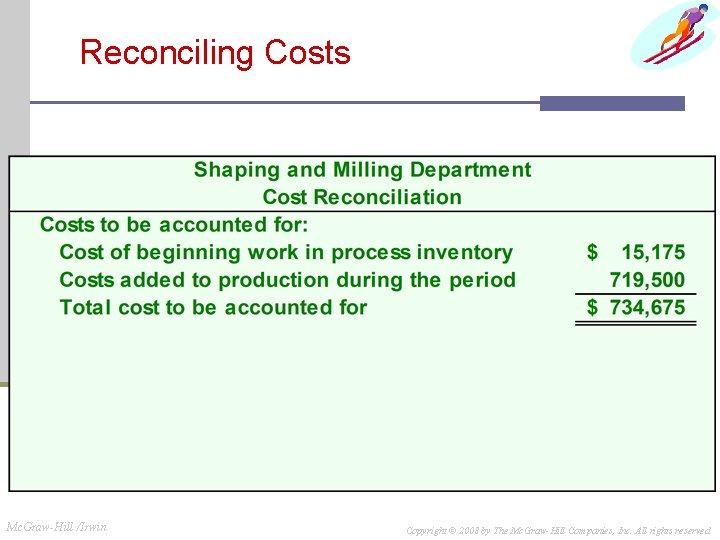
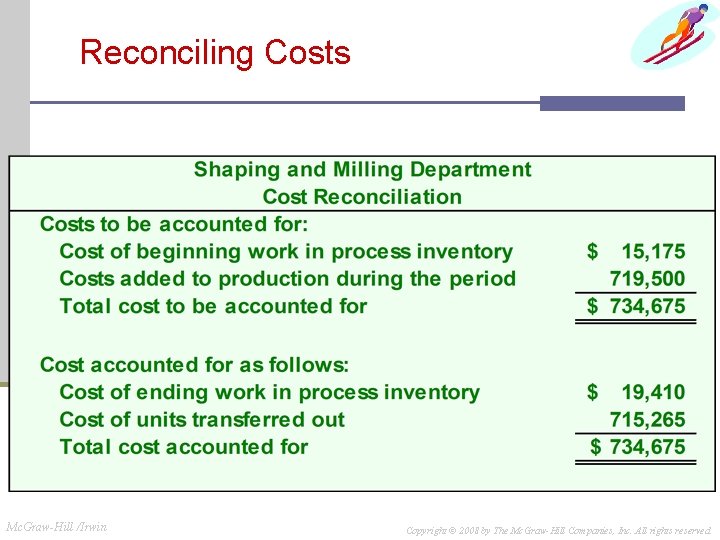
Reconciling Costs Step 1: Compute the costs to be accounted for by adding the cost of beginning work in process and the production costs added in May. Mc. Graw-Hill /Irwin Copyright © 2008 by The Mc. Graw-Hill Companies, Inc. All rights reserved.
Reconciling Costs Step 2: Compute the costs to accounted for by adding the cost of ending work in process and the cost of units transferred out in May. Mc. Graw-Hill /Irwin Copyright © 2008 by The Mc. Graw-Hill Companies, Inc. All rights reserved.
Appendix 4 A FIFO Method Mc. Graw-Hill /Irwin Copyright © 2008 by The Mc. Graw-Hill Companies, Inc. All rights reserved.
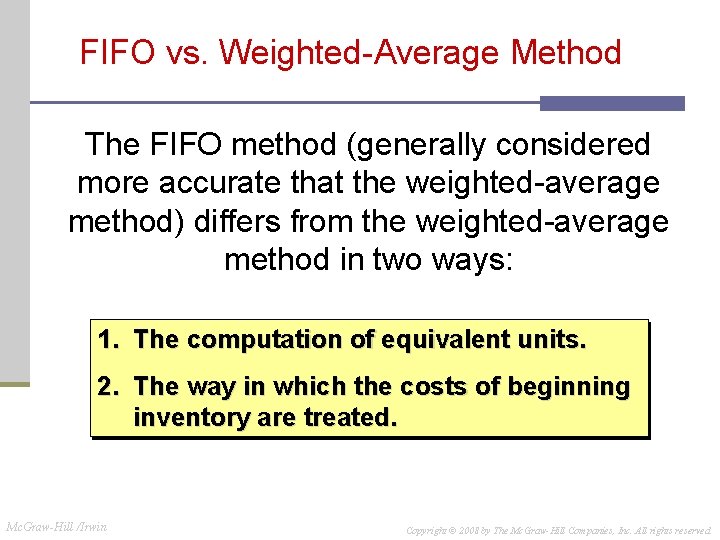
FIFO vs. Weighted-Average Method The FIFO method (generally considered more accurate that the weighted-average method) differs from the weighted-average method in two ways: 1. The computation of equivalent units. 2. The way in which the costs of beginning inventory are treated. Mc. Graw-Hill /Irwin Copyright © 2008 by The Mc. Graw-Hill Companies, Inc. All rights reserved.
Learning Objective 5 Compute the equivalent units of production using the FIFO method. Mc. Graw-Hill /Irwin Copyright © 2008 by The Mc. Graw-Hill Companies, Inc. All rights reserved.
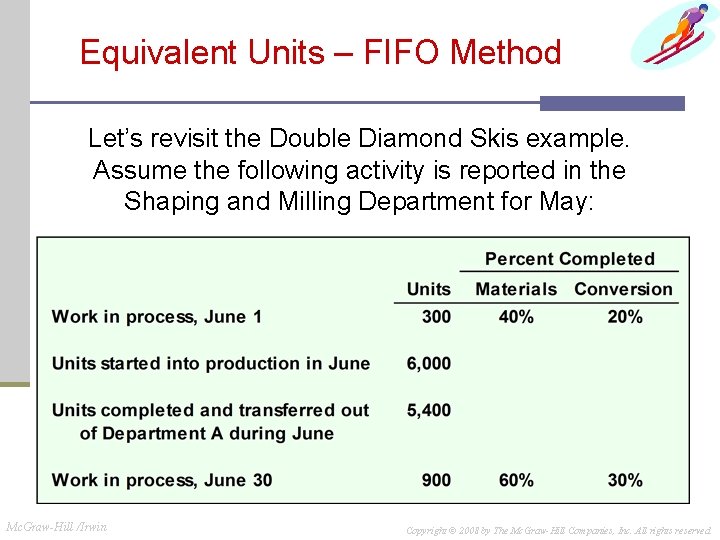
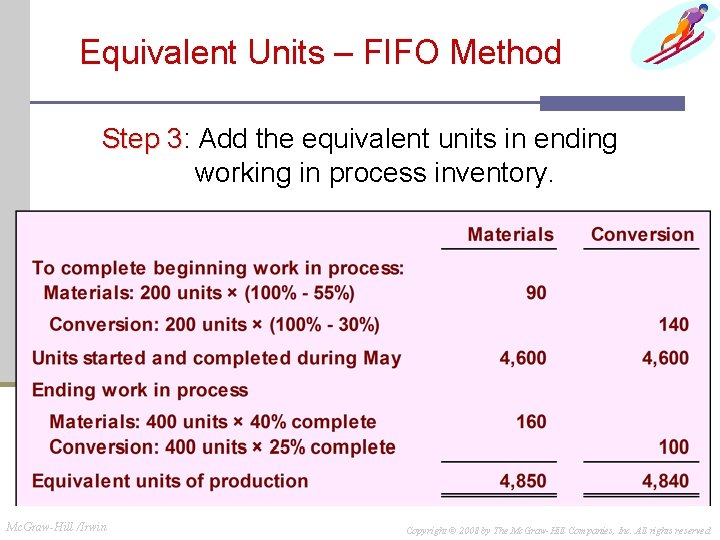
Equivalent Units – FIFO Method Let’s revisit the Double Diamond Skis example. Assume the following activity is reported in the Shaping and Milling Department for May: Mc. Graw-Hill /Irwin Copyright © 2008 by The Mc. Graw-Hill Companies, Inc. All rights reserved.
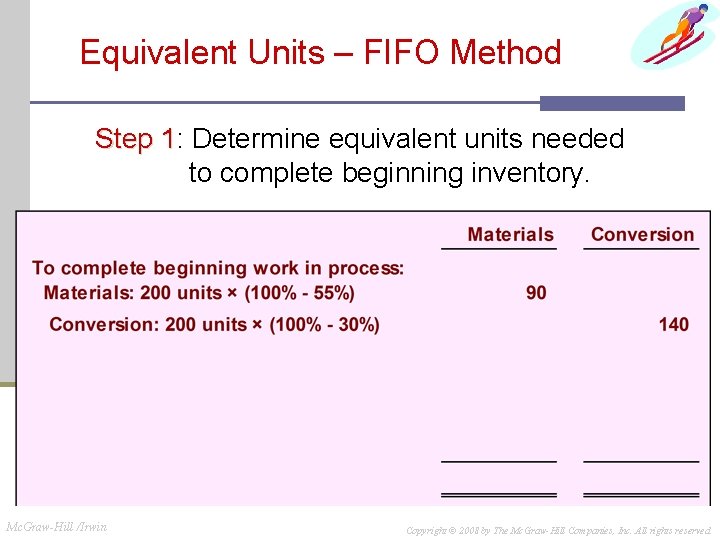
Equivalent Units – FIFO Method Step 1: 1 Determine equivalent units needed to complete beginning inventory. Mc. Graw-Hill /Irwin Copyright © 2008 by The Mc. Graw-Hill Companies, Inc. All rights reserved.
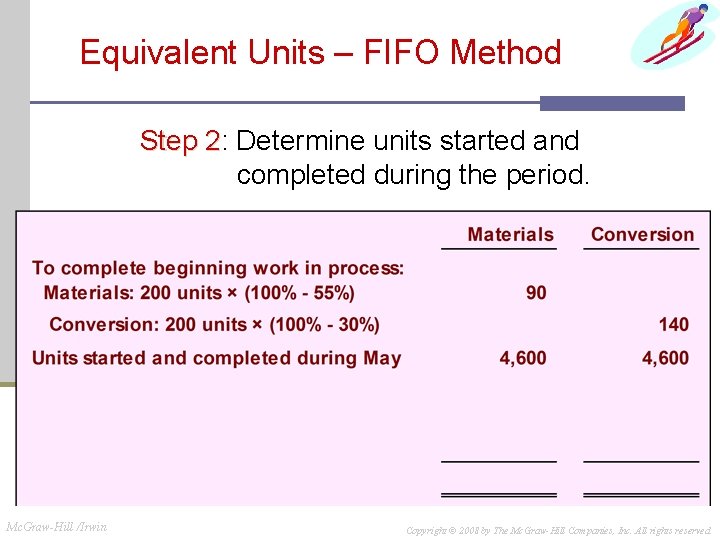
Equivalent Units – FIFO Method Step 2: 2 Determine units started and completed during the period. Mc. Graw-Hill /Irwin Copyright © 2008 by The Mc. Graw-Hill Companies, Inc. All rights reserved.
Equivalent Units – FIFO Method Step 3: 3 Add the equivalent units in ending working in process inventory. Mc. Graw-Hill /Irwin Copyright © 2008 by The Mc. Graw-Hill Companies, Inc. All rights reserved.
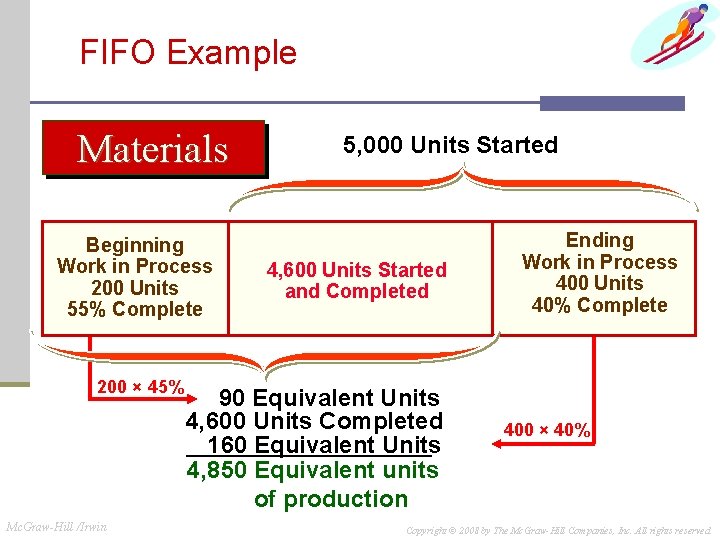
FIFO Example Materials Beginning Work in Process 200 Units 55% Complete 200 × 45% Mc. Graw-Hill /Irwin 5, 000 Units Started 4, 600 Units Started and Completed 90 Equivalent Units 4, 600 Units Completed 160 Equivalent Units 4, 850 Equivalent units of production Ending Work in Process 400 Units 40% Complete 400 × 40% Copyright © 2008 by The Mc. Graw-Hill Companies, Inc. All rights reserved.
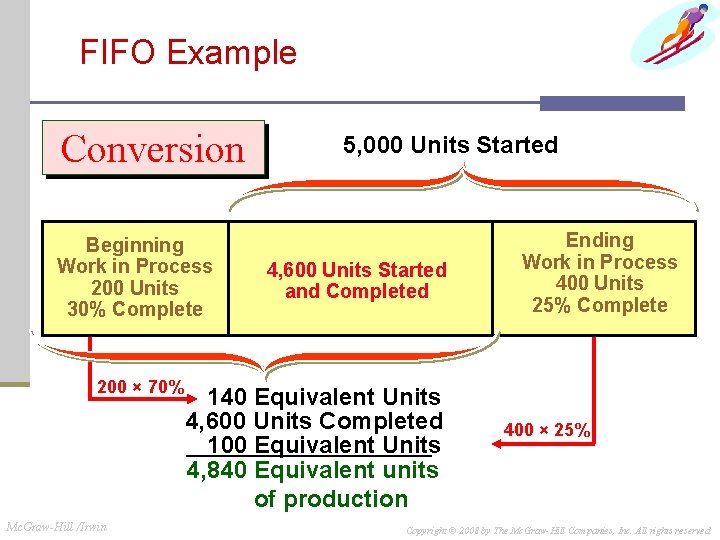
FIFO Example Conversion Beginning Work in Process 200 Units 30% Complete 200 × 70% Mc. Graw-Hill /Irwin 5, 000 Units Started 4, 600 Units Started and Completed 140 Equivalent Units 4, 600 Units Completed 100 Equivalent Units 4, 840 Equivalent units of production Ending Work in Process 400 Units 25% Complete 400 × 25% Copyright © 2008 by The Mc. Graw-Hill Companies, Inc. All rights reserved.
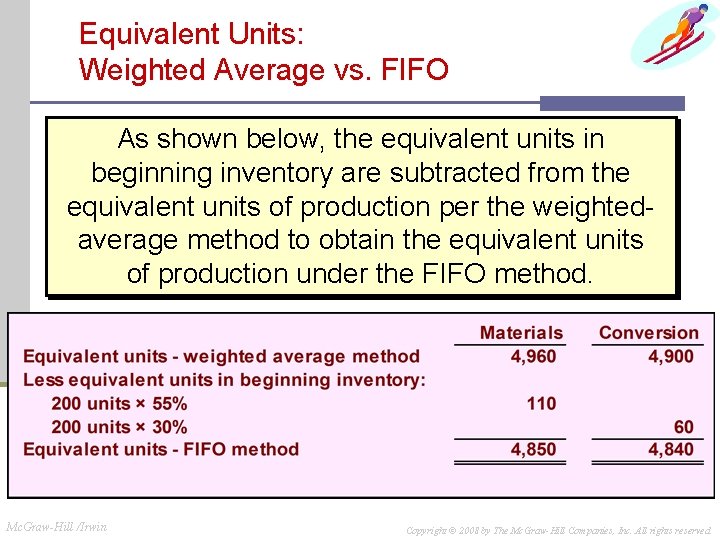
Equivalent Units: Weighted Average vs. FIFO As shown below, the equivalent units in beginning inventory are subtracted from the equivalent units of production per the weightedaverage method to obtain the equivalent units of production under the FIFO method. Mc. Graw-Hill /Irwin Copyright © 2008 by The Mc. Graw-Hill Companies, Inc. All rights reserved.
Learning Objective 6 Compute the cost per equivalent unit using the FIFO method. Mc. Graw-Hill /Irwin Copyright © 2008 by The Mc. Graw-Hill Companies, Inc. All rights reserved.
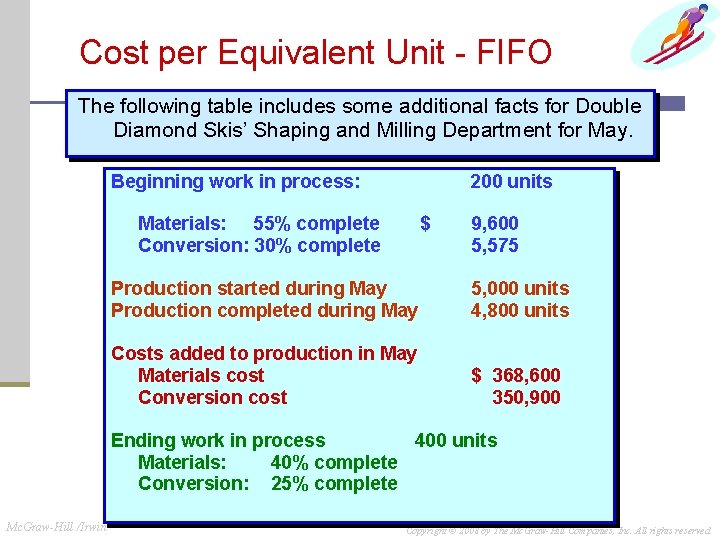
Cost per Equivalent Unit - FIFO The following table includes some additional facts for Double Diamond Skis’ Shaping and Milling Department for May. Beginning work in process: 200 units Materials: 55% complete Conversion: 30% complete $ 9, 600 5, 575 Production started during May Production completed during May 5, 000 units 4, 800 units Costs added to production in May Materials cost Conversion cost $ 368, 600 350, 900 Ending work in process 400 units Materials: 40% complete Conversion: 25% complete Mc. Graw-Hill /Irwin Copyright © 2008 by The Mc. Graw-Hill Companies, Inc. All rights reserved.
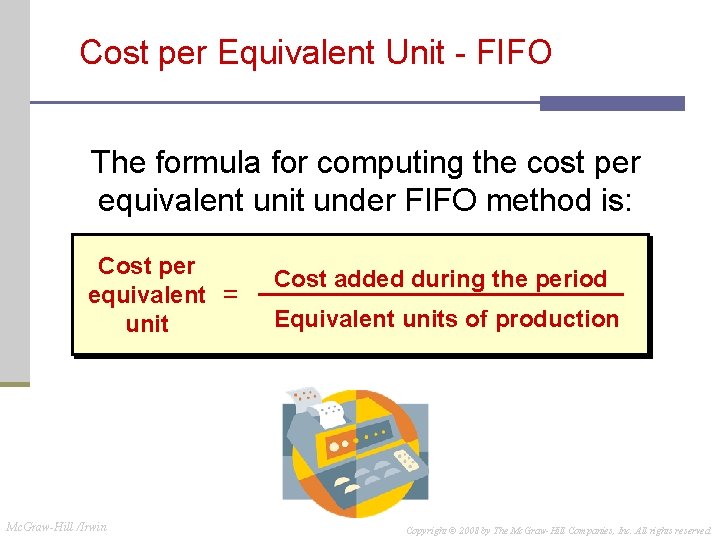
Cost per Equivalent Unit - FIFO The formula for computing the cost per equivalent unit under FIFO method is: Cost per equivalent = unit Mc. Graw-Hill /Irwin Cost added during the period Equivalent units of production Copyright © 2008 by The Mc. Graw-Hill Companies, Inc. All rights reserved.
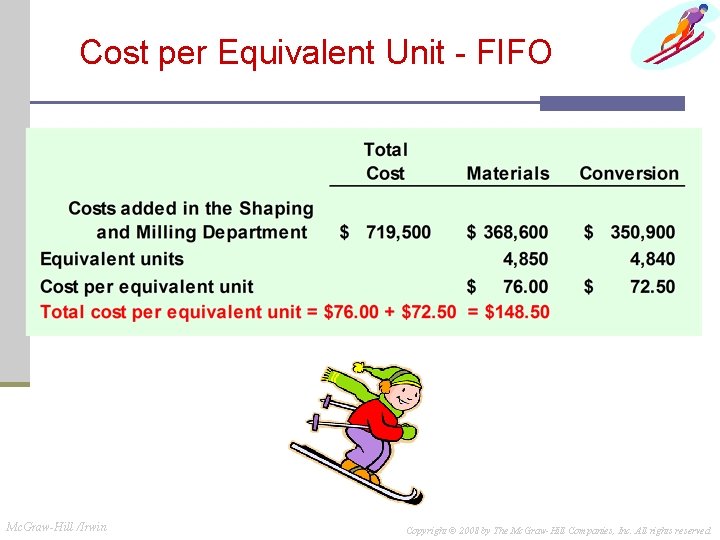
Cost per Equivalent Unit - FIFO Mc. Graw-Hill /Irwin Copyright © 2008 by The Mc. Graw-Hill Companies, Inc. All rights reserved.
Learning Objective 7 Assign costs to units using the FIFO method. Mc. Graw-Hill /Irwin Copyright © 2008 by The Mc. Graw-Hill Companies, Inc. All rights reserved.
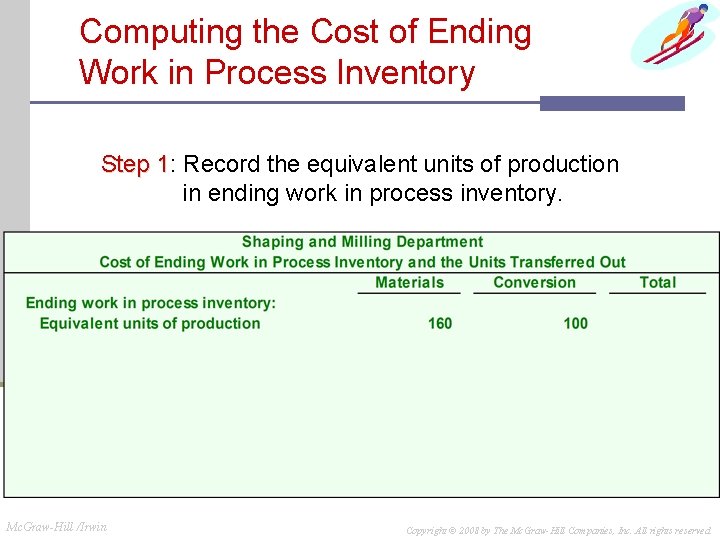
Computing the Cost of Ending Work in Process Inventory Step 1: 1 Record the equivalent units of production in ending work in process inventory. Mc. Graw-Hill /Irwin Copyright © 2008 by The Mc. Graw-Hill Companies, Inc. All rights reserved.
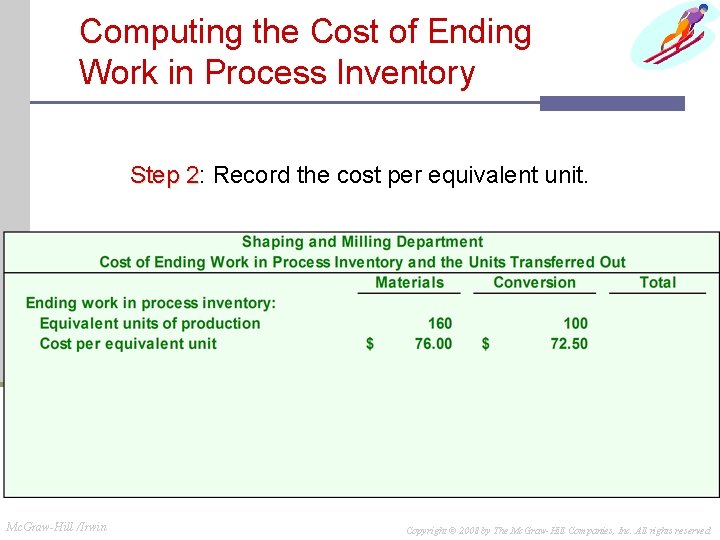
Computing the Cost of Ending Work in Process Inventory Step 2: 2 Record the cost per equivalent unit. Mc. Graw-Hill /Irwin Copyright © 2008 by The Mc. Graw-Hill Companies, Inc. All rights reserved.
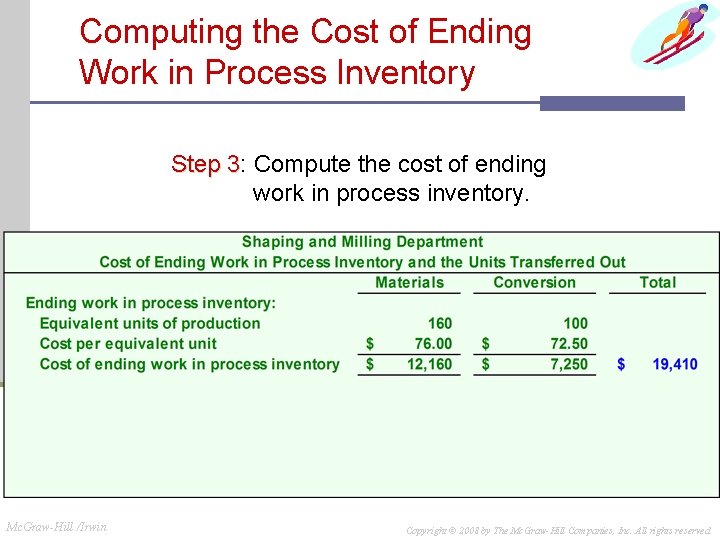
Computing the Cost of Ending Work in Process Inventory Step 3: 3 Compute the cost of ending work in process inventory. Mc. Graw-Hill /Irwin Copyright © 2008 by The Mc. Graw-Hill Companies, Inc. All rights reserved.
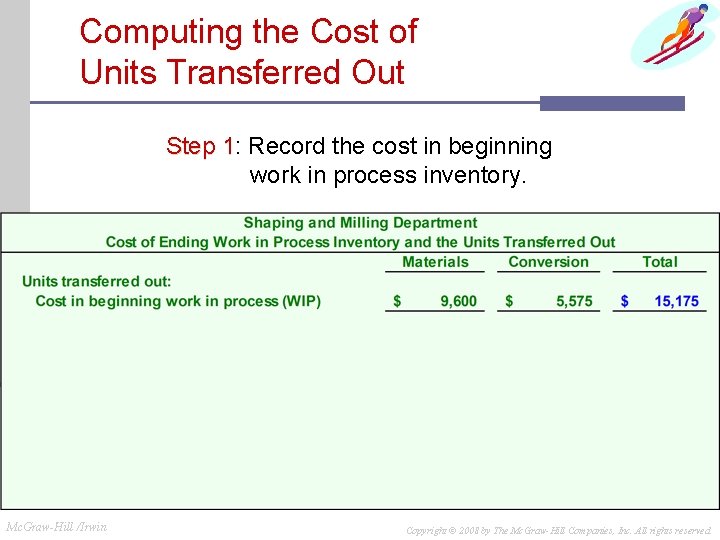
Computing the Cost of Units Transferred Out Step 1: 1 Record the cost in beginning work in process inventory. Mc. Graw-Hill /Irwin Copyright © 2008 by The Mc. Graw-Hill Companies, Inc. All rights reserved.
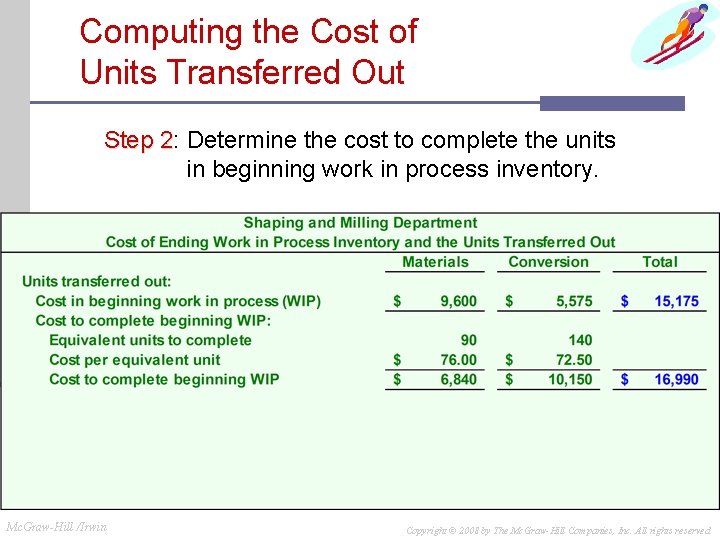
Computing the Cost of Units Transferred Out Step 2: 2 Determine the cost to complete the units in beginning work in process inventory. Mc. Graw-Hill /Irwin Copyright © 2008 by The Mc. Graw-Hill Companies, Inc. All rights reserved.
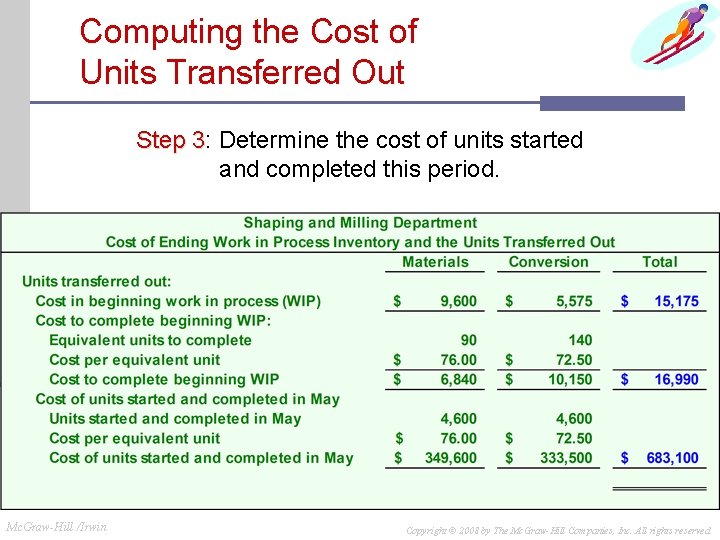
Computing the Cost of Units Transferred Out Step 3: 3 Determine the cost of units started and completed this period. Mc. Graw-Hill /Irwin Copyright © 2008 by The Mc. Graw-Hill Companies, Inc. All rights reserved.
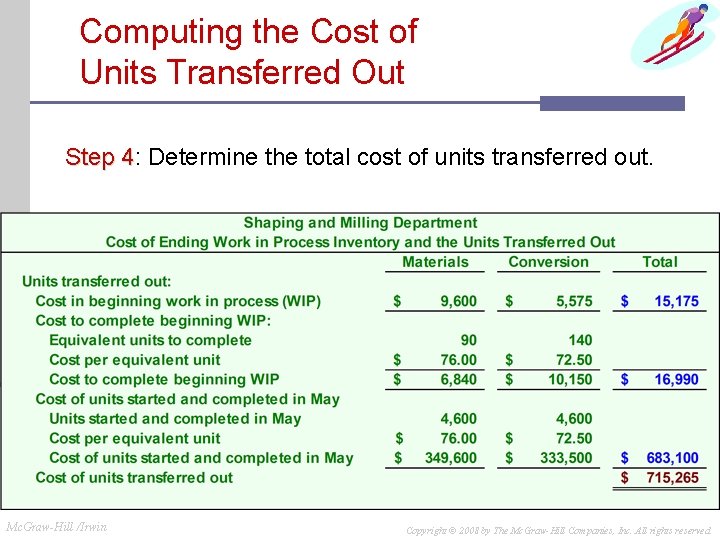
Computing the Cost of Units Transferred Out Step 4: 4 Determine the total cost of units transferred out. Mc. Graw-Hill /Irwin Copyright © 2008 by The Mc. Graw-Hill Companies, Inc. All rights reserved.
Reconciling Costs Mc. Graw-Hill /Irwin Copyright © 2008 by The Mc. Graw-Hill Companies, Inc. All rights reserved.
Reconciling Costs Mc. Graw-Hill /Irwin Copyright © 2008 by The Mc. Graw-Hill Companies, Inc. All rights reserved.
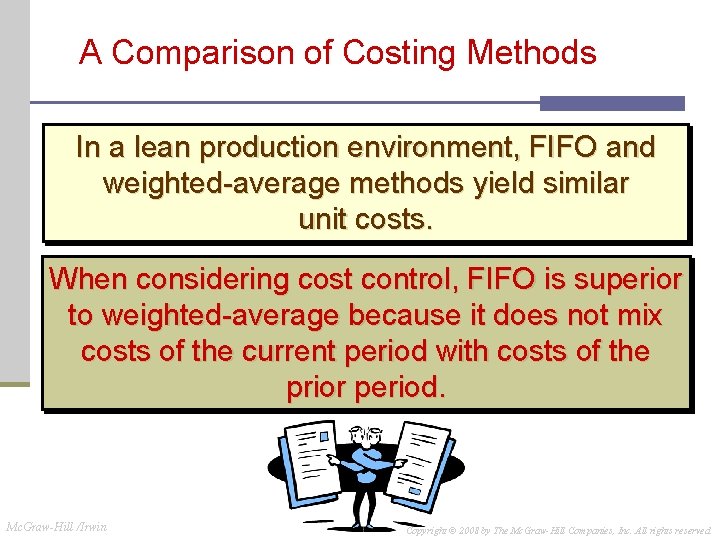
A Comparison of Costing Methods In a lean production environment, FIFO and weighted-average methods yield similar unit costs. When considering cost control, FIFO is superior to weighted-average because it does not mix costs of the current period with costs of the prior period. Mc. Graw-Hill /Irwin Copyright © 2008 by The Mc. Graw-Hill Companies, Inc. All rights reserved.
End of Chapter 4 Mc. Graw-Hill /Irwin Copyright © 2008 by The Mc. Graw-Hill Companies, Inc. All rights reserved.