
Chapter 4 Stochastic calculus 4 2 Itos Integral




- Slides: 36
Chapter 4 Stochastic calculus 4. 2 Ito’s Integral for Simple Integrands 報告者: 0253924張錦炘 0253926沈宣佑
Martingale
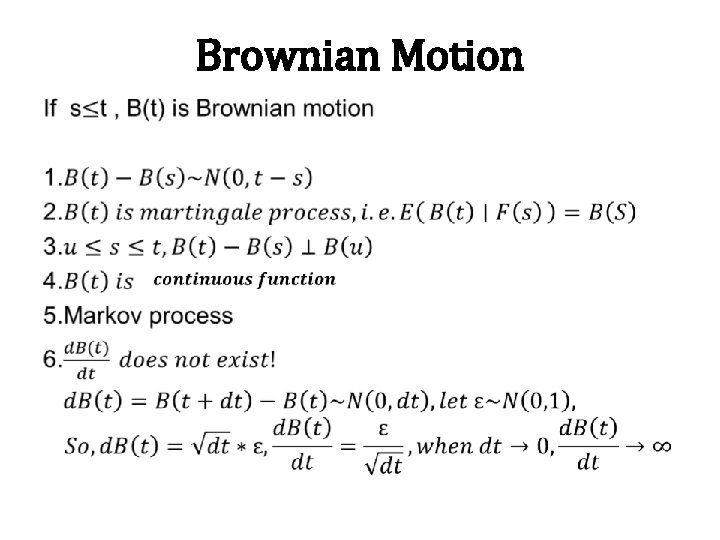
Brownian Motion
4. 2 Ito’s Integral for Simple Integrands (4. 2. 1)
Reason for doing this:
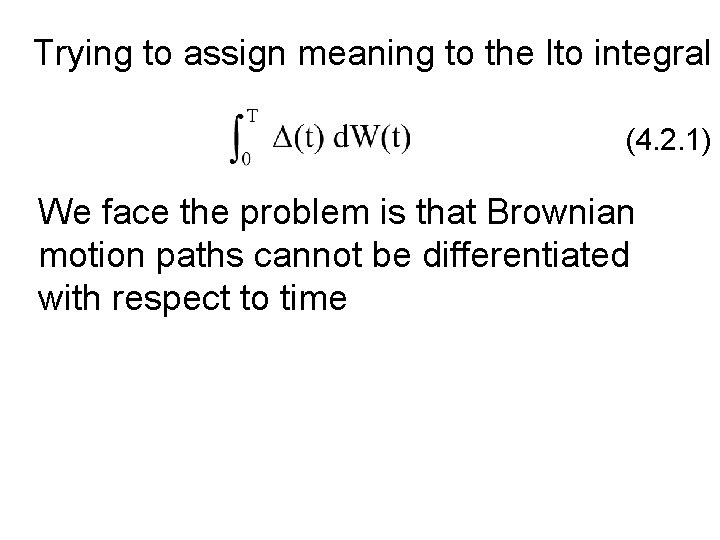
Trying to assign meaning to the Ito integral (4. 2. 1) We face the problem is that Brownian motion paths cannot be differentiated with respect to time
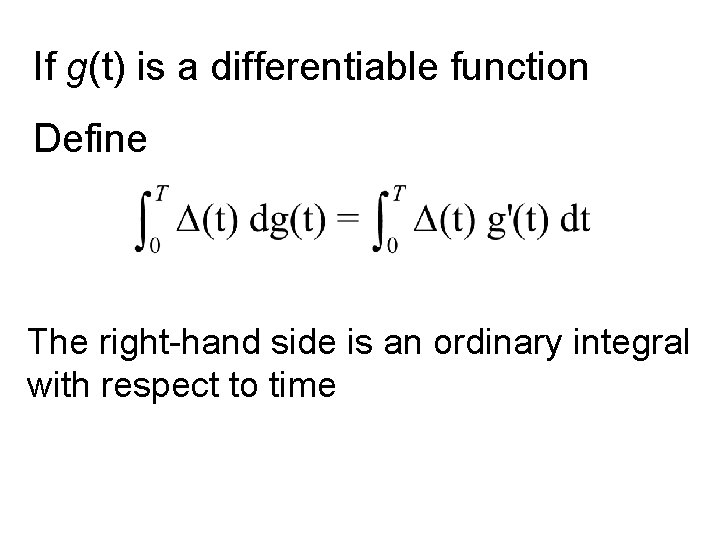
If g(t) is a differentiable function Define The right-hand side is an ordinary integral with respect to time
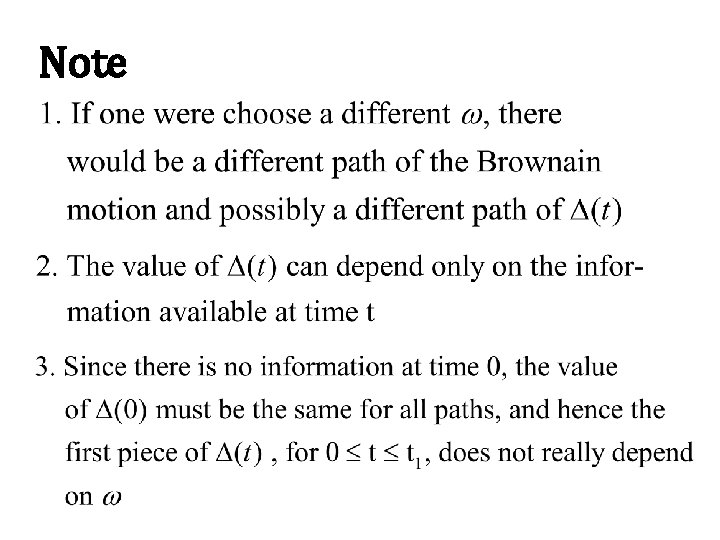
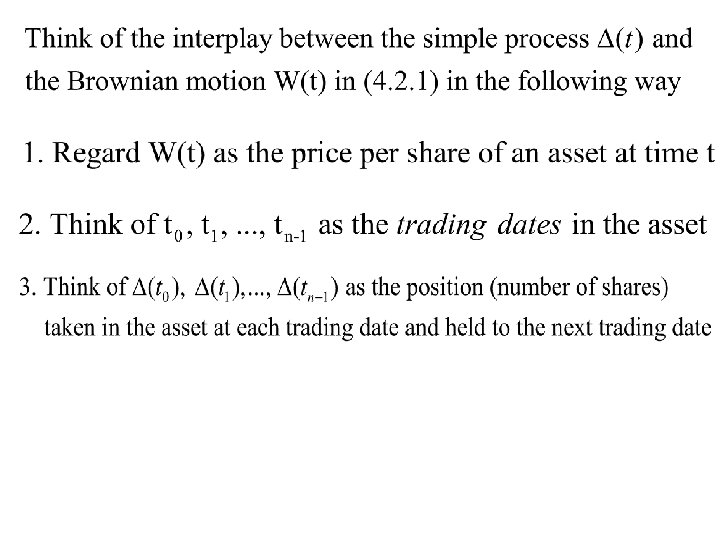
4. 2. 1 Construction of the Integral To define the integral (4. 2. 1), Ito devised the following way around the nondifferentiability of the Brownian motion paths We first define the simple integrands, and then extend it to non-simple integrands as a limit of the integral of simple integrands
Note
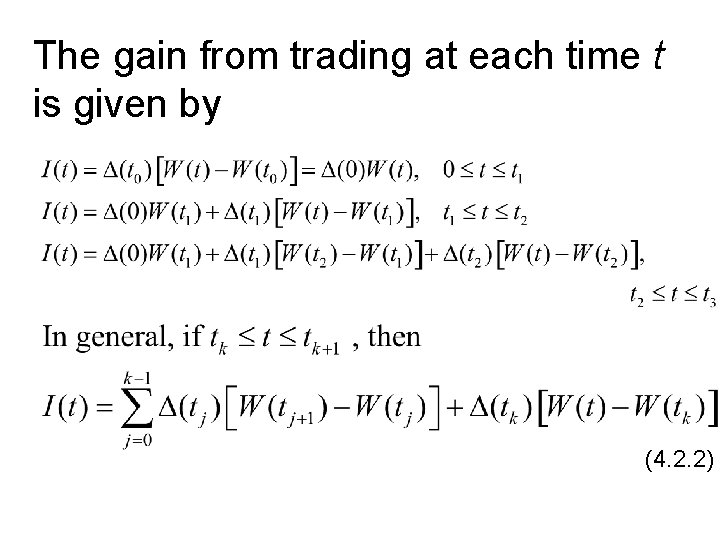
The gain from trading at each time t is given by (4. 2. 2)
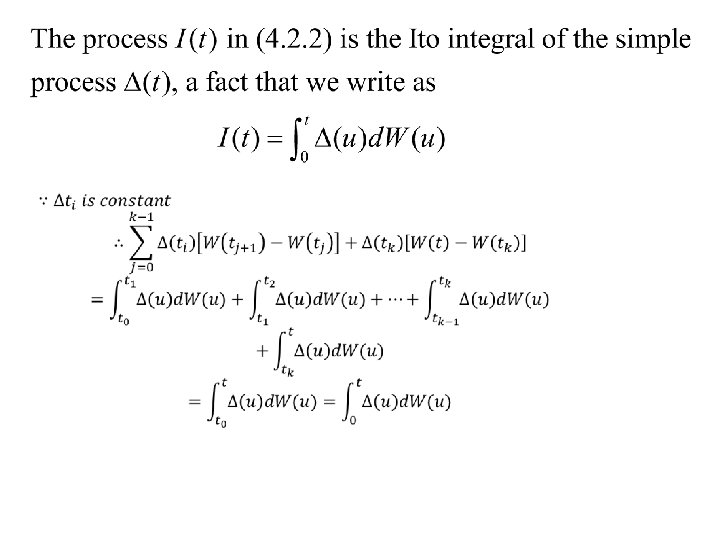
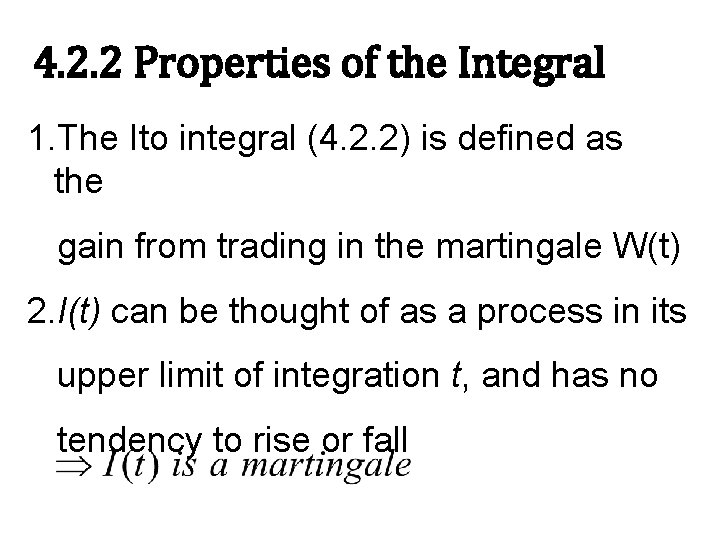
4. 2. 2 Properties of the Integral 1. The Ito integral (4. 2. 2) is defined as the gain from trading in the martingale W(t) 2. I(t) can be thought of as a process in its upper limit of integration t, and has no tendency to rise or fall
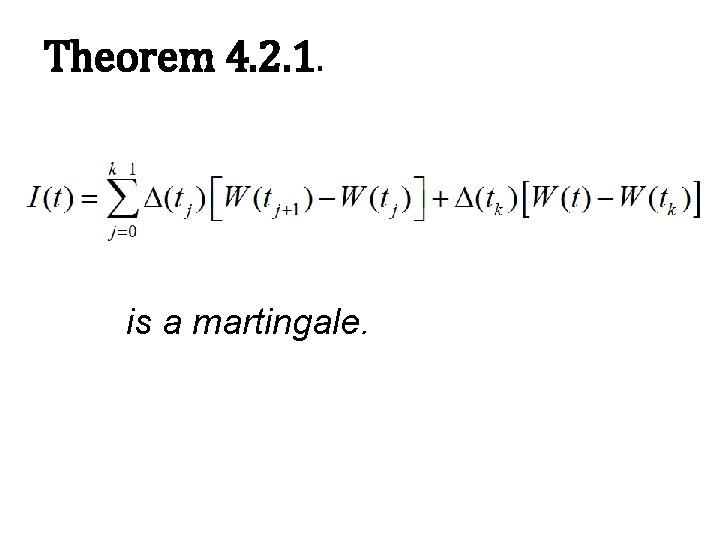
Theorem 4. 2. 1. is a martingale.
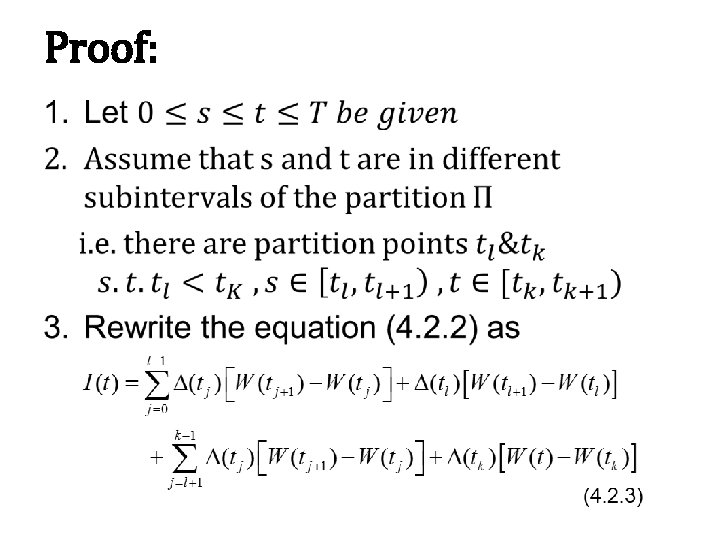
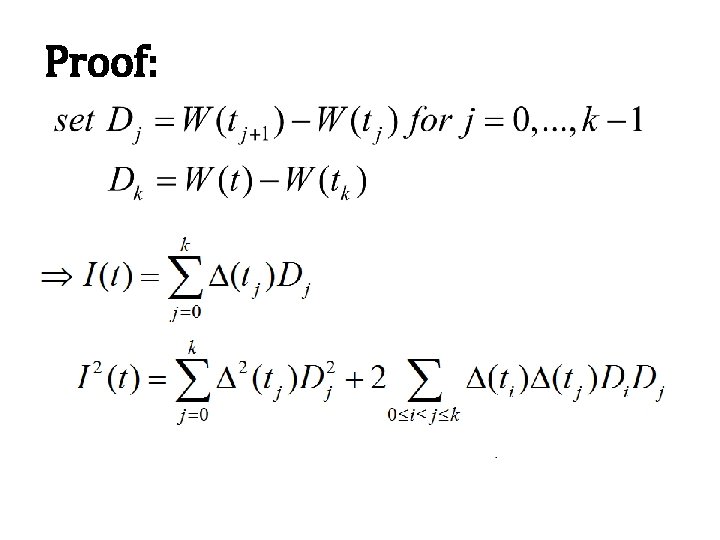
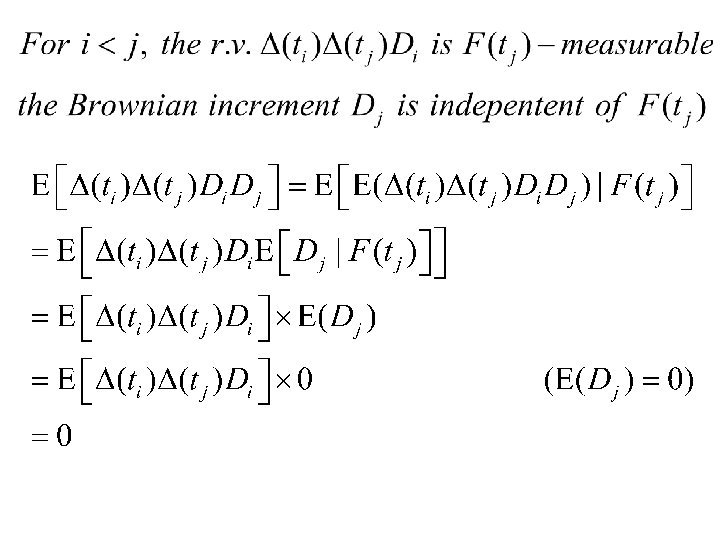
Proof: •
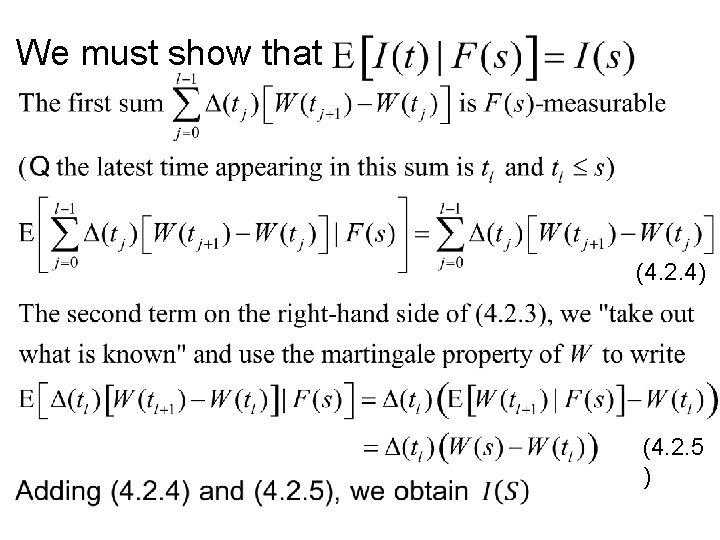
We must show that (4. 2. 4) (4. 2. 5 )
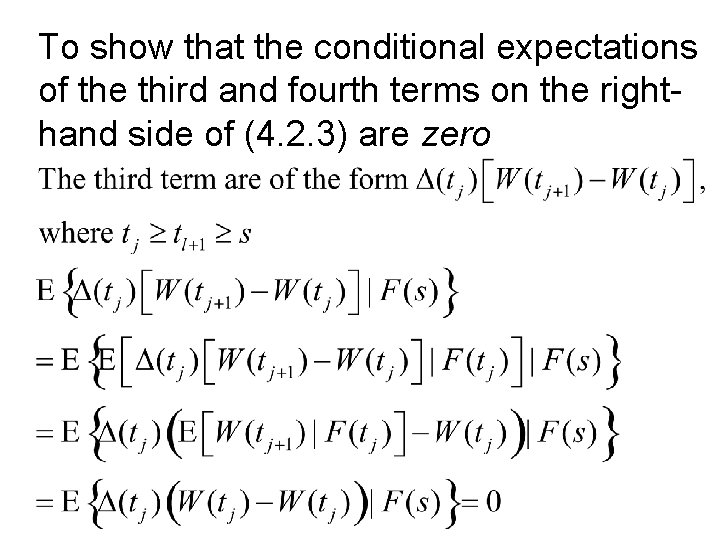
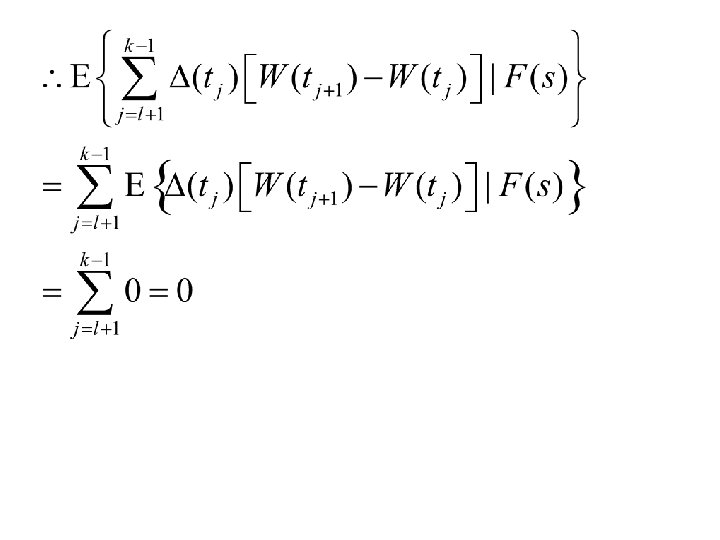
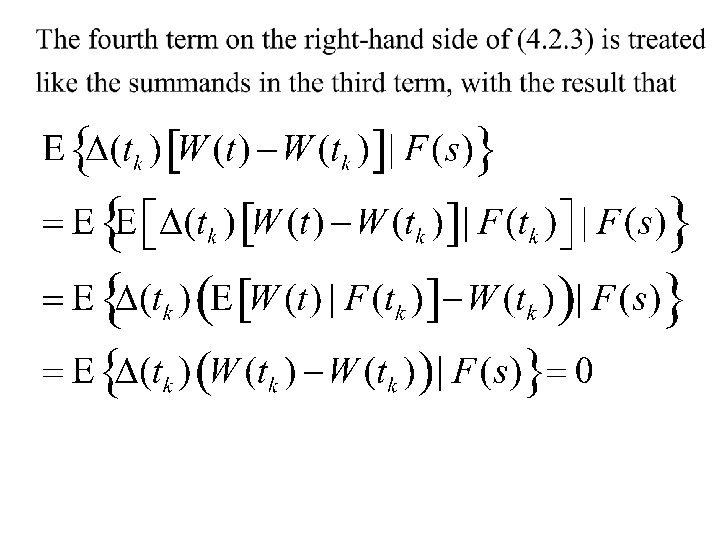
To show that the conditional expectations of the third and fourth terms on the righthand side of (4. 2. 3) are zero
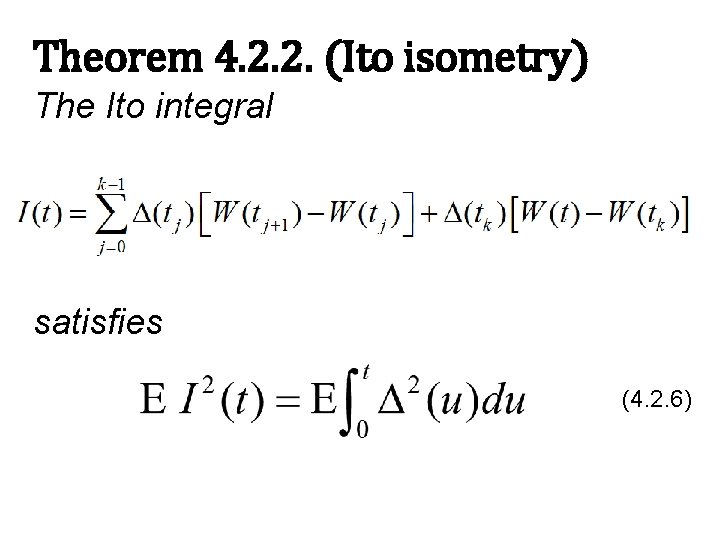
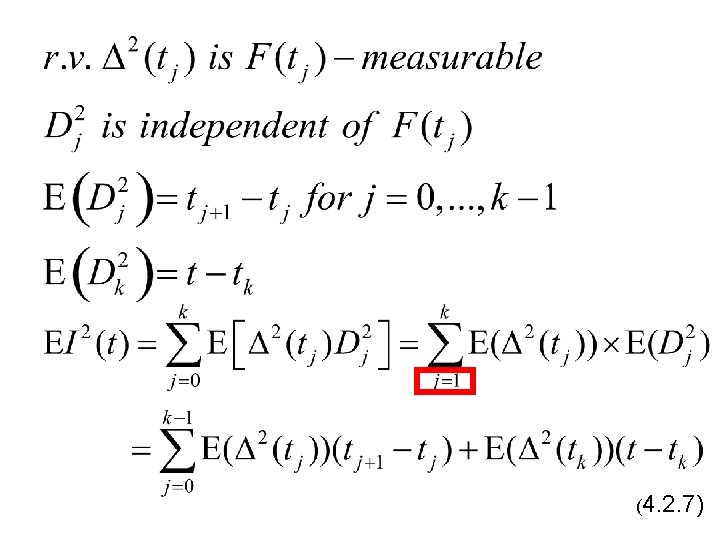
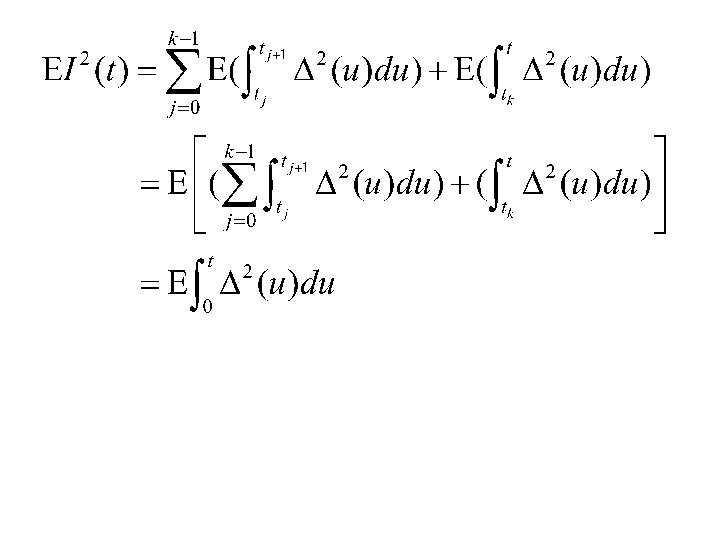
Theorem 4. 2. 2. (Ito isometry) The Ito integral satisfies (4. 2. 6)
Proof:
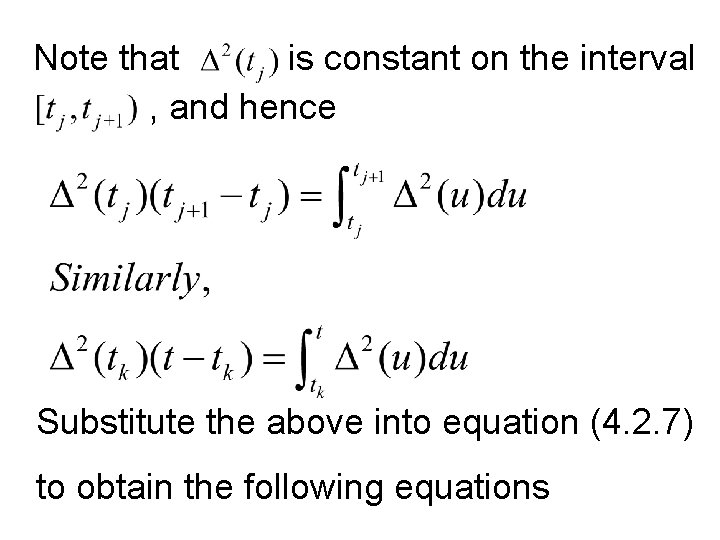
Note that is constant on the interval , and hence Substitute the above into equation (4. 2. 7) to obtain the following equations
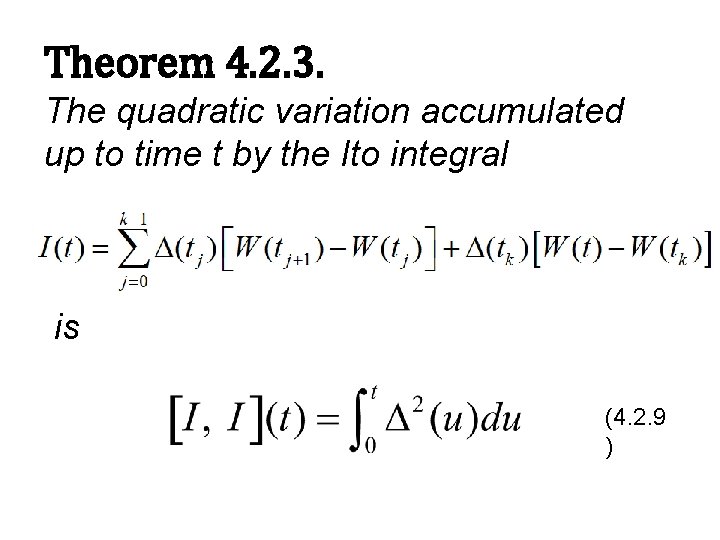
Theorem 4. 2. 3. The quadratic variation accumulated up to time t by the Ito integral is (4. 2. 9 )
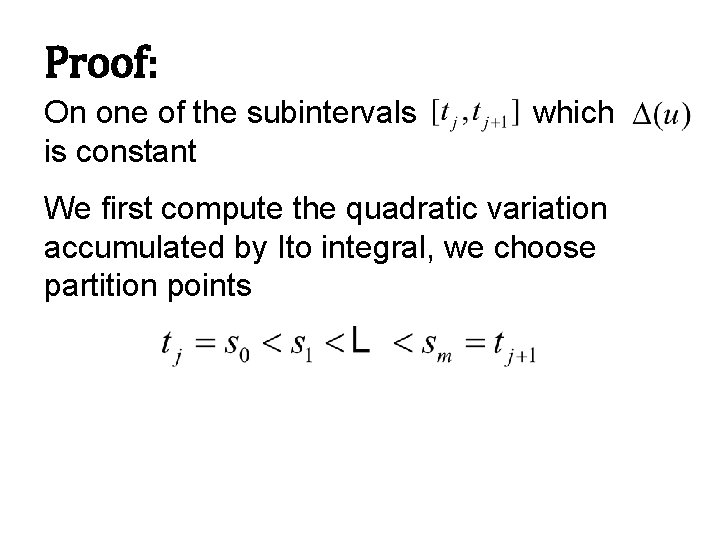
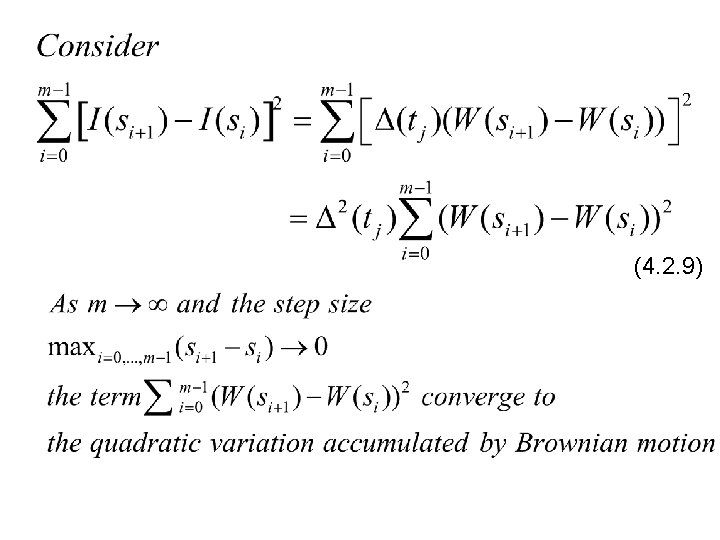
Proof: On one of the subintervals is constant which We first compute the quadratic variation accumulated by Ito integral, we choose partition points
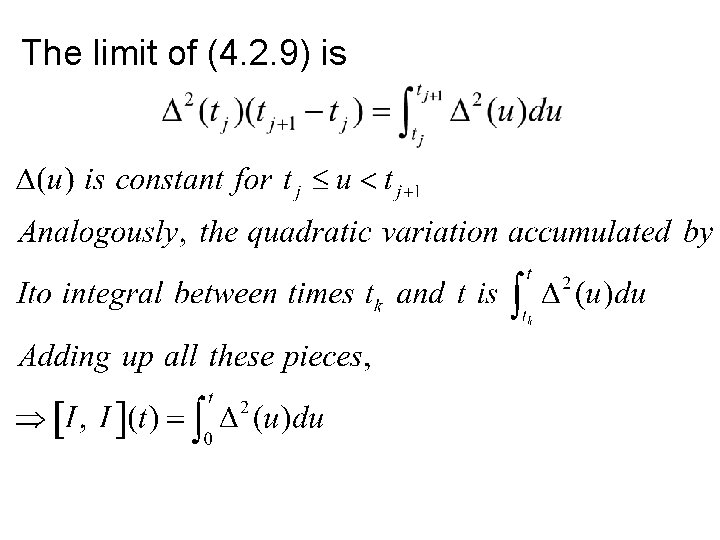
The limit of (4. 2. 9) is
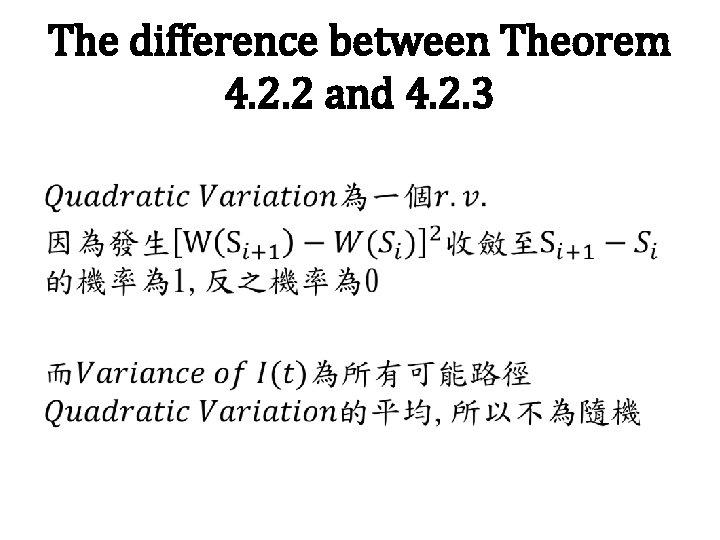
The difference between Theorem 4. 2. 2 and 4. 2. 3 • The quadratic variation – is computed path-by-path, and result can depend on the path – can be regard as a measure of risk – depend on the size of the position we take • The variance of I(t) – Is an average over all possible paths of quadratic variation – can’t be random
The difference between Theorem 4. 2. 2 and 4. 2. 3 •
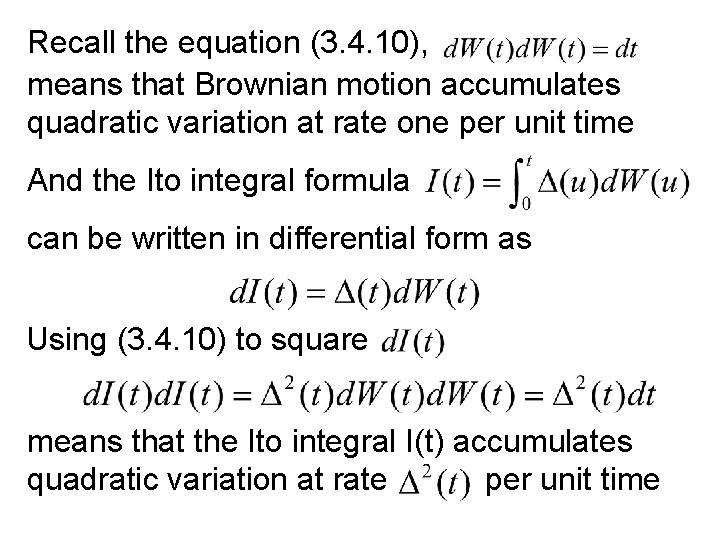
Recall the equation (3. 4. 10), means that Brownian motion accumulates quadratic variation at rate one per unit time And the Ito integral formula can be written in differential form as Using (3. 4. 10) to square means that the Ito integral I(t) accumulates quadratic variation at rate per unit time
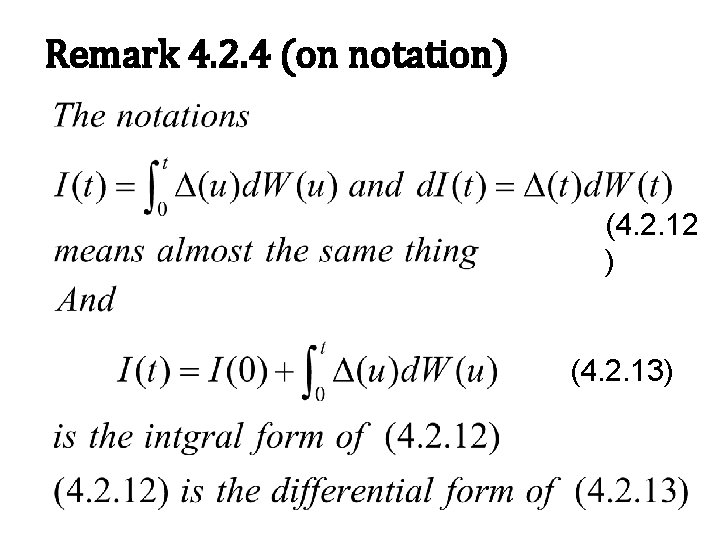
Remark 4. 2. 4 (on notation) (4. 2. 12 ) (4. 2. 13)