
Chapter 4 Software Process Models What is a
- Slides: 33
Chapter 4: Software Process Models
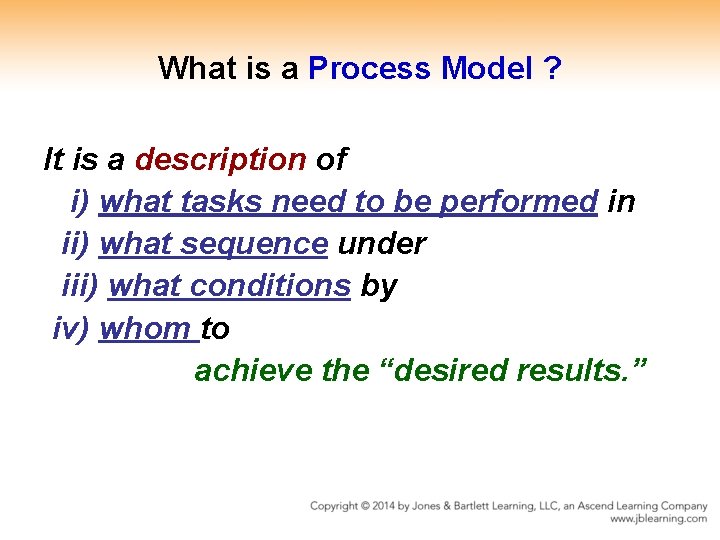
What is a Process Model ? It is a description of i) what tasks need to be performed in ii) what sequence under iii) what conditions by iv) whom to achieve the “desired results. ”
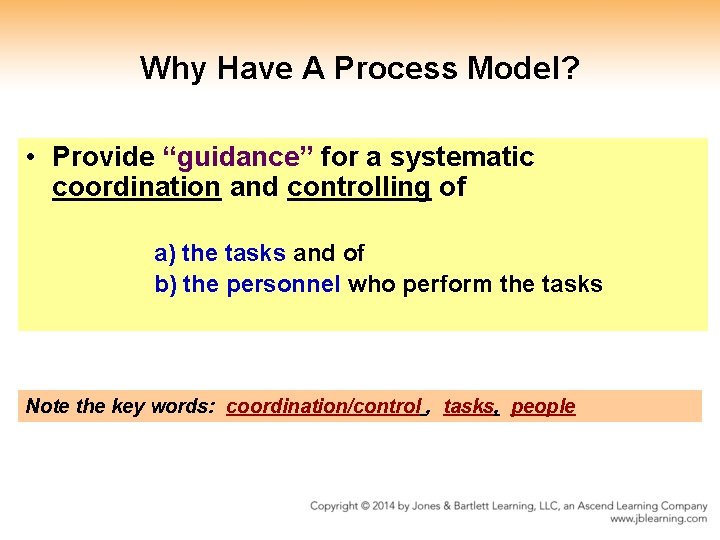
Why Have A Process Model? • Provide “guidance” for a systematic coordination and controlling of a) the tasks and of b) the personnel who perform the tasks Note the key words: coordination/control , tasks, people
Do we need a process if the project requires just 1 person or at most two people? Why? -- Why not ?
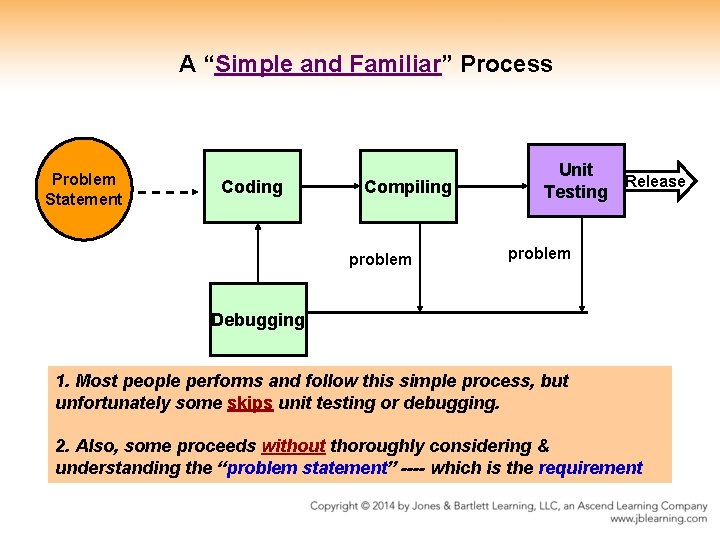
A “Simple and Familiar” Process Problem Statement Coding Compiling problem Unit Release Testing problem Debugging 1. Most people performs and follow this simple process, but unfortunately some skips unit testing or debugging. 2. Also, some proceeds without thoroughly considering & understanding the “problem statement” ---- which is the requirement
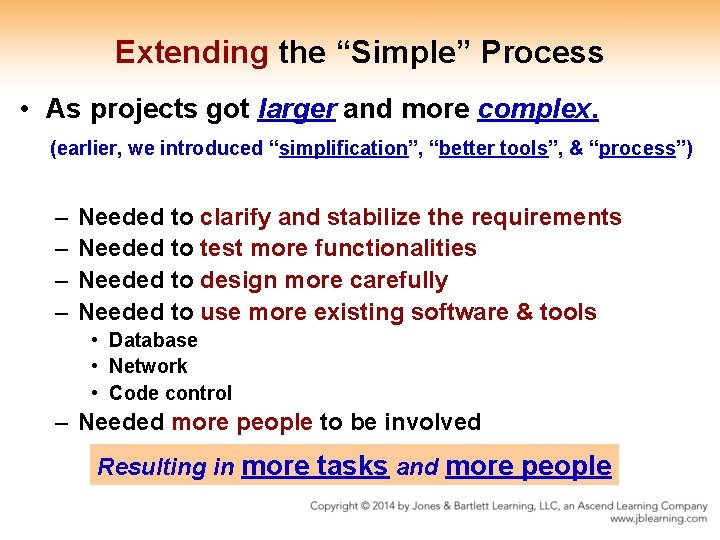
Extending the “Simple” Process • As projects got larger and more complex. (earlier, we introduced “simplification”, “better tools”, & “process”) – – Needed to clarify and stabilize the requirements Needed to test more functionalities Needed to design more carefully Needed to use more existing software & tools • Database • Network • Code control – Needed more people to be involved Resulting in more tasks and more people
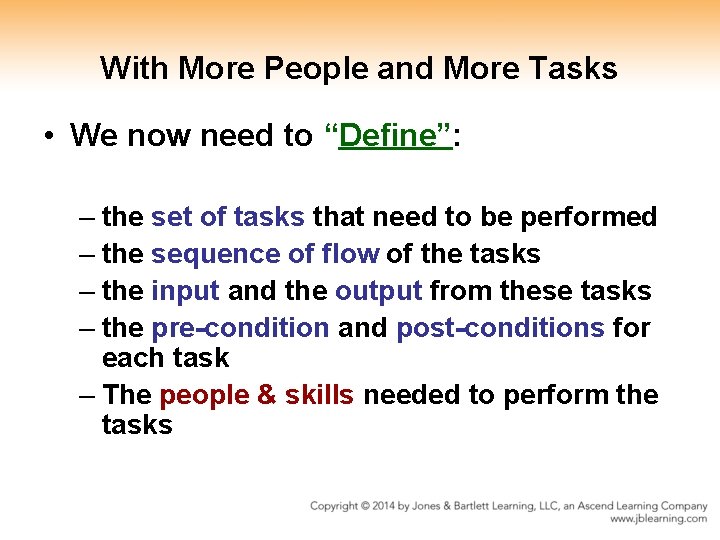
With More People and More Tasks • We now need to “Define”: – the set of tasks that need to be performed – the sequence of flow of the tasks – the input and the output from these tasks – the pre-condition and post-conditions for each task – The people & skills needed to perform the tasks
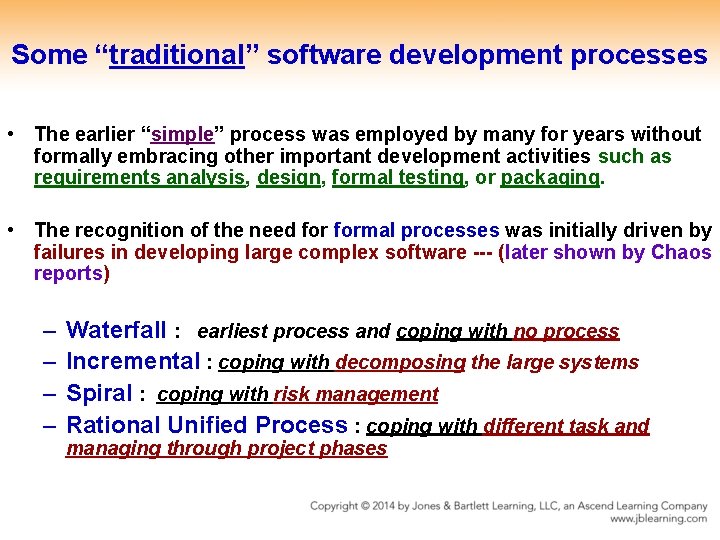
Some “traditional” software development processes • The earlier “simple” process was employed by many for years without formally embracing other important development activities such as requirements analysis, design, formal testing, or packaging. • The recognition of the need formal processes was initially driven by failures in developing large complex software --- (later shown by Chaos reports) – – Waterfall : earliest process and coping with no process Incremental : coping with decomposing the large systems Spiral : coping with risk management Rational Unified Process : coping with different task and managing through project phases
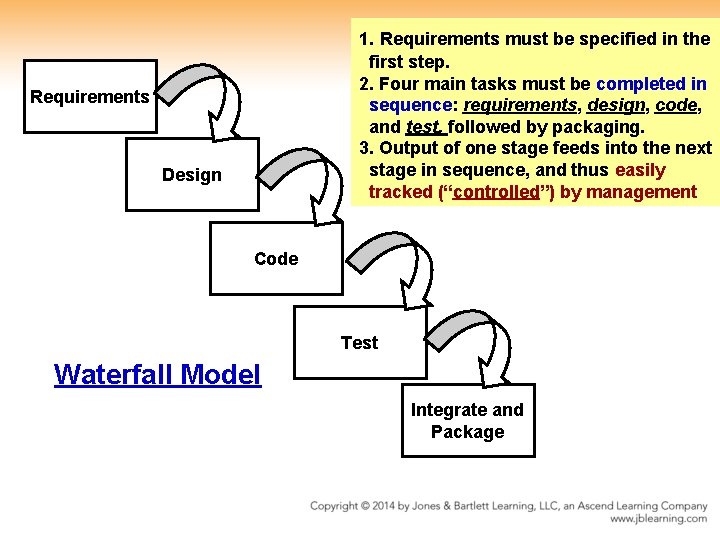
1. Requirements must be specified in the first step. 2. Four main tasks must be completed in sequence: requirements, design, code, and test, followed by packaging. 3. Output of one stage feeds into the next stage in sequence, and thus easily tracked (“controlled”) by management Requirements Design Code Test Waterfall Model Integrate and Package
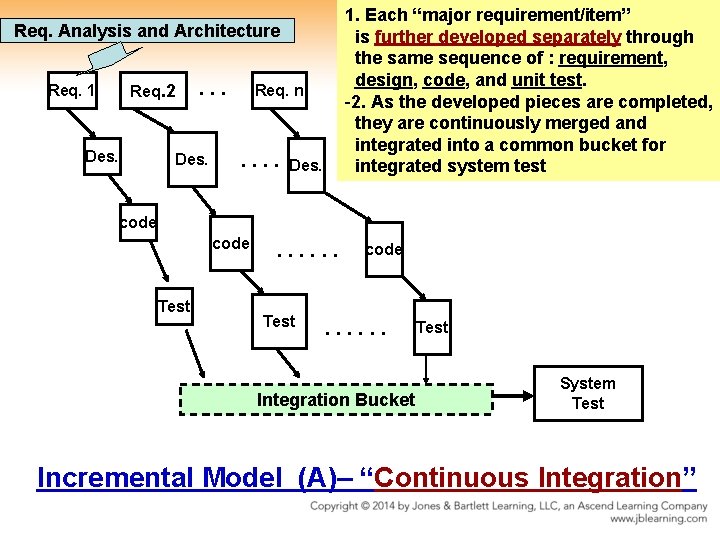
1. Each “major requirement/item” is further developed separately through the same sequence of : requirement, design, code, and unit test. -2. As the developed pieces are completed, they are continuously merged and integrated into a common bucket for integrated system test Req. Analysis and Architecture Req. 1 Req. 2 Des. Req. n . . Des. code Test . . . Test code . . . Integration Bucket Test System Test Incremental Model (A)– “Continuous Integration”
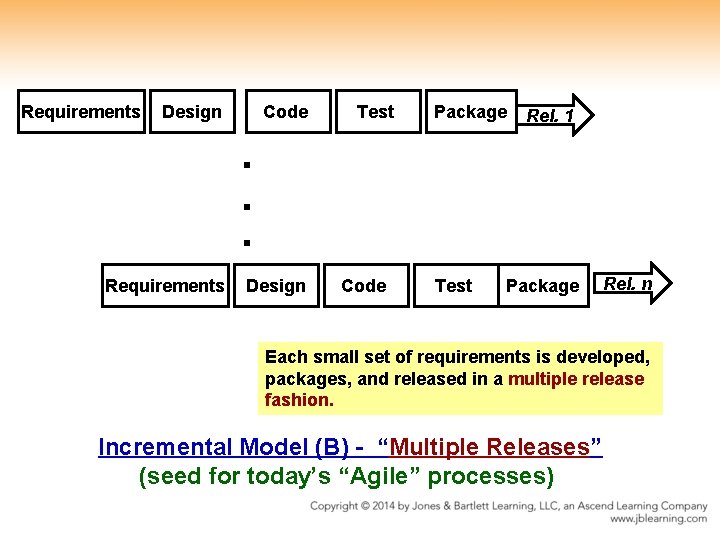
Requirements Design Code Test Package Rel. 1 . . . Requirements Design Code Test Package Rel. n Each small set of requirements is developed, packages, and released in a multiple release fashion. Incremental Model (B) - “Multiple Releases” (seed for today’s “Agile” processes)
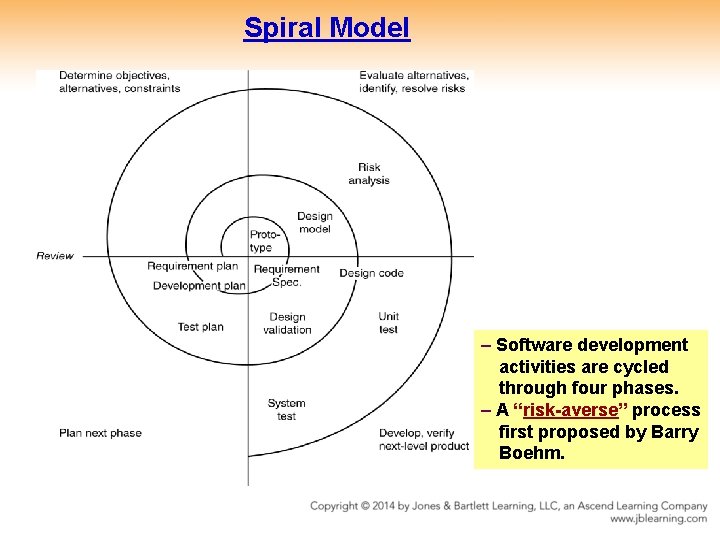
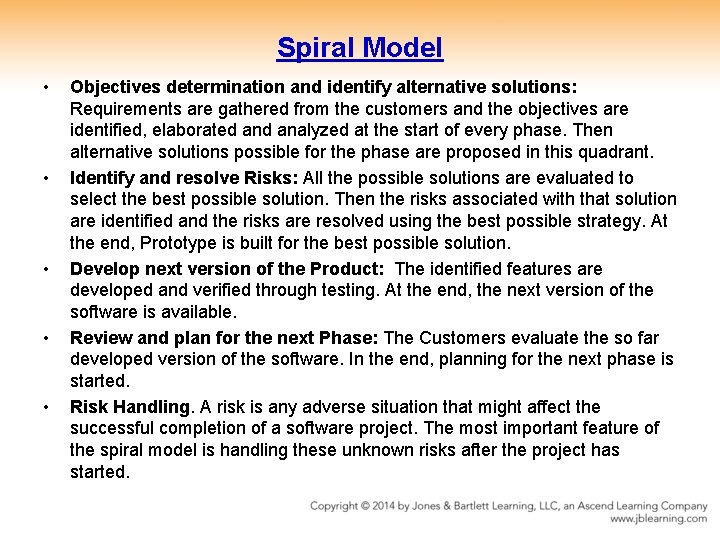
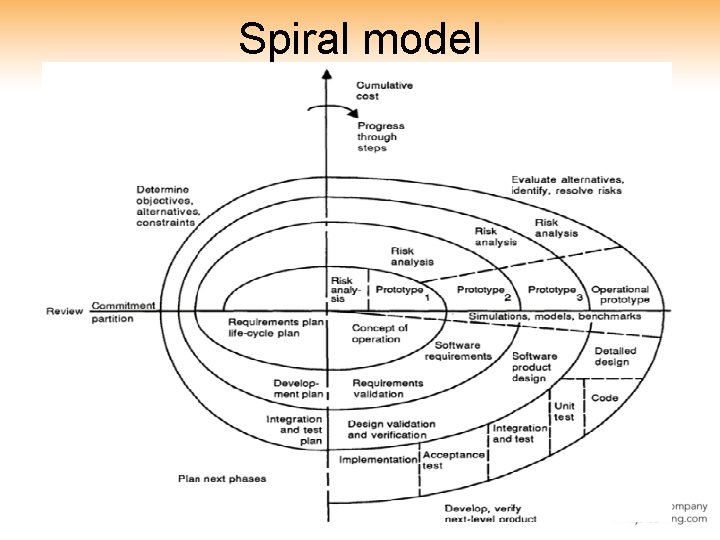
Spiral Model – Software development activities are cycled through four phases. – A “risk-averse” process first proposed by Barry Boehm.
Spiral Model • • • Objectives determination and identify alternative solutions: Requirements are gathered from the customers and the objectives are identified, elaborated analyzed at the start of every phase. Then alternative solutions possible for the phase are proposed in this quadrant. Identify and resolve Risks: All the possible solutions are evaluated to select the best possible solution. Then the risks associated with that solution are identified and the risks are resolved using the best possible strategy. At the end, Prototype is built for the best possible solution. Develop next version of the Product: The identified features are developed and verified through testing. At the end, the next version of the software is available. Review and plan for the next Phase: The Customers evaluate the so far developed version of the software. In the end, planning for the next phase is started. Risk Handling. A risk is any adverse situation that might affect the successful completion of a software project. The most important feature of the spiral model is handling these unknown risks after the project has started.
Spiral model
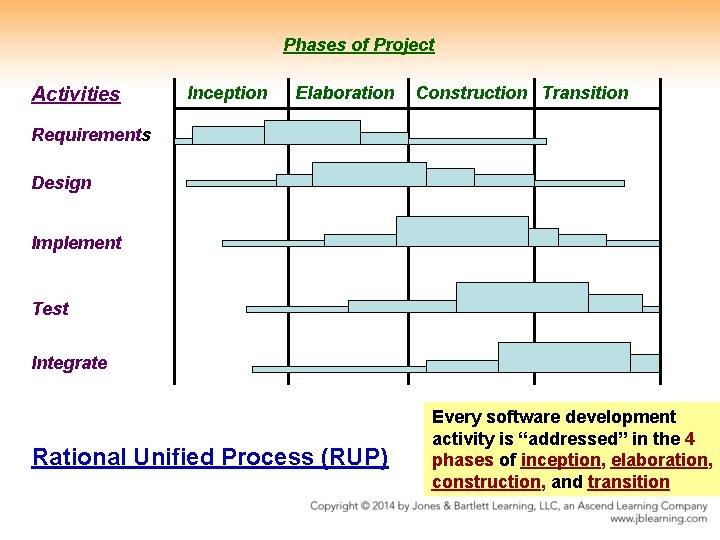
Phases of Project Activities Inception Elaboration Construction Transition Requirements Design Implement Test Integrate Rational Unified Process (RUP) Every software development activity is “addressed” in the 4 phases of inception, elaboration, construction, and transition
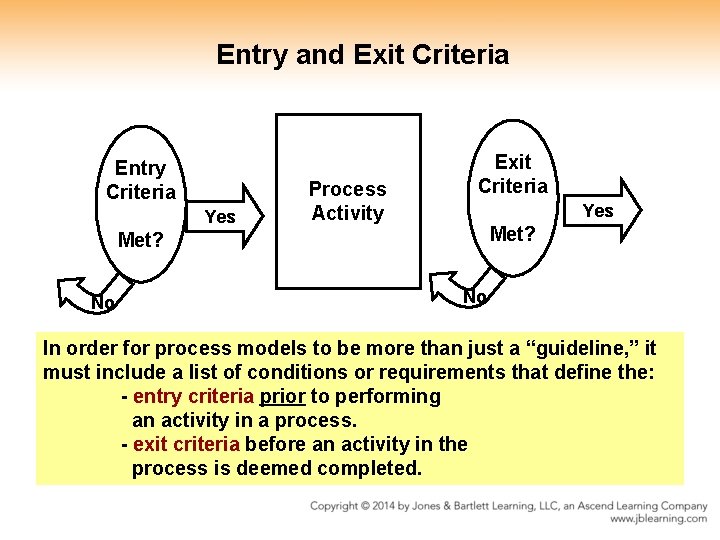
Entry and Exit Criteria Entry Criteria Yes Process Activity Exit Criteria Yes Met? No No In order for process models to be more than just a “guideline, ” it must include a list of conditions or requirements that define the: - entry criteria prior to performing an activity in a process. - exit criteria before an activity in the process is deemed completed.
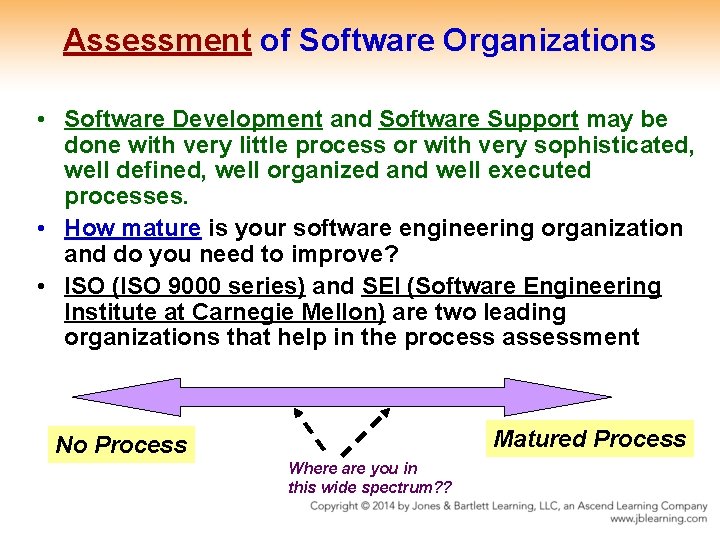
Assessment of Software Organizations • Software Development and Software Support may be done with very little process or with very sophisticated, well defined, well organized and well executed processes. • How mature is your software engineering organization and do you need to improve? • ISO (ISO 9000 series) and SEI (Software Engineering Institute at Carnegie Mellon) are two leading organizations that help in the process assessment Matured Process No Process Where are you in this wide spectrum? ?
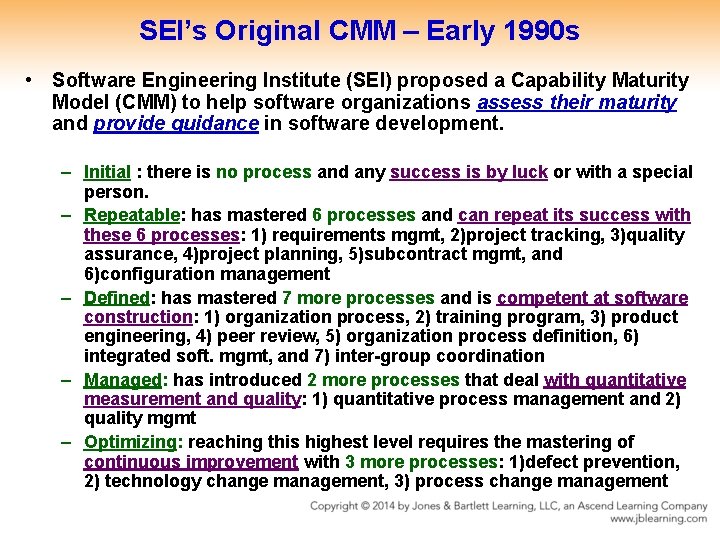
SEI’s Original CMM – Early 1990 s • Software Engineering Institute (SEI) proposed a Capability Maturity Model (CMM) to help software organizations assess their maturity and provide guidance in software development. – Initial : there is no process and any success is by luck or with a special person. – Repeatable: has mastered 6 processes and can repeat its success with these 6 processes: 1) requirements mgmt, 2)project tracking, 3)quality assurance, 4)project planning, 5)subcontract mgmt, and 6)configuration management – Defined: has mastered 7 more processes and is competent at software construction: 1) organization process, 2) training program, 3) product engineering, 4) peer review, 5) organization process definition, 6) integrated soft. mgmt, and 7) inter-group coordination – Managed: has introduced 2 more processes that deal with quantitative measurement and quality: 1) quantitative process management and 2) quality mgmt – Optimizing: reaching this highest level requires the mastering of continuous improvement with 3 more processes: 1)defect prevention, 2) technology change management, 3) process change management
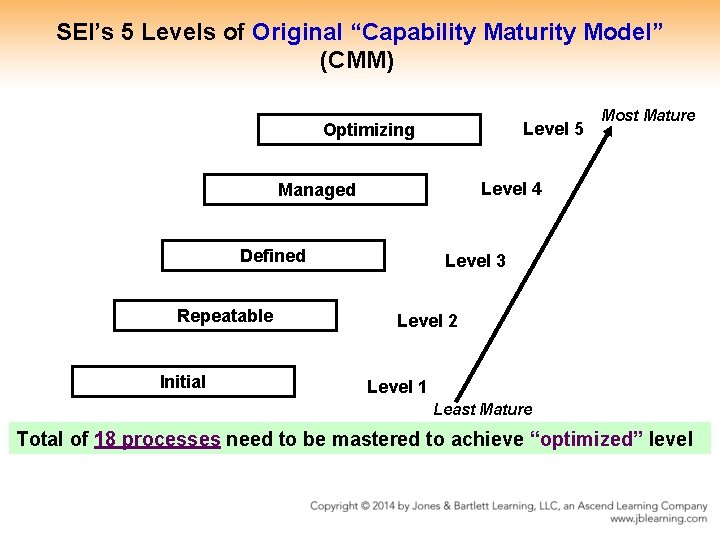
SEI’s 5 Levels of Original “Capability Maturity Model” (CMM) Level 5 Optimizing Level 4 Managed Defined Repeatable Initial Most Mature Level 3 Level 2 Level 1 Least Mature Total of 18 processes need to be mastered to achieve “optimized” level
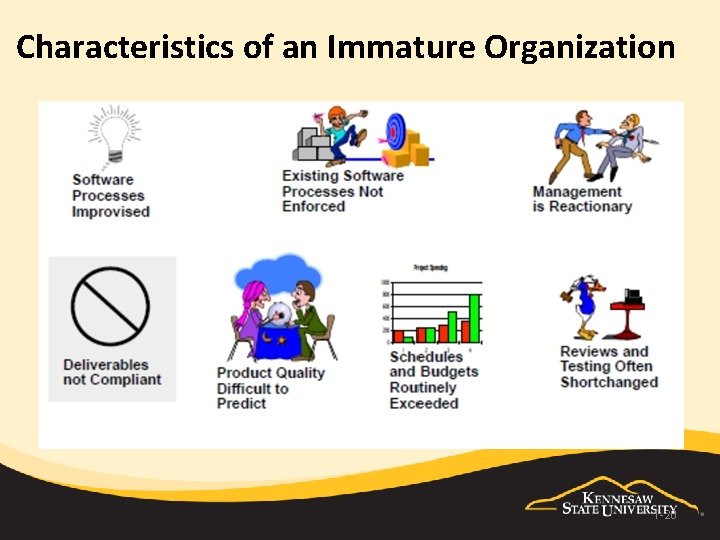
Characteristics of an Immature Organization 1 -20
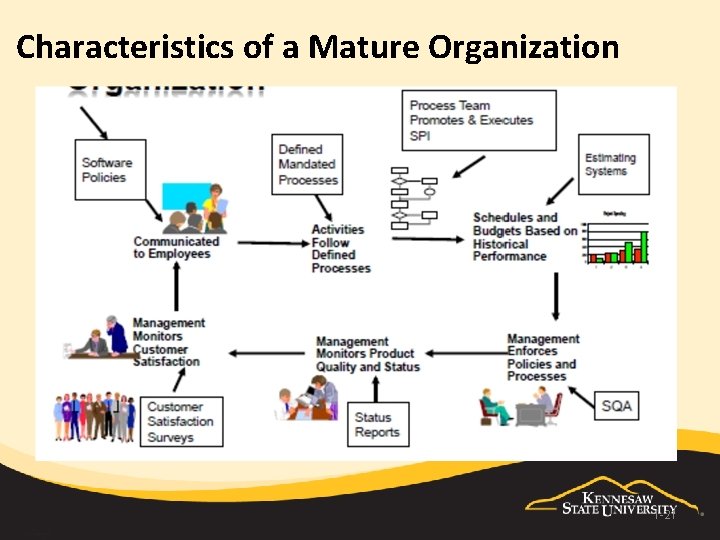
Characteristics of a Mature Organization 1 -21
Process Improvement Benefits • Process improvement benefits fall into eight general categories: – improved schedule and budget predictability – improved cycle time – increased productivity – improved quality (as measured by defects) – increased customer satisfaction – improved employee morale – increased return on investment – decreased cost of quality 1 -22
Business Value of Process Improvement • Software process improvement provides measurable return on investment (ROI). • Typical direct, immediate ROI reported is between 5: 1 and 8: 1. • Cost savings, productivity improvements, and quality gains are cumulative and recurring, not one time events. • Additional benefits are intangible and/or indirect and cannot be easily quantified. 1 -23
SEI’s CMMI • In 2001, CMM was upgraded to CMMI (CMM Integrated). Started with multiple, major aspects to CMMI: – Systems engineering – Software engineering – Integrated product and process development – Supplier sourcing
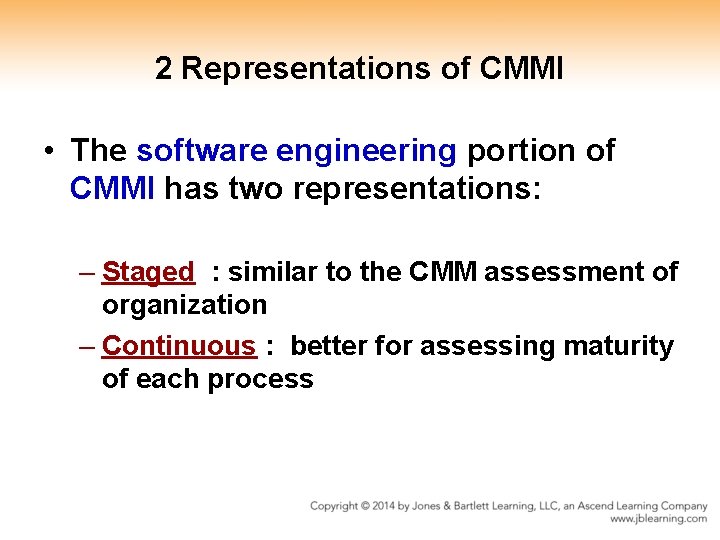
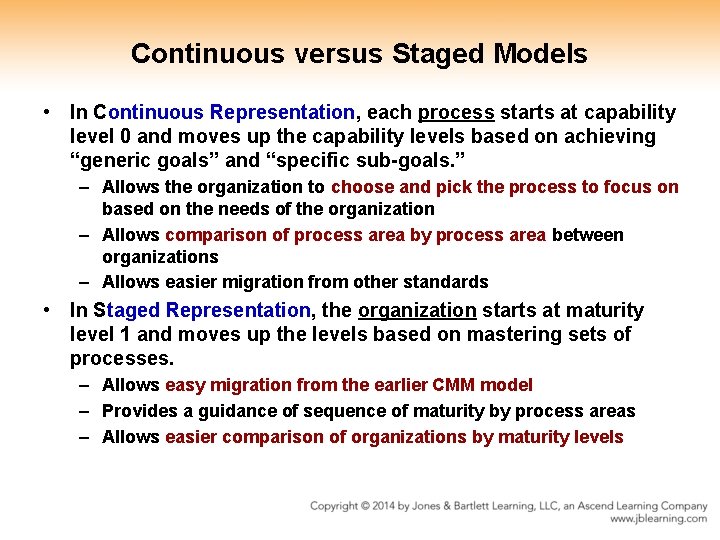
2 Representations of CMMI • The software engineering portion of CMMI has two representations: – Staged : similar to the CMM assessment of organization – Continuous : better for assessing maturity of each process
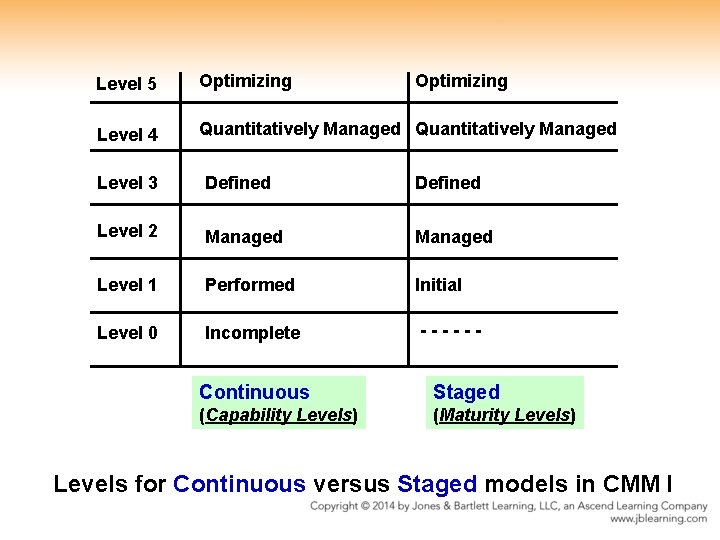
Level 5 Optimizing Level 4 Quantitatively Managed Level 3 Defined Level 2 Managed Level 1 Performed Initial Level 0 Incomplete ------ Continuous Staged (Capability Levels) (Maturity Levels) Levels for Continuous versus Staged models in CMM I
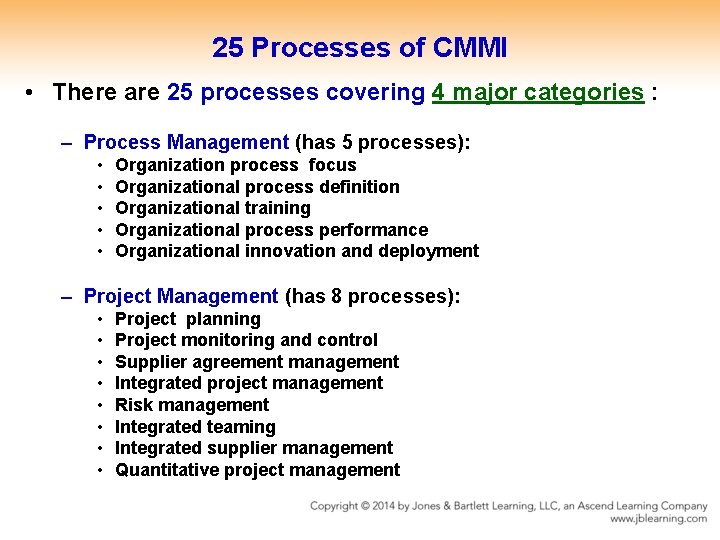
25 Processes of CMMI • There are 25 processes covering 4 major categories : – Process Management (has 5 processes): • • • Organization process focus Organizational process definition Organizational training Organizational process performance Organizational innovation and deployment – Project Management (has 8 processes): • • Project planning Project monitoring and control Supplier agreement management Integrated project management Risk management Integrated teaming Integrated supplier management Quantitative project management
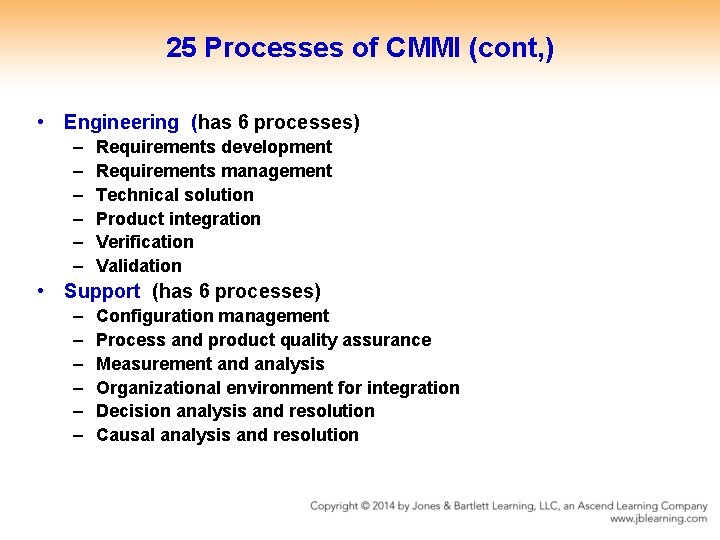
25 Processes of CMMI (cont, ) • Engineering (has 6 processes) – – – Requirements development Requirements management Technical solution Product integration Verification Validation • Support (has 6 processes) – – – Configuration management Process and product quality assurance Measurement and analysis Organizational environment for integration Decision analysis and resolution Causal analysis and resolution
Continuous versus Staged Models • In Continuous Representation, each process starts at capability level 0 and moves up the capability levels based on achieving “generic goals” and “specific sub-goals. ” – Allows the organization to choose and pick the process to focus on based on the needs of the organization – Allows comparison of process area by process area between organizations – Allows easier migration from other standards • In Staged Representation, the organization starts at maturity level 1 and moves up the levels based on mastering sets of processes. – Allows easy migration from the earlier CMM model – Provides a guidance of sequence of maturity by process areas – Allows easier comparison of organizations by maturity levels
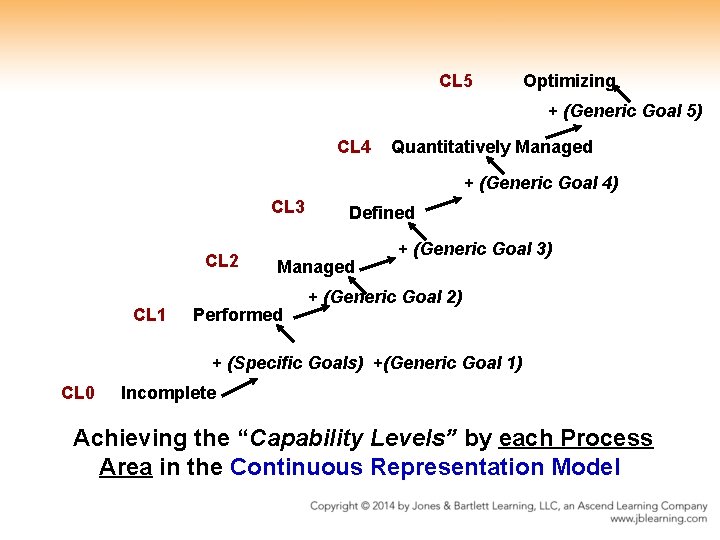
CL 5 Optimizing + (Generic Goal 5) CL 4 Quantitatively Managed + (Generic Goal 4) CL 3 CL 2 CL 1 Defined Managed Performed + (Generic Goal 3) + (Generic Goal 2) + (Specific Goals) +(Generic Goal 1) CL 0 Incomplete Achieving the “Capability Levels” by each Process Area in the Continuous Representation Model
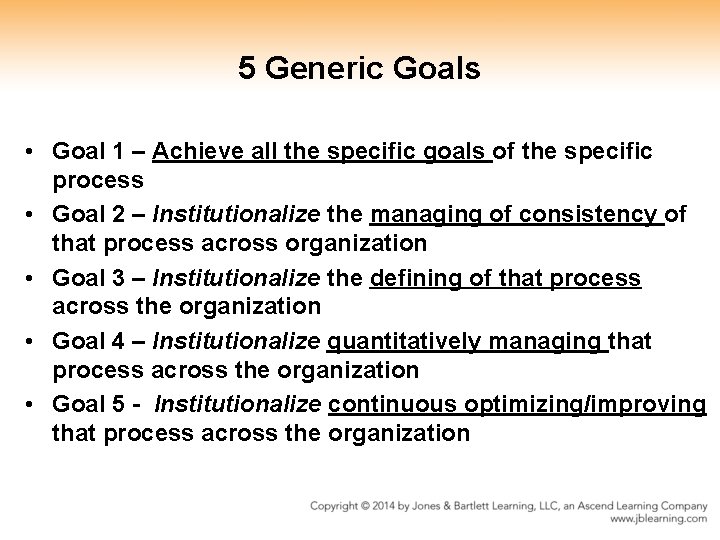
5 Generic Goals • Goal 1 – Achieve all the specific goals of the specific process • Goal 2 – Institutionalize the managing of consistency of that process across organization • Goal 3 – Institutionalize the defining of that process across the organization • Goal 4 – Institutionalize quantitatively managing that process across the organization • Goal 5 - Institutionalize continuous optimizing/improving that process across the organization
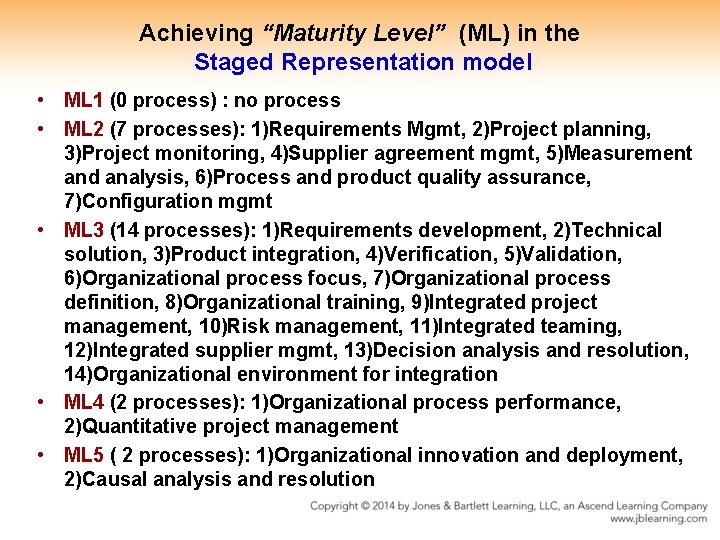
Achieving “Maturity Level” (ML) in the Staged Representation model • ML 1 (0 process) : no process • ML 2 (7 processes): 1)Requirements Mgmt, 2)Project planning, 3)Project monitoring, 4)Supplier agreement mgmt, 5)Measurement and analysis, 6)Process and product quality assurance, 7)Configuration mgmt • ML 3 (14 processes): 1)Requirements development, 2)Technical solution, 3)Product integration, 4)Verification, 5)Validation, 6)Organizational process focus, 7)Organizational process definition, 8)Organizational training, 9)Integrated project management, 10)Risk management, 11)Integrated teaming, 12)Integrated supplier mgmt, 13)Decision analysis and resolution, 14)Organizational environment for integration • ML 4 (2 processes): 1)Organizational process performance, 2)Quantitative project management • ML 5 ( 2 processes): 1)Organizational innovation and deployment, 2)Causal analysis and resolution
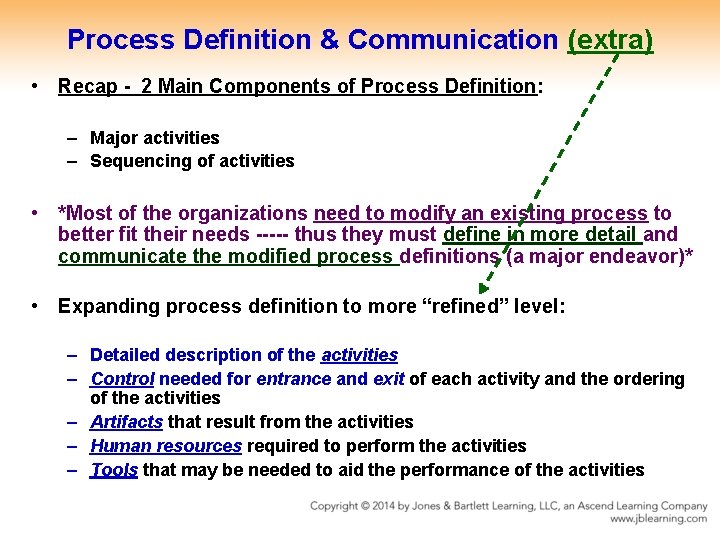
Process Definition & Communication (extra) • Recap - 2 Main Components of Process Definition: – Major activities – Sequencing of activities • *Most of the organizations need to modify an existing process to better fit their needs ----- thus they must define in more detail and communicate the modified process definitions (a major endeavor)* • Expanding process definition to more “refined” level: – Detailed description of the activities – Control needed for entrance and exit of each activity and the ordering of the activities – Artifacts that result from the activities – Human resources required to perform the activities – Tools that may be needed to aid the performance of the activities