
CHAPTER 4 Socialization and the Life Course Sociology







- Slides: 35
CHAPTER 4 Socialization and the Life Course Sociology in Modules, 4 th edition Richard T. Schaefer ©Mc. Graw-Hill Education. All rights reserved. Authorized only for instructor use in the classroom. No reproduction or further distribution permitted without the prior written consent of Mc. Graw-Hill Education.
Chapter Modules • Module 13 The Role of Socialization • Module 14 The Self and Socialization through the Life Course • Module 15 Agents of Socialization ©Mc. Graw-Hill Education.
Module 13 The Role of Socialization • Interaction of heredity and environment (nature and nurture) shapes human development and influences socialization process • Socialization: lifelong process in which people learn attitudes, values, and behaviors appropriate for members of a particular culture • Personality: person’s typical patterns of attitudes, needs, characteristics, and behavior ©Mc. Graw-Hill Education.
Social Environment: The Impact of Isolation • Extreme Isolation: Isabelle – Scientists involved with the case concluded all children need socialization in the form of love, care, and affection • Extreme Neglect: Romanian Orphans – Attention must be given not only to physical needs but also to social development ©Mc. Graw-Hill Education.
Social Environment: The Impact of Isolation (2) • Primate Studies – Social attachments develop from need for warmth, comfort, and intimacy ©Mc. Graw-Hill Education.
The Influence of Heredity • Minnesota twin family study – Twins have similar intelligence test scores when reared apart in roughly similar social settings – Different scores when reared in different social settings ©Mc. Graw-Hill Education.
Module 14 The Self and Socialization through the Life Course • View of ourselves comes from contemplation of personal qualities and impressions of how others perceive us • Self: distinct identity that sets us apart from others – Not a static phenomenon – Sociologists and psychologists both interested in how individuals develop and modify their sense of self as a result of social interaction ©Mc. Graw-Hill Education.
Sociological Approaches to the Self • Cooley: Looking-Glass Self – Charles Horton Cooley – View of ourselves comes from contemplation of personal qualities and impressions of how others perceive us – Looking-glass self: the self is product of social interactions with other people ©Mc. Graw-Hill Education.
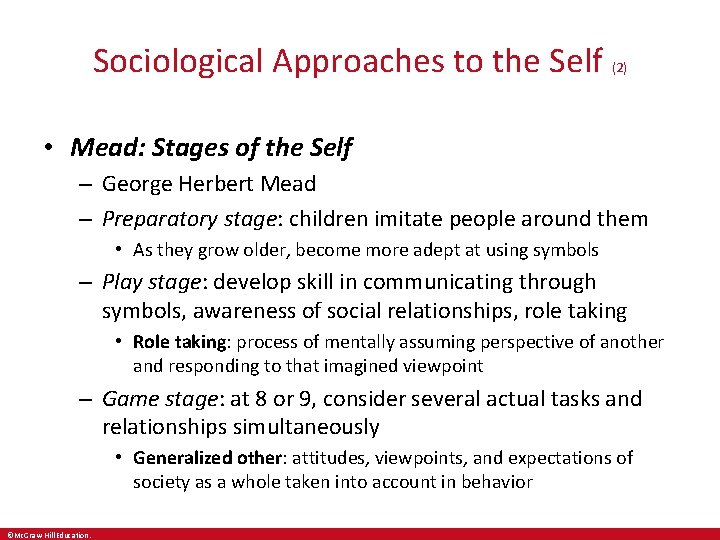
Sociological Approaches to the Self (2) • Mead: Stages of the Self – George Herbert Mead – Preparatory stage: children imitate people around them • As they grow older, become more adept at using symbols – Play stage: develop skill in communicating through symbols, awareness of social relationships, role taking • Role taking: process of mentally assuming perspective of another and responding to that imagined viewpoint – Game stage: at 8 or 9, consider several actual tasks and relationships simultaneously • Generalized other: attitudes, viewpoints, and expectations of society as a whole taken into account in behavior ©Mc. Graw-Hill Education.
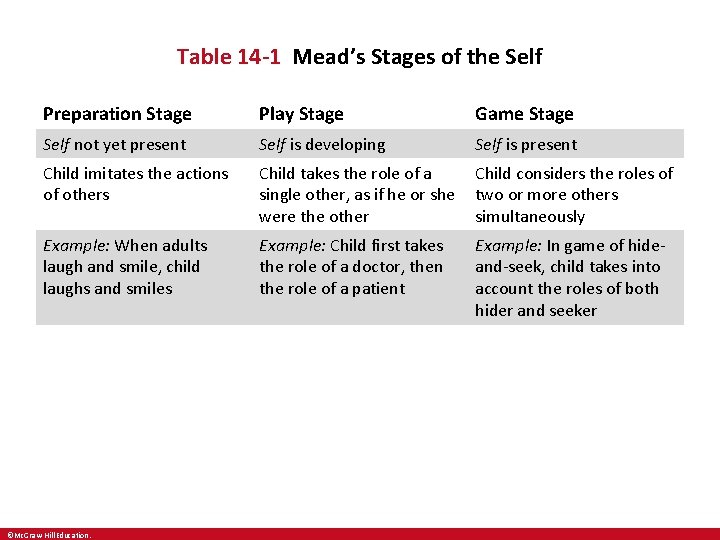
Table 14 -1 Mead’s Stages of the Self Preparation Stage Play Stage Game Stage Self not yet present Self is developing Self is present Child imitates the actions of others Child takes the role of a Child considers the roles of single other, as if he or she two or more others were the other simultaneously Example: When adults laugh and smile, child laughs and smiles Example: Child first takes the role of a doctor, then the role of a patient ©Mc. Graw-Hill Education. Example: In game of hideand-seek, child takes into account the roles of both hider and seeker
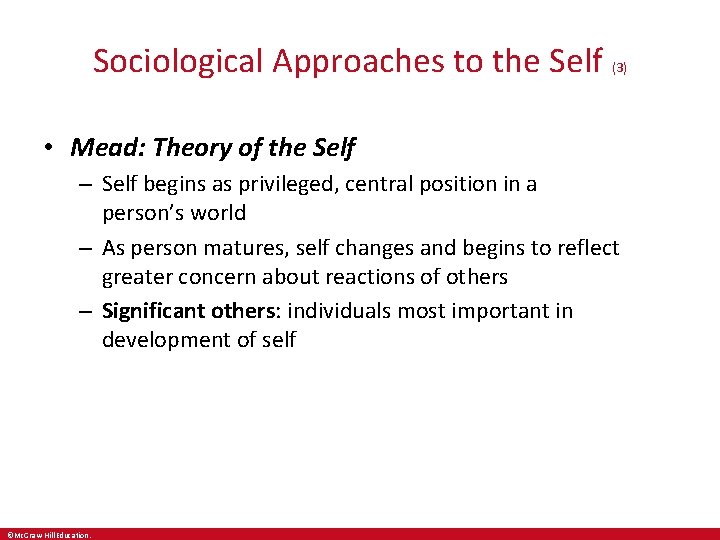
Sociological Approaches to the Self (3) • Mead: Theory of the Self – Self begins as privileged, central position in a person’s world – As person matures, self changes and begins to reflect greater concern about reactions of others – Significant others: individuals most important in development of self ©Mc. Graw-Hill Education.
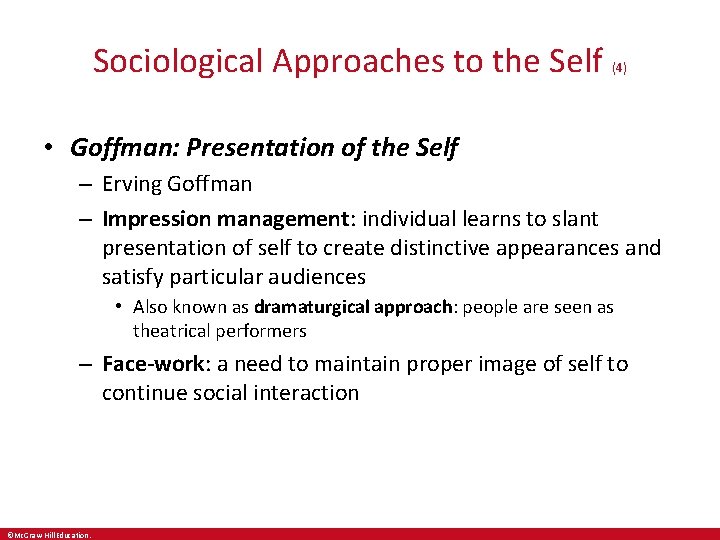
Sociological Approaches to the Self (4) • Goffman: Presentation of the Self – Erving Goffman – Impression management: individual learns to slant presentation of self to create distinctive appearances and satisfy particular audiences • Also known as dramaturgical approach: people are seen as theatrical performers – Face-work: a need to maintain proper image of self to continue social interaction ©Mc. Graw-Hill Education.
Psychological Approaches to the Self • Sigmund Freud – Self is a social product – Natural impulsive instincts in constant conflict with societal constraints – Personality influenced by others (especially one’s parents) – Self has components that work in opposition to each other ©Mc. Graw-Hill Education.
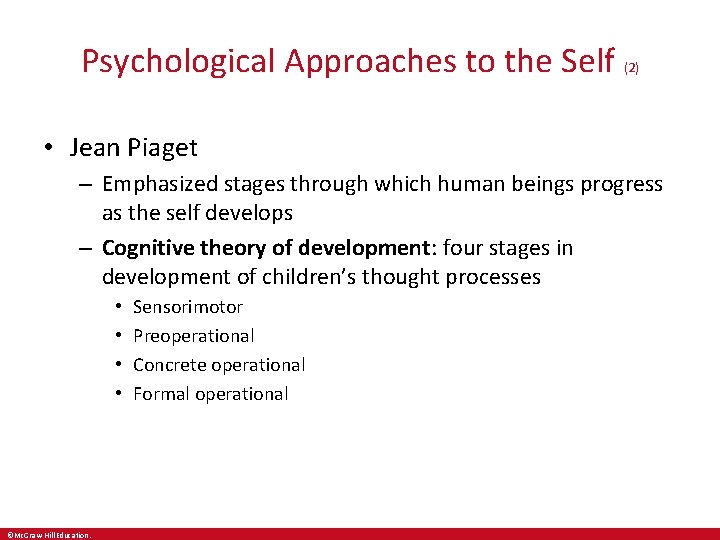
Psychological Approaches to the Self (2) • Jean Piaget – Emphasized stages through which human beings progress as the self develops – Cognitive theory of development: four stages in development of children’s thought processes • • ©Mc. Graw-Hill Education. Sensorimotor Preoperational Concrete operational Formal operational
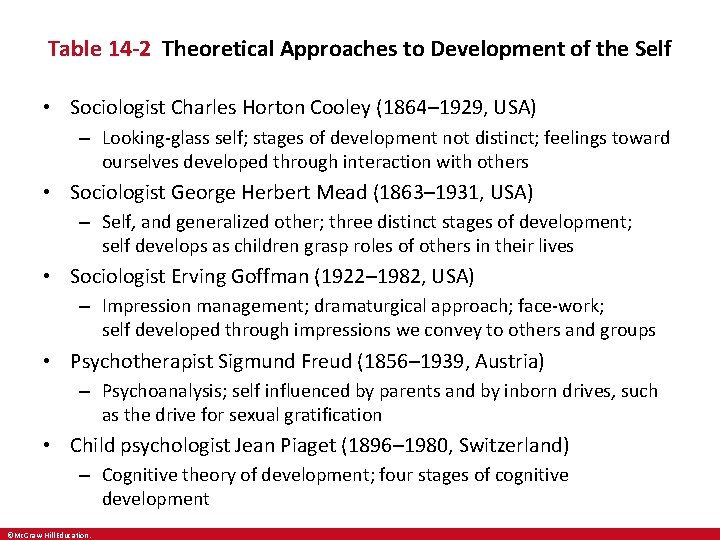
Table 14 -2 Theoretical Approaches to Development of the Self • Sociologist Charles Horton Cooley (1864– 1929, USA) – Looking-glass self; stages of development not distinct; feelings toward ourselves developed through interaction with others • Sociologist George Herbert Mead (1863– 1931, USA) – Self, and generalized other; three distinct stages of development; self develops as children grasp roles of others in their lives • Sociologist Erving Goffman (1922– 1982, USA) – Impression management; dramaturgical approach; face-work; self developed through impressions we convey to others and groups • Psychotherapist Sigmund Freud (1856– 1939, Austria) – Psychoanalysis; self influenced by parents and by inborn drives, such as the drive for sexual gratification • Child psychologist Jean Piaget (1896– 1980, Switzerland) – Cognitive theory of development; four stages of cognitive development ©Mc. Graw-Hill Education.
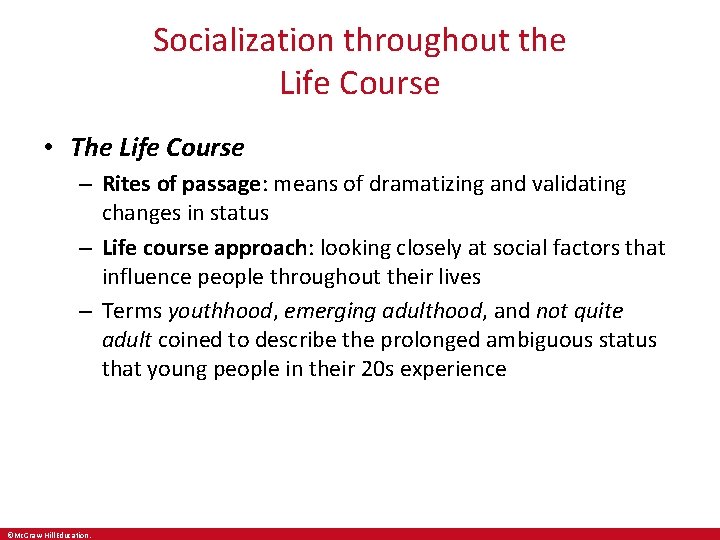
Socialization throughout the Life Course • The Life Course – Rites of passage: means of dramatizing and validating changes in status – Life course approach: looking closely at social factors that influence people throughout their lives – Terms youthhood, emerging adulthood, and not quite adult coined to describe the prolonged ambiguous status that young people in their 20 s experience ©Mc. Graw-Hill Education.
Anticipatory Socialization and Resocialization • Anticipatory socialization: person “rehearses” future occupations and social relationships • Resocialization: discarding former behavior patterns and accepting new ones during transitions in one’s life ©Mc. Graw-Hill Education.
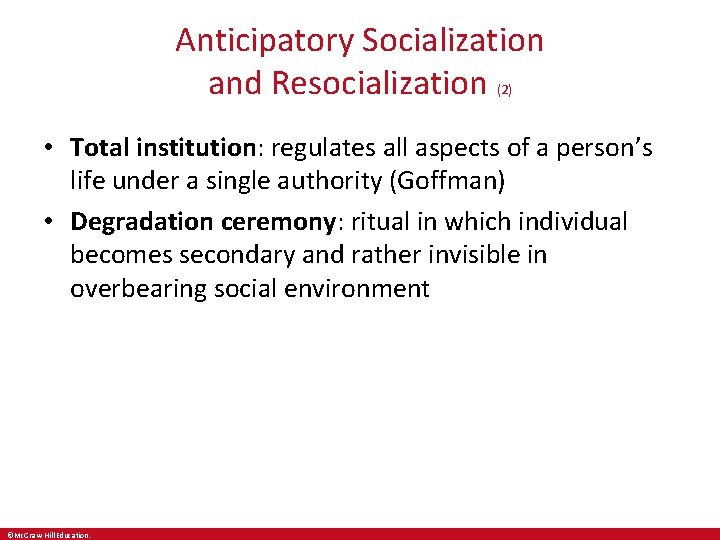
Anticipatory Socialization and Resocialization (2) • Total institution: regulates all aspects of a person’s life under a single authority (Goffman) • Degradation ceremony: ritual in which individual becomes secondary and rather invisible in overbearing social environment ©Mc. Graw-Hill Education.
Box 14 -1 Sociology on Campus: Impression Management by Students 1. How do you react to those who have received higher or lower grades than you? Do you engage in impression management? How would you like others to react to your grade? 2. What social norms govern students’ impression management strategies? ©Mc. Graw-Hill Education.
Module 15 Agents of Socialization • Continuing and lifelong socialization process involves many different social forces that influence people’s lives and alter their self-images • Most important of these in the U. S. is family ©Mc. Graw-Hill Education.
Family • All families engage in socialization • In the U. S. , children are socialized to cultural assumptions about gender and race – Gender roles: expectations regarding proper behavior, attitudes, and activities of males and females ©Mc. Graw-Hill Education.
School • Conflict theorists: schools foster competition through built-in systems of reward and punishment • Functionalists: schools teach the values and customs of larger society – Conflict theorists add that schools can reinforce the divisive aspects of society, especially social class ©Mc. Graw-Hill Education.
Peer Group • As children grow older, peer groups increasingly assume the role of Mead’s significant others • Gender differences are noteworthy among adolescents ©Mc. Graw-Hill Education.
Table 15 -1 High School Popularity Source: Suitor et al. 2001: 445. According to college men According to college women • What makes high school girls popular? 1. 2. 3. 4. 5. Physical attractiveness Grades/intelligence Participation in sports General sociability Popularity with boys • What makes high school boys popular? 1. 2. 3. 4. 5. ©Mc. Graw-Hill Education. Participation in sports Grades/intelligence Popularity with girls General sociability Car 1. 2. 3. 4. 5. Grades/intelligence Participation in sports General sociability Physical attractiveness Clothes • What makes high school boys popular? 1. 2. 3. 4. 5. Participation in sports Grades/intelligence General sociability Physical attractiveness School clubs/government
Mass Media and Technology • Media innovations are important agents of socialization • Concerns about teen use of Internet • Use of technology not always negative • New communication technologies in developing countries ©Mc. Graw-Hill Education.
Workplace • Learning to behave appropriately within an occupational setting is a fundamental aspect of human socialization • Workplace socialization changes when it involves full-time employment ©Mc. Graw-Hill Education.
Religion and the State • Government and organized religion both impact the life course by reinstituting some rites of passage – Traditional rites that bring together extended family – Ages at which certain activities allowed or expected ©Mc. Graw-Hill Education.
Social Policy and Socialization: Child Care around the World • Looking at the Issue – In the U. S. , 88% of employed mothers depend on others to care for their children – 30% of mothers who aren’t employed have regular care arrangements – Researchers found high quality child-care centers do not adversely affect socialization of children • Few can afford to have a parent stay at home ©Mc. Graw-Hill Education.
Social Policy and Socialization: Child Care around the World (2) • Applying Sociology – Interactionists favor studies assessing quality of child care outside of home; micro level of analysis – High-quality day care not equally available to all families • Conflict perspective notes child care costs are burden for lower-class families • Feminist perspective questions low status and wages of child care workers ©Mc. Graw-Hill Education.
Social Policy and Socialization: Child Care around the World (3) • Initiating Policy – Policies vary throughout the world – When policymakers decide child care is desirable, must determine degree to which taxpayers subsidize it ©Mc. Graw-Hill Education.
Box 15 -1 Research Today: Rum Springa: Raising Children Amish Style 1. Do you or anyone you know come from a subculture that rejects mainstream American culture? If so, describe the community’s norms and values. How do they resemble and how do they differ from Amish norms and values? 2. Why do you think so many Amish youths return to their families’ way of life after rebelling against it? ©Mc. Graw-Hill Education.
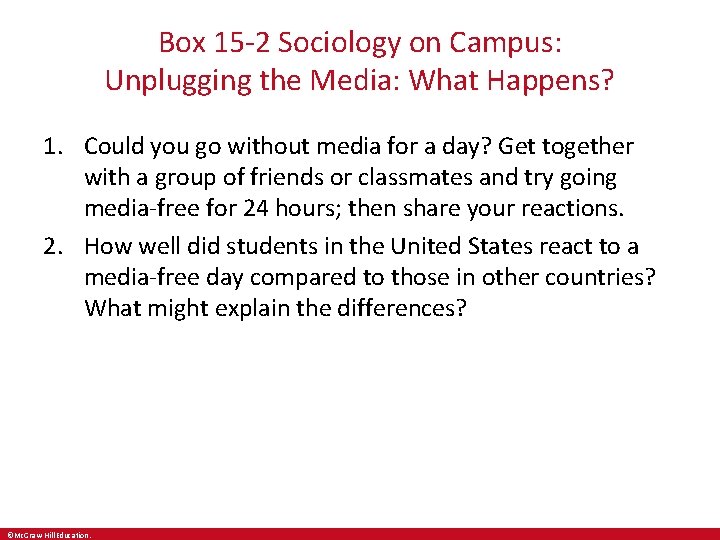
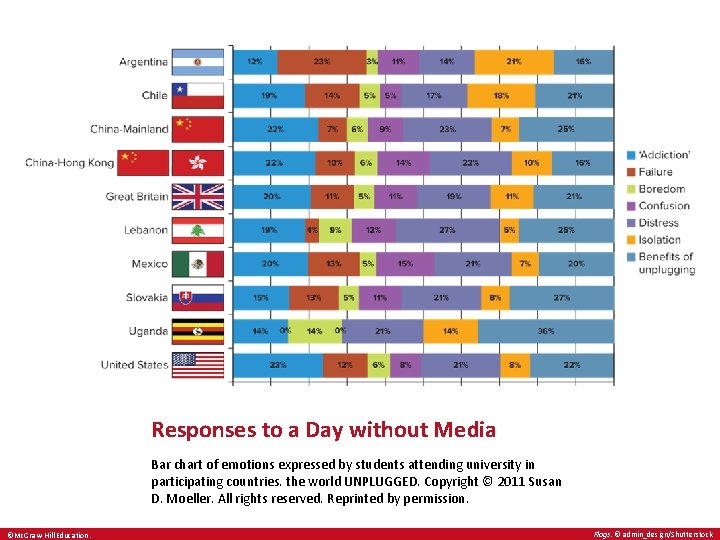
Box 15 -2 Sociology on Campus: Unplugging the Media: What Happens? 1. Could you go without media for a day? Get together with a group of friends or classmates and try going media-free for 24 hours; then share your reactions. 2. How well did students in the United States react to a media-free day compared to those in other countries? What might explain the differences? ©Mc. Graw-Hill Education.
Responses to a Day without Media Bar chart of emotions expressed by students attending university in participating countries. the world UNPLUGGED. Copyright © 2011 Susan D. Moeller. All rights reserved. Reprinted by permission. ©Mc. Graw-Hill Education. Flags: © admin_design/Shutterstock
Taking Sociology to Work: Rakefet Avramovitz, Program Administrator, Child Care Law Center 1. What might be some of the broad, long-term effects of the center’s work to expand child care options? Explain. 2. Besides the law, what other professions might benefit from the skills a sociology major has to offer? ©Mc. Graw-Hill Education.
Review • Socialization is a process through which people learn attitudes, values, and actions appropriate for members of a particular culture • In this chapter: – Role of socialization in human development – Way in which people develop perceptions, feelings, and beliefs about themselves – Important agents of socialization – Lifelong nature of the socialization process ©Mc. Graw-Hill Education. All rights reserved. Authorized only for instructor use in the classroom. No reproduction or further distribution permitted without the prior written consent of Mc. Graw-Hill Education.