
Chapter 4 Social Responsibility and Managerial Ethics Chapter
Chapter 4 Social Responsibility and Managerial Ethics Chapter 4, Stephen P. Robbins, Mary Coulter, and Nancy Langton, Management, Eighth Canadian Edition. Copyright © 2005 Pearson Education Canada Inc. 1
LEARNING OUTLINE Follow this Learning Outline as you read and study this chapter. • What Is Social Responsibility? – Contrast the classical and socio-economic views of social responsibility. – Discuss the role that stakeholders play in the four approaches to social responsibility. Chapter 4, Stephen P. Robbins, Mary Coulter, and Nancy Langton, Management, Eighth Canadian Edition. Copyright © 2005 Pearson Education Canada Inc. 2
LEARNING OUTLINE (cont’d) Follow this Learning Outline as you read and study this chapter. • Social Responsibility and Economic Performance – Explain what research studies have shown about the relationship between an organization’s social involvement and its economic performance. Chapter 4, Stephen P. Robbins, Mary Coulter, and Nancy Langton, Management, Eighth Canadian Edition. Copyright © 2005 Pearson Education Canada Inc. 3
LEARNING OUTLINE (cont’d) Follow this Learning Outline as you read and study this chapter. • Values-based Management – Discuss the four purposes that shared values serve. – Describe the relationship of values-based management to ethics. Chapter 4, Stephen P. Robbins, Mary Coulter, and Nancy Langton, Management, Eighth Canadian Edition. Copyright © 2005 Pearson Education Canada Inc. 4
LEARNING OUTLINE (cont’d) Follow this Learning Outline as you read and study this chapter. • Managerial Ethics – Contrast the four views of ethics. – Discuss the factors that affect ethical and unethical behaviour. – Discuss the six determinants of issue intensity. – Explain codes of ethics and how their effectiveness can be improved. – Describe the important roles managers play in encouraging ethical behaviour. – Discuss how managers and organizations can protect employees who raise ethical issues or concerns. Chapter 4, Stephen P. Robbins, Mary Coulter, and Nancy Langton, Management, Eighth Canadian Edition. Copyright © 2005 Pearson Education Canada Inc. 5
What Is Social Responsibility? • The Classical View – Maximize profits for the benefit of the stockholders – Doing “social good” unjustifiably increases costs Chapter 4, Stephen P. Robbins, Mary Coulter, and Nancy Langton, Management, Eighth Canadian Edition. Copyright © 2005 Pearson Education Canada Inc. 6
What Is Social Responsibility? (cont’d) • The Socio-economic View – Management should also protect and improve society’s welfare – Corporations are responsible not only to stockholders – Firms have a moral responsibility to larger society “to do the right thing” Chapter 4, Stephen P. Robbins, Mary Coulter, and Nancy Langton, Management, Eighth Canadian Edition. Copyright © 2005 Pearson Education Canada Inc. 7
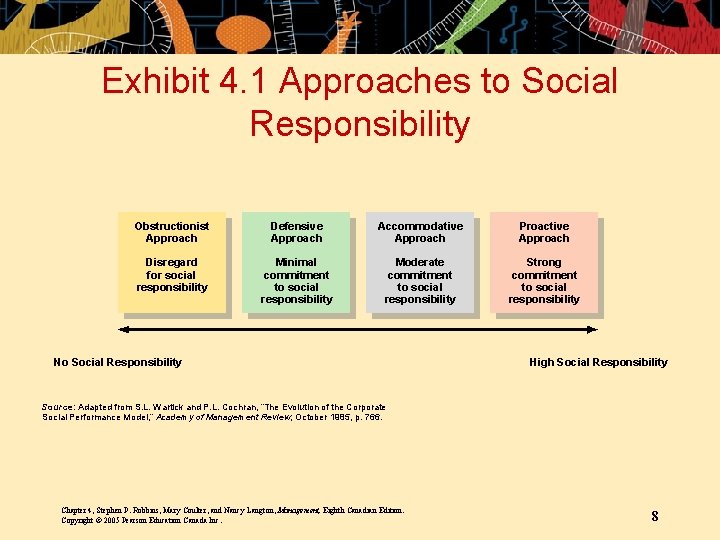
Exhibit 4. 1 Approaches to Social Responsibility Obstructionist Approach Defensive Approach Accommodative Approach Proactive Approach Disregard for social responsibility Minimal commitment to social responsibility Moderate commitment to social responsibility Strong commitment to social responsibility No Social Responsibility High Social Responsibility Source: Adapted from S. L. Wartick and P. L. Cochran, “The Evolution of the Corporate Social Performance Model, ” Academy of Management Review, October 1985, p. 766. Chapter 4, Stephen P. Robbins, Mary Coulter, and Nancy Langton, Management, Eighth Canadian Edition. Copyright © 2005 Pearson Education Canada Inc. 8
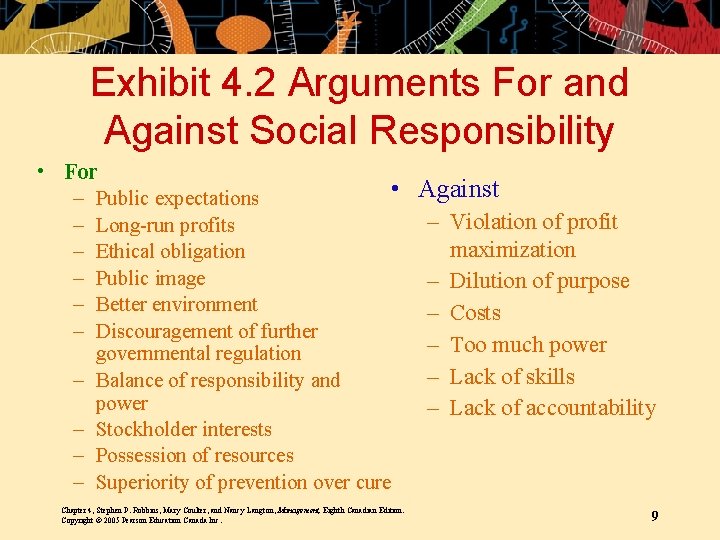
Exhibit 4. 2 Arguments For and Against Social Responsibility • For – Public expectations – Long-run profits – Ethical obligation – Public image – Better environment – Discouragement of further – – • Against governmental regulation Balance of responsibility and power Stockholder interests Possession of resources Superiority of prevention over cure Chapter 4, Stephen P. Robbins, Mary Coulter, and Nancy Langton, Management, Eighth Canadian Edition. Copyright © 2005 Pearson Education Canada Inc. – Violation of profit maximization – Dilution of purpose – Costs – Too much power – Lack of skills – Lack of accountability 9

Values-based Management • Values-based Management – Managers establish and uphold an organization’s shared values • Purposes of Shared Values – – Guiding managerial decisions Shaping employee behaviour Influencing the direction of marketing efforts Building team spirit • The Bottom Line on Shared Corporate Values – An organization’s values are reflected in the decisions and actions of its employees Chapter 4, Stephen P. Robbins, Mary Coulter, and Nancy Langton, Management, Eighth Canadian Edition. Copyright © 2005 Pearson Education Canada Inc. 10
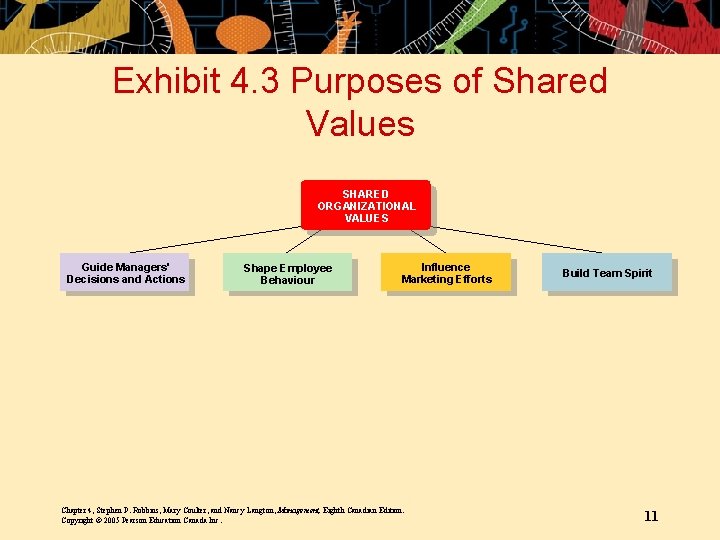
Exhibit 4. 3 Purposes of Shared Values SHARED ORGANIZATIONAL VALUES Guide Managers' Decisions and Actions Shape Employee Behaviour Influence Marketing Efforts Chapter 4, Stephen P. Robbins, Mary Coulter, and Nancy Langton, Management, Eighth Canadian Edition. Copyright © 2005 Pearson Education Canada Inc. Build Team Spirit 11
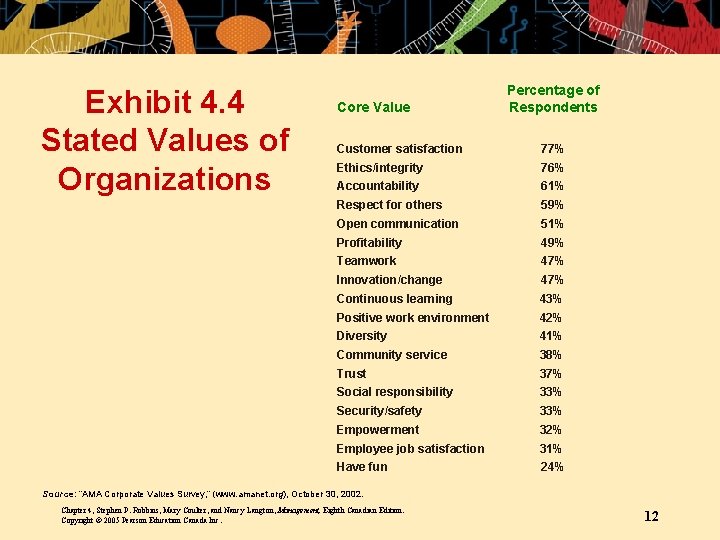
Exhibit 4. 4 Stated Values of Organizations Core Value Percentage of Respondents Customer satisfaction 77% Ethics/integrity 76% Accountability 61% Respect for others 59% Open communication 51% Profitability 49% Teamwork 47% Innovation/change 47% Continuous learning 43% Positive work environment 42% Diversity 41% Community service 38% Trust 37% Social responsibility 33% Security/safety 33% Empowerment 32% Employee job satisfaction 31% Have fun 24% Source: “AMA Corporate Values Survey, ” (www. amanet. org), October 30, 2002. Chapter 4, Stephen P. Robbins, Mary Coulter, and Nancy Langton, Management, Eighth Canadian Edition. Copyright © 2005 Pearson Education Canada Inc. 12
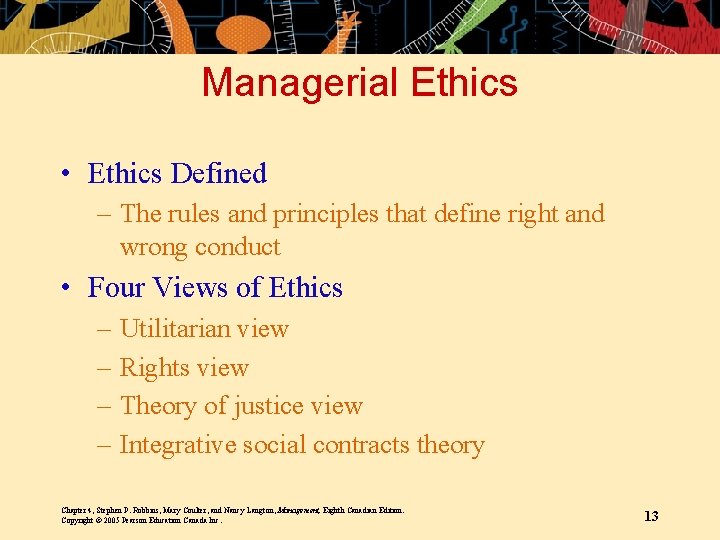
Managerial Ethics • Ethics Defined – The rules and principles that define right and wrong conduct • Four Views of Ethics – – Utilitarian view Rights view Theory of justice view Integrative social contracts theory Chapter 4, Stephen P. Robbins, Mary Coulter, and Nancy Langton, Management, Eighth Canadian Edition. Copyright © 2005 Pearson Education Canada Inc. 13
Managerial Ethics (cont’d) • Utilitarian View – Greatest good is provided for the greatest number • Encourages efficiency and productivity and is consistent with the goal of profit maximization • Rights View – Respecting and protecting individual liberties and privileges • Seeks to protect individual rights of conscience, free speech, life and safety, and due process Chapter 4, Stephen P. Robbins, Mary Coulter, and Nancy Langton, Management, Eighth Canadian Edition. Copyright © 2005 Pearson Education Canada Inc. 14
Managerial Ethics (cont’d) • Theory of Justice – Organizational rules are enforced fairly and impartially and follow all legal rules and regulations • Protects the interests of underrepresented stakeholders and the rights of employees • Integrative Social Contracts Theory – Ethical decisions should be based on existing ethical norms in industries and communities • Based on integration of the general social contract and the specific contract between community members Chapter 4, Stephen P. Robbins, Mary Coulter, and Nancy Langton, Management, Eighth Canadian Edition. Copyright © 2005 Pearson Education Canada Inc. 15
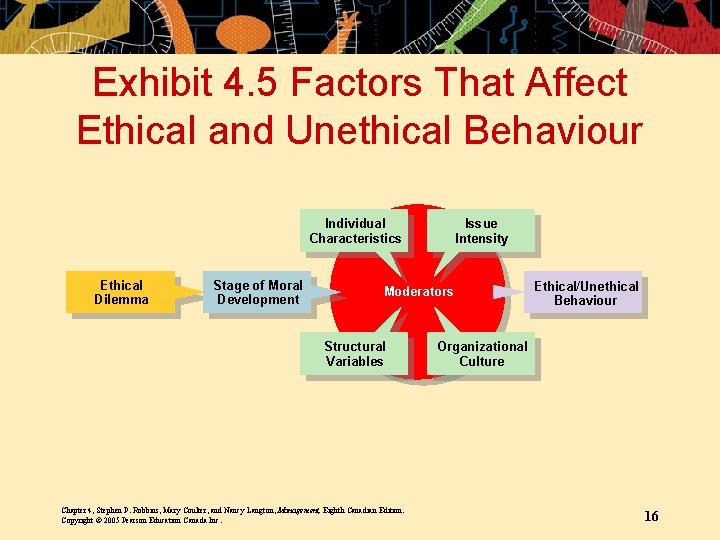
Exhibit 4. 5 Factors That Affect Ethical and Unethical Behaviour Individual Characteristics Ethical Dilemma Stage of Moral Development Issue Intensity Moderators Structural Variables Chapter 4, Stephen P. Robbins, Mary Coulter, and Nancy Langton, Management, Eighth Canadian Edition. Copyright © 2005 Pearson Education Canada Inc. Ethical/Unethical Behaviour Organizational Culture 16
Factors That Affect Employee Ethics • • • Stages of moral development Individual characteristics Structural variables Organizational culture Issue intensity A measure of independence from outside influences Levels of Individual Moral Development Preconventional level Conventional level Principled level Chapter 4, Stephen P. Robbins, Mary Coulter, and Nancy Langton, Management, Eighth Canadian Edition. Copyright © 2005 Pearson Education Canada Inc. 17
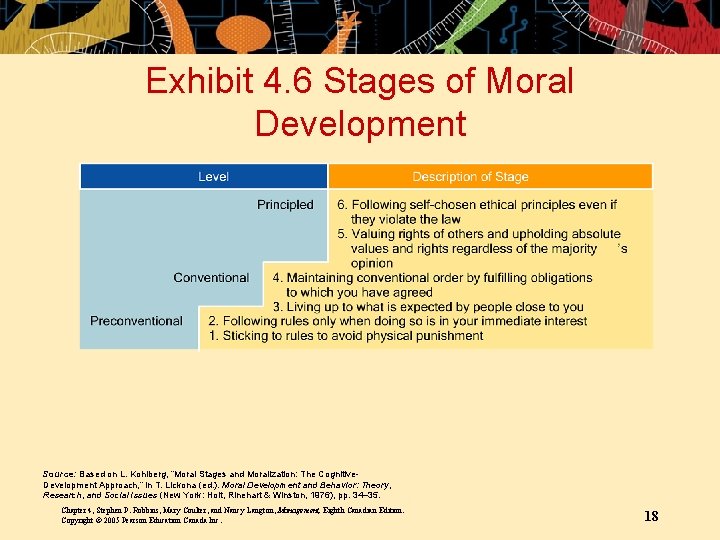
Exhibit 4. 6 Stages of Moral Development Source: Based on L. Kohlberg, “Moral Stages and Moralization: The Cognitive. Development Approach, ” in T. Lickona (ed. ). Moral Development and Behavior: Theory, Research, and Social Issues (New York: Holt, Rinehart & Winston, 1976), pp. 34– 35. Chapter 4, Stephen P. Robbins, Mary Coulter, and Nancy Langton, Management, Eighth Canadian Edition. Copyright © 2005 Pearson Education Canada Inc. 18
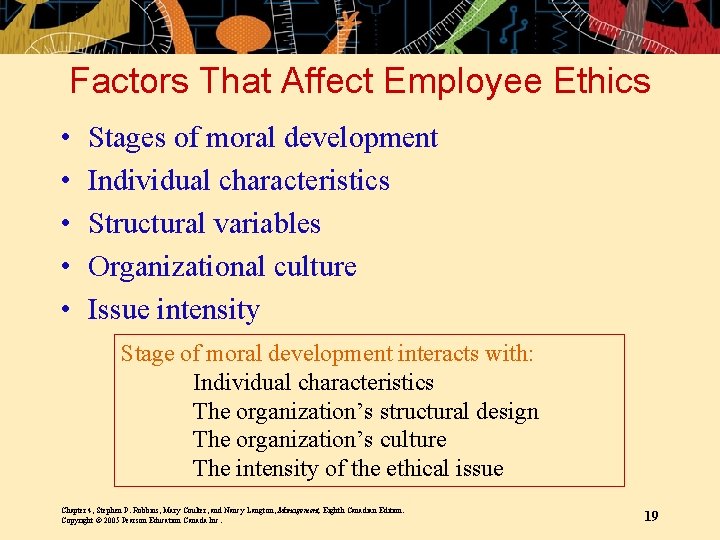
Factors That Affect Employee Ethics • • • Stages of moral development Individual characteristics Structural variables Organizational culture Issue intensity Stage of moral development interacts with: Individual characteristics The organization’s structural design The organization’s culture The intensity of the ethical issue Chapter 4, Stephen P. Robbins, Mary Coulter, and Nancy Langton, Management, Eighth Canadian Edition. Copyright © 2005 Pearson Education Canada Inc. 19
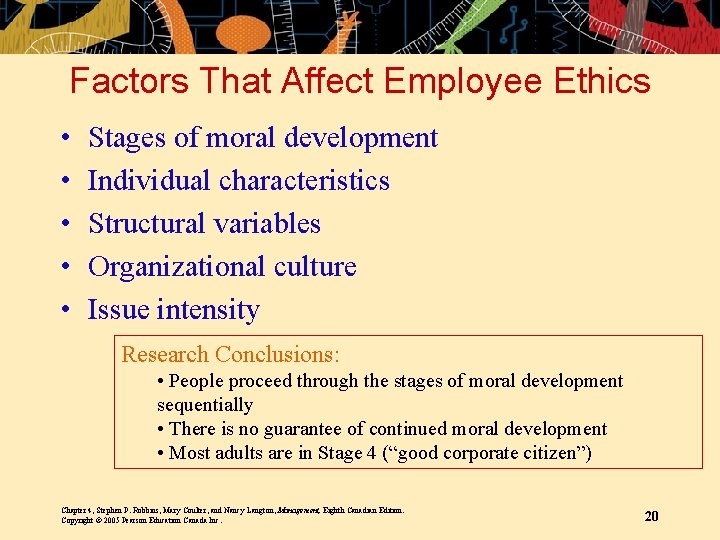
Factors That Affect Employee Ethics • • • Stages of moral development Individual characteristics Structural variables Organizational culture Issue intensity Research Conclusions: • People proceed through the stages of moral development sequentially • There is no guarantee of continued moral development • Most adults are in Stage 4 (“good corporate citizen”) Chapter 4, Stephen P. Robbins, Mary Coulter, and Nancy Langton, Management, Eighth Canadian Edition. Copyright © 2005 Pearson Education Canada Inc. 20
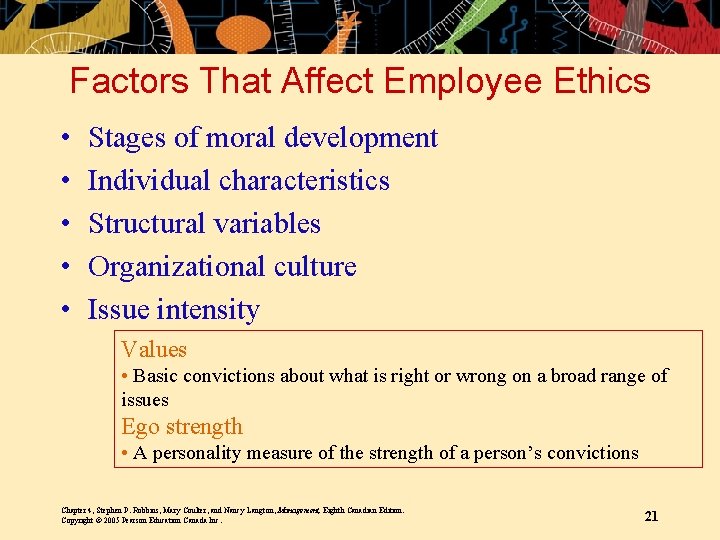
Factors That Affect Employee Ethics • • • Stages of moral development Individual characteristics Structural variables Organizational culture Issue intensity Values • Basic convictions about what is right or wrong on a broad range of issues Ego strength • A personality measure of the strength of a person’s convictions Chapter 4, Stephen P. Robbins, Mary Coulter, and Nancy Langton, Management, Eighth Canadian Edition. Copyright © 2005 Pearson Education Canada Inc. 21
Factors That Affect Employee Ethics • • • Stages of moral development Individual characteristics Structural variables Organizational culture Issue intensity Locus of Control A personality attribute that measures the degree to which people believe they control their own life • Internal locus: the belief that you control your destiny • External locus: the belief that what happens to you is due to luck or chance Chapter 4, Stephen P. Robbins, Mary Coulter, and Nancy Langton, Management, Eighth Canadian Edition. Copyright © 2005 Pearson Education Canada Inc. 22
Factors That Affect Employee Ethics • • • Stages of moral development Individual characteristics Structural variables Organizational culture Issue intensity Organizational characteristics and mechanisms that guide and influence individual ethics: –Performance appraisal systems –Reward allocation systems –Behaviours (ethical) of managers –An organization’s culture –Intensity of the ethical issue Chapter 4, Stephen P. Robbins, Mary Coulter, and Nancy Langton, Management, Eighth Canadian Edition. Copyright © 2005 Pearson Education Canada Inc. 23
Factors That Affect Employee Ethics • • • Stages of moral development Individual characteristics Structural variables Organizational culture Issue intensity Good structural design minimizes ambiguity and uncertainty and fosters ethical behaviour Chapter 4, Stephen P. Robbins, Mary Coulter, and Nancy Langton, Management, Eighth Canadian Edition. Copyright © 2005 Pearson Education Canada Inc. 24
Factors That Affect Employee Ethics • • • Stages of moral development Individual characteristics Structural variables Organizational culture Issue intensity Cultures high in risk tolerance, control, and conflict tolerance are most likely to encourage high ethical standards Weak cultures have less ability to encourage high ethical standards Chapter 4, Stephen P. Robbins, Mary Coulter, and Nancy Langton, Management, Eighth Canadian Edition. Copyright © 2005 Pearson Education Canada Inc. 25
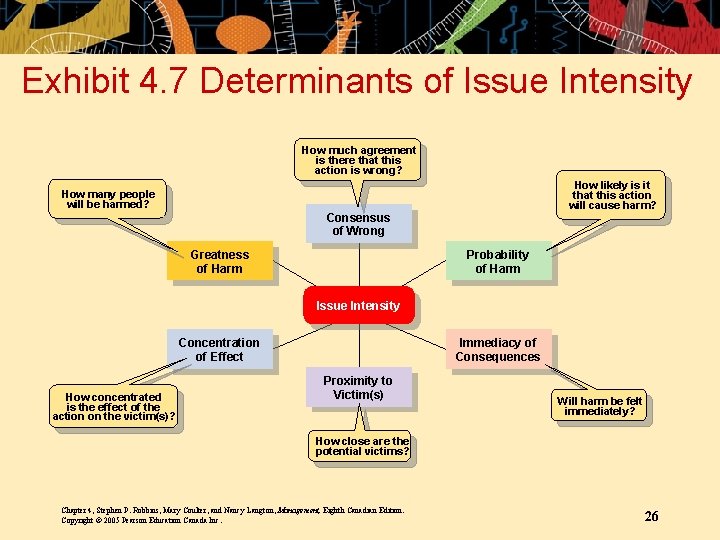
Exhibit 4. 7 Determinants of Issue Intensity How much agreement is there that this action is wrong? How likely is it that this action will cause harm? How many people will be harmed? Consensus of Wrong Greatness of Harm Probability of Harm Issue Intensity Concentration of Effect How concentrated is the effect of the action on the victim(s)? Immediacy of Consequences Proximity to Victim(s) Will harm be felt immediately? How close are the potential victims? Chapter 4, Stephen P. Robbins, Mary Coulter, and Nancy Langton, Management, Eighth Canadian Edition. Copyright © 2005 Pearson Education Canada Inc. 26
Ethics in an International Context • Ethical standards are not universal – Social and cultural differences determine acceptable behaviours Chapter 4, Stephen P. Robbins, Mary Coulter, and Nancy Langton, Management, Eighth Canadian Edition. Copyright © 2005 Pearson Education Canada Inc. 27
The Global Compact Human Rights • Principle 1: Support and respect the protection of international human rights within their sphere of influence • Principle 2: Make sure business corporations are not complicit in human rights abuses Labour Standards • Principle 3: Freedom of association and the effective recognition of the right to collective bargaining • Principle 4: Eliminate all forms of forced and compulsory labour • Principle 5: Abolish child labour • Principle 6: Eliminate discrimination in respect of employment and occupation Source: The Global Compact Web Site (www. unglobalcompact. org), November 7, 2004. Chapter 4, Stephen P. Robbins, Mary Coulter, and Nancy Langton, Management, Eighth Canadian Edition. Copyright © 2005 Pearson Education Canada Inc. 28
The Global Compact (cont’d) Environment • Principle 7: Support a precautionary approach to environmental challenges • Principle 8: Undertake initiatives to promote greater environmental responsibility • Principle 9: Encourage the development and diffusion of environmentally friendly technologies Anticorruption • Principle 10: Work against all forms of corruption, including extortion and bribery Source: The Global Compact Web Site (www. unglobalcompact. org), November 7, 2004. Chapter 4, Stephen P. Robbins, Mary Coulter, and Nancy Langton, Management, Eighth Canadian Edition. Copyright © 2005 Pearson Education Canada Inc. 29
How Managers Can Improve Ethical Behaviour in an Organization • Hire individuals with high ethical standards. • Establish codes of ethics and decision rules. • Lead by example. • Delineate job goals and performance appraisal mechanisms. • Provide ethics training. • Conduct independent social audits. • Provide support for individuals facing ethical dilemmas. Chapter 4, Stephen P. Robbins, Mary Coulter, and Nancy Langton, Management, Eighth Canadian Edition. Copyright © 2005 Pearson Education Canada Inc. 30
Code of Ethics • A formal statement of an organization’s primary values and the ethical rules it expects its employees to follow – Be a dependable organizational citizen – Don’t do anything unlawful or improper that will harm the organization – Be good to customers Source: F. R. David, “An Empirical Study of Codes of Business Ethics: A Strategic Perspective. ” Paper presented at the 48 th Annual Academy of Management Conference, Anaheim, California, August 1988. Chapter 4, Stephen P. Robbins, Mary Coulter, and Nancy Langton, Management, Eighth Canadian Edition. Copyright © 2005 Pearson Education Canada Inc. 31
Effective Use of a Code of Ethics • Develop a code of ethics to guide decision making • Communicate the code regularly • Have all levels of management show commitment to the code • Publicly reprimand consistently discipline those who break the code Chapter 4, Stephen P. Robbins, Mary Coulter, and Nancy Langton, Management, Eighth Canadian Edition. Copyright © 2005 Pearson Education Canada Inc. 32
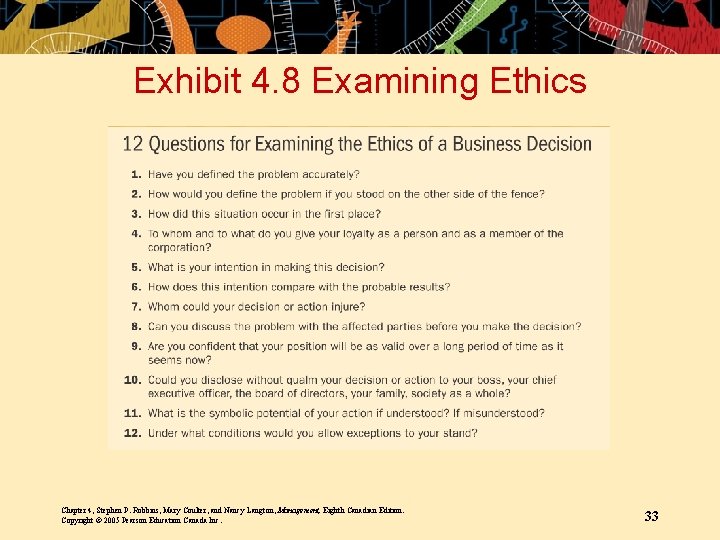
Exhibit 4. 8 Examining Ethics Chapter 4, Stephen P. Robbins, Mary Coulter, and Nancy Langton, Management, Eighth Canadian Edition. Copyright © 2005 Pearson Education Canada Inc. 33
Ethical Leadership • Managers must provide a good role model by: – Being ethical and honest at all times – Telling the truth – Admitting failure and not trying to cover it up – Communicating shared ethical values to employees through symbols, stories, and slogans – Rewarding employees who behave ethically and punishing those who do not – Protecting employees (whistleblowers) who bring to light unethical behaviours or raise ethical issues Chapter 4, Stephen P. Robbins, Mary Coulter, and Nancy Langton, Management, Eighth Canadian Edition. Copyright © 2005 Pearson Education Canada Inc. 34
The Value of Ethics Training • Training can make a difference in ethical behaviours • Training increases employee awareness of ethical issues in business decisions • Training clarifies and reinforces the standards of conduct • Employees are more confident of support when taking unpopular but ethically correct stances Chapter 4, Stephen P. Robbins, Mary Coulter, and Nancy Langton, Management, Eighth Canadian Edition. Copyright © 2005 Pearson Education Canada Inc. 35
- Slides: 35