
CHAPTER 4 SLIDE 1 CHAPTER 4 Social Responsibility
CHAPTER 4 SLIDE 1 CHAPTER 4 Social Responsibility of Business and Government 4 -1 Social Responsibility and Business Ethics 4 -2 Government Protection Activities 4 -3 Government Regulation and Assistance © 2012 Cengage Learning. All Rights Reserved. Principles of Business, 8 e
4 -1 Social Responsibility and Business Ethics Goal 1 Describe social responsibility issues. Goal 2 Identify benefits and costs of social responsibility. Goal 3 Explain the purpose of a code of ethics. © 2012 Cengage Learning. All Rights Reserved. SLIDE 2
CHAPTER KEY TERMS 4 SLIDE 3 ● social responsibility ● non-renewable resource ● ethics ● business ethics ● code of ethics © 2012 Cengage Learning. All Rights Reserved. Principles of Business, 8 e
SOCIAL RESPONSIBILITY ISSUES CHAPTER 4 SLIDE 4 ● Environmental protection ● Businesses feel need to conserve nonrenewable resources and avoid pollution ● Govt. sets standards enforced by EPA ● Workplace diversity ● Workforce should represent actual groups of a community ● Remove employment barriers ● Accommodate for challenges © 2012 Cengage Learning. All Rights Reserved. Principles of Business, 8 e
SOCIAL RESPONSIBILITY ISSUES CHAPTER 4 SLIDE 5 (continued) ● Job safety ● Must provide safe work environment ● Standards regulated by Occupational Safety and Health Administration (OSHA) ● Employee wellness ● Healthy employees = productive employees ● Some companies provide means of staying healthy (healthy food, gyms, seminars) © 2012 Cengage Learning. All Rights Reserved. Principles of Business, 8 e
CHAPTER 4 SLIDE 6 Checkpoint ● What are four areas of social responsibility that may require the attention of business? ● Environmental protection ● Workplace diversity ● Job safety ● Employee wellness © 2012 Cengage Learning. All Rights Reserved. Principles of Business, 8 e
SOCIAL RESPONSIBILITY EVALUATION CHAPTER 4 SLIDE 7 ● Benefits ● Expanded justice for groups of a society ● Enhanced company image ● Reduced need for government actions ● Improved quality of life in a community and around the world ● Increased awareness of social issues among workers, consumers, and others © 2012 Cengage Learning. All Rights Reserved. Principles of Business, 8 e
SOCIAL RESPONSIBILITY EVALUATION CHAPTER 4 SLIDE 8 (continued) ● Costs ● New nonpolluting or safer equipment ● Building repairs to remove risks ● Wellness and rehabilitation programs ● Social projects sponsored by a company © 2012 Cengage Learning. All Rights Reserved. Principles of Business, 8 e
CHAPTER 4 SLIDE 9 Checkpoint ● What are the main benefits of social responsibility? ● ● Expanded justice for groups of a society Enhanced company image Reduced need for government actions Improved quality of life in a community and around the world ● Increased awareness of social issues among workers, consumers, and others © 2012 Cengage Learning. All Rights Reserved. Principles of Business, 8 e
CHAPTER 4 SLIDE 10 BUSINESS ETHICS ● Code of ethics ● Set of rules guiding actions of employees ● Some ethical dilemmas can occur ● Ethical conduct guidelines ● Is the action legal? ● Does the action violate professional or company standards? ● Who is affected by the action and how? © 2012 Cengage Learning. All Rights Reserved. Principles of Business, 8 e
GUIDELINES FOR WRITING A CODE OF ETHICS CHAPTER 4 SLIDE 11 1. Determine the purpose of the code. 2. Tailor the code to the needs and values of the organization. 3. Consider involving employees from all levels of the company in writing the code. 4. Determine the rules or principles that all members of the organization will be expected to adhere to. 5. Include information about how the code will be enforced. 6. Determine how the code will be implemented and where it will be published or posted. 7. Determine how and when the code will be reviewed and revised. © 2012 Cengage Learning. All Rights Reserved. Principles of Business, 8 e
CHAPTER 4 SLIDE 12 Checkpoint ● What is the purpose of a code of ethics? ● The purpose of a code of ethics is to guide actions and decisions of employees or members of an organization. © 2012 Cengage Learning. All Rights Reserved. Principles of Business, 8 e

4 -2 Government Protection Activities Goal 1 Identify the roles and levels of government. Goal 2 Explain the role of government protection and the legal system in business. Goal 3 Describe types of intellectual property. © 2012 Cengage Learning. All Rights Reserved. SLIDE 13
CHAPTER KEY TERMS 4 SLIDE 14 ● contract ● patent ● copyright ● trademark © 2012 Cengage Learning. All Rights Reserved. Principles of Business, 8 e
CHAPTER GOVERNMENT IN SOCIETY 4 SLIDE 15 ● Government plays a role in all economic systems. ● Voting citizens play key role in deciding policies ● If we don’t like current policies, we elect new people to change how the government acts © 2012 Cengage Learning. All Rights Reserved. Principles of Business, 8 e
CHAPTER ROLES OF GOVERNMENT 4 SLIDE 16 ● Providing services for members of society ● Protecting citizens, consumers, businesses, and workers ● Regulating utilities and promoting competition ● Providing information and support to businesses ● Buying goods and services ● Hiring public employees ● Raising revenue © 2012 Cengage Learning. All Rights Reserved. Principles of Business, 8 e
CHAPTER LEVELS OF GOVERNMENT 4 SLIDE 17 ● Federal government ● State government ● Local government © 2012 Cengage Learning. All Rights Reserved. Principles of Business, 8 e
CHAPTER FEDERAL GOVERNMENT 4 SLIDE 18 ● Oversees the activities that involve two or more states or other countries. ● Regulates foreign and interstate commerce © 2012 Cengage Learning. All Rights Reserved. Principles of Business, 8 e
CHAPTER STATE GOVERNMENTS 4 SLIDE 19 ● Regulate business actions within their own borders ● Assign some of their legislative power to local governments © 2012 Cengage Learning. All Rights Reserved. Principles of Business, 8 e
CHAPTER LOCAL GOVERNMENTS 4 SLIDE 20 ● Include county boards and city or town councils ● Provide services needed for an orderly society, such as police and fire protection © 2012 Cengage Learning. All Rights Reserved. Principles of Business, 8 e
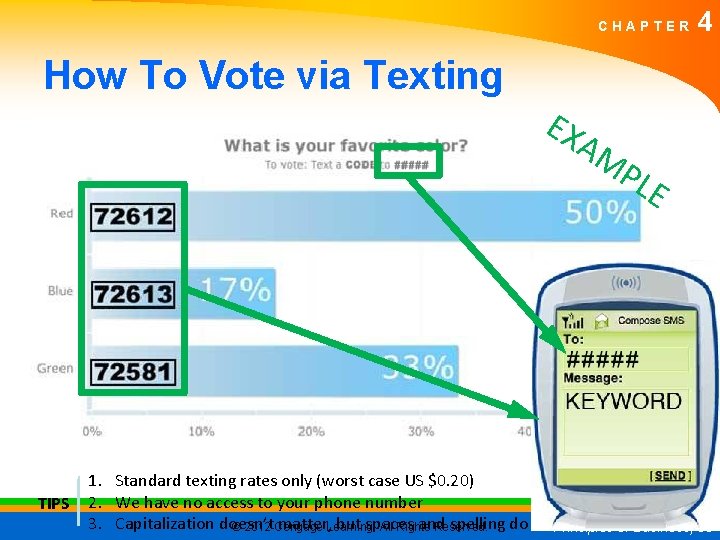
CHAPTER 4 How To Vote via Texting EX AM P LE TIPS 1. Standard texting rates only (worst case US $0. 20) 2. We have no access to your phone number 3. Capitalization doesn’t matter, Learning. but spaces and spelling do © 2012 Cengage All Rights Reserved. Principles of Business, 8 e
CHAPTER 4 Checkpoint © 2012 Cengage Learning. All Rights Reserved. Principles of Business, 8 e
CHAPTER 4 Checkpoint © 2012 Cengage Learning. All Rights Reserved. Principles of Business, 8 e

CHAPTER Poll: What are business dealings involving com. . . © 2012 Cengage Learning. All Rights Reserved. 4 Principles of Business, 8 e
CHAPTER Checkpoint 4 SLIDE 25 ● What are three levels of government? ● Local ● State ● Federal © 2012 Cengage Learning. All Rights Reserved. Principles of Business, 8 e
CHAPTER GOVERNMENT PROTECTION ACTIVITIES 4 SLIDE 26 ● Worker protection – working conditions and basic human rights ● Contract enforcement – in case of dispute about contract details ● Must meet certain criteria to be enforceable © 2012 Cengage Learning. All Rights Reserved. Principles of Business, 8 e
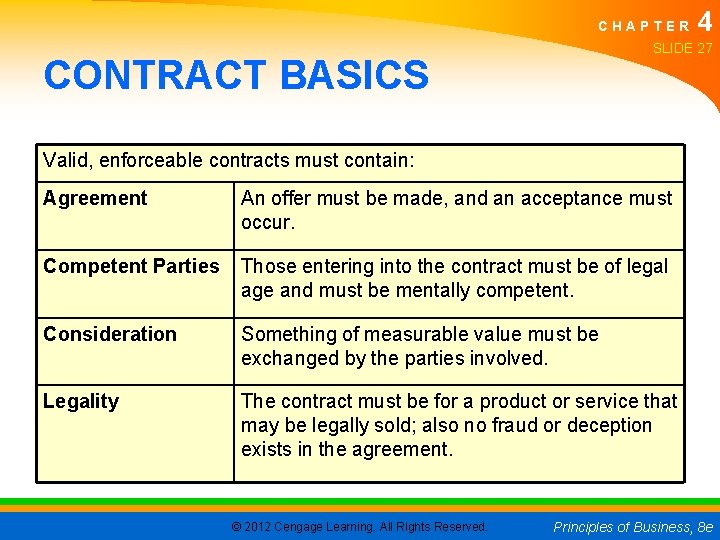
CHAPTER 4 SLIDE 27 CONTRACT BASICS Valid, enforceable contracts must contain: Agreement An offer must be made, and an acceptance must occur. Competent Parties Those entering into the contract must be of legal age and must be mentally competent. Consideration Something of measurable value must be exchanged by the parties involved. Legality The contract must be for a product or service that may be legally sold; also no fraud or deception exists in the agreement. © 2012 Cengage Learning. All Rights Reserved. Principles of Business, 8 e
CHAPTER 4 Checkpoint © 2012 Cengage Learning. All Rights Reserved. Principles of Business, 8 e
CHAPTER Checkpoint 4 SLIDE 29 ● What are the main elements of a contract? ● Agreement ● Competent parties ● Consideration ● Legality © 2012 Cengage Learning. All Rights Reserved. Principles of Business, 8 e
CHAPTER LEGAL SYSTEM 4 SLIDE 30 ● Criminal case – brought on by some level of government, depending on severity ● Civil case – brought on by civilians ● Plaintiff or defendant can be a business or an individual ● Based on some wrongdoing such as breach of contract, property damage, copyright infringement, etc. © 2012 Cengage Learning. All Rights Reserved. Principles of Business, 8 e
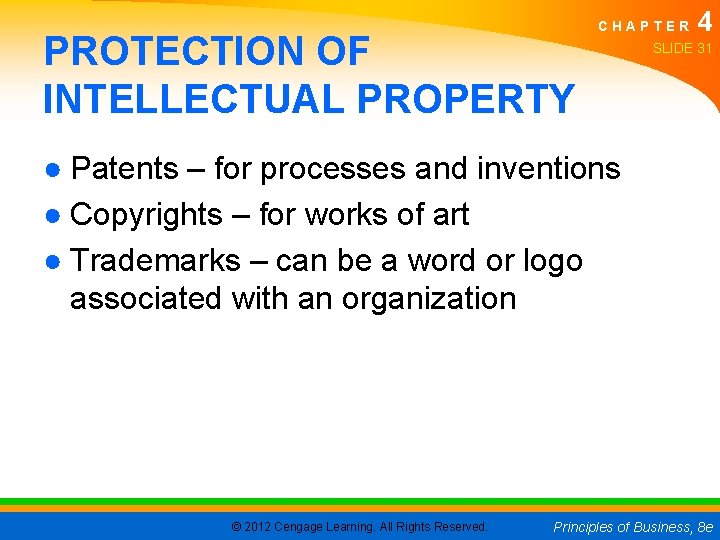
PROTECTION OF INTELLECTUAL PROPERTY CHAPTER 4 SLIDE 31 ● Patents – for processes and inventions ● Copyrights – for works of art ● Trademarks – can be a word or logo associated with an organization © 2012 Cengage Learning. All Rights Reserved. Principles of Business, 8 e
CHAPTER 4 Checkpoint © 2012 Cengage Learning. All Rights Reserved. Principles of Business, 8 e
CHAPTER 4 Checkpoint © 2012 Cengage Learning. All Rights Reserved. Principles of Business, 8 e
CHAPTER 4 Checkpoint © 2012 Cengage Learning. All Rights Reserved. Principles of Business, 8 e
CHAPTER 4 Checkpoint © 2012 Cengage Learning. All Rights Reserved. Principles of Business, 8 e
CHAPTER 4 SLIDE 36 Checkpoint ● What are three types of intellectual property? ● Patents ● Copyrights ● Trademarks © 2012 Cengage Learning. All Rights Reserved. Principles of Business, 8 e
4 -3 Government Regulation and Assistance Goal 1 Explain actions by government to regulate business. Goal 2 Discuss efforts of government to assist businesses. Goal 3 Identify methods used by government to raise money. © 2012 Cengage Learning. All Rights Reserved. SLIDE 37
CHAPTER KEY TERMS 4 SLIDE 38 ● public utility ● monopoly ● antitrust laws © 2012 Cengage Learning. All Rights Reserved. Principles of Business, 8 e
CHAPTER REGULATORY ACTIVITIES 4 SLIDE 39 ● Regulation of utilities ● Usually doesn’t make sense to have more than one utility company in a city ● Businesses without competition need regulation ● Prevent unfair business practices ● Prevent and regulate monopolies ● Pass antitrust laws against false advertising, etc. and to preserve competition © 2012 Cengage Learning. All Rights Reserved. Principles of Business, 8 e
CHAPTER 4 SLIDE 40 Checkpoint ● Why does government regulate utilities? ● Reasons for government regulation of utilities might include the assurance of fair prices, the conservation of resources, and to avoid overcrowding of utility poles and other facilities, such as power plants. ● What is an organization that supplies a service or product vital to all people? ● Public utility © 2012 Cengage Learning. All Rights Reserved. Principles of Business, 8 e
CHAPTER 4 SLIDE 41 Checkpoint ● Which of the following is an example of a public utility? ● Professional baseball team ● Fire department ● Insurance company ● Electric company © 2012 Cengage Learning. All Rights Reserved. Principles of Business, 8 e
CHAPTER 4 SLIDE 42 Checkpoint ● T or F: All public utility companies are owned and operated by state govts. ● False ● T or F: A monopoly exists when a business has control of the market for a product or service. ● True © 2012 Cengage Learning. All Rights Reserved. Principles of Business, 8 e
CHAPTER 4 SLIDE 43 Checkpoint ● Government attempts to prevent monopolies with… ● Antitrust laws do all of the following except: ● Promote competition ● Prevent false advertising ● Prevent misleading labels ● They do all of these © 2012 Cengage Learning. All Rights Reserved. Principles of Business, 8 e
GOVERNMENT ASSISTS BUSINESS CHAPTER 4 SLIDE 44 ● Government buys goods and services ● It buys about 20% of goods/services produced in U. S. ● Provide demographic info (census data) ● Government employs workers ● Largest employer in the country (16% of work force) ● These workers also buy goods and services © 2012 Cengage Learning. All Rights Reserved. Principles of Business, 8 e
CHAPTER 4 SLIDE 45 Checkpoint ● How does government assist business? ● The government assists businesses in a variety of ways, including providing demographic data, buying goods and services, and employing workers who then have the means to buy goods and services. © 2012 Cengage Learning. All Rights Reserved. Principles of Business, 8 e
GOVERNMENT RAISES MONEY CHAPTER 4 SLIDE 46 ● Taxes ● Income – largest source for federal govt. ● Property – largest source for local govt. ● Sales tax – largest source for state govt. ● Borrowing ● Borrow by selling bonds ● Considered least risky bonds b/c the govt has largest source of revenue to pay them back © 2012 Cengage Learning. All Rights Reserved. Principles of Business, 8 e
CHAPTER 4 SLIDE 47 Checkpoint ● What are three major kinds of taxes levied by the government? ● Income tax ● Sales tax ● Property tax ● How does the government borrow money? ● By issuing bonds © 2012 Cengage Learning. All Rights Reserved. Principles of Business, 8 e
CHAPTER 4 SLIDE 48 Checkpoint ● What is the difference between tax revenue and borrowing by government? ● Tax revenue is money the government collects to cover the costs of services. ● This is money that the government is not required to pay back. ● The government is required to pay back money borrowed. © 2012 Cengage Learning. All Rights Reserved. Principles of Business, 8 e
- Slides: 48