
Chapter 4 Skin and Body Membranes Pages 109
Chapter 4: Skin and Body Membranes Pages 109 -112

What are Body Membranes? �Layers of tissues that serve to: �Cover body surfaces �Line body cavities �Form protective sheets around organs �Membranes are classified according to tissue types �If you think about the function of a tissue, you can figure out where you’ll find specific membranes © 2015 Pearson Education, Inc.
Classification of Body Membranes �There are two major membrane systems: �Epithelial Membranes �Connective Membranes �There is a pattern to membrane arrangement, especially around organs �Once you remember the pattern, you can predict the specific arrangement © 2015 Pearson Education, Inc.
Functions of Membranes �Epithelial membranes- these cover or line �There are three groups: � Cutaneous membranes � Mucous membranes � Serous membranes �Connective tissue membranes- cushion, line/cover, lubricate to prevent friction � Synovial membranes
Epithelial: Cutaneous Membranes �This is your skin �a dry membrane �Two main layers: epidermis and dermis �Epidermis: (superficial) �Composed of stratified squamous epithelium �Dermis: (lies deep to the epidermis) �Mostly dense, fibrous connective tissue � the basement membrane © 2015 Pearson Education, Inc.
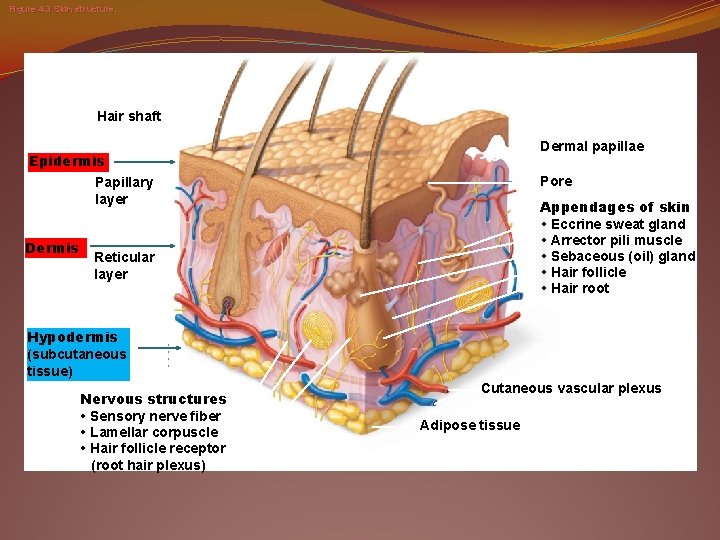
Figure 4. 3 Skin structure. Hair shaft Dermal papillae Epidermis Pore Papillary layer Dermis Appendages of skin • Eccrine sweat gland • Arrector pili muscle • Sebaceous (oil) gland • Hair follicle • Hair root Reticular layer Hypodermis (subcutaneous tissue) Nervous structures • Sensory nerve fiber • Lamellar corpuscle • Hair follicle receptor (root hair plexus) Cutaneous vascular plexus Adipose tissue
Epithelial: Mucous Membranes �Epithelial layer that rests on a connective tissue layer �lamina propria: Underlying loose connective tissue that forms the basement membrane �Mucous membranes line all body cavities that open to the exterior body surface �Mouth/nose, esophagus, digestive tract, bronchi � Wherever there is a need to absorb and/or secrete © 2015 Pearson Education, Inc.
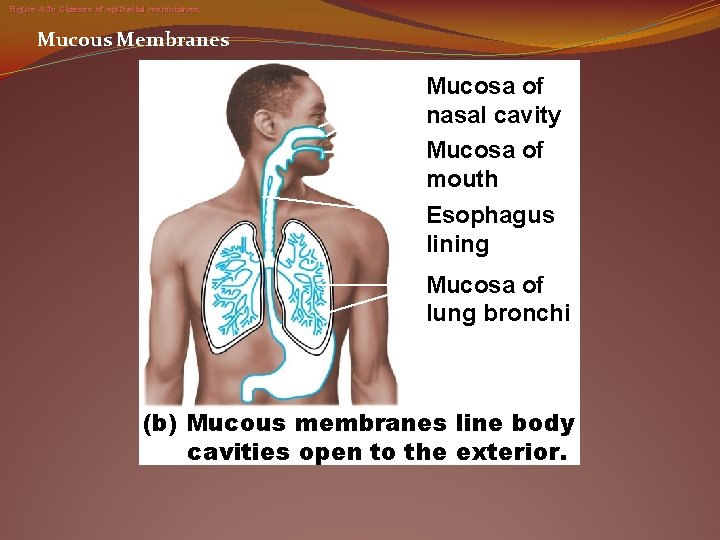
Figure 4. 1 b Classes of epithelial membranes. Mucous Membranes Mucosa of nasal cavity Mucosa of mouth Esophagus lining Mucosa of lung bronchi (b) Mucous membranes line body cavities open to the exterior.
Epithelial: Serous Membranes �Lines open body cavities that are closed to the exterior of the body such as the: �Abdominal cavity �Thoracic cavity �(Exceptions are the dorsal cavity and joints) �Serous membranes occur in pairs �Pairs are separated by serous fluid �This arrangement allows organs to slide past oneanother w/o friction
The Pairing System �Parietal layer: lines a portion of the wall of the ventral body cavity; like a perimeter lining �Visceral layer: covers the outside of the organ �This tissue is actually an extension of the parietal layer, but it folds back on itself to form the visceral layer © 2015 Pearson Education, Inc.
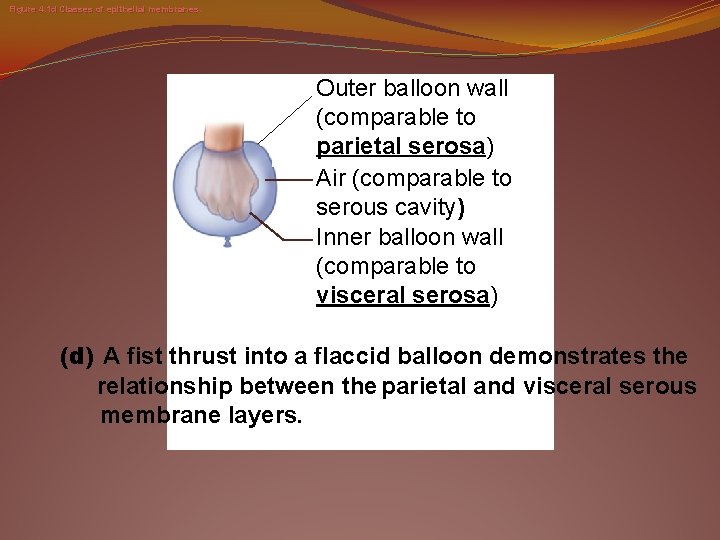
Figure 4. 1 d Classes of epithelial membranes. Outer balloon wall (comparable to parietal serosa) Air (comparable to serous cavity) Inner balloon wall (comparable to visceral serosa) (d) A fist thrust into a flaccid balloon demonstrates the relationship between the parietal and visceral serous membrane layers.
Specific serous membranes: �Peritoneum �Abdominal cavity �Pleura �Around the lungs �Pericardium �Around the heart © 2015 Pearson Education, Inc.
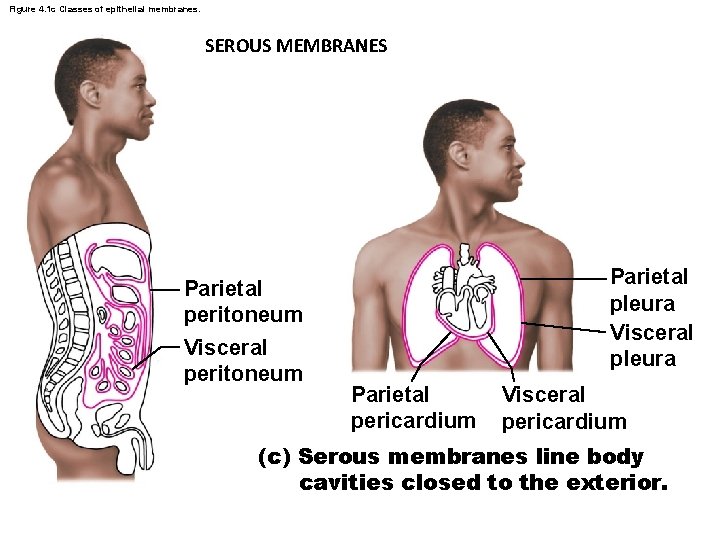
Figure 4. 1 c Classes of epithelial membranes. SEROUS MEMBRANES Parietal peritoneum Visceral peritoneum Parietal pleura Visceral pleura Parietal pericardium Visceral pericardium (c) Serous membranes line body cavities closed to the exterior.
Connective: Synovial �Made only of connective tissue �Lines fibrous capsules surrounding joints: �Lines bursae � Bursae are sacs containing synovial fluid �Lines tendon sheaths � Tendon sheaths are an elongated bursa sac �Secretes a lubricating fluid to reduce friction © 2015 Pearson Education, Inc.
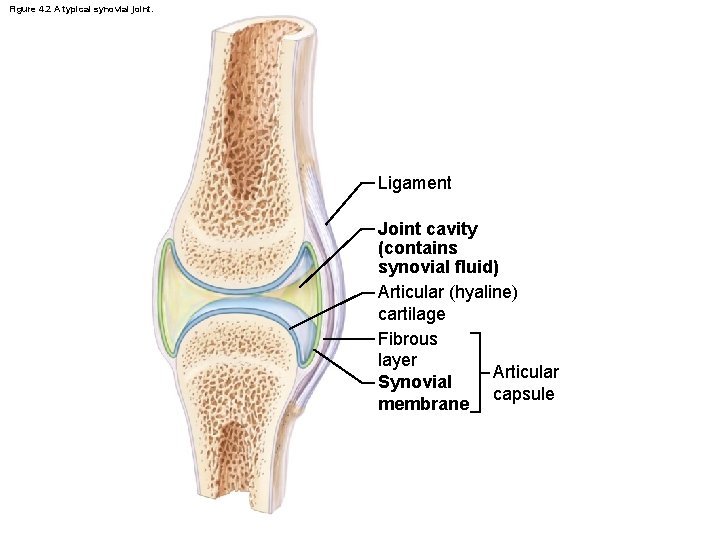
Figure 4. 2 A typical synovial joint. Ligament Joint cavity (contains synovial fluid) Articular (hyaline) cartilage Fibrous layer Articular Synovial capsule membrane
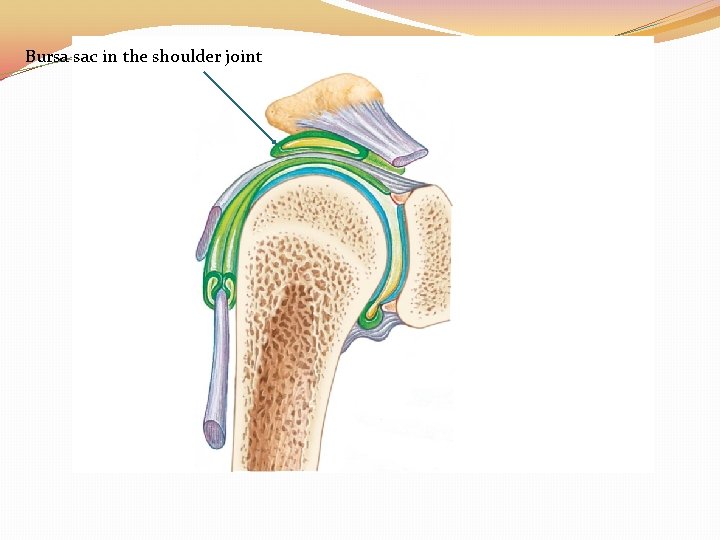
Bursa sac in the shoulder joint
- Slides: 16