
CHAPTER 4 Skin and Body Membranes Function of
CHAPTER 4 Skin and Body Membranes
Function of Body Membranes n Line or cover body surfaces n Protect body surfaces n Lubricate body surfaces
Classification of Body Membranes n Epithelial Membranes – are simple organs – Cutaneous membranes – Mucous membrane – Serous membrane n Connective Tissue Membranes
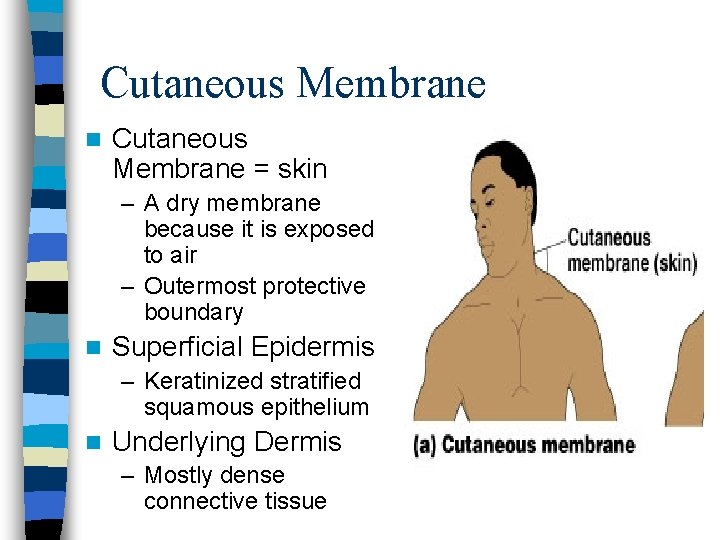
Cutaneous Membrane n Cutaneous Membrane = skin – A dry membrane because it is exposed to air – Outermost protective boundary n Superficial Epidermis – Keratinized stratified squamous epithelium n Underlying Dermis – Mostly dense connective tissue
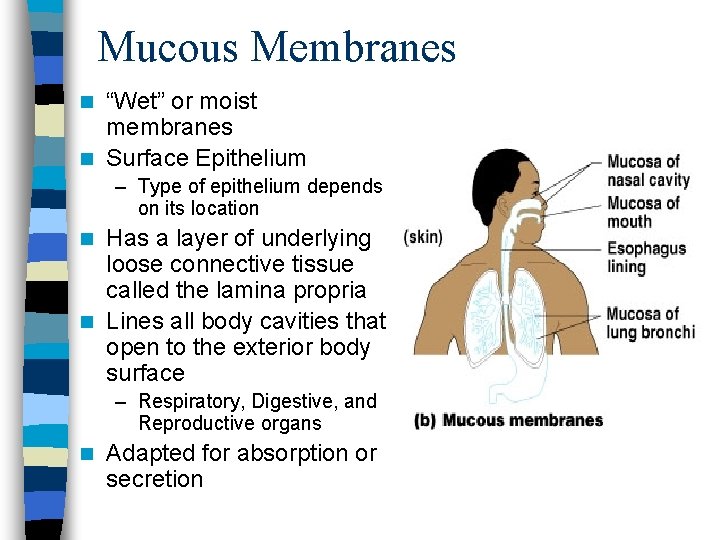
Mucous Membranes “Wet” or moist membranes n Surface Epithelium n – Type of epithelium depends on its location Has a layer of underlying loose connective tissue called the lamina propria n Lines all body cavities that open to the exterior body surface n – Respiratory, Digestive, and Reproductive organs n Adapted for absorption or secretion

Serous Membranes n Serous Membranes = “Serosa” n Surface simple squamous epithelium with underlying areolar connective tissue n Lines open body cavities that are closed to the exterior of the body n Serous membranes occur in pairs: – Parietal = lines the cavity wall – Visceral = covers the outside of the organ contained in the cavity
Serous Membranes n Serous layers are separated by serous fluid which helps to reduce friction between organs. n Specific Serous Membranes: – Peritoneum = covers the abdominal cavity – Pleura = surrounds the lungs – Pericardium = surrounds the heart
Connective Tissue Membrane n Synovial Membrane – Made of connective tissue only – Lines fibrous capsules surrounding joints
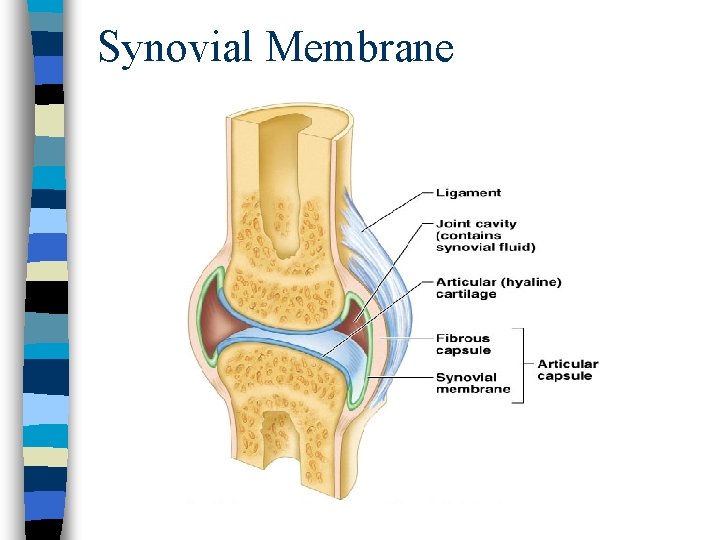
Synovial Membrane
Integumentary System n Components include: – Skin = cutaneous membrane – Sweat glands – Oil glands – Hairs – Nails
Integumentary System n Protects deeper tissues from: – Mechanical Damage – Chemical Damage – Bacterial Damage – Thermal Damage – UV Radiation – Drying Out
Integumentary System n The skin aids in: – Heat Regulation – Excretion of urea and uric acid – Synthesizing vitamin D
Skin Structure n Has 3 layers: – Epidermis = outermost layer • Stratified squamous epithelium • Often keratinized (hardened by keratin) – Dermis = middle layer • Dense connective tissue • Firmly connected to epidermis – Hypodermis = aka “subcutaneous” tissue; deep to the dermis • Not part of the skin • Anchors skin to underlying organs • Composed mostly of adipose tissue
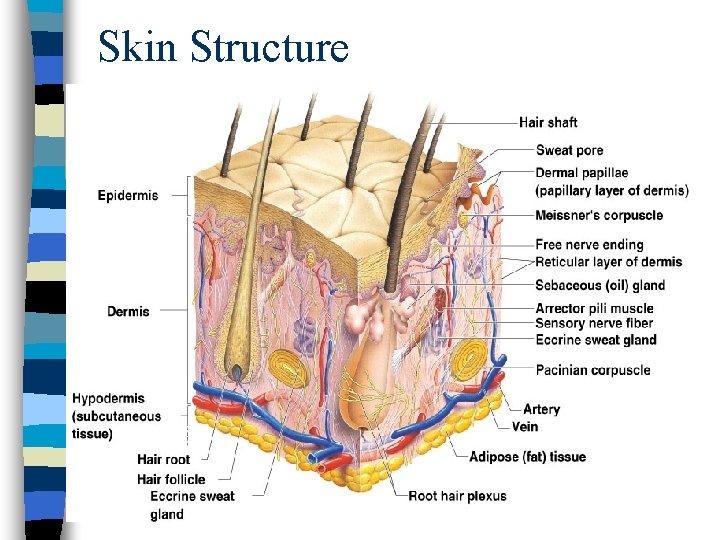
Skin Structure
Layers of the Epidermis n Stratum Basale – Layer lying next to the dermis and is undergoing mitosis Stratum Spinosum n Stratum Granulosum n Stratum Lucidum n – Occurs only in thick skin n Stratum Corneum – 20 to 30 cell layers thick – Shingle-like dead cells – Have a totally “new” epidermis every 25 -45 days
Melanin n Pigment produced by melanocytes n Color is yellow to brown to black n Found mostly in the stratum basale n Amount produced depends upon genetics and the exposure to sunlight
Layers of the Dermis n Papillary Layer – Have projections called dermal papillae – Contain pain receptors – Touch receptors(Meissner’s corpuscles) – and capillary loops n Reticular Layer – Deepest skin layer – Contains blood vessels, glands, and pressure receptors (Pacinian corpuscles)
Normal Skin Color Determinants n Melanin = yellow, brown, or black pigments n Carotene = orange-yellow pigment from some vegetables n Hemoglobin = red coloring from blood cells in the dermis capillaries; oxygen content determines the extent of red coloring
Accessory Organs of the Skin n Sebaceous Glands = produce oil – Acts as a lubricant for skin and kills bacteria – Most have ducts that empty into hair follicles – Glands are activated at puberty
Accessory Organs of the Skin n Sweat Glands = widely distributed in skin – 2 types: • Eccrine = open via duct to pore on skin surface • Apocrine = ducts empty into hair follicles – Composition of sweat: • Mostly water, some metabolic waste • Only in apocrine glands – fatty acids & proteins
– Function: • Helps get rid of excessive heat • Excretes waste products • Its acidic nature inhibits bacteria growth – Odor is from associated bacteria
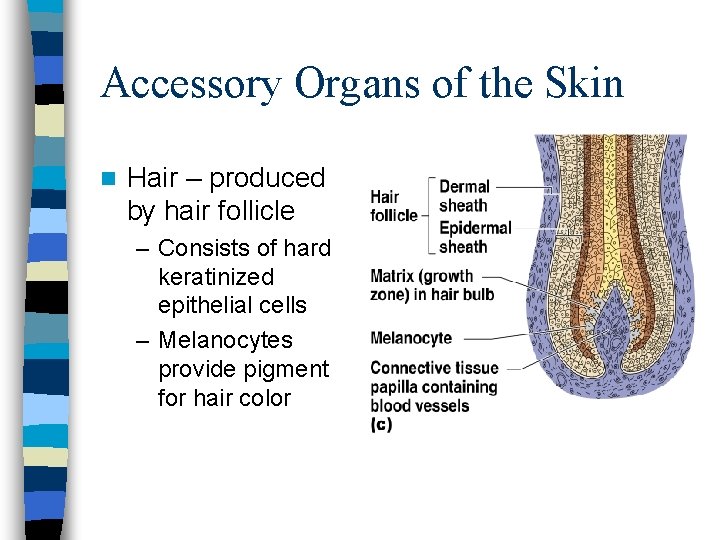
Accessory Organs of the Skin n Hair – produced by hair follicle – Consists of hard keratinized epithelial cells – Melanocytes provide pigment for hair color
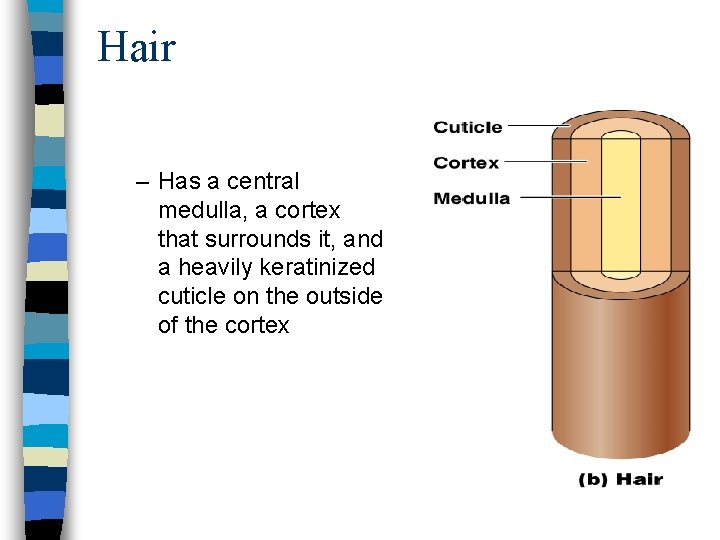
Hair – Has a central medulla, a cortex that surrounds it, and a heavily keratinized cuticle on the outside of the cortex
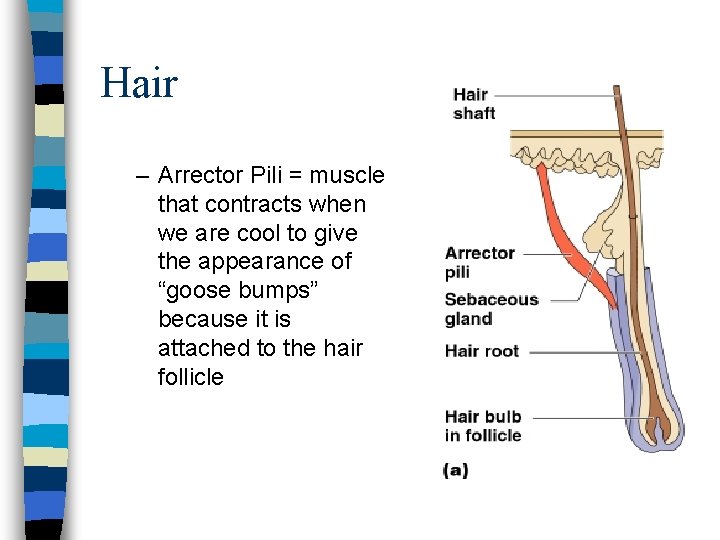
Hair – Arrector Pili = muscle that contracts when we are cool to give the appearance of “goose bumps” because it is attached to the hair follicle
Accessory Organs of the Skin n Nails = scale-like modifications of the epidermis that are heavily keratinized – Have a lack of pigment that makes them colorless – Stratum basale extends beneath the nail bed so that the nail grows
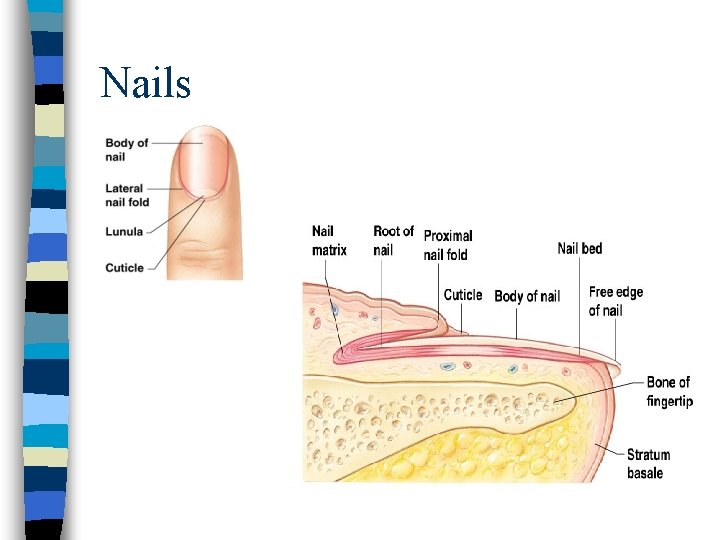
Nails
Skin Homeostatic Imbalances n Infections (page 107): – Athlete’s Foot = caused by fungal infection – Boils & Carbuncles = caused by bacterial infection – Cold Sores = caused by a virus – Contact Dermatitis = exposures cause an allergic reaction – Impetigo = caused by bacterial infection – Psoriasis = cause is unknown but is triggered by trauma, infection, and stress
Burns (pages 108 – 109) n Tissue damage and cell death caused by heat, electricity, UV radiation, or chemicals n Dangers of burns include dehydration, electrolyte imbalance, and circulatory shock n “Rule of Nines” is a way to determine the extent of burns – Body is divided into 11 areas for quick estimation and each area represents about 9%
Severity of Burns n 1 st Degree Burns = only epidermis is damaged – Skin is red and swollen n 2 nd Degree Burns = epidermis and upper dermis are damaged – Skin is red with blisters n 3 rd Degree Burns = destroys entire skin layer – Burn is gray-white or black
Burns n Burns are considered critical if: – Over 25% of the body has 2 nd degree burns – Over 10% of the body has 3 rd degree burns – There are 3 rd degree burns of the face, hands, or feet
Skin Cancer n Skin Cancer = most common type of cancer; abnormal cell mass; 2 types: – Benign – does not spread – Malignant – metastasized (moves) to other parts of the body
Basal Cell Carcinoma n Least malignant n Most common type arises from stratum basale
Squamous Cell Carcinoma n Early removal allows a good chance of cure n Arises from stratum spinosum n Metastasizes to lymph nodes
Malignant Melanoma n Most deadly of skin cancers n Cancer of melanocytes n Metastasizes rapidly to lymph and blood vessels
Detection of Skin Cancer n Uses ABCD rule: – A = Asymmetry • 2 sides of pigmented mole do not match – B = Border irregularity • Borders of mole are not smooth – C = Color • Different colors in pigmented area – D = Diameter • Spot is larger than 6 mm in diameter
- Slides: 35