
Chapter 4 Sensation and Perception 1 I Sensation
- Slides: 45
Chapter 4 Sensation and Perception 1
I. Sensation and Perception A. The Distinction n Sensation : stimulation of sense organs n Perception: selection, organization, and interpretation of sensory input n Psychophysics = the study of how physical stimuli are translated into psychological experience 2 Table of Contents
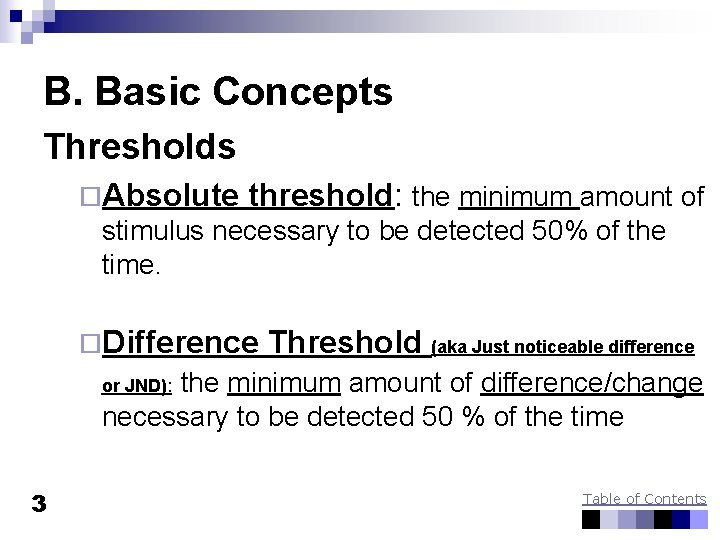
B. Basic Concepts Thresholds ¨Absolute threshold: the minimum amount of stimulus necessary to be detected 50% of the time. ¨Difference Threshold (aka Just noticeable difference the minimum amount of difference/change necessary to be detected 50 % of the time or JND): 3 Table of Contents
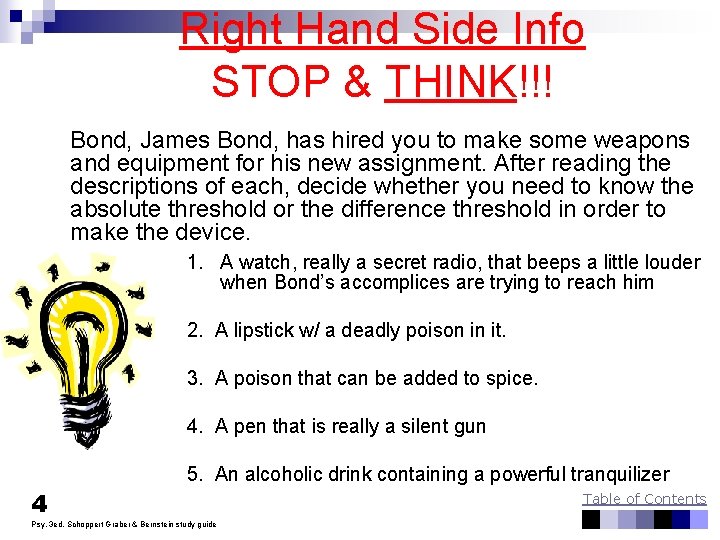
Right Hand Side Info STOP & THINK!!! Bond, James Bond, has hired you to make some weapons and equipment for his new assignment. After reading the descriptions of each, decide whether you need to know the absolute threshold or the difference threshold in order to make the device. 1. A watch, really a secret radio, that beeps a little louder when Bond’s accomplices are trying to reach him 2. A lipstick w/ a deadly poison in it. 3. A poison that can be added to spice. 4. A pen that is really a silent gun 5. An alcoholic drink containing a powerful tranquilizer 4 Psy. 3 ed. Schoppert Graber & Bernstein study guide Table of Contents
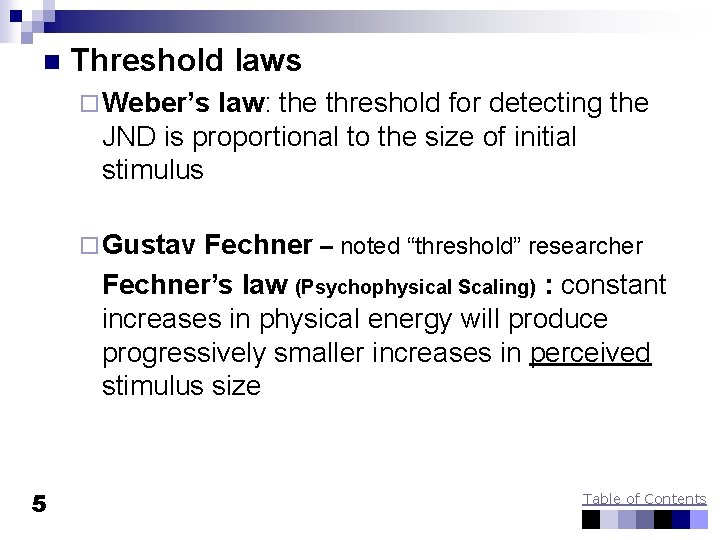
n Threshold laws ¨ Weber’s law: the threshold for detecting the JND is proportional to the size of initial stimulus ¨ Gustav Fechner – noted “threshold” researcher Fechner’s law (Psychophysical Scaling) : constant increases in physical energy will produce progressively smaller increases in perceived stimulus size 5 Table of Contents
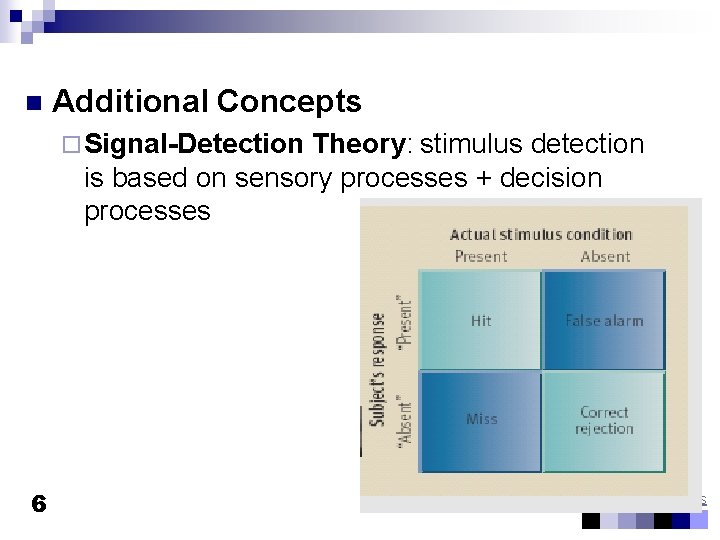
n Additional Concepts ¨ Signal-Detection Theory: stimulus detection is based on sensory processes + decision processes 6 Table of Contents
n Subliminal Perception: perception without conscious awareness ¨ *yes, it’s possible, but the effects are not practical n Sensory Adaptation: diminished sensitivity to an unchanging stimulus n Habituation: decreased responsiveness to a repeated stimulus n 7 Selective Attention: Table of Contents
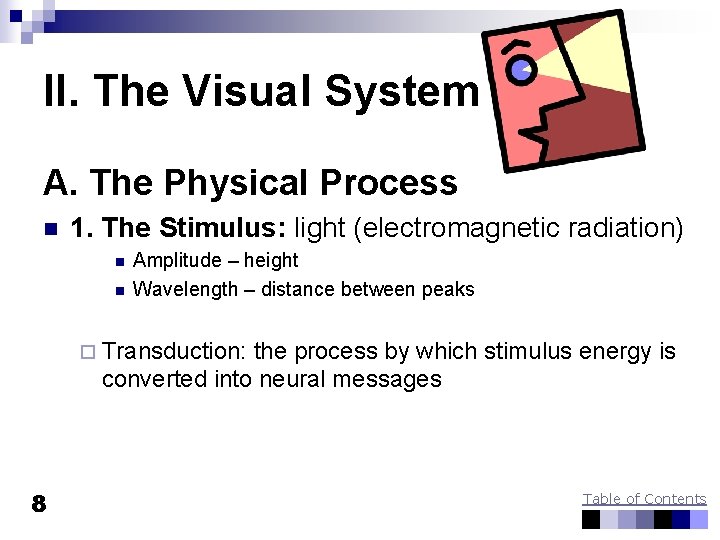
II. The Visual System A. The Physical Process n 1. The Stimulus: light (electromagnetic radiation) n n Amplitude – height Wavelength – distance between peaks ¨ Transduction: the process by which stimulus energy is converted into neural messages 8 Table of Contents
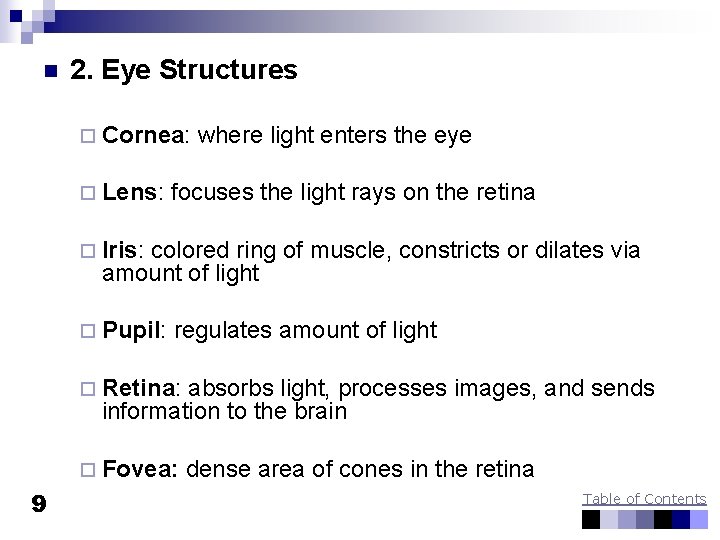
n 2. Eye Structures ¨ Cornea: ¨ Lens: where light enters the eye focuses the light rays on the retina ¨ Iris: colored ring of muscle, constricts or dilates via amount of light ¨ Pupil: regulates amount of light ¨ Retina: absorbs light, processes images, and sends information to the brain ¨ Fovea: 9 dense area of cones in the retina Table of Contents
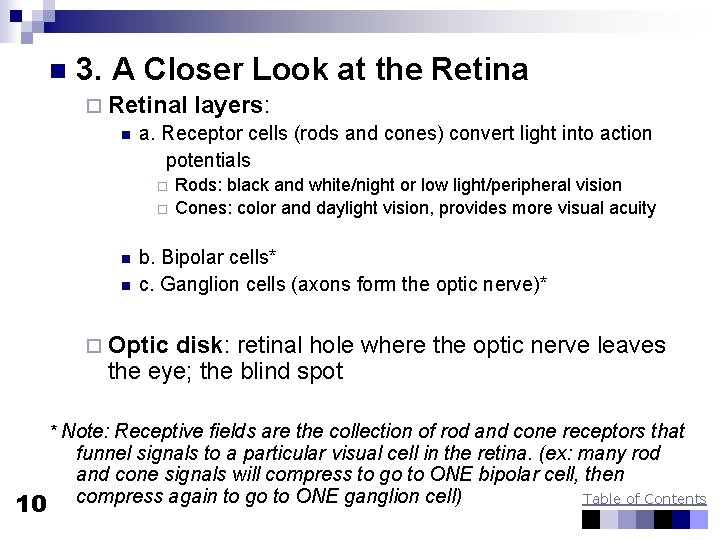
n 3. A Closer Look at the Retina ¨ Retinal layers: n a. Receptor cells (rods and cones) convert light into action potentials ¨ ¨ n n Rods: black and white/night or low light/peripheral vision Cones: color and daylight vision, provides more visual acuity b. Bipolar cells* c. Ganglion cells (axons form the optic nerve)* ¨ Optic disk: retinal hole where the optic nerve leaves the eye; the blind spot * Note: Receptive fields are the collection of rod and cone receptors that 10 funnel signals to a particular visual cell in the retina. (ex: many rod and cone signals will compress to go to ONE bipolar cell, then compress again to go to ONE ganglion cell) Table of Contents
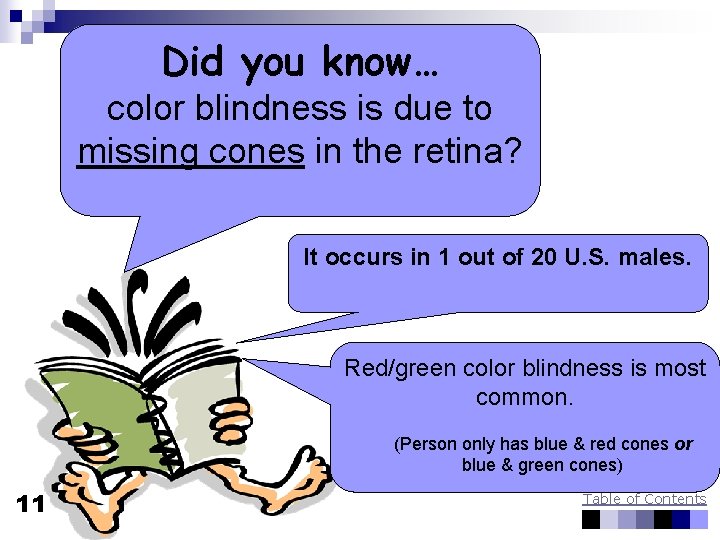
Did you know… color blindness is due to missing cones in the retina? It occurs in 1 out of 20 U. S. males. Red/green color blindness is most common. (Person only has blue & red cones or blue & green cones) 11 Table of Contents
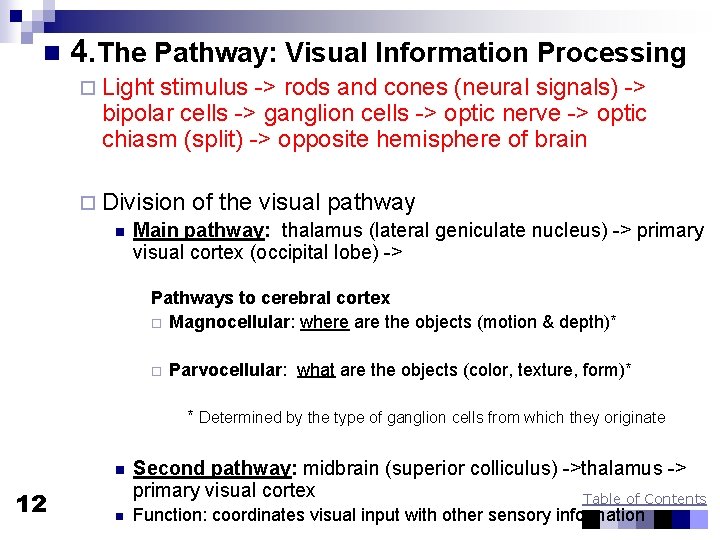
n 4. The Pathway: Visual Information Processing ¨ Light stimulus -> rods and cones (neural signals) -> bipolar cells -> ganglion cells -> optic nerve -> optic chiasm (split) -> opposite hemisphere of brain ¨ Division of the visual pathway n Main pathway: thalamus (lateral geniculate nucleus) -> primary visual cortex (occipital lobe) -> Pathways to cerebral cortex ¨ Magnocellular: where are the objects (motion & depth)* ¨ Parvocellular: what are the objects (color, texture, form)* * Determined by the type of ganglion cells from which they originate n 12 n Second pathway: midbrain (superior colliculus) ->thalamus -> primary visual cortex Table of Contents Function: coordinates visual input with other sensory information
n 5. Groundbreaking Research: Nobel Prize 1981 ¨ Early 1960’s: David Hubel and Torsten Wiesel n Microelectrode recording of axons in primary visual cortex of animals n 13 Discovered feature detectors: neurons that respond selectively to lines, edges, etc. Table of Contents
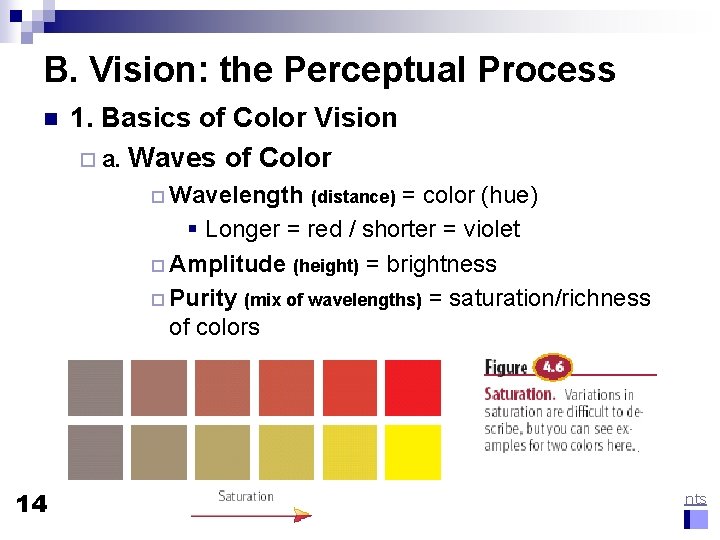
B. Vision: the Perceptual Process n 1. Basics of Color Vision ¨ a. Waves of Color ¨ Wavelength (distance) = color (hue) § Longer = red / shorter = violet ¨ Amplitude (height) = brightness ¨ Purity (mix of wavelengths) = saturation/richness of colors 14 Table of Contents
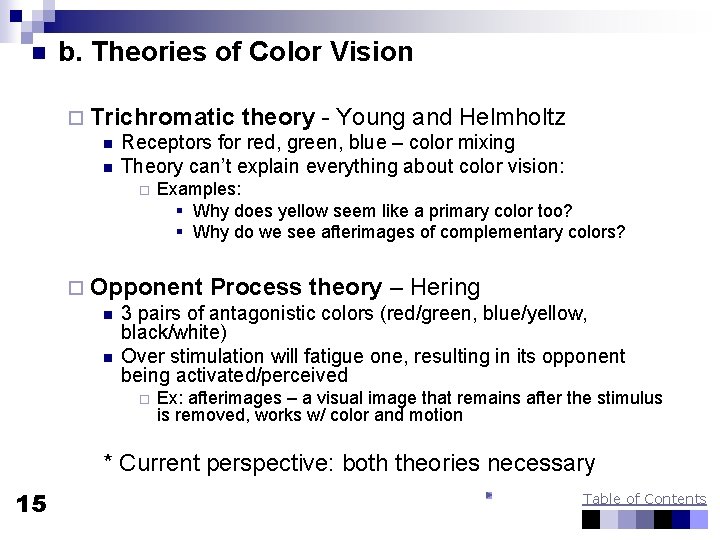
n b. Theories of Color Vision ¨ Trichromatic theory - Young and Helmholtz n Receptors for red, green, blue – color mixing n Theory can’t explain everything about color vision: ¨ Examples: § Why does yellow seem like a primary color too? § Why do we see afterimages of complementary colors? ¨ Opponent Process theory – Hering n 3 pairs of antagonistic colors (red/green, blue/yellow, black/white) n Over stimulation will fatigue one, resulting in its opponent being activated/perceived ¨ Ex: afterimages – a visual image that remains after the stimulus is removed, works w/ color and motion * Current perspective: both theories necessary 15 Table of Contents
2. Interpreting the Stimuli To perceive the brain must… 1. organize sensory information into coherent objects, and separate them from the background 2. relate sensory information to existing knowledge 3. learn to attend to certain features to make fine discriminations (i. e. : Eskimos & snow) • Perception is an economical process. We tend to… a. perceive the world in its simplest form • b. make judgments based on a small amount of clues • 16 Table of Contents
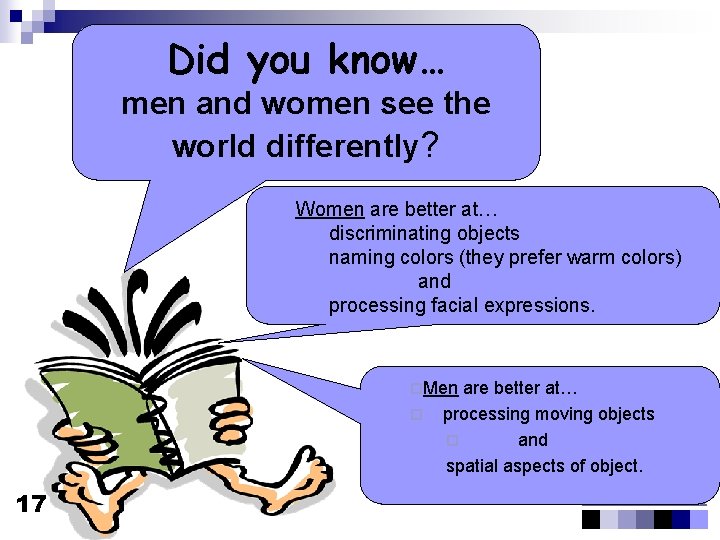
Did you know… men and women see the world differently? Women are better at… discriminating objects naming colors (they prefer warm colors) and processing facial expressions. ¨Men ¨ 17 are better at… processing moving objects ¨ and spatial aspects of object. Table of Contents
a. Perceiving Forms, Patterns, and Objects ¨ Reversible figures - figures compatible w/ two interpretations that can switch back and forth; influenced by perceptual set 18 Table of Contents
a. Perceiving Forms, Patterns, and Objects con’t ¨ Perceptual sets – a readiness to perceive a stimulus due to past experience or provided information n **Reversible figures and perceptual sets demonstrate that the same visual stimulus can result in very different perceptions 19 Table of Contents
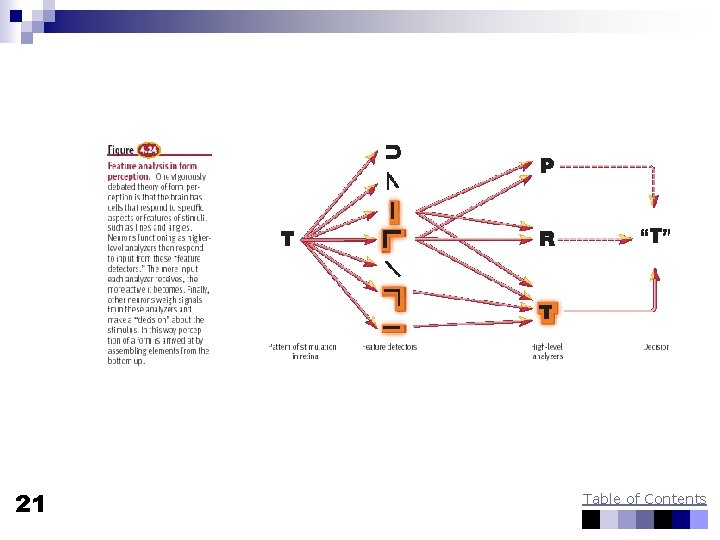
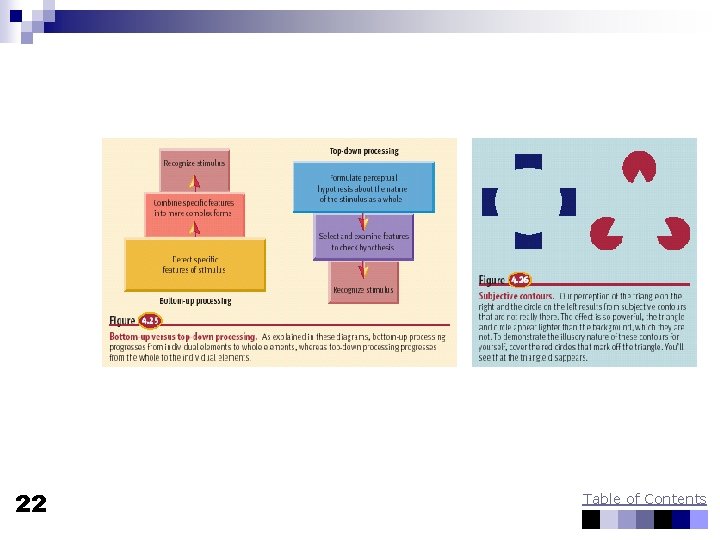
a. Perceiving Forms, Patterns, and Objects con’t ¨ Feature detection theory – process of identifying key elements then putting them together in a more complex form; uses bottom-up processing (features to the whole) – see figure 4. 23 on p. 144 n Problem: evidence supports that we also use top-down processing (whole to specific features); ex: we tend to read words, not letters ¨ Gestalt 20 psychologists: see next slide Table of Contents
21 Table of Contents
22 Table of Contents
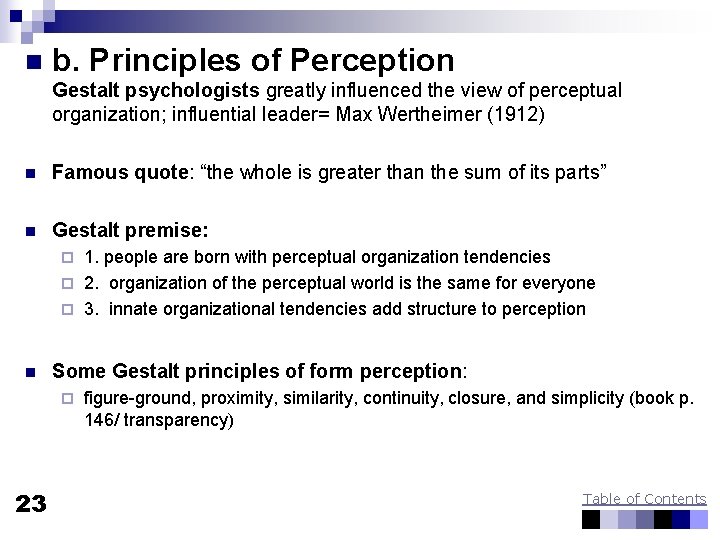
n b. Principles of Perception Gestalt psychologists greatly influenced the view of perceptual organization; influential leader= Max Wertheimer (1912) n Famous quote: “the whole is greater than the sum of its parts” n Gestalt premise: 1. people are born with perceptual organization tendencies ¨ 2. organization of the perceptual world is the same for everyone ¨ 3. innate organizational tendencies add structure to perception ¨ n Some Gestalt principles of form perception: ¨ 23 figure-ground, proximity, similarity, continuity, closure, and simplicity (book p. 146/ transparency) Table of Contents
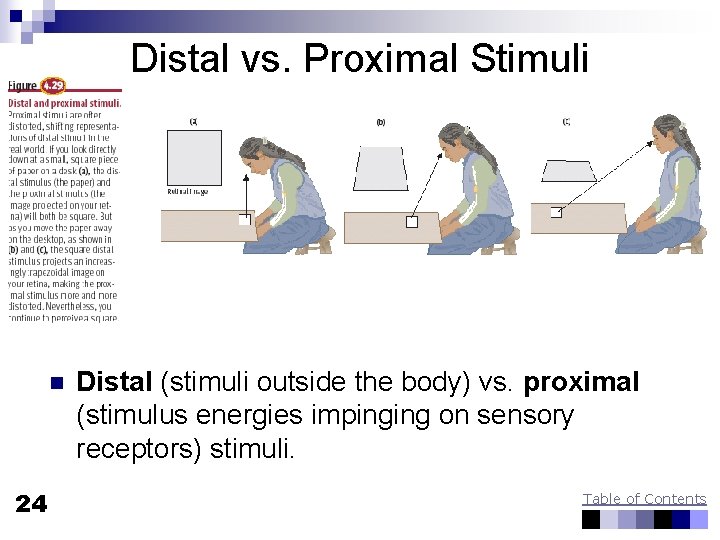
Distal vs. Proximal Stimuli n 24 Distal (stimuli outside the body) vs. proximal (stimulus energies impinging on sensory receptors) stimuli. Table of Contents
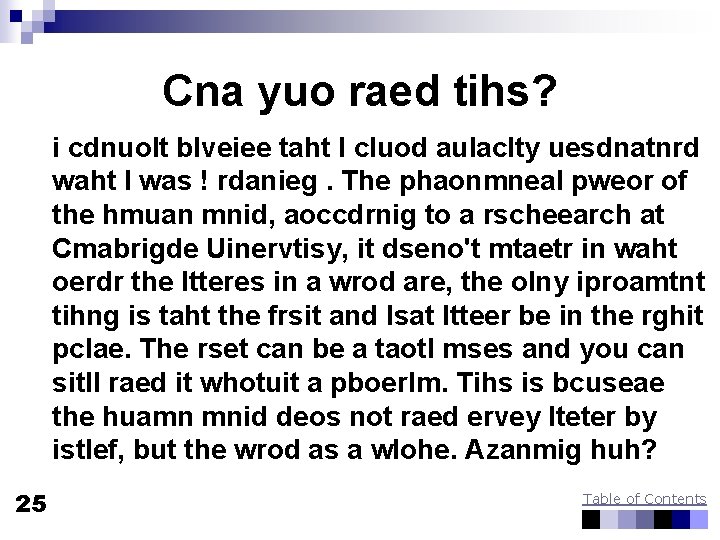
Cna yuo raed tihs? i cdnuolt blveiee taht I cluod aulaclty uesdnatnrd waht I was ! rdanieg. The phaonmneal pweor of the hmuan mnid, aoccdrnig to a rscheearch at Cmabrigde Uinervtisy, it dseno't mtaetr in waht oerdr the ltteres in a wrod are, the olny iproamtnt tihng is taht the frsit and lsat ltteer be in the rghit pclae. The rset can be a taotl mses and you can sitll raed it whotuit a pboerlm. Tihs is bcuseae the huamn mnid deos not raed ervey lteter by istlef, but the wrod as a wlohe. Azanmig huh? 25 Table of Contents
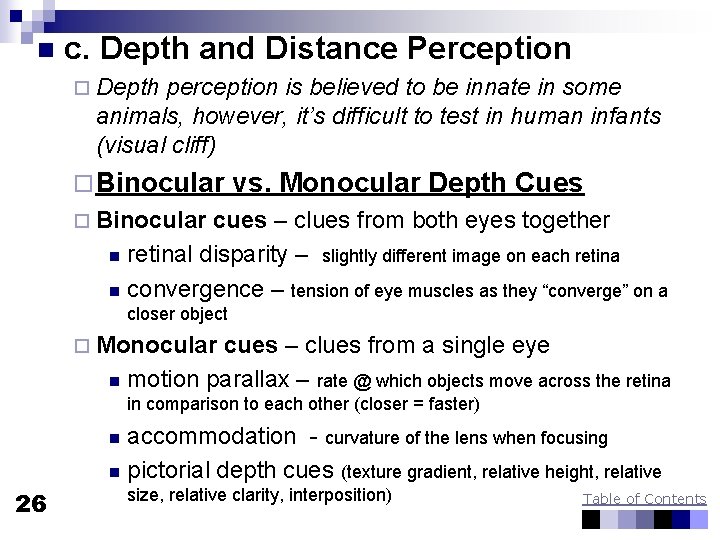
n c. Depth and Distance Perception ¨ Depth perception is believed to be innate in some animals, however, it’s difficult to test in human infants (visual cliff) ¨ Binocular vs. Monocular Depth Cues ¨ Binocular cues – clues from both eyes together n retinal disparity – slightly different image on each retina n convergence – tension of eye muscles as they “converge” on a closer object ¨ Monocular cues – clues from a single eye n motion parallax – rate @ which objects move across the retina in comparison to each other (closer = faster) accommodation - curvature of the lens when focusing n pictorial depth cues (texture gradient, relative height, relative n 26 size, relative clarity, interposition) Table of Contents
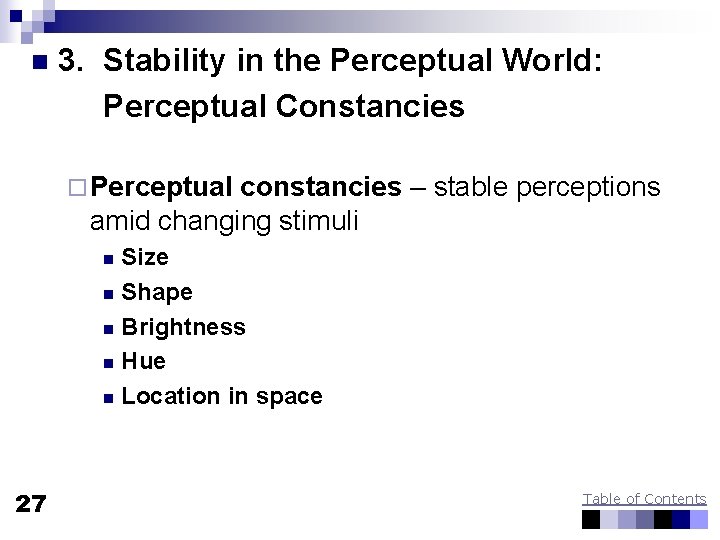
n 3. Stability in the Perceptual World: Perceptual Constancies ¨ Perceptual constancies – stable perceptions amid changing stimuli Size n Shape n Brightness n Hue n Location in space n 27 Table of Contents
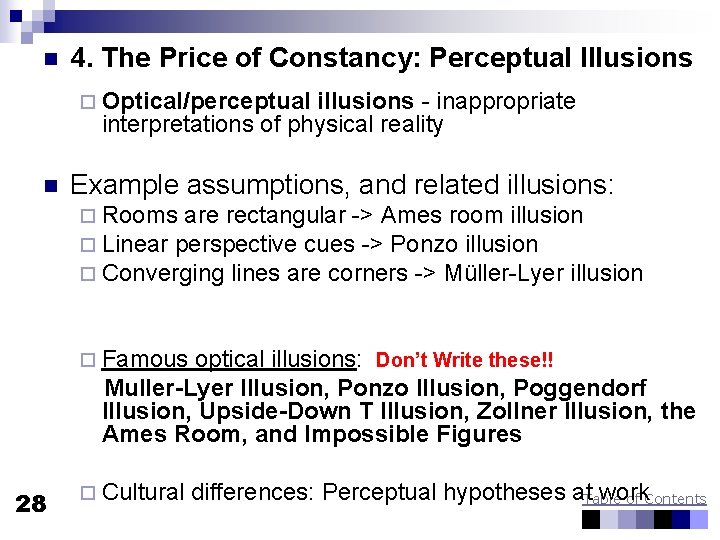
n 4. The Price of Constancy: Perceptual Illusions ¨ Optical/perceptual illusions - inappropriate interpretations of physical reality n Example assumptions, and related illusions: ¨ Rooms are rectangular -> Ames room illusion ¨ Linear perspective cues -> Ponzo illusion ¨ Converging lines are corners -> Müller-Lyer illusion ¨ Famous optical illusions: Don’t Write these!! Muller-Lyer Illusion, Ponzo Illusion, Poggendorf Illusion, Upside-Down T Illusion, Zollner Illusion, the Ames Room, and Impossible Figures 28 ¨ Cultural differences: Perceptual hypotheses at. Table work of Contents
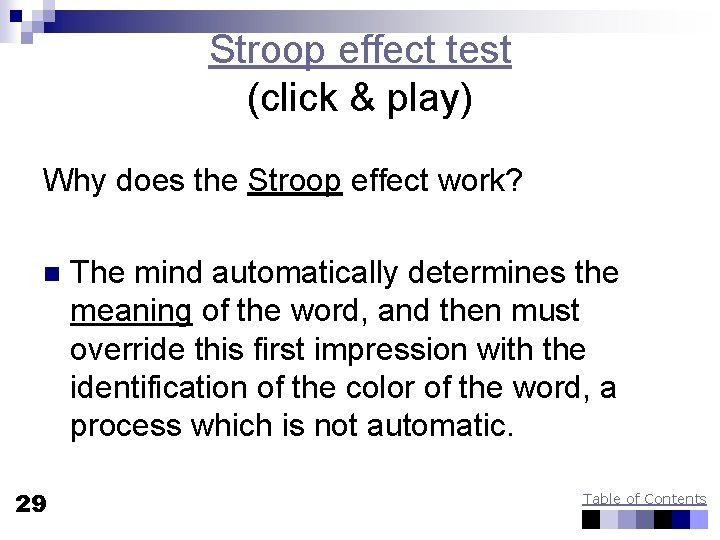
Stroop effect test (click & play) Why does the Stroop effect work? n 29 The mind automatically determines the meaning of the word, and then must override this first impression with the identification of the color of the word, a process which is not automatic. Table of Contents
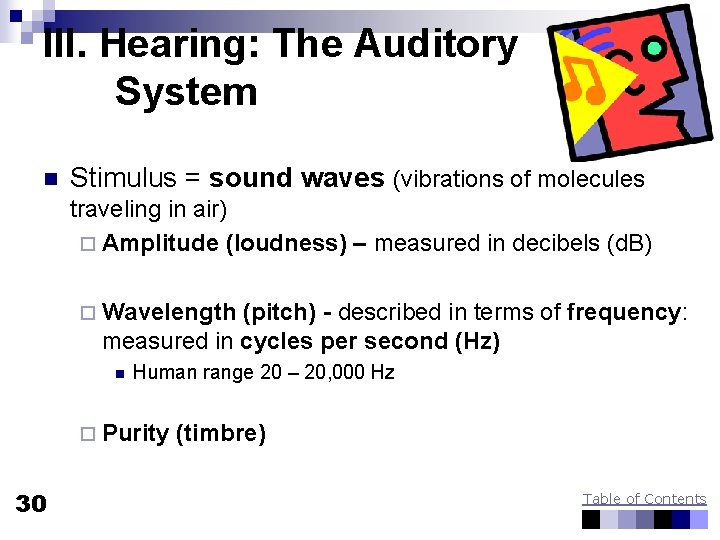
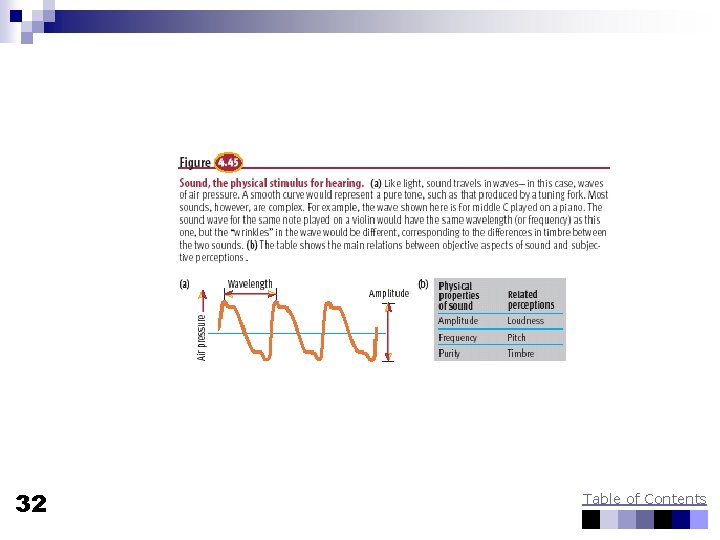
III. Hearing: The Auditory System n Stimulus = sound waves (vibrations of molecules traveling in air) ¨ Amplitude (loudness) – measured in decibels (d. B) ¨ Wavelength (pitch) - described in terms of frequency: measured in cycles per second (Hz) n Human range 20 – 20, 000 Hz ¨ Purity 30 (timbre) Table of Contents
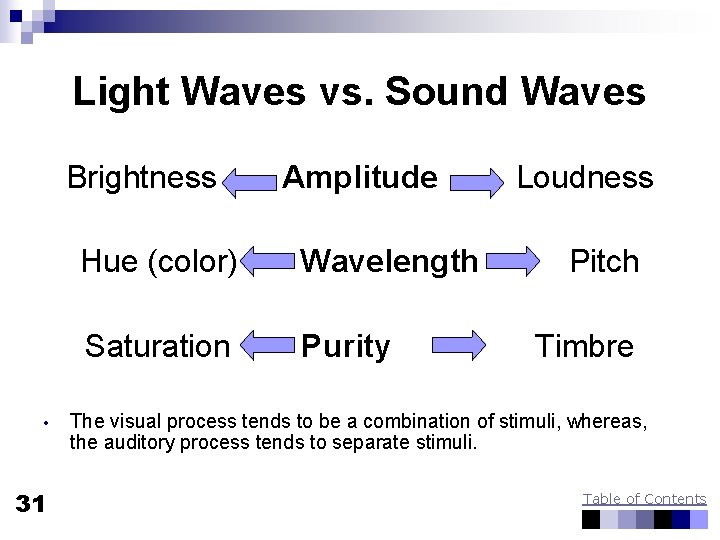
Light Waves vs. Sound Waves Brightness • 31 Amplitude Hue (color) Wavelength Saturation Purity Loudness Pitch Timbre The visual process tends to be a combination of stimuli, whereas, the auditory process tends to separate stimuli. Table of Contents
32 Table of Contents
n A. Structures ¨ 1. The Ear: Three Divisions n External ear (pinna): collects sound n Middle ear: the ossicles (hammer, anvil, stirrup) n Inner ear: the cochlea (a fluid-filled, coiled tunnel) lined with the basilar membrane ¨ contains hair cells (the auditory receptors) ¨ 33 Table of Contents
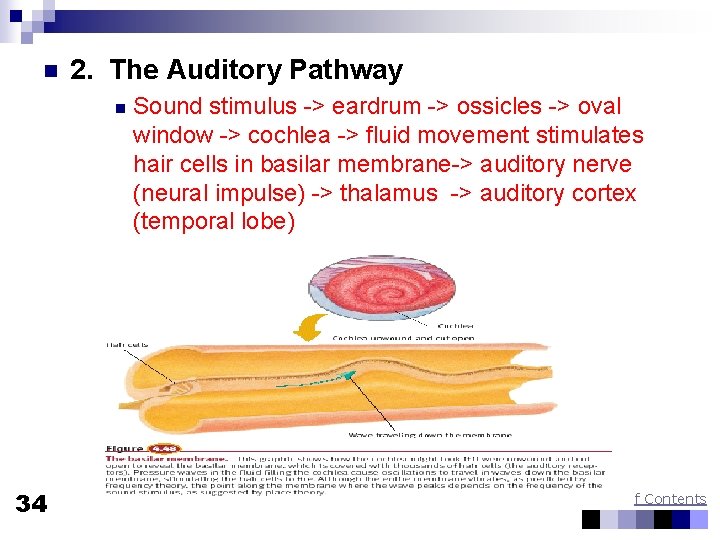
n 2. The Auditory Pathway n 34 Sound stimulus -> eardrum -> ossicles -> oval window -> cochlea -> fluid movement stimulates hair cells in basilar membrane-> auditory nerve (neural impulse) -> thalamus -> auditory cortex (temporal lobe) Table of Contents
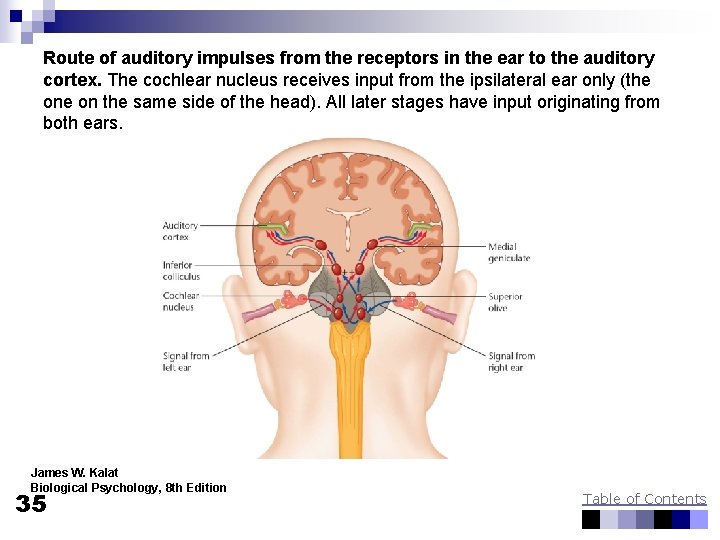
Route of auditory impulses from the receptors in the ear to the auditory cortex. The cochlear nucleus receives input from the ipsilateral ear only (the on the same side of the head). All later stages have input originating from both ears. James W. Kalat Biological Psychology, 8 th Edition 35 Table of Contents
B. Perceiving Sound n 1. Theories of Hearing ¨ Place theory (Hermann von Helmholtz - 1863) n ¨ Frequency theory (Rutherford + , 1886) n ¨ 36 perception corresponds to the rate at which the basilar membrane vibrates, the brain detects the frequency of a tone by the rate at which the auditory nerve fires Traveling wave theory (Georg von Bekesy - 1947) n ¨ perception of pitch corresponds to the vibrations of different places of the basilar membrane reconciled the two theories, the whole basilar membrane does move, but the waves peak at particular places, depending on frequency. Volley Theory (look in book) Table of Contents
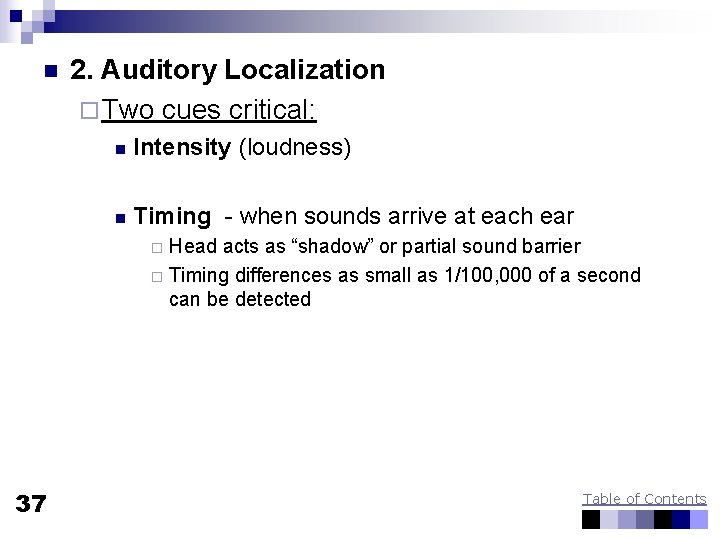
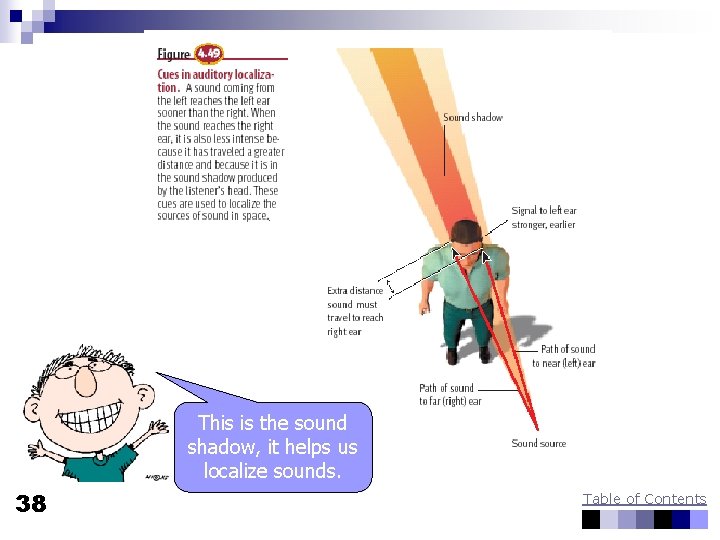
n 2. Auditory Localization ¨ Two cues critical: n Intensity (loudness) n Timing - when sounds arrive at each ear Head acts as “shadow” or partial sound barrier ¨ Timing differences as small as 1/100, 000 of a second can be detected ¨ 37 Table of Contents
This is the sound shadow, it helps us localize sounds. 38 Table of Contents
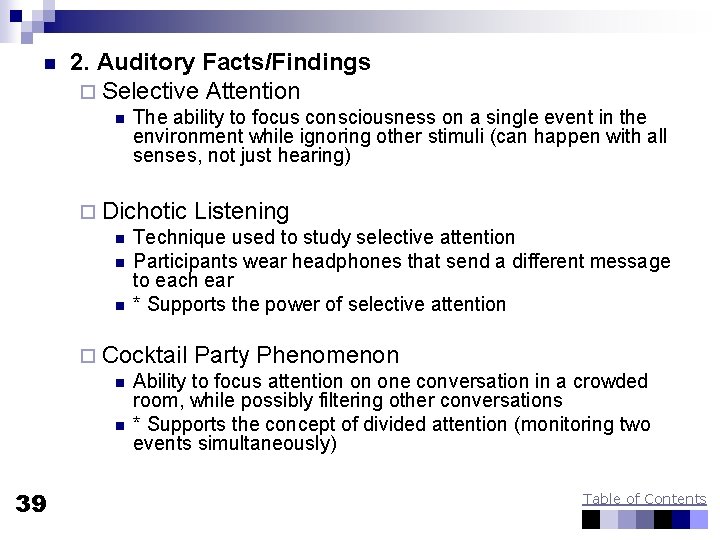
n 2. Auditory Facts/Findings ¨ Selective Attention n The ability to focus consciousness on a single event in the environment while ignoring other stimuli (can happen with all senses, not just hearing) ¨ Dichotic Listening n Technique used to study selective attention n Participants wear headphones that send a different message to each ear n * Supports the power of selective attention ¨ Cocktail Party Phenomenon n Ability to focus attention on one conversation in a crowded room, while possibly filtering other conversations n * Supports the concept of divided attention (monitoring two events simultaneously) 39 Table of Contents
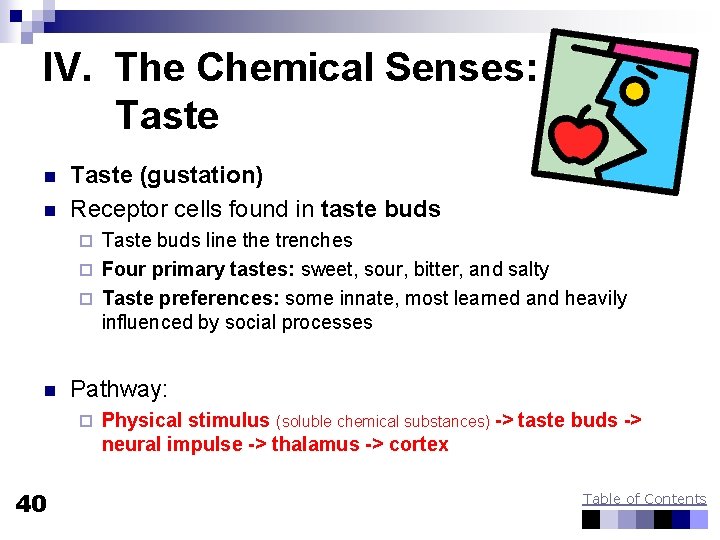
IV. The Chemical Senses: Taste n n Taste (gustation) Receptor cells found in taste buds Taste buds line the trenches ¨ Four primary tastes: sweet, sour, bitter, and salty ¨ Taste preferences: some innate, most learned and heavily influenced by social processes ¨ n Pathway: ¨ 40 Physical stimulus (soluble chemical substances) -> taste buds -> neural impulse -> thalamus -> cortex Table of Contents
V. The Chemical Senses: Smell n Smell (Olfaction) n Physical stimuli: substances carried in the air ¨ dissolved in fluid (mucus in the nose) ¨ Olfactory receptors = olfactory cilia (located at top of nasal cavity) n 41 Pathway: Olfactory cilia -> neural impulse -> olfactory bulb -> olfactory nerve -> brain n *Only sense that does NOT relay through the thalamus! Table of Contents
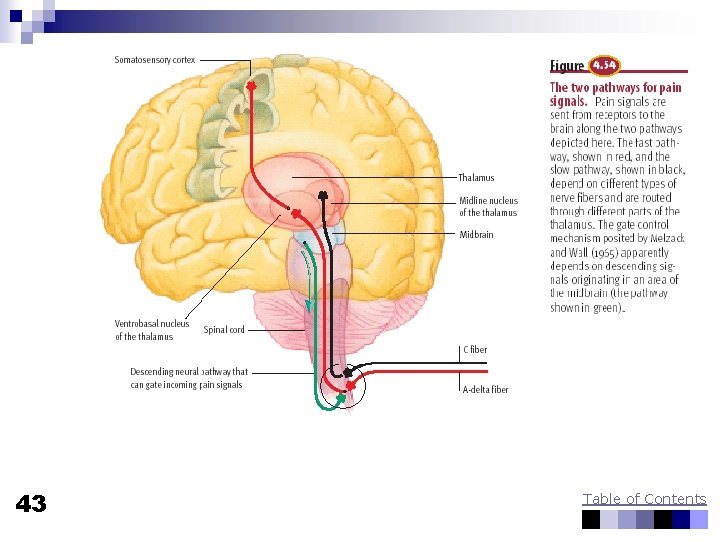
VI. Skin Senses: Touch n n n Physical stimuli = mechanical, thermal, and chemical energy impinging on the skin. Pathway: Sensory receptors -> the spinal column -> brainstem -> cross to opposite side of brain -> thalamus -> somatosensory cortex (parietal lobe) Temperature: detected by free nerve endings in the skin ¨ n FNE – unspecilalized, unencapsulated (naked dendrite) afferent nerve Pain receptors: also free nerve endings ¨ Two pain pathways: n n ¨ 42 Fast – localized, sharp pain Slow – less localized, aching pain Gate Control Theory – small nerve fibers carry the pain signal through a “gate”, but larger nerve fibers going through the same “gate” can inhibit the Table of Contents signal.
43 Table of Contents
VII. Other Senses: Kinesthetic and Vestibular n Kinesthesis - knowing the position of various parts of the body ¨ Receptors n in joints/muscles Vestibular - equilibrium/balance ¨ Semicircular 44 canals Table of Contents
The End Whew! All done!!! n Test: ¨ 100 questions multiple choice ¨ 1 AP style short answer 45 Table of Contents