
Chapter 4 Section III Highfrequency Ventilators Vyaire 3100






- Slides: 21
Chapter 4: Section III High-frequency Ventilators Vyaire 3100 B High-frequency Oscillator Percussionaire VDR-4 Bunnell Life Pulse
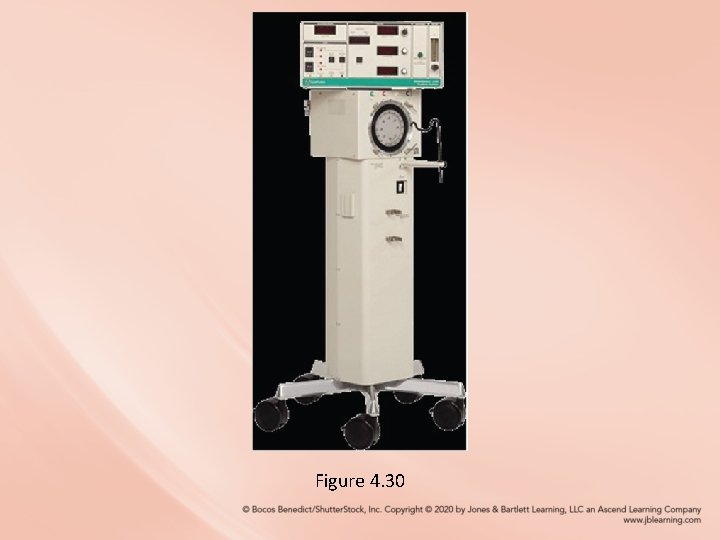
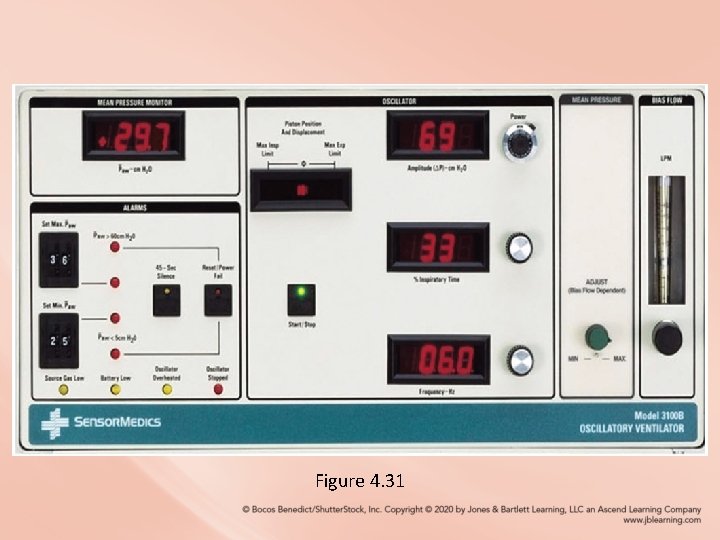
High-frequency Ventilators Vyaire 3100 B High-frequency Oscillator • Vyaire 3100 B delivers oscillations to patients (35 kg or larger) at a high frequency or rate. 18 • The 3100 B operator interface consists of various knobs and LED readouts; (see Figure 4 -31). (depicted in Figure 4 -30).
Figure 4. 30
Figure 4. 31
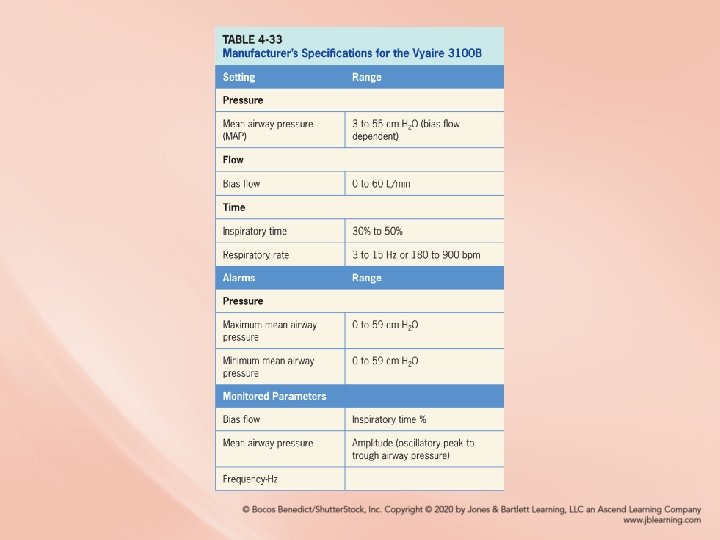
Mode • The 3100 B is a high-flow CPAP system with oscillations being superimposed on the gas in the patient circuit using an electrically-driven diaphragm. 18 • CPAP (called mean airway pressure or MAP), along with Fio 2 provide oxygenation while oscillations provide CO 2 removal. • Frequency of oscillations can be set between 3 and 15 Hz (each Hz comprises 60 oscillations). • Oscillatory pressure amplitude is controlled by a thumb wheel knob that controls power driving the piston forward.
Mode (cont’d) • Frequency of oscillations is set by the Frequency-Hz control. It is displayed in Hz and each Hz corresponds to 60 cycles per minute. • Contrary to conventional ventilation decreasing the Hz tends to increase CO 2 removal. The % Inspiratory Time represents the percentage of each respiratory cycle (oscillation) that the piston is moving forward and helps facilitate CO 2 removal. • The mean airway pressure is adjusted with a control that varies the resistance at the exhalation valve and can be set from approximately 5 to 55 cm H 2 O. Since it is not feedback -controlled, the MAP can vary depending on the other settings.
Mode (cont’d) • There is a sweep gas (called bias flow) that runs continuously through the circuit and it can be set from 0 to 60 L/min. The maximum pressure swing is approximately 140 cm H 2 O measured at the patient wye but the actual pressure swings in the trachea would be in range of 10% of this value because of attenuation in tracheal tube. • Tidal volumes tend to be small and often close to anatomic dead space. • maximum tidal volume will be approximately 250 m. L depending on the ventilator settings, tracheal tube size and patient's pulmonary compliance.
Circuit Special Features • The Vyaire 3100 B has to be used with a specifically designed circuit and humidifier. 18
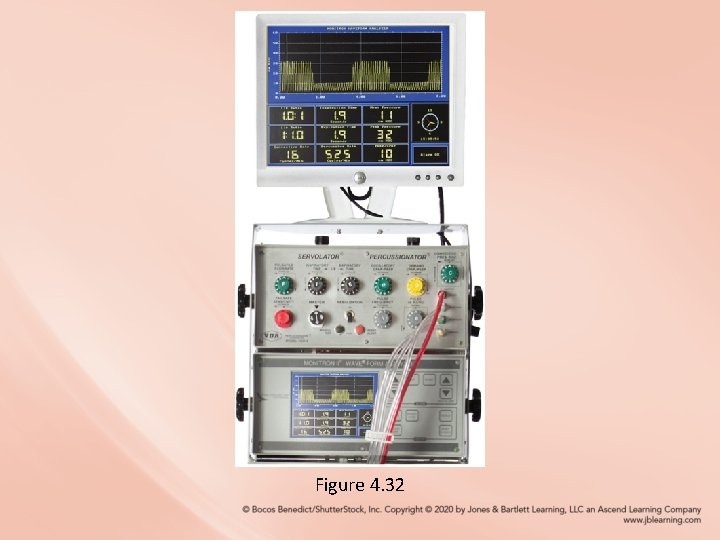
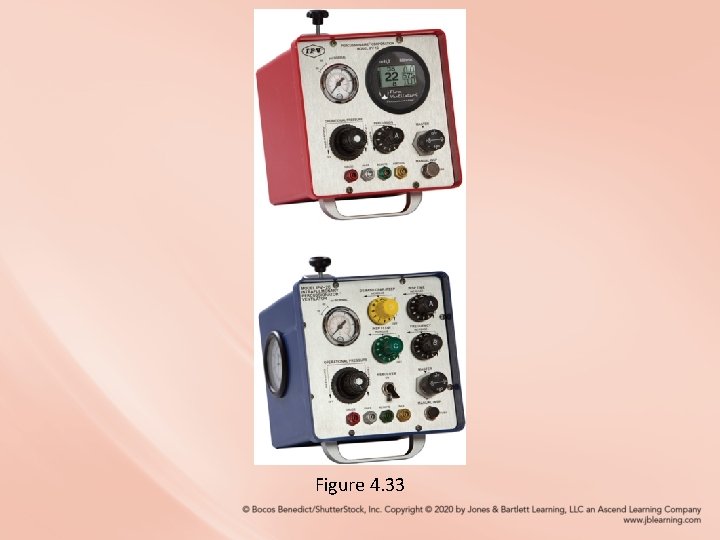
Percussionaire VDR-4 • VDR-4 stands for Volumetric Diffusive Respirator-4. 19 • It is depicted in (Figure 4 -32). It is the latest in the line of percussionators with previous versions shown in (Figure 433). • Pneumatically powered, pressure-limited, time-cycled, highfrequency flow interrupter that delivers high-frequency percussive ventilation (HFPV). • VDR-4 operates in conjunction with Monitron II Waveform Analyzer, which provides airway pressure waveforms and alarm monitoring. • VDR-4 operator interface consists of various knobs for adjusting pressures relating to the high-frequency ventilation. (see Figure 4 -34)
Figure 4. 32
Figure 4. 33
Figure 4. 34
Mode (HFPV) • High-frequency percussive ventilation (HFPV) produced by the VDR-4 provides subtidal volumes in conjunction with time cycled, pressure-limited controlled mechanical ventilation (i. e. , pressure control ventilation, PCV). 19 • Can be conceptualized as HFOV oscillating around two different pressure levels, the inspiratory and expiratory airway pressures. • HFPV is possible due to a device called a Phasitron. The Phasitron is an inspiratory and expiratory valve located at the end of the endotracheal tube.
Mode (HFPV) (cont’d) • High-pressure gas drives the Phasitron to deliver small tidal volumes at a high frequency (200 to 900 beats per minute), superimposed on the inspiratory and expiratory airway pressures of PCV. • PCV is typically delivered at a respiratory rate of 10 to 15 breaths per minute. • Resulting waveform can be seen on the monitor in Figure 432.
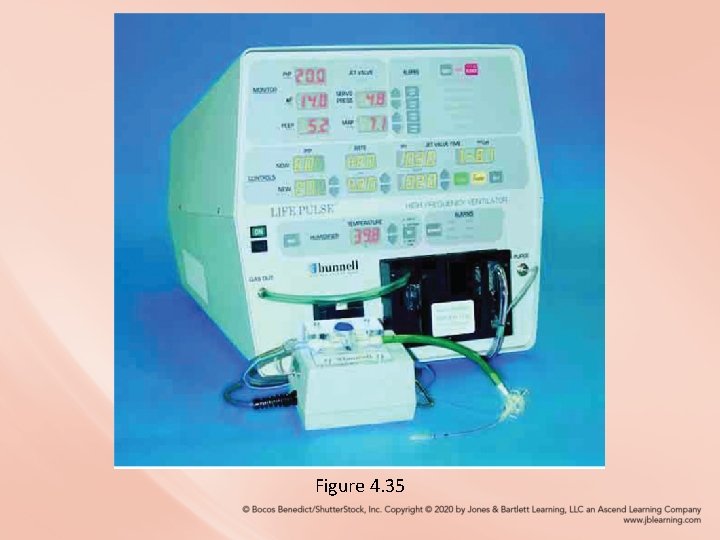
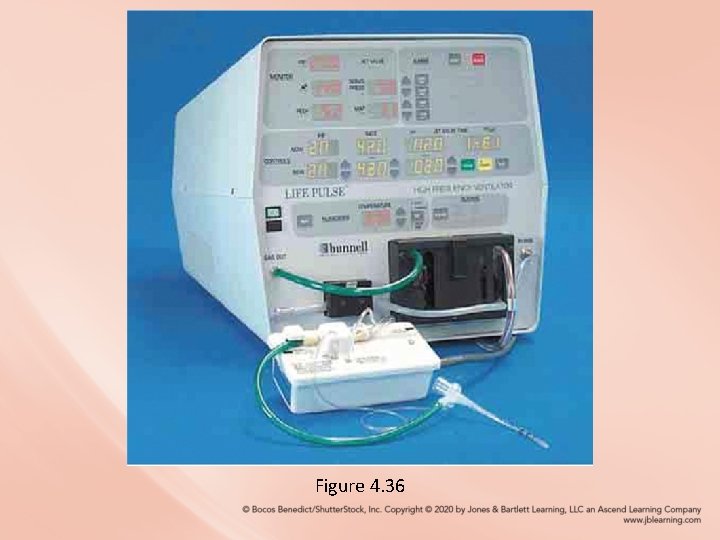
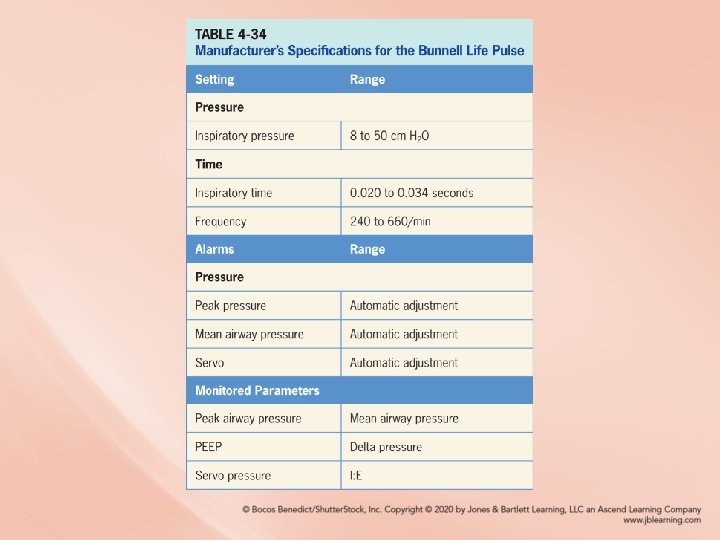
Bunnell Life Pulse • The Bunnell Life Pulse High-Frequency Ventilator (Figure 435) is a microprocessor-controlled infant ventilator capable of delivering and monitoring between 240 and 660 heated, humidified breaths per minute. 20 • The Life Pulse is composed of five subsystems (Figure 4 -36): the monitor (displays patient and machine pressures), the alarms (indicates various conditions that may require attention), the controls (regulates the On-Time, Peak Inspiratory Pressure, and Rate of the HFV breaths), the humidifier (monitors and controls the temperature and humidification of gas flowing through the disposable humidifier circuit to the patient), and the patient box (contains the pinch valve that breaks the flow of pressurized gas into tiny jet pulses and sends pressure information back to the ventilator’s microprocessor).
Figure 4. 35
Figure 4. 36
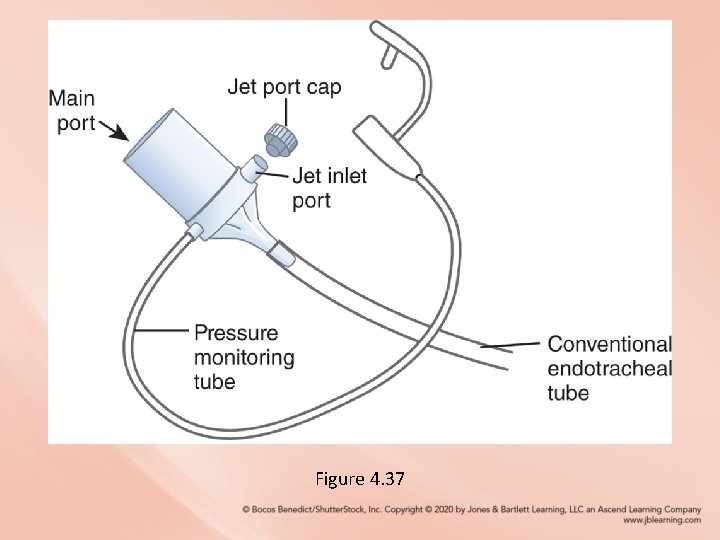
Mode • The Life Pulse itself provides high-frequency breaths, airway pressure monitoring, humidification and alarms. 20 • Life Pulse is used in conjunction with a conventional infant ventilator. • Conventional ventilator has 4 functions: to provide fresh gas for spontaneous breathing, to provide and regulate PEEP, to provide supplementary IMV if needed, and to provide periodic dilation of airways when needed. • Link between the Life Pulse and the conventional ventilator is the Life. Port Adapter (Figure 4 -37). • Consists of a 15 mm port to provide the standard connection for the conventional ventilator, the jet port to provide the entrance for the high-frequency pulses provided by the Life Pulse and the pressure monitoring tube that allows the Life Pulse to display approximations of distal tip airway pressures.
Figure 4. 37