
Chapter 4 Section 3 The Southern Colonies Plantations
- Slides: 7
Chapter 4, Section 3 The Southern Colonies: Plantations and Slavery
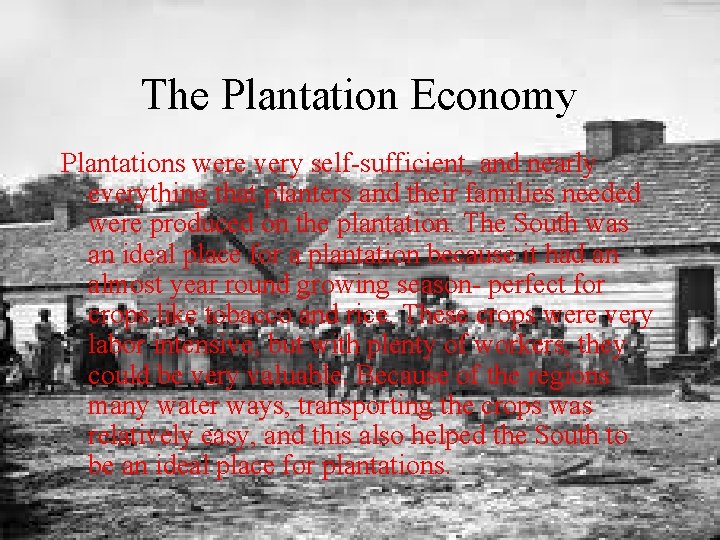
The Plantation Economy Plantations were very self-sufficient, and nearly everything that planters and their families needed were produced on the plantation. The South was an ideal place for a plantation because it had an almost year round growing season- perfect for crops like tobacco and rice. These crops were very labor intensive, but with plenty of workers, they could be very valuable. Because of the regions many water ways, transporting the crops was relatively easy, and this also helped the South to be an ideal place for plantations.
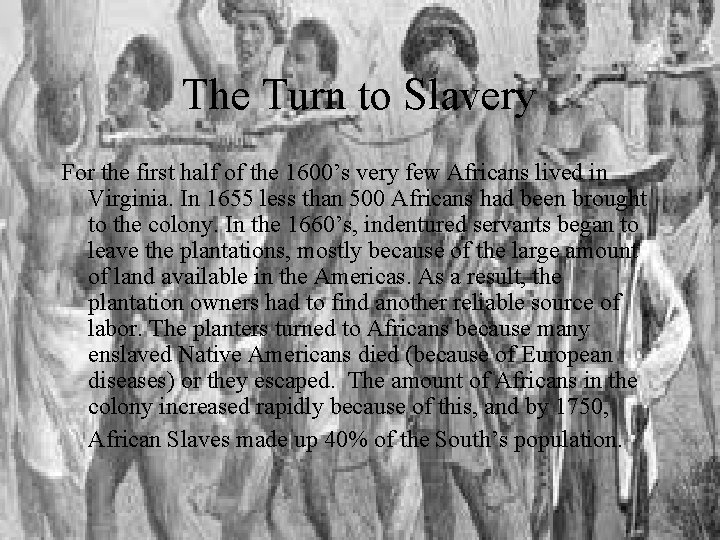
The Turn to Slavery For the first half of the 1600’s very few Africans lived in Virginia. In 1655 less than 500 Africans had been brought to the colony. In the 1660’s, indentured servants began to leave the plantations, mostly because of the large amount of land available in the Americas. As a result, the plantation owners had to find another reliable source of labor. The planters turned to Africans because many enslaved Native Americans died (because of European diseases) or they escaped. The amount of Africans in the colony increased rapidly because of this, and by 1750, African Slaves made up 40% of the South’s population.
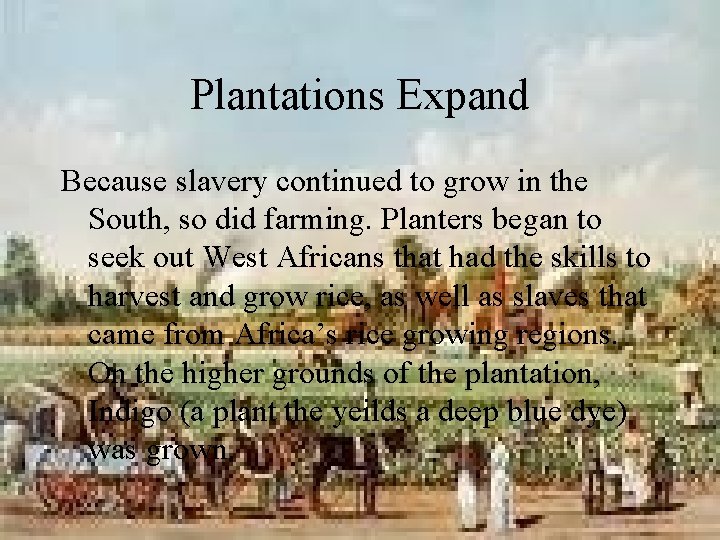
Plantations Expand Because slavery continued to grow in the South, so did farming. Planters began to seek out West Africans that had the skills to harvest and grow rice, as well as slaves that came from Africa’s rice growing regions. On the higher grounds of the plantation, Indigo (a plant the yeilds a deep blue dye) was grown.
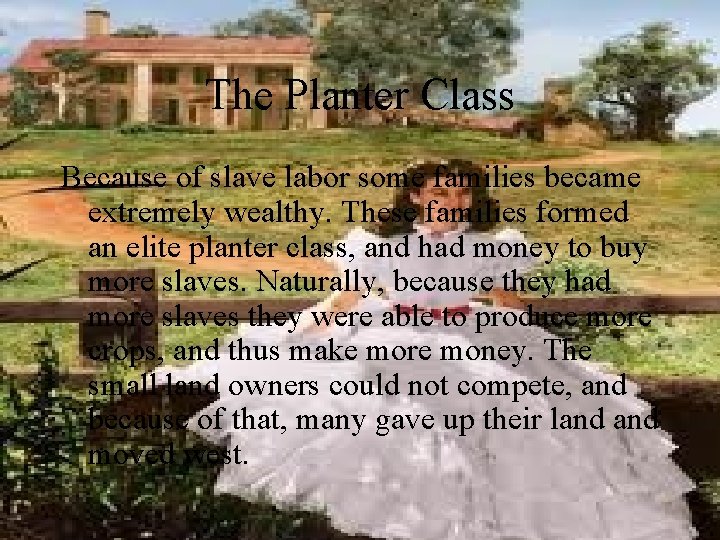
The Planter Class Because of slave labor some families became extremely wealthy. These families formed an elite planter class, and had money to buy more slaves. Naturally, because they had more slaves they were able to produce more crops, and thus make more money. The small land owners could not compete, and because of that, many gave up their land moved west.
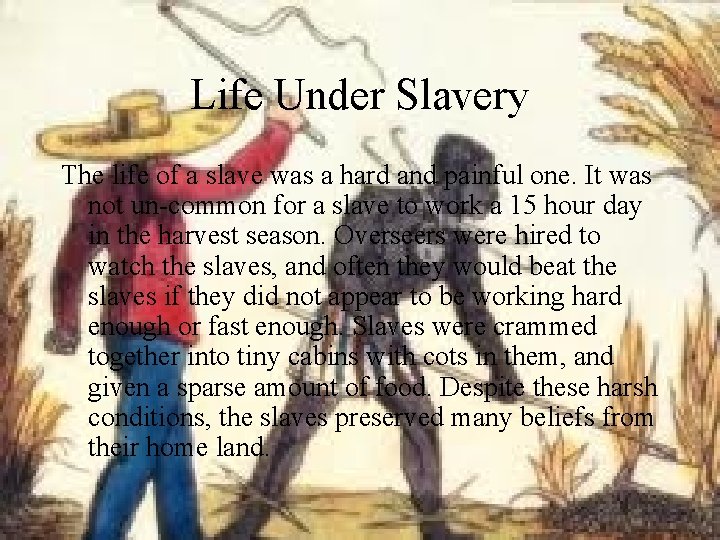
Life Under Slavery The life of a slave was a hard and painful one. It was not un-common for a slave to work a 15 hour day in the harvest season. Overseers were hired to watch the slaves, and often they would beat the slaves if they did not appear to be working hard enough or fast enough. Slaves were crammed together into tiny cabins with cots in them, and given a sparse amount of food. Despite these harsh conditions, the slaves preserved many beliefs from their home land.
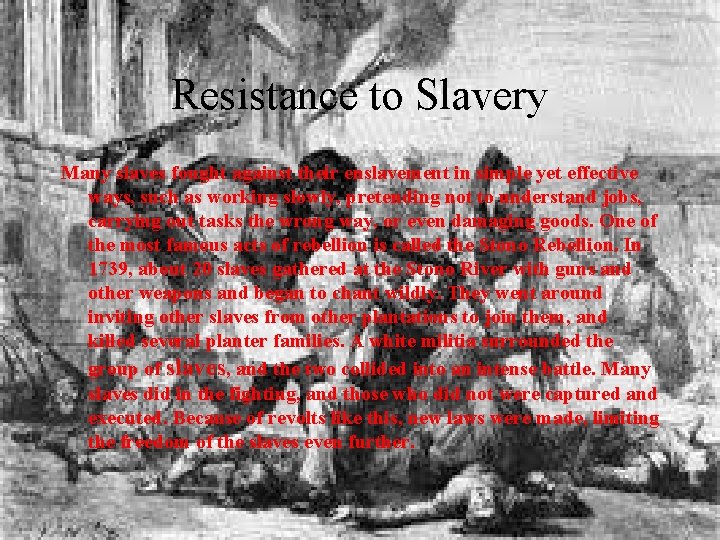
Resistance to Slavery Many slaves fought against their enslavement in simple yet effective ways, such as working slowly, pretending not to understand jobs, carrying out tasks the wrong way, or even damaging goods. One of the most famous acts of rebellion is called the Stono Rebellion. In 1739, about 20 slaves gathered at the Stono River with guns and other weapons and began to chant wildly. They went around inviting other slaves from other plantations to join them, and killed several planter families. A white militia surrounded the group of slaves, and the two collided into an intense battle. Many slaves did in the fighting, and those who did not were captured and executed. Because of revolts like this, new laws were made, limiting the freedom of the slaves even further.