
Chapter 4 Section 3 4 Civil War Amendments
- Slides: 14
Chapter 4 Section 3 & 4
Civil War Amendments • The 13 th Amendment – officially outlawed slavery in the United States (1865) • The 14 th Amendment – defined US citizenship (those born or naturalized in the US) and guaranteed equal protection of the laws (1868) • This meant that the Bill of Rights was extended to all citizens in all cases – not just federal cases • The 15 th Amendment – prohibited restrictions on the right to vote based on race, color, or previous condition of servitude (1870)
Women’s Suffrage • Women were denied the right to vote in most cases in the US • In 1848 a women’s suffrage movement began. It was led by many women, including Susan B. Anthony and Elizabeth Cady Stanton • Wyoming permitted women to vote in 1869 and many other states allowed at least partial suffrage to women • The 19 th Amendment gave women the right to vote in all federal and state elections (1920)
Election Amendments • 12 th Amendment – revised the procedures for electing the President and Vice-President (1804) • 17 th Amendment – allowed voters to directly elect US senators instead of State Legislatures (1913) • 23 rd Amendment – gave residents of the District of Columbia the right to vote for President (1961) • 25 th Amendment – abolished poll taxes (1967) – many states used these to prevent full suffrage • 26 th Amendment – Set the voting age at 18 (1971) – the protests over the Vietnam War caused it
Election Amendments • 20 th Amendment – changed the dates of the terms for the Executive and Legislative branches to the 20 th and 3 rd of January from March • 22 nd Amendment – limits the President to two terms of office or 10 years in office (1951) – basically a response to the four terms that FDR was elected to from 1932 – 1944 • The 25 th amendment (1967) officially states that the V. P. becomes President when the President is removed, dies, or resigns
Election Amendments 25 th Amendment says: The V. P. becomes Acting President if 1. the president informs Congress, in writing, “that he is unable to discharge the powers and duties of his office. ” 2. The Vice President and a majority of the members of the Cabinet inform Congress, in writing that the President is incapacitated • It has happened twice when Presidents have had minor surgery •
Other Amendments • 11 th Amendment – placed limits on suits against states (1795) • 16 th Amendment – gives Congress the power to levy an income tax (1913) • 18 th Amendment – Prohibited making, drinking, or selling alcoholic beverages (1917) • 21 st Amendment – Repeals the 18 th Amendment (1933) • 27 th Amendment – delays congressional pay raises until the term following their passage (1992)
Struggle for Rights • Discrimination – unfair treatment based on prejudice against a certain group • African Americans were denied the right to vote and were segregated – segregation is the social separation of the races • Plessy v. Ferguson (1896) – the Court said that separate but equal facilities were constitutional • This case established segregation as legal, it was the law in many states for close to 100 years
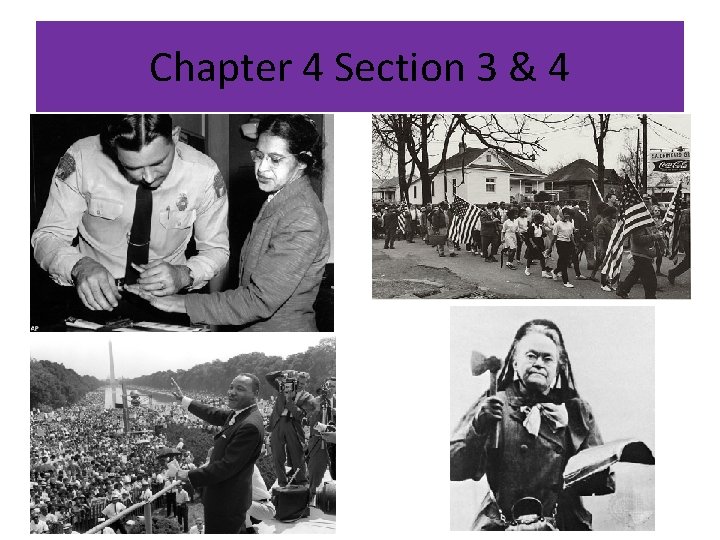
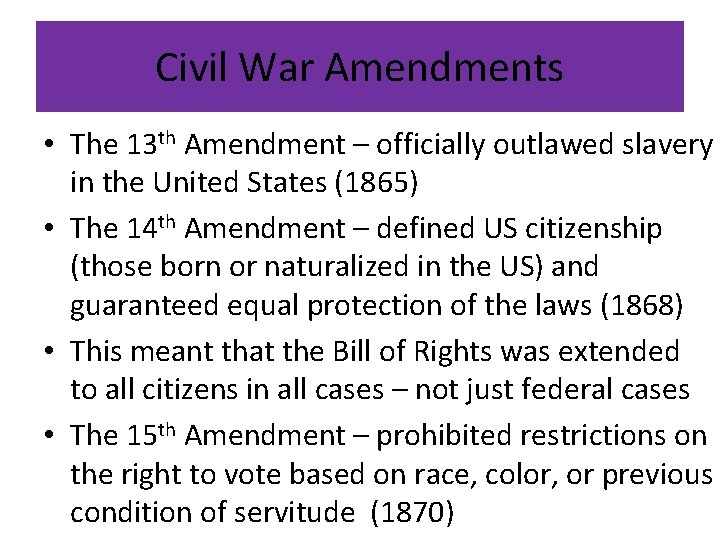
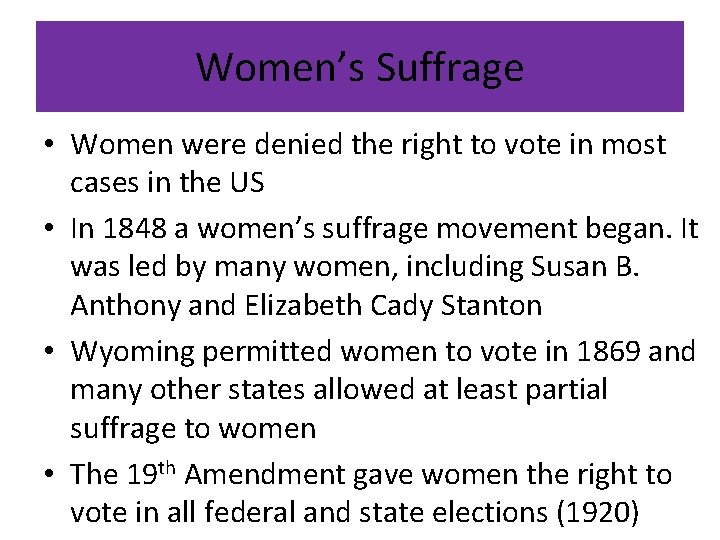
Struggle for Rights • Brown v. Board of Education of Topeka (1954) – the Court held that segregation in public education was unconstitutional • This landmark case reversed Plessy v. Ferguson and led to the end of segregation – it was a long, hard, and slow process though • In 1955, after the arrest of Rosa Parks, African. Americans, led by Dr. Martin Luther King, organized a peaceful protest against segregation with a bus boycott in Montgomery Alabama
Struggle for Rights • The Civil Rights Act of 1964 – – it provides that no person may be denied access to or refused service in various “public accommodations” because of race, color, religion, or national origin – Prohibits discrimination against any person on grounds of race, religion, national origin, sex, or physical disability in any program that receives any federal funding; require the cut-off of federal funds to any program that practices such discrimination – Forbids employers and labor unions to discriminate against any person on grounds of race, color, religion, sex, physical disability, or age in job-related matters
Struggle for Rights • The Voting Rights Act of 1965 was designed to finally guarantee African – Americans the right to vote. It was renewed in 2006. • The Civil Rights Act of 1968 (the Open Housing Act) – it forbids anyone to refuse to sell or rent a dwelling to any person on grounds of race, color, religion, national origin, sex, or disability – It also forbids refusal to sell or rent to a family with children ØHousing still remains one of the most segregated areas of our society today
Affirmative Action • A policy that requires most employers take positive steps to remedy the effects of past discriminations • It applies to all the agencies of the Federal Government, to all the States and their local governments, and to all private employers who sell goods or services to any agency of the Federal Government • The point of Affirmative Action is to make up for past discrimination
Affirmative Action • Some critics of affirmative action claim it is a form of reverse discrimination, or discrimination against the majority group – Regents of the university of California v. Bakke (1978) – a white male had been denied admission to the university’s medical school – the school reserved 16 or the 100 spots for minority students. The Court ruled that he be admitted – but did say that race can be one factor in admission – Gratz v. Bollinger (2003) – the court struck down a University of Michigan point-based admission policy that it felt gave excessive points to minority applicants
Racial Profiling • A continuing problem is racial profiling by law enforcement officers – it involves being singled out as a suspect because of the way a person looks • Many states have laws that treat acts of violence based on a person’s race, color, national origin, gender, or disability as hate crimes. These crimes carry tougher penalties.